Category Archive Health A – Z

By

Thoracic Outlet Syndrome; Symptom, Diagnosis, Treatment

Thoracic outlet syndrome can be described compression of the neurovascular structures as they exit through the thoracic outlet (cervicothoracobrachial region). It is a condition in which there is compression of the nerves, arteries, or veins in the passageway from the lower neck to the armpit. The neurogenic type is the most common and presents with pain, weakness, and occasionally loss of muscle at the base of the thumb. The venous type results in swelling, pain, and possibly a bluish coloration of the arm.The arterial type results in pain, coldness, and paleness of the arm The thoracic outlet is marked by the anterior scalene muscle anteriorly, the middle scalene posteriorly, and the first rib inferiorly.

Thoracic outlet syndrome covers a wide range of manifestations due to compression of nerves and vessels during their passage through the cervicothoracobrachial region. Various forms of TOS are distinguished: vascular forms (arterial or venous) which raise few diagnostic problems [], and “neurological” forms, which are by far the most frequent as they represent more than 95% of all cases of TOS []. The “neurological forms” are classified in the “true” neurological form associated with neurological deficits (mostly muscular atrophy), and painful neurological forms (with no objective neurological deficit). These painful forms are very frequent, especially when patients are systematically screened for these symptoms. The existence of these forms of TOS remains controversial in part because muscular and neurological manifestations are strongly interrelated. Clinical experience suggests that the main triggering mechanism is more often a muscular dysfunction in the cervicoscapular region than primitive nerve compression. It is directly responsible for cervicoscapular symptoms (pain and discomfort) and sometimes for referred scapulobrachial and facial pain. In parallel, shortened muscles (mainly scalene muscles) and cervicoscapular muscles imbalance may lead to intermittent nerve compression and/or tension on brachial plexus in the thoracic outlet resulting in proximal pain and producing pain and discomfort in the upper limb. The neurological involvement accounts for most of the distal symptoms, but the controversy concerning the reality of TOS is essentially due to the absence of objective criteria to confirm the diagnosis (no neurological weakness and normal neurophysiological examination). Despite considered as “debatable” for some authors, several arguments support the reality of this syndrome, such as the influence of TOS on the results of treatment of carpal tunnel and cubital tunnel syndromes [,]. This problem is further complicated by the frequent concomitant presence of other neuromuscular diseases of the upper limb, which can be secondary to TOS or, on the contrary, may precede and predispose to the development of TOS [], in which case TOS is often masked by the concomitant disease. “Neurological” forms of TOS can be subdivided into primary forms in which features of TOS may remain isolated or may be complicated by underlying neuromuscular disorders, and forms secondary to a more distal disease (neuromuscular or joint disease), always responsible for complex clinical features.

rxharun.com/thoracic-

Types of Thoracic Outlet Syndrome

  1. Vascular – This can be a compression of the artery and vein.
  2. Neurogenic – The nerves become compromised from an extra cervical rib, present at birth.
  3. Disputed or painful form –There is no neurological deficit but patients experience neurological symptoms and pain. Typically these patients’ electrodiagnostic studies (EMG / NCV) are normal, but they complain of pain.

The subtypes include

  • Arterial TOS (A-TOS) – due to compression of the subclavian artery, most commonly caused by a cervical rib. Symptoms may include blood clots, arm pain with exertion, or acute arterial thrombosis (sudden blood flow obstruction in an artery).
  • Venous TOS (V-TOS) – due to compression of the subclavian vein, often associated with repetitive arm activities. It may cause pain, swelling, and deep vein thrombosis.
  • Traumatic neurovascular TOS – occurs after trauma to the collarbone and may affect both nerves and vessels. Symptoms may include pain, swelling, bruising, weakness, and loss of sensation in the arm and hand.
  • True neurogenic TOS (TN-TOS) – caused by compression of the brachial plexus. Symptoms include numbness, abnormal sensations, and weakness of the arms and shoulders, as well as pain in the neck, shoulder or hand.
  • Disputed TOS – the vast majority of neurogenic cases. It is controversial whether it is a true form of TOS because it lacks a consistent physical abnormality, a recognized cause, consistent symptoms, a reliable method of testing, and a standard treatment. Pain and tingling or numbness in the neck, arm and hand are common complaints..

Anatomy of Thoracic Outlet Syndrome
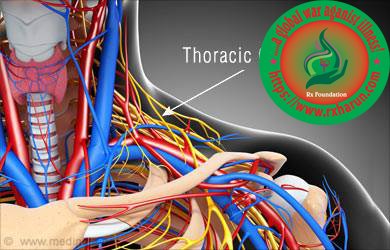
rxharun.com/thoracic outlet syndrome

Thoracic outlet

  • Comprised of three distinct spaces  
  • Interscalene triangle
  • Proximal space

Borders

  • Anterior: anterior scalene muscle
  • Posterior: middle scalene muscle
  • Inferior: first rib

Contents

  • Brachial plexus trunks
  • Subclavian artery
  • Subclavian vein does not pass through interscalene triangle
    • runs beneath anterior scalene muscle prior to entering the costoclavicular space

Costoclavicular space

  • Middle space
  • Separated from the interscalene triangle by the first rib

Borders

  • anterior: clavicle and subclavius muscle
  • posterior: first rib and scalene muscles
  • medial: costoclavicular ligament
  • lateral: upper scapular border

Contents

  • Brachial plexus divisions
  • Subclavian artery and vein

Retropectoralis minor space

  • Distal space
  • Also known as the thoraco-coraco-pectoral space or subcoracoid space
  • Borders
    • superior: coracoid
    • anterior: pectoralis minor muscle
    • posterior: ribs 2-4

Thoracic Outlet Syndrome

  • Brachial plexus cords
  • Axillary artery and vein

Causes of Thoracic Outlet Syndrome

TOS can be attributed to one or more of the following factors

  • Congenital abnormalities – are often reported and can be associated with traumatic or functional causes. Bone anomalies (cervical rib, prolonged transverse process), fibrous anomalies (transversocostal, costocostal, etc.), or muscular anomalies (scalenus anticus muscle, sickle-shaped scalenus medius, etc.) are more frequent in patients who develop TOS []. Bone anomalies are well known, but 2/3 of the abnormalities detected at operation are fibromuscular [] and the majority of bone anomalies do not cause TOS []. These anomalies are part of a real local and regional “dysplasia” constituting only one of the numerous predisposing factors, associated with a morphotype composed of narrow, drooping shoulders.

Congenital factors

  • Cervical rib
  • Prolonged transverse process
  • Anomalous muscles
  •  Fibrous anomalies (transverse costal, costocostal)
  •  Abnormalities of the insertion of the scalene muscles
  •  Fibrous muscular bands
  •  Exostosis of the first rib
  •  Cervicodorsal scoliosis
  •  Congenital uni- or bilateral elevated scapula
  •  Location of the A. or V. Subclavian in relation to the M. scalene anterior

Post-traumatic causes-  either due to isolated trauma or repeated trauma, account for up to 2/3 of cases in some series []. Post-traumatic TOS due to soft tissue injury raises medicolegal and often management problems. These forms are related to neck and shoulder trauma, particularly “whiplash” injuries, or sometimes upper limb trauma. Injuries to scalene muscles and their subsequent fibrosis are implicated in this process []. Diagnostic criteria of post-traumatic TOS are the pathogenic mechanism and the onset of symptoms within the first two years.

  • Functional acquired – causes are the most controversial, although probably the most frequent. In this group, upper limb dysfunction or a muscle imbalance of the neck and shoulder region is considered to be responsible []. Two main features are mainly associated with “functional” acquired causes: “hypertrophic” muscle morphotype of the cervicoscapular region and “dropped” scapular morphotype (leading in some patients to a dysfunction of the normal scalenus anterior muscle). Muscles of the thoracic outlet are also accessory respiratory muscles capable of prolonged tonic contractions due to their high percentage of type I muscle fibres []. Chronic stimulation of these muscles has also been shown to increase the percentage of type I fibres. Machleder showed that a normal scalenus anterior muscle contains 70% of type I fibres versus 85% in the case of TOS []. The factors involved in the pathogenesis of these disorders include overuse and physical and mental stress phenomena, frequently associated with unfavourable psychosocial factors [
  • Postural factors
  • Dropped shoulder condition
  • Wrong work posture (standing or sitting without paying attention to the physiological curvature of the spine
  • Heavy mammaries
  • Trauma
  • Clavicle fracture
  • Rib fracture
  • Hyperextension neck injury, whiplash
  • Repetitive stress injuries (repetitive injury most often form sitting at a keyboard for long hours)
  • Muscular causes – Hypertrophy of the scalene muscles Decrease of the tonus of the M. trapezius, M. levator scapulae, M.rhomboids
    Shortening of the scalene muscles, M. trapezius, M. levator scapulae, pectoral muscles
  • Post-traumatic causes –  either due to isolated trauma or repeated trauma, account for up to 2/3 of cases in some series []. Post-traumatic TOS due to soft tissue injury raises medicolegal and often management problems. These forms are related to neck and shoulder trauma, particularly “whiplash” injuries, or sometimes upper limb trauma. Injuries to scalene muscles and their subsequent fibrosis are implicated in this process []. Diagnostic criteria of post-traumatic TOS are the pathogenic mechanism and the onset of symptoms within the first two years.

Others Causes of Thoracic Outlet Syndrome

  • Trauma – (e.g., whiplash injuries) or repetitive strain is frequently implicated.Rarer acquired causes include tumors, hyperostosis, and osteomyelitis
  • Anatomical defects – Inherited defects that are present at birth (congenital) may include an extra rib located above the first rib (cervical rib) or an abnormally tight fibrous band connecting your spine to your rib.
  • Poor posture – Drooping your shoulders or holding your head in a forward position can cause compression in the thoracic outlet area.
  • Trauma – A traumatic event, such as a car accident, can cause internal changes that then compress the nerves in the thoracic outlet. The onset of symptoms related to a traumatic accident often is delayed.
  • Repetitive activity – Doing the same thing repeatedly can, over time, wear on your body’s tissue. You may notice symptoms of thoracic outlet syndrome if your job requires you to repeat a movement continuously, such as typing on a computer, working on an assembly line or lifting things above your head, as you would if you were stocking shelves.
  • Pressure on your joints – Obesity can put an undue amount of stress on your joints, as can carrying around an oversized bag or backpack.

Symptoms of Thoracic Outlet Syndrome

There are a number of types of thoracic outlet syndrome, including

  • Neurogenic (neurological) thoracic outlet syndrome – This form of thoracic outlet syndrome is characterized by compression of the brachial plexus. The brachial plexus is a network of nerves that come from your spinal cord and control muscle movements and sensation in your shoulder, arm and hand. In the majority of thoracic outlet syndrome cases, the symptoms are neurogenic.
  • Vascular thoracic outlet syndrome – This type of thoracic outlet syndrome occurs when one or more of the veins (venous thoracic outlet syndrome) or arteries (arterial thoracic outlet syndrome) under the collarbone (clavicle) are compressed.
  • Nonspecific-type thoracic outlet syndrome – This type is also called disputed thoracic outlet syndrome. Some doctors don’t believe it exists, while others say it’s a common disorder. People with nonspecific-type thoracic outlet syndrome have chronic pain in the area of the thoracic outlet that worsens with activity, but a specific cause of the pain can’t be determined.
  • Muscle wasting in the fleshy base of your thumb (Gilliatt-Sumner hand)
  • Numbness or tingling in your arm or fingers
  • Pain or aches in your neck, shoulder or hand
  • Weakening grip
  • Discoloration of your hand (bluish color)
  • Arm pain and swelling, possibly due to blood clots
  • Blood clot in veins or arteries in the upper area of your body
  • Lack of color (pallor) in one or more of your fingers or your entire hand
  • Weak or no pulse in the affected arm
  • Cold fingers, hands or arms
  • Arm fatigue with activity
  • Numbness or tingling in your fingers
  • Weakness of arm or neck
  • Throbbing lump near your collarbone

Diagnosis of Thoracic Outlet Syndrome

  • The following pathologies are common differential diagnosis for TOS
  • Carpal tunnel syndrome
  • De Quervain’s tenosynovitis
  • Lateral epicondylitis
  • Medial epicondylitis
  • Complex regional pain syndrome (CRPS I or II).
  • Horner’s Syndrome
  • Raynaud’s disease
  • disease (especially discogenic)
  • Brachial plexus trauma
  • Systemic disorders: inflammatory disease, esophageal or cardiac disease
  • Upper extremity deep venous thrombosis , Paget-Schroetter syndrome
  • Rotator cuff pathology
  • Glenohumeral joint instability
  • Nerve root involvement
  • Malignancies (local tumours)
  • Chest pain, angina
  • Vasculitis
  • Thoracic 4 syndrome
  • Sympathetic-mediated pain

Systematic causes of brachial plexus pain include 

History and examination features in ATOS, VTOS, and NTOS.

TOS Subtype History Examination
ATOS Claudication/rest pain of upper limb, excluding shoulder/neck
Numbness, coolness, pallor
Raynaud’s phenomenon
Upper limb ischaemia, digital ulceration, peripheral embolisation
Pulsatile mass ± bruit on auscultation
Blood pressure differential >20 mmHg
Positive EAST, ULTT, Adson’s test
VTOS Deep pain on movement or rest pain in upper limb, chest, shoulder
Swelling and cyanotic discoloration
Upper limb swelling
Cyanosis
Positive EAST, ULTT, Adson’s test
NTOS Pain in neck, trapezius, shoulder, arm, chest, occipital headache
Variable pattern upper limb weakness, numbness, paraesthesias
Tenderness on palpation: scalene triangle, subcoracoid space
Upper plexus (C5-C7): sensory disturbance of arm. Weakness/atrophy of deltoid, biceps, brachialis
Lower plexus (C8-T1): sensory disturbance ulnar forearm & hand. Weakness/atrophy of small muscles of the hand, weak wrist & finger flexion
Positive EAST, ULTT, Adson’s test

Special Tests

  • Elevated Arm Stress/ Roos test – The patient has arms at 90° abduction and the therapist puts downwards pressure on the scapula as the patient opens and closes the fingers. If the TOS symptoms are reproduced within 90 seconds, the test is positive.
  • Adson’s – The patient is asked to rotate the head and elevate the chin toward the affected side. If the radial pulse on the side is absent or decreased then the test is positive, showing the vascular component of the neurovascular bundle is compressed by the scalene muscle or cervical rib.
  • Wright’s  – The patient’s arm is hyper abducted. If there is a decrease or absence of a pulse on one side then the test is positive, showing the axillary artery is compressed by the pectoralis minor muscle or coracoid process due to stretching of the neurovascular bundle.
  • Cyriax Release – The patient is seated or standing. The examiner stands behind the patient and grasps under the forearms, holding the elbows at 80 degrees of flexion with the forearms and wrists in neutral. The examiner leans the patient’s trunk posteriorly and passively elevated the shoulder girdle. This position is held for up to 3 minutes. The test is positive when paresthesia and/or numbness (release phenomenon) occurs, including a reproduction of symptoms.
  • Supraclavicular Pressure – The patient is seated with the arms at the side. The examiner places his fingers on the upper trapezius and thumb on the anterior scalene muscle near the first rib. Then the examiner squeezes the fingers and thumb together for 30 seconds. If there is a reproduction of pain or paresthesia the test is positive, this addresses compromise to brachial plexus through scalene triangles.
  • Costoclavicular Maneuver – This test may be used for both neurological and vascular compromise. The patient brings his shoulders posteriorly and hyperflexes his chin. A decrease in symptoms means that the test is positive and that the neurogenic component of the neurovascular bundle is compressed.
  • Upper Limb Tension – These tests are designed to put stress on neurological structures of the upper limb. The shoulder, elbow, forearm, wrist, and fingers are kept in specific position to put stress on the particular nerve (nerve bias) and further modification in the position of each joint is done as “sensitizer”.
  • Cervical Rotation Lateral Flexion – The test is performed with the patient in sitting. The cervical spine is passively and maximally rotated away from the side being tested. While maintaining this position, the spine is gently flexed as far as possible moving the ear toward the chest. A test is considered positive when the lateral flexion movement is blocked.

Others Test

  • An X-ray of the thoracic outlet can reveal whether you have an extra rib. It may also rule out other conditions that could be causing your symptoms.
  • An MRI uses powerful magnets and radio waves to create clear, detailed images of the thoracic outlet. The pictures can help determine the location and cause of the compression. They may also show certain structural abnormalities that could be causing your symptoms.
  • Electromyography allows your doctor to see how well the muscles and nerves in the thoracic outlet are working. During this test, an electrode is inserted through your skin into various muscles. It evaluates the electrical activity of your muscles when at rest and when contracted.
  • A nerve conduction study uses a low amount of electrical current to measure how quickly your nerves send impulses to various muscles throughout the body. It can determine whether you have nerve damage.

Treatment of Thoracic Outlet Syndrome

  • Analgesics: Prescription-strength drugs that relieve pain but not inflammation.
  •  Antidepressants: A Drugs that block pain messages from your brain and boost the effects of eorphins .
  • Medication Common pain remedies such as aspirin, acetaminophen, ibuprofen and naproxen can offer short-term relief. All are available in low doses without a prescription. Other medications, including muscle relaxants and anti-seizure medications, treat aspects of spinal stenosis, such as muscle spasms and damaged nerves.
  • Corticosteroid injections – Your doctor will inject a steroid such as prednisone into your back or neck. Steroids make inflammation go down. However, because of side effects, they are used sparingly.
  • Anesthetics – Used with precision, an injection of a “nerve block” can stop pain for a time.
  • Muscle Relaxants – These medications provide relief from spinal muscle spasms.
  • Neuropathic Agents Drugs(pregabalin & gabapentine) that address neuropathic—or nerve-related—pain. This includes burning, numbness, and tingling.
  • Opioids – Also known as narcotics, these medications are intense pain relievers that should only be used under a doctor’s careful supervision.
  • Topical Medications These prescription-strength creams, gels, ointments, patches, and sprays help relieve pain and inflammation through the skin.
  • Calcium & vitamin D3 – to improve bones health and healing fracture.

Others Treatment Approach

  • Transaxillary approach  – The first rib forms the common denominator for all causes of nerve and artery compression in this region, so that its removal generally improves symptoms. Surgeon makes an incision in the chest to access the first rib, divide the muscles in front of the rib and remove a portion of the first rib to relieve compression, without disturbing the nerves or blood vessels.
  • Supraclavicular approach – Has been advocated to perform first rib resection and scalenectomy, a safe and effective procedure, characterized by a shorter operative time and having a complication rate lower or comparable to that of transaxillary first rib resection.
    This approach repairs compressed blood vessels. The surgeon makes an incision just under the neck to expose the brachial plexus region. Then he looks for signs of trauma or muscles contributing to compression near the first rib. The first rib may be removed if necessary to relieve compression.
  • Arterial TOS  – Decompression can include cervical and/or first rib removal and scalene muscle revision. The subclavian can then be inspected for degeneration, dilation, or an aneurysm. Saphenous vein graft or synthetic prosthesis can then be used if necessary Level of evidence 2B.
  • Venous TOS – Thrombolytic therapy is the first line of treatment for these patients. Because of the risk of recurrence, many recommend removal of the first rib is necessary even when thrombolytic therapy completely opened the vein. The results of a study show that the infraclavicular approach is a safe and effective treatment for acute VTOS. They had no brachial plexus or phrenic nerve injuries.

Physical Therapy in Thoracic Outlet Syndrome

Conservative management should be the first strategy to treat TOS since this seems to be effective at decreasing symptoms, facilitating return to work and improving function, but yet a few studies have evaluated the optimal exercise program as well as the difference between a conservative management and no treatment.

Stage 1 – The aim of the initial stage is to decrease the patient’s symptoms. This may be achieved by patient education, in which TOS, bad postures, the prognosis and the importance of therapy compliance are explained. Furthermore some patients who sleep with the arms in an overhead, abducted position should get some information about their sleeping posture to avoid waking up at night.

  • Cyriax release maneuver
  • Elbows flexed to 90°
  • Towels create a passive shoulder girdle elevation
  • Supported spine and the head in neutral
  • The position is held until peripheral symptoms are produced. The patient is encouraged to allow symptoms to occur as long as can be tolerated up to 30 minutes, observing for a symptom decrescendo as time passes.
  • The patient’s breathing techniques need to be evaluated as the scalenes and other accessory muscles often compensate to elevate the rib cage during inspiration.
  • Encouraging diaphragmatic breathing will lessen the workload on already overused or tight scalenes and can possibly reduce symptoms.

Stage 2 –  Once the patient has control over his/her symptoms, the patient can move to this stage of treatment. The goal of this stage is to directly address the tissues that create structural limitations of motion and compression. How this should be done is one of the most discussed topics of this pathology. Some examples of methods that are used in the literature are.

  • Massage
  •  Strengthening of the levator scapulae, sternocleidomastoid, and upper trapezius. This group of muscles open the thoracic outlet by raising the shoulder girdle and opening the costoclavicular space
  • Stretching of the pectoralis, lower trapezius and scalene muscles

These muscles close the thoracic outlet

  • Postural correction exercises
  • Relaxation of shortened muscles  Level of evidence 1A
  • exercises in a daily home exercise program
  • Shoulder exercises to restore the range of motion and so provide more space for the neurovascular structures.

Exercise

  • Lift your shoulders backwards and up, flex your upper thoracic spine and move the shoulders forward and down. Then straightened the back and repeat 5 to 10 times.ROM of the upper cervical spine

Exercise

  • Lower your chin 5 to 10 times against your chest, while you are standing with the back of your head against a wall. The effectiveness of this exercise can be enlarged by pressing the head down by hands.
  • Activation of the scalene muscles are the most important exercises. These exercises help to normalize the function of the thoracic aperture as well as all the malfunctions of the first rib.

Exercises

Anterior scalene

  • Press your forehead 5 times against the palm of your hand for a duration of 5 seconds, without creating any movement.
    Middle scalene
  • Press your head sidewards against your palm.
    Posterior scalene
  • Press your head backwards against your palm.

 Stretching exercises

  • Taping – some patients with severe symptoms respond to additional taping, adhesive bandages or braces that elevate or retract the shoulder girdle.
  • Manipulative treatment to mobilize the first rib
  • Repositioning/mobilization of the shoulder girdle and pelvis joints cervicothoracic, sternoclavicular, acromioclavicular, and costotransverse joints
  • Glenohumeral mobilizations in end-range elevation with the elbow supported in extension 

Posterior Glenohumeral Glide with Arm Flexion

  • The patient is supine. The mobilization hand contacts the proximal humerus avoiding coracoid process. The force is directed posterolaterally (direction of thumb).

Anterior Glenohumeral Glide with Arm Scaption

  • The patient is prone. The mobilization hand contacts the proximal humerus avoiding the acromion process. The force is directed anteromedially.

Inferior Glenohumeral Glide

  • The patient is prone. The stabilizing hand holds the proximal humerus the humerus distal to the lateral acromion process. The mobilization hand contacts the axillary border of the scapula. Mobilize the scapula in a craniomedial direction along the ribcage.

References


By

Chiropractic; Types, Diagnosis/tests, Treatment Technique

Chiropractic is a form of alternative medicine mostly concerned with the diagnosis and treatment of mechanical disorders of the musculoskeletal system, especially the spine.Proponents claim that such disorders affect general health via the nervous system.These claims are not backed by any evidence. The main chiropractic treatment technique involves manual therapy, especially spinal manipulation therapy(SMT), manipulations of other joints and soft tissues. Its foundation is at odds with mainstream medicine, and chiropractic is sustained by pseudoscientific ideas such as subluxation and “innate intelligence” that are not based on sound science.

Conditions for  Treatement for Chiropractic

Chiropractors use a variety of non-surgical treatments to treat patients with certain types of

While primarily focusing on treating neuromusculoskeletal disorders, chiropractors are not exclusively limited to problems with the nervous system and musculoskeletal system.

Disease condition for chiropractic

While we cannot go over every kind of arthritis, we will touch upon the most common types.

  1. Degenerative Arthritis -This is when the cartilage in your joints, that is the cushioning substance in between your bones, begins to break down and wear away. This means that bone is rubbing against bone and can cause swelling, stiffness, and pain. This can be caused by excess weight, family history, previous injury, or any combination of the three.
  2. Inflammatory Arthritis -Inflammatory arthritis is what occurs when your immune system goes off the rails and begins to attack your joints. It can also damage organs, eyes, and other parts of the body. Rheumatoid arthritis is the most common kind and may be tested through bloodwork. It is believed that family history and environmental factors can cause inflammatory arthritis.
  3. Metabolic Arthritis – This is caused when uric acid builds up in the joints and forms sharp crystals that cause severe pain. There are some treatments, but these symptoms often come and go for life.
  4. Vertebral subluxations – can be caused by the body’s inability to adapt to a wide variety of factors, what we’ll generally call stresses. These stresses can be physical (such as accidental trauma, sleeping posture, pillow and mattress condition, the birth process, sneezing, falling down, etc.), mental / emotional (in its many forms, probably the most familiar use of the word stress), or chemical (such as pollution, drugs, etc.), which are, unfortunately, regular parts of daily living for all age groups.  In short, a vertebral subluxation can occur for a multitude of reasons
  5. Neuromusculoskeletal disorders

    Treatment is usually for neck or low back pain and related disorders.For acute low back pain, low quality evidence has suggested no difference between real and sham spine manipulation, and moderate quality evidence has suggested no difference between spine manipulation and other commonly used treatments, such as medication and physical therapy

Chiropractic Examination

An initial chiropractic exam for back pain will typically have three parts: a consultation, case history, and physical examination. Laboratory analysis and X-ray examination may be performed.

Consultation

The patient meets with the chiropractor and provides a brief synopsis of his or her lower back pain, such as:

  • Duration and frequency of symptoms
  • Description of the symptoms (e.g. burning, throbbing)
  • Areas of pain
  • What makes the pain feel better (e.g. sitting, stretching)
  • What makes the pain feel worse (e.g. standing, lifting).

Case history

The chiropractor identifies the area(s) of complaint and the nature of the back pain by asking questions and learning more about different areas of the patient’s history, including:

  • Family history
  • Dietary habits
  • Past history of other treatments (chiropractic, osteopathic, medical and other)
  • Occupational history
  • Psychosocial history
  • Other areas to probe, often based on responses to above questions.

Physical examination

A chiropractor may utilize a variety of methods to determine the spinal segments that require chiropractic treatments, including but not limited to static and motion palpation techniques determining spinal segments that are hypo mobile (restricted in their movement) or fixated. Depending on the results of the above examination, a chiropractor may use additional diagnostic tests, such as:

  • X-ray to locate subluxations (the altered position of the vertebra)
  • A device that detects the temperature of the skin in the paraspinal region to identify spinal areas with a significant temperature variance that requires manipulation.

Many chiropractors utilize a holistic, biomechanical concept of treating the bipedal structure in its entirety, in an attempt to balance the structure from the feet upward.

In the assessment of lower back pain, differential diagnosis utilizing a “triage” concept of classifying low back injuries into one of three categories helps to guide the doctor of chiropractic. These categories of chiropractic diagnosis include:

Potentially serious

Tumor, infection, fracture, major neurological problem (cauda equina), local open wound or burn, prolonged bleeding (hemophilia), artificial joint implant problems, pacemaker problems, joint infection

Nerve problem

when the nerve root in the low back is pinched or compressed, causing a radiculopathy (sciatica). Typical causes of nerve root pinching include a lumbar herniated disc, spondylolisthesis, spinal stenosis

Non-specific

Mechanical back pain in the lumbar spine. This type of lower back pain is the most common presentation, and includes pain for which there is no identifiable cause.

Chiropractic Tests

When you visit your chiropractor for the first time, he/she will probably ask you to perform a series of simple tests to evaluate your posture and range of motion. You may be asked to bend forward,  backward or side-to-side. The chiropractor will also check the way you walk and how your posture looks sitting down and standing up.  Other tests may include:

  • Piriformis Test: The patient flexes and bends the knee while lying down.
  • Straight Leg Raise: One leg at a time is raised in a locked-knee position to check the sciatic nerve and flexibility of the hamstring muscle.
  • Measuring the length of each leg helps determine if there is a discrepancy in leg length or if the pelvis is out of balance.
  • Hand strength (grip)
  • Evaluation of reflexes and muscle testing

Sometimes you might hear a pop while the chiropractor is testing or adjusting you, which is perfectly normal. This is caused by small pockets of air or bubbles in the fluid that surrounds your joints. When joint tissues are stretched, those pockets of air “pop,” which creates the cracking sound you hear.

Diagnosis of Chiropractic

Once the chiropractor identifies the problem, he/she can recommend treatment options, and explain how many chiropractic visits are necessary to reach an expected outcome (eg, resolution of pain). He/she may also suggest improvements to your diet and lifestyle, such as quitting smoking or increasing/modifying certain activities. A chiropractor may also recommend certain types of exercises in conjunction with chiropractic treatment to stretch and/or strengthen the back and neck.

Adjustment Techniques

A chiropractor is educated in dozens of ways to treat pain. Here is a sampling of the different techniques that may be used.

  • Toggle Drop – The chiropractor presses down firmly on a particular area of the spine followed by a quick and precise thrust.
  • Lumbar Roll – With the patient on his/her side, a quick thrust is applied to the misaligned vertebrae.
  • Release Work – The chiropractor uses gentle pressure with the fingertips to separate the vertebrae.
  • TENS (Transcutaneous electrical stimulation) – This device sends stimulating pulses across the surface of the skin and nerve strands to block pain signals along the nerves and release endorphins which are natural painkillers.
  • Cold/Heat Treatment – Chiropractors may alternate between ice and heat therapy to treat back or neck pain. Ice packs are used to reduce inflammation (swelling) for 15 minutes at a time. A heating pad (or another heat source) helps to increase circulation and may promote faster healing.
  • Table Adjustments – The patient lies on a special table with a “drop piece” then a quick thrust is applied when the table drops.
  • Instrument Adjustments – Instead of hands-on manipulation, the patient lies on the table face down while the chiropractor uses a spring-loaded activator instrument to perform the adjustment.
  • Manipulation Under Anesthesia – This is performed by chiropractors certified in this technique. The treatment is performed in a hospital outpatient setting.

Chiropractic Treatment technique

Direct thrust technique

This technique, also referred to as spinal manipulation, focuses on the spine and is perhaps the most well-known chiropractic adjustment. The chiropractor uses a high-velocity, low-amplitude thrust, which is a swift, short movement to encourage proper vertebral alignment because misaligned spinal components may cause restricted motion and resulting pain.

This technique frequently produces the cracking sound that many people have come to associate with chiropractic care. The popping sound is nothing to worry about and is actually the release of gas trapped between joints..

Spinal mobilization

For patients with conditions such as osteoporosis who require a gentler approach, spinal mobilization may be used in place of the direct thrust technique, although the goal of proper spinal alignment and optimal joint functioning is the same.With this form of chiropractic adjustment, slow movements including gentle stretches or firm pressure—as opposed to thrusts—are used to encourage spinal components into their rightful places.

 Drop Table Adjusting

I use a type of chiropractic adjusting table that allows for certain pieces to be lifted.  These drop pieces can be tensioned according to patient comfort so that when the appropriate amount of force is given the drop piece drops a few inches quickly.  This allows us to use momentum to cause the joint motion and thus requiring less of a push.  This may sound forceful, but it is generally considered quite comfortable.  Because the table has so many positional options, I have the flexibility to move the joints in a variety of different ways. While we don’t typically bring the joint through it’s a full range of motion, it’s speed allows for a quick joint stretch that may have similar benefits to manipulation. Additionally, I can use the drop table to perform postural adjustments that work well to supplement the patient’s prescribed postural exercises.

Instrument Assisted Adjusting

I often use a common chiropractic tool to help with either preparing the joints for greater movement or as a stand-alone treatment.  This works well for individuals with severe pain or spasm that have difficulty with either the body position required or the amount of pressure being used for more forceful maneuvers.  The type of instrument I use has three intensity settings and can be used with a single impulse or with a burst of impulses.  It is generally considered the most gentle of the types since it’s smaller surface area contact means that we need less force to provide a very quick stretch to the joints.

Articulatory

Articulatory chiropractic adjustments target injured joints and help to restore them to their full range of motion. To achieve this goal, the chiropractor slowly moves the arm, leg, or other extremity through its range of motions while applying force.Moving the joint through the full range of motion helps to remedy stiffness and improve mobility.

Myofascial release

This chiropractic adjustment targets myofascial tissue, which is a layer of membranes that cover, support, and connect the body’s muscles. This type of therapy is also sometimes done in massage. Stress or other causes can lead to stiff areas in myofascial tissue, called trigger points, which lead to pain.Pain is not always present at the area of the trigger point. Sometimes, the patient will feel it in another area of the body, which can make the points difficult to find. A chiropractor works with patients to uncover these stiff areas and release tension to reduce pain.In addition to causing stiffness, trigger points may further restrict the movement of joints and muscles, which can cause problems and pain throughout the body.

Muscle energy technique

This type of chiropractic adjustment is a form of myofascial release, but is active because it requires patient participation. It targets stiff areas of the body that have developed into trigger points and cause pain.As the patient uses specific muscles, the chiropractor applies counter-pressure. This technique is repeated several times, with each repetition lasting for several seconds followed by a brief period of rest. After each repetition, the chiropractor will shift the position slightly to ensure the technique targets the complete range of motion.Muscle energy technique strengthens weak areas, promotes mobility, works to release trigger points, and improves blood flow to promote healing and flexibility. The goal is to provide full mobility and reduce pain.

Indirect positional technique

Some people suffer pain from hypertonic muscles, which means they are overly toned. Many times, people think of muscle tone as a good thing, but too much muscle tone, or uneven tone, can lead to tightness and pain.

For example, a mostly sedentary person with a desk job who then lifts weights several times each week may have overly developed pectoral muscles that result in poor posture, with the shoulders rolled forward. In this case, the pectoral muscles would be considered hypertonic.The indirect positional technique seeks to correct hypertonic muscles and help the surrounding joints regain the full range of motion. This chiropractic adjustment involves the practitioner holding the joint in a neutral position before applying a specific force. Sometimes, the force is used to lengthen the muscle and other times it’s intended only to release tightness and encourage the muscle’s return to health.

Cervical spine manipulation

Problems in the cervical spine, which is the portion in the neck, may lead to headaches, upper back pain, discomfort in the shoulders or arms, or diminished range of motion. Chiropractors manipulating the cervical spine use the same techniques as with direct thrust or the more gentle chiropractic adjustment, spinal mobilization.

Functional technique

Functional technique targets joints to free them from restriction and improve overall mobility. To achieve this goal, chiropractors use a gentle force as they move the joint through its natural range of motion. Once a restriction is detected, the practitioner holds the joint at the point of restriction until it releases.

Criteria going through chiropractors 

Soft Tissue Therapy

Many chiropractors provide soft tissue therapy either on its own or in preparation for adjustment. During this treatment, you will rest in a comfortable position on a massage or adjustment table. Next, your practitioner will apply a special warming lotion, cream, moisturizer, or gel to prepare your skin. Your chiropractor will then massage your tissue, adjusting your muscles, ligaments, tendons, and other deeper tissue to loosen them. He or she may do so by hand, or with specially made steel, aluminum, or polymer tools. Your chiropractor may massage back and forth or in specific patterns across your back and up and down your limbs, depending on the area of your injury or discomfort.

Soft tissue therapy can help stimulate tissue regeneration by breaking down damaged, tightened scar tissue and encouraging new, healthier, more nutrient-rich tissue to replace it. It can also relax your muscles, alleviate uncomfortable symptoms, and expand your range of motion. Soft tissue therapy typically takes less than ten minutes to complete. Your skin may ache slightly or tingle after your treatment. You may also experience redness or bruising after soft tissue therapy, so you may need to apply ice. These side effects typically dissipate quickly, leaving you with loosened tissue and a calmer feeling.

Chiropractic instruments of Chiropractic

Heat Therapy

Your chiropractor may use heat therapy to help relax and loosen your tissues to temporarily relieve tension and prepare your tissues for more intensive manipulation or modification. Before or after an adjustment, soft tissue massage, hydrotherapy session, or another treatment, your chiropractor may place a hot water bottle, heating pad, or wrap over your treatment area for between 5 and 20 minutes. Your practitioner may also use more advanced diathermy treatment. This involves transmitting electromagnetic waves through your tissue through electrodes placed on the surface of your skin to precisely and evenly warm it.

Heat therapy can enhance your joint health by enlarging your blood vessels and allowing your joints to loosen. Improving circulation in the treatment area can also speed healing and make your joints more pliable so they can be more easily adjusted. Heat therapy should provide a pleasantly warm sensation in your skin and underlying tissue. While your skin may be slightly red after treatment, heat therapy should not burn it. Heat therapy is most often used in conjunction with other chiropractic treatments. In addition to providing it in his or her office, your chiropractor may recommend administering heat therapy to relax your joints at home and keep them loosened in between appointments.

Cold Therapy

Your chiropractor may also use cryotherapy, or cold treatments, to enhance your care. During this treatment, your practitioner will apply ice or a cold compress to your affected area for between 5 and 20 minutes, similarly to heat therapy. Cryotherapy shrinks your blood vessels to desensitize treatment areas, relax your muscles, and alleviate uncomfortable symptoms. Many chiropractors combine heat and cold therapy, alternating the two for excellent results. As with heat therapy, your practitioner may suggest at-home cold therapy treatment. Cryotherapy is particularly helpful directly after experiencing an injury, since it can reduce inflammation and relieve discomfort. As with heat therapy, your cold therapy application should not be so extreme as to damage your skin, but should feel comfortably cool and numbing.

Nutrition Therapy

Since chiropractic treatment is a holistic therapy, many practitioners also provide nutrition therapy. This involves assessing patients’ diets, making suggestions to improve them, and prescribing appropriate vitamins and supplements. Many natural substances, such as glucosamine and chondroitin, can improve joint health, while others, such as turmeric or ginger, can reduce inflammation. Enhancing your nutrition can help you achieve optimal results from other chiropractic treatments and better your overall wellbeing.

Exercise Programs

A woman stretching before a run

Improving your joint health is an ongoing process that requires consistent effort, so your chiropractor may recommend an exercise regimen to accompany your in-office treatments. To maintain your flexibility, range of motion, posture, and general wellbeing between appointments, your chiropractor may suggest a regimen of exercises. Aerobic exercise can stimulate better digestion and encourage circulation. In addition, building and toning your muscles can help them remain in alignment. Your chiropractor may also suggest targeted stretches to promote healing and rehabilitation. These could include balance exercises, flexion conditioning to improve your mobility, and extension activities to lengthen and loosen your joints. Overall, exercise programs can help you maintain the results of your chiropractic treatment and help you alleviate uncomfortable symptoms at home.

Lifestyle Modification Counseling

Many aspects of your daily life can affect your joint health and posture. Your chiropractor can provide lifestyle modification counseling to help you improve your:

  • Weight: Heavier patients may suffer from a greater risk of strain, misalignment or other chiropractic disorders.
  • Overall stress: Anxiety or tension can tighten your muscles and impact your general health. Your practitioner can cooperate with you to improve your emotional and physical wellbeing, which contributes to your general health.
  • Work and home environment: Investing in ergonomic furniture and changing the way you sit, stand, and recline could enhance your chiropractic treatment.
  • Habits: Smoking or drinking excessively can negatively impact your joint and general health.
  • Medication usage: Many patients seek chiropractic care for their conditions because they would like to reduce their prescription drug usage. Your practitioner can help you alleviate your symptoms and assist you in the process of becoming less reliant on medications.

Your chiropractor may liaise with your nutritionist, general practitioner, orthopedic surgeon, or any other relevant medical professionals to create a comprehensive lifestyle modification plan that suits your needs and wishes.

Ultrasound Therapy

A man undergoing ultrasound therapy

As a precursor or alternative to other chiropractic treatments, your practitioner may provide ultrasound therapy. During this treatment, he or she will dress you in a medical gown, apply medicated gel, and pass a small handheld ultrasound device over your tissue. This appliance will transmit ultrasonic waves through your joints, providing heat to relax them, diminish swelling, stimulate blood flow, and promote healing. Each ultrasound therapy session can last between 10 and 45 minutes, depending on the size of the treatment area and your preferences.

Hydrotherapy

Some chiropractors provide hydrotherapy, which involves using water to manipulate your joints. Hydrotherapy can combine the following treatment techniques:

  • Chiropractic adjustment– Precise, pulsating jets of water can take the place of your practitioner’s hands or devices in repositioning your body.
  • Soft tissue therapy – Swirling waves of water can put pressure on your tissue to loosen it, much like the massage techniques of soft tissue therapy.
  • Heat and cold therapy – Your chiropractor may have you rest your treatment area in warm or cool water to experience the benefits of hot and cold therapy. As with these treatments, heat can help loosen your joints and improve blood circulation, while cold can numb affected areas.
  • Traction therapy – Some hydrotherapy systems combine water with traction tools such as rollers for more effective massage.

There are many types of hydrotherapy systems your chiropractor might use in his or her practice. To provide treatment, your practitioner may have you sit, lie, stretch, exercise, or undergo massage and adjustment in a sauna, bath, or hot tub. He or she could also use moist wraps to complement other therapies. Some chiropractors may invest in advanced hydrotherapy massage tables, in which you rest in water while the machine treats your tissue with pressurized hot or cold water.

Electrical Muscle Stimulation

Many chiropractors also treat patients using electrical muscle stimulation, a therapy that involves applying electrodes to specific areas of the body and passing low level currents through them. This causes them to flex and contract, exercising them so that they release tension and become stronger. Electrical muscle stimulation also stimulates the production of hormones, which help diminish discomfort and reduce swelling. During this treatment, most patients feel just a slight tingling sensation and then some measure of immediate symptom relief.Once he or she attaches the electrodes to your skin, your chiropractor will begin the electrical muscle stimulation, gradually increasing the energy level according to your comfort and treatment plan. Electrical muscle stimulation usually takes about ten minutes to complete, after which your practitioner may apply cold therapy. Chiropractors often use electrical muscle stimulation to help patients with sports injuries, headaches, or back, neck, and shoulder pain.

TENS Therapy

“TENS” stands for Transcutaneous Electrical Nerve Stimulation. This therapy is extremely similar to electrical muscle stimulation, but you as the patient control the electrode placement and the level of the current. You can undergo TENS treatment either in your chiropractor’s practice or in the comfort of your own homeIn either case, your practitioner will provide you with the TENS equipment (usually a small box with connected electrodes) and provide general guidelines about where to place the electrodes and how to adjust the current. A lighter current creates a milder tingling sensation, while a strong current exercises your muscles more rigorously with its vibrations. TENS therapy should not cause pain and should provide some form of immediate relief. Causing your muscles to repeatedly contract with TENS can assist with muscle spasms and aches by scrambling your nerve impulses and diminishing inflammation.

You may utilize TENS therapy for sessions between 10 and 40 minutes in length, depending on your chiropractor’s suggestions. TENS should not be used during driving or sleep, while exposed to water, or while simultaneously using heat or cold therapy. You should ensure that your skin is clean where the electrodes are placed and report any rashes or skin damage to your chiropractor.

Traction Therapy

Chiropractors may use traction therapy to stretch your muscles, release tension, reduce inflammation, and improve your postural alignment. This treatment involves using various techniques to decompress and expand your tissues. There are three primary forms of traction therapy:

  • Some practitioners use what is called anti-gravity” traction therapy, positioning patients on an inversion table so they are partially upside down. During this type of traction therapy, patients’ own weight pulls and elongates their spines and other tissues.
  • Mechanical traction involves the use of rollers or other handheld tools to accurately manipulate and open up the tissues. Your chiropractor may use special devices for different areas of tissue. For example, in a mechanical traction therapy called spinal decompression, chiropractors use motorized or manual appliances to stretch the spinal tissues. Some practitioners also invest in manual traction tables, automated pieces of chiropractic equipment that massage and elongate tissue as you sit or recline on them.
  • As a distinctive form of soft tissue therapy or massage, your chiropractor may focus on manual traction. This means that your practitioner will use his or her bare hands to lengthen your tissues and release tension with repeated motions. Some practitioners may also use weights or a pulley system to enhance manual traction therapy.

Your chiropractor can more thoroughly explain the types of traction therapy he or she offers at your initial consultation.

Wellness Care

Many chiropractors are also concerned with wellness care. This means that they provide holistic treatments to enhance your overall health. In addition to treating your tissues with chiropractic therapies, your practitioner may liaise with other health professionals to ensure that your care is as effective as possible. Nutritional therapy, exercise programs, and lifestyle modification counseling also fall under the heading of wellness care. Chiropractors who emphasize wellness care may also work with patients that do not have any clear musculoskeletal, spinal, or health issues, but simply want to enjoy more ideal alignment, comfort, flexibility, and quality of life.

Interventions

Skilled, specific hands-on techniques, including manipulation and mobilization, are used to diagnose and treat soft tissues and joint structures, to reduce pain and to increase range of motion and general health.

The approach is generally conservative, and treatment may include:

  • manual procedures, including spinal or joint manipulation or mobilization, soft‐tissue and reflex techniques;
  • exercise, and other active care;
  • psychosocial aspects of patient management;
  • patient education on spinal health, posture, nutrition and lifestyle modifications;
  • emergency treatment and acute pain management;
  • other supportive measures, including the use of back supports and orthotics;
  • recognition of the limitations of chiropractic care, and of the need for referral to other health professionals.

Chiropractors may also use exercise and other conservative treatments and advice.

Effectiveness of 

There is no good evidence that chiropractic is effective for the treatment of any medical condition, except perhaps for certain kinds of back pain. Generally, the research carried out into the effectiveness of chiropractic has been of poor quality. Numerous controlled clinical studies of treatments used by chiropractors have been conducted, with conflicting results. Research published by chiropractors is distinctly biased. For reviews of SM for back pain chiropractic authors tend to have positive conclusions, while others did not show any effectiveness.

There is a wide range of ways to measure treatment outcomes. Chiropractic care, like all medical treatment, benefits from the placebo response. It is difficult to construct a trustworthy placebo for clinical trials of spinal manipulative therapy (SMT), as experts often disagree about whether a proposed placebo actually has no effect. The efficacy of maintenance care in chiropractic is unknown.

Available evidence covers the following conditions:

  • Low back pain – A 2013 Cochrane review found very low to moderate evidence that SMT was no more effective than inert interventions, sham SMT or as an adjunct therapy for acute low back pain. The same review found that SMT appears to be no better than other recommended therapies. A 2016 review found moderate evidence indicating that chiropractic care seems to be effective as physical therapy for low back pain. 2012 overview of systematic reviews found that collectively, SM failed to show it is an effective intervention for pain. A 2011 Cochrane review found strong evidence that suggests there is no clinically meaningful difference between SMT and other treatments for reducing pain and improving function for chronic low back pain. A 2010 Cochrane review found no current evidence to support or refute a clinically significant difference between the effects of combined chiropractic interventions and other interventions for chronic or mixed duration low back pain. A 2010 systematic review found that most studies suggest SMT achieves equivalent or superior improvement in pain and function when compared with other commonly used interventions for short, intermediate, and long-term follow-up. Specific guidelines concerning the treatment of nonspecific (i.e. unknown cause) low back pain are inconsistent between countries.
  • Radiculopathy – A 2013 systematic review and meta-analysis found a statistically significant improvement in overall recovery from sciatica following SM, when compared to usual care, and suggested that SM may be considered. There is moderate quality evidence to support the use of SM for the treatment of acute lumbar radiculopathy and acute lumbar disc herniation with associated radiculopathy. There is low or very low evidence supporting SM for chronic lumbar spine-related extremity symptoms and cervical spine-related extremity symptoms of any duration and no evidence exists for the treatment of thoracic radiculopathy.
  • Whiplash and other neck pain – There is no consensus on the effectiveness of manual therapies for neck pain. A 2013 systematic review found that the data suggests that there are minimal short- and long-term treatment differences when comparing manipulation or mobilization of the cervical spine to physical therapy or exercise for neck pain improvement. A 2013 systematic review found that although there is insufficient evidence that thoracic SM is more effective than other treatments, it is a suitable intervention to treat some patients with non-specific neck pain. A 2011 systematic review found that thoracic SM may offer short-term improvement for the treatment of acute or subacute mechanical neck pain; although the body of literature is still weak. A 2010 Cochrane review found low-quality evidence that suggests cervical manipulation may offer better short-term pain relief than a control for neck pain, and moderate evidence that cervical manipulation and mobilization produced similar effects on pain, function and patient satisfaction. A 2010 systematic review found low-level evidence that suggests chiropractic care improves cervical range of motion and pain in the management of whiplash.
  • Headache A 2011 systematic review found evidence that suggests that chiropractic SMT might be as effective as propranolol or topiramate in the prevention of migraine headaches. A 2011 systematic review found evidence that does not support the use of SM for the treatment of migraine headaches. A 2006 review found no rigorous evidence supporting SM or other manual therapies for a tension headache. A 2005 review found that the evidence was weak for the effectiveness of chiropractic manipulation for a tension headache and that it was probably more effective for a tension headache than for a migraine. A 2004 Cochrane review found evidence that suggests SM may be effective for a migraine, tension headache and cervicogenic headache.
  • Extremity conditions A 2011 systematic review and meta-analysis concluded that the addition of manual mobilizations to an exercise program for the treatment of knee osteoarthritis resulted in better pain relief than a supervised exercise program alone and suggested that manual therapists consider adding manual mobilization to optimize supervised active exercise programs. There is silver level evidence that manual therapy is more effective than exercise for the treatment of hip osteoarthritis, however, this evidence could be considered to be inconclusive. There is a small amount of research into the efficacy of chiropractic treatment for upper limbs, limited to low-level evidence supporting chiropractic management of shoulder pain and limited or fair evidence supporting chiropractic management of leg conditions.
  • Other – A 2012 systematic review found insufficient low bias evidence to support the use of spinal manipulation as a therapy for the treatment of hypertension. A 2011 systematic review found moderate evidence to support the use of manual therapy for cervicogenic dizziness. There is very weak evidence for chiropractic care for adult scoliosis (curved or rotated spine) and no scientific data for idiopathic adolescent scoliosis. A 2007 systematic review found that few studies of chiropractic care for nonmusculoskeletal conditions are available, and they are typically not of high quality; it also found that the entire clinical encounter of chiropractic care (as opposed to just SM) provides benefit to patients with cervicogenic dizziness, and that the evidence from reviews is negative, or too weak to draw conclusions, for a wide variety of other nonmusculoskeletal conditions, including ADHD/learning disabilities, dizziness, high blood pressure, and vision conditions. Other reviews have found no evidence of significant benefit for asthma, baby colic, bedwetting, carpal tunnel syndrome, fibromyalgia, gastrointestinal disorders, kinetic imbalance due to suboccipital strain (KISS) in infants, menstrual cramps, insomnia, postmenopausal symptoms, or pelvic and back pain during pregnancy. As there is no evidence of effectiveness or safety for cervical manipulation for baby colic, it is not endorsed.

References
By

Delirium; Causes, Symptom, Diagnosis, Treatment

Delirium is a common neuropsychiatric syndrome in the elderly. The DSM-IV-TR defines delirium as a “disturbance of consciousness and a change in cognition that develop over a short period of time. The syndrome includes fluctuations in consciousness over the course of the day, a reduced ability to focus, sustain and shift attention, and evidence that the disturbance is caused by the direct physiological consequence of a medical condition [.

In general, the prevalence of delirium is dependent on several factors, including the patient population, care setting, the method of study and diversity of antecedent events. The prevalence of delirium in the community is 1–2%, but increases in the setting of general hospital admissions to 6–56% [, with the higher prevalence associated with increased age [ and increased severity of medical illness [.

Pathophysiology

Alcohol acts as central nervous system depressant. It enhances the effect of inhibitory neurotransmitters while down-regulating excitatory neurotransmitters. Alcohol interacts with GABA receptors, chloride ion receptor acting as an inhibitory neurotransmitter, via several mechanisms to enhance its activity. Over time, through prolonged alcohol exposure, there is a decrease in GABA activity and alteration in the type of GABA receptor and function. Abrupt cessation of alcohol causes a decrease in the inhibitory actions of GABA neurotransmitter resulting in overactivity of the central nervous system.

Alcohol also inhibits the action of NMDA receptor by acting as a receptor antagonist. It inhibits the action of glutamate, which is an excitatory amino acid. Prolonged alcohol abuse results in receptor up-regulation. Abrupt discontinuation of alcohol causes an increase in the action of glutamate, resulting in profound excitatory action. This may have a clinical manifestation of sympathetic overdrive, such as agitation, tremors, tachycardia, and hypertension.

Certain individuals are more vulnerable to suffer from withdrawal symptoms than others. Though the etiology remains unclear, there is a correlation between the duration of alcohol exposure and withdrawal symptoms.

Types of Delirium

There are three types of delirium

  • Hypoactive –  meaning that the person acts sleepy or withdrawn
  • Hyperactive – meaning that a person is agitated
  • Mixed – meaning that a person alternates between these two types
  • Delirium subtypes have been defined based on the presence (hyperactive) or absence (hypoactive) of psychomotor agitation, perceptual disturbances, and/or changes in level of consciousness. Often both subtypes are present concurrently (mixed).

Causes of Delirium

Mental confusion can result from chronic organic brain pathologies, such as dementia, as well.

  • Neuroinflammation – Patients who develop delirium have shown an elevated PCR and Cortisol, although IL-8 is prevalent among patients in and out of ICU. The cytokines activate the endothelium and the coagulation cascade, which predisposes to microvascular thrombosis and blood flow dysfunction. The neuroinflammation leads to infiltrate cytokines and leukocytes to the hematoencephalic barrier and then in the central nervous system in which produce ischemia and neuronal apoptosis.
  • Cholinergic Deficiency Hypothesis – Acetylcholine is a very important neurotransmitter in attention and consciousness. It is known, acetylcholine acts as a modulator in sensory and cognitive input so, an impairment in the route leads to develop symptoms of hypoactive or hyperactive delirium, including inattention, disorganized thinking, and perceptual disturbances. Cholinergic pathways project from basal forebrain and pontomesencephalon to interneurons in the striatum and finally targets throughout the cortex.
  • Neurotransmitter Imbalance – The dopamine excess contributes to hyperactive delirium and is related to decreased acetylcholine. The dopaminergic and cholinergic pathways overlap in the brain, this explains why dopamine receptors impact acetylcholine levels and explain the clinical manifestations of delirium, including hyperactive and hypoactive forms. The imbalance between neurotransmitter and cholinergic pathway may result in delirium.
  • Chronic Stress  – Activates the sympathetic nervous system and de hypothalamus-hypophysis-suprarenal glands axis, which elevate the cytokines levels and results in chronic hypercortisolism that can cause an alteration in the hippocampus function. Cortisol is the main hormone in response to stress and has deleterious effects among 5HT 1A receptors. The association between this receptors and delirium is not conclusive. High cortisol levels produce a reduction in GABA release and impairment in neuronal energy bombs.

Others Causes of Delirium

Potentially modifiable risk factors

  • Sensory impairment (hearing or vision)
  • Immobilization (catheters or restraints)
  • Medications (for example, sedative hypnotics, narcotics, anticholinergic drugs, corticosteroids, polypharmacy, withdrawal of alcohol or other drugs)
  • Acute neurological diseases (for example, acute stroke [usually right parietal], intracranial hemorrhage, meningitis, enkephalitis)
  • Intercurrent illness (for example, infections, iatrogenic complications, severe acute illness, anemia, dehydration, poor nutritional status, fracture or trauma, HIV infection)
  • Metabolic derangement
  • Surgery
  • Environment (for example, admission to an intensive care unit)
  • Pain
  • Emotional distress
  • Sustained sleep deprivation

Nonmodifiable risk factors

  • Dementia or cognitive impairment
  • Advancing age (>65 years)
  • History of delirium, stroke, neurological disease, falls or gait disorder
  • Multiple comorbidities
  • Male sex
  • Chronic renal or hepatic disease

Predisposing Factors

The most important predisposing factors are listed below:[rx]

  • Older age (> 65yo)
  • Male sex
  • Cognitive impairment / dementia
  • Physical comorbidity (biventricular failure, cancer, cerebrovascular disease)
  • Psychiatric comorbidity (e.g., depression)
  • Sensory impairment (vision, hearing)
  • Functional dependence (e.g., requiring assistance for self-care or mobility)
  • Dehydration/malnutrition
  • Drugs and drug-dependence
  • Alcohol dependence

Precipitating Factors

Acute confusional state caused by alcohol withdrawal, also known as delirium tremens. Any acute factors that affect neurotransmitter, neuroendocrine, or neuroinflammatory pathways can precipitate an episode of delirium in a vulnerable brain.[rx] Clinical environments can also precipitate delirium.[rx] Some of the most common precipitating factors are listed below

Prolonged sleep deprivation, Environmental, physical/psychological stress

  • Inadequately controlled pain
  • Admission to an intensive care unit
  • Immobilization, use of physical restraints
  • Urinary retention, use of bladder catheter,
  • Emotional stress
  • Severe constipation/fecal impaction

Medications

  • Sedatives (benzodiazepines, opioids), anticholinergics, dopaminergics, steroids, Polypharmacy
  • General anesthetic
  • Substance intoxication or withdrawal

Primary Neurologic Diseases

  • Severe drop in blood pressure, relative to the patient’s normal blood pressure (orthostatic hypotension) resulting in inadequate blood flow to the brain (cerebral hypoperfusion)
  • Stroke/transient ischemic attack
  • Intracranial bleeding
  • Meningitis, encephalitis

Concurrent Illness

  • Infections – especially respiratory (e.g. pneumonia) and urinary tract infections
  • Iatrogenic complications
  • Hypoxia, hypercapnea, anemia
  • Poor nutritional status, dehydration, electrolyte imbalances, hypoglycemia
  • Shock, heart attacks, heart failure
  • Metabolic derangements (e.g. SIADH, Addison’s disease, hyperthyroidism, )
  • Chronic/terminal illness (e.g. cancer)
  • Post-traumatic event (e.g. fall, fracture)
  • In surgery of cardiac, orthopedic, prolonged cardiopulmonary bypass, thoracic surgeries

Symptoms of Delirium

  • Inattention – As a required symptom to diagnose delirium, this is characterized by distractibility and an inability to shift and/or sustain attention.[rx]
  • Memory impairment – Memory impairment is linked to inattention, especially reduced formation of new long-term memory where higher degrees of attention is more necessary than for short-term memory. Since older memories are retained without need of concentration, previously formed long-term memories (i.e. those formed before the onset of delirium) are usually preserved in all but the most severe cases of delirium.
  • Disorientation – As another symptom of confusion, and usually a more severe one, this describes the loss of awareness of the surroundings, environment and context in which the person exists. One may be disoriented to time, place, or self.
  • Disorganized thinking – Disorganized thinking is usually noticed with speech that makes limited sense with apparent irrelevancies, and can involve poverty of speech, loose associations, perseveration, tangentiality, and other signs of a formal thought disorder.
  • Language disturbances – Anomic aphasia, paraphasia, impaired comprehension, agraphia, and word-finding difficulties all involve impairment of linguistic information processing.
  • Sleep changes – Sleep disturbances in delirium reflect disturbed circadian rhythm regulation, typically involving fragmented sleep or even sleep-wake cycle reversal (i.e. active at night, sleeping during the day) and often preceding the onset of a delirium episode
  • Psychotic symptoms –  Symptoms of psychosis include suspiciousness, overvalued ideation and frank delusions. Delusions are typically poorly formed and less stereotyped than in schizophrenia or Alzheimer’s disease. They usually relate to persecutory themes of impending danger or threat in the immediate environment (e.g. being poisoned by nurses).
  • Mood lability – Distortions to perceived or communicated emotional states as well as fluctuating emotional states can manifest in a delirious person (e.g. rapid changes between terror, sadness and joking).[rx]
  • Motor activity changes: Delirium has been commonly classified into psychomotor subtypes of hypoactive, hyperactive, and mixed,[rx] though studies are inconsistent as to the prevalence of these subtypes.[rx] Hypoactive cases are prone to non-detection or misdiagnosis as depression.
  • Hyperactive symptoms include hyper-vigilance, restlessness, fast or loud speech, irritability, combativeness, impatience, swearing, singing, laughing, uncooperativeness, euphoria, anger, wandering, easy startling, fast motor responses, distractibility, tangentiality, nightmares, and persistent thoughts (hyperactive sub-typing is defined with at least three of the above).[rx]
  • Hypoactive symptoms include unawareness, decreased alertness, sparse or slow speech, lethargy, slowed movements, staring, and apathy (hypoactive sub-typing is defined with at least four of the above).[rx]
  • An altered level of consciousness or awareness.
  • A shortened attention span.
  • Memory problems.
  • Disorganized thinking and speech.
  • Disorientation.
  • A reversal of day and night.
  • Difficulty writing, drawing, or finding words.
  • Personality changes.
  • An altered level of consciousness or awareness
  • A shortened attention span
  • Memory problems
  • Disorganized thinking and speech
  • Disorientation
  • A reversal of day and night
  • Difficulty writing, drawing, or finding words
  • Personality changes
  • Depression
  • Delusions or hallucinations
  • Restlessness, anxiety, sleep disturbance, or irritability
  • Having trouble solving problems or doing tasks that used to be easy for you.
  • Not knowing where you are or not recognizing family members or familiar items.
  • Firmly held but false beliefs (delusions).
  • Seeing, hearing, feeling, smelling, or tasting things that are not really there (hallucinations or illusions).
  • Unfounded suspicions that others are after you or want to harm you (paranoia).

Diagnosis of Delirium

Another symptom of confusion is an immense difficulty attempting to solve problems or accomplish tasks that were previously easy to perform. People suffering from confusion will also find it hard to recognize members of their own family, and even familiar objects.

Physical Examination

Examination, particularly in patients who are not fully cooperative, should focus on the following

  • Vital signs
  • Hydration status
  • Potential foci for infection
  • Skin and head and neck
  • Neurologic examination

Findings can suggest a cause, as with the following

  • Fever, meningismus, or Kernig and Brudzinski signs suggest CNS infection.
  • Tremor and myoclonus suggest uremia, liver failure, drug intoxication, or certain electrolyte disorders (eg, hypocalcemia, hypomagnesemia).
  • Ophthalmoplegia and ataxia suggest Wernicke-Korsakoff syndrome.
  • Focal neurologic abnormalities (eg, cranial nerve palsies, motor or sensory deficits) or papilledema suggests a structural CNS disorder.
  • Scalp or facial lacerations, bruising, swelling, and other signs of head trauma suggest traumatic brain injury.

[dropshadowbox align=”none” effect=”lifted-both” width=”auto” height=”” background_color=”#ffffff” border_width=”3″ border_color=”#dddddd” ]

DSM IV-TR Criteria for Delirium

A – Disturbance in consciousness with reduced ability to focus, sustain or shift attention.
B – A change in cognition or the development of a perceptual disturbance that is not better accounted for by a preexisting, established or evolving dementia.
C – The disturbance develops over a short period of time and tends to fluctuate over the course of the day.
D – There is evidence from history, physical examination, or laboratory findings that the disturbance is caused by the direct physiological consequences of a general medical condition.
CLINICAL SUBTYPES:
HYPERACTIVE – agitation, restlessness, with hallucinations and /or delusions
HYPOACTIVE – lethargic, difficult to arouse, minimal speech, psychomotor retardation
MIXED – symptoms of both hyperactive and hypoactive delirium

[/dropshadowbox]

The Confusion Assessment Method (CAM) Diagnostic Algorithm.

General diagnostic criteria

  • (A) Disturbance of consciousness (that is, reduced clarity of awareness of the environment) with reduced ability to focus, sustain, or shift attention

  • (B) A change in cognition (such as memory deficit, disorientation, language disturbance) or the development of a perceptual disturbance that is not better accounted for by a pre-existing, established, or evolving dementia

  • (C) The disturbance develops over a short period of time (usually hours to days) and tends to fluctuate during the course of the day

For delirium due to a general medical condition

  • (D) Evidence from the history, physical examination, or laboratory findings indicates that the disturbance is caused by the direct physiological consequences of a general medical condition

For substance intoxication delirium

  • (D) Evidence from the history, physical examination, or laboratory findings indicates that of either (1) the symptoms in Criteria A and B developed during substance intoxication, or (2) medication use is etiologically related to the disturbance

For substance withdrawal delirium

  • (D) History, physical examination, or laboratory findings indicate that the symptoms in Criteria A and B developed during, or shortly after, a withdrawal syndrome

For delirium due to multiple etiologies

  • (D) History, physical examination, or laboratory findings indicate that the delirium has more than one etiology (for example, more than one etiological general medical condition, a general medical condition plus substance intoxication or medication side effect)

[dropshadowbox align=”none” effect=”lifted-both” width=”auto” height=”” background_color=”#ffffff” border_width=”3″ border_color=”#dddddd” ]

Tools for the assessment of delirium

Tool Description Reference
CAM Most widely used screening test for the presence of delirium; a four-item instrument based on
DSM-III-R delirium criteria, requires the presence of acute onset and fluctuating course,
inattention, and disorganized thinking or loss of consciousness
Inouye et al.(1990)
Wei et al. (2008)
CAM–ICU Delirium is diagnosed when patients demonstrate an acute change in mental status or fluctuating
changes in mental status, inattention measured with either an auditory or a visual test, and either
disorganized thinking or an altered level of consciousness. Importantly, the CAM–ICU can only be
administered if the patient is arousable in response to a voice without the need for physical
stimulation
Ely et al.(2001)
Ely et al.(2001)
Drs-R98 16-item scale, including 13 severity items and 3 diagnostic items. Severity scores range from 0 to
39, with higher scores indicating more-severe delirium; delirium typically involves scores ≥15
points
Trzepacz et al.(2001)
DSI A structured interview detects the presence or absence of seven DSM-III criteria for delirium;
delirium is said to be present if disorientation, perceptual disturbance or disturbance of
consciousness have presented within the past 24h
Albert et al.(1992)
MDAS Measures delirium severity on a 10-item, four-point observer-rated scale with scores that range
from 0 to 30
Breitbart et al.(1997)
NEECHAM
Confusion Scale
Nine scaled items divided into three subscales: subscale I, information processing (score range
0–14 points), evaluates components of cognitive status; subscale II, behavior (score range 0–10
points), evaluates observed behavior and performance ability; subscale III, performance (score
range 0–16 points), assesses vital function (that is, vital signs, oxygen saturation level and urinary
incontinence). Total scores can range from 0 (minimal function) to 30 (normal function). Delirium
is present if the score is ≤ 24 points
Neelon et al.(1996)
ICDSC Bedside screening tool for delirium in the intensive care unit setting; eight-item checklist based on
DSM-IV® criteria, items scored as 1 (present) or 0 (absent); a score ≥ 4 points indicates delirium
Bergeron et al.(2001)
Cognitive Test
for Delirium
Can be used with patients unable to speak or write; assesses orientation, attention, memory,
comprehension and vigilance, primarily with visual and auditory modalities. Each individual domain
is scored 0–6 in two-point increments, except for comprehension, which is scored in single-point
increments. Total scores range from 0 to 30, with higher scores indicating better cognitive function
Hart et al.(1997)
Hart et al.(1996)
[/dropshadowbox]
  • Laboratory testingBlood and/or urine tests may be performed to determine the cause of the person’s delirium. Delirium may be the first manifestation of a severe infection or sepsis, so additional tests to identify infection may be done. A chest x-ray is often required to exclude pneumonia.
  • Brain imaging testsIf the cause of a person’s delirium cannot be determined based upon the history, physical examination, and laboratory testing, a computed tomography (CT) scan or magnetic resonance imaging (MRI) scan of the head may be recommended. This test can help to determine if an abnormal growth, bleeding, infection, or inflammation is present in the brain.
  • Lumbar punctureDuring a lumbar puncture, or spinal tap, a clinician uses a needle to remove a sample of spinal fluid from the area around the spinal cord in the low back. Several tests are done on the fluid to determine if an infection (such as meningitis or encephalitis) could be causing delirium, and if so, which antibiotic treatment is best. Lumbar puncture is not recommended for every person with delirium. It may be performed if other tests are unable to determine the cause, or if there are other signs of central nervous system infection.
  • EEG testingElectroencephalography (EEG) measures the electrical activity in the brain. It may be performed in a person with delirium to search for abnormal electrical activity that is commonly associated with seizures and epilepsy. It is not recommended for all people with delirium, but it may be performed if other tests are unable to determine the cause.

Differential Diagnosis

The differential diagnosis for DT includes the following

  • Sepsis
  • Uremia
  • Stroke
  • Meningitis
  • Encephalitis
  • Wernicke encephalopathy
  • Neuroleptic malignant syndrome
  • Pheochromocytoma
  • Drug toxicity such as with amphetamine, hallucinogen, cocaine, heroin, and PCP
  • Electrolyte abnormalities such as hypocalcemia and hypomagnesemia
  • Thyrotoxicosis
  • Cerebral hemorrhage
  • Cerebral embolism
  • Toxic ingestion or exposures (ethylene glycol)
  • Acute liver failure
  • Diabetic ketoacidosis
  • Brain abscess
  • Hypoglycemia

Treatment of Delirium

Any confusion that follows a trauma to the head, or immediately succeeding unconsciousness is a cause for serious concern. Even if the symptoms of confusion appear gradually over time, a person should consult a specialist for appropriate diagnosis and treatment.

There is no specific treatment for delirium. Instead, treatment focuses on several basic principles:

  • Avoid factors known to cause or aggravate delirium, such as certain medications
  • Identify and treat the underlying illness
  • Provide supportive and restorative care
  • Control dangerous and disruptive behaviors to avoid harm to the patient or others
  • In people with a first episode of delirium, the initial treatment is often provided in a hospital setting. This allows the health care provider to monitor the patient, begin treatment of the underlying problem, and develop a long-term care plan with the patient and/or family.

Supportive careThe goal of supportive care is to maintain the patient’s health, prevent additional complications, and avoid those factors that can aggravate delirium. This includes:

  • Making sure – the person gets enough to eat and drink (or providing nutrition through an IV, if needed)
  • Treating pain and avoiding discomfort – including avoiding constipation
  • Minimizing the use of restraints and bladder catheters – which can be uncomfortable, particularly to confused patients
  • Encouraging movement – (getting out of bed in order to walk) with necessary assistance to avoid falls
  • Having someone – help during meals and having the person sit upright to minimize the risk of inhaling food, drinks, and or saliva, which can lead to pneumonia
  • Maintaining  – a regular night-day/sleep-wake cycle when possible and avoiding sleep deprivation, and maintaining a reassuring and familiar environment with one or two visiting family members or familiar objects pictures from home
  • Avoiding overstimulation – (eg, multiple visitors, loud noise), which can worsen delirium, but also avoiding understimulation (darkened room, complete silence)
  • Making hearing – aids and eyeglasses available at the hospital if the patient uses these at home
  • Managing behaviorsSome people with delirium have disruptive behaviors, potentially causing them to harm themselves or others. The person may say or do things that are obscene or offensive, but such behaviors do not reflect the person’s true beliefs. The person may also be at risk for falling, wandering off, or inadvertently removing intravenous lines.
  • SitterAllowing a family member or other caregiver to stay with the patient at the bedside may help to manage the patient’s behavior. This person can provide reassurance, answer questions, reorient the patient, and notify staff if the person needs assistance. In some cases, the hospital is able to provide a sitter if a family member is unavailable. However, a familiar and trusted family member or friend can provide additional reassurance to the patient.
  • RestraintsThe use of restraints (to tie a person to their bed or chair) is almost never appropriate, as restraints can increase agitation and create additional problems by preventing the person from moving around as needed. Preventing movement also potentially allows skin sores (called pressure ulcers) to develop from sitting or lying in the same position for long periods. The use of restraints has not been shown to prevent harmful falls among hospitalized patients.
  • Medications — Medications to control difficult behavior are only to be considered as a last resort, if the patient’s agitation is so extreme as to be a potential source of harm. Some classes of drugs, especially sedatives such as lorazepam and diazepam, can build up in the bloodstream and cause the person to become more confused. Antipsychotic medications, such as haloperidol, may be considered, but only in small doses and for short periods of time. If necessary, these medications should be stopped frequently, with direction or approval by the physician, so that the patient can be reevaluated. Antipsychotic medications are not recommended for long-term treatment.

[dropshadowbox align=”none” effect=”lifted-both” width=”auto” height=”” background_color=”#ffffff” border_width=”3″ border_color=”#dddddd” ]

Pharmacological Parameters for Medications Used To Manage Symptoms of Delirium

Generic name Suggested dosing Breakthrough dosing based on tCmax Approximate elimination t½ Recommended dosing interval FDA-recommended maximum daily dosages Median lethal dose in rats (LD50)
Haloperidol Start with 1–2 mg, then use the titration technique PO/PR: 60 min
SC/IM: 30 min
IV: 15 min
21 hr Daily or twice daily 100 mg/day 128 mg/kg
Chlorpromazine Start with 25–50 mg, then use the titration technique PO/PR: 60 min
SC/IM: 30 min
IV: 15 min
24 hr Daily or twice daily 2000 mg/day 142 mg/kg
Lorazepam Start with 1–2 mg, then use the titration technique PO/PR: 60 min
SC/IM: 30 min
IV: 15 min
12 hr Twice daily 40 mg/day 4500 mg/kg
Midazolam 0.1 to 0.2 mg/kg loading dose repeated every 30 min until symptom control, then 25% of the total dose needed to control symptoms as a continuous infusion SC/IM: 30 min
IV: 15 min
2 hr Continuous infusion 240 mg/day 215 mg/kg
Phenobarbital PO/PR: Start with 30–120 mg/day in two to three divided doses; SC/IV: 10–30 mg/kg loading dose, then 20–100 mg/hr continuous infusion PO/PR: 10 hr
SC/IM: 2 hr
IV: 30 min
96 hr Twice or thrice daily or continuous infusion 2400 mg/day 162 mg/kg
Propofol 1 mg/kg/hr starting dose, then increase by 0.5 mg/kg every 30 min until symptom control (usually less than 6 mg/kg/hr) IV: 1–2 min 3–12 hr continuous infusion 12 mg/kg/hr 42 mg/kg

Pharmacological therapy for delirium

Drug Dose Adverse effects Comments
Acute therapy
Antipsychotics
  Haloperidol 0.5–1 mg PO or IM; can
repeat every 4h (PO) or
every 60 min (IM)
Extrapyramidal syndrome,
prolonged QT interval
Randomized, controlled trials demonstrate
reduction in symptom severity and duration,
Atypical antipsychotics
  Risperidone 0.5 mg BID Extrapyramidal syndrome,
prolonged QT interval
Randomized, controlled trials comparing effcacy
against haloperidol showed comparable
response rates
  Olanzapine 2.5–5 mg daily
  Quetiapine 25 mg BID
Benzodiazepines
  Lorazepam 0.5–1 mg PO; can
repeat every 4h
Paradoxical excitation,
respiratory depression,
excessive sedation, confusion
Did not show improvement in condition;
treatment limited by adverse effects
Cholinesterase inhibitors
  Donepezil 5 mg QD Nausea, vomiting, diarrhea No randomized, controlled studies have been
conducted; some case studies have indicated
promise
Prophylactic therapies (potential)
Antipsychotics
  Haloperidol 0.5–1 mg PO or IM; can
repeat every 4h (PO) or
every 60 min (IM)
Extrapyramidal syndrome,
prolonged QT interval
Use in surgical cases may reduce delirium
incidence; needs to be confirmed in additional
studies
Cholinesterase inhibitors
  Donepezil 5 mg QD Nausea, vomiting, diarrhea Prevention studies have not demonstrated
efficacy,
Antipsychotics are the most widely used drugs for the treatment of delirium-related agitation but can have marked adverse effects.
Benzodiazepines should be reserved for treatment of drug withdrawal, diffuse Lewy body disease, or as second-line treatment following failure of antipsychotics.
Not currently accepted clinical therapies

Abbreviations: BID, twice daily; IM, intramuscularly; PO, per os (by mouth); QD, once daily.

[/dropshadowbox]

First-Generation Antipsychotics

  • For the first-line treatment of a potentially reversible, hyperactive delirium, evidence supports, and published guidelines recommend, the use of first-generation antipsychotics, e.g., haloperidol and chlorpromazine. (These guidelines do not distinguish potentially reversible from irreversible delirium, nor do they address the principal underlying diagnosis and comorbidities, prognosis, functional status, goals of care, or irreversible delirium.),,,

Second-Generation Antipsychotics

  • No evidence currently exists for improved efficacy with atypical (second or third generation) antipsychotics.,These medications are often more expensive and have fewer routes of administration. Existing treatment guidelines suggest starting with first-generation antipsychotics.

Alpha-2 agonists

  • Alpha-2 agonist medication uses have been shown to be effective in decreasing the incidence of delirium in critically ill patients. These agents cause minimal respiratory depression and help in maintaining a low heart rate. Therefore, they facilitate minimal hemodynamic fluctuations and lower energy expenditure that might result in global cerebral insult.[] Further, alpha-2 agonists may inhibit the release and production of neurotoxic glutamate, thereby having a neuroprotective effect.[]

Opioids

  • Likewise, opioids have no role in the treatment of agitation or delirium. These are analgesics with no anti-agitation actions. Sedation is a side effect of opioids (not a therapeutic effect), and is not reliable from patient to patient or opioid to opioid. Care should be taken to differentiate pain-related behaviors from delirium-induced behaviors.

Benzodiazepines

  • These function as sedatives, anxiolytics – skeletal muscle relaxants, amnestics, and potent antiepileptics. Using the titration technique discussed above, the minimum benzodiazepine dose needed to rapidly and safely relieve symptoms can be established. The dose of a benzodiazepine typically needed to control the symptoms of delirium is far below their median lethal dosages.,
  • Olanzapine an atypical antipsychotic –  has also been tested as a prophylactic agent to prevent postoperative delirium. 495 elderly patients undergoing elective knee or hip replacement were either assigned to a placebo arm or a treatment arm of 10mg of oral olanzapine. The treatment group had a significantly decreased incidence of delirium, but those patients who did suffer delirium had a longer, more severe course [.
  • Donepezil – a cholinesterase inhibitor FDA-approved for the treatment of Alzheimer’s disease, has also been tried as a prophylactic agent for delirium. Eighty patients were randomized to receive donepezil 14 days prior to and 14 days after surgery. There was no significant difference in the two groups [.

Nonpharmacological Approaches

Following are example of environmental interventions

  • Engage patients in mentally stimulating activities to help them with disordered thinking
  • Provide orienting and familiar materials to help patients know the time and date, where they are, and which staff are working with them.
  • Ensure all individuals identify themselves each time they encounter the patient, even if the encounters are minutes apart.
  • Minimize the number of people interacting with the patient and the quantity of stimulation the patient receives, e.g., television or loud music
  • Use family or volunteers as constant companions to help reassure and reorient a delirious patient. Encourage staff to sit with the patient while they do their documentation
  • Provide adequate soft lighting so patients can see without being overstimulated by bright lights.
  • Manage fall risks.
  • Provide warm milk, massage, warm blankets, and use relaxation tapes to optimize sleep hygiene and minimize sleep disturbances.
  • Ensure patients use their glasses, hearing aids, etc., to optimize orientation, decrease confusion, and promote better communication.
  • Ensure patients have good nutrition and an effective bowel and bladder management strategy.
  • Monitor fluid intake. Rehydrate with oral fluids containing salt, e.g., soups, sport drinks, red vegetable juices. When necessary, infuse fluids subcutaneously rather than intravenously.
  • Use physical restraints only as a last resort to temporarily ensure the safety of both staff and a severely agitated and not redirectable patient,, and only until less restrictive interventions are possible.
  • Provide education and support to help family members cope with what they are witnessing.

Complications

  • Seizures
  • Disorientation
  • Hypertension
  • Hyperthermia
  • Altered mental status
  • Global confusion
  • Arrhythmias
  • Aspiration pneumonitis
  • Respiratory failure
  • Death
  • To prevent relapse, the patient should be referred to alcoholic anonymous and other support groups.
  • Cognitive behavior therapy may help some patients prevent relapse
  • A referral to a psychiatrist to assess for depression and anxiety may help abstain from alcohol.

These tips may help

  • Provide a reassuring environment for the patient, such as a quiet, well-lit room with familiar people and objects. It may also help to place a clock and wall calendar where a patient can see it.
  • Talk with the doctor, nurse, or another member of the health care team about a patient’s hallucinations or unusual behaviors. The health care team can help you learn what to expect and how to manage these symptoms.
  • Ask about stopping or switching medications that may worsen a patient’s mental confusion. Also, ask if there are other, untreated medical conditions that may be the cause of delirium.
  • In some cases, giving antipsychotic medications helps control the symptoms of delirium. Although these drugs can have side effects, most can be managed well.

References


Delirium

By

Indigestion; Causes, Symptoms, Diagnosis, Treatment

Indigestion also known as dyspepsia, is a condition of impaired digestion. Symptoms may include upper abdominal fullnessheartburnnausea, belching, or upper abdominal pain.People may also experience feeling full earlier than expected when eating.Dyspepsia is a common problem and is frequently caused by gastroesophageal reflux disease (GERD) or gastritis. In a small minority of cases it may be the first symptom of peptic ulcer disease (an ulcer of the stomach or duodenum) and, occasionally, cancer. Hence, unexplained newly onset dyspepsia in people over 55 or the presence of other alarming symptoms may require further investigations

Causes of Indigestion

Medications that may cause indigestion include:

Diseases

Lifestyle

  • Eating too much, eating too fast, eating foods high in fat or eating during stressful situations
  • Drinking too much alcohol
  • Smoking
  • Stress and fatigue.

 Symptoms of Indigestion

Diagnosis of Indigestion

In addition to a physical exam and questions about your symptoms, a doctor may perform the following tests:

Treatment of Indigestion

In severe or frequent cases of indigestion, a doctor may prescribe medication.

Some people may experience nausea, vomiting, constipation, dand headaches after taking these. Other side effects may include bruising or bleeding.

The doctor may also recommend making changes to a person’s current medication schedule if they suspect that it could be causing indigestion. A course of aspirin or ibuprofen may sometimes be stopped and alternative medications advised.

Prevention of Indigestion

The best way to prevent indigestion is to avoid the foods and situations that seem to cause it. Keeping a food diary is helpful in identifying foods that cause indigestion. Here are some other suggestions:

  • Eat small meals so the stomach does not have to work as hard or as long.
  • Eat slowly.
  • Avoid foods that contain high amounts of acids, such as citrus fruits and tomatoes.
  • Reduce or avoid foods and beverages that contain caffeine.
  • If stress is a trigger for your indigestion, re-evaluating your lifestyle may help to reduce stress. Learn new methods for managing stress, such as relaxation andbiofeedback techniques.
  • Smokers should consider stopping smoking, or at least not smoking right before or after eating, as smoking can irritate the stomach lining.
  • Cut back on alcohol consumption because alcohol can irritate the stomach lining.
  • Avoid wearing tight-fitting garments because they tend to compress the stomach, which can cause its contents to enter the oesophagus.
  • Do not exercise on a full stomach. Rather, exercise before a meal or at least one hour after eating a meal.
  • Do not lie down right after eating.
  • Eat your last meal of the day at least three hours before going to bed.
  • Sleep with your head elevated (at least 6 inches) above your feet using thick books or bricks under the bed to achieve this. This will help enable digestive juices to flow into the intestines rather than into the oesophagus.

Natural Home Remedies For Indigestion 

Fennel Seeds

The first remedy in the list of top 21 home remedies for indigestion is fennel seeds. In fact, fennel seeds are really beneficial in treating indigestion which is caused by consuming fatty or spicy foods.

“Fennel seeds have volatile oils helping you decrease nausea as well as control flatulence.”

Remedy:

Ingredients:

  • ½ teaspoon of fennel seed powder
  • A little water

Process:

  • You simply mix the fennel seed powder well with enough water and drink this remedy two times per day.
  • On another way, you may drink the fennel tea which is made by steeping 2 teaspoons of grinded fennel seeds in 1 cup of hot water.
  • Or you just chew 1 spoonful of fennel seeds to relieve this problem.

Baking Soda

Indigestion often occurs when the levels of stomach acids are high. Baking soda will be an effective and simple treatment for this condition because it works as an antacid, which, in turn, aids you in neutralizing your digestive tract acids. In addition, baking soda has the ability to break down foods you consumed and thus making digestion easier. Plus, the baking soda addition is able to balance the pH level of your body as well as reduce bloating and excess gas.

Remedy:

Ingredients:

  • ½ teaspoon of baking soda
  • ½ glass of water

Process:

  • You firstly mix the baking soda with the water and stir well.
  • Then you drink this mixture to balance the acid in the stomach as well as give you complete relief from bloating.
  • You should apply this process whenever you have the indigestion symptoms.

Peppermint Herbal Tea

Consuming herbal tea, especially peppermint tea, after you have a heavy meal may greatly decrease indigestion. Peppermint tea is one of the effective herbal home remedies for indigestion pain. This herb is capable of calming your stomach muscles and also improving bile flow, which, will allow foods to more easily move through your stomach into your small intestine. Here is one of the home remedies for indigestion with peppermint herbal tea that you may follow.

Remedy:

  • You simply dip a peppermint herbal tea bag into 1 cup of hot water.
  • You allow it to steep for about 5 minutes.
  • Then you drink this tea when it is still warm.

Coriander And Buttermilk

Coriander is considered as an effective spicy to heal indigestion because it can promote the digestive enzymes production as well as help you to calm your stomach. Apart from coriander, buttermilk is also used for many years as a natural effective treatment for indigestion. It can help you to neutralize acids causing indigestion and coat your stomach.

Remedy:

Ingredients:

  • 1 teaspoon of coriander seed powder (roasted)
  • 1 glass of buttermilk

Process:

  • First of all, you add the roasted coriander seed powder in the buttermilk
  • Then you stir them well to make a fine mixture
  • You drink this mixture one or two times per day.
  • Besides, to decrease acidity in your stomach, you extract a teaspoon of the fresh coriander leaves juice and then mix it in a cup of buttermilk. You should drink this 2 or 3 times a day.

 Boiling Water

This available herb may be useful for people who are suffering from indigestion. In fact, cinnamon can help you in your digestive process as well as provide relief from bloating and cramps. The extract of cinnamon has been used for ages to aid in treating gastrointestinal conditions and calming your stomach. Besides, cinnamon is known as a carminative that is an agent breaking up intestinal gas. In traditional, this agent has been used to fight against morning sickness and diarrhea.

Remedy:

Ingredients:

  • ½ teaspoon of cinnamon powder
  • 1 cup of boiling water

Process:

  • Now, you add the cinnamon powder into the boiling water
  • You allow it to steep for at least 5 minutes.
  • Then you drink this cinnamon tea when it is still warm to get the best results.
  • This home remedy will help you to alleviate the symptoms of indigestion. But once you have excessive vomiting or intense abdominal pain, you have to see a doctor immediately.

Basil Leaves, Sea Salt, Black Pepper, Hot Water, & Plain Yogurt

Basil is one of the excellent home remedies for indigestion along with acid reflux. Basil leaves also help you to relieve intestinal gas because of its carminative properties. You can chew some basil leaves after your meals to soothe your stomach and esophageal lining as well as relieve the soreness and irritation of your digestive tract. Besides, you can apply one of two home remedies for indigestion, using basil leaves as the main ingredient below:

 Basil and hot water 

Ingredients:

  • 1 teaspoon of basil
  • 1 cup of hot water

Process:

  • You firstly mix the basil with the hot water
  • Then you stir well and let it steep for about 10 minutes.
  • You should drink about 3 cups of this tea per day.

Basil leaves, sea salt, black pepper, and plain yogurt for indigestion 

Yogurt is known as a smooth, cool, and alkaline food which owns a soothing effect on your esophagus. It is also comprised of probiotics that are beneficial bacteria found in your digestive tract. In addition, yogurt has the ability to boost your immune system and thus ensuring good overall health. Yogurt is used to aid your body in absorbing proteins and nutrients properly while black pepper is capable of stimulating your digestion process as well as extremely effective for getting rid of acid reflux.

Ingredients:

  • 4 to 6 ground basil leaves
  • 2 or 3 tablespoons of plain yogurt
  • ¼ teaspoon of black pepper powder
  • ¼ teaspoon of sea salt

Process

  • You simply mix all 4 ingredients above together to make a mixture.
  • Then you consume this mixture 2 or 3 times per day to get rid of indigestion.

Cumin Seed, Black Pepper, & Buttermilk

Cumin is beneficial in healing many digestive problems such as indigestion, nausea, flatulence, and diarrhea. In fact, cumin may stimulate the pancreatic enzymes secretion that helps to aid digestion. Here are two home remedies for indigestion with using cumin seed as the main ingredient that you can follow.

Cumin seed powder and water 

Ingredients

  • 1 teaspoon of cumin seed powder (roasted)
  • 1 glass of water

Process:

  • Firstly, you mix the cumin seed powder which is roasted in the water.
  • Then you stir them well and drink it.
  • You should drink this cumin water whenever you have any indigestion problem.

Cumin seed, black pepper, & buttermilk for indigestion 

Ingredients:

  • ¼ teaspoon of cumin seed powder (roasted)
  • ¼ teaspoon of black pepper
  • 1 glass of buttermilk

Process:

  • For heaviness in your stomach, you add the roasted cumin seed powder, black pepper in the buttermilk.
  • You stir them well to make a fine mixture and then drink this mixture 2 or 3 times per day for several days.

Carom Seeds, Ginger, & Black Pepper

In fact, carom seeds (known as a Bishop’s weed) contain carminative and digestive properties which may help you a lot in treating indigestion, diarrhea, and flatulence, while ginger has a tendency to aid in neutralizing the toxin and acid balance found in your stomach and thus being used to treat indigestion. Besides, ginger is also proven to have the ability to control movement through your intestines as well as produce much more saliva and also various digestive fluids secreted in your body.

Remedy:

Ingredients:

  • A few carom seeds
  • Some dried ginger slices
  • ½ teaspoon of black pepper
  • 1 cup of lukewarm water

Process:

  • At first, you grind the carom seeds with the dried ginger to make a fine powder.
  • Then you add 1 teaspoon of this mixture powder with the black pepper in the warm water.
  • You stir well and drink it once or twice per day.
  • Or you can simply eat ½ teaspoon of carom seeds to help you relieve the indigestion symptoms.

Ginger, Lemon Juice, Table Salt, Black Salt, & Honey

Ginger has the ability to stimulate the digestive juices along with the enzymes flow which will help you to digest your food. Hence, ginger is considered as an effective remedy for healing indigestion, particularly when you eat too much.

In fact, you may sprinkle a little salt on the fresh ginger slices and then chew it thoroughly after you eat a heavy meal as a preventive measure.

Ginger juice, lemon juice, table salt, and black salt for indigestion 

In fact, lemon juice is packed with a high source of vitamin C known as a potent antioxidant having the ability to remove harmful toxins from your body. You can try applying the combination of ginger and lemon juice along with a bit of table salt and black salt as one among home remedies for indigestion.

Ingredients:

  • 2 teaspoons of ginger juice
  • 1 teaspoon of lemon juice
  • A pinch of black salt and table salt

Process:

  • At first, you mix all these ingredients thoroughly to make a mixture.
  • Then you consume this mixture (or with water) whenever you have any problem in your digest.

Remedy 2: ginger juice and manuka honey

This special kind of honey is very high in natural enzymes which will assist you a lot in digesting foods properly.

  • To do it, you cut a ginger root into slices.
  • Then you grind the slices and squeeze to get the ginger juice.
  • Now, you mix 2 teaspoons of ginger juice and 1 teaspoon of honey together.
  • You consume this mixture several times per day.

Besides, you may also drink the homemade ginger tea to help you get an instant relief from cramps, bloating, and gas along with stomach aches. To make the ginger tea, you simply add

Apple Cider Vinegar And Honey

Thanks to its natural acidic, apple cider vinegar will provide you with an alkalizing effect which helps you to get rid of indigestion while active manuka honey is loaded with antibiotics in nature, which, in turn, coats, protects, and soothes your esophagus outer lining.

Remedy:

Ingredients:

  • 1 tablespoon of unfiltered and raw apple cider vinegar
  • 1 cup of water
  • 1 teaspoon of honey

Process:

  • Firstly, you add the apple cider vinegar in the water.
  • Then you mix them well and add the raw honey in this mixture.
  • You stir thoroughly and drink this solution 2 to 3 times per day for a quick relief.

Turmeric

Generally, turmeric is beneficial in healing stomach bloating, diarrhea, stomach pain, intestinal gas, and heartburn. In addition, turmeric contains a superpower compound called curcumin which has many beneficial properties. Besides, it also promotes gallbladder contractions. Hence, you should include turmeric every day in any form to help you in healing indigestion.

Pomegranate Juice And Honey

If you are suffering from indigestion along with giddiness, this is one of the simple and natural home remedies that you must try. Pomegranate juice, in fact, is able to aid in balancing the acid in your stomach while honey is both free radical scavenging and antioxidant. When combining pomegranate juice with honey, you will have an effective solution which will help you to get rid of indigestion faster.

Remedy:

Ingredients:

  • A tablespoon of pomegranate juice
  • 1 tablespoon of honey

Process:

  • To do it, at first, you mix the pomegranate juice well with the honey.
  • Next, you to stir them well until they transfer a consistent mixture.
  • Now, you drink this mixture twice per day to keep indigestion at bay.

Black Pepper, & Cumin Seeds

In fact, you can run away from the garlic smell which might linger in the mouth. However, this little ingredient contains phenomenal properties which may stimulate the gastric system to assist you in getting relief from many ingestion problems. Besides, garlic has the pungent heating quality that can make it work so effectively. You may use garlic mixed with black pepper and cumin seeds as one of the home remedies for indigestion.

Remedy:

Ingredients:

  • Some ground garlic cloves
  • A teaspoon of black pepper powder
  • A teaspoon of cumin seeds powder

Process:

  • You firstly put the ground garlic cloves in the water and then boil this mixture.
  • After the mixture boils, you add the black pepper powder and cumin seeds powder in it. You continue to let it boil for a few minutes and strain this mixture.
  • You allow the mixture to cool down and drink this 2 or 3 times per day to get the fruitful results.
  • Or you may include the garlic in your hot soup which is hot to help it get absorbed by the digestive system faster.

Gentian

Gentian is a common bitter herb and it has hundreds of varieties available in all over the world. All varieties of gentian have a bitter component and this will help a lot in stimulating digestion. This herb can reduce many symptoms including indigestion and bloat. In addition, it also has the ability to promote the bile flow from your liver. Hence, it is recommended that consuming about 2 grams of the dried gentian root per day in the tea form is very useful for your digestion.

Artichoke Leaf

Another remedy in the list of top 21 home remedies for indigestion is artichoke leaf. A study in 2003 evaluated proved that using artichoke leaf extract is much more beneficial than placebo in healing the symptoms of indigestion. Therefore, 6 grams of dried artichoke leaf (or its equivalent) every day is the ideal dosage for people who are suffering from indigestion. Remember that the artichoke leaf extract must be consumed based on the instruction on the label.

Asafoetida

Asafoetida is also known as Hing. It is a digestive spicy that is cultivated commonly in India, Afghanistan, Iran, and Pakistan. Asafoetida is an effective herb which can help you to treat many digestive problems such as flatulence, constipation, and stomach ache.

  • To apply it, you simply take 1 pinch of asafoetida
  • Then you add it to a glass of lukewarm water
  • You stir well and consume this mixture 2 to 3 times per day to get an amazing result.

Dried Amla

Amla (known as Gooseberry) is one of the perfect and home remedies for indigestion and acidity. If you take it when you have an empty stomach, it will aid you in fighting against indigestion problems and also curing constipation. In addition, it is also beneficial in increasing the level of insulin in your body, which, in turn, protects against cancer. Here is a homemade remedy with using dried amla that you can follow to treat indigestion.

Remedy

  • You simply boil a few amla pieces in the water.
  • Then you mix them with salt and let them dry with the helping of sunshine.
  • Now, after they become dries, you put them in an airtight jar and chew 1 to 2 dried amla pieces whenever you suffer from indigestion.

Cardamom

A common kitchen spice that may be very beneficial in treating indigestion is cardamom. In fact, cardamom contains the volatile oil that can help you to heal a number of digestive problems including indigestion and gas. You simply consume the cardamom seeds alone or add the roasted cardamom powder into the vegetables while you cook your meal. Additionally, cardamom tea is a very effective way to heal indigestion. You may drink the cardamom tea several times per day to assist you in speeding up your digestive process.

References
Indigestion

By

Nausea-Vomiting; Causes, Symptom, Diagnosis, Treatment

Nausea-Vomiting is a sensation of unease and discomfort in the upper stomach with an involuntary urge to vomit. It may precede vomiting, but a person can have nausea without vomiting. When prolonged, it is a debilitating symptom. Nausea is a non-specific symptom, which means that it has many possible causes. Some common causes of nausea are motion sickness, dizziness, migraine, fainting, low blood sugar, gastroenteritis (stomach infection) or food poisoning. Nausea is a side effect of many medications including chemotherapy, or morning sickness in early pregnancy. Nausea may also be caused by anxiety, disgust, and depression

Nausea and vomiting interrupt the intrinsic motor activity of the gastrointestinal tract. With nausea, the normal tone of the fundus and body of the stomach is lost, and pyloric sphincter pressure decreases. Alkaline duodenal contents reflux freely into the distal stomach and may produce vomiting due to local irritation. Retching increases intra-abdominal pressure and promotes duodenogastric and gastroesophageal reflux by simultaneous contraction of the muscles of inspiration, the abdominal wall muscles, and the diaphragm. Vomiting usually occurs at end inspiration when intra-abdominal pressure is highest. The diaphragm abruptly relaxes, and abdominal pressure is suddenly transmitted to the chest. The cardio of the stomach herniates through the diaphragm into the thorax, and stomach contents are projected via the esophagus into the pharynx. Aboral peristalsis has not been demonstrated in humans and is not required to explain the vomiting process.

Pathophysiology of Nausea-Vomiting

Research on nausea and vomiting has relied on using animal models to mimic the anatomy and neuropharmacologic features of the human body. The physiologic mechanism of nausea is a complex process that has yet to be fully elucidated. There are four general pathways that are activated by specific triggers in the human body that go on to create the sensation of nausea and vomiting.

  • Central nervous system (CNS): Stimuli can affect areas of the CNS including the cerebral cortex and the limbic system. These areas are activated by elevated intracranial pressure, irritation of the meninges (i.e. blood or infection), and extreme emotional triggers such as anxiety.
  • Chemoreceptor trigger zone (CTZ): The CTZ is located in the area postrema in the floor of the fourth ventricle within the brain. This area is outside the blood-brain barrier and is therefore readily exposed to substances circulating through the blood and cerebral spinal fluid. Common triggers of the CTZ include metabolic abnormalities, toxins, and medications. Activation of the CTZ is mediated by dopamine (D2) receptors, serotonin (5HT3) receptors, and neurokinin receptors (NK1).
  • Vestibular system: This system is activated by disturbances to the vestibular apparatus in the inner ear. These include movements that cause motion sickness and dizziness. This pathway is triggered via histamine (H1) receptors and acetylcholine (ACh) receptors.
  • Peripheral Pathways: These pathways are triggered via chemoreceptors and mechanoreceptors in the gastrointestinal tract, as well as other organs such as the heart and kidneys. Common activators of these pathways include toxins present in the gastrointestinal lumen and distension of the gastrointestinal lumen from blockage or dysmotility of the bowels. Signals from these pathways travel via multiple neural tracts including the vagus, glossopharyngeal, splanchnic, and sympathetic nerves.

Causes Nausea-Vomiting

Nausea and vomiting are not diseases, but they are symptoms of many conditions such as

  • Acute gastritis (direct irritation of the stomach lining)
  • Central causes in which signals from the vomiting center in the brain cause nausea and vomiting
  • Other illnesses not due to stomach problems, for example, brain tumors, pancreatitis, and appendicitis
  • Medications, medical treatments, and illicit or illegal drugs, drug or alcohol overdose
  • Mechanical obstruction of the bowel
  • Motion sickness or seasickness
  • Early stages of pregnancy (nausea occurs in approximately 50%-90% of all pregnancies; vomiting in 25%-55%)
  • Medication-induced vomiting
  • Intense pain
  • Emotional stress (such as fear)
  • Gallbladder disease
  • Food poisoning
  • Infections (such as the “stomach flu”)
  • Overeating
  • A reaction to certain smells or odors
  • Heart attack
  • Concussion or brain injury
  • Brain tumor
  • Ulcers
  • Some forms of cancer
  • Bulimia or other psychological illnesses
  • Gastroparesis or slow stomach emptying (a condition that can be seen in people with diabetes)
  • Ingestion of toxins or excessive amounts of alcohol

Other possible causes of nausea and vomiting include

  • Acute liver failure
  • Alcohol use disorder (Alcoholism)
  • Anaphylaxis (in children)
  • Anorexia nervosa
  • Appendicitis
  • Benign paroxysmal positional vertigo (BPPV)
  • Brain tumor
  • Bulimia nervosa
  • Cholecystitis (gallbladder inflammation)
  • Crohn’s disease (a type of inflammatory bowel disease)
  • Cyclic vomiting syndrome
  • Depression (major depressive disorder)
  • Diabetic ketoacidosis (high levels of blood acids called ketones)
  • Dizziness
  • Ear infection (middle ear)
  • Enlarged spleen (splenomegaly)
  • Fever
  • Food poisoning
  • Gallstones
  • Gastroesophageal reflux disease (GERD)
  • Generalized anxiety disorder
  • Heart attack
  • Heart failure
  • Hepatitis (liver inflammation)
  • A hiatal hernia
  • Hydrocephalus (a congenital brain abnormality)
  • Hyperparathyroidism (overactive parathyroid)
  • Hyperthyroidism (overactive thyroid)
  • Hypoparathyroidism (underactive parathyroid)
  • Intestinal ischemia
  • Intracranial hematoma (blood vessel ruptures with bleeding in or around the brain)
  • Intussusception (in children)
  • Irritable bowel syndrome
  • Medications (including aspirin, nonsteroidal anti-inflammatories, oral contraceptives, digitalis, narcotics and antibiotics)
  • Meniere’s disease
  • Meningitis (inflammation of the membranes and fluid surrounding your brain and spinal cord)
  • Milk allergy
  • Pancreatic cancer
  • Pancreatitis (pancreas inflammation)
  • Peptic ulcer
  • Pseudotumor cerebri (increased pressure inside the skull), also known as idiopathic intracranial hypertension
  • Pyloric stenosis (in infants)
  • Radiation therapy
  • Severe pain
  • Toxin ingestion

Common causes of nausea

Medications and toxic etiologies Disorders of the gut and peritoneum
Cancer chemotherapy Mechanical obstruction
Analgesics Gastric outlet obstruction
Cardiovascular medications Small bowel obstruction
Digoxin Functional gastrointestinal disorders
Antiarrhythmics Functional dyspepsia
Antihypertensives Chronic idiopathic nausea
β-Blockers Cyclic Vomiting Syndrome
Calcium-channel antagonists Idiopathic vomiting
Hormonal preparations/therapies
Oral antidiabetics Non-ulcer dyspepsia
Oral contraceptives Irritable bowel syndrome
Antibiotics/antivirals Organic gastrointestinal disorders
Erythromycin Pancreatic adenocarcinoma
Tetracycline Peptic ulcer disease
Sulfonamides Cholecystitis
Antituberculous drugs Pancreatitis
Acyclovir Hepatitis
Gastrointestinal medications Crohn’s disease
Sulfasalazine Neuromuscular disorders of the gastrointestinal tract
Azathioprine Gastroparesis
Nicotine Post-operative nausea and vomiting
CNS active Chronic intestinal pseudo-obstruction
Narcotics CNS causes
Antiparkinsonian drugs A migraine
Anticonvulsants Increased intracranial pressure
Malignancy
Radiation therapy Hemorrhage
Infarction
Ethanol abuse Abscess
Meningitis
Infectious causes Congenital malformation
Gastroenteritis Hydrocephalus
Otitis media Pseudotumor cerebri
Acute intermittent porphyria Seizure disorders
Demyelinating disorders
Miscellaneous causes Psychiatric disease
Cardiac disease Psychogenic vomiting
Myocardial infarction Anxiety disorders
Congestive heart failure Depression
Radiofrequency ablation Pain
Starvation Eating disorders
Labyrinthine disorders
Motion sickness
Labyrinthitis
Tumors
Meniere’s disease
Iatrogenic
Endocrinological and metabolic causes
Pregnancy
Other endocrine and metabolic
Uremia
Diabetic ketoacidosis
Hyperparathyroidism
Hypoparathyroidism
Hyperthyroidism
Addison’s disease

Sign Symptom of Nausea-Vomiting

  • A headache
  • Lightheadedness
  • Dizziness
  • A general feeling of being sick to one’s stomach
  • The muscular ring between the esophagus and stomach (esophageal sphincter) relaxes.
  • The abdominal muscles and diaphragm contract.
  • The windpipe (larynx) closes.
  • The lower portion of the stomach contracts.
  • Stomach Cramps
  • Abdominal Pain
  • Diarrhea
  • Vertigo
  • weakness,

Other symptoms, which cause nausea after eating that indicate an underlying condition:

Condition Additional symptoms
Food poisoning vomiting
diarrhea
stomach pain
fatigue
loss of appetite
fever
aches
Stomach flu vomiting
diarrhea
head and muscle aches
fever
loss of appetite
weight loss
Food intolerance vomiting
diarrhea
stomach pain
cramps
bloating or gas
heartburn
Food allergy vomiting
diarrhea
stomach pain
skin rashes
swelling – typically on the face or throat
dizziness
shortness of breath
hay fever-like symptoms, such as sneezing
GERD heartburn
a sore throat
bad breath
bloating or gas
difficulty swallowing
a chronic cough
Gallbladder disease vomiting
diarrhea
fever
pain, typically in upper-right abdomen
jaundice
pale stools
Irritable bowel syndrome diarrhea
constipation
stomach pain
Mesenteric ischemia vomiting
diarrhea
fever
bloating or gas
stomach pain
Acute pancreatitis pain in upper left or middle of the abdomen, often through to the back
vomiting
fever
abdominal pain after eating

Diagnosis of Nausea-Vomiting

  • Blood tests (to check electrolytes and blood cell count)
  • Urinalysis (to check for dehydration and infection)
  • X-rays or CT scans may be helpful depending on the doctor’s clinical suspicion of the cause of nausea and vomiting
  • Ultrasound
  • A CT scan of the head may be ordered if there is a new onset headache or head trauma associated with nausea and vomiting.

Treatment of Nausea-Vomiting

Nausea does not always require treatment, but sometimes treatment is helpful. There are several things you can do on your own to help, including:

  • Drink beverages that settle the stomach, such as ginger ale or chamomile tea.
  • Avoid caffeinated colas, coffees, and teas.
  • Drink clear liquids to avoid dehydration (if vomiting is associated with nausea).
  • Eat small, frequent meals to allow the stomach to digest foods gradually.
  • Eat foods that are bland and simple for your stomach to digests, such as crackers or unbuttered bread, rice, chicken soup, and bananas.
  • Avoid spicy foods and fried foods.

Some over-the-counter medications can help to relieve nausea, including:

  • Chewable or liquid antacids, bismuth sub-salicylate (Pepto-Bismol) or a solution of glucose, fructose and phosphoric acid (Emetrol). These medicines help by coating the stomach lining and neutralizing stomach acid.
  • Dimenhydrinate (Dramamine) or meclizine hydrochloride (Bonine, Dramamine II). These medications are helpful for treating or preventing motion sickness and are thought to block receptors in the brain that trigger vomiting.

The most commonly prescribed anti-nausea and anti-vomiting medications include (but are not limited to)

Home or Natural Remedies

  • Avoiding foods and smells that trigger your nausea.
  • Keeping soda crackers by your bed and eating a couple before getting up. Allow some time for digestion, and rise slowly once you are ready.
  • Eating smaller meals more frequently throughout the day instead of three big meals.
  • Drinking less water/fluids with your meals, and instead,d drink them between meals.
  • Eatingdriery, plain foods such as white rice, dry toast, or a plain baked potato instead of richer, creamier foods.
  • Sucking on hard candy.
  • Keeping rooms well ventilated or having a fan close by for easier breathing. If neither of these are possible, take time to go outside to get some fresh air.
  • Getting plenty of rest; Listen to your body when you are feeling fatigued, and try lying down.
  • Sniffing ginger or lemons, or drinking ginger ale or lemonade, which can help ease the feeling of nausea.
  • Talking with your healthcare provider about the prenatal vitamins you are taking; having too much iron may cause nausea, and switching to a different vitamin could help.
  • Asking your healthcare provider about taking a vitamin B-6 supplement, which has proven to help reduce nausea and vomiting.

References

Dizziness

By

Dry Mouth; Causes, Symptoms, Diagnosis, Treatment

Dry mouth or xerostomia (zeer-o-STOE-me-uh), refers to a condition in which the salivary glands in your mouth don’t make enough saliva to keep your mouth wet. Dry mouth is often due to the side effect of certain medications or aging issues or as a result of radiation therapy for cancer. Less often, dry mouth may be caused by a condition that directly affects the salivary glands.

There are three pairs of relatively large, major salivary glands:

  • Parotid glands. Located in the upper part of each cheek, close to the ear. The duct of each parotid gland empties onto the inside of the cheek, near the molars of the upper jaw.
  • Submandibular glands. Under the jaw. They have ducts that empty behind the lower front teeth.
  • Sublingual glands. Beneath the tongue. They have ducts that empty onto the floor of the mouth.

Causes of Dry Mouth

There are several causes of dry mouth, also called xerostomia. These include:

Medications

There are over 1,800 medications, both prescription and over-the-counter, that have a side effect of dry mouth. Some of the most commonly prescribed include:

Age – While dry mouth tends to be more common in the elderly, it is not necessarily due to their age, but rather the fact that this population tends to take several medications. Half of all Americans aged 60 years or older take three or more prescription medications on a regular basis. Older people are also more likely to be affected by cancer and Sjögren’s syndrome, both of which cause dry mouth.

Sjögren’s Syndrome – Dry mouth is one of the more prominent symptoms of Sjögren’s syndrome. This disease affects the body’s immune system and attacks the tear and salivary glands. Females are more likely to suffer from this chronic condition as 90% of people with the disease are women.

Diabetes – One of the most common oral health problems of diabetics is dry mouth because diabetics have an increased risk of dehydration due to higher blood glucose levels. While thirst may be the first indicator people recognize, dry mouth and dry eyes are also a main symptom of dehydration. Learn how to treat dry mouth from diabetes.

Cancer and Treatment – Chemotherapy or radiation treatments can be damaging to the salivary glands of neck and head cancer patients specifically. Although some may regain partial salivary production after the first year of their treatment, many will continue to suffer from long-term dry mouth symptoms, especially if radiation was directed at their salivary glands.

Parkinson’s disease – Some people with Parkinson’s disease experience dry mouth because they swallow repeatedly, which uses up the saliva that is needed to be comfortable. Dry mouth may also be caused by some of the medications for Parkinson’s disease, particularly

Cancer treatment – Radiotherapy (radiation therapy) to the head and neck can damage the salivary glands, resulting in less saliva being produced. Chemotherapy can alter the nature of the saliva, as well as how much of it the body produces.

Injury or surgery – This can result in nerve damage to the head and neck area can result in dry mouth.

Nerve damage – An injury or surgery that causes nerve damage to your head and neck area can result in dry mouth.

Tobacco – Either chewing or smoking tobacco increases the risk of dry mouth symptoms.

Dehydration – This is caused by lack of sufficient fluids.

Exercising or playing in the heat – The salivary glands may become dry as bodily fluids are concentrated elsewhere in the body. Dry mouth symptoms are more likely if the exercise or playing continues for a long time.

Some health conditions, illnesses, and habits can cause dry mouth, such as:

Symptoms of Dry Mouth

True hyposalivation may give the following signs and symptoms:

Dental caries (xerostomia related caries) – Without the anticarcinogenic actions of saliva, tooth decay is a common feature and may progress much more aggressively than it would otherwise (“rampant caries”). It may affect tooth surfaces that are normally spared, e.g., cervical caries and root surface caries. This is often seen in patients who have had radiotherapy involving the major salivary glands, termed radiation-induced caries. Therefore it’s important that any products used in managing dry mouth symptoms are sugar-free, as the presence of sugars in the mouth support the growth of oral bacteria, resulting in acid production and development of dental caries

  • Acid erosion – Saliva acts as a buffer and helps to prevent demineralization of teeth.
  • Oral candidiasis – A loss of the antimicrobial actions of saliva may also lead to opportunistic infection with Candida species.
  • Ascending (suppurative) sialadenitis – an infection of the major salivary glands (usually the parotid gland) that may be recurrent. It is associated with hyposalivation, as bacteria are able to enter the ductal system against the diminished flow of saliva. There may be swollen salivary glands even without acute infection, possibly caused by autoimmune involvement.
  • Dysgeusia – altered taste sensation (e.g., a metallic taste)and dysosmia, altered sense of smell.
  • Intraoral halitosis – possibly due to increased activity of halitogenic biofilm on the posterior dorsal tongue (although dysgeusia may cause a complaint of nongenuine halitosis in the absence of hyposalivation).
  • Oral dysesthesia – a burning or tingling sensation in the mouth.
  • Saliva that appears thick or ropey.
  • Mucosa that appears dry.
  • A lack of saliva pooling in the floor of the mouth during the examination.
  • Dysphagia – difficulty swallowing and chewing, especially when eating dry foods. Food may stick to the tissues during eating.
  • The tongue may stick to the palate, causing a clicking noise during the speech, or the lips may stick together.
  • Gloves or a dental mirror may stick to the tissues.
  • Fissured tongue with atrophy of the filiform papillae and a lobulated, erythematous appearance of the tongue.
  • Saliva cannot be “milked” (expressed) from the parotid duct.
  • Difficulty wearing dentures, e.g., when swallowing or speaking. There may be generalized mucosal soreness and ulceration of the areas covered by the denture.
  • fungal infections in the mouth, such as thrush
  • glossodynia, or a painful tongue
  • increased need to drink water, especially at night
  • inflammation of the tongue, tongue ulcers
  • lipstick sticking to teeth
  • more frequent gum disease
  • more tooth decay and plaque
  • problems speaking
  • problems swallowing and chewing – especially dry and crumbly foods, such as crackers or cereals
  • problems wearing dentures – problems with denture retention, denture sores, and the tongue sticking to the palate
  • sialadenitis, a salivary gland infection
  • a sore throat
  • sticky saliva
  • stringy saliva
  • Mouth soreness and oral mucositis.
  • Lipstick or food may stick to the teeth.
  • A need to sip drinks frequently while talking or eating.
  • Dry, sore, and cracked lips and angles of the mouth.
  • Thirst.

Diagnosis of Dry Mouth

Tests vary depending on the condition thought to be causing the problem.

  • Images of the glands can be seen using ultrasound, MRI scan, and CT scans of the glands.
  • The ducts of the mouth can be investigated using an x-ray called a sialogram.
  • A salivary gland biopsy can be used to diagnose problems with the salivary glands.
  • Salivary flow rate — In this test, the amount of saliva produced during a specified amount of time may be measured. The test is non-invasive and painless.
  • Scintigraphy — Performed in the hospital, this test measures the rate at which a small amount of injected radioactive material is taken up from the blood by the salivary glands and secreted into the mouth. It is another method to measure salivary flow rate.
  • Biopsy of minor salivary glands — A small, shallow incision is made inside the lower lip to remove at least four of minor salivary glands. A pathologist then examines them for changes characteristic of the salivary component of Sjögren’s syndrome.
  • Sialometry –This is a simple procedure that measures the flow rate of saliva. Collection devices are placed over duct orifices of the saliva glands, and saliva production is stimulated with citric acid.
  • Saliography – This is a radiographic examination of the salivary glands and ducts. It may be useful in identifying salivary gland stones and masses.
  • Biopsy – A small sample of salivary gland tissue is taken. Often used in the diagnosis of Sjögren’s syndrome. If malignancy (cancer) is suspected, the doctor may also order a biopsy.

Treatment of dry mouth

  • Change the medication producing the dry mouth
  • Sipping water or melting ice in the mouth
  • Prescription dentifrices such as President and Clinpro 5000
  • OTC and Internet dentifrices containing higher amounts of xylitol (10% to 36%) to control acidophilic bacteria (Tom’s of Maine, Spry by Xlear)
  • OTC dentifrices containing triclosan or sodium bicarbonate (both have antimicrobial properties)
  • Refrain from using dentifrices containing the drying agent SLS
  • OTC fluoride or xylitol mouth rinses (ACT Dry Mouth Mouthwash)
  • Regular use of xylitol-containing (first listed ingredient) products that mechanically stimulate salivary flow and discourage S. mutans (TheraGum by 3M ESPE and X-Pur mints and gum by Oral Science, Canada)
  • OTC saliva substitutes that stimulate, moisten, and lubricate oral tissues, palliative products that contain carboxymethylcellulose (CMC), calcium and phosphorus, fluoride and other typical salivary ions (Biotene products by GlaxoSmithKline)
  • Gels that neutralize oral pH (Dry Mouth Gel, GC America) and lozenges (SalivaSure) with citric acid that chemically stimulate salivary flow (available on the Internet, several manufacturers and distributors)
  • Adhesive tablets applied to the palate (OraMoist by Quantum Health and XyliMelts by Oral Health) contain xylitol, a lubricant, oral enzymes, buffering compounds, and salivary secretion inducers
  • Application of vitamin E-containing ointment to dry lips
  • OTC (Oasis and Salivart Spray) and prescription artificial saliva (Neutra-sal) products that contain buffering and flavoring agents but no digestive enzymes or proteins
  • Customized night trays with remineralizing agents (several products available)
  • Prescription sialagogue medications such as pilocarpine (Salagen), cevimeline HCl (Evoxac), anethole trithione (Sialor) and bethanechol (Urecholine). These drugs enhance secretion for a few hours. Patients should increase fluid intake during use. NOTE: The ADA does not currently recommend the use of salivary-stimulating drugs due to a lack of quality evidence-based research on the efficacy of drugs that increase the flow rate of saliva.
  • Pilocarpine- Pilocarpine is a cholinergic parasympathomimetic agent with predominantly muscarinic M3 action that causes stimulation of residual-functioning exocrine glands. The tablets are indicated for the treatment of symptoms of dry mouth from salivary gland hypofunction caused by Sjögren’s syndrome or by radiotherapy for cancer of the head and neck. The time to reach peak concentrations following oral administration is approximately 1.25 hours.
  • Pilocarpine- is contraindicated in patients with uncontrolled asthma, narrow-angle glaucoma or iritis. It is pregnancy category C. The most common side effects are increased sweating and gastrointestinal intolerance. Hypotension, rhinitis, diarrhea and visual disturbances can also occur. The recommended initial dose is one 5 mg tablet taken TID or QID;
  • Cevimeline- Cevimeline is a cholinergic agonist with a high affinity for the muscarinic M3 receptors located on lacrimal and salivary gland epithelium, leading to an increase in exocrine gland secretions including saliva and sweat. It is indicated for the treatment of symptoms of dry mouth in patients with Sjögren’s syndrome. It is rapidly absorbed from the gastrointestinal tract, reaching peak concentrations in approximately 90 minutes without food
  • Xylitol -has beneficial oral effects: bacteriostatic and moisturizer, while it boosts the anticaries and remineralizing effects of Sodium fluoride. Betaine, Allantoin, and Aloe vera, thanks to their anti-irritant, regenerative and healing effects on tissues,

Additional Rx

The management of salivary gland dysfunction may involve the use of saliva substitutes and/or saliva stimulants:

Saliva substitutes – These are viscous products which are applied to the oral mucosa, which can be found in the form of sprays, gels, oils, mouthwashes, mouth rinses, pastilles or viscous liquids. This includes SalivaMAX, water, artificial salivas (mucin-based, carboxymethylcellulose-based), and other substances (milk, vegetable oil)

  • Mucin Spray: 4 Trials have been completed on the effects of Mucin Spray on Xerostomia, overall there is no strong evidence showing that Mucin Spray is more effective than a placebo in reducing the symptoms of dry mouth.
  • Mucin Lozenge: Only 1 trial (Gravenmade 1993) has been completed regarding the effectiveness of Mucin Lozenges. Whilst it was assessed as being at high risk of bias, it showed that Mucin Lozenges were ineffective when compared to a placebo.
  • Mucoadhesive Disk: These disks are stuck to the palate and they contain lubricating agents, flavouring agents and some antimicrobial agents. One trial (Kerr 2010) assessed their effectiveness against a placebo disk. Strangely, patients from both groups (placebo and the real disk) reported an increase in subjective oral moistness. No adverse effects were reported. More research is needed in this area before conclusions are drawn.
  • Biotene Oral Balance Gel & toothpaste: One trial has been completed (Epstein 1999) regarding the effectiveness of Biotene Oral Balance gel & toothpaste. The results showed that Biotene products were “more effective than control and reduced dry mouth on waking”.

Saliva stimulants – organic acids (ascorbic acid, malic acid), chewing gum, parasympathomimetic drugs (choline esters, e.g. pilocarpine hydrochloride, cholinesterase inhibitors), and other substances (sugar-free mints, nicotinamide). Medications which stimulate saliva production traditionally have been administered through oral tablets, which the patient goes on to swallow, although some saliva stimulants can also be found in the form of toothpaste. Lozenges, which are retained in the mouth and then swallowed are becoming more and more popular. Lozenges are soft and gentle on the mouth and there is a belief that prolonged contact with the oral mucosa mechanically stimulates saliva production. Pilocarpine: A study by Taweechaisupapong in 2006 showed no ‘statistical significant improvement in oral dryness and saliva production compared to placebo’ when administering pilocarpine lozenges.Physostigmine Gel: A study by Knosravini in 2009 showed a reduction in the oral dryness and a 5 times increase in saliva following physostigmine treatment.

  • Chewing gum increases saliva production but there is no strong evidence that it improves dry mouth symptoms.
  • The Cochrane oral health group concluded ‘there is insufficient evidence to determine whether pilocarpine or physostigmine’ are effective treatments for Xerostomia. More research is needed.
  • Detrol chewing gum (xylitol) –  A study by Risheim in 1993 showed that when subjects had 2 sticks of gum up to 5 x daily, the gum gave subjective dry mouth symptom relief in approximately 1/3 of participants but no change in SWS (stimulated the whole saliva).
  • Profilin lozenge (xylitol/sorbitol) – A study by Risheim in 1993 showed that when subjects had 1 lozenge 4 to 8 x daily, profilin lozenges gave subjective dry mouth symptom relief in approximately 1/3 of participants but no change in SWS (stimulated whole saliva)

How can I manage my symptoms of dry mouth

  • Drink liquids as directed. You may need to drink more water than usual. It may help to sip small amounts throughout the day. This will help keep your mouth moist. Do not drink caffeine or alcohol. Do not drink acidic juices such as tomato, orange, or grapefruit.
  • Eat soft, moist foods. Choose foods that are cool or room temperature. Moisten dry foods with milk, broth, or other sauces. Healthy foods include fruits, vegetables, whole-grain bread, low-fat dairy products, beans, lean meats, and fish.
  • Brush at least twice each day. This will help prevent tooth decay and cavities. You may need to brush after each meal as well. Use a soft toothbrush and fluoride toothpaste. Floss gently once each day. Use over-the-counter mouthrinses that help increase saliva. Do not use mouth rinses that have alcohol.
  • Chew sugarless gum or suck on sugar-free candy. This will help increase saliva production.
  • Use a cool mist humidifier. A humidifier will increase air moisture in your home. This may help moisten your mouth, especially at night.
  • Rinse your mouth 4 times each day. Rinse after every meal. Use a mixture of salt and baking soda. Mix ½ teaspoon of salt and ½ teaspoon of baking soda in 1 cup of warm water.
  • Do not smoke. Tobacco products can dry out your mouth. Do not use e-cigarettes or smokeless tobacco in place of cigarettes or to help you quit. They still contain nicotine. Ask your healthcare provider for information if you currently smoke and need help to quit.

Home Remedies for dry mouth include

Cayenne Pepper

When our taste buds and nerve endings experience an extreme stimulant, the body’s natural response is to produce saliva. For example, when we eat something spicy, we begin to salivate in order to soothe the burning sensation, so if you’re suffering from dry mouth, take a bit of cayenne powder and rub it on your tongue or gums.

Lemon

The citric acid found in lemons and lemon juice can quickly stimulate the production of saliva, and also protect your mouth from infections that can contribute to bad breath and other oral issues. You can rub a slice of lemon on your tongue, mix lemon juice with honey, or simply suck on a lemon slice to eliminate your dry mouth.

Aloe Vera

This is one of the oldest and most trusted remedies for dry mouth. Aloe vera juice is rich in antioxidants, nutrients, and naturally hydrating substances, and can also stimulate the production of saliva in the mouth. Furthermore, aloe vera can enhance the function of the tastebuds and protect you from oral infections.

Extra Water

Although dehydration isn’t the sole cause of dry mouth, it is certainly to blame some of the time. If you increase your daily intake of water, you’re much less likely to suffer from dry mouth, as it will increase the amount of saliva that your body produces, and also lubricates the throat, gums, and lips, preventing some of the more uncomfortable side effects of xerostomia.

Grapeseed Oil

There are a number of natural moisturizing properties of grapeseed oil that makes it very good at preventing or eliminating dry mouth symptoms. Simply rub a small amount of grapeseed oil on your gums and on your tongue, and it should keep your mouth hydrated and moisturized for hours!

Get a Humidifier

If you regularly wake up in the middle of the night suffering from dry mouth, it may be because the environment of your bedroom is too dry. Getting a humidifier can be a simple and effective way to handle dry mouth and ensure that you have restful, undisturbed sleep.

Different Medications

If you find yourself suffering from xerostomia and are also taking a new medication, try speaking to your doctor about alternative prescriptions that don’t have dry mouth as such a consistent symptom, as those medications are very commonly the root cause of your suffering.

Develop a Sweet Tooth

Anecdotal evidence suggests that sucking on hard candy or chewing on sugar-free gum can quickly stimulate the production of saliva, so if you feel a bout of cotton mouth coming on, simply pop a piece of candy and the problem should clear itself up in no time!

Change Your Breathing Pattern

One of the quickest ways to dry out your mouth is to continually breathe through your mouth. If you are constantly bringing dry air into your mouth and throat, that air will rob you of hydration, thus drying out your mouth. If you can consciously try to breathe through your nose and out through your mouth, you are far less likely to experience dry mouth.

Quit Smoking

All tobacco products dry out the mouth, so if you’re a regular smoker, or chew tobacco, don’t be surprised if you suffer from dry mouth. The best way to eliminate the problem, obviously, is to cease all use of tobacco products, not only for the sake of your xerostomia, but also the many other health risks that smoking and tobacco use incurs.

Reduce Caffeine Intake

Studies have shown that caffeine can dehydrate the body and also dry out the mouth, so eliminating coffee, or at least cutting back to one cup a day, should keep your mouth properly salivated all day.

Limit Alcohol Consumption

There is a good reason why you feel so thirsty and weak after a long night of drinking. Alcohol dehydrates the body faster than almost any other substance, so if you regularly suffer from xerostomia, your alcohol intake is certainly not helping.

Homeopathic Remedies

  • Arsenic Alb – Accompanied with a thirst for small quantities of water at short intervals.
  • Bryonia – with a thirst for large quantities of water, dryness from mouth to rectum. 
  • Nux mosch – Great dryness, tongue so dry that adheres to the roof of the mouth.
    Saliva seems like cotton, throat dry,stiffened.
    no thirst.
  • Lachesis – Dryness of mouth.
    the patient is unable to protrude his tongue
  • Nux vomica
    Breath offensive after meals in the morning.
  • Pulsatilla
    breath offensive in the evening.
  • Auram met
    breath offensive in girls at puberty.
  • Arum Trip
    Putrid odor from the mouth.

References

ByRx Harun

Impetigo – Causes, Symptoms, Diagnosis, Treatment

Impetigo is a highly contagious bacterial skin infection. It’s caused by the Staphylococcus Aureus bacteria. While an Impetigo skin infection is more common among children, skin-to-skin contact athletes, like wrestlers and BJJ artists, are also susceptible.

Impetigo is a bacterial infection that involves the superficial skin. The most common presentation is yellowish crusts on the face, arms, or legs. Less commonly there may be large blisters that affect the groin or armpits. The lesions may be painful or itchy. Fever is uncommon.

It is typically due to either Staphylococcus aureus or Streptococcus pyogenes. Risk factors include attending daycare, crowding, poor nutrition, diabetes mellitus, contact sports, and breaks in the skin such as from mosquito bites, eczema, scabies, or herpes. With contact, it can spread around or between people.

It generally appears on

  • Face
  • Nose
  • Mouth
  • Hands
  • Forearms
  • Behind the knees

Types of Impetigo

There are two main types of impetigo: Non-bullous and bullous.

Non-bullous impetigo, or impetigo contagiosa

  • Around 70 percent of cases of impetigo are of this type.
  • Small red blisters appear around the mouth and nose, or, occasionally, in the extremities. The blisters soon burst and ooze either fluid or pus, leaving thick, yellowish-brownish golden crusts. As the crusts dry, they leave a red mark which usually heals without scarring.
  • Although the sores are not painful, they may be very itchy. It is important not to touch or scratch them to prevent the infection from spreading to other parts of the body and other people.

In rare cases, symptoms may be more severe, with a fever and swollen glands.

Bullous impetigo

  • Bullous impetigo is caused by a certain strain of Staphylococcus aureus that secretes a type of toxin that targets the skin layer. It mainly affects infants under the age of 2 years.
  • The toxin attacks a protein that helps keep the skin bound together. As soon as this protein is damaged, the bacteria can spread rapidly.
  • Medium to large-sized fluid-filled blisters appears on the trunk, legs, and arms. The skin around the blister is red and itchy, but not sore. They often spread rapidly and eventually burst, leaving a yellow crust. The crust normally heals with no scarring.

Ecthyma 

Ecthyma is a more serious form of impetigo in which the infection penetrates deep into the skin’s second layer, the dermis. Signs and symptoms include:

  • Painful fluid- or pus-filled sores that turn into deep ulcers, usually on the legs and feet
  • A hard, thick, gray-yellow crust covering the sores
  • Swollen lymph glands in the affected area
  • Little holes the size of pinheads to the size of pennies appear after crust recedes
  • Scars that remain after the ulcers heal

The blisters are not painful, but they may be very itchy. Patients must try not to touch or scratch them.

Causes and Risk Factors of Impetigo

The pathogens mainly involved in causing impetigo are

  • Staphylococcus aureus – This is the most common one and causes both the bullous and non-bullous types
  • Streptococcus pyogenes – This causes mainly non-bullous impetigo
  • Methicillin-resistant Staphylococcus aureus (MRSA) – Impetigo is becoming resistant to a lot of antibiotics and hence this new class of bacteria is also another cause.

People who are at risk of getting impetigo are

  • Children – They quickly catch these infections when they are in contact with other children who might have had it. Touching infected toys and other infected objects can lead to spreading the infection. Children in the age group 2-5 are most prone to this infection. Impetigo spreads very fast in crowded places like childcare centers and schools.
  • Adults with compromised immunity – Those with diabetes and other preexisting conditions are at risk. Secondary impetigo is also possible in people who have had scabies or eczema.
  • People who live in warm climates – Impetigo bacteria thrive well usually during the summer season.
  • Poor hygiene habits
  • Direct contact with a person who has impetigo
  • Using personal items such as towels, linen or clothing of a person with impetigo
  • Anemia
  • Chronic dermatitis
  • Malnutrition
  • Crowded conditions
  • Participation in skin-to-skin contact sports such as football
  • Warm, humid weather
  • People with diabetes or a compromised immune system

Symptom of Impetigo

Fever and swollen glands are common with this type of impetigo.

Symptoms could include

Non-bullous impetigo

  • A less severe form of impetigo
  • Begins as a single, red sore which forms a blister
  • When the blister breaks, a yellowish exudate dries to form a crust
  • Areas affected are most commonly the face and extremities (arms, legs)
  • Sores are not painful but may be itchy
  • Multiple lesions may form
  • Minimal redness around the lesion
  • Fever is rare
  • Lymph nodes may be tender

Bullous impetigo

  • A more severe form of impetigo
  • Presents initially as rapidly enlarging soft bullae with sharp margins
  • Blisters do not have a red border, but surrounding skin may be reddened
  • When blister breaks, in 3-5 days, it forms an oozing, yellow crust
  • Areas affected are usually moist diaper areas, armpits and legs
  • Systemic symptoms more likely, such as fever and diarrhea

 Folliculitis

  • Small red, often itchy, papules and/or pustules at the base of hair shafts especially on neck, groin or armpits

Furuncles or boils

  • Secondary lesions which may follow folliculitis
  • Start as a tender, reddened area or a folliculitis
  • Progress to a hard, tender area with a white pustule at the center
  • The pustule may break open and drain or maybe surgically opened
  • May progress to carbuncles which are aggregates of furuncles that form an infected area under the skin. Carbuncles are reddened, tender areas from the size of a pea to as large as a golf ball which forms one or more pustules and may be accompanied by fever, fatigue and a general feeling of malaise

Diagnosis of Impetigo

Impetigo, folliculitis and furuncles are diagnosed based on symptoms and history. Rule out the following conditions that may present with similar symptoms

Contact dermatitis:

  • Did the patient have any recent contact with an unknown plant, chemical, or topical medicine?
  • Lesions would be limited to the exposed area
  • Distinguished by:
  • Sudden onset of severe pruritus
  • Asymmetric distribution
  • Location
  • Allergy history

Ecthyma

  • An ulcerative, deeper form of impetigo usually found on the lower leg area following a trauma to the skin such as a scratch or cut.
  • Punched out ulcers covered with a yellow crust; raised purple margins
  • Commonly on buttocks, thighs, legs, ankles or feet
  • Diabetes or immunosuppression are common co-morbidities
  • Slow to heal; high scarring potential
  • Tinea corporis (ringworm) may form similar-looking pustules but has a clear central area surrounded by a red, rash-like ring.
  • Viral skin diseases such as cold sores, shingles or chickenpox which may blister, but have a clear exudate. Herpes simplex or herpes zoster may resemble impetigo; however, the lesions are not honey-colored.
    • Cold sores usually occur singly around the border of lips. Refer to Guideline for Cold Sores
    • Chickenpox lesions usually develop over the trunk and extremities as well as the face.
    • Shingles follow are unilateral distribution along dermatome tracks
  • Scabies typically affects interdigital and intertriginous areas. Intense nighttime itching. Ask about exposure to others with scabies.
  • Stevens-Johnson syndrome involves high fever with a severe rash and skin-peeling in reaction to a drug.
  • Scalded Skin Syndrome starts with a localized infection caused by toxins produced by certain strains of Staphylococcus aureusWhen the blisters break the top layer of the skin peels and become inflamed resembling a burn. This most often affects infants and children under 5 years old.
  • Burns

Folliculitis and Furuncles (Boils)

  • Irritant folliculitis – caused by shaving, plucking, waxing, etc. Advise patient to stop hair removal procedure for three months after symptoms of folliculitis resolve. (Topical antibiotics are not effective.)
  • Contact folliculitis – may be caused by petroleum jelly, lanolin, moisturizers, coal tar and overuse of topical corticosteroids.
  • Acne vulgaris – may present as pustules or cysts on the face and upper back or gluteal area. Other acne lesions will likely be present. Refer to Guidelines for Acne.
  • Cysts – do not contain pus.
  • Fungal infections
  • Hidradenitis suppurativa which is the presence of boil-like pustules in the axillae and groin – occurs more frequently in women, more frequently in ages 20 – 40 years of age.
  • Fox-Fordyce disease presents as itchy papules around hair follicles in the armpits, pubic area and around the nipple.
  • Carbuncles are made up of several furuncles forming an infected area under the skin. Carbuncles present as a reddened, tender area that forms one or more pustules and may be accompanied by fever, fatigue and a general feeling of malaise.
  • Necrotizing fasciitis and gangrene both of which are rapidly progressing bacterial infections from wound contamination. Refer to the patient’s primary care provider if the area of inflammation around lesion expands rapidly over a few hours.

[stextbox id=’custom’]

DIAGNOSIS DISTINGUISHING FEATURES

Atopic dermatitis

Chronic or relapsing pruritic lesions and abnormally dry skin; flexural lichenification is common in adults; facial and extensor involvement is common in children

Candidiasis

Erythematous papules or red, moist plaques; usually confined to mucous membranes or intertriginous areas

Contact dermatitis

Pruritic areas with weeping on sensitized skin that comes in contact with haptens (e.g., poison ivy)

Dermatophytosis

Lesions may be scaly and red with slightly raised “active border” or classic ringworm; or maybe vesicular, especially on feet

Discoid lupus erythematosus

Well-defined plaques with an adherent scale that penetrates into hair follicles; peeled scales have “carpet tack” appearance

Ecthyma

Crusted lesions that cover ulceration rather than an erosion; may persist for weeks and may heal with scarring as the infection extends to the dermis

Herpes simplex virus

Vesicles on an erythematous base that rupture to become erosions covered by crusts, usually on the lips and skin

Insect bites

Papules usually are seen at the site of the bite, which may be painful; may have associated urticaria

Pemphigus foliaceus

Serum and crusts with occasional vesicles, usually starting on the face in a butterfly distribution or on the scalp, chest, and upper back as areas of erythema, scaling, crusting, or occasional bullae

Scabies

Lesions consist of burrows and small, discrete vesicles, often in finger webs; nocturnal pruritus is characteristic

Sweet’s syndrome

Abrupt onset of tender or painful plaques or nodules with occasional vesicles or pustules

Varicella

Thin-walled vesicles on an erythematous base that start on trunk and spread to face and extremities; vesicles break and crusts form; lesions of different stages are present at the same time in a given body area as new crops develop

DIAGNOSIS DISTINGUISHING FEATURES

Bullous erythema multiforme

Vesicles or bullae arise from a portion of red plaques, 1 to 5 cm in diameter, on the extensor surfaces of extremities

Bullous lupus erythematosus

The widespread vesiculobullous eruption that may be pruritic; tends to favor the upper part of the trunk and proximal upper extremities

Bullous pemphigoid

Vesicles and bullae appear rapidly on widespread pruritic, urticarial plaques

Herpes simplex virus

Grouped vesicles on an erythematous base that rupture to become erosions covered by crusts, usually on the lips and skin; may have prodromal symptoms

Insect bites

Bullae are seen with pruritic papules grouped in areas in which bites occur

Pemphigus Vulgaris

Nonpruritic bullae, varying in size from 1 to several centimeters, appear gradually and become generalized; erosions last for weeks before healing with hyperpigmentation, but no scarring occurs

Stevens-Johnson syndrome

The vesiculobullous disease of the skin, mouth, eyes, and genitalia; ulcerative stomatitis with hemorrhagic crusting is the most characteristic feature

Thermal burns

History of burn with blistering in second-degree burns

Toxic epidermal necrolysis

Stevens-Johnson–like mucous membrane disease followed by a diffuse generalized detachment of the epidermis

Varicella

Thin-walled vesicles on an erythematous base that start on trunk and spread to face and extremities; vesicles break and crusts form; lesions of different stages are present at the same time in a given body area as new crops develop


[/stextbox]

Treatment of Impetigo

Many mild skin infections are self-limiting and do not require topical antibiotics. Avoid the use of topical antibiotics for mild infections to prevent the development of antibiotic resistance.

Non-pharmacological treatment

Impetigo

  • Crusts may be removed with warm water or saline compresses applied for 10 minutes, 3 or 4 times daily. Some guidelines recommend the removal of crusts for cosmetic reasons and to help topical antibiotics absorb better; other guidelines suggest it is not necessary. Conflicting evidence, but it is not harmful to remove the crusts if the patient desires
  • Topical disinfectants, such as chlorhexidine or hydrogen peroxide, are ineffective. Soap and water is all that is necessary for cleansing
  • Wash area up to 4 times a day with soap and water
  • Avoid scratching or picking sores as this may spread infection
  • Wash hands often and avoids touching other parts of your body or others after touching lesions
  • Keep fingernails short
  • Keep the infected person’s clothing and towels separate from other members of the family. Launder frequently

Folliculitis and Furuncles

  • Apply saline or warm water compresses to the affected areas for 10 to 15 minutes three times daily. This increases circulation to the area and helps the pustule to rupture and drain
  • Do not squeeze the sores as this may cause the infection to spread
  • Wash hands often and after touching the affected area
  • Avoid tight-fitting clothing
  • Shave in the direction of hair growth; avoid shaving affected area
  • Sores may be covered with non-stick gauze dressings
  • Try to minimize friction on affected areas

Treatment for impetigo depends on how widespread or severe the blisters are.

Antibiotic

  • The Infectious Diseases Society of America recommends treatment with topical antibiotics for 5 to 7 days. The specific topical antibiotics recommended are mupirocin and fusidic acid. A 2003 meta-analysis of 16 studies found no significant difference between these two topical antibiotics.
  • If your impetigo is severe or widespread, oral antibiotics are recommended. These work more quickly than topical antibiotics. However, some studies show no significant difference in cure rates between topical and oral antibiotics.
  • The recommended oral antibiotics include anti-staphylococcal s, amoxicillin/clavulanate penicillin, cephalosporins, and macrolides. Erythromycin was found to be less effective. Note that oral antibiotics can have more side-effects than topical antibiotics, such as nausea.

Also, there is some evidence of antibiotic-resistant staph in impetigo treatment.

[stextbox id=’info’]

Dosage, Duration, and Cost of Treatment Regimens for Impetigo

ANTIBIOTIC DOSING AND DURATION OF TREATMENT COST (GENERIC)*†

Topical

Mupirocin 2% ointment (Bactroban)

Apply to lesions three times daily for three to five days

$62

Oral

Amoxicillin/clavulanate (Augmentin)

Adults: 250 to 500 mg twice daily for 10 days

66 (37 to 76)

Children: 90 mg per kg per day, divided, twice daily for 10 days

Cefuroxime 

Adults: 250 to 500 mg twice daily for 10 days

141 (41 to 88)

Children: 90 mg per kg per day, divided, twice daily for 10 days

Cephalexin

Adults: 250 to 500 mg four times daily for 10 days

70 (8 to 50)

Children: 90 mg per kg per day, divided, two to four times daily for 10 days

Dicloxacillin (Dynapen)

Adults: 250 to 500 mg four times daily for 10 days

Only available as 500 mg: 7 to 86 (26 to 48)

Children: 90 mg per kg per day, divided, two to four times daily for 10 days

Erythromycin

Adults: 250 to 500 mg four times daily for 10 days

10 (6 to 11)

Children: 90 mg per kg per day, divided, two to four times daily for 10 days

[/stextbox]

OTC drug options for superficial bacterial skin infections

These products have little evidence of efficacy for impetigo or folliculitis, but maybe an option.

  • Bacitracin 500IU/g ointment applied to the area up to 3 times a day. Bacitracin is only effective against Gram-positive bacteria
  • Polymyxin B sulfate/ gramicidin cream applied to the area up to 3 times a day
  • Polymyxin B sulfate/ bacitracin ointment applied up to 3 times a day.
  • Polymyxin B sulfate/ bacitracin/ gramicidin ointment up to 3 times a day
  • Products containing polymyxin combinations have both a Gram-positive and Gram-negative spectrum of activity; however, they are not as effective as mupirocin or fusidic acid (see below)
  • Bacitracin has been associated with contact dermatitis
  • Acetaminophen or ibuprofen may be recommended for pain

Prescription drug options

Impetigo (mild)

  • Patients are considered non-infectious after 48 hours of treatment
  • Both Mupirocin and Fuscidic acid are equally efficacious

Mupirocin 2% Cream or Ointment inhibits bacterial protein synthesis. It is considered to be at least as effective as oral antibiotics when used to treat mild impetigo caused by gram-positive bacteria. (Level 1 [likely reliable] evidence)

  • Each gram of product contains 20mg mupirocin. The ointment is a water-soluble base which contains polyethylene glycol. The cream is an oil and water-based emulsion
  • Mupirocin penetrates outer layers of skin with minimal systemic absorption.
  • Ointment provides a more occlusive treatment. If necessary, the area can be covered with gauze

Dosage

  • Apply sparingly to the infected area, 2-3 times a day for 5 days. If no significant healing occurs after 48 hours refer to the patient’s primary care provider

Pregnancy

  • Animal studies have not reported any safety issues but human data is limited. Only small amounts of mupirocin are absorbed after topical use and there are no reports of teratogenicity—risk appears minimal. However, consider avoiding unless the benefit outweighs the risk. Systemic agents [penicillins, cephalosporins, clindamycin, and erythromycin (except estolate)] are indicated for impetigo and are safe in pregnancy, so maybe an appropriate alternative.

Lactation: No problems documented with breastfeeding

  • Anyone with hypersensitivity to propylene glycol should avoid mupirocin ointment
  • Mupirocin ointment should not be applied intranasally because of propylene glycol content

Fusidic Acid 2% Cream or Sodium Fusidate 2% Ointment inhibits bacterial protein synthesis with comparable activity to mupirocin. It may be bacteriostatic or bactericidal depending on a number of bacteria causing the infection. Fusidic acid is inactive against gram-negative bacteria

  • Each gram of ointment contains 2% sodium fusidate in an ointment base containing lanolin. Each gram of cream contains 2% fusidic acid
  • Anyone with an allergy to lanolin should avoid fusidic acid ointment
  • Up to 2% of fusidic acid is absorbed systemically.
  • Ointment provides a more occlusive treatment. If possible, the area can be covered with gauze

Dosage

  • Apply sparingly 3 to 4 times a day for 5 days. If no significant healing occurs within 48 hours refer to the patient’s primary care provider

Pregnancy

  • Fusidic acid crosses the placenta when administered systemically. The effects of topical fusidic acid have not been studied in pregnancy, although there are no reports of teratogenicity. Systemic agents (penicillins, cephalosporins, clindamycin, and erythromycin) are indicated for folliculitis and furuncles and are safe in pregnancy, so maybe an appropriate alternative if non-pharmacologic treatment does not suffice

Lactation

  • Fusidic acid is excreted to a certain extent in breast milk. The effects of topical fusidic acid have not been studied during breastfeeding
  • Fucidin-H has no evidence for improved outcomes vs. fusidic acid monotherapy

Folliculitis and Furuncles

  • Folliculitis should be treated with non-pharmacologic measures for 1 week. If not resolved, topical antibiotic treatment may be indicated.

Mupirocin 2% Cream or Ointment inhibits bacterial protein synthesis of Gram-positive bacteria.

  • Each gram of ointment contains 20mg mupirocin in a water-soluble ointment base containing polyethylene glycol. The cream is an oil and water-based emulsion
  • Penetrates outer layers of skin with minimal systemic absorption
  • Ointment provides a more occlusive treatment. If necessary, the area can be covered with gauze

Dosage: Apply sparingly to the infected area, 3 times a day for 7 days

Fusidic Acid 2% Cream or Sodium Fusidate 2% Ointment inhibits bacterial protein synthesis with comparable activity to mupirocin. It may be bacteriostatic or bactericidal depending on a number of bacteria causing the infection. Fusidic acid is inactive against gram-negative bacteria.

  • Each gram of ointment contains 2% sodium fusidate in an ointment base containing lanolin. Each gram of cream contains 2% fusidic acid
  • Anyone with an allergy to lanolin should avoid using the fusidic acid ointment
  • Up to 2% of fusidic acid is absorbed systemically
  • Ointment provides a more occlusive treatment. If necessary, the area can be covered with gauze

Dosage: Apply sparingly 3 times a day for 7 days

Home Treatments

You can aid the healing and the appearance of impetigo with home treatments, cleaning and soaking, and bleach baths. Cleaning and soaking the sores is recommended, three to four times a day. Make sure to wash your hands thoroughly after treating the impetigo sores. Gently clean the sores with warm water and soap and then remove the crusts from nonbullous impetigo. Removing the crusts exposes the bacteria underneath. You can also soak the affected area in warm soapy water before removing the crusts.

Some common home remedies are described bellow

  • 1) Garlic – should be crushed to create a paste. Apply the garlic paste to the affected area to relieve the symptoms of impetigo.
  • 2) Green tea – has anti-inflammatory and antibacterial properties that can accelerate wound healing. It contains epigallocatechin gallate (EGCG), which prevents scarring.
  • 3) Tea tree oil – is a natural antiseptic that can help cure impetigo. You can dilute a small amount of tea tree oil into a moisturizing carrier oil or mix a few drops of tea tree oil with argan oil. Apply the oil directly to the affected areas to relieve impetigo.
  • 4) Aloe vera gel – can help speed up the healing process and can fight multidrug-resistant germs. It has been found to be more effective than topical antibacterial medications. The gel should be applied to the affected skin areas five times a day.
  • 5) Colloidal oatmeal bath – is one of the best solutions to itchy skin. It can be purchased but can also be made at home.
  • 6) Diet – eating foods with anti-inflammatory and antibacterial properties can help combat impetigo. Garlic in food helps treat impetigo. Even turmeric prevents the sores from getting worse.
  • 7) Pure Manuka honey – contains vitamins, enzymes, and minerals that can help facilitate a faster healing process. It also kills harmful germs. It can stop the growth of antibiotic-resistant Staphylococcus aureus because it has a low pH and contains hydrogen peroxide.
  • 8) Virgin coconut oil – its fat component moisturizes and softens the crusts, so they become easier to remove. VCO is also regarded as a natural antibiotic.

Prevention

  • Wash hands thoroughly and frequently – after using the bathroom, before cooking and eating, playing with pets and cleaning or dressing a wound
  • Ensure that each family member has his or her own toothbrush, washcloth and towel
  • Separate the infected person’s bed linens, towels, and clothing from those of other family members, and wash these items in hot water
  • Teach your child not to share personal items such as eating utensils, clothes, towels, toothbrushes or lip balm with other children
  • Clean and treat injuries with mild soap, antibacterial ointment and then cover with gauze
  • Practice good personal hygiene by showering or bathing every day
  • , washing your child’s hair and trimming his or her nails regularly
  • Teach your child not to scratch or pick scabs, wounds or sores as the area under the nails breeds bacteria
  • Keep your child at home until the infection has healed.

References

Impetigo

By

Etodolac; Uses, Dosage, Side effects, Interactions

Etodolac is a nonsteroidal anti-inflammatory agent with potent analgesic and antiarthritic properties. It has been shown to be effective in the treatment of osteoarthritis; rheumatoid arthritis; ankylosing SPONDYLITIS; and in the alleviation of postoperative pain (PAIN, POSTOPERATIVE).
Etodolac is a pyranocarboxylic acid and non-steroidal anti-inflammatory drug (NSAID) with antipyretic and analgesic activities. Etodolac inhibits the activity of cyclooxygenase I and II, thereby preventing the formation of prostaglandin which is involved in the induction of pain, fever, and inflammation. It also inhibits platelet aggregation by blocking platelet cyclooxygenase and the subsequent formation of thromboxane A2.
Etodolac is a nonsteroidal anti-inflammatory drug (NSAID) that is available by prescription only and is used long-term for therapy of chronic arthritis and short-term for acute pain. Etodolac has been linked to rare instances of clinically apparent drug-induced liver disease.

Mechanism of Action of Etodolac 

Similar to other NSAIDs, the anti-inflammatory effects of etodolac result from inhibition of the enzyme cyclooxygenase (COX). This decreases the synthesis of peripheral prostaglandins involved in mediating inflammation. Etodolac binds to the upper portion of the COX enzyme active site and prevents its substrate, arachidonic acid, from entering the active site. Etodolac was previously thought to be a non-selective COX inhibitor, but it is now known to be 5 – 50 times more selective for COX-2 than COX-1. Antipyresis may occur by central action on the hypothalamus, resulting in peripheral dilation, increased cutaneous blood flow, and subsequent heat loss.

Indications of Etodolac 

Carefully consider the potential benefits and risks of Etodolac and other treatment options before deciding to use Etodolac. Use the lowest effective dose for the shortest duration consistent with individual patient treatment goals.

Contra-Indications of Etodolac 

  • Active peptic ulcer
  • Acute rhinitis
  • Allergic to thiocolchicoside
  • Asthma
  • Breastfeeding
  • Pregnant
  • Urticaria
  • Concurrent peptic ulcer, or history of ulcer disease
  • Allergy to indomethacin, aspirin, or other NSAIDs
  • Patients with nasal polyps reacting with angioedema to other NSAIDs
  • Children under 2 years of age (with the exception of neonates with patent ductus arteriosus)
  • Some painkillers, including opioid painkillers;
  • Hypnotic drugs;
  • Psychotropic drugs;
  • Used monoamine oxidase inhibitors (MAOIs) such as phenelzine or tranylcypromine
  • Epilepsy;
  • Addiction or are recovering from addiction to another medication.
  • History of peptic ulcer disease,
  • Gastrointestinal bleeding,
  • Severe pre-existing renal and liver damage
  • Caution: pre-existing bone marrow damage (frequent blood cell counts are indicated)
  • Caution: bleeding tendencies of unknown origin
  • Caution: Parkinson’s disease, epilepsy, psychotic disorders
  • Patients who have a patent ductus arteriosus dependent heart defect (such as transposition of the great vessels)
  • Significant hypertension (high blood pressure)
  • Concomitant administration of lithium salts (such as lithium carbonate)
  • History of gastric bypass surgery

Dosage of Etodolac 

Strengths: 200 mg; 300 mg; 400 mg; 500 mg; 600 mg

Osteoarthritis

Immediate Release

  • Initial dose: 300 mg orally 2 to 3 times a day or 400 mg to 500 mg orally twice a day
  • Maintenance dose: A lower dose of 600 mg/day may suffice for long-term use
  • Maximum dose: 1000 mg/day

Extended Release

  • 400 mg to 1000 mg orally once a days

Rheumatoid Arthritis

Immediate Release

  • Initial dose: 300 mg orally 2 to 3 times a day or 400 mg to 500 mg orally twice a da
  • Maintenance dose: A lower dose of 600 mg/day may suffice for long-term use
  • Maximum dose: 1000 mg/day

Extended Release

  • 400 mg to 1000 mg orally once a day

Pediatric Juvenile Rheumatoid Arthritis

Extended Release>6 to 16 years

  • 20 to 30 kg: 400 mg orally once a day
  • 31 to 45 kg: 600 mg orally once a day
  • 40 to 60 kg: 480 mg orally once a day
  • Greater than 60 kg: 1000 mg orally once a day
  • 17 to 18 years: 400 mg to 1000 mg orally once a day

Side Effects of Etodolac 

The most common

  • GI disorders (e.g. dyspepsia, abdominal pain, nausea, vomiting, diarrhea, flatulence, constipation,ulcerative stomatitis, ), indigestion,
  • Disturbances of the gut such as diarrhea, constipation, nausea, vomiting or abdominal pain.
  • Drowsiness and lightheadedness
  • Nausea and vomiting
  • joint pain
  • Nausea and vomiting
  • Severe stomach ache
  • Severe diarrhea
  • Vaginal thrush
  • Skin rash
  • Headache
  • Chest pain
  • Diarrhea or loose stools
  • Difficulty with breathing
  • Dizziness
  • Heartburn
  • Muscle pain

More common

  • Abdominal or stomach pain,
  • Chills or fever
  • A headache,
  • Joint or back pain
  • Muscle aching or cramping
  • Muscle pains or stiffness
  • Chest pressure or squeezing pain in the chest
  • Excessive sweating
  • feeling of heaviness, pain, warmth and/or swelling in a leg or in the pelvis
  • sudden tingling or coldness in an arm or leg
  • Constipation
  • Diarrhoea
  • Loss of muscle coordination
  • Sleepiness or unusual drowsiness
  • Clumsiness or unsteadiness
  • Drowsiness

Rare

  • Anxiety
  • change in vision
  • seizures
  • abnormal or fast heart rate
  • weight loss
  • chest pain or tightness
  • confusion
  • a cough
  • Agitation
  • arm, back, or jaw pain
  • blurred vision
  • chest pain or discomfort
  • convulsions
  • extra heartbeats, fainting
  • blurred vision
  • chest pain or discomfort
  • convulsions
  • extra heartbeats
  • hallucinations
  • a headache
  • irritability
  • lightheadedness
  • mood or mental changes
  • muscle pain or cramps
  • muscle spasm or jerking of all extremities
  • muscle pains or stiffness
  • chest pressure or squeezing pain in the chest
  • discomfort in arms, shoulders, neck or upper back
  • pain or discomfort in the chest, upper stomach, or throat
  • pale or blue lips, fingernails, or skin
  • puffiness or swelling of the eyelids or around the eyes, face, lips, or tongue
  • unusual drowsiness, dullness, or feeling of sluggishness

Drug Interactions of Etodolac 

Etodolac may interact with following drugs, supplements & may change the efficacy of drugs

  • antacids (e.g., aluminum hydroxide, calcium carbonate, magnesium hydroxide)
  • bisphosphonates (e.g., alendronate, etidronate,  risedronate, zoledronic acid)
  • antipsychotics (e.g., chlorpromazine, clozapine, haloperidol, olanzapine, quetiapine, risperidone)
  • angiotensin-converting enzyme inhibitors (ACEIs; e.g., captopril, enalapril, ramipril)
  • angiotensin receptor blockers (ARBs; e.g., candesartan, irbesartan, losartan)
  • beta-adrenergic blockers (e.g., metoprolol, atenolol)
  • baclofen
  • barbiturates (e.g., butalbital, phenobarbital)
  • benzodiazepines (e.g., alprazolam, diazepam, lorazepam)
  • calcium channel blockers (e.g., amlodipine, diltiazem, nifedipine, verapamil)
  • celecoxib
  • cilostazol
  • “azole” antifungals (e.g., itraconazole, ketoconazole, voriconazole)
  • clopidogrel
  • corticosteroids (e.g., dexamethasone, hydrocortisone, prednisone)
  • cyclosporine
  • diuretics (water pills; e.g., furosemide, hydrochlorothiazide, triamterene)
  • 5-ASA medications (e.g, sulfasalazine)
  • glucosamine
  • haloperidol
  • heparin
  • methotrexate
  • multivitamins
  • other non-steroidal anti-inflammatory medications (NSAIDs;e.g., diclofenac, ibuprofen, ketorolac, naproxen)
  • Omega-3 fatty acids
  • phenytoin
  • phenobarbital
  • pentoxifylline
  • quinolone antibiotics (e.g., ciprofloxacin, ofloxacin)
  • selective serotonin reuptake inhibitors (SSRIs; e.g., citalopram, duloxetine,fluoxetine, paroxetine, sertraline)
  • serotonin/norepinephrine reuptake inhibitors (SNRIs; e.g., duloxetine, venlafaxine)
  • tricyclic antidepressants (e.g., amitriptyline, clomipramine, desipramine, trimipramine)
  • warferin

Other NSAIDs: Concomitant therapy with aspirin or other NSAIDs may increase the frequency of adverse reactions, including the risk of GI bleeding.

Pregnancy & Lactation of Etodolac 

FDA Pregnancy Category C

Pregnancy

It is unknown whether etodolac is excreted into breast milk. According to the manufacturer, because many drugs are excreted in human milk and because of the potential for serious adverse reactions in nursing babies from etodolac. The safety of using this medication during pregnancy has not been established. Using this medication during pregnancy is not recommended. If you become pregnant while taking this medication, contact your doctor immediately

Lactation

It is not known if etodolac passes into breast milk. If you are a breastfeeding mother and are taking this medication, it may affect your baby. Talk to your doctor about whether you should continue breastfeeding.

Important information

Etodolac can increase your risk of fatal heart attack or stroke, especially if you use it long term or take high doses, or if you have heart disease. Do not use this medicine just before or after heart bypass surgery (coronary artery bypass graft, or CABG). Etodolac may also cause stomach or intestinal bleeding, which can be fatal. These conditions can occur without warning while you are using etodolac, especially in older adults.

Do not use any other over-the-counter cold, allergy, or pain medication without first asking your doctor or pharmacist. Many medicines available over the counter contain aspirin or other medicines similar to etodolac (such as ibuprofen, ketoprofen, or naproxen). If you take certain products together you may accidentally take too much of this type of medication. Read the label of any other medicine you are using to see if it contains aspirin, ibuprofen, ketoprofen, or naproxen. Do not drink alcohol while taking this medicine. Alcohol can increase the risk of stomach bleeding caused by etodolac. Avoid exposure to sunlight or artificial UV rays (sunlamps or tanning beds). This medicine can make your skin more sensitive to sunlight and sunburn may result.

References

By

Computer Vision Syndrome; Causes, Research, Treatment

Computer vision syndrome is a group of eye and vision-related problems that result from prolonged computer, tablet, e-reader and mobile phone use. Individuals may present in pharmacies complaining of eye discomfort and vision problems, so pharmacists and pharmacy teams should be able to distinguish which factors may be at play for particular patients.

rxharun.com/computer-vision-syndrome-

Individuals are spending more time using digital devices, which is linked to more people experiencing eye discomfort and vision problems.

Computer vision syndrome (CVS) is the combination of eye and vision problems associated with the use of computers. In modern western society the use of computers for both vocational and avocational activities is almost universal. However, CVS may have a significant impact not only on visual comfort but also occupational productivity since between 64% and 90% of computer users experience visual symptoms which may include eyestrain, headaches, ocular discomfort, dry eye, diplopia and blurred vision either at near or when looking into the distance after prolonged computer use. This paper reviews the principal ocular causes for this condition, namely oculomotor anomalies and dry eye. Accommodation and vergence responses to electronic screens appear to be similar to those found when viewing printed materials, whereas the prevalence of dry eye symptoms is greater during computer operation. The latter is probably due to a decrease in blink rate and blink amplitude, as well as increased corneal exposure resulting from the monitor frequently being positioned in primary gaze. However, the efficacy of proposed treatments to reduce symptoms of CVS is unproven. A better understanding of the physiology underlying CVS is critical to allow more accurate diagnosis and treatment. This will enable practitioners to optimize visual comfort and efficiency during computer operation.[Rx]

Common symptoms related to computer vision syndrome and its pathophysiological mechanisms

Mechanism Symptoms
Extraocular Neck stiffness
Neck pain
Shoulder pain
A headache
A backache
Ocular surface Tearing
Gritty
Dryness
Redness
Gritty
sensation Burning
Contact lens related problem
Accommodative mechanism Blurring of vision
related Double vision
Presbyopia
Myopia
Slowness of focus change

Factors contributing to computer vision syndrome

Personal factor Poor seating posture
Improper viewing distances
Improper viewing angle
Ocular diseases
Medical diseases
Ageing
Environmental factor Poor lighting
mbalanced of light between
the computer screen and
the surrounding
Computer factor Poor resolution
Poor contrast
Glare of the display
Slow refresh rate

Diagnostic criteria

To evaluate the Chakshushya activity of both the drugs, whole importance was given to the subjective complaints as no particular objective findings have been mentioned or available for diagnosis of this disease so far. So, in this present study, routine hematological investigations, routine eye examination including intraocular pressure, visual acuity and slit lamp examination, were carried out to exclude any other ocular pathology.

Inclusion criteria

  1. Patients between 16 and 75 years of age.
  2. Computer users complaining of eye strain, dry eyes, blurred vision, redness, burning eyes, excessive tears, double vision, headache, glare sensitivity, fatigue, neck, shoulder and back pain.
  3. Patients having minimum three symptoms of CVS.
  4. Minimum 1 hour exposure to any type of VDT like desktop, laptop or both.
  5. Minimum 1 year exposure to any type of above-mentioned VDTs.

Exclusion criteria

  1. Patients of age below 16 years or above 75 years.
  2. Those having symptoms due to direct physiological effects of substance (e.g., drug abuse, medication) or a general medical condition (e.g., hypothyroidism).
  3. Patients suffering from infectious conditions of the eye like conjunctivitis, scleritis, uveitis, glaucoma, stye, blepharitis, etc.
  4. Patients having any fundus pathology like optic atrophy, diabetic retinopathy, hypertensive retinopathy, papilledema, etc.

In 2016, The Pharmaceutical Journal joined forces with UK health company RB to gauge how commonly dry eye is seen in the pharmacy and devised an independent editorial campaign to address the learning needs of pharmacists. This culminated in the publication of a print supplement ‘Focus: Dry eye’ and the production of The Pharmacy Learning Centre, a dedicated learning resource on the treatment, and management of eye conditions in pharmacy.

  • The prolonged use of digital devices has contributed to an increase in ‘computer-related’ ocular symptoms, called computer vision syndrome (CVS). CVS is often linked with dry eye disease, therefore, this article aims to build on the previous work and support pharmacists in discussing how lifestyle factors, including screen and device use, are associated with dry eye symptoms.
  • The prolonged use of digital devices has contributed to an increase of ‘computer-related’ ocular symptoms called computer vision syndrome (CVS), also known as digital eye fatigue. Research has found that around 75% of the population working in front of a screen for 6–9 hours daily complain of some ocular discomfort. Office-based studies have shown the prevalence of CVS to be higher in women than men, but similar between contact lens and spectacle wearers.
  • CVS broadly relates to ocular discomfort associated with prolonged computer use, but the time spent using screens, especially handheld devices, is increasing inexorably in our day-to-day activities, and avoiding screen use is not a possibility for many people. Indeed, it is estimated that children and young adults now spend around six hours a day using screens, including the use of multiple mobile devices.
  •  This article aims to help pharmacists and healthcare professionals to identify the causes of ocular discomfort and how they can help patients manage their symptoms effectively.

Identifying CVS

Symptoms of CVS can be divided into four categories:

  • Eye strain (asthenopia);
  • Dry or painful eyes relating to the ocular surface;
  • Difficulty focusing (visual blur);
  • Or non-ocular symptoms.

Asthenopia can be defined through non-specific symptoms such as fatigue, pain in or around the eyes, headache, or even double vision. In patients with dry eye disease (see Box 1: ‘What is dry eye disease?’), the ocular surface dries out, causing scratchy, tired, irritated eyes, which may become worse with contact lens use. Refractive errors may result in complaints of blurred vision, slow focusing, double vision or difficulty focusing for close work (presbyopia). Non-ocular symptoms include neck, back or shoulder pain. Patients with CVS quite often have a range of symptoms from more than one category, and the pharmacist or pharmacy team may need to work out which of these may be associated with the condition in order to recommend the most appropriate treatment. In some patients, symptoms of dry eye disease may be accompanied by symptoms of anxiety relating to work, or even depression.

Box 1: What is dry eye disease?

The Tear Film and Ocular Surface Society (TFOS) International Dry Eye Workshop (DEWS) II report and guidelines, published in 2017, provides the following defintion for dry eye: “Dry eye is a multifactorial disease of the ocular surface characterised by a loss of homeostasis of the tear film, and accompanied by ocular symptoms, in which tear film instability and hyperosmolarity, ocular surface inflammation and damage, and neurosensory abnormalities play aetiological roles.”

There are two types of dry eye disease, which can occur individually or in combination:

  • Evaporative dry eye is associated with an insufficient oily layer in the tear film, which can occur when the meibomian glands are damaged. Around 80% of patients with dry eye disease are affected by this type;
  • Aqueous deficient dry eye, on the other hand, occurs when the lacrimal glands do not produce enough of the watery component of tears to maintain a healthy eye surface.

Differentiating the causes of CVS

Pharmacists may be the first point of contact for someone who is complaining of dry or tired eyes, therefore, they need to distinguish which factors might be at play for particular patients and if screen use is one of the root causes.

Does the patient have difficulty focusing on the screen?

  • Refractive errors resulting from uncorrected long-sight (hyperopia), astigmatism or presbyopia may add to visual stress on the eye. While actual eyesight may be reasonable, correction of relatively small refractive errors can significantly reduce eye fatigue and other CVS symptoms.
  • In particular, older people may have glasses for distance correction and/or reading glasses, but computer screens are at an intermediate distance, so neither lens enables comfortable focus. Consequently, the patient is uncomfortable in trying to accommodate (pull focus back) to see the screen clearly, or over-corrects by leaning forward to read the screen comfortably.
  • Similarly, early middle-aged people (in their 40s) may struggle with prolonged reading, owing to presbyopia, and may need some “plus” lens correction. Patients with dry eye may also complain of blurred vision; however, unlike refractive error, this will usually improve with a blink.

Does the patient have double vision or need to close one eye to read comfortably?

  • Looking at objects close up (particularly handheld devices) stimulates convergence of the eyes, and difficulties with binocular vision can sometimes result in double vision, eye strain, fatigue and headaches. These symptoms are mostly transient because they ease after resting the eyes away from a digital device, and they are not a problem when looking into the distance.
  • Intermittent double vision (diplopia) may be caused by convergence insufficiency, where the eyes do not converge as well as they should. This is associated with some medical conditions (e.g. Parkinson’s disease), but is not uncommon in the general population. More rarely, convergence excess can cause difficulties with binocular vision, but this usually occurs in children. Some adults have a latent squint, and sustained close work can also cause them to be symptomatic.
  • Dry eyes may be described as gritty or sore with eye redness. Many aspects of computer use can predispose a person to dry eye disease, as well as having a reduced tear film, which may be because of too little water (aqueous deficiency) or increased evaporation because of a poor-quality tear film (evaporative dry eye) — see Box 1. For example, the tear film is replenished after every blink and studies have shown the blink rate to significantly reduce during long, concentrated hours on digital devices.
  • Furthermore, the environment (hot, dry air being circulated in sealed offices) adds to dry eye symptoms. Some studies suggest a strong correlation between ocular surface disease symptom scores and the frequency and severity of CVS episodes.
  • The impact of dry eye discomfort can be greater among contact lens wearers because a well-functioning tear film plays a vital role in good lens fitting and movement. Older contact lens wearers tend to be most symptomatic as tear production generally decreases with age. Pharmacists should consider additional factors when advising contact lens wearers on treatments for dry eye, see ‘Treatments for dry eye disease’, later.

Does the patient have neck/backache when using the computer?

  • Work stress and environmental working conditions may cause a person to adopt a posture in front of their screen to see better, while causing neck and back strain. The symptoms may present as neck, back or shoulder ache with transient headaches after long hours of computer use. Studies have shown optimal seating arrangements with a carefully considered distance from the screen, and altering image size to provide a more comfortable working environment, reduces symptoms of CVS(Figure 1: ‘Computer vision syndrome — the environment’).

rxharun.com/computer-vision-syndrome-

Figure 1: Computer vision syndrome — the environment

  • Screen time – individuals using screens should be told the 20:20:20 rule (i.e. every 20 minutes take a 20-second break and focus on an object 20 feet away).
  • Lighting, glare and screen configuration – abnormally bright or dim lighting, large windows or overhead lighting can form a washout effect on digital screens. The screen should also be positioned 35–40 inches from the eyes and display unit, where the center of the screen should be placed 5–6 inches below eye level.
  • Airflow – air conditioning, with hot, dry air can cause dry eye symptoms to be worse, particularly in offices with no openable windows and with high airflow.
  • Ocular features – persistent dry eye, blurred and double vision requiresreferrall to an optometrist.

Treatments and recommendations for CVS

  • The pharmacist can advise patients suffering symptoms of CVS in modifying the environment where screen use is a problem (usually at work), and on the specific causes identified.

Take regular breaks

  • To ease symptoms of fatigue, everyone using screens should be advised to follow the 20:20:20 rule, whereby every 20 minutes, individuals should take a 20-second break and focus on an object 20 feet away.
  • If the patient sounds like they have dry eye symptoms, while recommending the 20:20:20 rule, healthcare professionals may suggest to add blinking 20 times or advice to instill lubricating eye drops during these breaks.
  • No one should continuously use a screen for hours at a time without frequent breaks. It may be worth recommending to patients to set an alarm every 20 minutes to remind them to take eye breaks.

Refer to an optometrist (blurred vision)

  • If difficulty in focusing is a problem, patients should be advised of the Health and Safety Executive guidance (i.e. that employers have to provide an eye test if an employee habitually uses display screen equipment as a significant part of their normal day-to-day work).
  • This is a full eyesight test by an optometrist (or a doctor), and if glasses are particularly required for screen use, the employer should pay for them. Optometrists will be able to prescribe appropriate strength glasses for the patient’s preferred working distance.

Refer to an orthoptist (double vision)

  • Convergence insufficiency symptoms can be eased with exercises: the patient should hold a small target at 50cm and slowly bring it towards the face, while trying to maintain single and focused vision. When the image splits into double, the object is moved away and the exercise is repeated.
  • These exercises should be performed several times each day, with the aim of reducing the distance of the object before it splits into double vision.
  • Referral to optometric or orthoptic care usually results in the patient being prescribed simple convergence exercises, and others such as stereogram cards to train their eye muscles at home, and sometimes glasses with a prism incorporated to make reading easier.

Treatments for dry eye disease

Mild aqueous deficient dry eye (keratoconjunctivitis sicca)

  • This can be treated with artificial tears and ocular lubricants. Hydroxypropyl methylcellulose (hypromellose) was the most commonly recommended ocular lubricant in 2015.
  • However, a more viscous product such as carbomer 980 may be helpful for CVS patients because it can increase the time that moisture is retained.
  • Moderate-to-severe forms may require prescribed topical anti-inflammatory medications (e.g. ciclosporin, non-steroidal anti-inflammatory eye drops or corticosteroid eye drops). Sodium hyaluronate is often recommended for treatment of more advanced dry eye disease.

Evaporative dry eye

  • Around 80% of patients with dry eye disease are affected by evaporative dry eye, making this the most prevalent form of the disease. The oily layer of the tear film is significantly reduced; this could be secondary to untreated anterior blepharitis or meibomian gland dysfunction.
  • Ocular lubricants may be provided to ease symptoms. Further evidence is required to determine whether any of the tear film formulations available for evaporative dry eye are superior when compared with one another.

Administration

  • Treatments for dry eye disease are available in a range of formulations, including sprays, drops, gels and ointments. The proposed mechanism of action for newer lipid-containing artificial tear products involves stabilising the superficial lipid layer, thereby reducing tear film evaporation.
  • These products may be particularly useful in patients with evaporative dry eye disease, caused by either environmental conditions or secondary to meibomian gland dysfunction. Furthermore, some liposomal sprays have been shown to improve ocular comfort, increase the lipid layer thickness and promote tear film stability, particularly those containing soy lecithin.
  • Patients should be advised of the various products, their potential modes of action and administration methods, to allow them to make an informed decision. Liposomal sprays may be beneficial for patients with reduced dexterity, who may also struggle with administering drops or for use in situations where administering drops may be less convenient.
  • In addition, patients should be advised on appropriate lid hygiene, such as applying heat to the eyelids (either with a face cloth dipped in hot water or with commercial microwaveable eye masks), followed by lid massage with the face cloth, or cleansing the lid margins with lid-specific scrubs or cooled boiled water and a cotton bud.

Dosage 

  • Many patients only apply treatments when they are symptomatic. This sporadic use of treatment will provide temporary symptomatic relief, but will not improve long-term ocular health. Although manufacturers’ instructions should usually be followed, four times daily dosage is generally considered necessary for symptomatic improvement.
  • Further recommendations of dry eye treatments can be found in Evans and Madden.

Modify the environment

Lighting and glare 

  • Abnormally bright or dim lighting from desk lamps, large windows or overhead lighting can form a washout effect on digital screens: a discomfort glare. After long hours of a glare effect, the patient can experience fatigue and musculoskeletal problems (from constantly changing posture in an attempt to see the screen better).
  • Screen filters were popular with old-style computer monitors, but the brightness of modern LED screens can be easily adjusted. Spectacle coatings, such as an anti-reflective coating, are commonly advised to eliminate surface reflection. However, the evidence base to support their effectiveness is fairly limited.

Airflow 

  • Air conditioning with hot, dry air can cause dry eye symptoms to worsen, particularly in offices with no openable windows and with a high airflow. It may be beneficial for patients to consider where they sit in an office, use humidifiers or open the window, if possible, and reduce airflow. Lubricant eye drops applied 3–4 times a day can help replenish the tear film for long hours in front of a computer screen.

Screen and seating configuration 

  • The recommended screen positioning is a distance of 35–40 inches from the eyes and display unit where the centre of the screen should be placed 5–6 inches below eye level. Patients with postural problems can arrange an occupational health assessment at their workplace for proper seating posture advice and set-up.

Blue light

  • Blue light is the shortest wavelength in the visible spectrum and carries the highest amount of energy per photon. In theory, blue light has the ability to cause photochemical damages to the retina, which may result in damage to cells in the retina and cause premature death of the cells (apoptosis). Screens, particularly LED screens, emit blue light; however, the eye filters much of this light out.
  • Light damage is, in part, related to the brightness of the light, and modern screens emit very little light (hence no after-image) — the sun and blue-white LED bulbs emit much more blue light. Blue light filters will reduce glare so they may help some patients; however, there is no evidence that they are needed.
  • Blue light suppresses the brain’s release of the hormone melatonin, a sleep-inducing hormone. Sleep patterns help regulate the body’s circadian rhythm, which is required to moderate the natural clock function on individual organs and control wakefulness. Consequently, pharmacists and healthcare professionals should advise patients to switch off all screens at least an hour before going to bed, to allow a better quality of sleep.

References

By

Dry Skin; Causes, Symptoms, Diagnosis, Treatment

Dry skin or xerodermia is a condition involving the integumentary system, which in most cases can safely be treated with emollients or moisturizers. Xeroderma occurs most commonly on the scalp, lower legs, arms, hands, the knuckles, the sides of the abdomen, and thighs. Symptoms most associated with xeroderma are scaling (the visible peeling of the outer skin layer), itching, and skin cracking.

Dry skin, which refers to roughened, flaky, or scaly skin that is less flexible than normal and dry to feel, is a relatively common problem in all age groups but is more common in elderly individuals. The water content of the stratum corneum is of paramount importance in maintaining the normal appearance and texture of human skin. The relative hydration of the stratum corneum is a composite of 3 factors viz. the rate of water transport from the dermis to stratum corneum, the rate of surface loss of water and the rate of water binding ability of stratum corneum. Loss of integrity of the barrier function is a central factor in the development of dry skin conditions and eczema. The various factors involved in producing dry skin, various causes of dry skin and the role of emollients in the management of these conditions are discussed.[Rx]

Normal, healthy skin is coated in a thin layer of natural lipids or fatty substances. They keep in moisture, leaving the skin soft and supple.

rxharun.com/dry skin pic

www.rxharun.com/dry skin pic

While patches of dry, itchy skin can appear anywhere, it’s most common on the arms, hands, lower legs and abdomen. Dry skin is often felt more than it’s seen, but on some people, it can be noticeable and embarrassing. For many black people, dry skin is a special concern, since the flakes of skin can look grey.

Causes of Dry Skin

Who gets dry skin and why?

Anyone can get dry skin. Skin becomes dry when it loses too much water or oil. Some people are more likely to have dry skin. Some causes of dry skin are:

  • Age: As we age, our skin becomes thinner and drier. By our 40s, many people need to use a good moisturizer every day.
  • Climate: Living in a dry climate such as a desert.
  • Skin disease: People who had atopic dermatitis (also called eczema) as a child tend to have dry skin as adults. Psoriasis also causes very dry skin.
  • Job: Nurses, hair stylists, and people in other occupations often immerse their skin in water throughout the day. This can cause the skin to become dry, raw, and cracked.
  • Swimming: Some pools have high levels of chlorine, which can dry the skin.
  • Weather. Skin tends to be driest in winter when temperatures and humidity levels plummet. But the season may not matter as much if you live in desert regions.
  • Heat. Central heating, wood-burning stoves, space heaters and fireplaces all reduce humidity and dry your skin.
  • Hot baths and showers. Taking long, hot showers or baths can dry your skin. So can frequent swimming, particularly in heavily chlorinated pools.
  • Harsh soaps and detergents. Many popular soaps, detergents, and shampoos strip moisture from your skin as they are formulated to remove oil.
  • Other skin conditions. People with skin conditions such as atopic dermatitis (eczema) or psoriasis are prone to dry skin.

    rxharun.com/dry skin pic

    www.rxharun.com/dry skin pic

The signs (what you see) and symptoms (what you feel) of dry skin are

  • Rough, scaly, or flaking skin.
  • A feeling of skin tightness, especially after showering, bathing or swimming
  • Skin that feels and looks rough
  • Itching (pruritus)
  • Slight to severe flaking, scaling or peeling
  • Fine lines or cracks
  • Gray, ashy skin
  • Redness
  • Deep cracks that may bleed
  • Itching.
  • Gray, ashy skin in people with dark skin.
  • Cracks in the skin, which may bleed if severe.
  • Chapped or cracked lips.

When dry skin cracks, germs can get in through the skin. Once inside, germs can cause an infection. Red, sore spots on the skin may be an early sign of an infection.

Treatment and Prevention

These are easy suggestions that are important to keep in mind:

  • Choose short showers over baths. Long baths or showers, especially in hot water, increase the loss of natural oils from the skin and worsen skin dryness. The shower should be in warm rather than hot water. Apply a moisturizer after shower or hands washing.
  • Apply moisturizing creams, emollients or ointments moisturizers several times a day: they are fundamental in dry skin treatment because they reconstitute cutaneous hydro-lipidic film holding water in the skin. Cream moisturizers, when applied they disappear when rubbed into the skin because of they are more popular than other treatments. They protect damaged and sensitive skin and make skin softer and smoother. They preserve natural skin lipids and limit dehydration trapping and sealing water in the stratum corneum.
  • Choose a non-alcohol-based moisturizer.
  • Use a mild non-soap skin cleanser. Harsh soaps remove the oils from the surface of the skin and dry it out.
  • Avoid antibacterial soaps.
  • Place a humidifier in your home or add it to the central heating system to maintain the air moisturized during the winter and in dry weather.
  • Avoid rubbing or scratching the skin.
  • Wear gloves, hats, and scarves in the winter.
  • Avoid dehydration caused by drinking alcohol and by neglecting to replace fluids lost through sweating.
  • Avoid itchy clothing because it might get more itchy. Dry skin is especially sensitive to contact irritants and it may worsen itching and redness.

Special Additives in Moisturizers

Botanical substances – In this era of going natural, the use of herbal products and extracts has caught everyone’s attention. These herbal products are being used in topical preparations since time immemorial. However, the rationale to include herbal extracts in moisturizers has not always been based on controlled studies or evidence-based meta-analysis of clinical trials.[] Instead, they may be added for marketing reasons to nurture consumer interest in the perceived benefits of natural ingredients on the skin
  • The most famous of all is Aloe (Aloe barbadensis Miller leaf extract) – of which more than 300 species are available. Evidence to support its role as a moisturizer is lacking although its role in the healing of skin ulcers and burns due to its anti-inflammatory, antibacterial, and vasodilator action has been propounded from time to time[]
  • Allantoin (comfrey root) – is a synthetic derivative known as aluminum dihydroxy allantoinate. It has been marketed for its role as a moisturizer as well as keratolytic. However, supportive studies are lacking[]
  • Oatmeal (Avena sativa) – baths for soothing rashes have been part of nursing practice since decades and are considered to be highly reliving to the patient[]
  • Bioflavonoids – plant-derived polyphenols are being promoted as topical antioxidants. As a result, they have found a suitable place as an additive to the moisturizers. However, how far they are useful in relieving the oxidant stress of the skin is yet to be proved.[]
  • Antioxidants[]: Are the agents which inhibit oxidation of ingredients by reacting with free radicals and blocking the chain reaction. Typical antioxidants are tocopherols (Vitamin E), butylated hydroxytoluene, and alkyl gallates.[] Reducing agents, such as ascorbic acid, may also act by reacting with free radicals, as well as oxidize more readily than the ingredients they are intended to protect[]
  • Chelating agents[] –  Citric acid, tartaric acid ethylenediaminetetraacetic acid, and its salts have limited antioxidant activity themselves, but enhance the efficacy of antioxidants by reacting with heavy metal ions. Such substance is called chelating agents.

Vitamins

  • Vitamins[] – There have been poorly substantiated claims of skin rejuvenation by the addition of Vitamins such as A, C, and E. However, their penetration through the skin is doubtful. They should be in water-soluble form to be absorbed percutaneously hence oral/parenteral supplementation is preferred over topical application of the same.
  • Fragrances and coloring agents[] –  Added more for their cosmetic enhancement rather than any actual role as moisturizers. They may vary from cinnamic acid, cinnamates, menthol, benzoin resin, etc. Coloring agents impart subtle hues and other optical effects leading to more acceptance although at times can lead to irritant dermatitis.
  • Preservatives[] –  They are meant to kill or inhibit the growth of microorganisms inadvertently introduced during use or manufacturing. Contaminating organisms may be either pathogens or nonpathogens. The ideal preservative must have a broad spectrum of activity; it must be safe to use; it should be stable in the product, and it should not affect the physical properties of the product. No single preservative meets all these requirements, and usually, a combination of substances is used. Phenoxyethanol and parabens (methyl-, propyl-, ethyl- and butyl-paraben) are the most frequently used in moisturizers.
  • Emulsifying agents[] – The natural tendency of any oil and water to separate in different phases is undone by the addition of emulsifying agents mostly detergents. The most commonly used ones are Laureth 4 and 9, ethylene glycol monostearate, octoxinols, and nonoxinols. Liposomes dispersion is the newer technique which delivers the active ingredients into the epidermis for enhanced action.
  • Sunscreens[] –  Last but not the least, they have found a comfortable berth as an important ingredient in many moisturizers serving a dual function, for example, replenishing creams. Cinnamates, titanium dioxide, and zinc oxide have replaced the much toxic para-aminobenzoic acid agents.

Depending on the site of application, the moisturizers are generally marketed in various categories. Within each category, there are specialized products geared for certain areas such as lips, under eyes, feet. Commercially, they are classified as:

  • Facial moisturizers[] – Face in particular is prone to effects of the environment such as cold and hot weather, arid conditions, humidity, dust, pollution, and UV rays. Hence, facial moisturizers have a unique place in daily skin care. They are designed to be nongreasy, noncomedogenic with an emphasis on esthetics and maximal skin benefits. Silicone-based derivatives are suitable for oily skin. Other ingredients are added to reduce the appearance of excess shine such as oil absorbent compounds, for example, kaolin, talc.[] Under eye, creams are lightweight cream formulas meant to restore firmness, diminish dry lines, reduce puffiness, and pigmentation. Essentially, they are moisturizers, and their effects are limited to those of other routine moisturizers.
  • Body and hand feet moisturizers – They are mostly aimed at prevention as well as treatment of dry skin, eczema, and xerosis. They are dispensed in the form of lotions, creams, and mousse. Some specialized products aims include cellulite firming, bronzing, and minimizing the signs of aging.[]
  • Anti-aging products – The quest for a younger looking skin has led to a boost in the anti-aging technology. Special agents are especially useful for photoaged skin and include sun protectants, alpha hydroxyl acids (e.g., glycolic acid), retinol, and its derivatives. These moisturizers play a role in treating and augmenting therapy for the aging face.[]

Facing the enemy

  • As temperatures drop, heaters clank on, and the wind whips up, the battle for healthy skin begins. Dry air takes away the thin layer of oil that traps moisture in the skin, flaring itchy and painful conditions such as eczema, psoriasis, and severely dry skin.
  • If we stop producing moisture or if heating sucks it out of the skin, and it’s not being replaced, that will tend to cause little cracks that affect the barrier of the skin,” says Alan Menter, MD, chair of psoriasis research and the division of dermatology at Baylor University Medical Center in Dallas. Any trauma to the skin, such as cracking, causes an inflammatory response, which can make skin more susceptible to flare-ups of psoriasis and eczema.

Bathe Friquently

rxharun.com/dry skin pic/skin-dehydrators

When it’s cold outside, some of us prolong our hot showers and baths, which is a recipe for dry, irritated skin, says Dr. Menter. Instead, he recommends you

  • Keep the shower as brief as possible and use lukewarm, not hot, water.
  • Switch to less aggressive, moisture-rich soaps made for sensitive skin, such as those made by Dove and Aveeno.
  • Gently pat yourself dry to avoid traumatizing or overdrying the skin.
  • Apply moisturizer while your skin is still slightly damp.

Therapeutic baths, such as oatmeal baths or sea salt baths, may help some patients, but they tend to take time, and some salt treatments can be drying, so it’s important to moisturize afterward.

Moisturize, moisturize

rxharun.com/dry skin pic hd

  • Whether you have eczema, psoriasis, or severely dry skin (known as xerosis), you need to replace any moisture the dry air steals away. “As soon as the weather gets dry, I tell my patients to start a regular regime of moisturizing. The best time to do it is right after they bathe,” says Dr. Menter.
  • I tell patients that I don’t care how they moisturize, just do it regularly in a way that you like.” He recommends targeting problem areas first.

Get comfortable

rxharun.com/erectile-dysfunction-in-you

  • Dress for less irritation – If your skin does flare up, choose soft, breathable fabrics, like cotton, instead of itchy woolens or polyester. Loose-fitting clothing will also help to keep your skin from chafing and becoming irritated by perspiration.
  • Change the air around you – Dr. Strober suggests that his patients use a humidifier to increase moisture levels in the home. Experts recommend keeping the humidity level between 30% and 50% (which you can measure with a hygrometer).

Stay healthy

rxharun.com/erectile-dysfunction-in-you

  • Because psoriasis and eczema involve immune system responses, experts believe that many bacterial, viral, or fungal infections can make them worse.

Dry Skin Allergy Treatments:

  • There are different treatments for dry skin depending on the condition and severity of the problem. Treatments can be both external and internal. Few treatments are:

rxharun.com/dry skin care

Moisturizing

  • Moisturizing is an external treatment. It involves frequent application of moisturizers on the problem skin area. Applying moisturizer on damp skin is more effective. In case of extreme dry skin, moisturizers containing urea or lactic acid are useful.
  • These ingredients help the skin in holding and retaining the water and keeping the skin well hydrated. It is effective in not so very severe cases. Some of the moisturizers are – Vaseline, Aquaphor, Cetaphil lotion, Lubriderm Lotion, Crisco Vegetable Shortening etc. Topical steroid creams like hydrocortisone 1% cream, Pramosone 2.5% cream, Triamcinolone 0.1% cream, Clobetasol 0.05% cream may also be prescribed.

Medicines

  • If the condition of the skin gets worse, consulting a dermatologist is the best way forward. The dosage of the medicines depends on the severity of the case. If the condition is getting very severe, steroids may also be prescribed. Some of the oral medications are: Hydroxyzine (Atarax), Diphenhydramine (Benadryl), Cetirizine (Zyrtec), Loratidine (Claritin).

Change In Lifestyle

rxharun.com/erectile-dysfunction-in-you

  • This the most important factor in case of skin ailments. Most of the severe dry skin problems like eczema, psoriasis, dermatitis, etc., can be directly linked to unbalanced, unhealthy or stressful lifestyle. A person has to maintain healthy habits to avoid such kinds of ailments. One should avoid doing all such things which can trigger the problem or increase it. Like, if a person is allergic to some kind of environment or food which causes dry skin, he/she should avoid it. If pollution or cold is the reason, then one should keep the skin covered when going out.

 Humidify During Winter

  • Dry skin, as mentioned before, occurs due to lack of moisture. Humidifying the air to keep it moist is a good way to protect the skin during winter. One can use humidifiers at home and in office as well. They make the dry air moist and lessen the dry skin problems.

Applying Cool Cloths And Avoiding Heat

  • Heat is an enemy of dry skin as it bereft the skin of its moisture content. Using hot water strips the skin of its natural oils, making it dry.
  • You should replace hot water with warm water to give your skin some respite. One should also avoid frequent and long baths. Five-10 minutes in the bath hydrates the skin, but longer than that is bad for your skin. Harsh soaps and cleansers should also be avoided.

Dry Skin – Tips for Managing

Here are tips that can prevent dry skin or keep it from getting worse.

  • Do not use hot water. Hot water removes your natural skin oils more quickly. Warm water is best for bathing.
  • Use a gentle cleanser. Soaps can strip oils from the skin. Stop using deodorant bars, antibacterial soaps, perfumed soaps, and skin care products containing alcohol, like hand sanitizers. Look for either mild, fragrance-free soap or a soap substitute that moisturizes.
  • Limit time in the bathtub or shower. A 5- to 10-minute bath or shower adds moisture to the skin. Spending more time in the water often leaves your skin less hydrated than before you started. Do not bathe more often than once a day.
  • Moisturize right after baths and showers. To lock in moisture from a bath or shower, apply a moisturizer while the skin is still damp.
  • Before you shave, soften skin. It is best to shave right after bathing when hairs are soft. To lessen the irritating effects of shaving your face or legs, use a shaving cream or gel. Leave the product on your skin about 3 minutes before starting to shave. Shave in the direction that the hair grows.
  • Change razor blades after 5 to 7 shaves. A dull blade bothers dry skin.
  • Use a humidifier. Keep the air in your home moist with a humidifier.
  • Apply cool cloths to itchy dry skin.
  • Soothe chapped lips. At bedtime, apply a lip balm that contains petrolatum. Other names for this ingredient are petroleum jelly and mineral oil.
  • Cover up outdoors in winter. In the cold, wear a scarf and gloves to help prevent chapped lips and hands.
  • Be good to your face. If you have very dry skin, cleanse your face just once a day, at night. In the morning, rinse your face with cool water.

rxharun.com/erectile-dysfunction-in-you

Dry skin facts

  • Dry skin is a very common condition that causes small fine flakes and dry patches.
  • Itching is one of the most common symptoms of dry skin.
  • Scratching may be hard to resist.
  • Dry skin is more common in colder winter months and drier climates.
  • The elderly are more prone to dry skin than younger people.
  • Dry skin is more common in individuals with a history of eczema.
  • Dry skin may rarely be a side effect of certain medications.
  • Dry skin is more common in those with hypothyroidism.
  • Repeat itch-scratch cycles may lead to skin thickening and darkening.
  • Possible complications include rashes, eczema, and bacterial infections.
  • Extremely dry skin can cause cracks and breaks in the skin.
  • Medications including topical corticosteroids and lubricating lotions and creams can help ease itching.
  • Secondary infections may result from scratches and skin breakdown.
  • Topical or oral antibiotics may be necessary for secondarily infected dry skin.
  • Several home remedies, such as decreasing the bathing frequency and lubricating the skin with moisturizers after showers, can help control and prevent dry skin.

References

By

Adhesive Capsulitis link Diabetes Neuropathy

Adhesive capsulitis (also known as frozen shoulder) is a painful and disabling disorder of unclear cause in which the shoulder capsule, the connective tissue surrounding the glenohumeral joint of the shoulder, becomes inflamed and stiff, greatly restricting motion and causing chronic pain. Pain is usually constant, worse at night, and with cold weather. Certain movements or bumps can provoke episodes of tremendous pain and cramping. The condition is thought to be caused by injury or trauma to the area and may have an autoimmune component.

Adhesive capsulitis commonly known as frozen shoulder—can make routine activities like getting dressed and changing your insulin pump, nearly impossible. It is the most prevalent upper body musculoskeletal injury in people with diabetes.

Diabetic neuropathies are nerve-damaging disorders associated with diabetes mellitus. These conditions are thought to result from a diabetic microvascular injury involving small blood vessels that supply nerves (vasa nervorum) in addition to macrovascular conditions that can accumulate in diabetic neuropathy. Relatively common conditions which may be associated with diabetic neuropathy include third, fourth, or sixth cranial nerve palsy; mononeuropathy; mononeuropathy multiplex; diabetic amyotrophy; a painful polyneuropathy; autonomic neuropathy; and thoracoabdominal neuropathy.

Adhesive Capsulitis linked to Diabetes Neuropathy

The pain and stiffness of a frozen shoulder can wake you up at night and make routine activities like changing your insulin pump and getting dressed extremely challenging. Adhesive casulitis, also known as frozen should, is a rheumatic condition which can leave you unable to reach above your head or behind your back. It results from inflammatory changes in the connective tissue of an area called the shoulder capsule. Over time, the tissue can thicken and become tight. Stiff bands of tissue called adhesions develop, making movement of the joint painful and even blocking the shoulder joint’s normal range of motion.

Eventually the shoulder becomes extremely stiff and extremely painful to move, as if it’s “frozen” in place. If you wear an insulin pump, this condition can be especially challenging.

Diabetic Lifestyle Editorial Board Member Amy Hess Fischl, MS, RD, LDN, BC-ADM, CDE says she’s worked with several type 1 women diagnosed with frozen shoulder. “One of my patients who had long used an insulin pump, had to switch back to insulin injections until her shoulder issue resolved since inserting infusion sets was too difficult,” Hess Fischl explained. “Fortunately, she was able to resume her insulin pump after several months of regular physical therapy but in the interim more frequent communication was required between us to help her adjust her insulin doses to account for the pain, reduced sleep and less activity.”

There are two types of adhesive capsulitis.In the first, there is no direct explanation for the condition and pain and stiffness come on so gradually that you may not notice it until it interferes with your daily activities. The second type is caused by some kind of trauma, such as a fall, where pain and stiffness does not disappear over time.

Who Is At Risk?rxharun.com/adhesive capsulities

About three percent of the general population get frozen shoulder, compared to about 20% of people with insulin-dependent and non-insulin dependent diabetes and in those with prediabetes. Women are more likely to develop the condition than men, and it mainly affects people between the ages of 40-65.
Although there is no conclusive link to high sugars or insulin use, long-term complications of diabetes may include changes in the connective tissue that occur as a result of high glucose levels.

People who have a history of adhesive capsulitis are at an increased risk to develop the condition on the other side of the body. Recurrence on the affected side is also possible, particularly in patients with diabetes.

Other risk factors include:

  • Thyroid problems
  • Changes in your hormones, such as during menopause
  • Shoulder injury
  • Shoulder surgery
  • Open heart surgery
  • Cervical disk disease of the neck
  • Parkinson’s Disease
  • Cardiac disease or surgery.

According to Dr. John M. Vasudevan, MD, assistant professor of clinical physical medicine and rehabilitation and assistant professor of orthopedic surgery in the Perelman School of Medicine at the University of Pennsylvania, there may be a genetic predisposition for the condition, but evidence for this is unclear.

What Are The Symptoms?

The condition causes progressive pain, stiffness, limited activity and passive range of motion of the shoulder joints, and night pain. The pain is often described as a poorly localized, dull ache or if localized, in the area of the shoulder capsule. Pain can radiate down the biceps, and be significant enough to disturb sleep.

Adhesive capsulitis is often described as having three stages – a painful stage, a frozen stage, and a thawing stage. But the American Family Physicians’ guide to treating adhesive capsulitis notes that there is little evidence for this sequential progression. Pain and loss of range of motion can occur throughout the condition, and often lasts for one to two years.

How Is It Diagnosed?

rxharun.com/frozen-_shoulder

Frozen shoulder is a diagnosis of exclusion. If you cannot lift your arm without significant pain your doctor may order imaging tests to help him diagnose the problem that can usually be treated without surgery.

Your doctor will take a thorough shoulder history to determine if there has been an injury and perform a physical exam. Because the diagnosis is often one of exclusion, she may also order x-rays of the shoulder to determine that there is no other problem, such as osteoarthritis.

An MRI exam is better for soft tissue problems such as a rotator cuff issue and may reveal inflammation, but imaging tests do not show specific signs to diagnose frozen shoulder.

What Is The Treatment?

There are a number of treatments for adhesive capsulitis.

Early and active treatment is recommended by the American Family Physicians. Care should be taken to prevent the shoulder from remaining immobile.

Over 90 to 95 % of patients improve with nonsurgical treatments, including physical therapy, heat, corticosteroid injections and anti-inflammatory medications .

“Even if there is a small remaining difference in range of motion, it is rarely enough to hinder activity of daily living,” says Dr. Vasudevan. “The bad news is that it can take from 6 months to two years to achieve complete recovery.”

Since corticosteroids can raise glucose levels, injections may be limited for people with diabetes.

For people with diabetes, particularly those who are insulin dependent or with poor glycemic control, a cortisone shot can potentially cause a spike in blood sugar in the first several days after injection.I would strongly recommend that an injection be performed with image guidance—ultrasound or fluoroscopy—to accurately deliver the medication into the deep shoulder joint. This not only maximizes the amount of steroid distributed to the painful region, but minimizes the amount that can be absorbed into the bloodstream and cause elevation in blood glucose.”

If there has been no improvement with nonsurgical treatment after two months, surgery may be recommended.

One surgical approach involves manipulation of the shoulder while a patient is under anesthesia, where the surgeon forces the shoulder to move and causes the joint capsule to tear or stretch.

“Manipulation Under Anesthesia (MUA) is used for difficult cases and not required for most people who suffer the condition,” says Dr. Vasudevan. “Anesthesia is required for the pain, and to allow muscles to adequately relax, which allows for greater range of motion during the manipulation.”

While forcing the joint through and beyond its range of motion can temporarily exacerbate inflammatory pain in the shoulder “this is acceptable if the shoulder range of motion can be increased as a result,” the doctor explains.

A second surgical option is arthroscopic surgery, where several small incisions are made in and around the shoulder. A small camera helps the surgeon to see instruments inserted through the incisions. The instruments cut through the joint capsule’s tight portions, allowing the shoulder to move. In many cases, both types of surgery are used to obtain the best results.

After surgery you may receive pain blocks or shots so physical therapy can be performed.

What Is The Prognosis?

Treatment with physical therapy and NSAIDs often restores motion and function of the shoulder within a year. Left untreated, the shoulder may heal in two years. For about 10% of patients, however, the condition never fully disappears.

After surgery restores range of motion, you must continue physical therapy for several weeks or months to prevent frozen shoulder from returning.

How You Can Prevent Frozen Shoulder?

“Unfortunately, there is very little information on how to prevent frozen shoulder,” said Dr. Vasudevan. “Many cases are without cause. People with diabetes may have an elevated risk, but there are so many known causes that it is definitely hard to pin the problem to diabetes itself.”

rxharun.com/frozen-shoulder-stretching

One risk factor, however, is to avoid the temptation to reduce use of the shoulder after sustaining an injury. “If you sustain an injury keep moving and using the shoulder as much as much as you can tolerate: use it or lose it!”

References

By

Contraceptive Pill; Types, Indications, Uses, Site Effects

Contraceptive Pill also is known as contraception and fertility control pill is a method or device used to prevent pregnancy. Birth control has been used since ancient times, but effective and safe methods of birth control only became available in the 20th-century Planning, making available, and using birth control is called family planning. Some cultures limit or discourage access to birth control because they consider it to be morally, religiously, or politically undesirable.

Oral contraceptive pills have been associated with increased risk for myocardial infarction, stroke, and venous thromboembolism. Studies have been published recently that suggest that these risks are minimal inappropriately chosen low-risk women. Stroke is a very uncommon event in childbearing women, occurring in approximately 11 per 100,000 women over 1 year. Thus, even a doubling of this risk with oral contraceptive pills would have minimal effect on attributable risk. The estimated risk of myocardial infarction associated with oral contraceptive pill use in nonsmokers is 3 per million women over 1 year. The estimated risk of venous thromboembolism attributable to oral contraceptive pills is less than 3 per 10,000 women per year. Additionally, the literature suggests that there may be an increased risk of breast cancer associated with long-term oral contraceptive pill use in women under the age of 35. However, because the incidence of breast cancer is so low in this population, the attributable risk of breast cancer from birth control pill use is small.

Before taking Contraceptive Pill 

  • The most effective methods of birth control are sterilization by means of vasectomy in males and tubal ligation in females, intrauterine devices (IUDs), an implantable birth control. This is followed by a number of hormone-based methods including oral pills, patches, vaginal rings, and injections.
  • Less effective methods include physical barriers such as condoms, diaphragms, and birth control sponges and fertility awareness methods. The least effective methods are spermicides and withdrawal by the male before ejaculation. Sterilization, while highly effective, is not usually reversible; all other methods are reversible, most immediately upon stopping them.
  • Safe sex practices, such as with the use of male or female condoms, can also help prevent sexually transmitted infections. Other methods of birth control do not protect against sexually transmitted diseases. Emergency birth control can prevent pregnancy if taken within the 72 to 120 hours after unprotected sex. Some argue not having sex as a form of birth control, but abstinence-only sex education may increase teenage pregnancies if offered without birth control education, due to non-compliance

Contraceptive, pill Commonly called “the pill,” combined oral contraceptives are the most commonly used form of reversible birth control in the United States.

  • This form of birth control suppresses ovulation (the monthly release of an egg from the ovaries) by the combined actions of the hormones estrogen and progestin.
  • If a woman remembers to take the pill every day as directed, she has an extremely low chance of becoming pregnant in a year. But the pill’s effectiveness may be reduced if the woman is taking some medications, such as certain antibiotics.
  • Besides preventing pregnancy, the pill can make periods more regular. It also has a protective effect against pelvic inflammatory disease (PID), an infection of the fallopian tubes or uterus that is a major cause of infertility in women, and against ovarian and endometrial cancers.
rxharun.com/follow chart

www.rxharun.com/follow chart

  • Birth control pills (also called oral contraceptive pills and the “Pill”) are a type of female hormonal birth control method and are very effective at preventing pregnancy.
  • The Pills are small tablets that you swallow each day. Most pills contain two types of synthetic (man-made) female hormones: estrogen and progestin. These are similar to the estrogen and progesterone normally made by the ovaries. These pills are called “combination oral contraceptives,” and there are many different kinds.
  • The hormones in the pills prevent pregnancy by suppressing your pituitary gland, which stops the development and release of the egg in the ovary (ovulation) (see female reproductive anatomy image below). The progestin also helps to prevent the sperm from reaching the egg and changes the lining of the uterus.
rxharun.com/birth control pill

www.rxharun.com/birth control pill

Another type of pill contains only one hormone (progestin) and is called either the “progestin-only pill,” or the “mini-Pill.” It works by stopping ovulation and by helping to prevent the male’s sperm from reaching the egg.

Types of Contraceptive Pill 

Combination Pills (COCs) 

  • Birth control pills with two hormones — estrogen and progestin — are called combination pills. They’re the most common type of birth control pill. Most combination pills come in 28-day or 21-day packs. You’re protected from pregnancy as long as you take 1 pill every day. You don’t have to take it at the exact same time every day, but doing so helps keep you in the habit of remembering your pill. You can also use alarms, reminders, or birth control apps to help remind you.

28-day packs 

  • Take 1 pill every day for 28 days (four weeks), and then start a new pack on day 29. The last pills in 28-day packs of combination pills do not have hormones in them. How many days you take hormone-free pills are different for different brands. Most commonly you’ll take hormone-free pills for 7 days, but sometimes less. These pills are called “reminder” or “placebo” pills — they help remind you to take your pill every day and start your next pack on time. Even if you don’t take them, you’ll be protected from getting pregnant if you have sex on those days. They may contain iron or other supplements that help you stay healthy. During the time you take these “reminder” pills is when you get your period.

21-day packs

  • Take 1 pill every day for 21 days (three weeks) in a row. Then don’t take any pills for seven days (fourth week). You’ll get your period during the fourth week while you aren’t taking any pills. It’s important to take every pill in a 21-day pack because there are no reminder (hormone-free) pills. The hormone pills will prevent pregnancy even if you have sex during the week when you don’t take any pills.  Start your next pack after not taking your pills for seven days — you may want to use an alarm or reminder to help you stay on track.

91-day packs

  • Some combination pills have 12 weeks’ worth of hormone pills in a row, followed by up to 1 week of reminder pills. This is so you’ll only have your period once every three months. The hormones will prevent pregnancy even if you have sex during the reminder pill week.  Other pill brands can also be used to skip your period by skipping the reminder pills.

There are two different ways to take the pill:

  • The period option – Take the 21 hormone pills and then the 7 non-hormone pills. You will get your period while you are taking the 7 non-hormone pills. It may be lighter and less crampy than your regular period. You will not be protected from pregnancy if you forget more than one pill in a week
  • The no-period option – Take the hormone pills continuously, every day. Take the 21 hormone pills and then start a new packet, missing the 7 non-hormone pills. This means you won’t get your period. With this option, you are protected from pregnancy unless you forget more than eight pills in a row. You can do this for as many packets of hormone pills as you like, and then you can take the non-hormone pills to have a period when you want to. You might notice bleeding and spotting at first, but this usually goes away with time or you can take the 7 non-hormone pills to have a period.

Benefits of Contraceptive Pill 

Birth control pills have a number of benefits

  • They protect you 24/7. You don’t have to worry about birth control during intimacy.
  • They’re effective. They protect against pregnancy better than most other birth control options.
  • They help regulate your menstrual cycle. This can be helpful for women with irregular or heavy periods.
  • They’re fully reversible. This means when you stop taking them your cycle will return to normal and you can get pregnant later.

There are also benefits depending on the type of pill. Combination pills may also provide some protection against:

  • acne
  • ectopic pregnancy
  • thinning bones
  • non-cancerous breast growths
  • endometrial and ovarian cancer
  • anemia
  • heavy periods
  • severe menstrual cramps

Progestin-only pills have other benefits as well, such as being safer for women who:

  • can’t tolerate estrogen therapy
  • are smokers
  • are older than 35 years
  • have a history of blood clots
  • want to breastfeed

Birth control pills are used to treat many different conditions including

Polycystic Ovary Syndrome (PCOS)

  • Is a hormonal imbalance which causes irregular menstrual periods, acne, and excess hair growth. For girls whose menstrual periods are irregular (too few or not at all), birth control pills work by lowering certain hormone levels to regulate menstrual periods. When hormones are at normal levels, acne and hair growth often improve.

Endometriosis

  • Most girls with endometriosis have cramps or pelvic pain during their menstrual cycle. Birth control pills are often prescribed continuously to treat endometriosis and work by temporarily preventing periods. Since periods can cause pain for young women with endometriosis, stopping periods will usually improve cramps and pelvic pain.

Lack of periods (“amenorrhea”) from low weight, stress, or excessive exercise

  • Birth control pills may be prescribed to replace estrogen, which helps to regulate the menstrual cycle. Normal estrogen levels and healthy weight are important for healthy bones. If lack of periods is caused by low weight or an eating disorder, the best treatment is weight gain to a normal healthy weight.

Menstrual Cramps

  • When over-the-counter medications don’t help with severe cramps, birth control pills may be the solution because they prevent ovulation and lighten periods.

Premenstrual Syndrome (PMS)

  • Symptoms of PMS such as mood swings, breast soreness, weight gain and bloating, along with acne can occur up to 2 weeks before a young women’s period. Birth control pills may be prescribed to stop ovulation and keep hormone levels balanced. Symptoms may improve, particularly when oral contraceptive pills are prescribed continuously.

Primary Ovarian Insufficiency (POI)

  • Birth control pills are often prescribed to girls who have ovaries that don’t make enough estrogen because of radiation and/or chemotherapy or a genetic condition such as Turner Syndrome or other conditions. The goal of this treatment is to regulate the menstrual cycle and keep bones healthy.

Heavy Menstrual Periods 

  • Birth control pills can reduce the amount and length of menstrual bleeding.

Acne

  • For moderate to severe acne, which over-the-counter and prescription medications haven’t cured, birth control pills may be prescribed. The hormones in the Pill can help stop acne from forming. Be patient though, since it takes several months for birth control pills to work.

Guiding pill prescription

The guiding principles when considering which pill to prescribe for an individual woman are to choose a formulation that:

  • has the lowest dose of oestrogen and progestogen to provide good cycle control and effective contraception
  • is well tolerated
  • has the best safety profile
  • is affordable
  • offers additional non-contraceptive benefits if desired.

Effective regimens

  • The first available formulation of the combined oral contraceptive pill contained 50 microgram of ethinyloestradiol for cycle control. However, an association between the pill and venous thromboembolism soon emerged. This was due to the effect of oestrogen on the synthesis of clotting factors. To mitigate this risk, and reduce oestrogenic adverse effects, the dose of ethinyloestradiol was reduced to 35 and 30 microgram and more recently 20 microgram without an apparent loss of contraceptive efficacy.
  • The pills available in Australia are mostly in 28-day packs with 21 active and 7 inactive pills, to mimic the menstrual cycle. Some formulations contain 24 active and 4 inactive pills (24/4 regimes) which may reduce the chance of contraceptive failure and breakthrough ovulation. Extended pill-taking regimens are used by many women to delay or avoid a withdrawal bleed. This is most easily achieved with monophasic regimens in which each active pill contains the same amount of oestrogenand progestogen and the inactive pills are skipped. Typically this is done for three months at a time. Indeed evidence is available to support the safety of continuous use of the contraceptive pill for up to 12 months.Another approach is called a ‘menstrually signalled’ regimen. Women take the pill continuously until they experience four days of vaginal spotting or bleeding after which they have a four-day pill break.
  • Triphasic pills are commonly prescribed in Australia, but have no evidence-based advantage over monophasic pills in relation to their adverse effect profile or cycle control. A quadriphasic combined oral contraceptive pill that contains oestradiol valerate and desogestrel is formulated with an oestrogen step-down and progestogen step-up sequence.The pill is a user-dependent method. Its failure rate therefore differs between ‘perfect use’ (0.3% annually) by women who take it consistently and correctly and ‘typical use’ (9% annually) when the pill is used inconsistently or incorrectly.

Safety and tolerability

  • Long-term cohort studies show that, compared to non-users of the combined oral contraceptive pill, users have lower rates of death from any cause. They also have significantly lower rates of death from cancer, cardiovascular disease and other diseases.

Non-contraceptive benefits

  • There is not a great deal of evidence for the benefit of one pill type over another. Although the newer combined oral contraceptives have been marketed on their non-contraceptive benefits, it is important to understand which claims are well substantiated.

Acne and hirsutism

  • Most women with acne and hirsutism find that their skin improves when they take the combined oral contraceptive pill. This is in part because of a rise in sex hormone binding globulin. Pills containing cyproterone acetate, drospirenone, gestodene or desogestrel are often recommended, but the evidence for a benefit over levonorgestrel-containing pills is limited.
  • The pills containing cyproterone acetate and ethinyloestradiol appear to improve acne (judged by inflammatory lesions and global assessments) better than those containing levonorgestrel. Studies comparing pills containing cyproterone acetate with pills containing drospirenone, gestodene or desogestrel have had conflicting results. Women with hirsutism may benefit from pills containing one of the anti-androgenic progestogens, including cyproterone acetate or drospirenone, which have been found to result in improvements in clinical hirsutism scores.

Heavy menstrual bleeding

  • All combined contraceptive pills can reduce the duration and heaviness of menstrual blood loss. Extending the days women take active pills while reducing or eliminating inactive pills can be useful for heavy menstrual bleeding.
  • The oestradiol valerate with dienogest pill has a quadriphasic regimen which reduces menstrual blood loss through its effect on the endometrium. It has an indication for the management of heavy menstrual bleeding. This pill appears to be more effective at reducing the number of days of bleeding and the amount of blood loss when compared to combinations of ethinyloestradiol and levonorgestrel.

Premenstrual syndrome and premenstrual dysphoric disorder

  • Menstrual-related symptoms are commonly reported, but a proportion of women will experience more severe cyclic symptoms, known as premenstrual syndrome. A further subset of women will experience severe dysphoric symptoms, which have been labelled as a premenstrual dysphoric disorder.

Side Effects of Contraceptive Pill 

Birth control pill side effects that should be investigated are:

  • A: Abdominal/stomach pain
  • C: Chest pain (as well as shortness of breath)
  • H: Headaches that are severe
  • E: Eye problems such as blurred vision or loss of vision
  • S: Swelling or aching in the legs and thighs (also redness, swelling or pain in the calf or thighs).

Most women have no side effects when taking birth control pills, but some women do experience irregular periods, nausea, headaches, or bloating. Each type of oral contraceptive pill can affect each woman differently.

Spotting or Irregular Periods 

  • Very light bleeding (you just need a panty liner or light day pad) may occur during the first 3 weeks of taking the Pill and may continue for several cycles, but this is not serious. Irregular bleeding is common if you are late taking your pills or you miss a pill. If the bleeding is new and you are sexually active, get checked for Chlamydia infection. If the bleeding becomes heavier.

Nausea

  • Sometimes a young woman can feel nauseated (sick to her stomach), but the feeling usually goes away if the pill is taken with food or with a bedtime snack. Sometimes a pill with less estrogen is prescribed if the nausea doesn’t go away.

Headaches

  • Sometimes, young women may complain of headaches when they start taking birth control pills. Most often headaches happen because of stress or other reasons such as skipping meals, not enough sleep, sinus infections, or migraines. If your health care provider thinks your headaches are related to the Pill, he/she may prescribe a different pill with a lower amount of estrogen or may take you off of it completely and watch to see if headaches improve.

Mood changes

  • Feeling up and down emotionally can sometimes happen to anyone and is unlikely to be caused by the Pill. Exercise and a healthy diet may help, but if they don’t, you should talk with your health care provider and try a different kind of oral contraceptive pill.

Breakouts

  • Usually, the pill helps cure acne, but a few women feel they get acne from a certain kind of birth control pill.

Sore or enlarged breasts

  • Your breasts may become tender or may get larger.

Weight

  • Some teens gain weight and some teens lose weight while taking birth control pills, but most teens stay exactly the same weight. Many times a young woman thinks she has gained 5-10 pounds, but when her weight is actually checked, there is no change. If you think you may have gained weight while taking the Pill talk to your health care provider. Try to remember to watch your portion sizes and eat 5-7 servings of fruits and veggies each day and don’t forget to exercise. Your appetite may increase or stay the same.

What are the possible side effects of birth control pills?

Most women have no side effects when taking the oral contraceptive pill. However, it’s possible to have irregular periods, nausea, headaches, or weight change especially during the first few months. Each type of oral contraceptive pill can affect a young woman differently.

  • Irregular periods: Spotting (you don’t need to use a regular pad, just a panty shield) or very light bleeding may occur during the first 1-3 weeks of starting the Pill, or if you miss a pill. If the bleeding becomes heavier or lasts more than a few days or the bleeding happens after you have been on the pill for a few months, keep taking the pill and talk with your health care provider.
  • Nausea: Nausea occasionally occurs when you first start taking the Pill and will often go away in a few days. It is less likely to occur if the Pill is taken after dinner or with a bedtime snack.
  • Mood changes: Feeling up and down emotionally can sometimes happen to anyone and is unlikely to be caused by the Pill. Exercise and a healthy diet may help, along with talking to a counselor. Make sure you let your health care provider know how you are feeling.
  • Sore or enlarged breasts: Very occasionally, your breasts may become tender and/or get larger, but usually your breasts will stay the same. Breast tenderness usually goes away after a few months.
  • Weight change: Some teens gain weight and some teens lose weight while on the Pill, but most stay exactly the same. Try to remember to watch your portion sizes, avoid fast food, and eat 5-13 servings of fruits and vegetables each day. Drink lots of water and don’t forget to exercise! Just in case you were wondering, there are no calories in the Pill.

If you do have side effects, you should talk to your health care provider. If the side effects are very uncomfortable or if they don’t go away after three cycles, your health care provider may switch you to a different pill.

What about serious side-effects?

There’s no doubt at all that the Pill can occasionally cause serious problems like:

  • deep vein thrombosis. This is now known to be more common in women who are taking high oestrogen Pills and also third-generation Pills containing the progestogens desogestrel and gestodene
  • heart attacks
  • strokes.

Fortunately, these events are rare. But they are much more likely to happen if you have certain ‘risk factors’, which include:

  • being a smoker
  • having a family history of thrombosis or some similar illness (say, if your mother had a heart attack or a deep vein thrombosis at 40)
  • being severely overweight
  • being diabetic (though quite a few non-smoking diabetics do use the Pill, under careful supervision)
  • high blood pressure
  • high cholesterol level (hypercholesterolaemia)
  • past history of phlebitis (vein inflammation) or thrombophlebitis
  • being immobile for a while (especially when having a surgical operation).

Combined pill/Contraceptive Pill 

  • The combined oral contraceptive pill is usually just called “the pill”. It contains artificial versions of female hormones oestrogen and progesterone, which women produce naturally in their ovaries.
  • A woman can get pregnant if a man’s sperm reaches one of her eggs (ova). Contraception tries to stop this happening usually by keeping the egg and sperm apart or by stopping the release of an egg (ovulation).

How effective is the Pill at preventing pregnancy?

  • The Pill is very effective if you take it exactly as you are supposed to – one pill a day, taken at the same time each day. You should also use back-up contraception such as condoms if you have diarrhea or vomiting, or are taking a medication that could change the effectiveness of the birth control pill. Using condoms is always important to decrease your chances of getting a sexually transmitted infection (STI)

Female reproductive anatomy

Although it’s obvious that the Pill is most effective against pregnancy when it’s taken at the same time every day, perfect use can be difficult for both teens and adults. That’s why it’s often considered 92% effective. This means that if 100 women use the Pill, but don’t take it perfectly, 8 or more women will become pregnant in a year.

Advantages of the combined pill

Advantages of taking the combined pill include:

  • It usually makes periods shorter, lighter and more regular.
  • It can improve symptoms that can come with periods such as pain, mood swings and headaches.
  • It lessens the risk of cancer of the ovaries and uterus.
  • It can be used to safely skip periods.
  • It usually improves acne.

Disadvantages of the combined pill

Disadvantages of taking the combined pill include:

  • You will need to remember to take a pill every day.
  • Cost can be an issue.
  • You will need to be able to visit your doctor regularly to renew your prescription.
  • It can cause side effects such as nausea, breast tenderness, headaches and increased appetite.
  • It can lead to serious complications such as deep vein thrombosis (blood clots), heart attacks and strokes, but these are not common.
  • The combined pill does not suit women who have medical conditions such as certain types of migraines, high blood pressure, severe heart conditions or liver disease.
  • It is not recommended for women who are very overweight, or who smoke and are aged over 35.
  • Vomiting and severe diarrhoea can stop the combined pill from being absorbed by the body.
  • Some medication, such as the type used to treat epilepsy, and the herbal remedy St John’s wort, may stop the combined pill from working.
  • It does not give protection from sexually transmissible infections (STIs).

But can’t it give you a lot of side-effects when you start?

Yes. During the first few packs of the Pill, many women get minor, passing side-effects, such as:

These side-effects usually go away after the first few packs. If they don’t, it’s easy to get rid of them by simply switching to another brand. For a complete list of side-effects, please read the leaflet that comes with your Pills.

Image result for all about the contraceptive pill

THE PILL AND CANCER

Breast cancer

  • Research shows that even if there is a risk of breast cancer, it is small. Before you start taking the pill, the nurse will ask you if you or anyone in your family has had breast cancer.

Cervical cancer

  • If you’ve been on the pill for five or more years and you carry certain types of wart virus, you might be more at risk of cervical cancer. Whether you take the pill or not, you should get a cervical smear every three years.

Ovarian cancer

  • Your risk of ovarian cancer lowers by 50% if you take the pill. Even 30 years after stopping the pill you will still have a lower risk.

Endometrial cancer

  • This is cancer of the lining of the uterus. Your risk of endometrial cancer lowers by 50% if you take the pill. Even 15 years after stopping the pill you will still have a lower risk.

Who can use the combined pill

If there are no medical reasons why you cannot take the pill, and you don’t smoke, you can take the pill until your menopause. However, the pill is not suitable for all women. To find out whether the pill is right for you, talk to your GP, practice nurse or pharmacist.

You should not take the pill if you:

  • are pregnant
  • smoke and are 35 or older
  • stopped smoking less than a year ago and are 35 or older
  • are very overweight
  • take certain medicines (ask your GP or a health professional at a contraception clinic about this)

You should also not take the pill if you have (or have had):

  • thrombosis (a blood clot) in a vein, for example in your leg or lungs
  • stroke or any other disease that narrows the arteries
  • anyone in your close family having a blood clot under the age of 45
  • a heart abnormality or heart disease, including high blood pressure
  • severe migraines, especially with aura (warning symptoms)
  • breast cancer
  • disease of the gallbladder or liver
  • diabetes with complications or diabetes for the past 20 years.

References


Translate »