Category Archive Anatomy A – Z

ByRx Harun

How Many Muscle Consist in Upper Limb

How Many Muscle Consist in Upper limb/Upper Limb Muscle comprises many muscles that are organized into anatomical compartments. These muscles act on the various joints of the hand, arm, and shoulder, maintaining tone, providing stability and allowing precise fluid movement.

Axioappendicular groups of muscles arise from the axial skeleton to act upon the pectoral girdle. Scapulohumeral muscles originate from the scapula and insert into the proximal humerus. Included in this category are the rotator cuff muscles which provide stability to the glenohumeral joint. In the arm, the muscles of the anterior compartment are involved in flexion of the forearm, and the posterior comprises of the forearm extensors. Similarly, the anterior compartment of the forearm contains the flexors of the hand and the posterior has extensors. The hand is divided into the thenar, the hypothenar, the adductor compartment, as well as the short muscles of the hand.

The upper extremity (UE) is comprised of its associated muscles, nerves, and vessels, organized into anatomical compartments. The muscles cross joints to provide tone, maintain dynamic joint stability, and perform dynamic functions of the entire extremity.  In addition, the arteries and veins provide nourishment and remove waste, and the nerves provide the motor and sensory innervations.

Types of Muscle of Upper Limb Muscle

PectoralAnterior Axioappendicular Muscles (Thoracoappendicular Muscles)

Pectoral muscles lie in the chest and exert force through the shoulder to move the upper arm. Three pectoral muscles interact with the shoulder.

Pectoralis major

The pectoralis major is a large, fan-shaped muscle covering the chest. It is comprised of clavicular and sternocostal regions.

  • Function – flexion, adduction, medial rotation of the humerus.
  • Origin – clavicular head: medial clavicle anteriorly, sternocostal head: anterior sternum and costal cartilages of ribs 1 to 6 as well as an external oblique aponeurosis
  • Insertion: the lateral edge of the intertrabecular groove of the humerus
  • Innervation: medial pectoral nerve (C8, T1) lateral pectoral nerve (C5, C6, C7) of brachial plexus
  • Attachments: The clavicular region originates from the clavicle and the sternocostal region originates from the sternum and the fascia of the oblique muscles of the abdomen. Both attach to the humerus.
  • Actions: Adducts and rotates the upper arm.

Pectoralis minor

The pectoralis minor muscle is smaller and lies beneath the pectoralis major.

  • Function: Depression of the shoulder, protraction of the scapula
  • Origin: Third, fourth, fifth ribs close to their respective costal cartilages
  • Insertion: Coracoid process
  • Innervation: Medial pectoral nerve (C8, T1)
  • Attachments: The pectoralis minor originates from the third to fifth ribs and attaches to the scapula.
  • Actions: Supports and depresses the scapula.

Subclavius

  • Function: Depression and stabilization of the clavicle
  • Origin: First rib medially
  • Insertion: Middle of the clavicle, inferiorly
  • Innervation: Nerve to subclavius (C5, C6)

Serratus anterior 

The serratus anterior is located in the lateral wall of the chest.

  • Function: Protraction of scapula, rotation of the scapula
  • Origin: Lateral first to the eighth rib
  • Insertion: anterior scapula, medially
  • Innervation: long thoracic nerve (C5, C6, C7)
  • Attachments: The muscle is formed of several strips originating from the second to eight ribs, each of which attaches to the scapula.
  • Actions: Supports the scapula allowing for elevation of the upper arm.

Posterior Axioappendicular Muscles
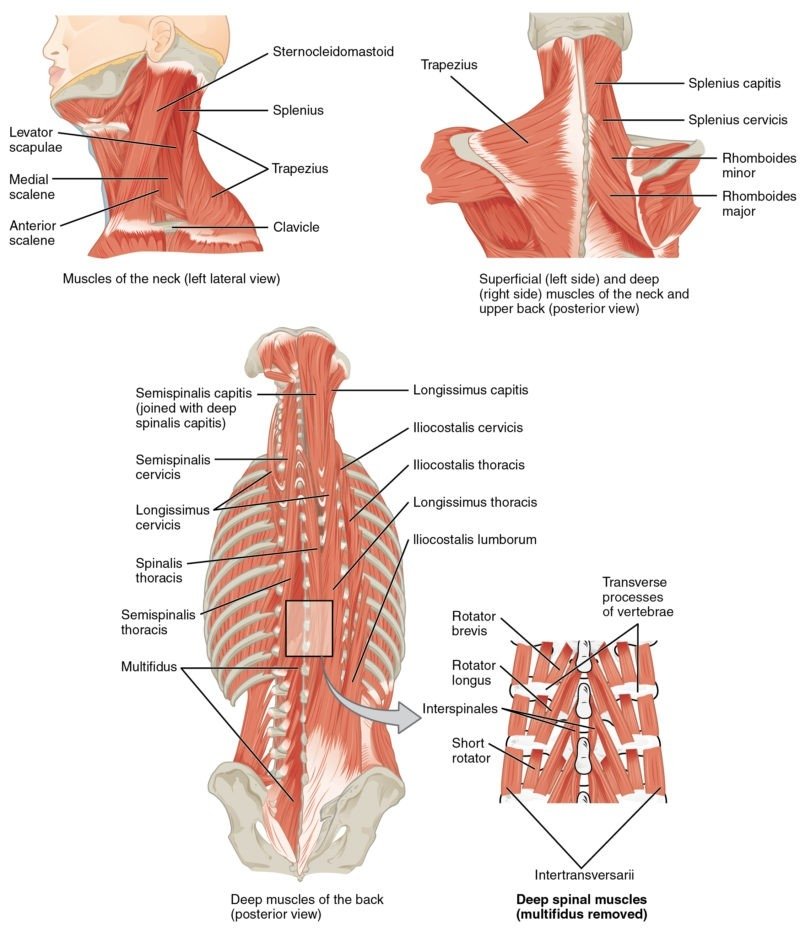
Superficial layer 

Latissimus dorsi 

The latissimus dorsi originates from the lower back and covers a wide area.

  • Function: Adduction, medial rotation, an extension of humerus
  • Origin: Spinous processes of seventh to 12th thoracic vertebrae, iliac crest, thoracolumbar fascia, and inferior third and fourth rib
  • Insertion: Intertubercular groove of humerus
  • Innervation: Thoracodorsal nerve (C5,C6,C7)
  • Attachments: The latissimus dorsi originates from the lower spine and ribs and the upper pelvis and fascia of the deep trunk muscles. The muscle converges into a tendon attaching to the humerus.
  • Actions: Extends, adducts, and medially rotates the upper arm.

Trapezius 

The trapezius is the most superficial muscle of the back and forms a broad flat triangle.

  • Function: Elevation, depression, and retraction of the scapula, rotation of glenoid cavity
  • Origin: Superior nuchal line, nuchal ligament, occipital protuberance, spinous processes of C7- T12
  • Insertion: Spine of scapula, acromion, and lateral clavicle
  • Innervation: CN XI
  • Actions: The superior region supports the arm and elevates and rotates the scapula, the intermediate region retracts the scapula, and the inferior region rotates and depresses the scapula.
  • Attachments: The trapezius originates from the skull and spine of the upper back and neck. It attaches to the clavicle and scapula.

Deep Layer

Levator scapulae

  • Function: Adduction, medial rotation, an extension of humerus
  • Origin: Transverse processes of C1 through C4 vertebrae
  • Insertion: Scapula at its medial border
  • Innervation: Thoracodorsal nerve (C5, C6, C7)

Rhomboid major

  • Function: Retraction of scapula and depression of glenoid cavity
  • Origin: Spinous processes of T2 through T5 vertebrae
  • Insertion: Inferior aspect of medial scapula
  • Innervation: Dorsal scapular nerve (C4, C5)

Rhomboid minor

  • Function: Retraction of scapula and depression of glenoid cavity
  • Origin: Nuchal ligament as well as spines of C7 and T1 vertebrae
  • Insertion: Superior aspect of medial scapula
  • Innervation: Dorsal scapular nerve (C4, C5)

Three deep muscles lie below the superficial muscles of the shoulder

Levator Scapulae  A small, strap-like muscle that joins the neck to the scapula.

  • Attachments: Originates from the side of the spine in the neck and attaches to the scapula.
  • Actions: Elevates the scapula.

Rhomboid Major  Sits inferiorly to the levator scapulae.

  • Attachments: Originates from the spine in the upper back and attaches to the scapula in an inferior position to the levator scapulae attachment.
  • Actions: Retracts and rotates the scapula.

Rhomboid Minor  Sits between the levator scapulae and rhomboid major, with which it is paired in action and function. It retracts and rotates the scapula.

Scapulohumeral (Intrinsic Shoulder Muscles)

Location of the deltoid muscles

  • Highlighted in orange, the deltoids cover the rounding of the shoulder joint. Intrinsic muscles originate from the scapula or clavicle and attach to the humerus. There are six intrinsic muscles, four of which form the rotator cuff.

Deltoid Muscle 

The deltoid muscle is a triangular muscle that covers the shoulder. The action of the muscle is complex, with the components acting in opposing and separate ways during the course of a contraction.

  • Attachments: The deltoid muscle originates from the scapula and clavicle and attaches to the lateral surface of the humerus.
  • Actions: The anterior region assists the pectoralis major during transverse flexion of the shoulder and acts weakly in strict transverse flexion. The lateral region assists in shoulder flexion when the shoulder is rotating, although it also assists the transverse abduction of the shoulder. The posterior region is the hyperextension of the shoulder, contributing to the transverse extension.
  • Function: Anterior part: flexion and medial rotation of the arm, middle part: the abduction of arm, posterior part: extension and lateral rotation of the arm
  • Origin: Lateral clavicle, acromion and scapular spine
  • Insertion: Deltoid tuberosity
  • Innervation: Axillary nerve (C5, C6)

Teres major

The teres major is a thick flattened muscle connecting the lower scapula with the humerus.

  • Function: Adduction and medial rotation of the arm
  • Origin: Posterior surface of  scapula at its inferior angle
  • Insertion: Intertubercular groove on its medial aspect
  • Innervation: Lower scapular nerve (C5, C6)
  • Attachments: Originates from the posterior of the scapula and attaches to the humerus.
  • Actions: Adducts the shoulder and assists in rotation of the arm.

Supraspinatus 

  • Function: Initiation of arm abduction
  • Origin: Posterior scapula, superior to the scapular spine
  • Insertion: Superior aspect of the greater tubercle
  • Innervation: Suprascapular nerve (C5, C6)
  • Part of rotator cuff muscles

Infraspinatus

  • Function: Lateral rotation of arm
  • Origin: Posterior scapula, inferior  to the scapular spine
  • Insertion: Greater tubercle of the humerus, between the supraspinatus and teres minor insertion
  • Innervation: Suprascapular nerve (C5, C6)
  • Part of rotator cuff muscles

Teres minor 

  • Function: Lateral rotation of arm
  • Origin: Posterior surface of scapula at its inferior angle
  • Insertion: Inferior aspect of the greater tubercle
  • Innervation: Axillary nerve (C5, C6)
  • Part of rotator cuff muscles

Subscapularis

  • Function: Adduction and medial rotation of the arm
  • Origin: Anterior aspect of the scapula
  • Insertion: Lesser tubercle of the humerus
  • Innervation: Subscapular nerves (C5, C6, C7)
  • Part of rotator cuff muscles

Rotator cuff muscles: supraspinatus, infraspinatus, teres minor, subscapularis

Muscles of Anterior Compartment of Arm (Flexors of Arm)

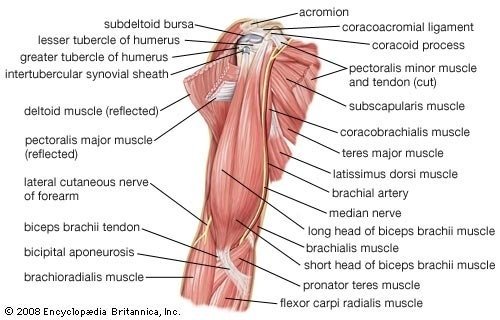
Biceps brachii The biceps brachii is a two-headed muscle. Although the majority of the muscle mass is located anteriorly to the humerus, it has no attachment to the bone itself.

  • Function: Major flexion of forearm, supination of forearm, resists dislocation of shoulder
  • Origin: Short head originates from the coracoid process. The long head is from the supraglenoid tubercle of scapula
  • Insertion: Radial tuberosity and forearm fascia (as bicipital aponeurosis)
  • Innervation: Musculocutaneous nerve (C5, C6)
  • Attachments: Both heads originate from the scapula and attach via the bicipital aponeurosis to the fascia of the forearm.
  • Action: Supination of the forearm. It also flexes the arm at the elbow and at the shoulder.

Brachialis  The brachialis muscle lies within the distal region of the biceps brachii.

  • Attachments: Originates from the humerus and attaches to the ulna.
  • Action: Flexing of the arm at the elbow.
  • Function: Flexion of forearm
  • Origin: Distal anterior humerus
  • Insertion: Coronoid process and ulnar tuberosity
  • Innervation:  musculocutaneous nerve (C5, C6, C7 small contribution)

Coracobrachialis – The coracobrachialis lies within the two heads of the biceps brachii.

  • Attachments: Originates from the scapula and attaches to the humerus.
  • Action: Flexing of the arm at the shoulder, and weak adduction
  • Function: Flexion and adduction of arm
  • Origin: Coracoid process
  • Insertion: Middle of the humerus, on its medial aspect
  • Innervation: Musculocutaneous nerve (C5, C6, C7)

Muscles of Posterior Compartment of Arm (Extensors of Arm)

Triceps brachii

  • Function: Major extensor of the forearm, resists dislocation of the shoulder
  • Origin: Lateral head: above the radial groove, medial head: below the radial groove, long head: infraglenoid tubercle of the scapula
  • Insertion: Olecranon process of ulna and  forearm fascia
  • Innervation: Radial nerve (C6,C7,C8)

Anconeus- The anconeus is located in the superficial region of the forearm posterior compartment and is blended with the triceps brachii.

  • Function: Extension of the forearm, stabilization of elbow joint
  • Origin: Lateral epicondyle of humerus
  • Insertion: Olecranon process and posterior ulna
  • Innervation: Radial nerve (C7, C8, T1)
  • Attachments: Originates from the humerus and attaches to the ulna.
  • Actions: Moves the ulna during pronation and extends the forearm at the elbow.

Muscles of Anterior Compartment of Forearm (Flexors of Forearm)

Superficial layer

Pronator Teres – A rectangular muscle located in the superficial region of the anterior compartment.

  • Attachments: The pronator teres has two origins, one on the proximal end of the humerus and one of the distal end of the ulna. It attaches to the mid-region of the radius.
  • Function: Pronation of radio-ulnar joint and Pronates the forearm.
  • Origin: Coronoid process and medial epicondyle of humerus
  • Insertion: Lateral surface of the radius
  • Innervation: Median nerve (C6, C7)

Pronator Quadratus A square-shaped muscle located adjacent to the wrist in the deep region of the anterior compartment.

  • Attachments: Originates from the ulna and attaches to the radius.
  • Action: Pronates the forearm.

Posterior

Superficial Layer

The superficial layer of the posterior forearm contains seven muscles. The posterior compartment of the forearm is split into superficial and deep regions.

Anconeus The anconeus is located in the superficial region of the forearm posterior compartment and is blended with the triceps brachii.

  • Attachments: Originates from the humerus and attaches to the ulna.
  • Action: Moves the ulna during pronation and extends the forearm at the elbow.

Brachioradialis  The brachioradialis is located in the superficial region of the forearm posterior compartment,The brachioradialis is located in the superficial region of the forearm posterior compartment

  • Attachments: Originates from the humerus and attaches to the distal end of the radius.
  • Action: Flexes the forearm at the elbow.
  • Attachments: Originates from the humerus and attaches to the distal end of the radius.
  • Actions: Flexes the forearm at the elbow.

Supinator – The supinator is located in the deep region of the forearm posterior compartment.

  • Attachments: The supinator has two heads: one originating from the humerus, the other from the ulna. Together they attach to the radius.
  • Action: Supinates the forearm.

Flexor carpi radialis

  • Function: Flexion and adduction at the wrist
  • Origin: Medial epicondyle of humerus
  • Insertion: Base of the second metacarpal
  • Innervation: Median nerve (C6, C7)

Palmaris longus

  • Function: Flexion at the wrist, tensing of the palmar aponeurosis
  • Origin: Medial epicondyle of humerus
  • Insertion: Flexor retinaculum
  • Innervation: Median nerve (C7, C8)

Flexor carpi ulnaris

  • Function: Flexion and adduction at the wrist
  • Origin: Medial epicondyle of humerus and olecranon
  • Insertion: Pisiform, hook of hamate and fifth metacarpal
  • Innervation: Median nerve (C7, C8)

Extensor Carpi Radialis Longus and Brevis A pair of muscles located on the side of the forearm, allowing them to control the extension and abduction of the wrist.

  • Attachments: Both originate from the humerus and attach to the base of the hand.
  • Actions: Extend and abduct the wrist.

Extensor Digitorum  The extensor digitorum is the main extensor of the fingers.

  • Attachments: Originates from the humerus, splitting into four tendons at the wrist which travel through the carpal tunnel and attach to the digits.
  • Actions: Extends fingers.

Extensor Digiti Minimi  Originates from the extensor digitorum. In some people, these muscles cannot be individually defined.

  • Attachments: Originates from the humerus and attaches to the little finger.
  • Actions: Extends the little finger, and contributes to extension at the wrist.

Extensor Carpi Ulnaris  Located on the other side of the forearm to the extensor carpi radialis longus and brevis, it performs a similar role.

  • Attachments: Originates from the humerus and attaches to the base of the hand.
  • Actions: Extension and adduction of the wrist.

Intermediate Layer

Flexor digitorum superficialis 

  • Function: Flexion of the proximal interphalangeal joint of the second, third, fourth, and fifth finger. Also has a weaker flexion action on the metacarpophalangeal joints of the same fingers
  • Origin: Medial epicondyle, coronoid process, and anterior radius
  • Insertion: Second, third, fourth, and fifth middle phalanges
  • Innervation: Median nerve (C7, C8, T1)

Deep Layer

Flexor digitorum profundus

  • Function: Flexion of the distal interphalangeal joint of the second, third, fourth, and fifth finger
  • Origin: Medial and the anterior surface of the proximal ulna and interosseous membrane
  • Insertion: Second, third, fourth, and fifth distal phalanges
  • Innervation: Ulnar nerve (C8, T1) for the medial part, anterior interosseous nerve (C8,T1) for the lateral

Flexor pollicis longus

  • Function: Flexion of the interphalangeal joint of the thumb
  • Origin: Anterior aspect of radius as well as interosseous membrane
  • Insertion: Base of distal phalanx of thumb
  • Innervation: Anterior interosseous nerve (C7, C8)

Pronator quadratus

  • Function: Pronator of the forearm
  • Origin: Anterior aspect of the distal ulna
  • Insertion: Anterior aspect of the distal radius
  • Innervation: Anterior interosseous nerve (C7, C8)

Brachioradialis

  • Function: Weak flexor of the forearm
  • Origin: Proximal supracondylar ridge on the humerus
  • Insertion: Lateral surface of distal end of radius
  • Innervation: Radial nerve (C5, C6, C7)

Muscles of Posterior Compartment of Forearm

Superficial

Extensor carpi radialis longus

  • Function: Extension and abduction of the wrist
  • Origin: Proximal supracondylar ridge on humerus
  • Insertion: Dorsal base of second metacarpal
  • Innervation: Radial nerve (C6, C7)

Extensor carpi radialis brevis 

  • Function: Extension and abduction of the wrist
  • Origin: Lateral epicondyle of humerus
  • Insertion: Dorsal base of the third metacarpal
  • Innervation: Deep branch of the radial nerve (C7, C8)

Extensor digitorum

  • Function: Extension of the proximal interphalangeal joint of the second, third, fourth, and fifth finger. Also has a weaker extension action on the metacarpophalangeal joints of the same fingers
  • Origin: Lateral epicondyle of humerus
  • Insertion: Extensor expansions on the dorsal aspect of second, third, fourth, and fifth middle and distal phalanges
  • Innervation: Posterior interosseous nerve (C7, C8)

Extensor digit minimi

  • Function: Extension of the little finger at the metacarpophalangeal joint and interphalangeal joint
  • Origin: Lateral epicondyle of humerus
  • Insertion: Extensor expansion on the dorsal aspect of the fifth phalanx
  • Innervation: Posterior interosseous nerve (C7, C8)

Extensor carpi ulnaris

  • Function: Extension and adduction of the wrist
  • Origin: Lateral epicondyle of the humerus and posterior ulna
  • Insertion: Fifth metacarpal base
  • Innervation: Posterior interosseous nerve (C7, C8)

Muscles of the Forearm

As with the upper arm, the forearm is split into the anterior and posterior compartment. Each contains many more muscles than described below due to the requirement for more complex movements in the wrist and hand.

Superficial Layer

Three muscles are located in the superficial layer of the anterior compartment of the forearm.

Flexor Carpi Ulnaris  A long muscle originating near the elbow and passing through into the wrist.

  • Attachments: Originates from the humerus and ulna and attaches to one of the carpal bones in the wrist.
  • Actions: Flexion and adduction at the wrist.

Palmaris Longus  – A long muscle originating near the elbow and passing through into the wrist.

  • Attachments: Originates from the humerus and attaches to the base of the hand.
  • Actions: Flexion at the wrist.

Flexor Carpi Radialis  A long muscle originating near the elbow and passing through into the wrist.

  • Attachments: Originates from the humerus and attaches to the base of the digits.
  • Actions: Flexion and abduction at the wrist.

Pronator Teres  A rectangular muscle.

  • Attachments: The pronator teres has two origins, one on the proximal end of the humerus and one of the distal end of the ulna. It attaches to the mid region of the radius.
  • Actions: Pronates the forearm.

Deep Layer

There are four muscles in the deep layer of the posterior compartment of the forearm.

Supinator  The supinator is located in the deep region of the forearm posterior compartment.

  • Attachments: The supinator has two heads: one originates from the humerus, the other from the ulna. Together they attach to the radius.
  • Actions: Supinates the forearm.

Abductor Pollicis Longus  The abductor pollicis longus is situated immediately distal to the supinator muscle.

  • Attachments: Originates from the radius and ulna attaching to the base of the thumb.
  • Actions: Abducts the thumb.

Extensor Pollicis Brevis The extensor pollicis Brevis is located below the abductor pollicis longus.

  • Attachments: Originates from radius and attaches to the base of the thumb.
  • Actions: Extends the thumb.

Extensor Indices Proprius – This muscle allows the index finger to be independent of the other fingers during extension.

  • Attachments: Originates from the ulna and attaches to the index finger.
  • Actions: Extends the index finger.

Intermediate Layer

There is just one muscle in the intermediate layer of the anterior compartment of the forearm.

Flexor Digitorum Superficialis – Lying below the superficial region, the flexor digitorum superficialis is a key muscle controlling wrist and finger flex.

  • Attachments: Originates from the humerus and the radius, splitting into four tendons at the wrist which travel through the carpal tunnel and attach to the fingers.
  • Actions: Flexes fingers and wrist.

Deep Layer

There are three muscles in the deep layer of the anterior compartment of the forearm.

Flexor Digitorum Profundus  A long muscle originating near the elbow and passing through into the wrist, lying adjacent to the flexor pollicis longus.

  • Attachments: Originates from the ulna, splitting into four tendons at the wrist which travel through the carpal tunnel and attach distally to the fingers.
  • Actions: Flexes the wrist and the most distal regions of the fingers.

Flexor Pollicis Longus  A long muscle originating near the elbow and passing through into the wrist, lying adjacent to the flexor digitorum profundus.

  • Attachments: Originates from the radius and attaches to the base of the thumb.
  • Actions: Flexes the thumb.

Pronator quadratus  A square-shaped muscle located adjacent to the wrist.

  • Attachments: Originates from the ulna and attaches to the radius.
  • Actions: Pronates the forearm.

Deep Layer

Extensor indices

  • Function: Extension of the index finger
  • Origin: Dorsal surface of the distal ulna and interosseous membrane
  • Insertion: Extensor expansion of the second finger
  • Innervation: Posterior interosseous nerve (C7, C8)

Supinator 

  • Function: Supination of the forearm
  • Origin: Lateral epicondyle and supinator crest of the ulna
  • Insertion: Lateral surface of radius
  • Innervation: Deep branch of the radial nerve (C7, C8)

Abductor policies longus 

  • Function: Abduction of the thumb by acting on the carpometacarpal joint and the metacarpophalangeal joint
  • Origin: Dorsal aspects of the proximal radius, ulna, and interosseous membrane
  • Insertion: Base of the first metacarpal
  • Innervation: Posterior interosseous nerve (C7, C8)

Extensor policies longus 

  • Function: Extension of the thumb by acting on the carpometacarpal joint, the metacarpophalangeal joint, and the interphalangeal joint.
  • Origin: Dorsal aspects of the middle ulna and interosseous membrane
  • Insertion: Distal phalanx of 1st finger
  • Innervation: Posterior interosseous nerve (C7, C8)

Extensor policies Brevis

  • Function: Extension of the thumb by acting on the carpometacarpal joint and the metacarpophalangeal joint
  • Origin: Dorsal aspects of middle radius and interosseous membrane
  • Insertion: Distal phalanx of 1st finger
  • innervation: Posterior interosseous nerve (C7, C8)

Intrinsic Muscles of Hand

Thenar muscles

  • The thenar muscles are three short muscles located at the base of the thumb and responsible for its fine movement.

Opponents policies 

The opponent’s pollicis is the largest and deepest-lying of the thenar muscles.

  • Function: Opposition of the thumb
  • Origin: Flexor retinaculum  and tubercle of trapezium
  • Insertion: Lateral aspect of the first metacarpal
  • Innervation: Recurrent branch of the median nerve (C8, T1)
  • Attachments: Originates from the wrist and attaches to the thumb.
  • Actions: Rotates the thumb towards the palm, producing opposition and improving grip.

Abductor policies Brevis

Located anteriorly to the opponens pollicis and proximal to the flexor pollicis brevis.

  • Function: Abduction of the thumb at the metacarpophalangeal joint, Abducts the thumb.
  • Origin: Flexor retinaculum  and tubercle of the scaphoid
  • Insertion: Lateral aspect of proximal phalanx of the first finger
  • Innervation: Recurrent branch of the median nerve (C8, T1)
  • Attachments: Originates from the wrist and attaches to the thumb.

Flexor policies Brevis 

The smallest and most distal of the thenar muscles.

  • Function: Flexion of the thumb at the metacarpophalangeal joint
  • Origin: Flexor retinaculum  and tubercle of trapezium
  • Insertion: Lateral aspect of proximal phalanx of the first finger
  • Actions: Flexes the thumb.Innervation: Recurrent branch of the median nerve (C8, T1)
  • Attachments: Originates from the wrist and attaches to the thumb

Adductor Compartment

Adductor policies

  • Function: Adduction of the thumb
  • Origin: Second, third metacarpal, and capitate
  • Insertion: Proximal phalanx and extensor expansion of 1st finger
  • Innervation: Deep branch of ulnar nerve (C8, T1)

Hypothenar Muscles

Hypothenar Muscles

  • The hypothenar muscles are located at the base of the little finger. Their naming, function, and organization are similar to those of the thenar muscles.

Abductor digiti minimi

The most superficial of the hypothenar muscles.

  • Function: Abduction of the little finger at the metacarpophalangeal joint
  • Origin: Pisiform
  • Insertion: Medial aspect of proximal phalanx of the fifth finger
  • Innervation: Deep branch of the ulnar nerve (C8, T1)
  • Attachments: Originates from the wrist and attaches to the little finger.
  • Actions: Abducts the little finger.

Flexor digiti Minimi Brevis

Located laterally to the digiti minimi.

  • Function: Flexion of the little finger at the metacarpophalangeal joint
  • Origin: Flexor retinaculum and hook of hamate
  • Insertion: Medial aspect of proximal phalanx of the fifth finger
  • Innervation: Deep branch of the ulnar nerve (C8, T1)
  • Attachments: Originates from the wrist and attaches to the little finger.
  • Actions: Flexes little finger.

Opponents digit minimi

The opponent’s digit minimi is the deepest-lying of the hypothenar muscles.

  • Function: Opposition of the little finger
  • Origin: Flexor retinaculum and hook of hamate
  • Insertion: Medial aspect of the fifth metacarpal
  • Innervation: Deep branch of the ulnar nerve (C8, T1)
  • Attachments: Originates from the wrist and attaches to the little finger.
  • Actions: Rotates little finger towards the palm, producing opposition and improving grip.


Short Muscles

Lubricants 

These are four lumbricals in the hand, each associated with an individual finger.

  • Attachments: Originates from a tendon of attached to the flexor digitorum profundus of the forearm, each attaching to an individual finger
  • Actions: Flexes and extends the fingers.
  • Function: Flexion of the metacarpophalangeal joints with the extension of the interphalangeal joints
  • Origin: Arise from tendons of flexor digitorum profundus. First 2 are unipennate, and the third and fourth are bipennate
  • Insertion: Extensor expansions of the second, third, fourth, and fifth finger
  • Innervation: Median nerve (C8, T1) for the lateral 2 lumbricals, deep branch of the ulnar nerve (C8, T1) for the medial 2 lumbricals

Interossei

The interossei muscles are located between the fingers; they can be split into two groups.

Dorsal interossei 

Located superficially on the dorsal side of the hand, there are four dorsal interossei muscles.

  • Function: Abduction of the second, third, and fourth finger away from the axial line
  • Origin: Adjacent metacarpals
  • Insertion: Extensor expansions and proximal phalanges of the second, third, and fourth fingers
  • Innervation: Deep branch of the ulnar nerve (C8, T1)
  • Attachments: Originates from the base of the finger, each attaching after the first finger joint.
  • Actions: Abducts the fingers.

Palmar interossei

Located on the anterior side of the hand, there are three palmar interossei, with the index finger controlled by the extensor indices properties.

  • Function: Adduction of the second, third, and fourth finger towards the axial line
  • Origin: Palmar surfaces of second, fourth, and fifth metacarpals
  • Insertion: Extensor expansions and proximal phalanges of the second, fourth, and fifth fingers
  • Innervation: Deep branch of the ulnar nerve (C8, T1)
  • Attachments: Originates from the base of the finger, each attaching after the first finger joint.
  • Actions: Adducts the fingers.

Palmaris Brevis  The palmaris brevis is a small superficial muscle found in the palm.

  • Attachments: Originates from the fascia of the palm and attaches to the dermis.
  • Actions: Wrinkles the skin and deepens the curvature of the palm improving grip.

Key Terms and Overview Upper Limb Muscle

  • Pronator Teres – A muscle of the anterior compartment of the forearm that controls pronation.
  • Supinator – A muscle of the posterior compartment of the forearm that controls supination.
  • Pronator Quadraturs – A muscle of the anterior compartment of the forearm that controls pronation.
  • Brachioradialis – A muscle of the posterior compartment of the forearm that flexes the forearm.
  • Biceps Brachii – A muscle of the anterior compartment of the upper arm that flexes the forearm.
  • Triceps Brachii – A muscle of the posterior compartment of the upper arm that extends the forearm.
  • The extension (forearm away from the upper arm) – Produced by the triceps brachii and anconeus of the forearm.
  • Flexion (forearm towards the upper arm) – Produced by the brachialis, biceps brachii, and brachioradialis of the forearm.
  • Pronation (rotation of the forearm so the palm faces downwards) – Produced by the pronator quadratus and pronator teres of the forearm.
  • Supination(rotation of the forearm so the palm faces upwards) – Produced by the supinator of the forearm and biceps brachii.
  • Palmaris Longus – A long muscle originating near the elbow and passing through into the wrist, attaching to the base of the hand.
  • Flexor Digitorum Superficialis – A key muscle controlling wrist and finger flex.
  • Flexor Carpi Ulnaris – A long muscle originating near the elbow and passing through into the wrist, attaching to one of the carpal bones in the wrist.
  • Flexor Carpi Radialis – A long muscle originating near the elbow and passing through into the wrist, attaching to the base of the digits (fingers).
  • Flexor Digitorum Profundus – A long muscle originating near the elbow and passing through into the wrist, flexing the wrist and the most distant regions of the fingers.
  • Pronator Teres – A rectangular muscle that pronates the forearm.
  • Flexor Pollicis Longus – A long, deep muscle responsible for flexing the thumb.
  • Pronator quadratus – A square-shaped muscle located adjacent to the wrists

Key Terms

  • Pectoralis major – A large, fan-shaped muscle of the chest.
  • Rotator cuff – A set of four smaller muscles in the shoulder responsible for rotating the humerus (upper arm bone).
  • Trapezius A large vertebrate skeletal muscle divided into an ascending, descending, and transverse portion, attaching the neck and central spine to the outer extremity of the scapula. It functions in scapular elevation, adduction, and depression.
  • Deltoid – The deltoid muscle, a triangular muscle on the human shoulder.
  • The extension (upper limb backward behind back) – Produced by the posterior deltoid, latissimus dorsi, and teres major.
  • Flexion (upper limb forwards past chest – Produced by the biceps brachii (both heads), pectoralis major, anterior deltoid, and coracobrachialis.
  • Abduction (upper limb away from the trunk, spreading arms wide) – Produced by the supraspinatus and deltoid. Past 90 degrees, the scapula needs to be rotated by the trapezius and serratus anterior to achieve abduction.
  • Adduction (upper limb towards the trunk, bringing arms down to side) – Produced by contraction of the pectoralis major, latissimus dorsi, and teres major.
  • Medial Rotation (rotation of arm inwards to cover abdomen) – Produced by contraction of the subscapularis, pectoralis major, latissimus dorsi, teres major, and anterior deltoid.
  • Lateral Rotation (rotation of arm outwards away from the abdomen) – Produced by contraction of the infraspinatus and teres minor.
  • The shoulder exhibits a wide range of movement, which makes it susceptible to dislocation and injury.
  • The trapezius muscles rotate the scapulae upward.
  • The rhomboid major and the rhomboid minor press the scapula against the thoracic wall, retracting the scapula towards the spine.
  • The deltoid is a complex muscle that forms the rounded edge of the shoulder and participates in many articulations of the shoulder joint.
  • The rotator cuff are the muscles that stabilize the movement of the shoulder.
  • The pectoralis minor and pectoralis major are large muscles of the chest that participate in many movements, including flexion of the humerus.

Blood Supply of Upper Limb Muscle

Blood supply of the supraspinatus

  • The suprascapular artery delivers blood to the supraspinatus muscle.

Blood supply of the deltoid

  • The posterior circumflex humeral artery and the deltoid branch of the thoracoacromial artery are the vascular sources for the deltoid.

Blood supply of the trapezius

  • The transverse cervical artery provides vascular supply to the trapezius.

Blood supply of the serratus anterior

  • The circumflex scapular artery is the blood supply to the serratus anterior.

Nerves of Upper Limb Muscle

The collateral nerves of the brachial plexus are listed as follows:

  • The dorsal scapular nerve.
  • The long thoracic nerve.
  • The suprascapular nerve.
  • The lateral pectoral nerve.
  • The medial pectoral nerve.
  • The upper subscapular nerve.
  • The lower subscapular nerve.
  • The thoracodorsal nerve.
  • The medial brachial cutaneous nerve.
  • The medial antebrachial cutaneous nerve.

Innervation of the supraspinatus

  • The neural supply of the supraspinatus is by the suprascapular nerve (C5, C6) from the upper trunk of the brachial plexus.

Innervation of the deltoid

  • The neural supply of the deltoid is via the axillary nerve (C5, C6) from the posterior cord of the brachial plexus.

Innervation of the trapezius

  • The neural supply of the trapezius is the spinal accessory nerve (C1-C5). C3 and C4 are responsible for the proprioception of the trapezius.

Innervation of the serratus anterior

  • The neural supply of the serratus anterior is the long thoracic nerve (C5-C7) which originates from the roots of the brachial plexus.


ByRx Harun

What are the functions of the upper limbs Muscle?

What are the functions of the upper limbs Muscle?/Upper Limb Muscle comprises many muscles that are organized into anatomical compartments. These muscles act on the various joints of the hand, arm, and shoulder, maintaining tone, providing stability and allowing precise fluid movement.

Axioappendicular groups of muscles arise from the axial skeleton to act upon the pectoral girdle. Scapulohumeral muscles originate from the scapula and insert into the proximal humerus. Included in this category are the rotator cuff muscles which provide stability to the glenohumeral joint. In the arm, the muscles of the anterior compartment are involved in flexion of the forearm, and the posterior comprises of the forearm extensors. Similarly, the anterior compartment of the forearm contains the flexors of the hand and the posterior has extensors. The hand is divided into the thenar, the hypothenar, the adductor compartment, as well as the short muscles of the hand.

The upper extremity (UE) is comprised of its associated muscles, nerves, and vessels, organized into anatomical compartments. The muscles cross joints to provide tone, maintain dynamic joint stability, and perform dynamic functions of the entire extremity.  In addition, the arteries and veins provide nourishment and remove waste, and the nerves provide the motor and sensory innervations.

What are the functions of the upper limbs Muscle?

Types of Muscle of Upper Limb Muscle

PectoralAnterior Axioappendicular Muscles (Thoracoappendicular Muscles)

Pectoral muscles lie in the chest and exert force through the shoulder to move the upper arm. Three pectoral muscles interact with the shoulder.

Pectoralis major

The pectoralis major is a large, fan-shaped muscle covering the chest. It is comprised of clavicular and sternocostal regions.

  • Function – flexion, adduction, medial rotation of the humerus.
  • Origin – clavicular head: medial clavicle anteriorly, sternocostal head: anterior sternum and costal cartilages of ribs 1 to 6 as well as an external oblique aponeurosis
  • Insertion: the lateral edge of the intertrabecular groove of the humerus
  • Innervation: medial pectoral nerve (C8, T1) lateral pectoral nerve (C5, C6, C7) of brachial plexus
  • Attachments: The clavicular region originates from the clavicle and the sternocostal region originates from the sternum and the fascia of the oblique muscles of the abdomen. Both attach to the humerus.
  • Actions: Adducts and rotates the upper arm.

Pectoralis minor

The pectoralis minor muscle is smaller and lies beneath the pectoralis major.

  • Function: Depression of the shoulder, protraction of the scapula
  • Origin: Third, fourth, fifth ribs close to their respective costal cartilages
  • Insertion: Coracoid process
  • Innervation: Medial pectoral nerve (C8, T1)
  • Attachments: The pectoralis minor originates from the third to fifth ribs and attaches to the scapula.
  • Actions: Supports and depresses the scapula.

Subclavius

  • Function: Depression and stabilization of the clavicle
  • Origin: First rib medially
  • Insertion: Middle of the clavicle, inferiorly
  • Innervation: Nerve to subclavius (C5, C6)

Serratus anterior 

The serratus anterior is located in the lateral wall of the chest.

  • Function: Protraction of scapula, rotation of the scapula
  • Origin: Lateral first to the eighth rib
  • Insertion: anterior scapula, medially
  • Innervation: long thoracic nerve (C5, C6, C7)
  • Attachments: The muscle is formed of several strips originating from the second to eight ribs, each of which attaches to the scapula.
  • Actions: Supports the scapula allowing for elevation of the upper arm.

Posterior Axioappendicular Muscles

What are the functions of the upper limbs Muscle?

Superficial layer 

Latissimus dorsi 

The latissimus dorsi originates from the lower back and covers a wide area.

  • Function: Adduction, medial rotation, an extension of humerus
  • Origin: Spinous processes of seventh to 12th thoracic vertebrae, iliac crest, thoracolumbar fascia, and inferior third and fourth rib
  • Insertion: Intertubercular groove of humerus
  • Innervation: Thoracodorsal nerve (C5,C6,C7)
  • Attachments: The latissimus dorsi originates from the lower spine and ribs and the upper pelvis and fascia of the deep trunk muscles. The muscle converges into a tendon attaching to the humerus.
  • Actions: Extends, adducts, and medially rotates the upper arm.

Trapezius 

The trapezius is the most superficial muscle of the back and forms a broad flat triangle.

  • Function: Elevation, depression, and retraction of the scapula, rotation of glenoid cavity
  • Origin: Superior nuchal line, nuchal ligament, occipital protuberance, spinous processes of C7- T12
  • Insertion: Spine of scapula, acromion, and lateral clavicle
  • Innervation: CN XI
  • Actions: The superior region supports the arm and elevates and rotates the scapula, the intermediate region retracts the scapula, and the inferior region rotates and depresses the scapula.
  • Attachments: The trapezius originates from the skull and spine of the upper back and neck. It attaches to the clavicle and scapula.

Deep Layer

Levator scapulae

  • Function: Adduction, medial rotation, an extension of humerus
  • Origin: Transverse processes of C1 through C4 vertebrae
  • Insertion: Scapula at its medial border
  • Innervation: Thoracodorsal nerve (C5, C6, C7)

Rhomboid major

  • Function: Retraction of scapula and depression of glenoid cavity
  • Origin: Spinous processes of T2 through T5 vertebrae
  • Insertion: Inferior aspect of medial scapula
  • Innervation: Dorsal scapular nerve (C4, C5)

Rhomboid minor

  • Function: Retraction of scapula and depression of glenoid cavity
  • Origin: Nuchal ligament as well as spines of C7 and T1 vertebrae
  • Insertion: Superior aspect of medial scapula
  • Innervation: Dorsal scapular nerve (C4, C5)

Three deep muscles lie below the superficial muscles of the shoulder

Levator Scapulae  A small, strap-like muscle that joins the neck to the scapula.

  • Attachments: Originates from the side of the spine in the neck and attaches to the scapula.
  • Actions: Elevates the scapula.

Rhomboid Major  Sits inferiorly to the levator scapulae.

  • Attachments: Originates from the spine in the upper back and attaches to the scapula in an inferior position to the levator scapulae attachment.
  • Actions: Retracts and rotates the scapula.

Rhomboid Minor  Sits between the levator scapulae and rhomboid major, with which it is paired in action and function. It retracts and rotates the scapula.

Scapulohumeral (Intrinsic Shoulder Muscles)

Location of the deltoid muscles

  • Highlighted in orange, the deltoids cover the rounding of the shoulder joint. Intrinsic muscles originate from the scapula or clavicle and attach to the humerus. There are six intrinsic muscles, four of which form the rotator cuff.

Deltoid Muscle 

The deltoid muscle is a triangular muscle that covers the shoulder. The action of the muscle is complex, with the components acting in opposing and separate ways during the course of a contraction.

  • Attachments: The deltoid muscle originates from the scapula and clavicle and attaches to the lateral surface of the humerus.
  • Actions: The anterior region assists the pectoralis major during transverse flexion of the shoulder and acts weakly in strict transverse flexion. The lateral region assists in shoulder flexion when the shoulder is rotating, although it also assists the transverse abduction of the shoulder. The posterior region is the hyperextension of the shoulder, contributing to the transverse extension.
  • Function: Anterior part: flexion and medial rotation of the arm, middle part: the abduction of arm, posterior part: extension and lateral rotation of the arm
  • Origin: Lateral clavicle, acromion and scapular spine
  • Insertion: Deltoid tuberosity
  • Innervation: Axillary nerve (C5, C6)

Teres major

The teres major is a thick flattened muscle connecting the lower scapula with the humerus.

  • Function: Adduction and medial rotation of the arm
  • Origin: Posterior surface of  scapula at its inferior angle
  • Insertion: Intertubercular groove on its medial aspect
  • Innervation: Lower scapular nerve (C5, C6)
  • Attachments: Originates from the posterior of the scapula and attaches to the humerus.
  • Actions: Adducts the shoulder and assists in rotation of the arm.

Supraspinatus 

  • Function: Initiation of arm abduction
  • Origin: Posterior scapula, superior to the scapular spine
  • Insertion: Superior aspect of the greater tubercle
  • Innervation: Suprascapular nerve (C5, C6)
  • Part of rotator cuff muscles

Infraspinatus

  • Function: Lateral rotation of arm
  • Origin: Posterior scapula, inferior  to the scapular spine
  • Insertion: Greater tubercle of the humerus, between the supraspinatus and teres minor insertion
  • Innervation: Suprascapular nerve (C5, C6)
  • Part of rotator cuff muscles

Teres minor 

  • Function: Lateral rotation of arm
  • Origin: Posterior surface of scapula at its inferior angle
  • Insertion: Inferior aspect of the greater tubercle
  • Innervation: Axillary nerve (C5, C6)
  • Part of rotator cuff muscles

Subscapularis

  • Function: Adduction and medial rotation of the arm
  • Origin: Anterior aspect of the scapula
  • Insertion: Lesser tubercle of the humerus
  • Innervation: Subscapular nerves (C5, C6, C7)
  • Part of rotator cuff muscles

Rotator cuff muscles: supraspinatus, infraspinatus, teres minor, subscapularis

Muscles of Anterior Compartment of Arm (Flexors of Arm)

Biceps brachii The biceps brachii is a two-headed muscle. Although the majority of the muscle mass is located anteriorly to the humerus, it has no attachment to the bone itself.

  • Function: Major flexion of forearm, supination of forearm, resists dislocation of shoulder
  • Origin: Short head originates from the coracoid process. The long head is from the supraglenoid tubercle of scapula
  • Insertion: Radial tuberosity and forearm fascia (as bicipital aponeurosis)
  • Innervation: Musculocutaneous nerve (C5, C6)
  • Attachments: Both heads originate from the scapula and attach via the bicipital aponeurosis to the fascia of the forearm.
  • Action: Supination of the forearm. It also flexes the arm at the elbow and at the shoulder.

Brachialis  The brachialis muscle lies within the distal region of the biceps brachii.

  • Attachments: Originates from the humerus and attaches to the ulna.
  • Action: Flexing of the arm at the elbow.
  • Function: Flexion of forearm
  • Origin: Distal anterior humerus
  • Insertion: Coronoid process and ulnar tuberosity
  • Innervation:  musculocutaneous nerve (C5, C6, C7 small contribution)

Coracobrachialis – The coracobrachialis lies within the two heads of the biceps brachii.

  • Attachments: Originates from the scapula and attaches to the humerus.
  • Action: Flexing of the arm at the shoulder, and weak adduction
  • Function: Flexion and adduction of arm
  • Origin: Coracoid process
  • Insertion: Middle of the humerus, on its medial aspect
  • Innervation: Musculocutaneous nerve (C5, C6, C7)

Muscles of Posterior Compartment of Arm (Extensors of Arm)

Triceps brachii

  • Function: Major extensor of the forearm, resists dislocation of the shoulder
  • Origin: Lateral head: above the radial groove, medial head: below the radial groove, long head: infraglenoid tubercle of the scapula
  • Insertion: Olecranon process of ulna and  forearm fascia
  • Innervation: Radial nerve (C6,C7,C8)

Anconeus- The anconeus is located in the superficial region of the forearm posterior compartment and is blended with the triceps brachii.

  • Function: Extension of the forearm, stabilization of elbow joint
  • Origin: Lateral epicondyle of humerus
  • Insertion: Olecranon process and posterior ulna
  • Innervation: Radial nerve (C7, C8, T1)
  • Attachments: Originates from the humerus and attaches to the ulna.
  • Actions: Moves the ulna during pronation and extends the forearm at the elbow.

Muscles of Anterior Compartment of Forearm (Flexors of Forearm)

Superficial layer

Pronator Teres – A rectangular muscle located in the superficial region of the anterior compartment.

  • Attachments: The pronator teres has two origins, one on the proximal end of the humerus and one of the distal end of the ulna. It attaches to the mid-region of the radius.
  • Function: Pronation of radio-ulnar joint and Pronates the forearm.
  • Origin: Coronoid process and medial epicondyle of humerus
  • Insertion: Lateral surface of the radius
  • Innervation: Median nerve (C6, C7)

Pronator Quadratus A square-shaped muscle located adjacent to the wrist in the deep region of the anterior compartment.

  • Attachments: Originates from the ulna and attaches to the radius.
  • Action: Pronates the forearm.

Posterior

Superficial Layer

The superficial layer of the posterior forearm contains seven muscles. The posterior compartment of the forearm is split into superficial and deep regions.

Anconeus The anconeus is located in the superficial region of the forearm posterior compartment and is blended with the triceps brachii.

  • Attachments: Originates from the humerus and attaches to the ulna.
  • Action: Moves the ulna during pronation and extends the forearm at the elbow.

Brachioradialis  The brachioradialis is located in the superficial region of the forearm posterior compartment,The brachioradialis is located in the superficial region of the forearm posterior compartment

  • Attachments: Originates from the humerus and attaches to the distal end of the radius.
  • Action: Flexes the forearm at the elbow.
  • Attachments: Originates from the humerus and attaches to the distal end of the radius.
  • Actions: Flexes the forearm at the elbow.

Supinator – The supinator is located in the deep region of the forearm posterior compartment.

  • Attachments: The supinator has two heads: one originating from the humerus, the other from the ulna. Together they attach to the radius.
  • Action: Supinates the forearm.

Flexor carpi radialis

  • Function: Flexion and adduction at the wrist
  • Origin: Medial epicondyle of humerus
  • Insertion: Base of the second metacarpal
  • Innervation: Median nerve (C6, C7)

Palmaris longus

  • Function: Flexion at the wrist, tensing of the palmar aponeurosis
  • Origin: Medial epicondyle of humerus
  • Insertion: Flexor retinaculum
  • Innervation: Median nerve (C7, C8)

Flexor carpi ulnaris

  • Function: Flexion and adduction at the wrist
  • Origin: Medial epicondyle of humerus and olecranon
  • Insertion: Pisiform, hook of hamate and fifth metacarpal
  • Innervation: Median nerve (C7, C8)

Extensor Carpi Radialis Longus and Brevis A pair of muscles located on the side of the forearm, allowing them to control the extension and abduction of the wrist.

  • Attachments: Both originate from the humerus and attach to the base of the hand.
  • Actions: Extend and abduct the wrist.

Extensor Digitorum  The extensor digitorum is the main extensor of the fingers.

  • Attachments: Originates from the humerus, splitting into four tendons at the wrist which travel through the carpal tunnel and attach to the digits.
  • Actions: Extends fingers.

Extensor Digiti Minimi  Originates from the extensor digitorum. In some people, these muscles cannot be individually defined.

  • Attachments: Originates from the humerus and attaches to the little finger.
  • Actions: Extends the little finger, and contributes to extension at the wrist.

Extensor Carpi Ulnaris  Located on the other side of the forearm to the extensor carpi radialis longus and brevis, it performs a similar role.

  • Attachments: Originates from the humerus and attaches to the base of the hand.
  • Actions: Extension and adduction of the wrist.

Intermediate Layer

Flexor digitorum superficialis 

  • Function: Flexion of the proximal interphalangeal joint of the second, third, fourth, and fifth finger. Also has a weaker flexion action on the metacarpophalangeal joints of the same fingers
  • Origin: Medial epicondyle, coronoid process, and anterior radius
  • Insertion: Second, third, fourth, and fifth middle phalanges
  • Innervation: Median nerve (C7, C8, T1)

Deep Layer

Flexor digitorum profundus

  • Function: Flexion of the distal interphalangeal joint of the second, third, fourth, and fifth finger
  • Origin: Medial and the anterior surface of the proximal ulna and interosseous membrane
  • Insertion: Second, third, fourth, and fifth distal phalanges
  • Innervation: Ulnar nerve (C8, T1) for the medial part, anterior interosseous nerve (C8,T1) for the lateral

Flexor pollicis longus

  • Function: Flexion of the interphalangeal joint of the thumb
  • Origin: Anterior aspect of radius as well as interosseous membrane
  • Insertion: Base of distal phalanx of thumb
  • Innervation: Anterior interosseous nerve (C7, C8)

Pronator quadratus

  • Function: Pronator of the forearm
  • Origin: Anterior aspect of the distal ulna
  • Insertion: Anterior aspect of the distal radius
  • Innervation: Anterior interosseous nerve (C7, C8)

Brachioradialis

  • Function: Weak flexor of the forearm
  • Origin: Proximal supracondylar ridge on the humerus
  • Insertion: Lateral surface of distal end of radius
  • Innervation: Radial nerve (C5, C6, C7)

Muscles of Posterior Compartment of Forearm

Superficial

Extensor carpi radialis longus

  • Function: Extension and abduction of the wrist
  • Origin: Proximal supracondylar ridge on humerus
  • Insertion: Dorsal base of second metacarpal
  • Innervation: Radial nerve (C6, C7)

Extensor carpi radialis brevis 

  • Function: Extension and abduction of the wrist
  • Origin: Lateral epicondyle of humerus
  • Insertion: Dorsal base of the third metacarpal
  • Innervation: Deep branch of the radial nerve (C7, C8)

Extensor digitorum

  • Function: Extension of the proximal interphalangeal joint of the second, third, fourth, and fifth finger. Also has a weaker extension action on the metacarpophalangeal joints of the same fingers
  • Origin: Lateral epicondyle of humerus
  • Insertion: Extensor expansions on the dorsal aspect of second, third, fourth, and fifth middle and distal phalanges
  • Innervation: Posterior interosseous nerve (C7, C8)

Extensor digit minimi

  • Function: Extension of the little finger at the metacarpophalangeal joint and interphalangeal joint
  • Origin: Lateral epicondyle of humerus
  • Insertion: Extensor expansion on the dorsal aspect of the fifth phalanx
  • Innervation: Posterior interosseous nerve (C7, C8)

Extensor carpi ulnaris

  • Function: Extension and adduction of the wrist
  • Origin: Lateral epicondyle of the humerus and posterior ulna
  • Insertion: Fifth metacarpal base
  • Innervation: Posterior interosseous nerve (C7, C8)

Muscles of the Forearm

As with the upper arm, the forearm is split into the anterior and posterior compartment. Each contains many more muscles than described below due to the requirement for more complex movements in the wrist and hand.

Superficial Layer

Three muscles are located in the superficial layer of the anterior compartment of the forearm.

Flexor Carpi Ulnaris  A long muscle originating near the elbow and passing through into the wrist.

  • Attachments: Originates from the humerus and ulna and attaches to one of the carpal bones in the wrist.
  • Actions: Flexion and adduction at the wrist.

Palmaris Longus  – A long muscle originating near the elbow and passing through into the wrist.

  • Attachments: Originates from the humerus and attaches to the base of the hand.
  • Actions: Flexion at the wrist.

Flexor Carpi Radialis  A long muscle originating near the elbow and passing through into the wrist.

  • Attachments: Originates from the humerus and attaches to the base of the digits.
  • Actions: Flexion and abduction at the wrist.

Pronator Teres  A rectangular muscle.

  • Attachments: The pronator teres has two origins, one on the proximal end of the humerus and one of the distal end of the ulna. It attaches to the mid region of the radius.
  • Actions: Pronates the forearm.

Deep Layer

There are four muscles in the deep layer of the posterior compartment of the forearm.

Supinator  The supinator is located in the deep region of the forearm posterior compartment.

  • Attachments: The supinator has two heads: one originates from the humerus, the other from the ulna. Together they attach to the radius.
  • Actions: Supinates the forearm.

Abductor Pollicis Longus  The abductor pollicis longus is situated immediately distal to the supinator muscle.

  • Attachments: Originates from the radius and ulna attaching to the base of the thumb.
  • Actions: Abducts the thumb.

Extensor Pollicis Brevis The extensor pollicis Brevis is located below the abductor pollicis longus.

  • Attachments: Originates from radius and attaches to the base of the thumb.
  • Actions: Extends the thumb.

Extensor Indices Proprius – This muscle allows the index finger to be independent of the other fingers during extension.

  • Attachments: Originates from the ulna and attaches to the index finger.
  • Actions: Extends the index finger.

Intermediate Layer

There is just one muscle in the intermediate layer of the anterior compartment of the forearm.

Flexor Digitorum Superficialis – Lying below the superficial region, the flexor digitorum superficialis is a key muscle controlling wrist and finger flex.

  • Attachments: Originates from the humerus and the radius, splitting into four tendons at the wrist which travel through the carpal tunnel and attach to the fingers.
  • Actions: Flexes fingers and wrist.

Deep Layer

There are three muscles in the deep layer of the anterior compartment of the forearm.

Flexor Digitorum Profundus  A long muscle originating near the elbow and passing through into the wrist, lying adjacent to the flexor pollicis longus.

  • Attachments: Originates from the ulna, splitting into four tendons at the wrist which travel through the carpal tunnel and attach distally to the fingers.
  • Actions: Flexes the wrist and the most distal regions of the fingers.

Flexor Pollicis Longus  A long muscle originating near the elbow and passing through into the wrist, lying adjacent to the flexor digitorum profundus.

  • Attachments: Originates from the radius and attaches to the base of the thumb.
  • Actions: Flexes the thumb.

Pronator quadratus  A square-shaped muscle located adjacent to the wrist.

  • Attachments: Originates from the ulna and attaches to the radius.
  • Actions: Pronates the forearm.

Deep Layer

Extensor indices

  • Function: Extension of the index finger
  • Origin: Dorsal surface of the distal ulna and interosseous membrane
  • Insertion: Extensor expansion of the second finger
  • Innervation: Posterior interosseous nerve (C7, C8)

Supinator 

  • Function: Supination of the forearm
  • Origin: Lateral epicondyle and supinator crest of the ulna
  • Insertion: Lateral surface of radius
  • Innervation: Deep branch of the radial nerve (C7, C8)

Abductor policies longus 

  • Function: Abduction of the thumb by acting on the carpometacarpal joint and the metacarpophalangeal joint
  • Origin: Dorsal aspects of the proximal radius, ulna, and interosseous membrane
  • Insertion: Base of the first metacarpal
  • Innervation: Posterior interosseous nerve (C7, C8)

Extensor policies longus 

  • Function: Extension of the thumb by acting on the carpometacarpal joint, the metacarpophalangeal joint, and the interphalangeal joint.
  • Origin: Dorsal aspects of the middle ulna and interosseous membrane
  • Insertion: Distal phalanx of 1st finger
  • Innervation: Posterior interosseous nerve (C7, C8)

Extensor policies Brevis

  • Function: Extension of the thumb by acting on the carpometacarpal joint and the metacarpophalangeal joint
  • Origin: Dorsal aspects of middle radius and interosseous membrane
  • Insertion: Distal phalanx of 1st finger
  • innervation: Posterior interosseous nerve (C7, C8)

Intrinsic Muscles of Hand

Thenar muscles

  • The thenar muscles are three short muscles located at the base of the thumb and responsible for its fine movement.

Opponents policies 

The opponent’s pollicis is the largest and deepest-lying of the thenar muscles.

  • Function: Opposition of the thumb
  • Origin: Flexor retinaculum  and tubercle of trapezium
  • Insertion: Lateral aspect of the first metacarpal
  • Innervation: Recurrent branch of the median nerve (C8, T1)
  • Attachments: Originates from the wrist and attaches to the thumb.
  • Actions: Rotates the thumb towards the palm, producing opposition and improving grip.

Abductor policies Brevis

Located anteriorly to the opponens pollicis and proximal to the flexor pollicis brevis.

  • Function: Abduction of the thumb at the metacarpophalangeal joint, Abducts the thumb.
  • Origin: Flexor retinaculum  and tubercle of the scaphoid
  • Insertion: Lateral aspect of proximal phalanx of the first finger
  • Innervation: Recurrent branch of the median nerve (C8, T1)
  • Attachments: Originates from the wrist and attaches to the thumb.

Flexor policies Brevis 

The smallest and most distal of the thenar muscles.

  • Function: Flexion of the thumb at the metacarpophalangeal joint
  • Origin: Flexor retinaculum  and tubercle of trapezium
  • Insertion: Lateral aspect of proximal phalanx of the first finger
  • Actions: Flexes the thumb.Innervation: Recurrent branch of the median nerve (C8, T1)
  • Attachments: Originates from the wrist and attaches to the thumb

Adductor Compartment

Adductor policies

  • Function: Adduction of the thumb
  • Origin: Second, third metacarpal, and capitate
  • Insertion: Proximal phalanx and extensor expansion of 1st finger
  • Innervation: Deep branch of ulnar nerve (C8, T1)

Hypothenar Muscles

Hypothenar Muscles

  • The hypothenar muscles are located at the base of the little finger. Their naming, function, and organization are similar to those of the thenar muscles.

Abductor digiti minimi

The most superficial of the hypothenar muscles.

  • Function: Abduction of the little finger at the metacarpophalangeal joint
  • Origin: Pisiform
  • Insertion: Medial aspect of proximal phalanx of the fifth finger
  • Innervation: Deep branch of the ulnar nerve (C8, T1)
  • Attachments: Originates from the wrist and attaches to the little finger.
  • Actions: Abducts the little finger.

Flexor digiti Minimi Brevis

Located laterally to the digiti minimi.

  • Function: Flexion of the little finger at the metacarpophalangeal joint
  • Origin: Flexor retinaculum and hook of hamate
  • Insertion: Medial aspect of proximal phalanx of the fifth finger
  • Innervation: Deep branch of the ulnar nerve (C8, T1)
  • Attachments: Originates from the wrist and attaches to the little finger.
  • Actions: Flexes little finger.

Opponents digit minimi

The opponent’s digit minimi is the deepest-lying of the hypothenar muscles.

  • Function: Opposition of the little finger
  • Origin: Flexor retinaculum and hook of hamate
  • Insertion: Medial aspect of the fifth metacarpal
  • Innervation: Deep branch of the ulnar nerve (C8, T1)
  • Attachments: Originates from the wrist and attaches to the little finger.
  • Actions: Rotates little finger towards the palm, producing opposition and improving grip.


Short Muscles

Lubricants 

These are four lumbricals in the hand, each associated with an individual finger.

  • Attachments: Originates from a tendon of attached to the flexor digitorum profundus of the forearm, each attaching to an individual finger
  • Actions: Flexes and extends the fingers.
  • Function: Flexion of the metacarpophalangeal joints with the extension of the interphalangeal joints
  • Origin: Arise from tendons of flexor digitorum profundus. First 2 are unipennate, and the third and fourth are bipennate
  • Insertion: Extensor expansions of the second, third, fourth, and fifth finger
  • Innervation: Median nerve (C8, T1) for the lateral 2 lumbricals, deep branch of the ulnar nerve (C8, T1) for the medial 2 lumbricals

Interossei

The interossei muscles are located between the fingers; they can be split into two groups.

Dorsal interossei 

Located superficially on the dorsal side of the hand, there are four dorsal interossei muscles.

  • Function: Abduction of the second, third, and fourth finger away from the axial line
  • Origin: Adjacent metacarpals
  • Insertion: Extensor expansions and proximal phalanges of the second, third, and fourth fingers
  • Innervation: Deep branch of the ulnar nerve (C8, T1)
  • Attachments: Originates from the base of the finger, each attaching after the first finger joint.
  • Actions: Abducts the fingers.

Palmar interossei

Located on the anterior side of the hand, there are three palmar interossei, with the index finger controlled by the extensor indices properties.

  • Function: Adduction of the second, third, and fourth finger towards the axial line
  • Origin: Palmar surfaces of second, fourth, and fifth metacarpals
  • Insertion: Extensor expansions and proximal phalanges of the second, fourth, and fifth fingers
  • Innervation: Deep branch of the ulnar nerve (C8, T1)
  • Attachments: Originates from the base of the finger, each attaching after the first finger joint.
  • Actions: Adducts the fingers.

Palmaris Brevis  The palmaris brevis is a small superficial muscle found in the palm.

  • Attachments: Originates from the fascia of the palm and attaches to the dermis.
  • Actions: Wrinkles the skin and deepens the curvature of the palm improving grip.

Key Terms and Overview Upper Limb Muscle

  • Pronator Teres – A muscle of the anterior compartment of the forearm that controls pronation.
  • Supinator – A muscle of the posterior compartment of the forearm that controls supination.
  • Pronator Quadraturs – A muscle of the anterior compartment of the forearm that controls pronation.
  • Brachioradialis – A muscle of the posterior compartment of the forearm that flexes the forearm.
  • Biceps Brachii – A muscle of the anterior compartment of the upper arm that flexes the forearm.
  • Triceps Brachii – A muscle of the posterior compartment of the upper arm that extends the forearm.
  • The extension (forearm away from the upper arm) – Produced by the triceps brachii and anconeus of the forearm.
  • Flexion (forearm towards the upper arm) – Produced by the brachialis, biceps brachii, and brachioradialis of the forearm.
  • Pronation (rotation of the forearm so the palm faces downwards) – Produced by the pronator quadratus and pronator teres of the forearm.
  • Supination(rotation of the forearm so the palm faces upwards) – Produced by the supinator of the forearm and biceps brachii.
  • Palmaris Longus – A long muscle originating near the elbow and passing through into the wrist, attaching to the base of the hand.
  • Flexor Digitorum Superficialis – A key muscle controlling wrist and finger flex.
  • Flexor Carpi Ulnaris – A long muscle originating near the elbow and passing through into the wrist, attaching to one of the carpal bones in the wrist.
  • Flexor Carpi Radialis – A long muscle originating near the elbow and passing through into the wrist, attaching to the base of the digits (fingers).
  • Flexor Digitorum Profundus – A long muscle originating near the elbow and passing through into the wrist, flexing the wrist and the most distant regions of the fingers.
  • Pronator Teres – A rectangular muscle that pronates the forearm.
  • Flexor Pollicis Longus – A long, deep muscle responsible for flexing the thumb.
  • Pronator quadratus – A square-shaped muscle located adjacent to the wrists

Key Terms

  • Pectoralis major – A large, fan-shaped muscle of the chest.
  • Rotator cuff – A set of four smaller muscles in the shoulder responsible for rotating the humerus (upper arm bone).
  • Trapezius A large vertebrate skeletal muscle divided into an ascending, descending, and transverse portion, attaching the neck and central spine to the outer extremity of the scapula. It functions in scapular elevation, adduction, and depression.
  • Deltoid – The deltoid muscle, a triangular muscle on the human shoulder.
  • The extension (upper limb backward behind back) – Produced by the posterior deltoid, latissimus dorsi, and teres major.
  • Flexion (upper limb forwards past chest – Produced by the biceps brachii (both heads), pectoralis major, anterior deltoid, and coracobrachialis.
  • Abduction (upper limb away from the trunk, spreading arms wide) – Produced by the supraspinatus and deltoid. Past 90 degrees, the scapula needs to be rotated by the trapezius and serratus anterior to achieve abduction.
  • Adduction (upper limb towards the trunk, bringing arms down to side) – Produced by contraction of the pectoralis major, latissimus dorsi, and teres major.
  • Medial Rotation (rotation of arm inwards to cover abdomen) – Produced by contraction of the subscapularis, pectoralis major, latissimus dorsi, teres major, and anterior deltoid.
  • Lateral Rotation (rotation of arm outwards away from the abdomen) – Produced by contraction of the infraspinatus and teres minor.
  • The shoulder exhibits a wide range of movement, which makes it susceptible to dislocation and injury.
  • The trapezius muscles rotate the scapulae upward.
  • The rhomboid major and the rhomboid minor press the scapula against the thoracic wall, retracting the scapula towards the spine.
  • The deltoid is a complex muscle that forms the rounded edge of the shoulder and participates in many articulations of the shoulder joint.
  • The rotator cuff are the muscles that stabilize the movement of the shoulder.
  • The pectoralis minor and pectoralis major are large muscles of the chest that participate in many movements, including flexion of the humerus.

Blood Supply of Upper Limb Muscle

Blood supply of the supraspinatus

  • The suprascapular artery delivers blood to the supraspinatus muscle.

Blood supply of the deltoid

  • The posterior circumflex humeral artery and the deltoid branch of the thoracoacromial artery are the vascular sources for the deltoid.

Blood supply of the trapezius

  • The transverse cervical artery provides vascular supply to the trapezius.

Blood supply of the serratus anterior

  • The circumflex scapular artery is the blood supply to the serratus anterior.

Nerves of Upper Limb Muscle

The collateral nerves of the brachial plexus are listed as follows:

  • The dorsal scapular nerve.
  • The long thoracic nerve.
  • The suprascapular nerve.
  • The lateral pectoral nerve.
  • The medial pectoral nerve.
  • The upper subscapular nerve.
  • The lower subscapular nerve.
  • The thoracodorsal nerve.
  • The medial brachial cutaneous nerve.
  • The medial antebrachial cutaneous nerve.

Innervation of the supraspinatus

  • The neural supply of the supraspinatus is by the suprascapular nerve (C5, C6) from the upper trunk of the brachial plexus.

Innervation of the deltoid

  • The neural supply of the deltoid is via the axillary nerve (C5, C6) from the posterior cord of the brachial plexus.

Innervation of the trapezius

  • The neural supply of the trapezius is the spinal accessory nerve (C1-C5). C3 and C4 are responsible for the proprioception of the trapezius.

Innervation of the serratus anterior

  • The neural supply of the serratus anterior is the long thoracic nerve (C5-C7) which originates from the roots of the brachial plexus.


ByRx Harun

What are the muscles of the upper limb?

What are the muscles of the upper limb?/Upper Limb Muscle comprises many muscles that are organized into anatomical compartments. These muscles act on the various joints of the hand, arm, and shoulder, maintaining tone, providing stability and allowing precise fluid movement.

Axioappendicular groups of muscles arise from the axial skeleton to act upon the pectoral girdle. Scapulohumeral muscles originate from the scapula and insert into the proximal humerus. Included in this category are the rotator cuff muscles which provide stability to the glenohumeral joint. In the arm, the muscles of the anterior compartment are involved in flexion of the forearm, and the posterior comprises of the forearm extensors. Similarly, the anterior compartment of the forearm contains the flexors of the hand and the posterior has extensors. The hand is divided into the thenar, the hypothenar, the adductor compartment, as well as the short muscles of the hand.

The upper extremity (UE) is comprised of its associated muscles, nerves, and vessels, organized into anatomical compartments. The muscles cross joints to provide tone, maintain dynamic joint stability, and perform dynamic functions of the entire extremity.  In addition, the arteries and veins provide nourishment and remove waste, and the nerves provide the motor and sensory innervations.

What are the muscles of the upper limb?

Types of Muscle of Upper Limb Muscle

PectoralAnterior Axioappendicular Muscles (Thoracoappendicular Muscles)

Pectoral muscles lie in the chest and exert force through the shoulder to move the upper arm. Three pectoral muscles interact with the shoulder.

Pectoralis major

The pectoralis major is a large, fan-shaped muscle covering the chest. It is comprised of clavicular and sternocostal regions.

  • Function – flexion, adduction, medial rotation of the humerus.
  • Origin – clavicular head: medial clavicle anteriorly, sternocostal head: anterior sternum and costal cartilages of ribs 1 to 6 as well as an external oblique aponeurosis
  • Insertion: the lateral edge of the intertrabecular groove of the humerus
  • Innervation: medial pectoral nerve (C8, T1) lateral pectoral nerve (C5, C6, C7) of brachial plexus
  • Attachments: The clavicular region originates from the clavicle and the sternocostal region originates from the sternum and the fascia of the oblique muscles of the abdomen. Both attach to the humerus.
  • Actions: Adducts and rotates the upper arm.

Pectoralis minor

The pectoralis minor muscle is smaller and lies beneath the pectoralis major.

  • Function: Depression of the shoulder, protraction of the scapula
  • Origin: Third, fourth, fifth ribs close to their respective costal cartilages
  • Insertion: Coracoid process
  • Innervation: Medial pectoral nerve (C8, T1)
  • Attachments: The pectoralis minor originates from the third to fifth ribs and attaches to the scapula.
  • Actions: Supports and depresses the scapula.

Subclavius

  • Function: Depression and stabilization of the clavicle
  • Origin: First rib medially
  • Insertion: Middle of the clavicle, inferiorly
  • Innervation: Nerve to subclavius (C5, C6)

Serratus anterior 

The serratus anterior is located in the lateral wall of the chest.

  • Function: Protraction of scapula, rotation of the scapula
  • Origin: Lateral first to the eighth rib
  • Insertion: anterior scapula, medially
  • Innervation: long thoracic nerve (C5, C6, C7)
  • Attachments: The muscle is formed of several strips originating from the second to eight ribs, each of which attaches to the scapula.
  • Actions: Supports the scapula allowing for elevation of the upper arm.

Posterior Axioappendicular Muscles

What are the muscles of the upper limb?

Superficial layer 

Latissimus dorsi 

The latissimus dorsi originates from the lower back and covers a wide area.

  • Function: Adduction, medial rotation, an extension of humerus
  • Origin: Spinous processes of seventh to 12th thoracic vertebrae, iliac crest, thoracolumbar fascia, and inferior third and fourth rib
  • Insertion: Intertubercular groove of humerus
  • Innervation: Thoracodorsal nerve (C5,C6,C7)
  • Attachments: The latissimus dorsi originates from the lower spine and ribs and the upper pelvis and fascia of the deep trunk muscles. The muscle converges into a tendon attaching to the humerus.
  • Actions: Extends, adducts, and medially rotates the upper arm.

Trapezius 

The trapezius is the most superficial muscle of the back and forms a broad flat triangle.

  • Function: Elevation, depression, and retraction of the scapula, rotation of glenoid cavity
  • Origin: Superior nuchal line, nuchal ligament, occipital protuberance, spinous processes of C7- T12
  • Insertion: Spine of scapula, acromion, and lateral clavicle
  • Innervation: CN XI
  • Actions: The superior region supports the arm and elevates and rotates the scapula, the intermediate region retracts the scapula, and the inferior region rotates and depresses the scapula.
  • Attachments: The trapezius originates from the skull and spine of the upper back and neck. It attaches to the clavicle and scapula.

Deep Layer

Levator scapulae

  • Function: Adduction, medial rotation, an extension of humerus
  • Origin: Transverse processes of C1 through C4 vertebrae
  • Insertion: Scapula at its medial border
  • Innervation: Thoracodorsal nerve (C5, C6, C7)

Rhomboid major

  • Function: Retraction of scapula and depression of glenoid cavity
  • Origin: Spinous processes of T2 through T5 vertebrae
  • Insertion: Inferior aspect of medial scapula
  • Innervation: Dorsal scapular nerve (C4, C5)

Rhomboid minor

  • Function: Retraction of scapula and depression of glenoid cavity
  • Origin: Nuchal ligament as well as spines of C7 and T1 vertebrae
  • Insertion: Superior aspect of medial scapula
  • Innervation: Dorsal scapular nerve (C4, C5)

Three deep muscles lie below the superficial muscles of the shoulder

Levator Scapulae  A small, strap-like muscle that joins the neck to the scapula.

  • Attachments: Originates from the side of the spine in the neck and attaches to the scapula.
  • Actions: Elevates the scapula.

Rhomboid Major  Sits inferiorly to the levator scapulae.

  • Attachments: Originates from the spine in the upper back and attaches to the scapula in an inferior position to the levator scapulae attachment.
  • Actions: Retracts and rotates the scapula.

Rhomboid Minor  Sits between the levator scapulae and rhomboid major, with which it is paired in action and function. It retracts and rotates the scapula.

Scapulohumeral (Intrinsic Shoulder Muscles)

Location of the deltoid muscles

  • Highlighted in orange, the deltoids cover the rounding of the shoulder joint. Intrinsic muscles originate from the scapula or clavicle and attach to the humerus. There are six intrinsic muscles, four of which form the rotator cuff.

Deltoid Muscle 

The deltoid muscle is a triangular muscle that covers the shoulder. The action of the muscle is complex, with the components acting in opposing and separate ways during the course of a contraction.

  • Attachments: The deltoid muscle originates from the scapula and clavicle and attaches to the lateral surface of the humerus.
  • Actions: The anterior region assists the pectoralis major during transverse flexion of the shoulder and acts weakly in strict transverse flexion. The lateral region assists in shoulder flexion when the shoulder is rotating, although it also assists the transverse abduction of the shoulder. The posterior region is the hyperextension of the shoulder, contributing to the transverse extension.
  • Function: Anterior part: flexion and medial rotation of the arm, middle part: the abduction of arm, posterior part: extension and lateral rotation of the arm
  • Origin: Lateral clavicle, acromion and scapular spine
  • Insertion: Deltoid tuberosity
  • Innervation: Axillary nerve (C5, C6)

Teres major

The teres major is a thick flattened muscle connecting the lower scapula with the humerus.

  • Function: Adduction and medial rotation of the arm
  • Origin: Posterior surface of  scapula at its inferior angle
  • Insertion: Intertubercular groove on its medial aspect
  • Innervation: Lower scapular nerve (C5, C6)
  • Attachments: Originates from the posterior of the scapula and attaches to the humerus.
  • Actions: Adducts the shoulder and assists in rotation of the arm.

Supraspinatus 

  • Function: Initiation of arm abduction
  • Origin: Posterior scapula, superior to the scapular spine
  • Insertion: Superior aspect of the greater tubercle
  • Innervation: Suprascapular nerve (C5, C6)
  • Part of rotator cuff muscles

Infraspinatus

  • Function: Lateral rotation of arm
  • Origin: Posterior scapula, inferior  to the scapular spine
  • Insertion: Greater tubercle of the humerus, between the supraspinatus and teres minor insertion
  • Innervation: Suprascapular nerve (C5, C6)
  • Part of rotator cuff muscles

Teres minor 

  • Function: Lateral rotation of arm
  • Origin: Posterior surface of scapula at its inferior angle
  • Insertion: Inferior aspect of the greater tubercle
  • Innervation: Axillary nerve (C5, C6)
  • Part of rotator cuff muscles

Subscapularis

  • Function: Adduction and medial rotation of the arm
  • Origin: Anterior aspect of the scapula
  • Insertion: Lesser tubercle of the humerus
  • Innervation: Subscapular nerves (C5, C6, C7)
  • Part of rotator cuff muscles

Rotator cuff muscles: supraspinatus, infraspinatus, teres minor, subscapularis

Muscles of Anterior Compartment of Arm (Flexors of Arm)

Biceps brachii The biceps brachii is a two-headed muscle. Although the majority of the muscle mass is located anteriorly to the humerus, it has no attachment to the bone itself.

  • Function: Major flexion of forearm, supination of forearm, resists dislocation of shoulder
  • Origin: Short head originates from the coracoid process. The long head is from the supraglenoid tubercle of scapula
  • Insertion: Radial tuberosity and forearm fascia (as bicipital aponeurosis)
  • Innervation: Musculocutaneous nerve (C5, C6)
  • Attachments: Both heads originate from the scapula and attach via the bicipital aponeurosis to the fascia of the forearm.
  • Action: Supination of the forearm. It also flexes the arm at the elbow and at the shoulder.

Brachialis  The brachialis muscle lies within the distal region of the biceps brachii.

  • Attachments: Originates from the humerus and attaches to the ulna.
  • Action: Flexing of the arm at the elbow.
  • Function: Flexion of forearm
  • Origin: Distal anterior humerus
  • Insertion: Coronoid process and ulnar tuberosity
  • Innervation:  musculocutaneous nerve (C5, C6, C7 small contribution)

Coracobrachialis – The coracobrachialis lies within the two heads of the biceps brachii.

  • Attachments: Originates from the scapula and attaches to the humerus.
  • Action: Flexing of the arm at the shoulder, and weak adduction
  • Function: Flexion and adduction of arm
  • Origin: Coracoid process
  • Insertion: Middle of the humerus, on its medial aspect
  • Innervation: Musculocutaneous nerve (C5, C6, C7)

Muscles of Posterior Compartment of Arm (Extensors of Arm)

Triceps brachii

  • Function: Major extensor of the forearm, resists dislocation of the shoulder
  • Origin: Lateral head: above the radial groove, medial head: below the radial groove, long head: infraglenoid tubercle of the scapula
  • Insertion: Olecranon process of ulna and  forearm fascia
  • Innervation: Radial nerve (C6,C7,C8)

Anconeus- The anconeus is located in the superficial region of the forearm posterior compartment and is blended with the triceps brachii.

  • Function: Extension of the forearm, stabilization of elbow joint
  • Origin: Lateral epicondyle of humerus
  • Insertion: Olecranon process and posterior ulna
  • Innervation: Radial nerve (C7, C8, T1)
  • Attachments: Originates from the humerus and attaches to the ulna.
  • Actions: Moves the ulna during pronation and extends the forearm at the elbow.

Muscles of Anterior Compartment of Forearm (Flexors of Forearm)

Superficial layer

Pronator Teres – A rectangular muscle located in the superficial region of the anterior compartment.

  • Attachments: The pronator teres has two origins, one on the proximal end of the humerus and one of the distal end of the ulna. It attaches to the mid-region of the radius.
  • Function: Pronation of radio-ulnar joint and Pronates the forearm.
  • Origin: Coronoid process and medial epicondyle of humerus
  • Insertion: Lateral surface of the radius
  • Innervation: Median nerve (C6, C7)

Pronator Quadratus A square-shaped muscle located adjacent to the wrist in the deep region of the anterior compartment.

  • Attachments: Originates from the ulna and attaches to the radius.
  • Action: Pronates the forearm.

Posterior

Superficial Layer

The superficial layer of the posterior forearm contains seven muscles. The posterior compartment of the forearm is split into superficial and deep regions.

Anconeus The anconeus is located in the superficial region of the forearm posterior compartment and is blended with the triceps brachii.

  • Attachments: Originates from the humerus and attaches to the ulna.
  • Action: Moves the ulna during pronation and extends the forearm at the elbow.

Brachioradialis  The brachioradialis is located in the superficial region of the forearm posterior compartment,The brachioradialis is located in the superficial region of the forearm posterior compartment

  • Attachments: Originates from the humerus and attaches to the distal end of the radius.
  • Action: Flexes the forearm at the elbow.
  • Attachments: Originates from the humerus and attaches to the distal end of the radius.
  • Actions: Flexes the forearm at the elbow.

Supinator – The supinator is located in the deep region of the forearm posterior compartment.

  • Attachments: The supinator has two heads: one originating from the humerus, the other from the ulna. Together they attach to the radius.
  • Action: Supinates the forearm.

Flexor carpi radialis

  • Function: Flexion and adduction at the wrist
  • Origin: Medial epicondyle of humerus
  • Insertion: Base of the second metacarpal
  • Innervation: Median nerve (C6, C7)

Palmaris longus

  • Function: Flexion at the wrist, tensing of the palmar aponeurosis
  • Origin: Medial epicondyle of humerus
  • Insertion: Flexor retinaculum
  • Innervation: Median nerve (C7, C8)

Flexor carpi ulnaris

  • Function: Flexion and adduction at the wrist
  • Origin: Medial epicondyle of humerus and olecranon
  • Insertion: Pisiform, hook of hamate and fifth metacarpal
  • Innervation: Median nerve (C7, C8)

Extensor Carpi Radialis Longus and Brevis A pair of muscles located on the side of the forearm, allowing them to control the extension and abduction of the wrist.

  • Attachments: Both originate from the humerus and attach to the base of the hand.
  • Actions: Extend and abduct the wrist.

Extensor Digitorum  The extensor digitorum is the main extensor of the fingers.

  • Attachments: Originates from the humerus, splitting into four tendons at the wrist which travel through the carpal tunnel and attach to the digits.
  • Actions: Extends fingers.

Extensor Digiti Minimi  Originates from the extensor digitorum. In some people, these muscles cannot be individually defined.

  • Attachments: Originates from the humerus and attaches to the little finger.
  • Actions: Extends the little finger, and contributes to extension at the wrist.

Extensor Carpi Ulnaris  Located on the other side of the forearm to the extensor carpi radialis longus and brevis, it performs a similar role.

  • Attachments: Originates from the humerus and attaches to the base of the hand.
  • Actions: Extension and adduction of the wrist.

Intermediate Layer

Flexor digitorum superficialis 

  • Function: Flexion of the proximal interphalangeal joint of the second, third, fourth, and fifth finger. Also has a weaker flexion action on the metacarpophalangeal joints of the same fingers
  • Origin: Medial epicondyle, coronoid process, and anterior radius
  • Insertion: Second, third, fourth, and fifth middle phalanges
  • Innervation: Median nerve (C7, C8, T1)

Deep Layer

Flexor digitorum profundus

  • Function: Flexion of the distal interphalangeal joint of the second, third, fourth, and fifth finger
  • Origin: Medial and the anterior surface of the proximal ulna and interosseous membrane
  • Insertion: Second, third, fourth, and fifth distal phalanges
  • Innervation: Ulnar nerve (C8, T1) for the medial part, anterior interosseous nerve (C8,T1) for the lateral

Flexor pollicis longus

  • Function: Flexion of the interphalangeal joint of the thumb
  • Origin: Anterior aspect of radius as well as interosseous membrane
  • Insertion: Base of distal phalanx of thumb
  • Innervation: Anterior interosseous nerve (C7, C8)

Pronator quadratus

  • Function: Pronator of the forearm
  • Origin: Anterior aspect of the distal ulna
  • Insertion: Anterior aspect of the distal radius
  • Innervation: Anterior interosseous nerve (C7, C8)

Brachioradialis

  • Function: Weak flexor of the forearm
  • Origin: Proximal supracondylar ridge on the humerus
  • Insertion: Lateral surface of distal end of radius
  • Innervation: Radial nerve (C5, C6, C7)

Muscles of Posterior Compartment of Forearm

Superficial

Extensor carpi radialis longus

  • Function: Extension and abduction of the wrist
  • Origin: Proximal supracondylar ridge on humerus
  • Insertion: Dorsal base of second metacarpal
  • Innervation: Radial nerve (C6, C7)

Extensor carpi radialis brevis 

  • Function: Extension and abduction of the wrist
  • Origin: Lateral epicondyle of humerus
  • Insertion: Dorsal base of the third metacarpal
  • Innervation: Deep branch of the radial nerve (C7, C8)

Extensor digitorum

  • Function: Extension of the proximal interphalangeal joint of the second, third, fourth, and fifth finger. Also has a weaker extension action on the metacarpophalangeal joints of the same fingers
  • Origin: Lateral epicondyle of humerus
  • Insertion: Extensor expansions on the dorsal aspect of second, third, fourth, and fifth middle and distal phalanges
  • Innervation: Posterior interosseous nerve (C7, C8)

Extensor digit minimi

  • Function: Extension of the little finger at the metacarpophalangeal joint and interphalangeal joint
  • Origin: Lateral epicondyle of humerus
  • Insertion: Extensor expansion on the dorsal aspect of the fifth phalanx
  • Innervation: Posterior interosseous nerve (C7, C8)

Extensor carpi ulnaris

  • Function: Extension and adduction of the wrist
  • Origin: Lateral epicondyle of the humerus and posterior ulna
  • Insertion: Fifth metacarpal base
  • Innervation: Posterior interosseous nerve (C7, C8)

Muscles of the Forearm

As with the upper arm, the forearm is split into the anterior and posterior compartment. Each contains many more muscles than described below due to the requirement for more complex movements in the wrist and hand.

Superficial Layer

Three muscles are located in the superficial layer of the anterior compartment of the forearm.

Flexor Carpi Ulnaris  A long muscle originating near the elbow and passing through into the wrist.

  • Attachments: Originates from the humerus and ulna and attaches to one of the carpal bones in the wrist.
  • Actions: Flexion and adduction at the wrist.

Palmaris Longus  – A long muscle originating near the elbow and passing through into the wrist.

  • Attachments: Originates from the humerus and attaches to the base of the hand.
  • Actions: Flexion at the wrist.

Flexor Carpi Radialis  A long muscle originating near the elbow and passing through into the wrist.

  • Attachments: Originates from the humerus and attaches to the base of the digits.
  • Actions: Flexion and abduction at the wrist.

Pronator Teres  A rectangular muscle.

  • Attachments: The pronator teres has two origins, one on the proximal end of the humerus and one of the distal end of the ulna. It attaches to the mid region of the radius.
  • Actions: Pronates the forearm.

Deep Layer

There are four muscles in the deep layer of the posterior compartment of the forearm.

Supinator  The supinator is located in the deep region of the forearm posterior compartment.

  • Attachments: The supinator has two heads: one originates from the humerus, the other from the ulna. Together they attach to the radius.
  • Actions: Supinates the forearm.

Abductor Pollicis Longus  The abductor pollicis longus is situated immediately distal to the supinator muscle.

  • Attachments: Originates from the radius and ulna attaching to the base of the thumb.
  • Actions: Abducts the thumb.

Extensor Pollicis Brevis The extensor pollicis Brevis is located below the abductor pollicis longus.

  • Attachments: Originates from radius and attaches to the base of the thumb.
  • Actions: Extends the thumb.

Extensor Indices Proprius – This muscle allows the index finger to be independent of the other fingers during extension.

  • Attachments: Originates from the ulna and attaches to the index finger.
  • Actions: Extends the index finger.

Intermediate Layer

There is just one muscle in the intermediate layer of the anterior compartment of the forearm.

Flexor Digitorum Superficialis – Lying below the superficial region, the flexor digitorum superficialis is a key muscle controlling wrist and finger flex.

  • Attachments: Originates from the humerus and the radius, splitting into four tendons at the wrist which travel through the carpal tunnel and attach to the fingers.
  • Actions: Flexes fingers and wrist.

Deep Layer

There are three muscles in the deep layer of the anterior compartment of the forearm.

Flexor Digitorum Profundus  A long muscle originating near the elbow and passing through into the wrist, lying adjacent to the flexor pollicis longus.

  • Attachments: Originates from the ulna, splitting into four tendons at the wrist which travel through the carpal tunnel and attach distally to the fingers.
  • Actions: Flexes the wrist and the most distal regions of the fingers.

Flexor Pollicis Longus  A long muscle originating near the elbow and passing through into the wrist, lying adjacent to the flexor digitorum profundus.

  • Attachments: Originates from the radius and attaches to the base of the thumb.
  • Actions: Flexes the thumb.

Pronator quadratus  A square-shaped muscle located adjacent to the wrist.

  • Attachments: Originates from the ulna and attaches to the radius.
  • Actions: Pronates the forearm.

Deep Layer

Extensor indices

  • Function: Extension of the index finger
  • Origin: Dorsal surface of the distal ulna and interosseous membrane
  • Insertion: Extensor expansion of the second finger
  • Innervation: Posterior interosseous nerve (C7, C8)

Supinator 

  • Function: Supination of the forearm
  • Origin: Lateral epicondyle and supinator crest of the ulna
  • Insertion: Lateral surface of radius
  • Innervation: Deep branch of the radial nerve (C7, C8)

Abductor policies longus 

  • Function: Abduction of the thumb by acting on the carpometacarpal joint and the metacarpophalangeal joint
  • Origin: Dorsal aspects of the proximal radius, ulna, and interosseous membrane
  • Insertion: Base of the first metacarpal
  • Innervation: Posterior interosseous nerve (C7, C8)

Extensor policies longus 

  • Function: Extension of the thumb by acting on the carpometacarpal joint, the metacarpophalangeal joint, and the interphalangeal joint.
  • Origin: Dorsal aspects of the middle ulna and interosseous membrane
  • Insertion: Distal phalanx of 1st finger
  • Innervation: Posterior interosseous nerve (C7, C8)

Extensor policies Brevis

  • Function: Extension of the thumb by acting on the carpometacarpal joint and the metacarpophalangeal joint
  • Origin: Dorsal aspects of middle radius and interosseous membrane
  • Insertion: Distal phalanx of 1st finger
  • innervation: Posterior interosseous nerve (C7, C8)

Intrinsic Muscles of Hand

Thenar muscles

  • The thenar muscles are three short muscles located at the base of the thumb and responsible for its fine movement.

Opponents policies 

The opponent’s pollicis is the largest and deepest-lying of the thenar muscles.

  • Function: Opposition of the thumb
  • Origin: Flexor retinaculum  and tubercle of trapezium
  • Insertion: Lateral aspect of the first metacarpal
  • Innervation: Recurrent branch of the median nerve (C8, T1)
  • Attachments: Originates from the wrist and attaches to the thumb.
  • Actions: Rotates the thumb towards the palm, producing opposition and improving grip.

Abductor policies Brevis

Located anteriorly to the opponens pollicis and proximal to the flexor pollicis brevis.

  • Function: Abduction of the thumb at the metacarpophalangeal joint, Abducts the thumb.
  • Origin: Flexor retinaculum  and tubercle of the scaphoid
  • Insertion: Lateral aspect of proximal phalanx of the first finger
  • Innervation: Recurrent branch of the median nerve (C8, T1)
  • Attachments: Originates from the wrist and attaches to the thumb.

Flexor policies Brevis 

The smallest and most distal of the thenar muscles.

  • Function: Flexion of the thumb at the metacarpophalangeal joint
  • Origin: Flexor retinaculum  and tubercle of trapezium
  • Insertion: Lateral aspect of proximal phalanx of the first finger
  • Actions: Flexes the thumb.Innervation: Recurrent branch of the median nerve (C8, T1)
  • Attachments: Originates from the wrist and attaches to the thumb

Adductor Compartment

Adductor policies

  • Function: Adduction of the thumb
  • Origin: Second, third metacarpal, and capitate
  • Insertion: Proximal phalanx and extensor expansion of 1st finger
  • Innervation: Deep branch of ulnar nerve (C8, T1)

Hypothenar Muscles

Hypothenar Muscles

  • The hypothenar muscles are located at the base of the little finger. Their naming, function, and organization are similar to those of the thenar muscles.

Abductor digiti minimi

The most superficial of the hypothenar muscles.

  • Function: Abduction of the little finger at the metacarpophalangeal joint
  • Origin: Pisiform
  • Insertion: Medial aspect of proximal phalanx of the fifth finger
  • Innervation: Deep branch of the ulnar nerve (C8, T1)
  • Attachments: Originates from the wrist and attaches to the little finger.
  • Actions: Abducts the little finger.

Flexor digiti Minimi Brevis

Located laterally to the digiti minimi.

  • Function: Flexion of the little finger at the metacarpophalangeal joint
  • Origin: Flexor retinaculum and hook of hamate
  • Insertion: Medial aspect of proximal phalanx of the fifth finger
  • Innervation: Deep branch of the ulnar nerve (C8, T1)
  • Attachments: Originates from the wrist and attaches to the little finger.
  • Actions: Flexes little finger.

Opponents digit minimi

The opponent’s digit minimi is the deepest-lying of the hypothenar muscles.

  • Function: Opposition of the little finger
  • Origin: Flexor retinaculum and hook of hamate
  • Insertion: Medial aspect of the fifth metacarpal
  • Innervation: Deep branch of the ulnar nerve (C8, T1)
  • Attachments: Originates from the wrist and attaches to the little finger.
  • Actions: Rotates little finger towards the palm, producing opposition and improving grip.


Short Muscles

Lubricants 

These are four lumbricals in the hand, each associated with an individual finger.

  • Attachments: Originates from a tendon of attached to the flexor digitorum profundus of the forearm, each attaching to an individual finger
  • Actions: Flexes and extends the fingers.
  • Function: Flexion of the metacarpophalangeal joints with the extension of the interphalangeal joints
  • Origin: Arise from tendons of flexor digitorum profundus. First 2 are unipennate, and the third and fourth are bipennate
  • Insertion: Extensor expansions of the second, third, fourth, and fifth finger
  • Innervation: Median nerve (C8, T1) for the lateral 2 lumbricals, deep branch of the ulnar nerve (C8, T1) for the medial 2 lumbricals

Interossei

The interossei muscles are located between the fingers; they can be split into two groups.

Dorsal interossei 

Located superficially on the dorsal side of the hand, there are four dorsal interossei muscles.

  • Function: Abduction of the second, third, and fourth finger away from the axial line
  • Origin: Adjacent metacarpals
  • Insertion: Extensor expansions and proximal phalanges of the second, third, and fourth fingers
  • Innervation: Deep branch of the ulnar nerve (C8, T1)
  • Attachments: Originates from the base of the finger, each attaching after the first finger joint.
  • Actions: Abducts the fingers.

Palmar interossei

Located on the anterior side of the hand, there are three palmar interossei, with the index finger controlled by the extensor indices properties.

  • Function: Adduction of the second, third, and fourth finger towards the axial line
  • Origin: Palmar surfaces of second, fourth, and fifth metacarpals
  • Insertion: Extensor expansions and proximal phalanges of the second, fourth, and fifth fingers
  • Innervation: Deep branch of the ulnar nerve (C8, T1)
  • Attachments: Originates from the base of the finger, each attaching after the first finger joint.
  • Actions: Adducts the fingers.

Palmaris Brevis  The palmaris brevis is a small superficial muscle found in the palm.

  • Attachments: Originates from the fascia of the palm and attaches to the dermis.
  • Actions: Wrinkles the skin and deepens the curvature of the palm improving grip.

Key Terms and Overview Upper Limb Muscle

  • Pronator Teres – A muscle of the anterior compartment of the forearm that controls pronation.
  • Supinator – A muscle of the posterior compartment of the forearm that controls supination.
  • Pronator Quadraturs – A muscle of the anterior compartment of the forearm that controls pronation.
  • Brachioradialis – A muscle of the posterior compartment of the forearm that flexes the forearm.
  • Biceps Brachii – A muscle of the anterior compartment of the upper arm that flexes the forearm.
  • Triceps Brachii – A muscle of the posterior compartment of the upper arm that extends the forearm.
  • The extension (forearm away from the upper arm) – Produced by the triceps brachii and anconeus of the forearm.
  • Flexion (forearm towards the upper arm) – Produced by the brachialis, biceps brachii, and brachioradialis of the forearm.
  • Pronation (rotation of the forearm so the palm faces downwards) – Produced by the pronator quadratus and pronator teres of the forearm.
  • Supination(rotation of the forearm so the palm faces upwards) – Produced by the supinator of the forearm and biceps brachii.
  • Palmaris Longus – A long muscle originating near the elbow and passing through into the wrist, attaching to the base of the hand.
  • Flexor Digitorum Superficialis – A key muscle controlling wrist and finger flex.
  • Flexor Carpi Ulnaris – A long muscle originating near the elbow and passing through into the wrist, attaching to one of the carpal bones in the wrist.
  • Flexor Carpi Radialis – A long muscle originating near the elbow and passing through into the wrist, attaching to the base of the digits (fingers).
  • Flexor Digitorum Profundus – A long muscle originating near the elbow and passing through into the wrist, flexing the wrist and the most distant regions of the fingers.
  • Pronator Teres – A rectangular muscle that pronates the forearm.
  • Flexor Pollicis Longus – A long, deep muscle responsible for flexing the thumb.
  • Pronator quadratus – A square-shaped muscle located adjacent to the wrists

Key Terms

  • Pectoralis major – A large, fan-shaped muscle of the chest.
  • Rotator cuff – A set of four smaller muscles in the shoulder responsible for rotating the humerus (upper arm bone).
  • Trapezius A large vertebrate skeletal muscle divided into an ascending, descending, and transverse portion, attaching the neck and central spine to the outer extremity of the scapula. It functions in scapular elevation, adduction, and depression.
  • Deltoid – The deltoid muscle, a triangular muscle on the human shoulder.
  • The extension (upper limb backward behind back) – Produced by the posterior deltoid, latissimus dorsi, and teres major.
  • Flexion (upper limb forwards past chest – Produced by the biceps brachii (both heads), pectoralis major, anterior deltoid, and coracobrachialis.
  • Abduction (upper limb away from the trunk, spreading arms wide) – Produced by the supraspinatus and deltoid. Past 90 degrees, the scapula needs to be rotated by the trapezius and serratus anterior to achieve abduction.
  • Adduction (upper limb towards the trunk, bringing arms down to side) – Produced by contraction of the pectoralis major, latissimus dorsi, and teres major.
  • Medial Rotation (rotation of arm inwards to cover abdomen) – Produced by contraction of the subscapularis, pectoralis major, latissimus dorsi, teres major, and anterior deltoid.
  • Lateral Rotation (rotation of arm outwards away from the abdomen) – Produced by contraction of the infraspinatus and teres minor.
  • The shoulder exhibits a wide range of movement, which makes it susceptible to dislocation and injury.
  • The trapezius muscles rotate the scapulae upward.
  • The rhomboid major and the rhomboid minor press the scapula against the thoracic wall, retracting the scapula towards the spine.
  • The deltoid is a complex muscle that forms the rounded edge of the shoulder and participates in many articulations of the shoulder joint.
  • The rotator cuff are the muscles that stabilize the movement of the shoulder.
  • The pectoralis minor and pectoralis major are large muscles of the chest that participate in many movements, including flexion of the humerus.

Blood Supply of Upper Limb Muscle

Blood supply of the supraspinatus

  • The suprascapular artery delivers blood to the supraspinatus muscle.

Blood supply of the deltoid

  • The posterior circumflex humeral artery and the deltoid branch of the thoracoacromial artery are the vascular sources for the deltoid.

Blood supply of the trapezius

  • The transverse cervical artery provides vascular supply to the trapezius.

Blood supply of the serratus anterior

  • The circumflex scapular artery is the blood supply to the serratus anterior.

Nerves of Upper Limb Muscle

The collateral nerves of the brachial plexus are listed as follows:

  • The dorsal scapular nerve.
  • The long thoracic nerve.
  • The suprascapular nerve.
  • The lateral pectoral nerve.
  • The medial pectoral nerve.
  • The upper subscapular nerve.
  • The lower subscapular nerve.
  • The thoracodorsal nerve.
  • The medial brachial cutaneous nerve.
  • The medial antebrachial cutaneous nerve.

Innervation of the supraspinatus

  • The neural supply of the supraspinatus is by the suprascapular nerve (C5, C6) from the upper trunk of the brachial plexus.

Innervation of the deltoid

  • The neural supply of the deltoid is via the axillary nerve (C5, C6) from the posterior cord of the brachial plexus.

Innervation of the trapezius

  • The neural supply of the trapezius is the spinal accessory nerve (C1-C5). C3 and C4 are responsible for the proprioception of the trapezius.

Innervation of the serratus anterior

  • The neural supply of the serratus anterior is the long thoracic nerve (C5-C7) which originates from the roots of the brachial plexus.


ByRx Harun

What are the functions of the upper limbs Muscle?

What are the functions of the upper limbs Muscle?/Upper Limb Muscle comprises many muscles that are organized into anatomical compartments. These muscles act on the various joints of the hand, arm, and shoulder, maintaining tone, providing stability and allowing precise fluid movement.

Axioappendicular groups of muscles arise from the axial skeleton to act upon the pectoral girdle. Scapulohumeral muscles originate from the scapula and insert into the proximal humerus. Included in this category are the rotator cuff muscles which provide stability to the glenohumeral joint. In the arm, the muscles of the anterior compartment are involved in flexion of the forearm, and the posterior comprises of the forearm extensors. Similarly, the anterior compartment of the forearm contains the flexors of the hand and the posterior has extensors. The hand is divided into the thenar, the hypothenar, the adductor compartment, as well as the short muscles of the hand.

The upper extremity (UE) is comprised of its associated muscles, nerves, and vessels, organized into anatomical compartments. The muscles cross joints to provide tone, maintain dynamic joint stability, and perform dynamic functions of the entire extremity.  In addition, the arteries and veins provide nourishment and remove waste, and the nerves provide the motor and sensory innervations.

Types of Muscle of Upper Limb Muscle

PectoralAnterior Axioappendicular Muscles (Thoracoappendicular Muscles)

Pectoral muscles lie in the chest and exert force through the shoulder to move the upper arm. Three pectoral muscles interact with the shoulder.

Pectoralis major

The pectoralis major is a large, fan-shaped muscle covering the chest. It is comprised of clavicular and sternocostal regions.

  • Function – flexion, adduction, medial rotation of the humerus.
  • Origin – clavicular head: medial clavicle anteriorly, sternocostal head: anterior sternum and costal cartilages of ribs 1 to 6 as well as an external oblique aponeurosis
  • Insertion: the lateral edge of the intertrabecular groove of the humerus
  • Innervation: medial pectoral nerve (C8, T1) lateral pectoral nerve (C5, C6, C7) of brachial plexus
  • Attachments: The clavicular region originates from the clavicle and the sternocostal region originates from the sternum and the fascia of the oblique muscles of the abdomen. Both attach to the humerus.
  • Actions: Adducts and rotates the upper arm.

Pectoralis minor

The pectoralis minor muscle is smaller and lies beneath the pectoralis major.

  • Function: Depression of the shoulder, protraction of the scapula
  • Origin: Third, fourth, fifth ribs close to their respective costal cartilages
  • Insertion: Coracoid process
  • Innervation: Medial pectoral nerve (C8, T1)
  • Attachments: The pectoralis minor originates from the third to fifth ribs and attaches to the scapula.
  • Actions: Supports and depresses the scapula.

Subclavius

  • Function: Depression and stabilization of the clavicle
  • Origin: First rib medially
  • Insertion: Middle of the clavicle, inferiorly
  • Innervation: Nerve to subclavius (C5, C6)

Serratus anterior 

The serratus anterior is located in the lateral wall of the chest.

  • Function: Protraction of scapula, rotation of the scapula
  • Origin: Lateral first to the eighth rib
  • Insertion: anterior scapula, medially
  • Innervation: long thoracic nerve (C5, C6, C7)
  • Attachments: The muscle is formed of several strips originating from the second to eight ribs, each of which attaches to the scapula.
  • Actions: Supports the scapula allowing for elevation of the upper arm.

Posterior Axioappendicular Muscles

Superficial layer 

Latissimus dorsi 

The latissimus dorsi originates from the lower back and covers a wide area.

  • Function: Adduction, medial rotation, an extension of humerus
  • Origin: Spinous processes of seventh to 12th thoracic vertebrae, iliac crest, thoracolumbar fascia, and inferior third and fourth rib
  • Insertion: Intertubercular groove of humerus
  • Innervation: Thoracodorsal nerve (C5,C6,C7)
  • Attachments: The latissimus dorsi originates from the lower spine and ribs and the upper pelvis and fascia of the deep trunk muscles. The muscle converges into a tendon attaching to the humerus.
  • Actions: Extends, adducts, and medially rotates the upper arm.

Trapezius 

The trapezius is the most superficial muscle of the back and forms a broad flat triangle.

  • Function: Elevation, depression, and retraction of the scapula, rotation of glenoid cavity
  • Origin: Superior nuchal line, nuchal ligament, occipital protuberance, spinous processes of C7- T12
  • Insertion: Spine of scapula, acromion, and lateral clavicle
  • Innervation: CN XI
  • Actions: The superior region supports the arm and elevates and rotates the scapula, the intermediate region retracts the scapula, and the inferior region rotates and depresses the scapula.
  • Attachments: The trapezius originates from the skull and spine of the upper back and neck. It attaches to the clavicle and scapula.

Deep Layer

Levator scapulae

  • Function: Adduction, medial rotation, an extension of humerus
  • Origin: Transverse processes of C1 through C4 vertebrae
  • Insertion: Scapula at its medial border
  • Innervation: Thoracodorsal nerve (C5, C6, C7)

Rhomboid major

  • Function: Retraction of scapula and depression of glenoid cavity
  • Origin: Spinous processes of T2 through T5 vertebrae
  • Insertion: Inferior aspect of medial scapula
  • Innervation: Dorsal scapular nerve (C4, C5)

Rhomboid minor

  • Function: Retraction of scapula and depression of glenoid cavity
  • Origin: Nuchal ligament as well as spines of C7 and T1 vertebrae
  • Insertion: Superior aspect of medial scapula
  • Innervation: Dorsal scapular nerve (C4, C5)

Three deep muscles lie below the superficial muscles of the shoulder

Levator Scapulae  A small, strap-like muscle that joins the neck to the scapula.

  • Attachments: Originates from the side of the spine in the neck and attaches to the scapula.
  • Actions: Elevates the scapula.

Rhomboid Major  Sits inferiorly to the levator scapulae.

  • Attachments: Originates from the spine in the upper back and attaches to the scapula in an inferior position to the levator scapulae attachment.
  • Actions: Retracts and rotates the scapula.

Rhomboid Minor  Sits between the levator scapulae and rhomboid major, with which it is paired in action and function. It retracts and rotates the scapula.

Scapulohumeral (Intrinsic Shoulder Muscles)

Location of the deltoid muscles

  • Highlighted in orange, the deltoids cover the rounding of the shoulder joint. Intrinsic muscles originate from the scapula or clavicle and attach to the humerus. There are six intrinsic muscles, four of which form the rotator cuff.

Deltoid Muscle 

The deltoid muscle is a triangular muscle that covers the shoulder. The action of the muscle is complex, with the components acting in opposing and separate ways during the course of a contraction.

  • Attachments: The deltoid muscle originates from the scapula and clavicle and attaches to the lateral surface of the humerus.
  • Actions: The anterior region assists the pectoralis major during transverse flexion of the shoulder and acts weakly in strict transverse flexion. The lateral region assists in shoulder flexion when the shoulder is rotating, although it also assists the transverse abduction of the shoulder. The posterior region is the hyperextension of the shoulder, contributing to the transverse extension.
  • Function: Anterior part: flexion and medial rotation of the arm, middle part: the abduction of arm, posterior part: extension and lateral rotation of the arm
  • Origin: Lateral clavicle, acromion and scapular spine
  • Insertion: Deltoid tuberosity
  • Innervation: Axillary nerve (C5, C6)

Teres major

The teres major is a thick flattened muscle connecting the lower scapula with the humerus.

  • Function: Adduction and medial rotation of the arm
  • Origin: Posterior surface of  scapula at its inferior angle
  • Insertion: Intertubercular groove on its medial aspect
  • Innervation: Lower scapular nerve (C5, C6)
  • Attachments: Originates from the posterior of the scapula and attaches to the humerus.
  • Actions: Adducts the shoulder and assists in rotation of the arm.

Supraspinatus 

  • Function: Initiation of arm abduction
  • Origin: Posterior scapula, superior to the scapular spine
  • Insertion: Superior aspect of the greater tubercle
  • Innervation: Suprascapular nerve (C5, C6)
  • Part of rotator cuff muscles

Infraspinatus

  • Function: Lateral rotation of arm
  • Origin: Posterior scapula, inferior  to the scapular spine
  • Insertion: Greater tubercle of the humerus, between the supraspinatus and teres minor insertion
  • Innervation: Suprascapular nerve (C5, C6)
  • Part of rotator cuff muscles

Teres minor 

  • Function: Lateral rotation of arm
  • Origin: Posterior surface of scapula at its inferior angle
  • Insertion: Inferior aspect of the greater tubercle
  • Innervation: Axillary nerve (C5, C6)
  • Part of rotator cuff muscles

Subscapularis

  • Function: Adduction and medial rotation of the arm
  • Origin: Anterior aspect of the scapula
  • Insertion: Lesser tubercle of the humerus
  • Innervation: Subscapular nerves (C5, C6, C7)
  • Part of rotator cuff muscles

Rotator cuff muscles: supraspinatus, infraspinatus, teres minor, subscapularis

Muscles of Anterior Compartment of Arm (Flexors of Arm)

Biceps brachii The biceps brachii is a two-headed muscle. Although the majority of the muscle mass is located anteriorly to the humerus, it has no attachment to the bone itself.

  • Function: Major flexion of forearm, supination of forearm, resists dislocation of shoulder
  • Origin: Short head originates from the coracoid process. The long head is from the supraglenoid tubercle of scapula
  • Insertion: Radial tuberosity and forearm fascia (as bicipital aponeurosis)
  • Innervation: Musculocutaneous nerve (C5, C6)
  • Attachments: Both heads originate from the scapula and attach via the bicipital aponeurosis to the fascia of the forearm.
  • Action: Supination of the forearm. It also flexes the arm at the elbow and at the shoulder.

Brachialis  The brachialis muscle lies within the distal region of the biceps brachii.

  • Attachments: Originates from the humerus and attaches to the ulna.
  • Action: Flexing of the arm at the elbow.
  • Function: Flexion of forearm
  • Origin: Distal anterior humerus
  • Insertion: Coronoid process and ulnar tuberosity
  • Innervation:  musculocutaneous nerve (C5, C6, C7 small contribution)

Coracobrachialis – The coracobrachialis lies within the two heads of the biceps brachii.

  • Attachments: Originates from the scapula and attaches to the humerus.
  • Action: Flexing of the arm at the shoulder, and weak adduction
  • Function: Flexion and adduction of arm
  • Origin: Coracoid process
  • Insertion: Middle of the humerus, on its medial aspect
  • Innervation: Musculocutaneous nerve (C5, C6, C7)

Muscles of Posterior Compartment of Arm (Extensors of Arm)

Triceps brachii

  • Function: Major extensor of the forearm, resists dislocation of the shoulder
  • Origin: Lateral head: above the radial groove, medial head: below the radial groove, long head: infraglenoid tubercle of the scapula
  • Insertion: Olecranon process of ulna and  forearm fascia
  • Innervation: Radial nerve (C6,C7,C8)

Anconeus- The anconeus is located in the superficial region of the forearm posterior compartment and is blended with the triceps brachii.

  • Function: Extension of the forearm, stabilization of elbow joint
  • Origin: Lateral epicondyle of humerus
  • Insertion: Olecranon process and posterior ulna
  • Innervation: Radial nerve (C7, C8, T1)
  • Attachments: Originates from the humerus and attaches to the ulna.
  • Actions: Moves the ulna during pronation and extends the forearm at the elbow.

Muscles of Anterior Compartment of Forearm (Flexors of Forearm)

Superficial layer

Pronator Teres – A rectangular muscle located in the superficial region of the anterior compartment.

  • Attachments: The pronator teres has two origins, one on the proximal end of the humerus and one of the distal end of the ulna. It attaches to the mid-region of the radius.
  • Function: Pronation of radio-ulnar joint and Pronates the forearm.
  • Origin: Coronoid process and medial epicondyle of humerus
  • Insertion: Lateral surface of the radius
  • Innervation: Median nerve (C6, C7)

Pronator Quadratus A square-shaped muscle located adjacent to the wrist in the deep region of the anterior compartment.

  • Attachments: Originates from the ulna and attaches to the radius.
  • Action: Pronates the forearm.

Posterior

Superficial Layer

The superficial layer of the posterior forearm contains seven muscles. The posterior compartment of the forearm is split into superficial and deep regions.

Anconeus The anconeus is located in the superficial region of the forearm posterior compartment and is blended with the triceps brachii.

  • Attachments: Originates from the humerus and attaches to the ulna.
  • Action: Moves the ulna during pronation and extends the forearm at the elbow.

Brachioradialis  The brachioradialis is located in the superficial region of the forearm posterior compartment,The brachioradialis is located in the superficial region of the forearm posterior compartment

  • Attachments: Originates from the humerus and attaches to the distal end of the radius.
  • Action: Flexes the forearm at the elbow.
  • Attachments: Originates from the humerus and attaches to the distal end of the radius.
  • Actions: Flexes the forearm at the elbow.

Supinator – The supinator is located in the deep region of the forearm posterior compartment.

  • Attachments: The supinator has two heads: one originating from the humerus, the other from the ulna. Together they attach to the radius.
  • Action: Supinates the forearm.

Flexor carpi radialis

  • Function: Flexion and adduction at the wrist
  • Origin: Medial epicondyle of humerus
  • Insertion: Base of the second metacarpal
  • Innervation: Median nerve (C6, C7)

Palmaris longus

  • Function: Flexion at the wrist, tensing of the palmar aponeurosis
  • Origin: Medial epicondyle of humerus
  • Insertion: Flexor retinaculum
  • Innervation: Median nerve (C7, C8)

Flexor carpi ulnaris

  • Function: Flexion and adduction at the wrist
  • Origin: Medial epicondyle of humerus and olecranon
  • Insertion: Pisiform, hook of hamate and fifth metacarpal
  • Innervation: Median nerve (C7, C8)

Extensor Carpi Radialis Longus and Brevis A pair of muscles located on the side of the forearm, allowing them to control the extension and abduction of the wrist.

  • Attachments: Both originate from the humerus and attach to the base of the hand.
  • Actions: Extend and abduct the wrist.

Extensor Digitorum  The extensor digitorum is the main extensor of the fingers.

  • Attachments: Originates from the humerus, splitting into four tendons at the wrist which travel through the carpal tunnel and attach to the digits.
  • Actions: Extends fingers.

Extensor Digiti Minimi  Originates from the extensor digitorum. In some people, these muscles cannot be individually defined.

  • Attachments: Originates from the humerus and attaches to the little finger.
  • Actions: Extends the little finger, and contributes to extension at the wrist.

Extensor Carpi Ulnaris  Located on the other side of the forearm to the extensor carpi radialis longus and brevis, it performs a similar role.

  • Attachments: Originates from the humerus and attaches to the base of the hand.
  • Actions: Extension and adduction of the wrist.

Intermediate Layer

Flexor digitorum superficialis 

  • Function: Flexion of the proximal interphalangeal joint of the second, third, fourth, and fifth finger. Also has a weaker flexion action on the metacarpophalangeal joints of the same fingers
  • Origin: Medial epicondyle, coronoid process, and anterior radius
  • Insertion: Second, third, fourth, and fifth middle phalanges
  • Innervation: Median nerve (C7, C8, T1)

Deep Layer

Flexor digitorum profundus

  • Function: Flexion of the distal interphalangeal joint of the second, third, fourth, and fifth finger
  • Origin: Medial and the anterior surface of the proximal ulna and interosseous membrane
  • Insertion: Second, third, fourth, and fifth distal phalanges
  • Innervation: Ulnar nerve (C8, T1) for the medial part, anterior interosseous nerve (C8,T1) for the lateral

Flexor pollicis longus

  • Function: Flexion of the interphalangeal joint of the thumb
  • Origin: Anterior aspect of radius as well as interosseous membrane
  • Insertion: Base of distal phalanx of thumb
  • Innervation: Anterior interosseous nerve (C7, C8)

Pronator quadratus

  • Function: Pronator of the forearm
  • Origin: Anterior aspect of the distal ulna
  • Insertion: Anterior aspect of the distal radius
  • Innervation: Anterior interosseous nerve (C7, C8)

Brachioradialis

  • Function: Weak flexor of the forearm
  • Origin: Proximal supracondylar ridge on the humerus
  • Insertion: Lateral surface of distal end of radius
  • Innervation: Radial nerve (C5, C6, C7)

Muscles of Posterior Compartment of Forearm

Superficial

Extensor carpi radialis longus

  • Function: Extension and abduction of the wrist
  • Origin: Proximal supracondylar ridge on humerus
  • Insertion: Dorsal base of second metacarpal
  • Innervation: Radial nerve (C6, C7)

Extensor carpi radialis brevis 

  • Function: Extension and abduction of the wrist
  • Origin: Lateral epicondyle of humerus
  • Insertion: Dorsal base of the third metacarpal
  • Innervation: Deep branch of the radial nerve (C7, C8)

Extensor digitorum

  • Function: Extension of the proximal interphalangeal joint of the second, third, fourth, and fifth finger. Also has a weaker extension action on the metacarpophalangeal joints of the same fingers
  • Origin: Lateral epicondyle of humerus
  • Insertion: Extensor expansions on the dorsal aspect of second, third, fourth, and fifth middle and distal phalanges
  • Innervation: Posterior interosseous nerve (C7, C8)

Extensor digit minimi

  • Function: Extension of the little finger at the metacarpophalangeal joint and interphalangeal joint
  • Origin: Lateral epicondyle of humerus
  • Insertion: Extensor expansion on the dorsal aspect of the fifth phalanx
  • Innervation: Posterior interosseous nerve (C7, C8)

Extensor carpi ulnaris

  • Function: Extension and adduction of the wrist
  • Origin: Lateral epicondyle of the humerus and posterior ulna
  • Insertion: Fifth metacarpal base
  • Innervation: Posterior interosseous nerve (C7, C8)

Muscles of the Forearm

As with the upper arm, the forearm is split into the anterior and posterior compartment. Each contains many more muscles than described below due to the requirement for more complex movements in the wrist and hand.

Superficial Layer

Three muscles are located in the superficial layer of the anterior compartment of the forearm.

Flexor Carpi Ulnaris  A long muscle originating near the elbow and passing through into the wrist.

  • Attachments: Originates from the humerus and ulna and attaches to one of the carpal bones in the wrist.
  • Actions: Flexion and adduction at the wrist.

Palmaris Longus  – A long muscle originating near the elbow and passing through into the wrist.

  • Attachments: Originates from the humerus and attaches to the base of the hand.
  • Actions: Flexion at the wrist.

Flexor Carpi Radialis  A long muscle originating near the elbow and passing through into the wrist.

  • Attachments: Originates from the humerus and attaches to the base of the digits.
  • Actions: Flexion and abduction at the wrist.

Pronator Teres  A rectangular muscle.

  • Attachments: The pronator teres has two origins, one on the proximal end of the humerus and one of the distal end of the ulna. It attaches to the mid region of the radius.
  • Actions: Pronates the forearm.

Deep Layer

There are four muscles in the deep layer of the posterior compartment of the forearm.

Supinator  The supinator is located in the deep region of the forearm posterior compartment.

  • Attachments: The supinator has two heads: one originates from the humerus, the other from the ulna. Together they attach to the radius.
  • Actions: Supinates the forearm.

Abductor Pollicis Longus  The abductor pollicis longus is situated immediately distal to the supinator muscle.

  • Attachments: Originates from the radius and ulna attaching to the base of the thumb.
  • Actions: Abducts the thumb.

Extensor Pollicis Brevis The extensor pollicis Brevis is located below the abductor pollicis longus.

  • Attachments: Originates from radius and attaches to the base of the thumb.
  • Actions: Extends the thumb.

Extensor Indices Proprius – This muscle allows the index finger to be independent of the other fingers during extension.

  • Attachments: Originates from the ulna and attaches to the index finger.
  • Actions: Extends the index finger.

Intermediate Layer

There is just one muscle in the intermediate layer of the anterior compartment of the forearm.

Flexor Digitorum Superficialis – Lying below the superficial region, the flexor digitorum superficialis is a key muscle controlling wrist and finger flex.

  • Attachments: Originates from the humerus and the radius, splitting into four tendons at the wrist which travel through the carpal tunnel and attach to the fingers.
  • Actions: Flexes fingers and wrist.

Deep Layer

There are three muscles in the deep layer of the anterior compartment of the forearm.

Flexor Digitorum Profundus  A long muscle originating near the elbow and passing through into the wrist, lying adjacent to the flexor pollicis longus.

  • Attachments: Originates from the ulna, splitting into four tendons at the wrist which travel through the carpal tunnel and attach distally to the fingers.
  • Actions: Flexes the wrist and the most distal regions of the fingers.

Flexor Pollicis Longus  A long muscle originating near the elbow and passing through into the wrist, lying adjacent to the flexor digitorum profundus.

  • Attachments: Originates from the radius and attaches to the base of the thumb.
  • Actions: Flexes the thumb.

Pronator quadratus  A square-shaped muscle located adjacent to the wrist.

  • Attachments: Originates from the ulna and attaches to the radius.
  • Actions: Pronates the forearm.

Deep Layer

Extensor indices

  • Function: Extension of the index finger
  • Origin: Dorsal surface of the distal ulna and interosseous membrane
  • Insertion: Extensor expansion of the second finger
  • Innervation: Posterior interosseous nerve (C7, C8)

Supinator 

  • Function: Supination of the forearm
  • Origin: Lateral epicondyle and supinator crest of the ulna
  • Insertion: Lateral surface of radius
  • Innervation: Deep branch of the radial nerve (C7, C8)

Abductor policies longus 

  • Function: Abduction of the thumb by acting on the carpometacarpal joint and the metacarpophalangeal joint
  • Origin: Dorsal aspects of the proximal radius, ulna, and interosseous membrane
  • Insertion: Base of the first metacarpal
  • Innervation: Posterior interosseous nerve (C7, C8)

Extensor policies longus 

  • Function: Extension of the thumb by acting on the carpometacarpal joint, the metacarpophalangeal joint, and the interphalangeal joint.
  • Origin: Dorsal aspects of the middle ulna and interosseous membrane
  • Insertion: Distal phalanx of 1st finger
  • Innervation: Posterior interosseous nerve (C7, C8)

Extensor policies Brevis

  • Function: Extension of the thumb by acting on the carpometacarpal joint and the metacarpophalangeal joint
  • Origin: Dorsal aspects of middle radius and interosseous membrane
  • Insertion: Distal phalanx of 1st finger
  • innervation: Posterior interosseous nerve (C7, C8)

Intrinsic Muscles of Hand

Thenar muscles

  • The thenar muscles are three short muscles located at the base of the thumb and responsible for its fine movement.

Opponents policies 

The opponent’s pollicis is the largest and deepest-lying of the thenar muscles.

  • Function: Opposition of the thumb
  • Origin: Flexor retinaculum  and tubercle of trapezium
  • Insertion: Lateral aspect of the first metacarpal
  • Innervation: Recurrent branch of the median nerve (C8, T1)
  • Attachments: Originates from the wrist and attaches to the thumb.
  • Actions: Rotates the thumb towards the palm, producing opposition and improving grip.

Abductor policies Brevis

Located anteriorly to the opponens pollicis and proximal to the flexor pollicis brevis.

  • Function: Abduction of the thumb at the metacarpophalangeal joint, Abducts the thumb.
  • Origin: Flexor retinaculum  and tubercle of the scaphoid
  • Insertion: Lateral aspect of proximal phalanx of the first finger
  • Innervation: Recurrent branch of the median nerve (C8, T1)
  • Attachments: Originates from the wrist and attaches to the thumb.

Flexor policies Brevis 

The smallest and most distal of the thenar muscles.

  • Function: Flexion of the thumb at the metacarpophalangeal joint
  • Origin: Flexor retinaculum  and tubercle of trapezium
  • Insertion: Lateral aspect of proximal phalanx of the first finger
  • Actions: Flexes the thumb.Innervation: Recurrent branch of the median nerve (C8, T1)
  • Attachments: Originates from the wrist and attaches to the thumb

Adductor Compartment

Adductor policies

  • Function: Adduction of the thumb
  • Origin: Second, third metacarpal, and capitate
  • Insertion: Proximal phalanx and extensor expansion of 1st finger
  • Innervation: Deep branch of ulnar nerve (C8, T1)

Hypothenar Muscles

Hypothenar Muscles

  • The hypothenar muscles are located at the base of the little finger. Their naming, function, and organization are similar to those of the thenar muscles.

Abductor digiti minimi

The most superficial of the hypothenar muscles.

  • Function: Abduction of the little finger at the metacarpophalangeal joint
  • Origin: Pisiform
  • Insertion: Medial aspect of proximal phalanx of the fifth finger
  • Innervation: Deep branch of the ulnar nerve (C8, T1)
  • Attachments: Originates from the wrist and attaches to the little finger.
  • Actions: Abducts the little finger.

Flexor digiti Minimi Brevis

Located laterally to the digiti minimi.

  • Function: Flexion of the little finger at the metacarpophalangeal joint
  • Origin: Flexor retinaculum and hook of hamate
  • Insertion: Medial aspect of proximal phalanx of the fifth finger
  • Innervation: Deep branch of the ulnar nerve (C8, T1)
  • Attachments: Originates from the wrist and attaches to the little finger.
  • Actions: Flexes little finger.

Opponents digit minimi

The opponent’s digit minimi is the deepest-lying of the hypothenar muscles.

  • Function: Opposition of the little finger
  • Origin: Flexor retinaculum and hook of hamate
  • Insertion: Medial aspect of the fifth metacarpal
  • Innervation: Deep branch of the ulnar nerve (C8, T1)
  • Attachments: Originates from the wrist and attaches to the little finger.
  • Actions: Rotates little finger towards the palm, producing opposition and improving grip.


Short Muscles

Lubricants 

These are four lumbricals in the hand, each associated with an individual finger.

  • Attachments: Originates from a tendon of attached to the flexor digitorum profundus of the forearm, each attaching to an individual finger
  • Actions: Flexes and extends the fingers.
  • Function: Flexion of the metacarpophalangeal joints with the extension of the interphalangeal joints
  • Origin: Arise from tendons of flexor digitorum profundus. First 2 are unipennate, and the third and fourth are bipennate
  • Insertion: Extensor expansions of the second, third, fourth, and fifth finger
  • Innervation: Median nerve (C8, T1) for the lateral 2 lumbricals, deep branch of the ulnar nerve (C8, T1) for the medial 2 lumbricals

Interossei

The interossei muscles are located between the fingers; they can be split into two groups.

Dorsal interossei 

Located superficially on the dorsal side of the hand, there are four dorsal interossei muscles.

  • Function: Abduction of the second, third, and fourth finger away from the axial line
  • Origin: Adjacent metacarpals
  • Insertion: Extensor expansions and proximal phalanges of the second, third, and fourth fingers
  • Innervation: Deep branch of the ulnar nerve (C8, T1)
  • Attachments: Originates from the base of the finger, each attaching after the first finger joint.
  • Actions: Abducts the fingers.

Palmar interossei

Located on the anterior side of the hand, there are three palmar interossei, with the index finger controlled by the extensor indices properties.

  • Function: Adduction of the second, third, and fourth finger towards the axial line
  • Origin: Palmar surfaces of second, fourth, and fifth metacarpals
  • Insertion: Extensor expansions and proximal phalanges of the second, fourth, and fifth fingers
  • Innervation: Deep branch of the ulnar nerve (C8, T1)
  • Attachments: Originates from the base of the finger, each attaching after the first finger joint.
  • Actions: Adducts the fingers.

Palmaris Brevis  The palmaris brevis is a small superficial muscle found in the palm.

  • Attachments: Originates from the fascia of the palm and attaches to the dermis.
  • Actions: Wrinkles the skin and deepens the curvature of the palm improving grip.

Key Terms and Overview Upper Limb Muscle

  • Pronator Teres – A muscle of the anterior compartment of the forearm that controls pronation.
  • Supinator – A muscle of the posterior compartment of the forearm that controls supination.
  • Pronator Quadraturs – A muscle of the anterior compartment of the forearm that controls pronation.
  • Brachioradialis – A muscle of the posterior compartment of the forearm that flexes the forearm.
  • Biceps Brachii – A muscle of the anterior compartment of the upper arm that flexes the forearm.
  • Triceps Brachii – A muscle of the posterior compartment of the upper arm that extends the forearm.
  • The extension (forearm away from the upper arm) – Produced by the triceps brachii and anconeus of the forearm.
  • Flexion (forearm towards the upper arm) – Produced by the brachialis, biceps brachii, and brachioradialis of the forearm.
  • Pronation (rotation of the forearm so the palm faces downwards) – Produced by the pronator quadratus and pronator teres of the forearm.
  • Supination(rotation of the forearm so the palm faces upwards) – Produced by the supinator of the forearm and biceps brachii.
  • Palmaris Longus – A long muscle originating near the elbow and passing through into the wrist, attaching to the base of the hand.
  • Flexor Digitorum Superficialis – A key muscle controlling wrist and finger flex.
  • Flexor Carpi Ulnaris – A long muscle originating near the elbow and passing through into the wrist, attaching to one of the carpal bones in the wrist.
  • Flexor Carpi Radialis – A long muscle originating near the elbow and passing through into the wrist, attaching to the base of the digits (fingers).
  • Flexor Digitorum Profundus – A long muscle originating near the elbow and passing through into the wrist, flexing the wrist and the most distant regions of the fingers.
  • Pronator Teres – A rectangular muscle that pronates the forearm.
  • Flexor Pollicis Longus – A long, deep muscle responsible for flexing the thumb.
  • Pronator quadratus – A square-shaped muscle located adjacent to the wrists

Key Terms

  • Pectoralis major – A large, fan-shaped muscle of the chest.
  • Rotator cuff – A set of four smaller muscles in the shoulder responsible for rotating the humerus (upper arm bone).
  • Trapezius A large vertebrate skeletal muscle divided into an ascending, descending, and transverse portion, attaching the neck and central spine to the outer extremity of the scapula. It functions in scapular elevation, adduction, and depression.
  • Deltoid – The deltoid muscle, a triangular muscle on the human shoulder.
  • The extension (upper limb backward behind back) – Produced by the posterior deltoid, latissimus dorsi, and teres major.
  • Flexion (upper limb forwards past chest – Produced by the biceps brachii (both heads), pectoralis major, anterior deltoid, and coracobrachialis.
  • Abduction (upper limb away from the trunk, spreading arms wide) – Produced by the supraspinatus and deltoid. Past 90 degrees, the scapula needs to be rotated by the trapezius and serratus anterior to achieve abduction.
  • Adduction (upper limb towards the trunk, bringing arms down to side) – Produced by contraction of the pectoralis major, latissimus dorsi, and teres major.
  • Medial Rotation (rotation of arm inwards to cover abdomen) – Produced by contraction of the subscapularis, pectoralis major, latissimus dorsi, teres major, and anterior deltoid.
  • Lateral Rotation (rotation of arm outwards away from the abdomen) – Produced by contraction of the infraspinatus and teres minor.
  • The shoulder exhibits a wide range of movement, which makes it susceptible to dislocation and injury.
  • The trapezius muscles rotate the scapulae upward.
  • The rhomboid major and the rhomboid minor press the scapula against the thoracic wall, retracting the scapula towards the spine.
  • The deltoid is a complex muscle that forms the rounded edge of the shoulder and participates in many articulations of the shoulder joint.
  • The rotator cuff are the muscles that stabilize the movement of the shoulder.
  • The pectoralis minor and pectoralis major are large muscles of the chest that participate in many movements, including flexion of the humerus.

Blood Supply of Upper Limb Muscle

Blood supply of the supraspinatus

  • The suprascapular artery delivers blood to the supraspinatus muscle.

Blood supply of the deltoid

  • The posterior circumflex humeral artery and the deltoid branch of the thoracoacromial artery are the vascular sources for the deltoid.

Blood supply of the trapezius

  • The transverse cervical artery provides vascular supply to the trapezius.

Blood supply of the serratus anterior

  • The circumflex scapular artery is the blood supply to the serratus anterior.

Nerves of Upper Limb Muscle

The collateral nerves of the brachial plexus are listed as follows:

  • The dorsal scapular nerve.
  • The long thoracic nerve.
  • The suprascapular nerve.
  • The lateral pectoral nerve.
  • The medial pectoral nerve.
  • The upper subscapular nerve.
  • The lower subscapular nerve.
  • The thoracodorsal nerve.
  • The medial brachial cutaneous nerve.
  • The medial antebrachial cutaneous nerve.

Innervation of the supraspinatus

  • The neural supply of the supraspinatus is by the suprascapular nerve (C5, C6) from the upper trunk of the brachial plexus.

Innervation of the deltoid

  • The neural supply of the deltoid is via the axillary nerve (C5, C6) from the posterior cord of the brachial plexus.

Innervation of the trapezius

  • The neural supply of the trapezius is the spinal accessory nerve (C1-C5). C3 and C4 are responsible for the proprioception of the trapezius.

Innervation of the serratus anterior

  • The neural supply of the serratus anterior is the long thoracic nerve (C5-C7) which originates from the roots of the brachial plexus.


ByRx Harun

What are the four major muscle that make up the upper limb?

What are the four major muscle that makes up the upper limb?/Upper Limb Muscle comprises many muscles that are organized into anatomical compartments. These muscles act on the various joints of the hand, arm, and shoulder, maintaining tone, providing stability and allowing precise fluid movement.

Axioappendicular groups of muscles arise from the axial skeleton to act upon the pectoral girdle. Scapulohumeral muscles originate from the scapula and insert into the proximal humerus. Included in this category are the rotator cuff muscles which provide stability to the glenohumeral joint. In the arm, the muscles of the anterior compartment are involved in flexion of the forearm, and the posterior comprises of the forearm extensors. Similarly, the anterior compartment of the forearm contains the flexors of the hand and the posterior has extensors. The hand is divided into the thenar, the hypothenar, the adductor compartment, as well as the short muscles of the hand.

The upper extremity (UE) is comprised of its associated muscles, nerves, and vessels, organized into anatomical compartments. The muscles cross joints to provide tone, maintain dynamic joint stability, and perform dynamic functions of the entire extremity.  In addition, the arteries and veins provide nourishment and remove waste, and the nerves provide the motor and sensory innervations.

Types of Muscle of Upper Limb Muscle

PectoralAnterior Axioappendicular Muscles (Thoracoappendicular Muscles)

Pectoral muscles lie in the chest and exert force through the shoulder to move the upper arm. Three pectoral muscles interact with the shoulder.

Pectoralis major

The pectoralis major is a large, fan-shaped muscle covering the chest. It is comprised of clavicular and sternocostal regions.

  • Function – flexion, adduction, medial rotation of the humerus.
  • Origin – clavicular head: medial clavicle anteriorly, sternocostal head: anterior sternum and costal cartilages of ribs 1 to 6 as well as an external oblique aponeurosis
  • Insertion: the lateral edge of the intertrabecular groove of the humerus
  • Innervation: medial pectoral nerve (C8, T1) lateral pectoral nerve (C5, C6, C7) of brachial plexus
  • Attachments: The clavicular region originates from the clavicle and the sternocostal region originates from the sternum and the fascia of the oblique muscles of the abdomen. Both attach to the humerus.
  • Actions: Adducts and rotates the upper arm.

Pectoralis minor

The pectoralis minor muscle is smaller and lies beneath the pectoralis major.

  • Function: Depression of the shoulder, protraction of the scapula
  • Origin: Third, fourth, fifth ribs close to their respective costal cartilages
  • Insertion: Coracoid process
  • Innervation: Medial pectoral nerve (C8, T1)
  • Attachments: The pectoralis minor originates from the third to fifth ribs and attaches to the scapula.
  • Actions: Supports and depresses the scapula.

Subclavius

  • Function: Depression and stabilization of the clavicle
  • Origin: First rib medially
  • Insertion: Middle of the clavicle, inferiorly
  • Innervation: Nerve to subclavius (C5, C6)

Serratus anterior 

The serratus anterior is located in the lateral wall of the chest.

  • Function: Protraction of scapula, rotation of the scapula
  • Origin: Lateral first to the eighth rib
  • Insertion: anterior scapula, medially
  • Innervation: long thoracic nerve (C5, C6, C7)
  • Attachments: The muscle is formed of several strips originating from the second to eight ribs, each of which attaches to the scapula.
  • Actions: Supports the scapula allowing for elevation of the upper arm.

Posterior Axioappendicular Muscles

Superficial layer 

Latissimus dorsi 

The latissimus dorsi originates from the lower back and covers a wide area.

  • Function: Adduction, medial rotation, an extension of humerus
  • Origin: Spinous processes of seventh to 12th thoracic vertebrae, iliac crest, thoracolumbar fascia, and inferior third and fourth rib
  • Insertion: Intertubercular groove of humerus
  • Innervation: Thoracodorsal nerve (C5,C6,C7)
  • Attachments: The latissimus dorsi originates from the lower spine and ribs and the upper pelvis and fascia of the deep trunk muscles. The muscle converges into a tendon attaching to the humerus.
  • Actions: Extends, adducts, and medially rotates the upper arm.

Trapezius 

The trapezius is the most superficial muscle of the back and forms a broad flat triangle.

  • Function: Elevation, depression, and retraction of the scapula, rotation of glenoid cavity
  • Origin: Superior nuchal line, nuchal ligament, occipital protuberance, spinous processes of C7- T12
  • Insertion: Spine of scapula, acromion, and lateral clavicle
  • Innervation: CN XI
  • Actions: The superior region supports the arm and elevates and rotates the scapula, the intermediate region retracts the scapula, and the inferior region rotates and depresses the scapula.
  • Attachments: The trapezius originates from the skull and spine of the upper back and neck. It attaches to the clavicle and scapula.

Deep Layer

Levator scapulae

  • Function: Adduction, medial rotation, an extension of humerus
  • Origin: Transverse processes of C1 through C4 vertebrae
  • Insertion: Scapula at its medial border
  • Innervation: Thoracodorsal nerve (C5, C6, C7)

Rhomboid major

  • Function: Retraction of scapula and depression of glenoid cavity
  • Origin: Spinous processes of T2 through T5 vertebrae
  • Insertion: Inferior aspect of medial scapula
  • Innervation: Dorsal scapular nerve (C4, C5)

Rhomboid minor

  • Function: Retraction of scapula and depression of glenoid cavity
  • Origin: Nuchal ligament as well as spines of C7 and T1 vertebrae
  • Insertion: Superior aspect of medial scapula
  • Innervation: Dorsal scapular nerve (C4, C5)

Three deep muscles lie below the superficial muscles of the shoulder

Levator Scapulae  A small, strap-like muscle that joins the neck to the scapula.

  • Attachments: Originates from the side of the spine in the neck and attaches to the scapula.
  • Actions: Elevates the scapula.

Rhomboid Major  Sits inferiorly to the levator scapulae.

  • Attachments: Originates from the spine in the upper back and attaches to the scapula in an inferior position to the levator scapulae attachment.
  • Actions: Retracts and rotates the scapula.

Rhomboid Minor  Sits between the levator scapulae and rhomboid major, with which it is paired in action and function. It retracts and rotates the scapula.

Scapulohumeral (Intrinsic Shoulder Muscles)

Location of the deltoid muscles

  • Highlighted in orange, the deltoids cover the rounding of the shoulder joint. Intrinsic muscles originate from the scapula or clavicle and attach to the humerus. There are six intrinsic muscles, four of which form the rotator cuff.

Deltoid Muscle 

The deltoid muscle is a triangular muscle that covers the shoulder. The action of the muscle is complex, with the components acting in opposing and separate ways during the course of a contraction.

  • Attachments: The deltoid muscle originates from the scapula and clavicle and attaches to the lateral surface of the humerus.
  • Actions: The anterior region assists the pectoralis major during transverse flexion of the shoulder and acts weakly in strict transverse flexion. The lateral region assists in shoulder flexion when the shoulder is rotating, although it also assists the transverse abduction of the shoulder. The posterior region is the hyperextension of the shoulder, contributing to the transverse extension.
  • Function: Anterior part: flexion and medial rotation of the arm, middle part: the abduction of arm, posterior part: extension and lateral rotation of the arm
  • Origin: Lateral clavicle, acromion and scapular spine
  • Insertion: Deltoid tuberosity
  • Innervation: Axillary nerve (C5, C6)

Teres major

The teres major is a thick flattened muscle connecting the lower scapula with the humerus.

  • Function: Adduction and medial rotation of the arm
  • Origin: Posterior surface of  scapula at its inferior angle
  • Insertion: Intertubercular groove on its medial aspect
  • Innervation: Lower scapular nerve (C5, C6)
  • Attachments: Originates from the posterior of the scapula and attaches to the humerus.
  • Actions: Adducts the shoulder and assists in rotation of the arm.

Supraspinatus 

  • Function: Initiation of arm abduction
  • Origin: Posterior scapula, superior to the scapular spine
  • Insertion: Superior aspect of the greater tubercle
  • Innervation: Suprascapular nerve (C5, C6)
  • Part of rotator cuff muscles

Infraspinatus

  • Function: Lateral rotation of arm
  • Origin: Posterior scapula, inferior  to the scapular spine
  • Insertion: Greater tubercle of the humerus, between the supraspinatus and teres minor insertion
  • Innervation: Suprascapular nerve (C5, C6)
  • Part of rotator cuff muscles

Teres minor 

  • Function: Lateral rotation of arm
  • Origin: Posterior surface of scapula at its inferior angle
  • Insertion: Inferior aspect of the greater tubercle
  • Innervation: Axillary nerve (C5, C6)
  • Part of rotator cuff muscles

Subscapularis

  • Function: Adduction and medial rotation of the arm
  • Origin: Anterior aspect of the scapula
  • Insertion: Lesser tubercle of the humerus
  • Innervation: Subscapular nerves (C5, C6, C7)
  • Part of rotator cuff muscles

Rotator cuff muscles: supraspinatus, infraspinatus, teres minor, subscapularis

Muscles of Anterior Compartment of Arm (Flexors of Arm)

Biceps brachii The biceps brachii is a two-headed muscle. Although the majority of the muscle mass is located anteriorly to the humerus, it has no attachment to the bone itself.

  • Function: Major flexion of forearm, supination of forearm, resists dislocation of shoulder
  • Origin: Short head originates from the coracoid process. The long head is from the supraglenoid tubercle of scapula
  • Insertion: Radial tuberosity and forearm fascia (as bicipital aponeurosis)
  • Innervation: Musculocutaneous nerve (C5, C6)
  • Attachments: Both heads originate from the scapula and attach via the bicipital aponeurosis to the fascia of the forearm.
  • Action: Supination of the forearm. It also flexes the arm at the elbow and at the shoulder.

Brachialis  The brachialis muscle lies within the distal region of the biceps brachii.

  • Attachments: Originates from the humerus and attaches to the ulna.
  • Action: Flexing of the arm at the elbow.
  • Function: Flexion of forearm
  • Origin: Distal anterior humerus
  • Insertion: Coronoid process and ulnar tuberosity
  • Innervation:  musculocutaneous nerve (C5, C6, C7 small contribution)

Coracobrachialis – The coracobrachialis lies within the two heads of the biceps brachii.

  • Attachments: Originates from the scapula and attaches to the humerus.
  • Action: Flexing of the arm at the shoulder, and weak adduction
  • Function: Flexion and adduction of arm
  • Origin: Coracoid process
  • Insertion: Middle of the humerus, on its medial aspect
  • Innervation: Musculocutaneous nerve (C5, C6, C7)

Muscles of Posterior Compartment of Arm (Extensors of Arm)

Triceps brachii

  • Function: Major extensor of the forearm, resists dislocation of the shoulder
  • Origin: Lateral head: above the radial groove, medial head: below the radial groove, long head: infraglenoid tubercle of the scapula
  • Insertion: Olecranon process of ulna and  forearm fascia
  • Innervation: Radial nerve (C6,C7,C8)

Anconeus- The anconeus is located in the superficial region of the forearm posterior compartment and is blended with the triceps brachii.

  • Function: Extension of the forearm, stabilization of elbow joint
  • Origin: Lateral epicondyle of humerus
  • Insertion: Olecranon process and posterior ulna
  • Innervation: Radial nerve (C7, C8, T1)
  • Attachments: Originates from the humerus and attaches to the ulna.
  • Actions: Moves the ulna during pronation and extends the forearm at the elbow.

Muscles of Anterior Compartment of Forearm (Flexors of Forearm)

Superficial layer

Pronator Teres – A rectangular muscle located in the superficial region of the anterior compartment.

  • Attachments: The pronator teres has two origins, one on the proximal end of the humerus and one of the distal end of the ulna. It attaches to the mid-region of the radius.
  • Function: Pronation of radio-ulnar joint and Pronates the forearm.
  • Origin: Coronoid process and medial epicondyle of humerus
  • Insertion: Lateral surface of the radius
  • Innervation: Median nerve (C6, C7)

Pronator Quadratus A square-shaped muscle located adjacent to the wrist in the deep region of the anterior compartment.

  • Attachments: Originates from the ulna and attaches to the radius.
  • Action: Pronates the forearm.

Posterior

Superficial Layer

The superficial layer of the posterior forearm contains seven muscles. The posterior compartment of the forearm is split into superficial and deep regions.

Anconeus The anconeus is located in the superficial region of the forearm posterior compartment and is blended with the triceps brachii.

  • Attachments: Originates from the humerus and attaches to the ulna.
  • Action: Moves the ulna during pronation and extends the forearm at the elbow.

Brachioradialis  The brachioradialis is located in the superficial region of the forearm posterior compartment,The brachioradialis is located in the superficial region of the forearm posterior compartment

  • Attachments: Originates from the humerus and attaches to the distal end of the radius.
  • Action: Flexes the forearm at the elbow.
  • Attachments: Originates from the humerus and attaches to the distal end of the radius.
  • Actions: Flexes the forearm at the elbow.

Supinator – The supinator is located in the deep region of the forearm posterior compartment.

  • Attachments: The supinator has two heads: one originating from the humerus, the other from the ulna. Together they attach to the radius.
  • Action: Supinates the forearm.

Flexor carpi radialis

  • Function: Flexion and adduction at the wrist
  • Origin: Medial epicondyle of humerus
  • Insertion: Base of the second metacarpal
  • Innervation: Median nerve (C6, C7)

Palmaris longus

  • Function: Flexion at the wrist, tensing of the palmar aponeurosis
  • Origin: Medial epicondyle of humerus
  • Insertion: Flexor retinaculum
  • Innervation: Median nerve (C7, C8)

Flexor carpi ulnaris

  • Function: Flexion and adduction at the wrist
  • Origin: Medial epicondyle of humerus and olecranon
  • Insertion: Pisiform, hook of hamate and fifth metacarpal
  • Innervation: Median nerve (C7, C8)

Extensor Carpi Radialis Longus and Brevis A pair of muscles located on the side of the forearm, allowing them to control the extension and abduction of the wrist.

  • Attachments: Both originate from the humerus and attach to the base of the hand.
  • Actions: Extend and abduct the wrist.

Extensor Digitorum  The extensor digitorum is the main extensor of the fingers.

  • Attachments: Originates from the humerus, splitting into four tendons at the wrist which travel through the carpal tunnel and attach to the digits.
  • Actions: Extends fingers.

Extensor Digiti Minimi  Originates from the extensor digitorum. In some people, these muscles cannot be individually defined.

  • Attachments: Originates from the humerus and attaches to the little finger.
  • Actions: Extends the little finger, and contributes to extension at the wrist.

Extensor Carpi Ulnaris  Located on the other side of the forearm to the extensor carpi radialis longus and brevis, it performs a similar role.

  • Attachments: Originates from the humerus and attaches to the base of the hand.
  • Actions: Extension and adduction of the wrist.

Intermediate Layer

Flexor digitorum superficialis 

  • Function: Flexion of the proximal interphalangeal joint of the second, third, fourth, and fifth finger. Also has a weaker flexion action on the metacarpophalangeal joints of the same fingers
  • Origin: Medial epicondyle, coronoid process, and anterior radius
  • Insertion: Second, third, fourth, and fifth middle phalanges
  • Innervation: Median nerve (C7, C8, T1)

Deep Layer

Flexor digitorum profundus

  • Function: Flexion of the distal interphalangeal joint of the second, third, fourth, and fifth finger
  • Origin: Medial and the anterior surface of the proximal ulna and interosseous membrane
  • Insertion: Second, third, fourth, and fifth distal phalanges
  • Innervation: Ulnar nerve (C8, T1) for the medial part, anterior interosseous nerve (C8,T1) for the lateral

Flexor pollicis longus

  • Function: Flexion of the interphalangeal joint of the thumb
  • Origin: Anterior aspect of radius as well as interosseous membrane
  • Insertion: Base of distal phalanx of thumb
  • Innervation: Anterior interosseous nerve (C7, C8)

Pronator quadratus

  • Function: Pronator of the forearm
  • Origin: Anterior aspect of the distal ulna
  • Insertion: Anterior aspect of the distal radius
  • Innervation: Anterior interosseous nerve (C7, C8)

Brachioradialis

  • Function: Weak flexor of the forearm
  • Origin: Proximal supracondylar ridge on the humerus
  • Insertion: Lateral surface of distal end of radius
  • Innervation: Radial nerve (C5, C6, C7)

Muscles of Posterior Compartment of Forearm

Superficial

Extensor carpi radialis longus

  • Function: Extension and abduction of the wrist
  • Origin: Proximal supracondylar ridge on humerus
  • Insertion: Dorsal base of second metacarpal
  • Innervation: Radial nerve (C6, C7)

Extensor carpi radialis brevis 

  • Function: Extension and abduction of the wrist
  • Origin: Lateral epicondyle of humerus
  • Insertion: Dorsal base of the third metacarpal
  • Innervation: Deep branch of the radial nerve (C7, C8)

Extensor digitorum

  • Function: Extension of the proximal interphalangeal joint of the second, third, fourth, and fifth finger. Also has a weaker extension action on the metacarpophalangeal joints of the same fingers
  • Origin: Lateral epicondyle of humerus
  • Insertion: Extensor expansions on the dorsal aspect of second, third, fourth, and fifth middle and distal phalanges
  • Innervation: Posterior interosseous nerve (C7, C8)

Extensor digit minimi

  • Function: Extension of the little finger at the metacarpophalangeal joint and interphalangeal joint
  • Origin: Lateral epicondyle of humerus
  • Insertion: Extensor expansion on the dorsal aspect of the fifth phalanx
  • Innervation: Posterior interosseous nerve (C7, C8)

Extensor carpi ulnaris

  • Function: Extension and adduction of the wrist
  • Origin: Lateral epicondyle of the humerus and posterior ulna
  • Insertion: Fifth metacarpal base
  • Innervation: Posterior interosseous nerve (C7, C8)

Muscles of the Forearm

As with the upper arm, the forearm is split into the anterior and posterior compartment. Each contains many more muscles than described below due to the requirement for more complex movements in the wrist and hand.

Superficial Layer

Three muscles are located in the superficial layer of the anterior compartment of the forearm.

Flexor Carpi Ulnaris  A long muscle originating near the elbow and passing through into the wrist.

  • Attachments: Originates from the humerus and ulna and attaches to one of the carpal bones in the wrist.
  • Actions: Flexion and adduction at the wrist.

Palmaris Longus  – A long muscle originating near the elbow and passing through into the wrist.

  • Attachments: Originates from the humerus and attaches to the base of the hand.
  • Actions: Flexion at the wrist.

Flexor Carpi Radialis  A long muscle originating near the elbow and passing through into the wrist.

  • Attachments: Originates from the humerus and attaches to the base of the digits.
  • Actions: Flexion and abduction at the wrist.

Pronator Teres  A rectangular muscle.

  • Attachments: The pronator teres has two origins, one on the proximal end of the humerus and one of the distal end of the ulna. It attaches to the mid region of the radius.
  • Actions: Pronates the forearm.

Deep Layer

There are four muscles in the deep layer of the posterior compartment of the forearm.

Supinator  The supinator is located in the deep region of the forearm posterior compartment.

  • Attachments: The supinator has two heads: one originates from the humerus, the other from the ulna. Together they attach to the radius.
  • Actions: Supinates the forearm.

Abductor Pollicis Longus  The abductor pollicis longus is situated immediately distal to the supinator muscle.

  • Attachments: Originates from the radius and ulna attaching to the base of the thumb.
  • Actions: Abducts the thumb.

Extensor Pollicis Brevis The extensor pollicis Brevis is located below the abductor pollicis longus.

  • Attachments: Originates from radius and attaches to the base of the thumb.
  • Actions: Extends the thumb.

Extensor Indices Proprius – This muscle allows the index finger to be independent of the other fingers during extension.

  • Attachments: Originates from the ulna and attaches to the index finger.
  • Actions: Extends the index finger.

Intermediate Layer

There is just one muscle in the intermediate layer of the anterior compartment of the forearm.

Flexor Digitorum Superficialis – Lying below the superficial region, the flexor digitorum superficialis is a key muscle controlling wrist and finger flex.

  • Attachments: Originates from the humerus and the radius, splitting into four tendons at the wrist which travel through the carpal tunnel and attach to the fingers.
  • Actions: Flexes fingers and wrist.

Deep Layer

There are three muscles in the deep layer of the anterior compartment of the forearm.

Flexor Digitorum Profundus  A long muscle originating near the elbow and passing through into the wrist, lying adjacent to the flexor pollicis longus.

  • Attachments: Originates from the ulna, splitting into four tendons at the wrist which travel through the carpal tunnel and attach distally to the fingers.
  • Actions: Flexes the wrist and the most distal regions of the fingers.

Flexor Pollicis Longus  A long muscle originating near the elbow and passing through into the wrist, lying adjacent to the flexor digitorum profundus.

  • Attachments: Originates from the radius and attaches to the base of the thumb.
  • Actions: Flexes the thumb.

Pronator quadratus  A square-shaped muscle located adjacent to the wrist.

  • Attachments: Originates from the ulna and attaches to the radius.
  • Actions: Pronates the forearm.

Deep Layer

Extensor indices

  • Function: Extension of the index finger
  • Origin: Dorsal surface of the distal ulna and interosseous membrane
  • Insertion: Extensor expansion of the second finger
  • Innervation: Posterior interosseous nerve (C7, C8)

Supinator 

  • Function: Supination of the forearm
  • Origin: Lateral epicondyle and supinator crest of the ulna
  • Insertion: Lateral surface of radius
  • Innervation: Deep branch of the radial nerve (C7, C8)

Abductor policies longus 

  • Function: Abduction of the thumb by acting on the carpometacarpal joint and the metacarpophalangeal joint
  • Origin: Dorsal aspects of the proximal radius, ulna, and interosseous membrane
  • Insertion: Base of the first metacarpal
  • Innervation: Posterior interosseous nerve (C7, C8)

Extensor policies longus 

  • Function: Extension of the thumb by acting on the carpometacarpal joint, the metacarpophalangeal joint, and the interphalangeal joint.
  • Origin: Dorsal aspects of the middle ulna and interosseous membrane
  • Insertion: Distal phalanx of 1st finger
  • Innervation: Posterior interosseous nerve (C7, C8)

Extensor policies Brevis

  • Function: Extension of the thumb by acting on the carpometacarpal joint and the metacarpophalangeal joint
  • Origin: Dorsal aspects of middle radius and interosseous membrane
  • Insertion: Distal phalanx of 1st finger
  • innervation: Posterior interosseous nerve (C7, C8)

Intrinsic Muscles of Hand

Thenar muscles

  • The thenar muscles are three short muscles located at the base of the thumb and responsible for its fine movement.

Opponents policies 

The opponent’s pollicis is the largest and deepest-lying of the thenar muscles.

  • Function: Opposition of the thumb
  • Origin: Flexor retinaculum  and tubercle of trapezium
  • Insertion: Lateral aspect of the first metacarpal
  • Innervation: Recurrent branch of the median nerve (C8, T1)
  • Attachments: Originates from the wrist and attaches to the thumb.
  • Actions: Rotates the thumb towards the palm, producing opposition and improving grip.

Abductor policies Brevis

Located anteriorly to the opponens pollicis and proximal to the flexor pollicis brevis.

  • Function: Abduction of the thumb at the metacarpophalangeal joint, Abducts the thumb.
  • Origin: Flexor retinaculum  and tubercle of the scaphoid
  • Insertion: Lateral aspect of proximal phalanx of the first finger
  • Innervation: Recurrent branch of the median nerve (C8, T1)
  • Attachments: Originates from the wrist and attaches to the thumb.

Flexor policies Brevis 

The smallest and most distal of the thenar muscles.

  • Function: Flexion of the thumb at the metacarpophalangeal joint
  • Origin: Flexor retinaculum  and tubercle of trapezium
  • Insertion: Lateral aspect of proximal phalanx of the first finger
  • Actions: Flexes the thumb.Innervation: Recurrent branch of the median nerve (C8, T1)
  • Attachments: Originates from the wrist and attaches to the thumb

Adductor Compartment

Adductor policies

  • Function: Adduction of the thumb
  • Origin: Second, third metacarpal, and capitate
  • Insertion: Proximal phalanx and extensor expansion of 1st finger
  • Innervation: Deep branch of ulnar nerve (C8, T1)

Hypothenar Muscles

Hypothenar Muscles

  • The hypothenar muscles are located at the base of the little finger. Their naming, function, and organization are similar to those of the thenar muscles.

Abductor digiti minimi

The most superficial of the hypothenar muscles.

  • Function: Abduction of the little finger at the metacarpophalangeal joint
  • Origin: Pisiform
  • Insertion: Medial aspect of proximal phalanx of the fifth finger
  • Innervation: Deep branch of the ulnar nerve (C8, T1)
  • Attachments: Originates from the wrist and attaches to the little finger.
  • Actions: Abducts the little finger.

Flexor digiti Minimi Brevis

Located laterally to the digiti minimi.

  • Function: Flexion of the little finger at the metacarpophalangeal joint
  • Origin: Flexor retinaculum and hook of hamate
  • Insertion: Medial aspect of proximal phalanx of the fifth finger
  • Innervation: Deep branch of the ulnar nerve (C8, T1)
  • Attachments: Originates from the wrist and attaches to the little finger.
  • Actions: Flexes little finger.

Opponents digit minimi

The opponent’s digit minimi is the deepest-lying of the hypothenar muscles.

  • Function: Opposition of the little finger
  • Origin: Flexor retinaculum and hook of hamate
  • Insertion: Medial aspect of the fifth metacarpal
  • Innervation: Deep branch of the ulnar nerve (C8, T1)
  • Attachments: Originates from the wrist and attaches to the little finger.
  • Actions: Rotates little finger towards the palm, producing opposition and improving grip.


Short Muscles

Lubricants 

These are four lumbricals in the hand, each associated with an individual finger.

  • Attachments: Originates from a tendon of attached to the flexor digitorum profundus of the forearm, each attaching to an individual finger
  • Actions: Flexes and extends the fingers.
  • Function: Flexion of the metacarpophalangeal joints with the extension of the interphalangeal joints
  • Origin: Arise from tendons of flexor digitorum profundus. First 2 are unipennate, and the third and fourth are bipennate
  • Insertion: Extensor expansions of the second, third, fourth, and fifth finger
  • Innervation: Median nerve (C8, T1) for the lateral 2 lumbricals, deep branch of the ulnar nerve (C8, T1) for the medial 2 lumbricals

Interossei

The interossei muscles are located between the fingers; they can be split into two groups.

Dorsal interossei 

Located superficially on the dorsal side of the hand, there are four dorsal interossei muscles.

  • Function: Abduction of the second, third, and fourth finger away from the axial line
  • Origin: Adjacent metacarpals
  • Insertion: Extensor expansions and proximal phalanges of the second, third, and fourth fingers
  • Innervation: Deep branch of the ulnar nerve (C8, T1)
  • Attachments: Originates from the base of the finger, each attaching after the first finger joint.
  • Actions: Abducts the fingers.

Palmar interossei

Located on the anterior side of the hand, there are three palmar interossei, with the index finger controlled by the extensor indices properties.

  • Function: Adduction of the second, third, and fourth finger towards the axial line
  • Origin: Palmar surfaces of second, fourth, and fifth metacarpals
  • Insertion: Extensor expansions and proximal phalanges of the second, fourth, and fifth fingers
  • Innervation: Deep branch of the ulnar nerve (C8, T1)
  • Attachments: Originates from the base of the finger, each attaching after the first finger joint.
  • Actions: Adducts the fingers.

Palmaris Brevis  The palmaris brevis is a small superficial muscle found in the palm.

  • Attachments: Originates from the fascia of the palm and attaches to the dermis.
  • Actions: Wrinkles the skin and deepens the curvature of the palm improving grip.

Key Terms and Overview Upper Limb Muscle

  • Pronator Teres – A muscle of the anterior compartment of the forearm that controls pronation.
  • Supinator – A muscle of the posterior compartment of the forearm that controls supination.
  • Pronator Quadraturs – A muscle of the anterior compartment of the forearm that controls pronation.
  • Brachioradialis – A muscle of the posterior compartment of the forearm that flexes the forearm.
  • Biceps Brachii – A muscle of the anterior compartment of the upper arm that flexes the forearm.
  • Triceps Brachii – A muscle of the posterior compartment of the upper arm that extends the forearm.
  • The extension (forearm away from the upper arm) – Produced by the triceps brachii and anconeus of the forearm.
  • Flexion (forearm towards the upper arm) – Produced by the brachialis, biceps brachii, and brachioradialis of the forearm.
  • Pronation (rotation of the forearm so the palm faces downwards) – Produced by the pronator quadratus and pronator teres of the forearm.
  • Supination(rotation of the forearm so the palm faces upwards) – Produced by the supinator of the forearm and biceps brachii.
  • Palmaris Longus – A long muscle originating near the elbow and passing through into the wrist, attaching to the base of the hand.
  • Flexor Digitorum Superficialis – A key muscle controlling wrist and finger flex.
  • Flexor Carpi Ulnaris – A long muscle originating near the elbow and passing through into the wrist, attaching to one of the carpal bones in the wrist.
  • Flexor Carpi Radialis – A long muscle originating near the elbow and passing through into the wrist, attaching to the base of the digits (fingers).
  • Flexor Digitorum Profundus – A long muscle originating near the elbow and passing through into the wrist, flexing the wrist and the most distant regions of the fingers.
  • Pronator Teres – A rectangular muscle that pronates the forearm.
  • Flexor Pollicis Longus – A long, deep muscle responsible for flexing the thumb.
  • Pronator quadratus – A square-shaped muscle located adjacent to the wrists

Key Terms

  • Pectoralis major – A large, fan-shaped muscle of the chest.
  • Rotator cuff – A set of four smaller muscles in the shoulder responsible for rotating the humerus (upper arm bone).
  • Trapezius A large vertebrate skeletal muscle divided into an ascending, descending, and transverse portion, attaching the neck and central spine to the outer extremity of the scapula. It functions in scapular elevation, adduction, and depression.
  • Deltoid – The deltoid muscle, a triangular muscle on the human shoulder.
  • The extension (upper limb backward behind back) – Produced by the posterior deltoid, latissimus dorsi, and teres major.
  • Flexion (upper limb forwards past chest – Produced by the biceps brachii (both heads), pectoralis major, anterior deltoid, and coracobrachialis.
  • Abduction (upper limb away from the trunk, spreading arms wide) – Produced by the supraspinatus and deltoid. Past 90 degrees, the scapula needs to be rotated by the trapezius and serratus anterior to achieve abduction.
  • Adduction (upper limb towards the trunk, bringing arms down to side) – Produced by contraction of the pectoralis major, latissimus dorsi, and teres major.
  • Medial Rotation (rotation of arm inwards to cover abdomen) – Produced by contraction of the subscapularis, pectoralis major, latissimus dorsi, teres major, and anterior deltoid.
  • Lateral Rotation (rotation of arm outwards away from the abdomen) – Produced by contraction of the infraspinatus and teres minor.
  • The shoulder exhibits a wide range of movement, which makes it susceptible to dislocation and injury.
  • The trapezius muscles rotate the scapulae upward.
  • The rhomboid major and the rhomboid minor press the scapula against the thoracic wall, retracting the scapula towards the spine.
  • The deltoid is a complex muscle that forms the rounded edge of the shoulder and participates in many articulations of the shoulder joint.
  • The rotator cuff are the muscles that stabilize the movement of the shoulder.
  • The pectoralis minor and pectoralis major are large muscles of the chest that participate in many movements, including flexion of the humerus.

Blood Supply of Upper Limb Muscle

Blood supply of the supraspinatus

  • The suprascapular artery delivers blood to the supraspinatus muscle.

Blood supply of the deltoid

  • The posterior circumflex humeral artery and the deltoid branch of the thoracoacromial artery are the vascular sources for the deltoid.

Blood supply of the trapezius

  • The transverse cervical artery provides vascular supply to the trapezius.

Blood supply of the serratus anterior

  • The circumflex scapular artery is the blood supply to the serratus anterior.

Nerves of Upper Limb Muscle

The collateral nerves of the brachial plexus are listed as follows:

  • The dorsal scapular nerve.
  • The long thoracic nerve.
  • The suprascapular nerve.
  • The lateral pectoral nerve.
  • The medial pectoral nerve.
  • The upper subscapular nerve.
  • The lower subscapular nerve.
  • The thoracodorsal nerve.
  • The medial brachial cutaneous nerve.
  • The medial antebrachial cutaneous nerve.

Innervation of the supraspinatus

  • The neural supply of the supraspinatus is by the suprascapular nerve (C5, C6) from the upper trunk of the brachial plexus.

Innervation of the deltoid

  • The neural supply of the deltoid is via the axillary nerve (C5, C6) from the posterior cord of the brachial plexus.

Innervation of the trapezius

  • The neural supply of the trapezius is the spinal accessory nerve (C1-C5). C3 and C4 are responsible for the proprioception of the trapezius.

Innervation of the serratus anterior

  • The neural supply of the serratus anterior is the long thoracic nerve (C5-C7) which originates from the roots of the brachial plexus.


ByRx Harun

Upper Limb Muscle; Types, Nerve, Blood Supply

Upper Limb Muscle comprises many muscles that are organized into anatomical compartments. These muscles act on the various joints of the hand, arm, and shoulder, maintaining tone, providing stability and allowing precise fluid movement.

Axioappendicular groups of muscles arise from the axial skeleton to act upon the pectoral girdle. Scapulohumeral muscles originate from the scapula and insert into the proximal humerus. Included in this category are the rotator cuff muscles which provide stability to the glenohumeral joint. In the arm, the muscles of the anterior compartment are involved in flexion of the forearm, and the posterior comprises of the forearm extensors. Similarly, the anterior compartment of the forearm contains the flexors of the hand and the posterior has extensors. The hand is divided into the thenar, the hypothenar, the adductor compartment, as well as the short muscles of the hand.

The upper extremity (UE) is comprised of its associated muscles, nerves, and vessels, organized into anatomical compartments. The muscles cross joints to provide tone, maintain dynamic joint stability, and perform dynamic functions of the entire extremity.  In addition, the arteries and veins provide nourishment and remove waste, and the nerves provide the motor and sensory innervations.

Types of Muscle of Upper Limb Muscle

PectoralAnterior Axioappendicular Muscles (Thoracoappendicular Muscles)

Pectoral muscles lie in the chest and exert force through the shoulder to move the upper arm. Three pectoral muscles interact with the shoulder.

Pectoralis major

The pectoralis major is a large, fan-shaped muscle covering the chest. It is comprised of clavicular and sternocostal regions.

  • Function – flexion, adduction, medial rotation of the humerus.
  • Origin – clavicular head: medial clavicle anteriorly, sternocostal head: anterior sternum and costal cartilages of ribs 1 to 6 as well as an external oblique aponeurosis
  • Insertion: the lateral edge of the intertrabecular groove of the humerus
  • Innervation: medial pectoral nerve (C8, T1) lateral pectoral nerve (C5, C6, C7) of brachial plexus
  • Attachments: The clavicular region originates from the clavicle and the sternocostal region originates from the sternum and the fascia of the oblique muscles of the abdomen. Both attach to the humerus.
  • Actions: Adducts and rotates the upper arm.

Pectoralis minor

The pectoralis minor muscle is smaller and lies beneath the pectoralis major.

  • Function: Depression of the shoulder, protraction of the scapula
  • Origin: Third, fourth, fifth ribs close to their respective costal cartilages
  • Insertion: Coracoid process
  • Innervation: Medial pectoral nerve (C8, T1)
  • Attachments: The pectoralis minor originates from the third to fifth ribs and attaches to the scapula.
  • Actions: Supports and depresses the scapula.

Subclavius

  • Function: Depression and stabilization of the clavicle
  • Origin: First rib medially
  • Insertion: Middle of the clavicle, inferiorly
  • Innervation: Nerve to subclavius (C5, C6)

Serratus anterior 

The serratus anterior is located in the lateral wall of the chest.

  • Function: Protraction of scapula, rotation of the scapula
  • Origin: Lateral first to the eighth rib
  • Insertion: anterior scapula, medially
  • Innervation: long thoracic nerve (C5, C6, C7)
  • Attachments: The muscle is formed of several strips originating from the second to eight ribs, each of which attaches to the scapula.
  • Actions: Supports the scapula allowing for elevation of the upper arm.

Posterior Axioappendicular Muscles

Superficial layer 

Latissimus dorsi 

The latissimus dorsi originates from the lower back and covers a wide area.

  • Function: Adduction, medial rotation, an extension of humerus
  • Origin: Spinous processes of seventh to 12th thoracic vertebrae, iliac crest, thoracolumbar fascia, and inferior third and fourth rib
  • Insertion: Intertubercular groove of humerus
  • Innervation: Thoracodorsal nerve (C5,C6,C7)
  • Attachments: The latissimus dorsi originates from the lower spine and ribs and the upper pelvis and fascia of the deep trunk muscles. The muscle converges into a tendon attaching to the humerus.
  • Actions: Extends, adducts, and medially rotates the upper arm.

Trapezius 

The trapezius is the most superficial muscle of the back and forms a broad flat triangle.

  • Function: Elevation, depression, and retraction of the scapula, rotation of glenoid cavity
  • Origin: Superior nuchal line, nuchal ligament, occipital protuberance, spinous processes of C7- T12
  • Insertion: Spine of scapula, acromion, and lateral clavicle
  • Innervation: CN XI
  • Actions: The superior region supports the arm and elevates and rotates the scapula, the intermediate region retracts the scapula, and the inferior region rotates and depresses the scapula.
  • Attachments: The trapezius originates from the skull and spine of the upper back and neck. It attaches to the clavicle and scapula.

Deep Layer

Levator scapulae

  • Function: Adduction, medial rotation, an extension of humerus
  • Origin: Transverse processes of C1 through C4 vertebrae
  • Insertion: Scapula at its medial border
  • Innervation: Thoracodorsal nerve (C5, C6, C7)

Rhomboid major

  • Function: Retraction of scapula and depression of glenoid cavity
  • Origin: Spinous processes of T2 through T5 vertebrae
  • Insertion: Inferior aspect of medial scapula
  • Innervation: Dorsal scapular nerve (C4, C5)

Rhomboid minor

  • Function: Retraction of scapula and depression of glenoid cavity
  • Origin: Nuchal ligament as well as spines of C7 and T1 vertebrae
  • Insertion: Superior aspect of medial scapula
  • Innervation: Dorsal scapular nerve (C4, C5)

Three deep muscles lie below the superficial muscles of the shoulder

Levator Scapulae  A small, strap-like muscle that joins the neck to the scapula.

  • Attachments: Originates from the side of the spine in the neck and attaches to the scapula.
  • Actions: Elevates the scapula.

Rhomboid Major  Sits inferiorly to the levator scapulae.

  • Attachments: Originates from the spine in the upper back and attaches to the scapula in an inferior position to the levator scapulae attachment.
  • Actions: Retracts and rotates the scapula.

Rhomboid Minor  Sits between the levator scapulae and rhomboid major, with which it is paired in action and function. It retracts and rotates the scapula.

Scapulohumeral (Intrinsic Shoulder Muscles)

Location of the deltoid muscles

  • Highlighted in orange, the deltoids cover the rounding of the shoulder joint. Intrinsic muscles originate from the scapula or clavicle and attach to the humerus. There are six intrinsic muscles, four of which form the rotator cuff.

Deltoid Muscle 

The deltoid muscle is a triangular muscle that covers the shoulder. The action of the muscle is complex, with the components acting in opposing and separate ways during the course of a contraction.

  • Attachments: The deltoid muscle originates from the scapula and clavicle and attaches to the lateral surface of the humerus.
  • Actions: The anterior region assists the pectoralis major during transverse flexion of the shoulder and acts weakly in strict transverse flexion. The lateral region assists in shoulder flexion when the shoulder is rotating, although it also assists the transverse abduction of the shoulder. The posterior region is the hyperextension of the shoulder, contributing to the transverse extension.
  • Function: Anterior part: flexion and medial rotation of the arm, middle part: the abduction of arm, posterior part: extension and lateral rotation of the arm
  • Origin: Lateral clavicle, acromion and scapular spine
  • Insertion: Deltoid tuberosity
  • Innervation: Axillary nerve (C5, C6)

Teres major

The teres major is a thick flattened muscle connecting the lower scapula with the humerus.

  • Function: Adduction and medial rotation of the arm
  • Origin: Posterior surface of  scapula at its inferior angle
  • Insertion: Intertubercular groove on its medial aspect
  • Innervation: Lower scapular nerve (C5, C6)
  • Attachments: Originates from the posterior of the scapula and attaches to the humerus.
  • Actions: Adducts the shoulder and assists in rotation of the arm.

Supraspinatus 

  • Function: Initiation of arm abduction
  • Origin: Posterior scapula, superior to the scapular spine
  • Insertion: Superior aspect of the greater tubercle
  • Innervation: Suprascapular nerve (C5, C6)
  • Part of rotator cuff muscles

Infraspinatus

  • Function: Lateral rotation of arm
  • Origin: Posterior scapula, inferior  to the scapular spine
  • Insertion: Greater tubercle of the humerus, between the supraspinatus and teres minor insertion
  • Innervation: Suprascapular nerve (C5, C6)
  • Part of rotator cuff muscles

Teres minor 

  • Function: Lateral rotation of arm
  • Origin: Posterior surface of scapula at its inferior angle
  • Insertion: Inferior aspect of the greater tubercle
  • Innervation: Axillary nerve (C5, C6)
  • Part of rotator cuff muscles

Subscapularis

  • Function: Adduction and medial rotation of the arm
  • Origin: Anterior aspect of the scapula
  • Insertion: Lesser tubercle of the humerus
  • Innervation: Subscapular nerves (C5, C6, C7)
  • Part of rotator cuff muscles

Rotator cuff muscles: supraspinatus, infraspinatus, teres minor, subscapularis

Muscles of Anterior Compartment of Arm (Flexors of Arm)

Biceps brachii The biceps brachii is a two-headed muscle. Although the majority of the muscle mass is located anteriorly to the humerus, it has no attachment to the bone itself.

  • Function: Major flexion of forearm, supination of forearm, resists dislocation of shoulder
  • Origin: Short head originates from the coracoid process. The long head is from the supraglenoid tubercle of scapula
  • Insertion: Radial tuberosity and forearm fascia (as bicipital aponeurosis)
  • Innervation: Musculocutaneous nerve (C5, C6)
  • Attachments: Both heads originate from the scapula and attach via the bicipital aponeurosis to the fascia of the forearm.
  • Action: Supination of the forearm. It also flexes the arm at the elbow and at the shoulder.

Brachialis  The brachialis muscle lies within the distal region of the biceps brachii.

  • Attachments: Originates from the humerus and attaches to the ulna.
  • Action: Flexing of the arm at the elbow.
  • Function: Flexion of forearm
  • Origin: Distal anterior humerus
  • Insertion: Coronoid process and ulnar tuberosity
  • Innervation:  musculocutaneous nerve (C5, C6, C7 small contribution)

Coracobrachialis – The coracobrachialis lies within the two heads of the biceps brachii.

  • Attachments: Originates from the scapula and attaches to the humerus.
  • Action: Flexing of the arm at the shoulder, and weak adduction
  • Function: Flexion and adduction of arm
  • Origin: Coracoid process
  • Insertion: Middle of the humerus, on its medial aspect
  • Innervation: Musculocutaneous nerve (C5, C6, C7)

Muscles of Posterior Compartment of Arm (Extensors of Arm)

Triceps brachii

  • Function: Major extensor of the forearm, resists dislocation of the shoulder
  • Origin: Lateral head: above the radial groove, medial head: below the radial groove, long head: infraglenoid tubercle of the scapula
  • Insertion: Olecranon process of ulna and  forearm fascia
  • Innervation: Radial nerve (C6,C7,C8)

Anconeus- The anconeus is located in the superficial region of the forearm posterior compartment and is blended with the triceps brachii.

  • Function: Extension of the forearm, stabilization of elbow joint
  • Origin: Lateral epicondyle of humerus
  • Insertion: Olecranon process and posterior ulna
  • Innervation: Radial nerve (C7, C8, T1)
  • Attachments: Originates from the humerus and attaches to the ulna.
  • Actions: Moves the ulna during pronation and extends the forearm at the elbow.

Muscles of Anterior Compartment of Forearm (Flexors of Forearm)

Superficial layer

Pronator Teres – A rectangular muscle located in the superficial region of the anterior compartment.

  • Attachments: The pronator teres has two origins, one on the proximal end of the humerus and one of the distal end of the ulna. It attaches to the mid-region of the radius.
  • Function: Pronation of radio-ulnar joint and Pronates the forearm.
  • Origin: Coronoid process and medial epicondyle of humerus
  • Insertion: Lateral surface of the radius
  • Innervation: Median nerve (C6, C7)

Pronator Quadratus A square-shaped muscle located adjacent to the wrist in the deep region of the anterior compartment.

  • Attachments: Originates from the ulna and attaches to the radius.
  • Action: Pronates the forearm.

Posterior

Superficial Layer

The superficial layer of the posterior forearm contains seven muscles. The posterior compartment of the forearm is split into superficial and deep regions.

Anconeus The anconeus is located in the superficial region of the forearm posterior compartment and is blended with the triceps brachii.

  • Attachments: Originates from the humerus and attaches to the ulna.
  • Action: Moves the ulna during pronation and extends the forearm at the elbow.

Brachioradialis  The brachioradialis is located in the superficial region of the forearm posterior compartment,The brachioradialis is located in the superficial region of the forearm posterior compartment

  • Attachments: Originates from the humerus and attaches to the distal end of the radius.
  • Action: Flexes the forearm at the elbow.
  • Attachments: Originates from the humerus and attaches to the distal end of the radius.
  • Actions: Flexes the forearm at the elbow.

Supinator – The supinator is located in the deep region of the forearm posterior compartment.

  • Attachments: The supinator has two heads: one originating from the humerus, the other from the ulna. Together they attach to the radius.
  • Action: Supinates the forearm.

Flexor carpi radialis

  • Function: Flexion and adduction at the wrist
  • Origin: Medial epicondyle of humerus
  • Insertion: Base of the second metacarpal
  • Innervation: Median nerve (C6, C7)

Palmaris longus

  • Function: Flexion at the wrist, tensing of the palmar aponeurosis
  • Origin: Medial epicondyle of humerus
  • Insertion: Flexor retinaculum
  • Innervation: Median nerve (C7, C8)

Flexor carpi ulnaris

  • Function: Flexion and adduction at the wrist
  • Origin: Medial epicondyle of humerus and olecranon
  • Insertion: Pisiform, hook of hamate and fifth metacarpal
  • Innervation: Median nerve (C7, C8)

Extensor Carpi Radialis Longus and Brevis A pair of muscles located on the side of the forearm, allowing them to control the extension and abduction of the wrist.

  • Attachments: Both originate from the humerus and attach to the base of the hand.
  • Actions: Extend and abduct the wrist.

Extensor Digitorum  The extensor digitorum is the main extensor of the fingers.

  • Attachments: Originates from the humerus, splitting into four tendons at the wrist which travel through the carpal tunnel and attach to the digits.
  • Actions: Extends fingers.

Extensor Digiti Minimi  Originates from the extensor digitorum. In some people, these muscles cannot be individually defined.

  • Attachments: Originates from the humerus and attaches to the little finger.
  • Actions: Extends the little finger, and contributes to extension at the wrist.

Extensor Carpi Ulnaris  Located on the other side of the forearm to the extensor carpi radialis longus and brevis, it performs a similar role.

  • Attachments: Originates from the humerus and attaches to the base of the hand.
  • Actions: Extension and adduction of the wrist.

Intermediate Layer

Flexor digitorum superficialis 

  • Function: Flexion of the proximal interphalangeal joint of the second, third, fourth, and fifth finger. Also has a weaker flexion action on the metacarpophalangeal joints of the same fingers
  • Origin: Medial epicondyle, coronoid process, and anterior radius
  • Insertion: Second, third, fourth, and fifth middle phalanges
  • Innervation: Median nerve (C7, C8, T1)

Deep Layer

Flexor digitorum profundus

  • Function: Flexion of the distal interphalangeal joint of the second, third, fourth, and fifth finger
  • Origin: Medial and the anterior surface of the proximal ulna and interosseous membrane
  • Insertion: Second, third, fourth, and fifth distal phalanges
  • Innervation: Ulnar nerve (C8, T1) for the medial part, anterior interosseous nerve (C8,T1) for the lateral

Flexor pollicis longus

  • Function: Flexion of the interphalangeal joint of the thumb
  • Origin: Anterior aspect of radius as well as interosseous membrane
  • Insertion: Base of distal phalanx of thumb
  • Innervation: Anterior interosseous nerve (C7, C8)

Pronator quadratus

  • Function: Pronator of the forearm
  • Origin: Anterior aspect of the distal ulna
  • Insertion: Anterior aspect of the distal radius
  • Innervation: Anterior interosseous nerve (C7, C8)

Brachioradialis

  • Function: Weak flexor of the forearm
  • Origin: Proximal supracondylar ridge on the humerus
  • Insertion: Lateral surface of distal end of radius
  • Innervation: Radial nerve (C5, C6, C7)

Muscles of Posterior Compartment of Forearm

Superficial

Extensor carpi radialis longus

  • Function: Extension and abduction of the wrist
  • Origin: Proximal supracondylar ridge on humerus
  • Insertion: Dorsal base of second metacarpal
  • Innervation: Radial nerve (C6, C7)

Extensor carpi radialis brevis 

  • Function: Extension and abduction of the wrist
  • Origin: Lateral epicondyle of humerus
  • Insertion: Dorsal base of the third metacarpal
  • Innervation: Deep branch of the radial nerve (C7, C8)

Extensor digitorum

  • Function: Extension of the proximal interphalangeal joint of the second, third, fourth, and fifth finger. Also has a weaker extension action on the metacarpophalangeal joints of the same fingers
  • Origin: Lateral epicondyle of humerus
  • Insertion: Extensor expansions on the dorsal aspect of second, third, fourth, and fifth middle and distal phalanges
  • Innervation: Posterior interosseous nerve (C7, C8)

Extensor digit minimi

  • Function: Extension of the little finger at the metacarpophalangeal joint and interphalangeal joint
  • Origin: Lateral epicondyle of humerus
  • Insertion: Extensor expansion on the dorsal aspect of the fifth phalanx
  • Innervation: Posterior interosseous nerve (C7, C8)

Extensor carpi ulnaris

  • Function: Extension and adduction of the wrist
  • Origin: Lateral epicondyle of the humerus and posterior ulna
  • Insertion: Fifth metacarpal base
  • Innervation: Posterior interosseous nerve (C7, C8)

Muscles of the Forearm

As with the upper arm, the forearm is split into the anterior and posterior compartment. Each contains many more muscles than described below due to the requirement for more complex movements in the wrist and hand.

Superficial Layer

Three muscles are located in the superficial layer of the anterior compartment of the forearm.

Flexor Carpi Ulnaris  A long muscle originating near the elbow and passing through into the wrist.

  • Attachments: Originates from the humerus and ulna and attaches to one of the carpal bones in the wrist.
  • Actions: Flexion and adduction at the wrist.

Palmaris Longus  – A long muscle originating near the elbow and passing through into the wrist.

  • Attachments: Originates from the humerus and attaches to the base of the hand.
  • Actions: Flexion at the wrist.

Flexor Carpi Radialis  A long muscle originating near the elbow and passing through into the wrist.

  • Attachments: Originates from the humerus and attaches to the base of the digits.
  • Actions: Flexion and abduction at the wrist.

Pronator Teres  A rectangular muscle.

  • Attachments: The pronator teres has two origins, one on the proximal end of the humerus and one of the distal end of the ulna. It attaches to the mid region of the radius.
  • Actions: Pronates the forearm.

Deep Layer

There are four muscles in the deep layer of the posterior compartment of the forearm.

Supinator  The supinator is located in the deep region of the forearm posterior compartment.

  • Attachments: The supinator has two heads: one originates from the humerus, the other from the ulna. Together they attach to the radius.
  • Actions: Supinates the forearm.

Abductor Pollicis Longus  The abductor pollicis longus is situated immediately distal to the supinator muscle.

  • Attachments: Originates from the radius and ulna attaching to the base of the thumb.
  • Actions: Abducts the thumb.

Extensor Pollicis Brevis The extensor pollicis Brevis is located below the abductor pollicis longus.

  • Attachments: Originates from radius and attaches to the base of the thumb.
  • Actions: Extends the thumb.

Extensor Indices Proprius – This muscle allows the index finger to be independent of the other fingers during extension.

  • Attachments: Originates from the ulna and attaches to the index finger.
  • Actions: Extends the index finger.

Intermediate Layer

There is just one muscle in the intermediate layer of the anterior compartment of the forearm.

Flexor Digitorum Superficialis – Lying below the superficial region, the flexor digitorum superficialis is a key muscle controlling wrist and finger flex.

  • Attachments: Originates from the humerus and the radius, splitting into four tendons at the wrist which travel through the carpal tunnel and attach to the fingers.
  • Actions: Flexes fingers and wrist.

Deep Layer

There are three muscles in the deep layer of the anterior compartment of the forearm.

Flexor Digitorum Profundus  A long muscle originating near the elbow and passing through into the wrist, lying adjacent to the flexor pollicis longus.

  • Attachments: Originates from the ulna, splitting into four tendons at the wrist which travel through the carpal tunnel and attach distally to the fingers.
  • Actions: Flexes the wrist and the most distal regions of the fingers.

Flexor Pollicis Longus  A long muscle originating near the elbow and passing through into the wrist, lying adjacent to the flexor digitorum profundus.

  • Attachments: Originates from the radius and attaches to the base of the thumb.
  • Actions: Flexes the thumb.

Pronator quadratus  A square-shaped muscle located adjacent to the wrist.

  • Attachments: Originates from the ulna and attaches to the radius.
  • Actions: Pronates the forearm.

Deep Layer

Extensor indices

  • Function: Extension of the index finger
  • Origin: Dorsal surface of the distal ulna and interosseous membrane
  • Insertion: Extensor expansion of the second finger
  • Innervation: Posterior interosseous nerve (C7, C8)

Supinator 

  • Function: Supination of the forearm
  • Origin: Lateral epicondyle and supinator crest of the ulna
  • Insertion: Lateral surface of radius
  • Innervation: Deep branch of the radial nerve (C7, C8)

Abductor policies longus 

  • Function: Abduction of the thumb by acting on the carpometacarpal joint and the metacarpophalangeal joint
  • Origin: Dorsal aspects of the proximal radius, ulna, and interosseous membrane
  • Insertion: Base of the first metacarpal
  • Innervation: Posterior interosseous nerve (C7, C8)

Extensor policies longus 

  • Function: Extension of the thumb by acting on the carpometacarpal joint, the metacarpophalangeal joint, and the interphalangeal joint.
  • Origin: Dorsal aspects of the middle ulna and interosseous membrane
  • Insertion: Distal phalanx of 1st finger
  • Innervation: Posterior interosseous nerve (C7, C8)

Extensor policies Brevis

  • Function: Extension of the thumb by acting on the carpometacarpal joint and the metacarpophalangeal joint
  • Origin: Dorsal aspects of middle radius and interosseous membrane
  • Insertion: Distal phalanx of 1st finger
  • innervation: Posterior interosseous nerve (C7, C8)

Intrinsic Muscles of Hand

Thenar muscles

  • The thenar muscles are three short muscles located at the base of the thumb and responsible for its fine movement.

Opponents policies 

The opponent’s pollicis is the largest and deepest-lying of the thenar muscles.

  • Function: Opposition of the thumb
  • Origin: Flexor retinaculum  and tubercle of trapezium
  • Insertion: Lateral aspect of the first metacarpal
  • Innervation: Recurrent branch of the median nerve (C8, T1)
  • Attachments: Originates from the wrist and attaches to the thumb.
  • Actions: Rotates the thumb towards the palm, producing opposition and improving grip.

Abductor policies Brevis

Located anteriorly to the opponens pollicis and proximal to the flexor pollicis brevis.

  • Function: Abduction of the thumb at the metacarpophalangeal joint, Abducts the thumb.
  • Origin: Flexor retinaculum  and tubercle of the scaphoid
  • Insertion: Lateral aspect of proximal phalanx of the first finger
  • Innervation: Recurrent branch of the median nerve (C8, T1)
  • Attachments: Originates from the wrist and attaches to the thumb.

Flexor policies Brevis 

The smallest and most distal of the thenar muscles.

  • Function: Flexion of the thumb at the metacarpophalangeal joint
  • Origin: Flexor retinaculum  and tubercle of trapezium
  • Insertion: Lateral aspect of proximal phalanx of the first finger
  • Actions: Flexes the thumb.Innervation: Recurrent branch of the median nerve (C8, T1)
  • Attachments: Originates from the wrist and attaches to the thumb

Adductor Compartment

Adductor policies

  • Function: Adduction of the thumb
  • Origin: Second, third metacarpal, and capitate
  • Insertion: Proximal phalanx and extensor expansion of 1st finger
  • Innervation: Deep branch of ulnar nerve (C8, T1)

Hypothenar Muscles

Hypothenar Muscles

  • The hypothenar muscles are located at the base of the little finger. Their naming, function, and organization are similar to those of the thenar muscles.

Abductor digiti minimi

The most superficial of the hypothenar muscles.

  • Function: Abduction of the little finger at the metacarpophalangeal joint
  • Origin: Pisiform
  • Insertion: Medial aspect of proximal phalanx of the fifth finger
  • Innervation: Deep branch of the ulnar nerve (C8, T1)
  • Attachments: Originates from the wrist and attaches to the little finger.
  • Actions: Abducts the little finger.

Flexor digiti Minimi Brevis

Located laterally to the digiti minimi.

  • Function: Flexion of the little finger at the metacarpophalangeal joint
  • Origin: Flexor retinaculum and hook of hamate
  • Insertion: Medial aspect of proximal phalanx of the fifth finger
  • Innervation: Deep branch of the ulnar nerve (C8, T1)
  • Attachments: Originates from the wrist and attaches to the little finger.
  • Actions: Flexes little finger.

Opponents digit minimi

The opponent’s digit minimi is the deepest-lying of the hypothenar muscles.

  • Function: Opposition of the little finger
  • Origin: Flexor retinaculum and hook of hamate
  • Insertion: Medial aspect of the fifth metacarpal
  • Innervation: Deep branch of the ulnar nerve (C8, T1)
  • Attachments: Originates from the wrist and attaches to the little finger.
  • Actions: Rotates little finger towards the palm, producing opposition and improving grip.


Short Muscles

Lubricants 

These are four lumbricals in the hand, each associated with an individual finger.

  • Attachments: Originates from a tendon of attached to the flexor digitorum profundus of the forearm, each attaching to an individual finger
  • Actions: Flexes and extends the fingers.
  • Function: Flexion of the metacarpophalangeal joints with the extension of the interphalangeal joints
  • Origin: Arise from tendons of flexor digitorum profundus. First 2 are unipennate, and the third and fourth are bipennate
  • Insertion: Extensor expansions of the second, third, fourth, and fifth finger
  • Innervation: Median nerve (C8, T1) for the lateral 2 lumbricals, deep branch of the ulnar nerve (C8, T1) for the medial 2 lumbricals

Interossei

The interossei muscles are located between the fingers; they can be split into two groups.

Dorsal interossei 

Located superficially on the dorsal side of the hand, there are four dorsal interossei muscles.

  • Function: Abduction of the second, third, and fourth finger away from the axial line
  • Origin: Adjacent metacarpals
  • Insertion: Extensor expansions and proximal phalanges of the second, third, and fourth fingers
  • Innervation: Deep branch of the ulnar nerve (C8, T1)
  • Attachments: Originates from the base of the finger, each attaching after the first finger joint.
  • Actions: Abducts the fingers.

Palmar interossei

Located on the anterior side of the hand, there are three palmar interossei, with the index finger controlled by the extensor indices properties.

  • Function: Adduction of the second, third, and fourth finger towards the axial line
  • Origin: Palmar surfaces of second, fourth, and fifth metacarpals
  • Insertion: Extensor expansions and proximal phalanges of the second, fourth, and fifth fingers
  • Innervation: Deep branch of the ulnar nerve (C8, T1)
  • Attachments: Originates from the base of the finger, each attaching after the first finger joint.
  • Actions: Adducts the fingers.

Palmaris Brevis  The palmaris brevis is a small superficial muscle found in the palm.

  • Attachments: Originates from the fascia of the palm and attaches to the dermis.
  • Actions: Wrinkles the skin and deepens the curvature of the palm improving grip.

Key Terms and Overview Upper Limb Muscle

  • Pronator Teres – A muscle of the anterior compartment of the forearm that controls pronation.
  • Supinator – A muscle of the posterior compartment of the forearm that controls supination.
  • Pronator Quadraturs – A muscle of the anterior compartment of the forearm that controls pronation.
  • Brachioradialis – A muscle of the posterior compartment of the forearm that flexes the forearm.
  • Biceps Brachii – A muscle of the anterior compartment of the upper arm that flexes the forearm.
  • Triceps Brachii – A muscle of the posterior compartment of the upper arm that extends the forearm.
  • The extension (forearm away from the upper arm) – Produced by the triceps brachii and anconeus of the forearm.
  • Flexion (forearm towards the upper arm) – Produced by the brachialis, biceps brachii, and brachioradialis of the forearm.
  • Pronation (rotation of the forearm so the palm faces downwards) – Produced by the pronator quadratus and pronator teres of the forearm.
  • Supination(rotation of the forearm so the palm faces upwards) – Produced by the supinator of the forearm and biceps brachii.
  • Palmaris Longus – A long muscle originating near the elbow and passing through into the wrist, attaching to the base of the hand.
  • Flexor Digitorum Superficialis – A key muscle controlling wrist and finger flex.
  • Flexor Carpi Ulnaris – A long muscle originating near the elbow and passing through into the wrist, attaching to one of the carpal bones in the wrist.
  • Flexor Carpi Radialis – A long muscle originating near the elbow and passing through into the wrist, attaching to the base of the digits (fingers).
  • Flexor Digitorum Profundus – A long muscle originating near the elbow and passing through into the wrist, flexing the wrist and the most distant regions of the fingers.
  • Pronator Teres – A rectangular muscle that pronates the forearm.
  • Flexor Pollicis Longus – A long, deep muscle responsible for flexing the thumb.
  • Pronator quadratus – A square-shaped muscle located adjacent to the wrists

Key Terms

  • Pectoralis major – A large, fan-shaped muscle of the chest.
  • Rotator cuff – A set of four smaller muscles in the shoulder responsible for rotating the humerus (upper arm bone).
  • Trapezius A large vertebrate skeletal muscle divided into an ascending, descending, and transverse portion, attaching the neck and central spine to the outer extremity of the scapula. It functions in scapular elevation, adduction, and depression.
  • Deltoid – The deltoid muscle, a triangular muscle on the human shoulder.
  • The extension (upper limb backward behind back) – Produced by the posterior deltoid, latissimus dorsi, and teres major.
  • Flexion (upper limb forwards past chest – Produced by the biceps brachii (both heads), pectoralis major, anterior deltoid, and coracobrachialis.
  • Abduction (upper limb away from the trunk, spreading arms wide) – Produced by the supraspinatus and deltoid. Past 90 degrees, the scapula needs to be rotated by the trapezius and serratus anterior to achieve abduction.
  • Adduction (upper limb towards the trunk, bringing arms down to side) – Produced by contraction of the pectoralis major, latissimus dorsi, and teres major.
  • Medial Rotation (rotation of arm inwards to cover abdomen) – Produced by contraction of the subscapularis, pectoralis major, latissimus dorsi, teres major, and anterior deltoid.
  • Lateral Rotation (rotation of arm outwards away from the abdomen) – Produced by contraction of the infraspinatus and teres minor.
  • The shoulder exhibits a wide range of movement, which makes it susceptible to dislocation and injury.
  • The trapezius muscles rotate the scapulae upward.
  • The rhomboid major and the rhomboid minor press the scapula against the thoracic wall, retracting the scapula towards the spine.
  • The deltoid is a complex muscle that forms the rounded edge of the shoulder and participates in many articulations of the shoulder joint.
  • The rotator cuff are the muscles that stabilize the movement of the shoulder.
  • The pectoralis minor and pectoralis major are large muscles of the chest that participate in many movements, including flexion of the humerus.

Blood Supply of Upper Limb Muscle

Blood supply of the supraspinatus

  • The suprascapular artery delivers blood to the supraspinatus muscle.

Blood supply of the deltoid

  • The posterior circumflex humeral artery and the deltoid branch of the thoracoacromial artery are the vascular sources for the deltoid.

Blood supply of the trapezius

  • The transverse cervical artery provides vascular supply to the trapezius.

Blood supply of the serratus anterior

  • The circumflex scapular artery is the blood supply to the serratus anterior.

Nerves of Upper Limb Muscle

The collateral nerves of the brachial plexus are listed as follows:

  • The dorsal scapular nerve.
  • The long thoracic nerve.
  • The suprascapular nerve.
  • The lateral pectoral nerve.
  • The medial pectoral nerve.
  • The upper subscapular nerve.
  • The lower subscapular nerve.
  • The thoracodorsal nerve.
  • The medial brachial cutaneous nerve.
  • The medial antebrachial cutaneous nerve.

Innervation of the supraspinatus

  • The neural supply of the supraspinatus is by the suprascapular nerve (C5, C6) from the upper trunk of the brachial plexus.

Innervation of the deltoid

  • The neural supply of the deltoid is via the axillary nerve (C5, C6) from the posterior cord of the brachial plexus.

Innervation of the trapezius

  • The neural supply of the trapezius is the spinal accessory nerve (C1-C5). C3 and C4 are responsible for the proprioception of the trapezius.

Innervation of the serratus anterior

  • The neural supply of the serratus anterior is the long thoracic nerve (C5-C7) which originates from the roots of the brachial plexus.


ByRx Harun

Trunk Muscles; Types, Classifications, Functions

Trunk Muscles mean muscles of the trunk include those that move the vertebral column, the muscles that form the thoracic and abdominal walls, and those that cover the pelvic outlet. The erector spinae group of muscles on each side of the vertebral column is a large muscle mass that extends from the sacrum to the skull. These muscles are primarily responsible for extending the vertebral column to maintain an erect posture. The deep back muscles occupy the space between the spinous and transverse processes of adjacent vertebrae.

The muscles of the thoracic wall are involved primarily in the process of breathing. The intercostal muscles are located in spaces between the ribs. They contract during forced expiration. External intercostal muscles contract to elevate the ribs during the inspiration phase of breathing. The diaphragm is a dome-shaped muscle that forms a partition between the thorax and the abdomen. It has three openings in it for structures that have to pass from the thorax to the abdomen.

Trunk Muscles

Trunk Muscles

Anterior Muscles

The anterior muscles of the torso (trunk) are those on the front of the body, including the muscles of the chest, abdomen, and pelvis.

Muscles of the Chest

Pectoral Muscles

  • Pectoral muscles lie in the chest and exert force through the shoulder to move the upper arm.

Pectoralis Major – The pectoralis major is a fan-shaped muscle covering the chest and comprised of clavicular and sternocostal regions.

  • Attachments: The clavicular region originates from the clavicle and the sternocostal region originates from the sternum and the fascia of the oblique muscles of the abdomen. Both attach to the humerus.
  • Actions: Adducts and rotates the upper arm.

Pectoralis Minor  The smaller pectoralis minor muscle lies beneath the pectoralis major.

  • Attachments: The pectoralis minor originates from the third to fifth ribs and attaches to the scapula.
  • Actions: Supports and depresses the scapula.

Serratus Anterior The serratus anterior is located in the lateral wall of the chest.

  • Attachments: The muscle is formed of several strips originating from the second to eighth ribs, each of which attaches to the scapula.
  • Actions: Supports the scapula, allowing for elevation of the upper arm.

Intercostal Muscles

Intercostal muscles of the anterior trunk – Deep muscles of the chest and front of the arm, with the boundaries of the axilla. The intercostals are muscles between the ribs that form the chest cavity wall. Lying below the pectoral muscles, the intercostal muscles from the chest wall and play a key role in respiration. All intercostal muscles originate on the lower border of a rib and attach to the upper border of the rib below.

External Intercostals  The external intercostals are the most superficial of the intercostal muscles. They are continuous with the external oblique muscle of the abdomen.

  • Actions: Elevate the ribs.

Internal Intercostals – Lying below the external intercostals, the internal intercostals are continuous with the internal oblique muscle of the abdomen.

  • Actions: Elevate or depress the ribs.

Innermost Intercostals The deepest lying of the intercostals, these muscles are similar in structure to the internal intercostals.

  • Actions: Elevate or depress the ribs.

Other Muscles

Diaphragm  The diaphragm is a large, flat, sheet-like muscle that extends horizontally underneath the rib cage.

Functionally, the diaphragm separates the thoracic cavity, containing the lungs and heart and enclosed by the rib cage from the abdominal cavity, which contains the digestive organs. The diaphragm’s position allows it to aid in respiration. When it contracts, it physically moves the lungs and deforms the volume of the thoracic cavity.

  • Attachments: The diaphragm has several points of origin along the sternum, the lower ribs, and the lower vertebrae. The muscle fibers combine into a central tendon, which ascends and attaches to the surface of the pericardium.
  • Actions: Contracts, flattening and increasing the volume of the thoracic cavity. Relaxes and returns to the original shape, reducing the volume of the thoracic cavity.

Muscles of the Abdomen

The skeletal muscles of the abdomen form part of the abdominal wall, which holds and protects the gastrointestinal system. Five muscles form the abdominal wall, divided into vertical and flat groups. The flat muscles act to flex, laterally flex, and rotate the trunk. The fibers run in different directions and cross each other, strengthening the abdominal wall. The vertical muscles aid in compressing the abdominal cavity, stabilizing the pelvis, and depressing the ribs when a person is walking. Toward the midline, the muscles form aponeuroses, which merge into the linea alba.

Location of the external obliques: Highlighted in orange, the external obliques lie inferior to the pectoral muscles

External Oblique – The external oblique is the largest and most superficial of the flat muscles.

  • Attachments: Originates from the lower ribs and attaches to the pelvis, forming an aponeurosis toward the midline and linea alba.

Internal Oblique – Lying deep to the external oblique, the internal oblique is smaller and thinner. Its fibers run perpendicular to the external oblique, improving the strength of the abdominal wall.

  • Attachments: Originates from the pelvis and thoracolumbar fascia, running through the back. Attaches to the lower ribs and forms an aponeurosis toward the midline and linea alba.

Transversus Abdominis The deepest of the flat muscles, the transversus abdominis consists of transversely-running fibers.

  • Attachments: Originates from the lower ribs, thoracolumbar fascia, and pelvis, forming an aponeurosis toward the midline and linea alba.

Rectus Abdominis A long vertical muscle that covers the abdomen, lying below the flat muscles. It is split through the midline by the linea alba formed from the aponeuroses of the abdominal muscles and separated by horizontal tendinous intersections which give rise to the six-pack.

  • Attachments: Originates from the pubis and attaches to the lower edge of the rib cage and sternum.

Pyramidalis  Lying superficial to the rectus abdominal,s the pyramidalis is a small, triangular vertical muscle.

  • Attachments: Originates from the pubis and attaches to the linea alba.


Posterior Muscles

Muscles of the posterior portion of the trunk include muscles of the back, suboccipital region, and perineum region.

Superficial Posterior Muscles

Location of the latissimus dorsi muscle – Highlighted in orange, the latissimus dorsi is a muscle of the posterior torso. The superficial posterior muscles are associated with the movement of the shoulder. As the name suggests, they are the most superficially located of the muscles covering the intermediate and intrinsic layers.

Trapezius – The trapezius is the most superficial muscle of the back and forms a broad flat triangle.

  • Attachments: The trapezius originates from the skull and spine of the upper back and neck. It attaches to the clavicle and scapula.
  • Actions: The superior region supports the arm and elevates and rotates the scapula, the intermediate region retracts the scapula, and the inferior region rotates and depresses the scapula.

Latissimus Dorsi  The latissimus dorsi originates from the lower back and covers a wide area.

  • Attachments: The latissimus dorsi originates from the lower spine and ribs and the upper pelvis and fascia of the deep trunk muscles. The muscle converges into a tendon attaching to the humerus.
  • Actions: Extends, adducts, and medially rotates the upper arm.

Levator Scapulae A small, strap-like muscle that joins the neck to the scapula.

  • Attachments: Originates from the side of the spine in the neck and attaches to the scapula.
  • Actions: Elevates the scapula.

Rhomboid Major  Sits inferiorly to the levator scapulae.

  • Attachments: Originates from the spine in the upper back and attaches to the scapula inferior to the levator scapulae attachment.
  • Actions: Retracts and rotates the scapula.

Rhomboid Minor  Sits between the levator scapulae and rhomboid major, with which it is paired in action and function, this retracts and rotates the scapula.

Intermediate Posterior Muscles

The intermediate muscles of the posterior contribute to the movements of the ribcage during respiration.

Serratus Posterior Superior – The serratus posterior superior is a thin, rectangular-shaped muscle lying below the rhomboid muscles.

  • Attachments: Originates from the lower spine and attaches to ribs 2 through 5.
  • Actions: Elevates ribs 2 through 5.

Serratus Posterior Inferior  The serratus posterior inferior is a broad muscle lying beneath the latissimus dorsi.

  • Attachments: Originates from the spine and attaches to ribs 9 through 12.
  • Actions: Depresses ribs 9 through 12.

Intrinsic Posterior Muscles

Trunk Muscles

The intrinsic muscles of the posterior are responsible for maintaining posture and facilitating the movement of the head and neck. They are divided into three layers.

Superficial Layer

Location of the splenius muscle – The splenius capitis is highlighted in orange, with the splenius cervicis directly below. Two muscles in the superficial layer are responsible for the rotation of the head.

Splenius CapitisThis thick rectangular muscle is the most superior of the next muscles.

  • Attachments: Originates from the upper spine and attaches to the skull.
  • Actions: Rotates and extends the head and neck.

Splenius cervicis A small triangular-shaped muscle located immediately below the splenius capitis.

  • Attachments: Originates from the spine and attaches several vertebrae higher.
  • Actions: Rotates and extends the head and neck.

Intermediate Layer

Three columnar muscles in the intermediate layer are responsible for flexing and extending the neck as well as maintaining posture. All three originate from a common tendon associated with the pelvis.

Iliocostalis  The most laterally located of the three intermediate muscles.

  • Attachments: Originates from the common tendon and attaches to the ribs and lower neck.
  • Actions: Extends and controls abduction and adduction of the spine and neck.

Longissimus Located between the iliocostalis and spinal muscles, it is the largest of the intermediate layer muscles.

  • Attachments: Originates from the common tendon and attaches to the lower ribs, spine, and skull.
  • Actions: Extends and controls abduction and adduction of the spine and neck.

Spinalis  The most medially-located and smallest of the three intermediate layer muscles.

  • Attachments: Originates from the common tendon and attaches to the upper spine and skull.
  • Actions: Extends, flexes, and controls abduction and adduction of the spine and neck.

Deep Layer

Two muscles in the deep layer are responsible for the maintenance of posture and rotation of the neck.

Semispinalis  The semispinalis is the most superficial of the deep muscles.

  • Attachments: A broad origin on the upper regions of the spine, with each origin attaching several vertebrae higher or to the skull.
  • Actions: Extends and rotates the head and maintains posture.

Multifidus – The multifidus is located underneath the semispinalis muscle, and is key in maintaining posture.

  • Attachments: A broad origin up the length of the spine, with each origin attaching several vertebrae higher.
  • Actions: Maintains posture through the spine.

Location of the multifidus muscle – Highlighted in orange, the multifidus muscle is a muscle of the posterior trunk and lies interior to a majority of muscles.

Key Terms

  • Diaphragm – The key muscle in the control of respiration.
  • Abdominal wall – A layer of muscle and fascia that protects and encloses the abdominal cavity, allowing for its compression as well as torso movement.
  • Linea alba – A tough, fibrous line running down the midline of the abdomen, formed from the aponeuroses of the abdominal muscles.
  • Intercostal – Muscles forming the chest wall, which aids in respiration.
  • The back is characterized by numerous muscle groups which allow movement of the shoulder, head, and neck, as well as aid in respiration and maintain posture and balance.
  • The superficial muscles of the back are responsible for the movement of the shoulder.
  • The intermediate muscles of the back assist in the movement of the rib cage during respiration.
  • The intrinsic back muscles facilitate the movement of the head and neck and are fundamental in maintaining posture and balance.
  • The posterior or back muscles perform a wide range of functions, including the movement of the shoulder, head, and neck and assisting in respiration, posture, and balance. Posterior muscles are split into three groups depending on their physiological location.
  • The anterior muscles of the trunk (torso) are associated with the front of the body, include chest and abdominal muscles. Chest muscles function in respiration while abdominal muscles function in torso movement and in the maintenance of balance and posture.
  • The intercostal muscles from the chest wall and function in respiration.
  • The diaphragm is a sheet-like muscle that extends underneath the rib cage and aids in respiration by physically moving the lungs.
  • The obliques are abdominal muscles that assist during bending and twisting of the torso.
  • The rectus abdominis is the muscles often referred to as the “six-pack abs” and is involved in numerous aspects of trunk stabilization and bending.

Frequently Asking  Muscle of Face and Neck

  • Anterior scalene – a muscle anterior to the middle scalene
  • Appendicular – of the arms and legs axial of the trunk and head
  • Buccinator – the muscle that compresses the cheek
  • Corrugator supercilii – prime mover of the eyebrows
  • Deglutition – swallowing
  • Digastric – a muscle that has anterior and posterior bellies and elevates the hyoid bone and larynx when one swallows; it also depresses the mandible
  • Epicranial aponeurosis – (also, galea aponeurosis) flat broad tendon that connects the frontalis and occipitalis
  • Erector spinae group – large muscle mass of the back; primary extensor of the vertebral column
  • Extrinsic eye muscles – originate outside the eye and insert into the outer surface of the white of the eye, and create eyeball movement
  • Frontalis – the front part of the occipitofrontalis muscle
  • Genioglossus – the muscle that originates on the mandible and allows the tongue to move downward and forward
  • Geniohyoid – the muscle that depresses the mandible, and raises and pulls the hyoid bone anteriorly
  • Hyoglossus – a muscle that originates on the hyoid bone to move the tongue downward and flatten it
  • Iliocostalis cervicis – the muscle of the iliocostalis group associated with the cervical region
  • Iliocostalis group – laterally placed muscles of the erector spinae
  • Iliocostalis lumborum – the muscle of the iliocostalis group associated with the lumbar region
  • Iliocostalis thoracic – the muscle of the iliocostalis group associated with the thoracic region
  • Infrahyoid muscles – anterior neck muscles that are attached to, and inferior to the hyoid bone
  • Lateral pterygoid – the muscle that moves the mandible from side to side
  • Longissimus capitis – the muscle of the longissimus group associated with the head region
  • Longissimus cervicis – the muscle of the longissimus group associated with the cervical region
  • Longissimus group – intermediately placed muscles of the erector spinae
  • Longissimus thoracis – the muscle of the longissimus group associated with the thoracic region
  • Masseter – main muscle for chewing that elevates the mandible to close the mouth
  • Mastication – chewing
  • Medial pterygoid – the muscle that moves the mandible from side to side
  • Middle scalene – longest scalene muscle, located between the anterior and posterior scalenes
  • Multifidus – the muscle of the lumbar region that helps extend and laterally flex the vertebral column
  • Mylohyoid – the muscle that lifts the hyoid bone and helps press the tongue to the top of the mouth
  • Occipitalis – posterior part of the occipitofrontalis muscle
  • Occipitofrontalis – the muscle that makes up the scalp with a frontal belly and an occipital belly
  • Omohyoid – a muscle that has superior and inferior bellies and depresses the hyoid bone
  • Orbicularis oculi – a circular muscle that closes the eye
  • Orbicularis oris – a circular muscle that moves the lips
  • Palatoglossus – the muscle that originates on the soft palate to elevate the back of the tongue
  • Posterior scalene – smallest scalene muscle, located posterior to the middle scalene
  • Scalene muscles – flex, laterally flex, and rotate the head; contribute to deep inhalation
  • Segmental muscle group – interspinal and intertransversarii muscles that bring together the spinous and transverse processes of each consecutive vertebra
  • Semispinalis capitis – transversospinales muscle associated with the head region
  • Semispinalis services – transversospinales muscle associated with the cervical region
  • Semispinalis thoracic – transversospinales muscle associated with the thoracic region
  • Spinalis capitis – the muscle of the spinal group associated with the head region
  • Spinalis cervicis – the muscle of the spinal group associated with the cervical region
  • Spinalis group – medially placed muscles of the erector spinae
  • Spinalis thoracis – the muscle of the spinal group associated with the thoracic region
  • Splenius – posterior neck muscles; includes the splenius capitis and splenius cervicis
  • Splenius capitis – neck muscle that inserts into the head region
  • Splenius cervicis – neck muscle that inserts into the cervical region
  • Sternocleidomastoid – the major muscle that laterally flexes and rotates the head
  • Sternohyoid – a muscle that depresses the hyoid bone
  • Sternothyroid – a muscle that depresses the larynx’s thyroid cartilage
  • Styloglossus – a muscle that originates on the styloid bone, and allows upward and backward motion of the tongue
  • Stylohyoid – a muscle that elevates the hyoid bone posteriorly
  • Suprahyoid muscles – neck muscles that are superior to the hyoid bone
  • Temporalis – a muscle that retracts the mandible
  • Thyrohyoid – a muscle that depresses the hyoid bone and elevates the larynx’s thyroid cartilage
  • Transversospinales – muscles that originate at the transverse processes and insert at the spinous processes of the vertebrae.


References


ByRx Harun

Muscles of the Lower Limb; Types, Functions, Movement

Muscles of the Lower Limb means the leg is the region of the lower limb between the knee and the foot. It comprises two bones: the tibia and the fibula. The role of these two bones is to provide stability and support to the rest of the body, and through articulations with the femur and foot/ankle and the muscles attached to these bones, provide mobility and the ability to ambulate in an upright position. The tibia articulates with the femur at the knee joint.  The knee joint consists of three compartments

The lower leg subdivides into four compartments which are the anterior, lateral, superficial posterior and deep posterior compartments. The anterior compartment contains the tibialis anterior, extensor hallucis longus, extensor digitorum longus, and fibularis tertius muscles, innervated by the deep peroneal nerve and supplied by the anterior tibial artery. The anterior compartment muscles function as the primary extensors of the ankle (dorsiflexion) and extensors of the toes.

  • Adductor group – The adductor brevis, adductor longus, adductor magnus, pectineus, and gracilis.
  • Lateral rotator group – The externus and internus obturators, the piriformis, the superior and inferior Gemelli, and the quadratus femoris.
  • Gluteal group – The gluteus maximus, gluteus medius, gluteus minimus, and tensor fasciae latae.
  • Iliopsoas group – The iliacus and psoas major.

Muscles of the Lower Limb

Gluteal Group

Key muscles of the hip – The gluteus maximus can be seen at the top, cut away to expose the underlying muscles. Muscles in the gluteal group are superficially located and act mainly to abduct and extend the thigh at the hip.

Gluteus Maximus The gluteus maximus is the largest of the gluteal muscles and gives structure to the buttocks.

  • Attachments: Originates from the posterior of the pelvis and coccyx (tailbone) and attaches to the femur.
  • Actions: Extends of the thigh and assists with rotation. It is only used when the generation of force is required (e.g. when climbing).

Gluteus Medius  The fan-shaped gluteus medius muscle lies between the gluteus maximus and minimus and performs a similar function to the gluteus minimus.

  • Attachments: Originates from the posterior of the pelvis and attaches to the femur.
  • Actions: Abducts and medially rotates the thigh and fixes the pelvis during walking.

Gluteus Minimus – The gluteus minimus is the deepest and smallest of the superficial gluteal muscles and performs a similar function to the gluteus medius.

  • Attachments: Originates from the pelvis and attaches to the femur.
  • Actions: Abducts and medially rotates the thigh and fixes the pelvis during walking.

Lateral Rotator Group

The muscles of the lateral rotator group are deeply located and as the name suggests, act to laterally rotate the thigh at the hip. All of the lateral rotator group muscles originate from the pelvis and attach to the femur.

Piriformis  The piriformis is the most superior of the lateral rotator group muscles.

  • Actions: Lateral rotation and abduction of the thigh at the hip.

Obturator internus  The obturator internus lines the internal wall of the pelvis.

  • Actions: Lateral rotation and abduction of the thigh at the hip.

Gemelli  The gemelli are two (superior and inferior) narrow and triangular muscles, separated by the obturator internus tendon.

  • Actions: Lateral rotation and abduction of the thigh at the hip.

Quadratus Femoris  The quadratus femoris is a flat, square-shaped muscle (actually composed of four distinct muscles). It is the most inferior of the lateral rotator group muscles, located below the gemelli and obturator internus.

  • Actions: Lateral rotation of the thigh at the hip, plays a major role in extension of the lower leg at the knee as well.

Vastus Lateralis –  The largest of the four muscles.

  • Origin is from the greater trochanter and lateral lip of linea Aspera.
  • It inserts at the lateral base and border of the patella, forming the lateral patellar retinaculum and the lateral side of the quadriceps femoris tendon.
Vastus Medialis:
  • It originates at the inferior portion of the intertrochanteric line and medial lip of the linea Aspera.
  • Inserts at the medial base and border of the patella, forming the medial patellar retinaculum and the medial side of the quadriceps femoris tendon.
Vastus Intermedius:
  • It originates at the anterior and lateral surfaces of the femoral shaft.
  • It inserts at the lateral border of the patella, forming the deep portion of the quadriceps tendon.
Rectus Femoris: Comprised of two proximal heads
  • The straight head consists of the anterior inferior iliac spine (ASIS) of the ilium.
  • The reflected head consists of the ilium superior to the acetabulum. Inserts at the quadriceps femoris tendon.
Quadriceps femoris is a group of 4 muscles:
  • vastus medialis, vastus lateralis, vastus intermedius and the rectus femorisIt is the main extensor of the knee.

Adductor Group

(a) Adductor Group Muscles and (b) Key muscles associated with movement at the hip: The deep-lying adductor group muscles originate from the pubis and attach to the length of the femur. The iliac and psoas major comprise the iliopsoas group and can be seen at the pelvis and lower spine. The five muscles of the adductor group are responsible for the adduction of the thigh, although several have additional functions.

Adductor Longus The adductor longus is a large, flat muscle covering the adductor Magnus and adductor Brevis.

  • Attachments: Originates from the pubis and broadly attaches to the femur.
  • Actions: Adduction and medial rotation of the thigh.

Adductor Magnus The adductor Magnus is the largest and most posterior of the adductor group muscles.

  • Attachments: Originates from the pubis and attaches to the femur.
  • Actions: Adducts, flexes, and extends the thigh.

Adductor Brevis – The adductor brevis is a short muscle lying underneath the adductor longus.

  • Attachments: Originates from the pubis and attaches to the femur.
  • Actions: Adduction of the thigh.

Obturator externus This is one of the smaller muscles of the medial thigh, and it is located most superiorly.

  • Attachments: Originates from the pubis and attaches to the femur.
  • Actions: Laterally rotates the thigh.

Gracilis  The gracilis is the most superficial and medial of the adductor group muscles. Crossing both the hip and knee joints, it can induce movement at both the hip and knee.

  • Attachments: Originates from the pubis and attaches to the tibia.
  • Actions: Adduction of the thigh at the hip, and flexing of the thigh at the knee.

Other Muscles

There are several other muscles that induce movement around the hip joint.

Psoas Major  The psoas major is located deep in the back near the midline immediately adjacent to the spine. The iliacus and psoas major comprise the iliopsoas group.

  • Attachments: Originates from the base of the spine, combining with the iliacus to attach to the femur.
  • Actions: Flexing of the thigh at the hip joint.

Iliacus  – The iliacus muscle is a large, fan-shaped muscle which lines the interior of the pelvis. The iliacus and psoas major comprise the iliopsoas group.

  • Attachments: Originates from the pelvis and the base of the spine, combining with the psoas major to attach to the femur.
  • Actions: Flexing of the thigh at the hip joint.

Sartorius  The sartorius is a long thin muscle in the thigh, the longest muscle in the body.

  • Attachments: Originates from the pelvis and attaches to the tibia.
  • Actions: Flexing, abducting and rotation of the thigh at the hip joint.

Pectineus  The pectineus muscle is a large flat muscle found in the thigh.

  • Attachments: Originates from the pelvis and attaches to the femur.
  • Actions: Adduction and flexing at the thigh at the hip joint.

Biceps Femoris  A similar muscle to the biceps brachii in the upper arm, also double-headed. Two synergistic muscles are associated with the biceps femoris, the semitendinosus, and the semimembranosus.

  • Attachments: Originates from the pelvis and femur and attaches to the fibula.
  • Actions: Extends and laterally rotates at the hip. The main action is flexing of the lower leg at the knee.
Muscles of the Lower Limb

Muscles that Cause Movement at the Knee Joint

Three sets of muscles (popliteus, quadriceps and hamstrings) allow for movement, balance, and stability at the knee joint.

Anterior Muscles of the Thigh

(a) Posterior muscles of the thigh and (b) posterior region of the lower leg: The biceps femoris and synergistic semitendinosus and the semimembranosus muscles are responsible for flexing of the lower leg at the knee. Posterior view of muscles of the lower leg, the popliteus can be seen at the top located behind the knee.

Sartorius  The sartorius, a thin muscle in the thigh, the is the body’s longest muscle.

  • Attachments: Originates from the pelvis and attaches to the tibia.
  • Actions: Flexing of the lower leg at the knee joint.

Quadriceps Femoris The quadriceps femoris is actually composed of four muscles that comprise the front of the thigh: three deep-lying vastus muscles (lateral, intermedius, and medialis) and the rectus femoris which covers them. All four muscles are the key extensors of the lower leg at the knee joint and also stabilize and protect the patella.

  • Attachments: The vastus lateralis, intermedius, and medialis originate from the femur and attach to the patella. The rectus femoris originates from the pelvis and attaches to the patella.
  • Actions: Extends the lower leg at the knee joint and stabilizes the patella. The rectus femoris additionally facilitates rotation at the hip.

Posterior Muscles of the Thigh

There are three muscles in the posterior compartment of the thigh: the biceps femoris and two synergistic muscles (the semitendinosus and semimembranosus). These muscles are sometimes termed the hamstring group. The posterior region of the thigh displays similarity with the anterior region of the upper arm in both structure and function.

Biceps Femoris A similar muscle to the biceps brachii in the upper arm and also double-headed. Two synergistic muscles are associated with the biceps femoris, the semitendinosus, and the semimembranosus.

  • Attachments: Originates from the pelvis and femur and attaches to the fibula.
  • Actions: Extends and laterally rotates at the hip, the main action is flexing of the lower leg at the knee.

Biceps Femoris Long Head

  • Origin: Common (conjoint) tendon from the superior medial quadrant of the posterior ischial tuberosity (with semitendinosus)
  • Insertion: Majority onto the fibular head; also the lateral collateral ligament of the knee and lateral tibial condyle
  • Action: Flexion of the knee, and lateral rotation of the tibia; extension of the hip joint
  • Innervation: Tibial nerve (a portion of the sciatic nerve)
  • Arterial Supply: Perforating (muscular) branches of profunda femoris artery, inferior gluteal artery, and the superior muscular branches of the popliteal artery

Biceps Femoris Short Head

  • Origin: Lateral lip of linea aspera, the lateral intermuscular septum of the thigh, and lateral supracondylar ridge of femur
  • Insertion: Majority on the fibular head; and lateral collateral ligament of the knee, and lateral tibial condyle
  • Action: Flexion of the knee, and lateral rotation of the tibia
  • Innervation: Common peroneal nerve (a portion of the sciatic nerve)
  • Arterial Supply: Perforating (muscular) branches of profunda femoris artery, inferior gluteal artery, and the superior muscular branches of the popliteal artery

Semimembranosus

  • Origin: Superior lateral aspect of the ischial tuberosity
  • Insertion: The posterior surface of the medial tibial condyle
  • Action: Extension of the hip, flexion of the knee, and medial rotation of the tibia (specifically with knee flexion)
  • Innervation: Tibial nerve (a portion of the sciatic nerve)
  • Arterial Supply: Perforating (muscular) branches of profunda femoris artery, inferior gluteal artery, and the superior muscular branches of the popliteal artery

Semitendinosus

  • Origin: The common (conjoint) tendon from the superior medial quadrant of the posterior ischial tuberosity (with biceps femoris long head)
  • Insertion: Superior aspect of the medial tibial shaft (into the distal portion of the pes anserinus along with the gracious and sartorius muscles)
  • Action: Extension of the hip and flexion of the knee, medial rotation of the tibia (specifically with knee flexion)
  • Innervation: Tibial nerve (a portion of the sciatic nerve)
  • Arterial Supply: Perforating (muscular) branches of the profundal femoris artery, inferior gluteal artery, and the superior muscular branches of the popliteal artery.

Muscles of the Lower Limb

Other Muscles

Popliteus – The popliteus is located behind the knee joint and acts to “unlock” the knee by rotating the femur on the tibia allowing for the lower leg to be flexed.

  • Attachments: Originates from the posterior of the tibia and attaches to the femur.
  • Actions: Laterally rotates the femur on the tibia “unlocking” the knee joint so that flexion can occur.

Muscles that Cause Movement at the Ankle


Anterior Compartment

(a) Anterior Compartment of the Leg and (b) Posterior Compartment of the leg: Anterior view of leg showing the muscles and tendons involved in ankle movement. : Posterior view of leg showing muscles and tendons involved in ankle movement. Three muscles in the anterior compartment of the leg act to dorsiflex and invert the foot at the ankle joint.

Tibialis Anterior  The tibialis anterior muscle is located alongside the lateral surface of the tibia and is the strongest dorsiflexor of the foot.

  • Attachments: Originates from the lateral surface of the tibia and attaches to the base of the big toe.
  • Actions: Dorsiflexion and inversion of the foot.

Extensor Digitorum Longus The extensor digitorum longus is a deep-lying extrinsic muscle that runs the length of the tibia.

  • Attachments: Originates from the tibia and transitions into a tendon, passes into the foot, split into four, and attaches to the toes.
  • Actions: Extension of the toes and dorsiflexion of the foot.

Extensor Hallucis Longus The extensor hallucis longus is a deep-lying extrinsic muscle beneath the extensor digitorum longus.

  • Attachments: Originates from the fibula and attaches to the big toe.
  • Actions: Extension of the big toe, and dorsiflexion of the foot.

Posterior Compartment

Several muscles are located in the posterior compartment of the leg, typically grouped into superficial and basal groups. The majority of these muscles work to plantarflex the foot at the ankle.

Superficial Muscles

The superficial muscles give rise to the characteristic shape of the lower leg.

Gastrocnemius  The gastrocnemius, a two-headed muscle, is the most superficial of the muscles in the posterior compartment.

  • Attachments: Both heads originate from the femur. The fibers converge to form the calcaneal tendon which attaches to the heel.
  • Actions: Plantarflexes the foot, can also flex the lower leg at the knee but is not key in this movement.

Plantaris – The plantaris is a small muscle lying between the gastrocnemius and soleus. It is absent in 10% of people.

  • Attachments: Originates from the femur and attaches to the heel via the calcaneal tendon.
  • Actions: Plantarflexes the foot, can also flex the lower leg at the knee but is not key in this movement.

Soleus  The soleus is a large flat muscle which is the deepest lying of the superficial muscles.

  • Attachments: Originates from the tibia and fibula and attaches to the heel via the calcaneal tendon.
  • Actions: Plantarflexes the foot.

Deep Muscles

Tibialis Posterior  The tibialis posterior is the deepest lying of the muscles in the posterior compartment.

  • Attachments: Originates from the tibia and fibula and attaches to the plantar surfaces of the toes.
  • Actions: Inverts and plantarflexes the foot, maintains the arch of the foot.

Lateral Compartment

Two muscles found in the lateral compartment function to control the eversion of the foot. Physiologically, there is a preference for the foot to invert, so these muscles also prevent excessive inversion.

Fibularis Longus – The fibularis longus is the longer and more superficial of the two muscles.

  • Attachments: Originates from the fibula and tibia. The fibers converge into a tendon that passes under the foot and attaches to the medial side of the foot.
  • Actions: Eversion and plantarflexion of the foot.

Fibularis Brevis The fibularis brevis muscles are the deeper and shorter of the two muscles.

  • Attachments: Originates from the lateral surface of the fibula and attaches to the little toe.
  • Actions: Eversion of the foot.

Dorsal Compartment

Although many extrinsic muscles attach within the dorsal compartment, there are only three intrinsic muscles that act on the foot and two extrinsic muscles which act on the foot rather than the ankle.

Extensor Digitorum Longus  The extensor digitorum longus is a deep-lying extrinsic muscle that lies runs down the length of the tibia.

  • Attachments: Originates from the tibia and transitions into a tendon, passes into the foot, split into four, and attaches to the toes.
  • Actions: Extension of the toes.

Extensor Digitorum Brevis  The extensor digitorum brevis muscle is a deep-lying intrinsic muscle lying beneath the tendon of the extensor digitorum longus.

  • Attachments: Originates from the heel and attaches to the toes.
  • Actions: Extension of the toes.

Extensor Hallucis Longus The extensor hallucis longus is a deep-lying extrinsic muscle lying beneath the extensor digitorum longus.

  • Attachments: Originates from the fibula and attaches to the big toe.
  • Actions: Extension of the big toe.

Extensor Hallucis Brevis  The extensor hallucis brevis muscle is an intrinsic muscle of the foot lying between the extensor digitorum longus and lateral to extensor hallucis longus.

  • Attachments: Originates from the heel and attaches to the big toe.
  • Actions: Extension of the big toe.

Dorsal Interossei  There are four dorsal interossei located between the metatarsals. Each arises from two metatarsals.

  • Attachments: Originates from the sides of metatarsals one to five (big toe to little toe). The first muscle attaches to the medial side of the phalanx of the second toe. The second to fourth interossei attach to the lateral sides of the phalanxes of toes two to four.
  • Actions: Abduct and flexes digits two to four.

Plantar Compartment

The muscles of the plantar compartment play a key role in stabilizing the arch of the foot and controlling the digits, providing the necessary strength and fine movements to maintain balance and posture and promote walking.

Plantar View of Foot: The muscles, tendons, and ligaments of the sole of the foot with flexor digitorum brevis shown in red.

Abductor Hallucis  The abductor hallucis muscle is located on the medial side of the sole.

  • Attachments: Originates from the heel and attaches to the base of the big toe.
  • Actions: Abducts and flexes the big toe.

Flexor Digitorum Brevis  The flexor digitorum brevis muscle is located laterally to the abductor hallucis and lies in the middle of the sole of the foot.

  • Attachments: Originates from the heel and attaches to all the toes excluding the little toe.
  • Actions: Flexes the toes at the proximal interphalangeal (between the phalanges preoxmales and phalanges mediae) joints.

Abductor Digiti Minimi – The abductor digit minimi muscle is located on the lateral side of the foot.

  • Attachments: Originates from the heel and attaches to the little toe.
  • Actions: Abducts and flexes the little toe.

Quadratus Plantae The quadratus Plantae muscle is located superior to the flexor digitorum longus tendons.

  • Attachments: Originates from the heel and attaches to the tendons of flexor digitorum longus.
  • Actions: Assists flexor digitorum longus in flexing the lateral four toes.

Lubricants The lubricants are four small skeletal muscles, accessory to the tendons of the flexor digitorum longus and numbered from the medial side of the foot.

  • Attachments: Originates from the tendons of flexor digitorum longus. Attaches to the toes.
  • Actions: Flexes at the metatarsophalangeal (between the metatarsals and phalanges proximal) joints, while extending the interphalangeal joints (between the phalanges proximal and phalanges mediae).

Flexor Hallucis Brevis – The flexor hallucis brevis muscle is located on the medial side of the foot.

  • Attachments: Originates from the plantar surfaces of the cuboid and lateral cuneiform bones in the sole of the foot and attaches to the big toe.
  • Actions: Flexes the big toe.

Adductor Hallucis – The adductor hallucis muscle is located laterally to the flexor hallucis Brevis.

  • Attachments:  The adductor hallucis originates from the bases of the first four metatarsals, and also from the plantar ligaments before attaching to the big toe.
  • Actions: Adduct the big toe and maintains the arch of the foot.

Plantar Interossei  The three plantar interossei lie beneath rather than between the metatarsal bones. Each is connected with one metatarsal bone.

  • Attachments: Originates from the medial side of metatarsals three to five. Attaches to the medial sides of the phalanges of digits three to five.
  • Actions: Adducts and flexes digits three to five.

Flexor Digiti Minimi Brevis Similar to the interossei in structure, the flexor digit minimi brevis muscle is located on the lateral side of the foot underneath the metatarsal of the little toe.

  • Attachments: Originates from the base of the fifth metatarsal and attaches to the base of a phalanx of the little toe
  • Actions: Flexes the little toe.

Key Points

  • The gluteus maximus extends the hip, while the gluteus medius and minimus are involved in hip rotation and abduction (moving hip out from the midline).
  • The adductor group (adductor brevis, longus, and Magnus along with pectineus and gracilis) moves the femur towards the midline from an abducted position.
  • The iliopsoas group of muscles (iliacus and psoas major) is responsible for hip flexion.
  • The lateral rotator group of muscles (externus and internus obturators, the piriformis, the superior and inferior Gemelli, and the quadratus femoris) turns the anterior surface of the femur outward. This motion is aided by the gluteus maximus and the adductor Magnus.


Key Movement

  • Eversion of the Foot (tilting of the sole of the foot away from the midline) – Performed by the fibularis brevis and fibularis longus.
  • Inversion of the Foot (tilting of the sole of the foot inwards towards the midline) Performed by the tibialis posterior and tibialis anterior.
  • Dorsiflexion of the Foot (pulling the foot upwards towards the leg) – Performed by the tibialis anterior, extensor hallucis longus and extensor digitorum longus.
  • Plantarflexion of the Foot (pulling the foot downwards away from the lower leg) – Performed by the gastrocnemius, plantaris, soleus, and fibularis longus.
  • Plantarflexion – Movement of the foot downwards away from the lower leg.
  • Eversion – Tilting of the foot so the sole faces away from the midline.
  • Inversion – Tilting of the foot so the sole faces into the midline.
  • Dorsiflexion – Movement of the foot upwards towards the lower leg.
  • Extension – Produced by the sartorius and quadriceps femoris group of muscles.
  • Flexion – Produced by the biceps femoris, semitendinosus, and semimembranosus muscles. The popliteus muscle facilitates this movement by unlocking the fully extended knee joint.
  • Rotation – The knee joint allows for slight rotation when flexed, which is produced by the biceps femoris, semitendinosus, semimembranosus, gracilis, and sartorius.
  • Hamstring group – A group of three muscles found in the posterior region of the thigh, responsible for the flexing of the lower leg at the knee.
  • Quadriceps femoris – A group of four muscles found in the anterior region of the thigh, responsible for extension of the lower leg at the knee.
  • Popliteus – A muscles located behind the knee which “unlocks” the fully extended knee joint allowing for flexion.

Key Points

  • The ankle consists of two joints which permit dorsiflexion, plantarflexion, inversion, and eversion of the foot.
  • Strong ligaments hold the ankle joint in place, although it is susceptible to damage.
  • Muscles controlling movement at the ankle are found in the leg and can be split into anterior, posterior, and lateral compartments.
  • At full extension, the tibia and femur “lock” into position, providing stability in the leg and improving load-bearing capacity. The popliteus muscle at the back of the leg unlocks the knee by rotating the femur on the tibia, allowing flexion of the joint.
  • The quadriceps femoris muscle group (rectus femoris, vastus lateralis, vastus medius, and vastus intermedius) crosses the knee via the patella and acts to extend the leg.
  • The hamstring group muscles (semitendinosus, semimembranosus, and biceps femoris) flex the knee and extend the hip.

More About The Muscles of Foot

To simplify the organization of the muscles, the following will break them up into those that act upon the foot and ankle and those classified as intrinsic.

Foot and Ankle

Peroneus Longus

  • The peroneus longus is one of the three muscles that span the lateral leg – peroneus may also be interchanged with fibular, referring to the lateral bone of the lower leg running deep to the peroneal muscles
  • Origin: The peroneus longus muscle originates on the head of the fibula and the upper half of the fibular shaft – this muscle crosses the ankle joint and courses deep into the foot and passes into a groove of the cuboid bone.
  • Insertion: the posterolateral aspect of the medial cuneiform bone and the lateral portion of the base of the first metatarsal
  • Action: The peroneus longus acts to evert the foot, plantarflex the ankle and adds support to the transverse arch of the foot
  • Blood Supply: Anterior tibial artery
  • Innervation: Superficial peroneal nerve

Peroneus Brevis

  • The peroneus brevis is another of the three muscles spanning the lateral leg and may also be called fibularis brevis, referring to the fibula
  • Origin: The peroneus brevis originates on the inferior two-thirds of the lateral fibula and courses posteriorly to the lateral malleolus of the fibula ultimately
  • Insertion: The styloid process of the fifth metatarsal
  • Action: The primary action of the peroneus brevis is to evert the foot and plantarflex the ankle
  • Blood Supply: Peroneal artery
  • Innervation: The superficial peroneal nerve innervates the peroneus brevis muscle

Peroneus Tertius

  • The peroneus Tertius is the third and final muscle of the lateral peroneus or fibular muscles
  • Origin: The peroneus Tertius originates from the middle fibular shaft
  • Insertion: The dorsal surface of the fifth metatarsal
  • Action: Dorsiflex, evert, and abduct the foot
  • Blood Supply: The peroneus Tertius primarily receives its blood supply from the anterior tibial artery
  • Innervation: Peroneus Tertius innervation comes from the deep peroneal nerve, and innervation different than its similarly named peroneal counterparts

Anterior Tibialis

  • The anterior tibialis is the most prominent muscle in the anterior leg and is often visible during dorsiflexion of the foot
  • Origin: The lateral condyle of the tibia and the proximal half to two-thirds of the tibial shaft.
  • Insertion: This occurs after passing under the extensor retinaculum and is on the medial and plantar surfaces of the medial cuneiform and base of the 1st metatarsal.
  • Action: Dorsiflex the ankle and invert the hindfoot
  • Blood Supply: Anterior tibial artery
  • Innervation: Comes from the deep peroneal nerve

Posterior Tibialis

  • Origin: The superior two-thirds of the medial posterior surface of the tibia
  • Insertion: The tendon courses distally, splitting into two at the calcaneonavicular ligament, to insert on the tuberosity of the navicular bone (superficial slip) and the plantar surfaces of the metatarsals two to four (deep slip)
  • Action: The posterior tibialis is the primary inverter of the foot but also adducts, plantar flexes, and aides in supination of the foot
  • Blood Supply: Sural, peroneal, and posterior tibial arteries
  • Innervation: Tibial nerve

Extensor Digitorum Longus

  • Origin: Lateral tibial condyle and continues distally to split into four tendons after the level of the extensor retinaculum
  • Insertion: Dorsum of the middle and distal phalanges
  • Action: Extend the second through fifth digits and dorsiflex the ankle
  • Blood Supply: anterior tibial artery
  • Innervation: deep peroneal nerve

Flexor Digitorum Longus

  • Origin: Posterior surface of the tibia distal to the popliteal line
  • Insertion: Continues distally to split into four individual tendons which insert on the plantar surfaces of the bases of the second through fifth distal phalanges
  • Action: Flex the digits two through five and may aid in plantar flexion of the ankle
  • Blood Supply: Posterior tibial artery
  • Innervation: Tibial nerve

Flexor Hallucis Longus

  • Origin: inferior two-thirds of the posterior fibula
  • Insertion: The plantar surface of the base of the distal phalanx of the great toe
  • Action: Flex the great toe but may minimally supinate and plantarflex the ankle
  • Blood Supply: Peroneal and posterior tibial artery
  • Innervation: Tibial nerve

Gastrocnemius

  • The gastrocnemius is the most superficial calf muscle
  • Origin: femoral condyles
  • Insertion: thick Achilles tendon inserting on the calcaneus.
  • Action: Plantarflex the ankle.
  • Blood Supply: Sural branch of the popliteal artery
  • Innervation: Tibial nerve

Soleus

  • The soleus is the deep muscle of the posterior leg and makes up most of the bulk of the calf
  • Origin: Upper quarter of the posterior fibula and the middle third of the posterior tibial shaft
  • Insertion: The soleus eventually joins the gastrocnemius to for the Achilles tendon to insert on the calcaneus
  • Action: The action is to plantarflex the ankle
  • Blood Supply: Posterior tibial, peroneal, and sural arteries
  • Innervation: Tibial nerve

Intrinsic – Dorsal

Extensor Digitorum Brevis

  • Origin: Dorsal surface of the calcaneus
  • Insertion: The base of the proximal phalanx of digits two through four
  • Action: Extend the toes
  • Blood Supply: Dorsalis pedis
  • Innervation: Deep peroneal nerve

Dorsal Interosseous

  • The dorsal interossei muscles exist between digits two through five – the two adjacent muscles form a central tendon and act to abduct the metatarsal-phalangeal joints and innervation comes from the lateral plantar nerve

Extensor Hallucis Brevis

  • Origin: Dorsal surface of the calcaneus
  • Insertion: The base of the proximal phalanx of the great toe
  • Action: Extend the great toe
  • Blood Supply: Dorsalis pedis.
  • Innervation: Deep peroneal nerve

Plantar 1st layer

Abductor Hallucis

  • Origin: Calcaneal tuberosity
  • Insertion: Base of the great toe and the proximal phalanx.
  • Action: Abduct the great toe
  • Blood Supply: Medial plantar artery
  • Innervation: Medial plantar nerve

Flexor Digitorum Brevis

  • Origin: Calcaneal tuberosity
  • Insertion: The middle phalanx of digits two through five
  • Action: Flex the digits two through five
  • Blood Supply: Medial plantar artery
  • Innervation: Medial plantar nerve

Abductor Digiti Minimi

  • Origin: Calcaneal tuberosity
  • Insertion: Base of the fifth metatarsal
  • Action: Abduct the 5th digit
  • Blood Supply: Lateral plantar artery
  • Innervation: Lateral plantar nerve lateral plantar artery

2nd Layer

Quadratus Plantae

  • Origin: Plantar surface of the calcaneus
  • Insertion: Flexor digitorum longus tendon
  • Action: Help flex the distal phalanges
  • Blood Supply: Lateral plantar artery
  • Innervation: Lateral plantar nerve

Lubricants

  • There are four muscles referred to as lumbricals in the foot
  • Origin: Flexor digitorum longus tendon
  • Insertion: Extensor digitorum longus tendon
  • Action: Flex the metatarsophalangeal joints and extend the interphalangeal joints
  • Blood Supply: Medial and lateral plantar arteries
  • Innervation: Medial and lateral plantar nerve

3rd layer

Flexor Hallucis Brevis

  • Origin: The cuboid and the lateral cuneiform
  • Insertion: Proximal phalanx of the great toe
  • Action: Flex the great toe
  • Blood Supply: Medial plantar artery
  • Innervation: Medial plantar nerve

Oblique and Transverse Head of Adductor Hallucis

  • The adductor hallucis has two heads, an oblique head, and a transverse head
  • Origin: The oblique head originates at the proximal ends of the metatarsals two through four, and the transverse head originates via MTP ligaments of digits three through five
  • Insertion: inserts at the proximal phalanx of the great toe
  • Action: The primary action is to adduct the great toe
  • Blood Supply: First plantar metatarsal artery
  • Innervation: Deep branch of lateral plantar

Flexor Digiti Minimi Brevis

  • Origin: Base of the fifth metatarsal
  • Insertion: Proximal phalanx of the fifth metatarsal
  • Action: The primary action is to flex the fifth digit
  • Blood Supply: Lateral Plantar artery
  • Innervation: Lateral plantar nerve

4th layer

Plantar Interosseous

  • The plantar interossei
  • Origin: medial aspect of the individual metatarsals of digits three through five
  • Insertion: The proximal phalanges
  • Action: Adduct the digits
  • Blood Supply: Plantar metatarsal artery
  • Innervation: Lateral plantar nerve

References


ByRx Harun

How Way Can Strenghten My Rotator Cuff Muscle

How Way Can Strengthen My Rotator Cuff Muscle/ (inflammation) and rotator cuff tears are common conditions, inactive people. Both conditions are usually caused by a prolonged period of repetitive stress (and the tendonitis condition itself may, over time, lead to an eventual tear). This type of stress is usually associated with overhead work-related activities or athletics such as tennis or throwing sports like baseball, cricket or jai alai. However, the rotator cuff may also be acutely injured in trauma involving a fall on the arm and shoulder or from heavy lifting.

Rotator cuff tears are a common cause of shoulder pain and dysfunction. A rotator cuff tear frequently occurs after seemingly minor trauma to the musculotendinous unit of the shoulder. However, in most cases, the pathologic process responsible for the tear has been a long time in the making and is the result of ongoing tendinitis. The rotator cuff is made up of the subscapularis, supraspinatus, infraspinatus, and teres minor muscles and the associated tendons. The function of the rotator cuff is to rotate the arm and help provide shoulder joint stability along with the other muscles, tendons, and ligaments of the shoulder.

Mechanism Of Rotator Cuff Tendonitis

Chronically, RC tendinopathy can occur secondary to a variety of proposed mechanisms:

  • Extrinsic compression The extrinsic theory of mechanical impingement and pathologic contact between the undersurface of the acromion and the RC results in repetitive injury to the cuff. RC tendinopathy results in weakened areas of the cuff, eventually resulting in PTTs and/or FTTs. The mechanical compression can occur secondary to a degenerative bursa, acromial spurring, and predisposing acromial morphologies (i.e., the hooked-type acromion). Theories were popularized and modified by Watson-Jones, Neer, and Bigliani.
  • Intrinsic mechanisms – Several theories exist to support intrinsic degeneration of the cuff as the primary source of shoulder impingement. In general, the intrinsic degenerative theories cite that cuff degeneration eventually compromises the overall stability of the glenohumeral joint. Once compromised, the humeral head migrates superiorly, and the subacromial space decreases in size. Thus, the cuff becomes susceptible to secondary extrinsic compressive forces, ultimately leading to cuff degeneration, tendinopathy, and tearing.
  • Vascular changes – Advocates for intrinsic degenerative theories cite focal vascular adaptations that occur secondary to age-related changes and intrinsic cuff failure from repetitive eccentric forces directly experienced by the cuff itself. Controversy proposed by other studies, however, supports that the attritional areas develop secondary to the preceding impingement mechanisms. Subsequently, external impingement (EI) leads to blood vessel damage, ensuing ischemia, tenocyte apoptosis, gross tendinopathy, and attritional cuff damage. Furthermore, many studies cite increased vascularity in focal areas of the cuff, and the hypervascularity has been associated with age-related changes, tendinopathy, and PTTs and/or FTTs.
  • Age, sex, and genetics –Histologically, age-related RC changes include collagen fiber disorientation and myxoid degeneration. The literature favors increasing frequencies of RC abnormalities with increasing age. The frequency increases from 5% to 10% in patients younger than 20 years of age, to 30% to 35% in those in their sixth and seventh decades of life, topping out at 60% to 65% in patients over 80 years of age.
  • Tensile forces –A study by Budoff et al. proposed that the primary mode of failure of the cuff occurs intrinsically within the cuff itself as it repeatedly withstands significant eccentric tensile forces during physical activity.

Pathophysiology of Rotator Cuff Tendonitis

Acute rotator cuff (RC) tendonitis can occur secondary to direct blows to the shoulder, poor throwing mechanics in overhead sports, or from falls on an outstretched arm.

Tendinopathy ensues after repetitive RC injury triggers a recurrent pathological cycle that results in acute on chronic tendonitis, increasing levels of tendinopathy and tendinosis, and ultimately, PTTs and/or FTTs to varying degrees of tear sizes and retraction. The exact pathogenesis of RC tears still remains controversial, but most clinicians agree the underlying mechanism is comprised of a combination of extrinsic impingement from structures surrounding the cuff and intrinsic degeneration from changes within the tendon itself.

[stextbox id=’alert’]

Origin on Scapula Insertion on Humerus Primary Function
Supraspinatus Supraspinous Fossa Superior Facet of Greater Tuberosity Abduction
Infraspinatus Infraspinous Fossa Middle Facet of Greater Tuberosity External Rotation
Teres Minor Lateral Border of Scapula Inferior Facet of Greater Tuberosity External Rotation
Subscapularis Subscapular Fossa Lesser Tuberosity of Humeral Neck Internal Rotation

[/stextbox]

Causes of Rotator Cuff Tendonitis


Acute Tear

If you fall down on your outstretched arm or lift something too heavy with a jerking motion, you can tear your rotator cuff. This type of tear can occur with other shoulder injuries, such as a broken collarbone or dislocated shoulder.

Degenerative Tear

Most tears are the result of a wearing down of the tendon that occurs slowly over time. This degeneration naturally occurs as we age. Rotator cuff tears are more common in the dominant arm. If you have a degenerative tear in one shoulder, there is a greater likelihood of a rotator cuff tear in the opposite shoulder even if you have no pain in that shoulder.

Several factors contribute to degenerative, or chronic, rotator cuff tears.

  • Repetitive stress – Repeating the same shoulder motions, again and again, can stress your rotator cuff muscles and tendons. Baseball, tennis, rowing, and weightlifting are examples of sports activities that can put you at risk for overuse tears. Many jobs and routine chores can cause overuse of tears, as well.
  • Lack of blood supply – As we get older, the blood supply in our rotator cuff tendons lessens. Without a good blood supply, the body’s natural ability to repair tendon damage is impaired. This can ultimately lead to a tendon tear.
  • Bone spurs – As we age, bone spurs (bone overgrowth) often develop on the underside of the acromion bone. When we lift our arms, the spurs rub on the rotator cuff tendon. This condition is called shoulder impingement, and over time will weaken the tendon and make it more likely to tear.
  • Sudden forceful  fall down
  • Road traffic accident
  • Falls – Falling onto an outstretched hand is one of the most common causes of injury.
  • Sports injuries – Many Injury occurs during contact sports or sports in which you might fall onto an outstretched hand — such as in-line skating or snowboarding.
  • Motor vehicle crashes – Motor vehicle crashes can cause necks of femur fracture to break, sometimes into many pieces, and often require surgical repair.
  • Have osteoporosis –  a disease that weakens your bones
  • Eave low muscle mass or poor muscle strength – or lack agility and have poor balance (these conditions make you more likely to fall)
  • Walk or do other activities in the snow or on the ice – or do activities that require a lot of forwarding momenta, such as in-line skating and skiing
  • Wave an inadequate intake of calcium or vitamin D
  • Football or soccer, especially on artificial turf
  • Rugby
  • Horseback riding
  • Hockey
  • Skiing
  • Snowboarding
  • In-line skating
  • Jumping on a trampoline

Symptoms of Rotator Cuff Tendonitis

In Acute Stage

  • Many rotator cuff tears have no symptoms. Both partial and full-thickness tears have been found on post mortem and MRI studies in those without any history of shoulder pain or symptoms.
  • However, the most common presentation is shoulder pain or discomfort. This may occur with activity, particularly shoulder activity above the horizontal position, but may also be present at rest in bed.
  • Pain-restricted movement above the horizontal position may be present, as well as weakness with shoulder flexion and abduction.
  • Pain at rest and at night, particularly if lying on the affected shoulder
  • Pain when lifting and lowering your arm or with specific movements
  • Weakness when lifting or rotating your arm
  • Crepitus or crackling sensation when moving your shoulder in certain positions
  • Severe pain that might worsen when gripping or squeezing or moving.
  • Inability to move immediately after a fall
  • Inability to put weight on your hand on the side of your injured thighs.
  • Stiffness, bruising and swelling in and around your hip area
  • Shorter leg on the side of your injured thighs.
  • Turning outward of your leg on the side of your injured
  • Swelling
  • Tenderness
  • Bruising

Chronic Stage

  • You have Pain in the shoulder when doing a repetitive shoulder activity that eventually becomes noticeable when the shoulder is at rest.
  • You are experiencing Atrophy (loss of Range of Motion)or weakening of the tendons and muscles in the rotator cuff.
  • You have pain that starts as a dull ache and progresses to radiating pain from the shoulder, especially when sleeping.
  • You have Sudden pain when reaching above the head or bringing the arm out to the side.
  • You are experiencing Muscle spasm and weakness in the arm and shoulder area with a limited range of motion.
  • You are experiencing a crackling sensation that may be felt as the condition worsens.

Rotator cuff (RC) tendinopathic histologic changes include the following 

  • Rounded tenocytes (apoptosis)
  • Extracellular matrix disorganization and myxoid degeneration
  • Vascular changes (focal hypervascularity; focal hypovascular regions as well)
  • Reduced total cellularity
  • Calcified depositions
  • Collagen fiber thinning
  • Degenerative acromion, coracoacromial ligament (CAL)

Diagnosis of Rotator Cuff Tendonitis

A comprehensive history should be obtained by clinicians evaluating patients with acute or chronic shoulder pain.  Characteristics of a history of potential rotator cuff (RC) injury include

  • Acute RC tendonitis –  history of trauma and/or acute on chronic exacerbation
  • Chronic RC tendinopathy – either acute on chronic history/mechanism or an atraumatic, insidious onset presentation
  • Symptom exacerbation with overhead activity
  • Pain at night
Group I—partial-thickness tears

  • Group II—full-thickness tears involving the entire supraspinatus
  • Group III—full-thickness tears involving more than one tendon
  • Group IV—massive tears with secondary osteoarthritis

Physical Examination Pearls

  • C-spine/neck exam – Co-existing cervical radiculopathy should be ruled out in any situation where neck and/or shoulder pathology is in consideration. Observation of neck posturing, muscular symmetry, palpable tenderness, and active/passive ROM should be evaluated. Special tests that are helpful in this regard include the Spurling maneuver, myelopathic testing, reflex testing, and a comprehensive neurovascular exam.
  • Shoulder exam – Clinicians must observe the overall shoulder girdle for assessment of symmetry, shoulder posturing, and overall muscle bulk and symmetry.  Scapular winging should also be ruled out. The skin should be observed for the presence of any previous surgical incisions, lacerations, scars, erythema or induration. In the absence of advanced degenerative changes affecting the glenohumeral joint, limited passive ROM is considered diagnostic for adhesive capsulitis and involves a separate treatment algorithm from RC tendinopathy/impingement.

The clinician can assess motor strength grading for C5 to T1 nerve roots in addition to specific RC muscle strength testing. Specifically, RC strength and/or pathology can be assessed via the following examinations:

Supraspinatus (SS)

  • Jobe’s test – a positive test is a pain/weakness with resisted downward pressure while the patient’s shoulder is at 90 degrees of forwarding flexion and abduction in the scapular plane with the thumb pointing toward the floor.
  • Drop arm test – the patient’s shoulder is brought into a position of 90 degrees of shoulder abduction in the scapular plane. The examiner initially supports the limb and then instructs the patient to slowly adduct the arm to the side of the body. A positive test includes the patient’s inability to maintain the abducted position of the shoulder and/or an inability to adduct the arm to the side of the trunk in a controlled manner.

Infraspinatus (IS)

  • Strength testing – is performed while the shoulder is positioned against the side of the trunk, the elbow is flexed to 90 degrees, and the patient is asked to externally rotate (ER) the arm while the examiner resists this movement.
  • External rotation lag sign – the examiner positions the patient’s shoulder in the same position, and while holding the wrist, the arm is brought into maximum ER. The test is positive if the patient’s shoulder drifts into internal rotation (IR) once the examiner removes the supportive ER force at the wrist.

Teres Minor (TM)

  • Strength testing – is performed while the shoulder positioned at 90 degrees of abduction and the elbow is also flexed to 90 degrees.  Teres minor (TM) is best isolated for strength testing in this position while ER is resisted by the examiner.
  • Hornblower’s sign – the examiner positions the shoulder in the same position and maximally ERs the shoulder under support. A positive test occurs when the patient is unable to hold this position, and the arm drifts into IR once the examiner removes the supportive ER force.

Subscapularis (SubSc)

  • IR lag sign –  the examiner passively brings the patient’s shoulder behind the trunk (about 20 degrees of extension) with the elbow flexed to 90 degrees. The examiner passively IRs the shoulder by lifting the dorsum of the handoff of the patient’s back while supporting the elbow and wrist. A positive test occurs when the patient is unable to maintain this position once the examiner releases support at the wrist (i.e., the arm is not maintained in IR, and the dorsum of the hand drifts toward the back).
  • Passive ER ROM –  a partial or complete tear of the subscapularis (SubSc) can manifest as an increase in passive ER compared to the contralateral shoulder.
  • Lift-off test – more sensitive/specific for lower SubSc pathology. In the same position as the IR lag sign position, the examiner places the patient’s dorsum of the hand against the lower back and then resists the patient’s ability to lift the dorsum of the hand away from the lower back.
  • Belly press –  more sensitive/specific for upper subscapularis pathology. The examiner has the patient’s arm at 90 degrees of elbow flexion, and IR testing is performed by the patient pressing the palm of his/her hand against the belly, bringing the elbow in front of the plane of the trunk. The elbow is initially supported by the examiner, and a positive test occurs if the elbow is not maintained in this position upon the examiner removing the supportive force.
  • Hawkins-Kennedy Impingement Sign—with the arm in 90 degrees of forwarding flexion, the patient’s arm is internally rotated; pain with internal rotation is a positive sign.
  • Painful Arc Sign—arm is abducted as far as possible; the positive result if the patient has pain from 60 to 120 degrees.
  • Cross-Body Adduction Test—with the arm in 90 degrees of forwarding flexion, the examiner adducts arm across the body; pain with adduction is a positive sign.
  • Drop Arm Test—patient slowly elevates arm and reverses motion; if the arm drops suddenly or pain occurs, the test s considered positive.

External impingement/SIS

  • Neer impingement sign – positive if the patient reports pain with passive shoulder forward flexion beyond 90 degrees. With the scapula stabilized, the arm is forward flexed passively; anterior or lateral pain in the range of 90 to 140 degrees is a positive sign for tear.
  • Neer impingement test – positive test occurs after a subacromial injection is given by the examiner and the patient reports improved symptoms upon repeating the forced passive forward flexion beyond 90 degrees.
  • Hawkins test – positive test occurs with the examiner passively positioning the shoulder and elbow at 90 degrees of flexion in front of the body; the patient will report pain when the examiner passively IR’s the shoulder.

Internal impingement

  •  Internal impingement test – the patient is placed in a supine position and the shoulder is brought into terminal abduction and external rotation; a positive test consists of the reproduction of the patient’s pain.

Radiographs

  • Recommended imaging includes a true anteroposterior (AP) image of the glenohumeral joint (i.e., the “Grashey” view). The true AP image is taken with the patient rotated between 30 and 45 degrees offset the cassette in the coronal plane. Alternatively, the beam can be rotated while the patient remains neutral in the coronal plane. The distance between the acromion and the humeral head (i.e., the acromiohumeral interval) can be calculated. A normal interval is between 7 and 14 mm, and this interval is decreased in cases of advanced degenerative arthritis and RCA.

Pertinent findings

The following are the most common radiographic changes associated with rotator cuff (RC) pathology:

  • RCA  Proximal humeral migration and decreases in the acromiohumeral interval to <7mm
  • Degenerative findings
    • osteophytes on the acromion, proximal humerus and/or glenoid are often seen in cases of advanced disease
    • calcification of the CAL and/or coracohumeral ligament (CHL)
    • greater tuberosity cystic degeneration
    • AC joint arthritis
  • “Hooked” acromion best appreciated on the supraspinatus outlet view
  • Os acromialebest seen on an axillary lateral radiograph

Ultrasound

  • Ultrasound (US) is an often-underutilized imaging modality to detect RC tendon and muscle belly integrity. In 2011, a meta-analysis of over 6,000 shoulders revealed a sensitivity of 0.96 and specificity of 0.93 in assessing shoulders for PTTs or FTTs.

Magnetic Resonance Imaging

  • Magnetic resonance imaging (MRI) is useful in evaluating the overall degree of RC pathology. MRI can be helpful in providing more accurate cuff tear details, including partial- versus full-thickness tears, the extent and size of the tear(s), location, and degree of retraction.
  • In cases of chronic RC pathology, the cuff can be assessed for fatty degenerative changes on the T1-weighted sagittal sequence series.


Treatment of Rotator Cuff Tendonitis

  • Rest – Continuing to use your arm when it is painful prevents your supraspinatus tear from healing.
  • Avoiding activities that aggravate the pain –  like overhead reaching or reaching behind the back
  • Keep your arm down – in front of and close to your body (avoid an arm sling, as you risk the development of a frozen shoulder)
  • Ice to reduce initial inflammation in tendonitis – (apply a cold pack to shoulder for 15 to 20 minutes every four to six hours)
  • For a partial rupture – complete rest is best. Your shoulder should be immobilized in a sling or similar. See a sports injury specialist or doctor who can advise on treatment and rehabilitation.
  • When your injury – has healed and you are pain-free, begin rotator cuff rehabilitation exercises. These should include mobility, strengthening and functional or sports specific exercises that should be done.
  • Apply ice – after you get home from the hospital (regardless if you had surgery or not), you should apply a bag of crushed ice (or something cold) to your injured in order to reduce the swelling and numb the pain. Ice therapy is effective for acute (recent) injuries that involve swelling because it reduces blood flow by constricting local blood vessels. Apply the crushed ice to your injured area for 15 minutes three to five times daily until the soreness and inflammation eventually fade away or Ice can be applied for 15 minutes every 2 hours for the first day or two. From then on the frequency can be gradually reduced over a period of days.
  • Lightly exercise after the pain fades – after a couple of weeks when the swelling has subsided and the pain has faded away, remove your arm sling for short periods and carefully move in all different directions. Don’t aggravate the necks but gently reintroduce movements to the involved joints and muscles. Start cautiously, maybe starting with light and then progress to holding light weights (five-pound weights to start).
  • Practice stretching and strengthening exercises – of the fingers, leg if your doctor recommends them.
  • A splint – which you might use for a few days to a week while the swelling goes down; if a splint is used initially, a cast is usually put on about a week later.
  • A cast – which you might need for six to eight weeks or longer, depending on how bad the break is (you might need a second cast if the first one gets too loose after the swelling goes away.)
  • Get a referral to physical therapy – Once you’ve recovered and able to remove your arm sling splint for good, you’ll likely notice that the muscles surrounding your shoulder joint look smaller and feel weaker. That’s because muscle tissue atrophies without movement. If this occurs, then you’ll need to get a referral for some physical rehabilitation. Rehab can start once you are cleared by your orthopedist, are pain-free, and can perform all the basic arm and necks of femur fracture movements. A physiotherapist or athletic trainer can show you specific rehabilitation exercises and stretches to restore your muscle strength, joint movements, and flexibility.
  • For RC tendonitis – the most utilized injection includes one into the subacromial space.  Patients can experience symptomatic relief almost instantaneously after the injection is given, allowing them to participate in subsequent PT therapy sessions ideally.

Medication

Rehabilitation of Rotator Cuff Tendonitis

Group 1: Partial-Thickness (PTT) or Full-Thickness RC Tears (FTTs), Asymptomatic Patient 

Patients presenting with MRI-evidence of PTTs or FTTs often present without any symptoms. The most recent American Academy of Orthopaedic Surgeons (AAOS) clinical practice guideline (CPG) summary reported the growing awareness of incidental RC pathology revealed via shoulder MRIs in asymptomatic patient populations. Although there is evidence of the increasing prevalence of RC disease in the aging population, there is no reliable evidence that surgical intervention prevents tear propagation or the development of clinical symptoms.  Thus, the committee recommended symptomatic management via nonoperative modalities alone.

Group 2: Partial-Thickness (PTT), Symptomatic Patients

Patients presenting with symptoms of EI/SIS in the absence of FTTs are first managed with nonoperative treatment modalities. There is no agreed-upon time interval of when is most appropriate to proceed with surgical intervention in this particular group of patients. The literature ranges from 3 months to 18 months. Surgical intervention should be individually tailored based on the patient’s symptoms, improvement with nonoperative modalities, and overall goals of the patient.

Group 3: Chronic RC Tears, Symptomatic Patients

The AAOS CPG reported a “weak” recommendation grade secondary to limited available evidence in the literature comparing rotator cuff repair (RCR) to continued nonoperative treatment modalities in this subset of patients. Certainly, the overall clinical picture must be considered, and the treatment tailored to the individual patient in each scenario.

Nonoperative RCS Treatment Modalities

Physical therapy (PT)

  • Physical therapy (PT) remains the mainstay of first-line treatment for RC tendonitis.  Even in the setting of PTTs, patients can still be managed with PT alone.
  • PT modalities include aggressive RC and periscapular stabilizer strengthening programs, as well as ROM exercises.

Rest/Activity modifications

  • Patients benefit from an initial period of rest from the exacerbating activity (occupation or sport), especially repetitive overhead activity and heavy lifting.

Surgical Management

RCS surgical techniques range from debridement, subacromial decompression (SAD), and/or acromioplasty to RC debridement and, when indicated, RC bursal- or articular-sided tear completion with RCR.  The latter will not be discussed in this review. Assuming no RC FTTs are present, the extent of surgical management for external impingement/SIS alone includes:

Subacromial decompression

  • Extensive debridement of the subacromial space is beneficial in patients with persistent symptoms of EI/SIS after at least 4 to 6 months of failed nonoperative modalities.
  • Comprehensive bursectomy allows for the thorough and more accurate evaluation of thehttps://www.ncbi.nlm.nih.gov/pmc/articles/PMC4004132/ bursal side of the cuff itself.
  • CAL debridement is recommended in the setting of substantial CAL fraying and/or calcification as this is considered an additional source of impingement.
  • A meta-analysis of 9 studies comparing open versus arthroscopic procedures yielded equivalent surgical times, outcomes, and complication rates at 1-year follow-up; the arthroscopic cohort returned to work quicker compared to the open cohort.

Acromioplasty

  • Shaving the undersurface of the acromion, especially in the setting of significant spurring, improves the environment surrounding the cuff and allows additional clearance distance between the acromion and cuff itself throughout mid-arc and terminal range of motion (ROM) and impingement positions.
  • In the case of hooked acromion morphologies, care is taken to debride this area with a shaver, burr, or rasp to flatten the undersurface.
  • The anterior extent of the acromioplasty is demarcated by the anterior deltoid origin. This area should be respected in the debridement process. The anteroinferior region of the acromion is a common site of spurring and causes impingement symptoms in these patients.

Os acromiale

  • In the case of persistent symptoms, a two-stage procedure is often utilized. First, the os acromiale is fused using bone grafting-techniques, followed by a formal acromioplasty after healing is achieved.

Differential Diagnosis

The differential diagnosis for chronic shoulder pain includes several etiologies:

Impingement

  • External/SIS
  • Subcoracoid
  • Calcific tendonitis
  • Internal (including SLAP lesions, glenohumeral internal rotation deficit (GIRD), Little league shoulder, posterior labral tears)

Rotator Cuff (RC) Pathology

  • Tendonitis (acute), tendinopathy (chronic or acute on chronic)
  • Partial- versus full-thickness tears (PTTs versus FTTs)
  • RCA

Degenerative

  • Advanced DJD, often associated with RCA
  • Glenohumeral arthritis
  • Adhesive capsulitis
  • Avascular necrosis (AVN)
  • Scapulothoracic crepitus

Proximal Biceps

  • Subluxation–often seen in association with SubSc injuries
  • Tendonitis and tendinopathy

AC Joint Conditions

  • AC separation
  • Distal clavicle osteolysis
  • AC arthritis

Instability

  • Unidirectional instability–seen in association with an inciting event/dislocation (anterior, posterior, inferior)
  • Multidirectional instability (MDI)
  • Associated labral injuries/pathology

Neurovascular Conditions

  • Suprascapular neuropathy – can be associated with paralabral cyst at the spinoglenoid notch
  • Scapular winging–medial or lateral
  • Brachial neuritis
  • Thoracic outlet syndrome (TOS)
  • Quadrilateral space syndrome

Other Conditions

  • Scapulothoracic dyskinesia
  • Os acromiale
  • Muscle ruptures (pectoralis major, deltoid, latissimus dorsi)
  • Fracture (acute injury or pain resulting from long-standing deformity, malunion, or nonunion)

Prognosis

The majority of patients with rotator cuff (RC) tendinopathy in the absence of FTTs improve with nonoperative management. The most recent AAOS CPGs touted a “moderate” recommendation grade for initial treatment of NSAIDs and/or exercises programs based on multiple level II studies in the literature

Complications

Complications associated with rotator cuff syndrome (RCS) are best broken down into nonoperative- versus operative-related complications:

Nonoperative Management

  • Persistent pain/recurrent symptoms
  • In the setting of PTTs, there is at least a theoretical risk of tear propagation, lack of healing, fatty infiltration, atrophy, and retraction.
    • Overall a controversial topic, a 2017 study analyzed independent risk factors for symptomatic RC tear progression over a 19-month period of nonoperatively managed shoulders; risk factors for tear progression included:
      • The initial presence of an FTT
      • Medium-sized cuff tears (1 to 3 cm)
      • Smoking
      • While PTTs were included in the study, the presence of a PTT was not a risk factor for cuff tear progression
  • In the setting of chronic/atrophic tears, especially with RC tear propagation, degenerative joint disease and RCA ensue

Surgical Management

  • Surgical treatment tends to be most effective in patients that have failed or reported persistent or worsening symptoms despite at least 4-6 months of exhaustive nonoperative treatment modalities
  • The standard risks of surgery, including recurrent pain/symptoms, infection, stiffness, neurovascular injury, and risks associated with anesthetic use
  • SAD/acromioplasty
    • Deltoid dysfunction: can occur secondary to failed deltoid repair following an open acromioplasty or excessive debridement during arthroscopy
    • Anterosuperior escape: occurs secondary to aggressive CAL release–the coracoacromial arch and suspensory system becomes compromised, and with CAL release in the setting of massive, retracted, and irreparable RC tears, the humeral head migrates superiorly and anteriorly to compromise patient functional outcomes

Prevention

There are a few things you can do to prevent the development of a rotator cuff problem. These self-care strategies include

  • Warming up before exercising
  • Learning how to lift weights properly (for example, using your legs and maintaining a straight back)
  • Engaging in stretching and strengthening shoulder exercises, such as those recommended by the American Academy of Orthopedic Surgeons
  • Practicing good posture
  • Avoiding smoking
  • Maintaining a healthy body weight


References

How Way Can Strengthen My Rotator Cuff Muscle


ByRx Harun

What Is Triceps Tendinitis? Causes, Symptoms ,Treatment

What Is Triceps Tendinitis?/Triceps Tendinitis is a large, thick muscle on the dorsal part of the upper arm. It often appears as the shape of a horseshoe at the back part of the arm. The main function of the triceps is for extension of the elbow joint. It is composed of three heads (tri = three, cep = head): a long head, a lateral head, and a medial head. The tendons all have different origins, but the three heads combine to form a single tendon distally. The long head originates from the infraglenoid tubercle of the scapula while both the lateral head and the medial head both originate from the humerus. The lateral intermuscular septum is what separates the dorsal part from the arm from the ventral part which is where the flexors of the arm are (biceps, brachialis, and brachioradialis). The three heads converge into a single tendon, and this tendon attaches to the proximal portion of the olecranon process (the bony prominence of the elbow) located on the upper portion of the ulna.

Triceps tendon tear is one of the least commonly recognized major tendon tears. Bilateral triceps tendon tears are especially rare. We present a case of simultaneous complete tears of bilateral triceps tendons secondary to a fall. The anatomy, etiology, image findings, and current literature are discussed.

Anatomy of Triceps Tendinitis

Long head—The origin of the long head is the infra-glenoid tubercle of the scapula. Because it attaches the scapula, the long head not only extends the elbow, but will also have a small action on the glenohumeral, or shoulder joint. With the arm adducted, the triceps muscle acts to hold the head of the humerus in the glenoid cavity. This action can help prevent any displacement of the humerus. The long head also assists with the extension and adduction of the arm at the shoulder joint. The lateral head is also active during extension forearm at the elbow joint when the forearm is supinated or pronated.

Medial head—The origin of the medial head is at the dorsal humerus, inferior to the radial groove, and connecting to the intermuscular septum. The medial head does not attach to the scapula and therefore has no action on the glenohumeral joint whether that be with stabilization or movement. The medial head is active, however during extension of the forearm at the elbow joint when the forearm is supinated or pronated.

Lateral head—The lateral head originates at the dorsal humerus as well, but unlike the medial head, it is superior to the radial groove where it fuses to the lateral intermuscular septum. This head is considered to be the strongest head of the three. It is active during the extension of the forearm at the elbow joint when the forearm is supinated or pronated.

Causes Of Triceps Tendinitis

  • Mechanism of injury – The two described mechanisms for acute tears of the triceps are direct contact trauma, such as a fall or hitting fixed resistance with the posterior elbow[,,,]. Weightlifting[,,,,] was the most common sport associated with acute tears and was often associated with a history of steroid use[,,]. American football[,] and general sports injuries[], as well as direct lacerations[] have all also been reported as mechanism
  • Trauma – Injuries to the triceps, such as a muscle tear from placing too much force on the muscle, can lead to pain.
  • Repetitive stress – Repeating the same shoulder motions, again and again, can stress your triceps muscles and tendons. Baseball, tennis, rowing, and weightlifting are examples of sports activities that can put you at risk for overuse tears. Many jobs and routine chores can cause overuse of tears, as well.
  • Lack of blood supply – As we get older, the blood supply in our triceps brachiilessens. Without a good blood supply, the body’s natural ability to repair tendon damage is impaired. This can ultimately lead to a tendon tear.
  • Bone spurs – As we age, bone spurs (bone overgrowth) often develop on the underside of the acromion bone. When we lift our arms, the spurs rub on the triceps brachii muscle. This condition is called shoulder impingement, and over time will weaken the tendon and make it more likely to tear.
  • Sudden forceful  fall down
  • Road traffic accident
  • Falls – Falling onto an outstretched hand is one of the most common causes of injury.
  • Sports injuries – Many Injury occurs during contact sports or sports in which you might fall onto an outstretched hand — such as in-line skating or snowboarding.
  • Motor vehicle crashes – Motor vehicle crashes can cause necks of femur fracture to break, sometimes into many pieces, and often require surgical repair.
  • Have osteoporosis –  a disease that weakens your bones
  • Eave low muscle mass or poor muscle strength – or lack agility and have poor balance (these conditions make you more likely to fall)
  • Walk or do other activities in the snow or on the ice – or do activities that require a lot of forwarding momenta, such as in-line skating and skiing
  • Wave an inadequate intake of calcium or vitamin D
  • Football or soccer, especially on artificial turf
  • Rugby
  • Horseback riding
  • Hockey
  • Skiing
  • Snowboarding
  • In-line skating
  • Jumping on a trampoline

Symptoms Of Triceps Tendinitis

Depending on the cause of your shoulder pain you may experience:

  • Pain deep in the shoulder joint, in the back or the front of the shoulder and the upper part of the arm. Sometimes the pain in the shoulder can be described as a ‘catching pain’. The location and type of pain is likely to relate to the structure causing the pain
  • Reduced movement, and pain when moving your shoulder.
  • The weakness of the shoulder/upper arm. Depending on the condition, there may be a sensation of the joint slipping out and back into the joint socket, or the shoulder can become completely dislodged (dislocated)
  • Sensations of pins and needles (tingling) and burning pain. This is more likely to be associated with nerves from the neck than the shoulder joint itself.
  • Lack of movement after a shoulder dislocation. This is usually due to pain. Complete rotator cuff tears and injury to the axillary nerve both cause weakness in moving the arm away from the body. These problems require close clinical examination.

Symptoms Of Triceps Muscle Tendinopathy

  • Pain in the muscle after impact.
  • Pain and difficulty when lifting the arm to the side.
  • Tender to touch the muscle.
  • Bruising appears.
  • There may be some swelling.

Diagnosis of Triceps Tendinitis


Grading

While histologic grading of the severity of tendinopathic changes remains separate from the clinical presentation and MRI and/or intra-operative findings, there are some noteworthy pathologic patterns associated with increasing grades of severity of tendinopathy.

Grade 0

  • Tenocytes are normal in appearance
  • Myxoid degenerative material not present
  • Collagen remains arranged in tight, cohesive bundles
  • Blood vessels arranged inconspicuously between collagen bundles

Grade I

  • Tenocytes are rounded
  • Myxoid degenerative material present in small amounts between collagen bundles
  • Collagen remains arranged in discrete bundles, but a slight separation between bundles becomes apparent
  • Capillary clustering is evident (less than 1 cluster per 10 high-power fields)

Grade II

  • Tenocytes are rounded and enlarged
  • Myxoid degenerative material evident in moderate to large amounts
  • Collagen bundles lose discrete organization as the separation between individual fibers and bundles increases
  • Capillary clustering is increased (1 to 2 clusters per 10 high-power fields)

Grade III

  • Tenocytes are rounded and enlarged with abundant cytoplasm and lacuna
  • Myxoid degenerative material abundant
  • Collagen disorganized, loss of microarchitecture
  • Capillary clustering is increased (greater than 2 clusters per 10 high-power fields)

Bicipital groove palpation Direct palpation over the patient’s bicipital groove elicits a painful response in the setting of pathology.

Speed’s test – A positive test consists of pain elicited in the bicipital groove when the patient attempts to forward elevate the shoulder against examiner resistance; the elbow is slightly flexed, and the forearm is supinated.

Uppercut test  The involved shoulder is positioned at neutral, the elbow is flexed to 90 degrees, the forearm is supinated, and the patient makes a fist.  The examiner instructs the patient to perform a boxing “uppercut” punch while placing his or her hand over the patient’s fist to resist the upward motion. A positive test is pain or a painful pop over the anterior shoulder near the bicipital groove region.

Ferguson’s test The arm is stabilized against the patient’s trunk, and the elbow is flexed to 90 degrees with the forearm pronated. The examiner manually resists supination while the patient also externally rotated the arm against resistance. A positive test is noted if the patient reports pain over the bicipital groove and/or subluxation of the LHB tendon.

Dynamic tests for bicipital groove symptoms

  • The examiner brings the patients shoulder to 90 degrees of abduction and 90 degrees of external rotation. The examiner passively rotates the shoulder at this position in an attempt to elicit the patient-reported audible “popping” or “clicking” sensations. Sometimes passively maneuvering the shoulder from the extension to cross-body plan is helpful in eliciting instability symptoms.
  • At the 90/90 shoulder abduction/external rotation position, the patient is asked to “throw forward” while the examiner resists this forward motion. A positive test for groove pain must be localized to the anterior aspect of the shoulder to enhance diagnostic sensitivity and specificity.

Other Changes Associated with Tendinopathy

Tenosynovium

  • Irrespective of histologic grade of tendinopathy, the surrounding bicipital sheath/synovium demonstrates varying degrees of synovial hypertrophy, hyperplasia, and proliferation

Low-Grade Degenerative Tendinopathy

  • Total cellularity (cell density, cells/ mm): Minimal increase
  • Apoptotic index (percent relative to the total number of cells counted): Minimal increase

Moderate Grade Degenerative Tendinopathy

  • Total cellularity (cell density, cells/ mm): Peak increase
  • Apoptotic index (percent relative to the total number of cells counted): Moderate increase

Severe Grade Degenerative Tendinopathy

  • Total cellularity (cell density, cells/ mm): Decreases
  • Apoptotic index (% relative to the total number of cells counted): Peak increase

Histologic studies have consistently reported that irrespective of patient age, the severity of symptoms, and duration of symptoms, acute inflammatory changes are rarely evident upon histologic specimen analysis.

In 2004, Habermeyer and colleagues identified 4 different subtypes of soft tissue injury groups. These types were similar to those described by Braun and colleagues, also noting 4 different types of soft tissue pulley lesions during shoulder arthroscopy.

  • Type I SGHL lesion, isolated
  • Type II SGHL lesion and partial articular-sided supraspinatus tendon tear
  • Type III – SGHL lesion and deep surface tear of the subscapularis tendon
  • Type IV – SGHL lesion combined with a partial articular-sided supraspinatus and subscapularis tendon tears

Bennett’s classification system subdivides biceps soft tissue pulley lesions into types I to V.

  • Type I  Intra-articular subscapularis injury
  • Type II – Medial band of CHL incompetent
  • Type III – Subscapularis and the medial band of the CHL are both compromised; LHBT dislocates intra-articularly, medially
  • Type IV  A lateral band of CHL along with a leading-edge injury of the subscapularis; Can lead to LHBT dislocation anterior to the subscapularis
  • Type V – All soft tissue pulley components are disrupted

Walch classified biceps pulley lesions based on the observed LHBT instability pattern.

  • Type I  SGHL/CHL injury; Superior LHBT subluxation at the proximal groove entrance; Subscapularis remains intact, preventing frank LHBT dislocation
  • Type II  At least partial subscapularis injury is seen in association with the onset of pathology; Medial LHBT subluxation or dislocation
  • Type III  Secondary to proximal humerus fracture; usually a lesser tuberosity fracture that is prone to malunion or nonunion

Ultrasound (US) 

Ultrasound (US) is highly operator-dependent but is touted as a fast, cost-effective tool for diagnosing LHBT pathology. Characteristic findings include tendon thickening, tenosynovitis, and synovial sheath hypertrophy, and fluid surrounding the tendon in the bicipital groove. The ability to perform a dynamic examination increases the sensitivity and specificity for detecting subtle instability.

Magnetic Resonance Imaging

Magnetic resonance imaging (MRI) is useful in evaluating the LHBT, bicipital groove, and any fluid or edema that may be indicative of pathology. MRI helps define other associated shoulder pathologies, and in the setting of LHBT instability, particular attention should be given to evaluating for concomitant subscapularis injury.

MR Arthrography

Many studies have suggested MR arthrography (MRA) as the best imaging modality for the detection of triceps soft tissue pulley lesions.  Walch previously described the “pulley sign” on MRA, suggesting a lesion to the soft tissue pulley structures.  The “pulley sign” is an extra-articular collection of contrast material anterior to the upper subscapularis muscle. A 2012 study established MRA criteria for diagnosing biceps pulley lesions. The findings on MRA included:

  • LHBT displacement relative to subscapularis tendon on oblique sagittal series; Up to 86% sensitive, 98% specific
  • LHBT tendinopathy on oblique sagittal image series; Up to 93% sensitive, 96% specific
  • Medial LHBT subluxation on axial image series; Up to 64% sensitive, 100% specific
  • Discontinuity of the SGHL; Up to 89% sensitive, 83% specific

Treatment Of  Triceps Tendinitis

Non-Pharmacological 

  • Rest – Rest, ice and heat are the initial steps to take to rehabilitate your muscles. Resting allows the muscle strain to heal, while ice reduces the inflammation and dulls your pain. Apply ice on a 15-minute on, 15-minute off schedule for the first day for grade 1 strains. Grade 1 strains are injuries that feel tight but do not produce pain or visible swelling of the shoulder area. Continue icing for several days for grade 2 and 3 strains. Strains of this severity will cause pain and hamper your mobility.
  • Stretching and Strengthening Stretching and strengthening you’re can help you recover from an injury and prevent future strains. Stretching can begin as soon as you are pain-free, and include the barbell stretch. Stand with your arms at your sides. Bring your arms up to shoulder height, keeping your elbows straight and arms out in front of you.
  • Massage Sports massage may be a part of your rehab program. A sports massage, administered by a certified professional, keeps your muscles loose and limber and warms the injured tissues. Grade 1 deltoid injuries may be massaged after the first two days of rest and icing; more severe strains or tears may require up to a week’s healing time before the massage is possible.
  • Ultrasound – Grade 3 injuries can benefit from more advanced rehab techniques, including ultrasound and electrical stimulation. These types of treatments must be performed by certified professionals and may include your athletic trainer or physical therapist. Ultrasound treatments send sound waves into the deltoid muscle; electrical stimulation provides the injured tissues a low-grade electrical current. Both of these treatments can reduce pain and inflammation.


Medication

In Severe Condition of the Proximal Biceps Tendon Rupture

Physical Therapy Management

Physical therapy has been commonly used for the treatment of tendinopathies: initially focusing on unloading followed by reloading the affected tendon.

  • This may start with isometric training if the pain is the primary issue progressing into eccentric training and eventually concentric loading as with other forms of tendon rehab.
  • Stretching and strengthening programs are a common component of most therapy programs. Therapists also use other modalities, including ultrasound, iontophoresis, deep transverse friction massage, low-level laser therapy, and hyperthermia; however evidence for these modalities has low quality.
  • The physical therapist must consider both the patient’s subjective response to injury and the physiological mechanisms of tissue healing; both are essential in relation to a patient’s return to optimal performance.

As a preface to a discussion of the goals of treatment during injury rehabilitation, two points must be made:

  • Healing tissue must not be overstressed and a very slow heavy loading program should be undertaken. During tissue healing, controlled therapeutic stress is necessary to optimize collagen matrix formation, but too much stress can damage new structures and slow the patient’s rehabilitation
  • The patient must meet specific objectives to progress from one phase of healing to the next. These objectives may depend on ROM, strength, or activity. It is the responsibility of the physical therapist to establish these guidelines

Exercise therapy should include

  • Restoring a pain-free range of motion – Pain-free range can be achieved with such activities as PROM, Active-Assisted Range of Motion (AAROM), and mobilization via manual therapy
  • Proper scapulothoracic rhythm.
  • Painful activities such as abduction and overhead activities should be avoided in the early stages of recovery as it can exacerbate symptoms
  • Strengthening program consisting of heavy slow loading should begin with an emphasis on the scapular stabilizers, rotator cuff, and biceps tendon


References

ByRx Harun

What Is Triceps Muscle? Anatomy, Function

What Is Triceps Muscle?/Triceps muscle any muscle with three heads, or points of origin, particularly the large extensor along the back of the upper arm in humans. It originates just below the socket of the scapula (shoulder blade) and at two distinct areas of the humerus, the bone of the upper arm. It extends downward and inserts on (attaches to) the upper part of the ulna, in the forearm. Its major action is an extension of the forearm upon the elbow joint, in opposition to the biceps brachi The gastrocnemius muscle and soleus muscle are sometimes considered the triceps of the lower leg (triceps surae).

Triceps tendon tear is a relatively rare injury and the rupture of the distal triceps is the most uncommon rupture in the upper extremity. Namely less than 1% of all the upper extremity tendon injuries.[rx][rx].Rupture is often associated with pre-existing systemic conditions or drug treatments, including the local or systemic of steroids or systematic endocrine disorders, renal failure, anabolic steroid use, local steroid injection.

Anatomy of Triceps Muscle

Details
Origin Long head – infraglenoid tubercle of the scapula
Lateral head – above the radial groove
Medial head –below the radial groove
Insertion Olecranon process of ulna
Artery The deep brachial artery, posterior circumflex humeral artery (long head only)
Nerve Radial nerve and Axillary nerve
Actions Extends forearm, the long head extends, adducts arm, Extends the shoulder
Antagonist Biceps brachii muscle
Identifiers
Latin Musculus triceps brachii
TA A04.6.02.019
FMA 37688
Anatomical terms of muscle


Triceps muscle

The triceps brachii forms the posterior compartment of our arm. It acts to extend the elbow and also extend the shoulder, in part. The muscle has a close relationship with the humerus and with the radial nerve. It is differentiated from the triceps surae of the leg, which consists of the two heads of gastrocnemius, and the soleus muscle. The other muscle that is present in the extensor compartment of the arm is anconeus (abducts the ulna during pronation).

Origins and insertions of Triceps Muscle

The triceps brachii muscle is so named, as it is a muscle with three heads. The triceps brachii forms the bulk of the posterior or extensor compartment of the arm. The triceps is an extensor of the elbow, as well the long head acting as an extensor of the shoulder. Histological studies of the triceps muscle heads have shown that the three heads of triceps brachii consist of different types of muscle fibers.

The long head arises from the infraglenoid tubercle of the scapula, a small bony projection from the lower part of the rim of the glenoid fossa. It consists of type IIa fibers and is therefore at maximal function when the sustained contraction is required.

The lateral head arises from the posterior lateral surface of the humeral shaft, above the radial groove. It consists of largely type IIb fibers and is therefore at maximal function when short intensity high power contraction is required.

Triceps muscle

The lateral head of triceps brachii muscle (dorsal view)

The medial head arises from the posterior medial surface of the humeral shaft, below the radial groove. It consists of type I fibers and is therefore required for continuous long-term contraction. It lies close to the radial sulcus and if it is overused, it may compress the radial nerve as it descends. The radial sulcus is where the radial nerve and profound brachial artery run in the arm. The three heads of triceps brachii converge into a single tendon that inserts onto the olecranon process.

Triceps muscle

The quadrangular space is bordered superiorly by teres minor, inferiorly by teres major, medially by the long head of triceps and laterally by humerus. The axillary nerve and posterior circumflex humeral artery pass through this space. The triangular space is inferior to the quadrangular space and has the same medial and lateral borders. It is however bordered superiorly by the teres minor muscle, inferiorly by teres major and laterally by the long head of triceps. It allows the radial nerve to enter the arm, as well as the profunda brachii artery.

Innervation

The radial nerve (ventral rami of C5 – T1) is a branch of the posterior cord of the brachial plexus. Triceps is innervated by C6,7 and 8 component of radial nerve, a separate branch for each head. It passes through the triangular space accompanied by the profunda brachii branch of the brachial artery, and the circumflex scapular artery. Here it supplies the long head of triceps.

Radial nerve

The nerve then passes into the radial/spiral groove of the humerus, and runs between the medial and lateral head of the triceps brachii and supplies them. It emerges by passing between brachialis and brachioradialis and emerges anterior to the lateral epicondyle. The nerve continues to descend into the extensor compartment of the forearm, which it innervates via its branch, the posterior interosseus nerve. The radial sulcus is also known as the spiral groove or radial groove.

Triceps muscle)

Blood supply

The blood supply to the triceps comes from the:

  • Profunda brachial artery
  • Superior ulnar collateral artery
  • Posterior circumflex humeral artery

Anatomically the upper limb is divided into the arm and the forearm. The profound brachial artery supplies all of the muscles of the flexor and extensor compartment of the arm.

Triceps muscle

The venous drainage is via the brachial vein that runs with the profunda brachii artery.

The Function of Triceps Muscle

The triceps is an extensor muscle of the elbow joint and an antagonist of the biceps and brachialis muscles. It can also fixate the elbow joint when the forearm and hand are used for fine movements e.g when writing. It has been suggested that the long head fascicle is employed when sustained force generation is demanded, or when there is a need for synergistic control of the shoulder and elbow or both. The lateral head is used for movements requiring occasional high-intensity force, while the medial fascicle enables more precise, low-force movements.[rx]

With its origin on the scapula, the long head also acts on the shoulder joint and is also involved in retroversion and adduction of the arm. It helps stabilize the shoulder joint at the top of the humerus.[rx][rx]


Beginner Triceps Triceps Muscle

  • Attach a straight or angled bar to a high pulley, says Adepitan, and hold it with your palms facing down (overhand grip) and your hands shoulder-width apart. Standing upright with your torso straight, bring your upper arms close to your body and perpendicular to the floor. Your forearms should be pointing up towards the pulley.
  • Using your triceps to move your forearms, bring the bar down until it touches the front of your thighs with your arms fully extended and perpendicular to the floor. Your upper arms should remain stationary next to your torso. After holding for one second at the contracted position, bring the bar slowly back up to the starting point. Exhale as you bring the bar down and breathe in as you return to the start position

Triceps reverse press-down

  • Start by setting a bar attachment (straight or EZ-bar) on a high pulley of the cable machine,” says Adepitan. “Facing the bar attachment with feet shoulder-width apart, grab it with palms facing up (supinated grip) and hands shoulder-width apart. Lower the bar by using your lats until your arms are fully extended by your sides with elbows tucked in.
  • Moving your forearms but keeping your elbows and upper arms stationary by your sides, slowly bring the bar attachment up, inhaling as you go, until it is at chest height. Lower the cable bar back to the starting position while exhaling and contracting the triceps.”

Cable overhead triceps extension

  • Attach a rope to the bottom pulley of the cable machine,” says Adepitan. “Face away from the pulley and, holding the rope with both hands with palms facing each other (neutral grip), extend your arms until your hands are directly above your head. Your elbows should be in close to your head and the arms should be perpendicular to the floor with the knuckles pointing to the ceiling.
  • Slowly lower the rope behind your head as you hold the upper arms stationary. Inhale as you perform this movement and pause when your triceps are fully stretched. Breathe out as you return to the starting position by flexing your triceps.

Press-up

  • The diamond press-up variation may put more focus on the triceps, but when you’re starting out it’s a good idea to split the work between your chest and triceps so you can complete the optimal number of reps with good form. Start on all fours, supporting yourself on your toes and palms with your arms extended and hands under your shoulders.
  • Your body should form a straight line between your shoulders, hips and heels. Take approximately three seconds to lower your chest to the ground, keeping your elbows tight to your sides. Once your chest is roughly 5cm off the ground, press back up with force, taking one second to return to the top position.

Dumbbell jab

  • Grab two light dumbbells, no heavier than 2kg or 3kg each. Stand with your feet squared and knees slightly bent. Hold the dumbbells in front of your chin with your palms facing you and throw a straight punch at head height – standing in front of a mirror can help you keep to the right height throughout.
  • The punch should end with your arm fully extended, your torso rotated to extend your reach and your palm facing the ground. Alternate arms with each punch, working at speed. Work to time rather than sets and reps.

Intermediate Triceps Muscle Exercises

  • Position yourself on the left side of the bench with your right knee and right hand resting on it, says Adepitan. Using a neutral grip, pick up the dumbbell with your left hand. Keep your back straight and look forward. Tuck your left upper arm close to your torso and bend at the elbow, forming a 90° angle with your upper arm and forearm.
  • Moving only below the elbow, raise the dumbbell behind you until your arm is fully extended. Pause, and then lower the dumbbell back to the starting position. Repeat this movement for the desired number of reps and then switch to your right arm.
  • Using dumbbells rather than the cable machine works each arm individually, helping to even out any strength imbalances in your triceps. The move is done in the same way as with a cable machine. Start holding both dumbbells above your head with your arms extended.

Cableunilateral triceps extension

  • Stand directly in front of the weight stack in a staggered stance, says Adepitan. With your right hand, grasp a single handle attached to the high pulley using an underhand grip so your palm faces up. Pull the handle down so that your upper arm and elbow are locked in to the side of your body. Your upper arm and forearm should form an acute angle (less than 90°).
  • Contract your triceps and breathe out as you move your forearm to bring the attachment down to your side until your arm is straight. Squeeze your triceps and hold for a second in this contracted position. Slowly return the handle to the starting position. Complete all reps, then switch arms.

Bench dip

  • Place two flat benches parallel to one another, around 1-1.5m apart (adjust the width to suit your height),” says Adepitan. Place your hands on the edge of the bench, around shoulder-width apart, and put your heels on the edge of the other bench.
  • Keeping your body close to the bench, slowly lower in a dip until your elbows are at the same height as your shoulders. Slowly push back up, squeezing through the triceps. Do not lock out your elbows at the top of the exercise.”

Floor press

  • If you’ve spotted someone doing this in the gym you probably assumed the queue for the bench press got out of hand, but there are more benefits to the floor press than simply avoiding a wait. By pressing from the floor you place less strain on your shoulders, and because your arms hit the floor after each rep you momentarily relieve your muscles of the load, which makes initiating every rep more of a challenge.
  • Lie on the floor holding a barbell above your chest with your arms extended. Slowly lower it to your chest until your upper arms touch the ground, then press it above you.

Landmine press

  • This is another pressing exercise that’s less stressful for your shoulders than the bench or overhead press. The landmine press hits your triceps hard, along with your chest and shoulders, and can be performed using a dedicated landmine holder for the bar or simply by wedging one end of the bar into a corner (if your gym won’t mind scuff marks on the wall).
  • You can do the lift one- or two-handed. With the former, adopt a split stance with one foot in front of the other and begin holding the weight by your shoulder. When using two hands, stand with your feet shoulder-width apart and press the bar from the middle of your chest.

Bench press

  • While the close-grip bench press (below) shifts the focus to your triceps, the standard move still requires your arms to put in a shift. Lie on a weight bench, holding a barbell with your hands slightly wider than shoulder-width apart and arms extended. Lower the bar towards your chest until the barbell reaches your chest, taking three seconds to complete this phase, then push up for a count of one second.

Advanced Triceps Exercises

Roman chair dip

  • Position yourself on the Roman chair (find a gym staff member to help you if you’ve not used one before),” says Adepitan. “Bend your knees, slowly lower yourself, then press back up. Make sure to look up, keep your body straight and keep your elbows next to your body so they bend back behind you, rather than out to the sides.”

Close-grip bench

  • Lie with your back on a flat bench,” says Adepitan. “With hands around shoulder-width apart, lift the barbell from the rack and hold it straight over you with your arms locked.
  • Lower the bar slowly until the bar touches the middle of your chest, inhaling as you go. Make sure that, as opposed to a regular bench press, you keep the elbows close to your torso at all times in order to maximize the involvement of your triceps. Pause for a second, then press the bar back to the starting position using your triceps muscles, exhaling as you go. Lock your arms in the contracted position, hold for a second and then start coming down slowly again. It should take at least twice as long to go down than to come up.

Diamond press-up

  • This is similar to the standard press-up, but you bring your hands together and form a diamond shape with your index fingers and thumbs, which puts more emphasis on the triceps as you perform the exercise,” says Breckenridge.
  • Make sure you keep your elbows close to your sides as you drop down and push back up – this will ensure you are hitting your triceps as hard as possible.

Barbell/EZ-bar French press

  • The French press is an important exercise for the long head of the triceps,” says Martin, “but if done incorrectly it can place a huge amount of stress on the elbow joint.
  • Set a bench on a high incline (90° or a notch shy of). Hold the bar overhead with a narrow grip and your elbows facing forwards. Bend at the elbows, then allow the weight of the bar to pull your arms back until your forearms are next to your head. Then drag your elbows forwards while pressing the bar back up to the start position. Use a controlled motion throughout and make sure your elbows don’t flare during the movement. To help keep tension in the muscles, don’t fully lock the elbows at the top.”

Lying dumbbell triceps extension

  • Many gym-goers place an undue amount of stress on their elbow joints,” says Martin, “so if you’re going to do triceps extensions of any kind where you flex the elbow, dumbbells are preferable because they allow a greater range of movement. Lying on a flat bench, press two dumbbells above your head with your elbows facing forwards.
  • Lower the dumbbells towards your shoulders by flexing at the elbow. Once there, return to the start by contracting your triceps and extending your elbows until the dumbbells are back overhead. Don’t fully lock the elbows at the top so that you maintain tension in the muscles.”

L-sit

  • This classic core-buster is also tough on the arms – you may well find you can’t get airborne for the L-sit if your abs are willing but your triceps are weak. Sit with your legs outstretched in front of you and your palms pressed into the floor by your sides. Maintaining that seated position, push yourself off the floor and hold for as long as you can.

Skullcrusher

  • Hold a weight above your head, then bring it closer to your head. Yep, we’ll file this one under “advanced”. As simple as it sounds, it’s not for beginners.
  • Lie on your back on a flat bench holding two dumbbells with your arms extended straight up and palms facing. For (hopefully) obvious reasons, choose a light weight while you familiarise yourself with the form and demands of the move.
  • Keeping your upper arms stationary throughout, bend at your elbows to slowly lower the weights under control towards your forehead, then use your triceps to raise the dumbbells back to the start. You can use an EZ-bar or a barbell, but there’s a greater chance of losing control with these, so only consider them once you’ve truly mastered the dumbbell version.

Clap press-up

  • This variation is a great way to build explosive power in your triceps. If you love to prove the haters wrong, the sound of the solitary slow hand-clap you’re giving yourself may spur you on to go the extra mile. Start in the standard top press-up position with your core braced. Lower your chest towards the ground, then push up explosively. As your body comes up, bring your hands off the ground and clap them together, then place them down again before your face hits the floor.


REferences

ByRx Harun

Triceps Muscle; Origin, Insertion, Nerve Supply, Function

Triceps muscle any muscle with three heads, or points of origin, particularly the large extensor along the back of the upper arm in humans. It originates just below the socket of the scapula (shoulder blade) and at two distinct areas of the humerus, the bone of the upper arm. It extends downward and inserts on (attaches to) the upper part of the ulna, in the forearm. Its major action is an extension of the forearm upon the elbow joint, in opposition to the biceps brachi The gastrocnemius muscle and soleus muscle are sometimes considered the triceps of the lower leg (triceps surae).

Triceps tendon tear is a relatively rare injury and the rupture of the distal triceps is the most uncommon rupture in the upper extremity. Namely less than 1% of all the upper extremity tendon injuries.[rx][rx].Rupture is often associated with pre-existing systemic conditions or drug treatments, including the local or systemic of steroids or systematic endocrine disorders, renal failure, anabolic steroid use, local steroid injection.

Anatomy of Triceps Muscle

Details
Origin Long head – infraglenoid tubercle of the scapula
Lateral head – above the radial groove
Medial head –below the radial groove
Insertion Olecranon process of ulna
Artery The deep brachial artery, posterior circumflex humeral artery (long head only)
Nerve Radial nerve and Axillary nerve
Actions Extends forearm, the long head extends, adducts arm, Extends the shoulder
Antagonist Biceps brachii muscle
Identifiers
Latin Musculus triceps brachii
TA A04.6.02.019
FMA 37688
Anatomical terms of muscle


Triceps muscle

The triceps brachii forms the posterior compartment of our arm. It acts to extend the elbow and also extend the shoulder, in part. The muscle has a close relationship with the humerus and with the radial nerve. It is differentiated from the triceps surae of the leg, which consists of the two heads of gastrocnemius, and the soleus muscle. The other muscle that is present in the extensor compartment of the arm is anconeus (abducts the ulna during pronation).

Origins and insertions of Triceps Muscle

The triceps brachii muscle is so named, as it is a muscle with three heads. The triceps brachii forms the bulk of the posterior or extensor compartment of the arm. The triceps is an extensor of the elbow, as well the long head acting as an extensor of the shoulder. Histological studies of the triceps muscle heads have shown that the three heads of triceps brachii consist of different types of muscle fibers.

The long head arises from the infraglenoid tubercle of the scapula, a small bony projection from the lower part of the rim of the glenoid fossa. It consists of type IIa fibers and is therefore at maximal function when the sustained contraction is required.

The lateral head arises from the posterior lateral surface of the humeral shaft, above the radial groove. It consists of largely type IIb fibers and is therefore at maximal function when short intensity high power contraction is required.

Triceps muscle

The lateral head of triceps brachii muscle (dorsal view)

The medial head arises from the posterior medial surface of the humeral shaft, below the radial groove. It consists of type I fibers and is therefore required for continuous long-term contraction. It lies close to the radial sulcus and if it is overused, it may compress the radial nerve as it descends. The radial sulcus is where the radial nerve and profound brachial artery run in the arm. The three heads of triceps brachii converge into a single tendon that inserts onto the olecranon process.

Triceps muscle

The quadrangular space is bordered superiorly by teres minor, inferiorly by teres major, medially by the long head of triceps and laterally by humerus. The axillary nerve and posterior circumflex humeral artery pass through this space. The triangular space is inferior to the quadrangular space and has the same medial and lateral borders. It is however bordered superiorly by the teres minor muscle, inferiorly by teres major and laterally by the long head of triceps. It allows the radial nerve to enter the arm, as well as the profunda brachii artery.

Innervation

The radial nerve (ventral rami of C5 – T1) is a branch of the posterior cord of the brachial plexus. Triceps is innervated by C6,7 and 8 component of radial nerve, a separate branch for each head. It passes through the triangular space accompanied by the profunda brachii branch of the brachial artery, and the circumflex scapular artery. Here it supplies the long head of triceps.

Radial nerve

The nerve then passes into the radial/spiral groove of the humerus, and runs between the medial and lateral head of the triceps brachii and supplies them. It emerges by passing between brachialis and brachioradialis and emerges anterior to the lateral epicondyle. The nerve continues to descend into the extensor compartment of the forearm, which it innervates via its branch, the posterior interosseus nerve. The radial sulcus is also known as the spiral groove or radial groove.

Triceps muscle)

Blood supply

The blood supply to the triceps comes from the:

  • Profunda brachial artery
  • Superior ulnar collateral artery
  • Posterior circumflex humeral artery

Anatomically the upper limb is divided into the arm and the forearm. The profound brachial artery supplies all of the muscles of the flexor and extensor compartment of the arm.

Triceps muscle

The venous drainage is via the brachial vein that runs with the profunda brachii artery.

The Function of Triceps Muscle

The triceps is an extensor muscle of the elbow joint and an antagonist of the biceps and brachialis muscles. It can also fixate the elbow joint when the forearm and hand are used for fine movements e.g when writing. It has been suggested that the long head fascicle is employed when sustained force generation is demanded, or when there is a need for synergistic control of the shoulder and elbow or both. The lateral head is used for movements requiring occasional high-intensity force, while the medial fascicle enables more precise, low-force movements.[rx]

With its origin on the scapula, the long head also acts on the shoulder joint and is also involved in retroversion and adduction of the arm. It helps stabilize the shoulder joint at the top of the humerus.[rx][rx]


Beginner Triceps Triceps Muscle

  • Attach a straight or angled bar to a high pulley, says Adepitan, and hold it with your palms facing down (overhand grip) and your hands shoulder-width apart. Standing upright with your torso straight, bring your upper arms close to your body and perpendicular to the floor. Your forearms should be pointing up towards the pulley.
  • Using your triceps to move your forearms, bring the bar down until it touches the front of your thighs with your arms fully extended and perpendicular to the floor. Your upper arms should remain stationary next to your torso. After holding for one second at the contracted position, bring the bar slowly back up to the starting point. Exhale as you bring the bar down and breathe in as you return to the start position

Triceps reverse press-down

  • Start by setting a bar attachment (straight or EZ-bar) on a high pulley of the cable machine,” says Adepitan. “Facing the bar attachment with feet shoulder-width apart, grab it with palms facing up (supinated grip) and hands shoulder-width apart. Lower the bar by using your lats until your arms are fully extended by your sides with elbows tucked in.
  • Moving your forearms but keeping your elbows and upper arms stationary by your sides, slowly bring the bar attachment up, inhaling as you go, until it is at chest height. Lower the cable bar back to the starting position while exhaling and contracting the triceps.”

Cable overhead triceps extension

  • Attach a rope to the bottom pulley of the cable machine,” says Adepitan. “Face away from the pulley and, holding the rope with both hands with palms facing each other (neutral grip), extend your arms until your hands are directly above your head. Your elbows should be in close to your head and the arms should be perpendicular to the floor with the knuckles pointing to the ceiling.
  • Slowly lower the rope behind your head as you hold the upper arms stationary. Inhale as you perform this movement and pause when your triceps are fully stretched. Breathe out as you return to the starting position by flexing your triceps.

Press-up

  • The diamond press-up variation may put more focus on the triceps, but when you’re starting out it’s a good idea to split the work between your chest and triceps so you can complete the optimal number of reps with good form. Start on all fours, supporting yourself on your toes and palms with your arms extended and hands under your shoulders.
  • Your body should form a straight line between your shoulders, hips and heels. Take approximately three seconds to lower your chest to the ground, keeping your elbows tight to your sides. Once your chest is roughly 5cm off the ground, press back up with force, taking one second to return to the top position.

Dumbbell jab

  • Grab two light dumbbells, no heavier than 2kg or 3kg each. Stand with your feet squared and knees slightly bent. Hold the dumbbells in front of your chin with your palms facing you and throw a straight punch at head height – standing in front of a mirror can help you keep to the right height throughout.
  • The punch should end with your arm fully extended, your torso rotated to extend your reach and your palm facing the ground. Alternate arms with each punch, working at speed. Work to time rather than sets and reps.

Intermediate Triceps Muscle Exercises

  • Position yourself on the left side of the bench with your right knee and right hand resting on it, says Adepitan. Using a neutral grip, pick up the dumbbell with your left hand. Keep your back straight and look forward. Tuck your left upper arm close to your torso and bend at the elbow, forming a 90° angle with your upper arm and forearm.
  • Moving only below the elbow, raise the dumbbell behind you until your arm is fully extended. Pause, and then lower the dumbbell back to the starting position. Repeat this movement for the desired number of reps and then switch to your right arm.
  • Using dumbbells rather than the cable machine works each arm individually, helping to even out any strength imbalances in your triceps. The move is done in the same way as with a cable machine. Start holding both dumbbells above your head with your arms extended.

Cableunilateral triceps extension

  • Stand directly in front of the weight stack in a staggered stance, says Adepitan. With your right hand, grasp a single handle attached to the high pulley using an underhand grip so your palm faces up. Pull the handle down so that your upper arm and elbow are locked in to the side of your body. Your upper arm and forearm should form an acute angle (less than 90°).
  • Contract your triceps and breathe out as you move your forearm to bring the attachment down to your side until your arm is straight. Squeeze your triceps and hold for a second in this contracted position. Slowly return the handle to the starting position. Complete all reps, then switch arms.

Bench dip

  • Place two flat benches parallel to one another, around 1-1.5m apart (adjust the width to suit your height),” says Adepitan. Place your hands on the edge of the bench, around shoulder-width apart, and put your heels on the edge of the other bench.
  • Keeping your body close to the bench, slowly lower in a dip until your elbows are at the same height as your shoulders. Slowly push back up, squeezing through the triceps. Do not lock out your elbows at the top of the exercise.”

Floor press

  • If you’ve spotted someone doing this in the gym you probably assumed the queue for the bench press got out of hand, but there are more benefits to the floor press than simply avoiding a wait. By pressing from the floor you place less strain on your shoulders, and because your arms hit the floor after each rep you momentarily relieve your muscles of the load, which makes initiating every rep more of a challenge.
  • Lie on the floor holding a barbell above your chest with your arms extended. Slowly lower it to your chest until your upper arms touch the ground, then press it above you.

Landmine press

  • This is another pressing exercise that’s less stressful for your shoulders than the bench or overhead press. The landmine press hits your triceps hard, along with your chest and shoulders, and can be performed using a dedicated landmine holder for the bar or simply by wedging one end of the bar into a corner (if your gym won’t mind scuff marks on the wall).
  • You can do the lift one- or two-handed. With the former, adopt a split stance with one foot in front of the other and begin holding the weight by your shoulder. When using two hands, stand with your feet shoulder-width apart and press the bar from the middle of your chest.

Bench press

  • While the close-grip bench press (below) shifts the focus to your triceps, the standard move still requires your arms to put in a shift. Lie on a weight bench, holding a barbell with your hands slightly wider than shoulder-width apart and arms extended. Lower the bar towards your chest until the barbell reaches your chest, taking three seconds to complete this phase, then push up for a count of one second.

Advanced Triceps Exercises

Roman chair dip

  • Position yourself on the Roman chair (find a gym staff member to help you if you’ve not used one before),” says Adepitan. “Bend your knees, slowly lower yourself, then press back up. Make sure to look up, keep your body straight and keep your elbows next to your body so they bend back behind you, rather than out to the sides.”

Close-grip bench

  • Lie with your back on a flat bench,” says Adepitan. “With hands around shoulder-width apart, lift the barbell from the rack and hold it straight over you with your arms locked.
  • Lower the bar slowly until the bar touches the middle of your chest, inhaling as you go. Make sure that, as opposed to a regular bench press, you keep the elbows close to your torso at all times in order to maximize the involvement of your triceps. Pause for a second, then press the bar back to the starting position using your triceps muscles, exhaling as you go. Lock your arms in the contracted position, hold for a second and then start coming down slowly again. It should take at least twice as long to go down than to come up.

Diamond press-up

  • This is similar to the standard press-up, but you bring your hands together and form a diamond shape with your index fingers and thumbs, which puts more emphasis on the triceps as you perform the exercise,” says Breckenridge.
  • Make sure you keep your elbows close to your sides as you drop down and push back up – this will ensure you are hitting your triceps as hard as possible.

Barbell/EZ-bar French press

  • The French press is an important exercise for the long head of the triceps,” says Martin, “but if done incorrectly it can place a huge amount of stress on the elbow joint.
  • Set a bench on a high incline (90° or a notch shy of). Hold the bar overhead with a narrow grip and your elbows facing forwards. Bend at the elbows, then allow the weight of the bar to pull your arms back until your forearms are next to your head. Then drag your elbows forwards while pressing the bar back up to the start position. Use a controlled motion throughout and make sure your elbows don’t flare during the movement. To help keep tension in the muscles, don’t fully lock the elbows at the top.”

Lying dumbbell triceps extension

  • Many gym-goers place an undue amount of stress on their elbow joints,” says Martin, “so if you’re going to do triceps extensions of any kind where you flex the elbow, dumbbells are preferable because they allow a greater range of movement. Lying on a flat bench, press two dumbbells above your head with your elbows facing forwards.
  • Lower the dumbbells towards your shoulders by flexing at the elbow. Once there, return to the start by contracting your triceps and extending your elbows until the dumbbells are back overhead. Don’t fully lock the elbows at the top so that you maintain tension in the muscles.”

L-sit

  • This classic core-buster is also tough on the arms – you may well find you can’t get airborne for the L-sit if your abs are willing but your triceps are weak. Sit with your legs outstretched in front of you and your palms pressed into the floor by your sides. Maintaining that seated position, push yourself off the floor and hold for as long as you can.

Skullcrusher

  • Hold a weight above your head, then bring it closer to your head. Yep, we’ll file this one under “advanced”. As simple as it sounds, it’s not for beginners.
  • Lie on your back on a flat bench holding two dumbbells with your arms extended straight up and palms facing. For (hopefully) obvious reasons, choose a light weight while you familiarise yourself with the form and demands of the move.
  • Keeping your upper arms stationary throughout, bend at your elbows to slowly lower the weights under control towards your forehead, then use your triceps to raise the dumbbells back to the start. You can use an EZ-bar or a barbell, but there’s a greater chance of losing control with these, so only consider them once you’ve truly mastered the dumbbell version.

Clap press-up

  • This variation is a great way to build explosive power in your triceps. If you love to prove the haters wrong, the sound of the solitary slow hand-clap you’re giving yourself may spur you on to go the extra mile. Start in the standard top press-up position with your core braced. Lower your chest towards the ground, then push up explosively. As your body comes up, bring your hands off the ground and clap them together, then place them down again before your face hits the floor.


REferences

Translate »