Category Archive Fracture of Bone A-Z

ByRx Harun

Greenstick and Buckle/Torus Fractures – Symptoms, Treatment

Greenstick and Buckle/Torus Fractures Both Torus and greenstick fractures are incomplete fractures. Pediatric bones are poorly mineralized relative to adults and can bend without frankly breaking. These fractures can occur in any long bone but frequently occur in the metaphysis of the distal radius. Torus fractures occur with axial loading whereas Greenstick fractures result from bending forces. Torus fractures are characterized by buckling of the bony cortex and periosteum without any true fracture lines. There is generally minimal deformity with Torus fractures, and the periosteum and cortex are intact. Greenstick fractures will show bony bending. There will be a fracture of the convex surface with an intact concave surface. These fractures are extremely common in children, and unfortunately frequently missed.

greenstick fracture is a fracture in a young, soft bone in which the bone bends and breaks. Greenstick fractures occur most often during infancy and childhood when bones are soft. The name is by analogy with green (i.e., fresh) wood which similarly breaks on the outside when bent.

Causes Of Greenstick and Buckle/Torus Fractures

Greenstick and Buckle/Torus Fractures

  • Sudden forceful  fall down
  • Road traffic accident
  • Falls – Falling onto an outstretched hand is one of the most common causes of broken Greenstick and Buckle/Torus Fractures.
  • Sports injuries – Many Greenstick and Buckle/Torus Fractures occur during contact sports or sports in which you might fall onto an outstretched hand — such as in-line skating or snowboarding.
  • Motor vehicle crashes – Motor vehicle crashes can cause wrist bones to break, sometimes into many pieces, and often require surgical repair.
  • Have osteoporosis –  a disease that weakens your bones
  • Eave low muscle mass or poor muscle strength – or lack agility and have poor balance (these conditions make you more likely to fall)
  • Walk or do other activities in the snow or on the ice – or do activities that require a lot of forwarding momenta, such as in-line skating and skiing
  • Wave an inadequate intake of calcium or vitamin D
  • Football or soccer, especially on artificial turf
  • Rugby
  • Horseback riding
  • Hockey
  • Skiing
  • Snowboarding
  • In-line skating
  • Jumping on a trampoline

Symptoms Of Greenstick and Buckle/Torus Fractures

Common symptoms of radial styloid fractures include:

  • Severe pain that might worsen when gripping or squeezing or moving your hand or wrist
  • Swelling
  • Tenderness
  • Bruising
  • Obvious deformity, such as a bent wrist
  • Pain
  • The wrist hanging in a deformed way
  • Pain, especially when flexing the wrist
  • Deformity of the wrist, causing it to look crooked and bent.
  • Your wrist is in great pain.
  • Your wrist, arm, or hand is numb.
  • Your fingers are pale.

Diagnosis of Greenstick and Buckle/Torus Fractures

Plain Radiographs

  • Radiographic imaging is important in diagnosis, classification, treatment, and follow-up assessment of these fractures. The routine minimal evaluation for Greenstick and Buckle/Torus Fractures must include two views-a posteroanterior (PA) view and a lateral view.[rx]
  • The PA view should be obtained with the humerus abducted 90 degrees from the chest wall, so that the elbow is at the same level as the shoulder and flexed 90 degrees.[rx] The palm is maintained flat against the cassette

Computed Tomography

  • CT may be useful and can give significant information in comparison with that obtained with conventional radiography in the evaluation of complex or occult fractures, radial and ulnar shaft articular surface, distal radio-ulnar joint, ventromedial fracture fragment (as described by Melone),[rx] assessments of fracture healing as well as post-surgical evaluation.[rx]
  • CT may be indicated for the confirmation of occult fractures suspected on the basis of physical examination when plain films are normal.

Magnetic Resonance Imaging

  • Although this modality is not the first choice in evaluating acute Greenstick and Buckle/Torus Fractures, it is a powerful diagnostic tool to assess bony, ligamentous, and soft tissue abnormalities associated with these fractures.
  • MRI has proved to be a very important diagnostic tool for delineating perforation of triangular fibrocartilage complex (TFCC),[rx] perforation of interosseous ligaments of the proximal carpal row, evaluating occult fractures, post-traumatic or avascular necrosis of carpal bones.

Treatment Of Greenstick and Buckle/Torus Fractures

Non-Surgical

Treatment available can be broadly

  • Get medical help immediately – If you fall on an outstretched arm, get into a car accident or are hit while playing a sport and feel intense pain in your shoulder area, then get medical care immediately. You’ll innately know that something is seriously wrong because you won’t be able to lift your arm up. Other symptoms include immediate swelling and/or bruising near the fracture, grinding sounds with arm movements and potential numbness, and tingling in the arm/hand.
  • Apply ice to your fractured area – After you get home from the hospital Greenstick and Buckle/Torus Fractures(regardless if you had surgery or not), you should apply a bag of crushed ice (or something cold) to your injured in order to reduce the swelling and numb the pain. Ice therapy is effective for acute (recent) injuries that involve swelling because it reduces blood flow by constricting local blood vessels. Apply the crushed ice to your  for 15 minutes three to five times daily until the soreness and inflammation eventually fades away
    Lightly exercise after the pain fades – After a couple of weeks when the swelling has subsided and the pain has faded away, remove your arm sling for short periods and carefully move your arm and in all different directions. Don’t aggravate so that it hurts, but gently reintroduce movements to the involved joints and muscles. Start cautiously, maybe starting with light calisthenics and then progress to holding light weights (five-pound weights to start). Your distal radius fractures need to move a little bit during the later phases of the injury to stimulate complete recovery.
  • Practice stretching and strengthening exercises – of the fingers, elbow, and shoulder if your doctor recommends them.
  • A splint – which you might use for a few days to a week while the swelling goes down; if a splint is used initially, a cast is usually put on about a week later.
  • A cast – which you might need for six to eight weeks or longer, depending on how bad the break is (you might need a second cast if the first one gets too loose after the swelling goes away.)
  • Get a supportive arm sling – Due to their anatomical position, Greenstick and Buckle/Torus Fractures can’t be cast like a broken limb can. Instead, a supportive arm sling or “figure-eight” splint is typically used for support and comfort, either immediately after the injury if it’s just a hairline fracture or following surgery, if it’s a complicated fracture. Sometimes a larger swath of material is wrapped around the sling to keep it closer to your body. You’ll need to wear the sling constantly until there is no pain with arm movements, which takes between two to four weeks for children or four to eight weeks for adults.
  • Get a referral to physical therapy – Once you’ve recovered and able to remove your arm sling splint for good, you’ll likely notice that the muscles surrounding your shoulder and upper chest look smaller and feel weaker. That’s because muscle tissue atrophies without movement. If this occurs, then you’ll need to get a referral for some physical rehabilitation. Rehab can start once you are cleared by your orthopedist, are pain-free, and can perform all the basic arm and hand movements. A physiotherapist or athletic trainer can show you specific rehabilitation exercises and stretches to restore your muscle strength, joint movements, and flexibility
  • Rigid fixation – osteosynthesis with locking plate, hook plate fixation, fixation with Greenstick and Buckle/Torus Fractures locking plate, coracoclavicular screws, Knowles pin fixation.
  • Flexible fixation – simple k wire fixation, tension band wiring, suture anchors, vinyl tape, dacron arterial graft for styloid process ligament reconstruction.
  • A splint – which you might use for a few days to a week while the swelling goes down; if a splint is used initially, a cast is usually put on about a week later.
  • A cast – which you might need for six to eight weeks or longer, depending on how bad the break is (you might need a second cast if the first one gets too loose after the swelling goes away.)

Rest Your Hand

Once you’re discharged from the hospital in an arm sling, your top priority is to rest your shoulder and not further inflame the injury. Of course, the arm sling not only provides support, but it also restricts movement, which is why you should keep it on even during sleep. Avoiding the temptation to move your shoulder and arm will help the bone mend quicker and the pain fades away sooner.
  • Depending on what you do for a living and if the injury is to your dominant side, you may need to take a couple of weeks off work to recuperate.
  • Healing takes between four to six weeks in younger people and up to 12 weeks in the elderly, but it depends on the severity.
  • Athletes in good health are typically able to resume their sporting activities within two months of breaking they’re depending on the severity of the break and the specific sport.
  • Sleeping on your back (with the sling on) is necessary to keep the pressure off your shoulder and prevent stressing the hand.

Eat Nutritiously During Your Recovery

All bones and tissues in the body need certain nutrients in order to heal properly and in a timely manner. Eating a nutritious and balanced diet that includes lots of minerals and vitamins is proven to help heal broken bones of all types of fractures. Therefore, focus on eating lots of fresh produce (fruits and veggies), whole grains, lean meats, and fish to give your body the building blocks needed to properly repair your. In addition, drink plenty of purified water, milk, and other dairy-based beverages to augment what you eat.

  • Broken bones need ample minerals (calcium, phosphorus, magnesium, boron) and protein to become strong and healthy again.
  • Excellent sources of minerals/protein include dairy products, tofu, beans, broccoli, nuts and seeds, sardines and salmon.
  • Important vitamins that are needed for bone healing include vitamin C (needed to make collagen), vitamin D (crucial for mineral absorption), and vitamin K (binds calcium to bones and triggers collagen formation).
  • Conversely, don’t consume food or drink that is known to impair bone/tissue healing, such as alcoholic beverages, sodas, most fast food items and foods made with lots of refined sugars and preservatives.

Physical Therapy

  • Although there will be some pain, it is important to maintain arm motion to prevent stiffness. Often, patients will begin doing exercises for elbow motion immediately after the injury.  After a Greenstick and Buckle/Torus Fractures, it is common to lose some shoulder and arm strength. Once the bone begins to heal, your pain will decrease and your doctor may start gentle shoulder exercises. These exercises will help prevent stiffness and weakness. More strenuous exercises will be started gradually once the fracture is completely healed.

Follow-Up Care

  • You will need to see your doctor regularly until your fracture heals. During these visits, he or they will take x-rays to make sure the bone is healing in a good position. After the bone has healed, you will be able to gradually return to your normal activities.

Breathing Exercise

  • To elevate breathing problems or remove lung congestion if needed.

Medication

Complications Of Greenstick and Buckle/Torus Fractures

There were no major complications such as neurovascular injury, infection, or impaired wound healing. Surgery-related complication at 2-year follow-up included nonunion in 3 patients (11%),

  • DRUJ subluxation in 3 patients (11%),
  • Implant migration in 4 patients (14%),
  • Radiographic resorption of the ulnar styloid in 4 patients (14%).
  • Radiographic nonunion was noted in 1 patient in group A (8%) and 2 in group B (13%). Residual DRUJ subluxation was noted in 3 patients; all were in group B (20%).
  • Partial or complete radiographic resorption of the ulna was found in 1 patient in group A (8%) and 3 in group B (20%).
  • Implant migration was noted in 1 patient in group A (8%), and 2 in group B (13%).
  • Subsequent removal surgery due to implant irritation occurred in 13 patients (46%), with 4 in group A (31%) and 8 in group B (53%).
  • A total of 11 patients (39%) with surgery-related complications included 5 (38%) in group A and 12 (80%) in group B, with a significant difference

There are risks associated with any type of surgery. These include

  • Nonunion (1-5%)
  • Infection (~4.8%)
  • 4% in the surgical group develop adhesive capsulitis requiring surgical intervention
  • Bleeding
  • Problems with wound healing
  • Blood clots
  • Damage to blood vessels or nerves
  • Reaction to anesthesia
  • Hardware prominence
  • Malunion with cosmetic deformity
  • Restriction of ROM
  • The difficulty with bone healing
  • Hardware irritation
  • Fracture comminution (Z deformity)
  • Fracture displacement
  • Increased fatigue with overhead activities
  • Dissatisfaction with appearance
  • The difficulty with shoulder straps, backpacks and the like
  • ~30% of patient request plate removal
  • Superior plates associated with increased irritation
  • Superior plates associated with increased risk of subclavian artery or vein penetration

References

Greenstick and Buckle/Torus Fractures

ByRx Harun

Fracture of Distal Radius – Causes, Symptoms, Treatment

Fracture of Distal Radius/Barton’s Fracture /A Barton’s fracture is an intra-articular rim fracture of the distal radius. It can be classified as either dorsal or volar. Dorsal rim fractures are more common and result from forced dorsiflexion and pronation. Volar rim fractures often occur with a fall onto a supinated hand/wrist. These forces disrupt the radiocarpal ligaments and subsequent avulsion fracture of the radial rim. In dorsal fractures, the avulsed fragment migrates dorsally. The opposite is true with volar fractures. These fractures are unstable and often present with a dislocation of the carpal bones. [rx][rx]

A Barton fracture is a compression injury with a marginal shearing fracture of the distal radius. The most common cause of this injury is a fall on an outstretched, pronated wrist. The compressive force travels from the hand and wrist through the articular surface of the radius, resulting in a triangular portion of the distal radius being displaced dorsally along with the carpus. [rx][rx][rx]Multiple stabilizing structures help to maintain the relationship between the radius and the carpal bones, including the extrinsic radiocarpal ligaments, the joint capsule, and the scaphoid and lunate fossa of the radius.

Causes Of Barton Fracture

Fracture of Distal Radius

  • Sudden forceful  fall down
  • Road traffic accident
  • Falls – Falling onto an outstretched hand is one of the most common causes of broken radial and causes Barton fracture
  • Sports injuries – Many Barton fractures occur during contact sports or sports in which you might fall onto an outstretched hand — such as in-line skating or snowboarding.
  • Motor vehicle crashes – Motor vehicle crashes can cause wrist bones to break, sometimes into many pieces, and often require surgical repair.
  • Have osteoporosis –  a disease that weakens your bones
  • Eave low muscle mass or poor muscle strength – or lack agility and have poor balance (these conditions make you more likely to fall)
  • Walk or do other activities in the snow or on the ice – or do activities that require a lot of forwarding momenta, such as in-line skating and skiing
  • Wave an inadequate intake of calcium or vitamin D
  • Football or soccer, especially on artificial turf
  • Rugby
  • Horseback riding
  • Hockey
  • Skiing
  • Snowboarding
  • In-line skating
  • Jumping on a trampoline

Symptoms Of Barton fracture

Common symptoms of Barton fracture include:

  • Severe pain that might worsen when gripping or squeezing or moving your hand or wrist
  • Swelling
  • Tenderness
  • Bruising
  • Obvious deformity, such as a bent wrist
  • Pain
  • The wrist hanging in a deformed way
  • Pain, especially when flexing the wrist
  • Deformity of the wrist, causing it to look crooked and bent.
  • Your wrist is in great pain.
  • Your wrist, arm, or hand is numb.
  • Your fingers are pale.

Diagnosis of Barton fracture

Plain Radiographs

  • Radiographic imaging is important in diagnosis, classification, treatment, and follow-up assessment of these fractures. The routine minimal evaluation for Barton fracture must include two views-a posteroanterior (PA) view and a lateral view.[rx]
  • The PA view should be obtained with the humerus abducted 90 degrees from the chest wall, so that the elbow is at the same level as the shoulder and flexed 90 degrees.[rx] The palm is maintained flat against the cassette

Computed Tomography

  • CT may be useful and can give significant information in comparison with that obtained with conventional radiography in the evaluation of complex or occult fractures, radial and ulnar shaft articular surface, distal radio-ulnar joint, ventromedial fracture fragment (as described by Melone),[rx] assessments of fracture healing as well as post-surgical evaluation.[rx]
  • CT may be indicated for the confirmation of occult fractures suspected on the basis of physical examination when plain films are normal.

Magnetic Resonance Imaging

  • Although this modality is not the first choice in evaluating acute distal radius fractures, it is a powerful diagnostic tool to assess bony, ligamentous, and soft tissue abnormalities associated with these fractures.
  • MRI has proved to be a very important diagnostic tool for delineating perforation of triangular fibrocartilage complex (TFCC),[rx] perforation of interosseous ligaments of the proximal carpal row, evaluating occult fractures, post-traumatic or avascular necrosis of carpal bones.

Treatment Of Barton fracture

Non-Surgical

Treatment available can be broadly

  • Get medical help immediately – If you fall on an outstretched arm, get into a car accident or are hit while playing a sport and feel intense pain in your shoulder area, then get medical care immediately. Barton fractures cause significant pain in the front part of your shoulder, closer to the base of your neck. You’ll innately know that something is seriously wrong because you won’t be able to lift your arm up. Other symptoms include immediate swelling and/or bruising near the fracture, grinding sounds with arm movements and potential numbness, and tingling in the arm/hand.
  • Apply ice to your fractured area – After you get home from the hospital Barton fracture (regardless if you had surgery or not), you should apply a bag of crushed ice (or something cold) to your injured in order to reduce the swelling and numb the pain. Ice therapy is effective for acute (recent) injuries that involve swelling because it reduces blood flow by constricting local blood vessels. Apply the crushed ice to your clavicle for 15 minutes three to five times daily until the soreness and inflammation eventually fades away
    Lightly exercise after the pain fades – After a couple of weeks when the swelling has subsided and the pain has faded away, remove your arm sling for short periods and carefully move your arm and shoulder in all different directions. Don’t aggravate the Barton fracture so that it hurts, but gently reintroduce movements to the involved joints and muscles. Start cautiously, maybe starting with light calisthenics and then progress to holding light weights (five-pound weights to start). Your distal radius fractures need to move a little bit during the later phases of the injury to stimulate complete recovery.
  • Practice stretching and strengthening exercises – of the fingers, elbow, and shoulder if your doctor recommends them.
  • A splint – which you might use for a few days to a week while the swelling goes down; if a splint is used initially, a cast is usually put on about a week later.
  • A cast – which you might need for six to eight weeks or longer, depending on how bad the break is (you might need a second cast if the first one gets too loose after the swelling goes away.)
  • Get a supportive arm sling – Due to their anatomical position, Barton fracture can’t be cast like a broken limb can. Instead, a supportive arm sling or “figure-eight” splint is typically used for support and comfort, either immediately after the injury if it’s just a hairline fracture or following surgery, if it’s a complicated fracture. Sometimes a larger swath of material is wrapped around the sling to keep it closer to your body. You’ll need to wear the sling constantly until there is no pain with arm movements, which takes between two to four weeks for children or four to eight weeks for adults.
  • Get a referral to physical therapy – Once you’ve recovered and able to remove your arm sling splint for good, you’ll likely notice that the muscles surrounding your shoulder and upper chest look smaller and feel weaker. That’s because muscle tissue atrophies without movement. If this occurs, then you’ll need to get a referral for some physical rehabilitation. Rehab can start once you are cleared by your orthopedist, are pain-free, and can perform all the basic arm and shoulder movements. A physiotherapist or athletic trainer can show you specific rehabilitation exercises and stretches to restore your muscle strength, joint movements, and flexibility
  • Rigid fixation – osteosynthesis with locking plate, hook plate fixation, fixation with radial and styloid process locking plate, coracoclavicular screws, Knowles pin fixation.
  • Flexible fixation – simple k wire fixation, tension band wiring, suture anchors, vinyl tape, dacron arterial graft for styloid process ligament reconstruction.
  • A splint – which you might use for a few days to a week while the swelling goes down; if a splint is used initially, a cast is usually put on about a week later.
  • A cast – which you might need for six to eight weeks or longer, depending on how bad the break is (you might need a second cast if the first one gets too loose after the swelling goes away.)

Rest Your Hand

Once you’re discharged from the hospital in an arm sling, your top priority is to rest your shoulder and not further inflame the injury. Of course, the arm sling not only provides support, but it also restricts movement, which is why you should keep it on even during sleep. Avoiding the temptation to move your shoulder and arm will help the bone mend quicker and the pain fades away sooner.
  • Depending on what you do for a living and if the injury is to your dominant side, you may need to take a couple of weeks off work to recuperate.
  • Healing takes between four to six weeks in younger people and up to 12 weeks in the elderly, but it depends on the severity of the radial and ulnar shaft fractures.
  • Athletes in good health are typically able to resume their sporting activities within two months of breaking they’re ulnar styloid depending on the severity of the break and the specific sport.
  • Sleeping on your back (with the sling on) is necessary to keep the pressure off your shoulder and prevent stressing the styloid process injury.

Eat Nutritiously During Your Recovery

All bones and tissues in the body need certain nutrients in order to heal properly and in a timely manner. Eating a nutritious and balanced diet that includes lots of minerals and vitamins is proven to help heal broken bones of all types, including ulnar styloid. Therefore, focus on eating lots of fresh produce (fruits and veggies), whole grains, lean meats, and fish to give your body the building blocks needed to properly repair your Barton fracture. In addition, drink plenty of purified water, milk, and other dairy-based beverages to augment what you eat.

  • Broken bones need ample minerals (calcium, phosphorus, magnesium, boron) and protein to become strong and healthy again.
  • Excellent sources of minerals/protein include dairy products, tofu, beans, broccoli, nuts and seeds, sardines and salmon.
  • Important vitamins that are needed for bone healing include vitamin C (needed to make collagen), vitamin D (crucial for mineral absorption), and vitamin K (binds calcium to bones and triggers collagen formation).
  • Conversely, don’t consume food or drink that is known to impair bone/tissue healing, such as alcoholic beverages, sodas, most fast food items and foods made with lots of refined sugars and preservatives.

Physical Therapy

  • Although there will be some pain, it is important to maintain arm motion to prevent stiffness. Often, patients will begin doing exercises for elbow motion immediately after the injury.  After a fracture, it is common to lose some shoulder and arm strength. Once the bone begins to heal, your pain will decrease and your doctor may start gentle shoulder exercises. These exercises will help prevent stiffness and weakness. More strenuous exercises will be started gradually once the fracture is completely healed.

Follow-Up Care

  • You will need to see your doctor regularly until your fracture heals. During these visits, he or will take x-rays to make sure the bone is healing in a good position. After the bone has healed, you will be able to gradually return to your normal activities.

Breathing Exercise

  • To elevate breathing problems or remove lung congestion if needed.

Medication

The following key radiographic signs should alert the surgeon that the fracture is unstable and indicate closed reduction will be insufficient:

  • Dorsal comminution greater than 50% of the lateral width of the distal radius,
  • Palmar metaphyseal comminution,
  • Initial dorsal tilt greater than 20 degrees, initial fragment displacement greater than 1 cm,
  • Radial shortening of more than 5 mm,
  • Intra-articular disruption,
  • An associated ulna fracture, and
  • Severe osteoporosis.

Most Barton fractures will be treated with closed reduction and application of external fixation devices, followed by percutaneous pin insertion. However, it should be noted that recent studies have found little difference between conservative management and surgical treatment in the elderly. Those who elect to forgo surgery are treated with reduction and immobilization for at least six weeks. [rx]When electing to treat these patients with either operative or nonoperative therapy, it is essential to include the patient in the management decision, clearly allowing them to establish and understand the pre-management expectations. The choice of treatment must be based on a two-way conversation with the patient that includes the understanding of the limitations of available data on the optimal treatment (surgical versus nonsurgical) and ultimately should rely on a combination of the treating surgeon’s experience and the patient’s preference.

Complications Of Radial Styloid Process Fractures

There were no major complications such as neurovascular injury, infection, or impaired wound healing. Surgery-related complication at 2-year follow-up included nonunion in 3 patients (11%),

  • DRUJ subluxation in 3 patients (11%),
  • Implant migration in 4 patients (14%),
  • Radiographic resorption of the ulnar styloid in 4 patients (14%).
  • Radiographic nonunion was noted in 1 patient in group A (8%) and 2 in group B (13%). Residual DRUJ subluxation was noted in 3 patients; all were in group B (20%).
  • Partial or complete radiographic resorption of the ulna was found in 1 patient in group A (8%) and 3 in group B (20%).
  • Implant migration was noted in 1 patient in group A (8%), and 2 in group B (13%).
  • Subsequent removal surgery due to implant irritation occurred in 13 patients (46%), with 4 in group A (31%) and 8 in group B (53%).
  • A total of 11 patients (39%) with surgery-related complications included 5 (38%) in group A and 12 (80%) in group B, with a significant difference

There are risks associated with any type of surgery. These include

  • Nonunion (1-5%)
  • Infection (~4.8%)
  • 4% in the surgical group develop adhesive capsulitis requiring surgical intervention
  • Bleeding
  • Problems with wound healing
  • Blood clots
  • Damage to blood vessels or nerves
  • Reaction to anesthesia
  • Hardware prominence
  • Malunion with cosmetic deformity
  • Restriction of ROM
  • The difficulty with bone healing
  • Hardware irritation
  • Fracture comminution (Z deformity)
  • Fracture displacement
  • Increased fatigue with overhead activities
  • Dissatisfaction with appearance
  • The difficulty with shoulder straps, backpacks and the like
  • ~30% of patient request plate removal
  • Superior plates associated with increased irritation
  • Superior plates associated with increased risk of subclavian artery or vein penetration

References
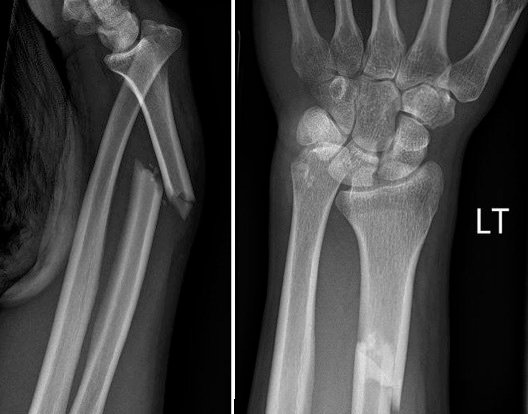
Barton’s Fracture

ByRx Harun

Barton’s Fracture – Causes, Symptoms, Diagnosis, Treatment

Barton’s Fracture /A Barton’s fracture is an intra-articular rim fracture of the distal radius. It can be classified as either dorsal or volar. Dorsal rim fractures are more common and result from forced dorsiflexion and pronation. Volar rim fractures often occur with a fall onto a supinated hand/wrist. These forces disrupt the radiocarpal ligaments and subsequent avulsion fracture of the radial rim. In dorsal fractures, the avulsed fragment migrates dorsally. The opposite is true with volar fractures. These fractures are unstable and often present with a dislocation of the carpal bones. [rx][rx]

A Barton fracture is a compression injury with a marginal shearing fracture of the distal radius. The most common cause of this injury is a fall on an outstretched, pronated wrist. The compressive force travels from the hand and wrist through the articular surface of the radius, resulting in a triangular portion of the distal radius being displaced dorsally along with the carpus. [rx][rx][rx]Multiple stabilizing structures help to maintain the relationship between the radius and the carpal bones, including the extrinsic radiocarpal ligaments, the joint capsule, and the scaphoid and lunate fossa of the radius.

Causes Of Barton Fracture

Barton’s Fracture

  • Sudden forceful  fall down
  • Road traffic accident
  • Falls – Falling onto an outstretched hand is one of the most common causes of broken radial and causes Barton fracture
  • Sports injuries – Many Barton fractures occur during contact sports or sports in which you might fall onto an outstretched hand — such as in-line skating or snowboarding.
  • Motor vehicle crashes – Motor vehicle crashes can cause wrist bones to break, sometimes into many pieces, and often require surgical repair.
  • Have osteoporosis –  a disease that weakens your bones
  • Eave low muscle mass or poor muscle strength – or lack agility and have poor balance (these conditions make you more likely to fall)
  • Walk or do other activities in the snow or on the ice – or do activities that require a lot of forwarding momenta, such as in-line skating and skiing
  • Wave an inadequate intake of calcium or vitamin D
  • Football or soccer, especially on artificial turf
  • Rugby
  • Horseback riding
  • Hockey
  • Skiing
  • Snowboarding
  • In-line skating
  • Jumping on a trampoline

Symptoms Of Barton fracture

Common symptoms of Barton fracture include:

  • Severe pain that might worsen when gripping or squeezing or moving your hand or wrist
  • Swelling
  • Tenderness
  • Bruising
  • Obvious deformity, such as a bent wrist
  • Pain
  • The wrist hanging in a deformed way
  • Pain, especially when flexing the wrist
  • Deformity of the wrist, causing it to look crooked and bent.
  • Your wrist is in great pain.
  • Your wrist, arm, or hand is numb.
  • Your fingers are pale.

Diagnosis of Barton fracture

Plain Radiographs

  • Radiographic imaging is important in diagnosis, classification, treatment, and follow-up assessment of these fractures. The routine minimal evaluation for Barton fracture must include two views-a posteroanterior (PA) view and a lateral view.[rx]
  • The PA view should be obtained with the humerus abducted 90 degrees from the chest wall, so that the elbow is at the same level as the shoulder and flexed 90 degrees.[rx] The palm is maintained flat against the cassette

Computed Tomography

  • CT may be useful and can give significant information in comparison with that obtained with conventional radiography in the evaluation of complex or occult fractures, radial and ulnar shaft articular surface, distal radio-ulnar joint, ventromedial fracture fragment (as described by Melone),[rx] assessments of fracture healing as well as post-surgical evaluation.[rx]
  • CT may be indicated for the confirmation of occult fractures suspected on the basis of physical examination when plain films are normal.

Magnetic Resonance Imaging

  • Although this modality is not the first choice in evaluating acute distal radius fractures, it is a powerful diagnostic tool to assess bony, ligamentous, and soft tissue abnormalities associated with these fractures.
  • MRI has proved to be a very important diagnostic tool for delineating perforation of triangular fibrocartilage complex (TFCC),[rx] perforation of interosseous ligaments of the proximal carpal row, evaluating occult fractures, post-traumatic or avascular necrosis of carpal bones.

Treatment Of Barton fracture

Non-Surgical

Treatment available can be broadly

  • Get medical help immediately – If you fall on an outstretched arm, get into a car accident or are hit while playing a sport and feel intense pain in your shoulder area, then get medical care immediately. Barton fractures cause significant pain in the front part of your shoulder, closer to the base of your neck. You’ll innately know that something is seriously wrong because you won’t be able to lift your arm up. Other symptoms include immediate swelling and/or bruising near the fracture, grinding sounds with arm movements and potential numbness, and tingling in the arm/hand.
  • Apply ice to your fractured area – After you get home from the hospital Barton fracture (regardless if you had surgery or not), you should apply a bag of crushed ice (or something cold) to your injured in order to reduce the swelling and numb the pain. Ice therapy is effective for acute (recent) injuries that involve swelling because it reduces blood flow by constricting local blood vessels. Apply the crushed ice to your clavicle for 15 minutes three to five times daily until the soreness and inflammation eventually fades away
    Lightly exercise after the pain fades – After a couple of weeks when the swelling has subsided and the pain has faded away, remove your arm sling for short periods and carefully move your arm and shoulder in all different directions. Don’t aggravate the Barton fracture so that it hurts, but gently reintroduce movements to the involved joints and muscles. Start cautiously, maybe starting with light calisthenics and then progress to holding light weights (five-pound weights to start). Your distal radius fractures need to move a little bit during the later phases of the injury to stimulate complete recovery.
  • Practice stretching and strengthening exercises – of the fingers, elbow, and shoulder if your doctor recommends them.
  • A splint – which you might use for a few days to a week while the swelling goes down; if a splint is used initially, a cast is usually put on about a week later.
  • A cast – which you might need for six to eight weeks or longer, depending on how bad the break is (you might need a second cast if the first one gets too loose after the swelling goes away.)
  • Get a supportive arm sling – Due to their anatomical position, Barton fracture can’t be cast like a broken limb can. Instead, a supportive arm sling or “figure-eight” splint is typically used for support and comfort, either immediately after the injury if it’s just a hairline fracture or following surgery, if it’s a complicated fracture. Sometimes a larger swath of material is wrapped around the sling to keep it closer to your body. You’ll need to wear the sling constantly until there is no pain with arm movements, which takes between two to four weeks for children or four to eight weeks for adults.
  • Get a referral to physical therapy – Once you’ve recovered and able to remove your arm sling splint for good, you’ll likely notice that the muscles surrounding your shoulder and upper chest look smaller and feel weaker. That’s because muscle tissue atrophies without movement. If this occurs, then you’ll need to get a referral for some physical rehabilitation. Rehab can start once you are cleared by your orthopedist, are pain-free, and can perform all the basic arm and shoulder movements. A physiotherapist or athletic trainer can show you specific rehabilitation exercises and stretches to restore your muscle strength, joint movements, and flexibility
  • Rigid fixation – osteosynthesis with locking plate, hook plate fixation, fixation with radial and styloid process locking plate, coracoclavicular screws, Knowles pin fixation.
  • Flexible fixation – simple k wire fixation, tension band wiring, suture anchors, vinyl tape, dacron arterial graft for styloid process ligament reconstruction.
  • A splint – which you might use for a few days to a week while the swelling goes down; if a splint is used initially, a cast is usually put on about a week later.
  • A cast – which you might need for six to eight weeks or longer, depending on how bad the break is (you might need a second cast if the first one gets too loose after the swelling goes away.)

Rest Your Hand

Once you’re discharged from the hospital in an arm sling, your top priority is to rest your shoulder and not further inflame the injury. Of course, the arm sling not only provides support, but it also restricts movement, which is why you should keep it on even during sleep. Avoiding the temptation to move your shoulder and arm will help the bone mend quicker and the pain fades away sooner.
  • Depending on what you do for a living and if the injury is to your dominant side, you may need to take a couple of weeks off work to recuperate.
  • Healing takes between four to six weeks in younger people and up to 12 weeks in the elderly, but it depends on the severity of the radial and ulnar shaft fractures.
  • Athletes in good health are typically able to resume their sporting activities within two months of breaking they’re ulnar styloid depending on the severity of the break and the specific sport.
  • Sleeping on your back (with the sling on) is necessary to keep the pressure off your shoulder and prevent stressing the styloid process injury.

Eat Nutritiously During Your Recovery

All bones and tissues in the body need certain nutrients in order to heal properly and in a timely manner. Eating a nutritious and balanced diet that includes lots of minerals and vitamins is proven to help heal broken bones of all types, including ulnar styloid. Therefore, focus on eating lots of fresh produce (fruits and veggies), whole grains, lean meats, and fish to give your body the building blocks needed to properly repair your Barton fracture. In addition, drink plenty of purified water, milk, and other dairy-based beverages to augment what you eat.

  • Broken bones need ample minerals (calcium, phosphorus, magnesium, boron) and protein to become strong and healthy again.
  • Excellent sources of minerals/protein include dairy products, tofu, beans, broccoli, nuts and seeds, sardines and salmon.
  • Important vitamins that are needed for bone healing include vitamin C (needed to make collagen), vitamin D (crucial for mineral absorption), and vitamin K (binds calcium to bones and triggers collagen formation).
  • Conversely, don’t consume food or drink that is known to impair bone/tissue healing, such as alcoholic beverages, sodas, most fast food items and foods made with lots of refined sugars and preservatives.

Physical Therapy

  • Although there will be some pain, it is important to maintain arm motion to prevent stiffness. Often, patients will begin doing exercises for elbow motion immediately after the injury.  After a fracture, it is common to lose some shoulder and arm strength. Once the bone begins to heal, your pain will decrease and your doctor may start gentle shoulder exercises. These exercises will help prevent stiffness and weakness. More strenuous exercises will be started gradually once the fracture is completely healed.

Follow-Up Care

  • You will need to see your doctor regularly until your fracture heals. During these visits, he or will take x-rays to make sure the bone is healing in a good position. After the bone has healed, you will be able to gradually return to your normal activities.

Breathing Exercise

  • To elevate breathing problems or remove lung congestion if needed.

Medication

The following key radiographic signs should alert the surgeon that the fracture is unstable and indicate closed reduction will be insufficient:

  • Dorsal comminution greater than 50% of the lateral width of the distal radius,
  • Palmar metaphyseal comminution,
  • Initial dorsal tilt greater than 20 degrees, initial fragment displacement greater than 1 cm,
  • Radial shortening of more than 5 mm,
  • Intra-articular disruption,
  • An associated ulna fracture, and
  • Severe osteoporosis.

Most Barton fractures will be treated with closed reduction and application of external fixation devices, followed by percutaneous pin insertion. However, it should be noted that recent studies have found little difference between conservative management and surgical treatment in the elderly. Those who elect to forgo surgery are treated with reduction and immobilization for at least six weeks. [rx]When electing to treat these patients with either operative or nonoperative therapy, it is essential to include the patient in the management decision, clearly allowing them to establish and understand the pre-management expectations. The choice of treatment must be based on a two-way conversation with the patient that includes the understanding of the limitations of available data on the optimal treatment (surgical versus nonsurgical) and ultimately should rely on a combination of the treating surgeon’s experience and the patient’s preference.

Complications Of Radial Styloid Process Fractures

There were no major complications such as neurovascular injury, infection, or impaired wound healing. Surgery-related complication at 2-year follow-up included nonunion in 3 patients (11%),

  • DRUJ subluxation in 3 patients (11%),
  • Implant migration in 4 patients (14%),
  • Radiographic resorption of the ulnar styloid in 4 patients (14%).
  • Radiographic nonunion was noted in 1 patient in group A (8%) and 2 in group B (13%). Residual DRUJ subluxation was noted in 3 patients; all were in group B (20%).
  • Partial or complete radiographic resorption of the ulna was found in 1 patient in group A (8%) and 3 in group B (20%).
  • Implant migration was noted in 1 patient in group A (8%), and 2 in group B (13%).
  • Subsequent removal surgery due to implant irritation occurred in 13 patients (46%), with 4 in group A (31%) and 8 in group B (53%).
  • A total of 11 patients (39%) with surgery-related complications included 5 (38%) in group A and 12 (80%) in group B, with a significant difference

There are risks associated with any type of surgery. These include

  • Nonunion (1-5%)
  • Infection (~4.8%)
  • 4% in the surgical group develop adhesive capsulitis requiring surgical intervention
  • Bleeding
  • Problems with wound healing
  • Blood clots
  • Damage to blood vessels or nerves
  • Reaction to anesthesia
  • Hardware prominence
  • Malunion with cosmetic deformity
  • Restriction of ROM
  • The difficulty with bone healing
  • Hardware irritation
  • Fracture comminution (Z deformity)
  • Fracture displacement
  • Increased fatigue with overhead activities
  • Dissatisfaction with appearance
  • The difficulty with shoulder straps, backpacks and the like
  • ~30% of patient request plate removal
  • Superior plates associated with increased irritation
  • Superior plates associated with increased risk of subclavian artery or vein penetration

References

Barton’s Fracture

ByRx Harun

Lunate Fossa And Distal Radius Fractures

Lunate Fossa And Distal Radius Fractures/A die punch fracture is an intra-articular fracture involving the lunate facet of the radius. The lunate facet is one of the three articular surfaces of the distal radius. It lies between the ulnar articulation and the scaphoid facet. It connects the distal radius to the lunate bone in the wrist. A die-punch fracture occurs with axial loading of the lunate, which causes an impaction fracture to the lunate facet of the radius. This fracture often occurs in isolation but can have associated injuries.

Die-punch fractures result from an axial loading force on the distal radius. It is an intra-articular fracture of the lunate fossa of the distal radius. It is by definition depressed or impacted and is named after the machining technique of shearing a shape, depression, or hole in a material with a die implement or cutter used in the tool-and-die trade (Figure 1). The die-punch mechanism classically involves the lunate fossa of the radius but can occur from any loading injury.

Causes Of Lunate Fossa And Distal Radius Fractures

Lunate Fossa And Distal Radius Fractures

  • Sudden forceful  fall down
  • Road traffic accident
  • Falls – Falling onto an outstretched hand is one of the most common causes of broken or causes Die-Punch Fracture.
  • Sports injuries – Many radials styloid fractures/Die-Punch Fracture occur during contact sports or sports in which you might fall onto an outstretched hand — such as in-line skating or snowboarding.
  • Motor vehicle crashes – Motor vehicle crashes can cause wrist bones to break, sometimes into many pieces, and often require surgical repair.
  • Have osteoporosis –  a disease that weakens your bones
  • Have low muscle mass or poor muscle strength – or lack agility and have poor balance (these conditions make you more likely to fall)
  • Walk or do other activities in the snow or on the ice – or do activities that require a lot of forwarding momenta, such as in-line skating and skiing
  • Wave an inadequate intake of calcium or vitamin D
  • Football or soccer, especially on artificial turf
  • Rugby
  • Horseback riding
  • Hockey
  • Skiing
  • Snowboarding
  • In-line skating
  • Jumping on a trampoline

Symptoms Of Die-Punch Fracture

Common symptoms of radial styloid fractures/Die-Punch Fracture include:

  • Severe pain that might worsen when gripping or squeezing or moving your hand or wrist
  • Swelling
  • Tenderness
  • Bruising
  • Obvious deformity, such as a bent wrist
  • Pain
  • The wrist hanging in a deformed way
  • Pain, especially when flexing the wrist
  • Deformity of the wrist, causing it to look crooked and bent.
  • Your wrist is in great pain.
  • Your wrist, arm, or hand is numb.
  • Your fingers are pale.

Diagnosis of Die-Punch Fracture

Plain Radiographs

  • Radiographic imaging is important in diagnosis, classification, treatment, and follow-up assessment of these fractures. The routine minimal evaluation for radial styloid fractures/Die-Punch Fracture must include two views-a posteroanterior (PA) view and a lateral view.[rx]
  • The PA view should be obtained with the humerus abducted 90 degrees from the chest wall, so that the elbow is at the same level as the shoulder and flexed 90 degrees.[rx] The palm is maintained flat against the cassette

Computed Tomography

  • CT may be useful and can give significant information in comparison with that obtained with conventional radiography in the evaluation of complex or occult fractures, radial and ulnar shaft articular surface, distal radio-ulnar joint, ventromedial fracture fragment (as described by Melone),[rx] assessments of fracture healing as well as post-surgical evaluation.[rx]
  • CT may be indicated for the confirmation of occult fractures suspected on the basis of physical examination when plain films are normal./

Magnetic Resonance Imaging

  • Although this modality is not the first choice in evaluating acute distal radius fractures/Die-Punch Fracture, it is a powerful diagnostic tool to assess bony, ligamentous, and soft tissue abnormalities associated with these fractures.
  • MRI has proved to be a very important diagnostic tool for delineating perforation of triangular fibrocartilage complex (TFCC),[rx] perforation of interosseous ligaments of the proximal carpal row, evaluating occult fractures, post-traumatic or avascular necrosis of carpal bones.

Treatment Of Die-Punch Fracture

Non-Surgical

Treatment available can be broadly

  • Get medical help immediately – If you fall on an outstretched arm, get into a car accident or are hit while playing a sport and feel intense pain in your shoulder area, then get medical care immediately. Radial styloid process fractures cause significant pain in the front part of your hand, closer to the base of your neck. You’ll innately know that something is seriously wrong because you won’t be able to lift your arm up. Other symptoms include immediate swelling and/or bruising near the fracture, grinding sounds with arm movements and potential numbness, and tingling in the arm/hand.
  • Apply ice to your fractured area – After you get home from the hospital radial and styloid/Die-Punch Fracture process fractures (regardless if you had surgery or not), you should apply a bag of crushed ice (or something cold) to your injured in order to reduce the swelling and numb the pain. Ice therapy is effective for acute (recent) injuries that involve swelling because it reduces blood flow by constricting local blood vessels. Apply the crushed ice to your clavicle for 15 minutes three to five times daily until the soreness and inflammation eventually fades away
    Lightly exercise after the pain fades – After a couple of weeks when the swelling has subsided and the pain has faded away, remove your arm sling for short periods and carefully move your arm and shoulder in all different directions. Don’t aggravate the radial and styloid process fractures so that it hurts, but gently reintroduce movements to the involved joints and muscles. Start cautiously, maybe starting with light calisthenics and then progress to holding light weights (five-pound weights to start). Your distal radius fractures need to move a little bit during the later phases of the injury to stimulate complete recovery.
  • Practice stretching and strengthening exercises – of the fingers, elbow, and shoulder if your doctor recommends them.
  • A splint – which you might use for a few days to a week while the swelling goes down; if a splint is used initially, a cast is usually put on about a week later.
  • A cast – which you might need for six to eight weeks or longer, depending on how bad the break is (you might need a second cast if the first one gets too loose after the swelling goes away.)
  • Get a supportive arm sling – Due to their anatomical position, distal radius fractures can’t be cast like a broken limb can. Instead, a supportive arm sling or “figure-eight” splint is typically used for support and comfort, either immediately after the injury if it’s just a hairline fracture or following surgery, if it’s a complicated fracture. Sometimes a larger swath of material is wrapped around the sling to keep it closer to your body. You’ll need to wear the sling constantly until there is no pain with arm movements, which takes between two to four weeks for children or four to eight weeks for adults.
  • Get a referral to physical therapy – Once you’ve recovered and able to remove your arm sling splint for good, you’ll likely notice that the muscles surrounding your shoulder and upper chest look smaller and feel weaker. That’s because muscle tissue atrophies without movement. If this occurs, then you’ll need to get a referral for some physical rehabilitation. Rehab can start once you are cleared by your orthopedist, are pain-free, and can perform all the basic arm and shoulder movements. A physiotherapist or athletic trainer can show you specific rehabilitation exercises and stretches to restore your muscle strength, joint movements, and flexibility
  • Rigid fixation – osteosynthesis with locking plate, hook plate fixation, fixation with radial and styloid process locking plate, coracoclavicular screws, Knowles pin fixation.
  • Flexible fixation – simple k wire fixation, tension band wiring, suture anchors, vinyl tape, dacron arterial graft for styloid process ligament reconstruction.
  • A splint – which you might use for a few days to a week while the swelling goes down; if a splint is used initially, a cast is usually put on about a week later.
  • A cast – which you might need for six to eight weeks or longer, depending on how bad the break is (you might need a second cast if the first one gets too loose after the swelling goes away.)

Rest Your Hand

Once you’re discharged from the hospital in an arm sling, your top priority is to rest your shoulder and not further inflame the injury. Of course, the arm sling not only provides support, but it also restricts movement, which is why you should keep it on even during sleep. Avoiding the temptation to move your shoulder and arm will help the bone mend quicker and the pain fades away sooner.
  • Depending on what you do for a living and if the injury is to your dominant side, you may need to take a couple of weeks off work to recuperate.
  • Healing takes between four to six weeks in younger people and up to 12 weeks in the elderly, but it depends on the severity of the radial and ulnar shaft fractures.
  • Athletes in good health are typically able to resume their sporting activities within two months of breaking they’re ulnar styloid depending on the severity of the break and the specific sport.
  • Sleeping on your back (with the sling on) is necessary to keep the pressure off your shoulder and prevent stressing the styloid process injury.

Eat Nutritiously During Your Recovery

All bones and tissues in the body need certain nutrients in order to heal properly and in a timely manner. Eating a nutritious and balanced diet that includes lots of minerals and vitamins is proven to help heal broken bones of all types, including ulnar styloid. Therefore, focus on eating lots of fresh produce (fruits and veggies), whole grains, lean meats, and fish to give your body the building blocks needed to properly repair your radial and ulnar shaft fractures. In addition, drink plenty of purified water, milk, and other dairy-based beverages to augment what you eat.

  • Broken bones need ample minerals (calcium, phosphorus, magnesium, boron) and protein to become strong and healthy again.
  • Excellent sources of minerals/protein include dairy products, tofu, beans, broccoli, nuts and seeds, sardines and salmon.
  • Important vitamins that are needed for bone healing include vitamin C (needed to make collagen), vitamin D (crucial for mineral absorption), and vitamin K (binds calcium to bones and triggers collagen formation).
  • Conversely, don’t consume food or drink that is known to impair bone/tissue healing, such as alcoholic beverages, sodas, most fast food items and foods made with lots of refined sugars and preservatives.

Physical Therapy

  • Although there will be some pain, it is important to maintain arm motion to prevent stiffness. Often, patients will begin doing exercises for elbow motion immediately after the injury.  After a radial and ulnar shaft fractures, it is common to lose some shoulder and arm strength. Once the bone begins to heal, your pain will decrease and your doctor may start gentle shoulder exercises. These exercises will help prevent stiffness and weakness. More strenuous exercises will be started gradually once the fracture is completely healed.

Follow-Up Care

  • You will need to see your doctor regularly until your fracture heals. During these visits, he or will take x-rays to make sure the bone is healing in a good position. After the bone has healed, you will be able to gradually return to your normal activities.

Breathing Exercise

  • To elevate breathing problems or remove lung congestion if needed.

Medication

Complications Of Die-Punch Fracture

There were no major complications such as neurovascular injury, infection, or impaired wound healing. Surgery-related complication at 2-year follow-up included nonunion in 3 patients (11%),

  • DRUJ subluxation in 3 patients (11%),
  • Implant migration in 4 patients (14%),
  • Radiographic resorption of the ulnar styloid in 4 patients (14%).
  • Radiographic nonunion was noted in 1 patient in group A (8%) and 2 in group B (13%). Residual DRUJ subluxation was noted in 3 patients; all were in group B (20%).
  • Partial or complete radiographic resorption of the ulna was found in 1 patient in group A (8%) and 3 in group B (20%).
  • Implant migration was noted in 1 patient in group A (8%), and 2 in group B (13%).
  • Subsequent removal surgery due to implant irritation occurred in 13 patients (46%), with 4 in group A (31%) and 8 in group B (53%).
  • A total of 11 patients (39%) with surgery-related complications included 5 (38%) in group A and 12 (80%) in group B, with a significant difference

There are risks associated with any type of surgery. These include

  • Nonunion (1-5%)
  • Infection (~4.8%)
  • 4% in the surgical group develop adhesive capsulitis requiring surgical intervention
  • Bleeding
  • Problems with wound healing
  • Blood clots
  • Damage to blood vessels or nerves
  • Reaction to anesthesia
  • Hardware prominence
  • Malunion with cosmetic deformity
  • Restriction of ROM
  • The difficulty with bone healing
  • Hardware irritation
  • Fracture comminution (Z deformity)
  • Fracture displacement
  • Increased fatigue with overhead activities
  • Dissatisfaction with appearance
  • The difficulty with shoulder straps, backpacks and the like
  • ~30% of patient request plate removal
  • Superior plates associated with increased irritation
  • Superior plates associated with increased risk of subclavian artery or vein penetration

References

Lunate Fossa And Distal Radius Fractures

ByRx Harun

Die-Punch Fracture – Causes, Symptoms, Treatment

Die-Punch Fracture /A die punch fracture is an intra-articular fracture involving the lunate facet of the radius. The lunate facet is one of the three articular surfaces of the distal radius. It lies between the ulnar articulation and the scaphoid facet. It connects the distal radius to the lunate bone in the wrist. A die-punch fracture occurs with axial loading of the lunate, which causes an impaction fracture to the lunate facet of the radius. This fracture often occurs in isolation but can have associated injuries.

Die-punch fractures result from an axial loading force on the distal radius. It is an intra-articular fracture of the lunate fossa of the distal radius. It is by definition depressed or impacted and is named after the machining technique of shearing a shape, depression, or hole in a material with a die implement or cutter used in the tool-and-die trade (Figure 1). The die-punch mechanism classically involves the lunate fossa of the radius but can occur from any loading injury.

Causes Of Die-Punch Fracture

Die-Punch Fracture

  • Sudden forceful  fall down
  • Road traffic accident
  • Falls – Falling onto an outstretched hand is one of the most common causes of broken or causes Die-Punch Fracture.
  • Sports injuries – Many radials styloid fractures/Die-Punch Fracture occur during contact sports or sports in which you might fall onto an outstretched hand — such as in-line skating or snowboarding.
  • Motor vehicle crashes – Motor vehicle crashes can cause wrist bones to break, sometimes into many pieces, and often require surgical repair.
  • Have osteoporosis –  a disease that weakens your bones
  • Have low muscle mass or poor muscle strength – or lack agility and have poor balance (these conditions make you more likely to fall)
  • Walk or do other activities in the snow or on the ice – or do activities that require a lot of forwarding momenta, such as in-line skating and skiing
  • Wave an inadequate intake of calcium or vitamin D
  • Football or soccer, especially on artificial turf
  • Rugby
  • Horseback riding
  • Hockey
  • Skiing
  • Snowboarding
  • In-line skating
  • Jumping on a trampoline

Symptoms Of Die-Punch Fracture

Common symptoms of radial styloid fractures/Die-Punch Fracture include:

  • Severe pain that might worsen when gripping or squeezing or moving your hand or wrist
  • Swelling
  • Tenderness
  • Bruising
  • Obvious deformity, such as a bent wrist
  • Pain
  • The wrist hanging in a deformed way
  • Pain, especially when flexing the wrist
  • Deformity of the wrist, causing it to look crooked and bent.
  • Your wrist is in great pain.
  • Your wrist, arm, or hand is numb.
  • Your fingers are pale.

Diagnosis of Die-Punch Fracture

Plain Radiographs

  • Radiographic imaging is important in diagnosis, classification, treatment, and follow-up assessment of these fractures. The routine minimal evaluation for radial styloid fractures/Die-Punch Fracture must include two views-a posteroanterior (PA) view and a lateral view.[rx]
  • The PA view should be obtained with the humerus abducted 90 degrees from the chest wall, so that the elbow is at the same level as the shoulder and flexed 90 degrees.[rx] The palm is maintained flat against the cassette

Computed Tomography

  • CT may be useful and can give significant information in comparison with that obtained with conventional radiography in the evaluation of complex or occult fractures, radial and ulnar shaft articular surface, distal radio-ulnar joint, ventromedial fracture fragment (as described by Melone),[rx] assessments of fracture healing as well as post-surgical evaluation.[rx]
  • CT may be indicated for the confirmation of occult fractures suspected on the basis of physical examination when plain films are normal./

Magnetic Resonance Imaging

  • Although this modality is not the first choice in evaluating acute distal radius fractures/Die-Punch Fracture, it is a powerful diagnostic tool to assess bony, ligamentous, and soft tissue abnormalities associated with these fractures.
  • MRI has proved to be a very important diagnostic tool for delineating perforation of triangular fibrocartilage complex (TFCC),[rx] perforation of interosseous ligaments of the proximal carpal row, evaluating occult fractures, post-traumatic or avascular necrosis of carpal bones.

Treatment Of Die-Punch Fracture

Non-Surgical

Treatment available can be broadly

  • Get medical help immediately – If you fall on an outstretched arm, get into a car accident or are hit while playing a sport and feel intense pain in your shoulder area, then get medical care immediately. Radial styloid process fractures cause significant pain in the front part of your hand, closer to the base of your neck. You’ll innately know that something is seriously wrong because you won’t be able to lift your arm up. Other symptoms include immediate swelling and/or bruising near the fracture, grinding sounds with arm movements and potential numbness, and tingling in the arm/hand.
  • Apply ice to your fractured area – After you get home from the hospital radial and styloid/Die-Punch Fracture process fractures (regardless if you had surgery or not), you should apply a bag of crushed ice (or something cold) to your injured in order to reduce the swelling and numb the pain. Ice therapy is effective for acute (recent) injuries that involve swelling because it reduces blood flow by constricting local blood vessels. Apply the crushed ice to your clavicle for 15 minutes three to five times daily until the soreness and inflammation eventually fades away
    Lightly exercise after the pain fades – After a couple of weeks when the swelling has subsided and the pain has faded away, remove your arm sling for short periods and carefully move your arm and shoulder in all different directions. Don’t aggravate the radial and styloid process fractures so that it hurts, but gently reintroduce movements to the involved joints and muscles. Start cautiously, maybe starting with light calisthenics and then progress to holding light weights (five-pound weights to start). Your distal radius fractures need to move a little bit during the later phases of the injury to stimulate complete recovery.
  • Practice stretching and strengthening exercises – of the fingers, elbow, and shoulder if your doctor recommends them.
  • A splint – which you might use for a few days to a week while the swelling goes down; if a splint is used initially, a cast is usually put on about a week later.
  • A cast – which you might need for six to eight weeks or longer, depending on how bad the break is (you might need a second cast if the first one gets too loose after the swelling goes away.)
  • Get a supportive arm sling – Due to their anatomical position, distal radius fractures can’t be cast like a broken limb can. Instead, a supportive arm sling or “figure-eight” splint is typically used for support and comfort, either immediately after the injury if it’s just a hairline fracture or following surgery, if it’s a complicated fracture. Sometimes a larger swath of material is wrapped around the sling to keep it closer to your body. You’ll need to wear the sling constantly until there is no pain with arm movements, which takes between two to four weeks for children or four to eight weeks for adults.
  • Get a referral to physical therapy – Once you’ve recovered and able to remove your arm sling splint for good, you’ll likely notice that the muscles surrounding your shoulder and upper chest look smaller and feel weaker. That’s because muscle tissue atrophies without movement. If this occurs, then you’ll need to get a referral for some physical rehabilitation. Rehab can start once you are cleared by your orthopedist, are pain-free, and can perform all the basic arm and shoulder movements. A physiotherapist or athletic trainer can show you specific rehabilitation exercises and stretches to restore your muscle strength, joint movements, and flexibility
  • Rigid fixation – osteosynthesis with locking plate, hook plate fixation, fixation with radial and styloid process locking plate, coracoclavicular screws, Knowles pin fixation.
  • Flexible fixation – simple k wire fixation, tension band wiring, suture anchors, vinyl tape, dacron arterial graft for styloid process ligament reconstruction.
  • A splint – which you might use for a few days to a week while the swelling goes down; if a splint is used initially, a cast is usually put on about a week later.
  • A cast – which you might need for six to eight weeks or longer, depending on how bad the break is (you might need a second cast if the first one gets too loose after the swelling goes away.)

Rest Your Hand

Once you’re discharged from the hospital in an arm sling, your top priority is to rest your shoulder and not further inflame the injury. Of course, the arm sling not only provides support, but it also restricts movement, which is why you should keep it on even during sleep. Avoiding the temptation to move your shoulder and arm will help the bone mend quicker and the pain fades away sooner.
  • Depending on what you do for a living and if the injury is to your dominant side, you may need to take a couple of weeks off work to recuperate.
  • Healing takes between four to six weeks in younger people and up to 12 weeks in the elderly, but it depends on the severity of the radial and ulnar shaft fractures.
  • Athletes in good health are typically able to resume their sporting activities within two months of breaking they’re ulnar styloid depending on the severity of the break and the specific sport.
  • Sleeping on your back (with the sling on) is necessary to keep the pressure off your shoulder and prevent stressing the styloid process injury.

Eat Nutritiously During Your Recovery

All bones and tissues in the body need certain nutrients in order to heal properly and in a timely manner. Eating a nutritious and balanced diet that includes lots of minerals and vitamins is proven to help heal broken bones of all types, including ulnar styloid. Therefore, focus on eating lots of fresh produce (fruits and veggies), whole grains, lean meats, and fish to give your body the building blocks needed to properly repair your radial and ulnar shaft fractures. In addition, drink plenty of purified water, milk, and other dairy-based beverages to augment what you eat.

  • Broken bones need ample minerals (calcium, phosphorus, magnesium, boron) and protein to become strong and healthy again.
  • Excellent sources of minerals/protein include dairy products, tofu, beans, broccoli, nuts and seeds, sardines and salmon.
  • Important vitamins that are needed for bone healing include vitamin C (needed to make collagen), vitamin D (crucial for mineral absorption), and vitamin K (binds calcium to bones and triggers collagen formation).
  • Conversely, don’t consume food or drink that is known to impair bone/tissue healing, such as alcoholic beverages, sodas, most fast food items and foods made with lots of refined sugars and preservatives.

Physical Therapy

  • Although there will be some pain, it is important to maintain arm motion to prevent stiffness. Often, patients will begin doing exercises for elbow motion immediately after the injury.  After a radial and ulnar shaft fractures, it is common to lose some shoulder and arm strength. Once the bone begins to heal, your pain will decrease and your doctor may start gentle shoulder exercises. These exercises will help prevent stiffness and weakness. More strenuous exercises will be started gradually once the fracture is completely healed.

Follow-Up Care

  • You will need to see your doctor regularly until your fracture heals. During these visits, he or will take x-rays to make sure the bone is healing in a good position. After the bone has healed, you will be able to gradually return to your normal activities.

Breathing Exercise

  • To elevate breathing problems or remove lung congestion if needed.

Medication

Complications Of Die-Punch Fracture

There were no major complications such as neurovascular injury, infection, or impaired wound healing. Surgery-related complication at 2-year follow-up included nonunion in 3 patients (11%),

  • DRUJ subluxation in 3 patients (11%),
  • Implant migration in 4 patients (14%),
  • Radiographic resorption of the ulnar styloid in 4 patients (14%).
  • Radiographic nonunion was noted in 1 patient in group A (8%) and 2 in group B (13%). Residual DRUJ subluxation was noted in 3 patients; all were in group B (20%).
  • Partial or complete radiographic resorption of the ulna was found in 1 patient in group A (8%) and 3 in group B (20%).
  • Implant migration was noted in 1 patient in group A (8%), and 2 in group B (13%).
  • Subsequent removal surgery due to implant irritation occurred in 13 patients (46%), with 4 in group A (31%) and 8 in group B (53%).
  • A total of 11 patients (39%) with surgery-related complications included 5 (38%) in group A and 12 (80%) in group B, with a significant difference

There are risks associated with any type of surgery. These include

  • Nonunion (1-5%)
  • Infection (~4.8%)
  • 4% in the surgical group develop adhesive capsulitis requiring surgical intervention
  • Bleeding
  • Problems with wound healing
  • Blood clots
  • Damage to blood vessels or nerves
  • Reaction to anesthesia
  • Hardware prominence
  • Malunion with cosmetic deformity
  • Restriction of ROM
  • The difficulty with bone healing
  • Hardware irritation
  • Fracture comminution (Z deformity)
  • Fracture displacement
  • Increased fatigue with overhead activities
  • Dissatisfaction with appearance
  • The difficulty with shoulder straps, backpacks and the like
  • ~30% of patient request plate removal
  • Superior plates associated with increased irritation
  • Superior plates associated with increased risk of subclavian artery or vein penetration

References

Die-Punch Fracture

ByRx Harun

Radial Styloid Process Fractures – Symptoms, Treatment

Radial Styloid Process Fractures/Chauffeur’s Fracture, also known as Hutchinson fracture, is a type of fracture of the forearm, specifically the radial styloid process. The injury is typically caused by compression of the scaphoid bone of the hand against the styloid process of the distal radius. It can be caused by falling onto an outstretched hand. Treatment is often open reduction and internal fixation, which is a surgical realignment of the bone fragments and fixation with pins, screws, or plates.

Radial styloid fractures can occur in isolation or in association with other injuries, including complex intra-articular distal radius fractures, carpal fractures, carpal dislocations, and radiocarpal dislocations. The anatomy surrounding the radial styloid is complex, and complications related to the surgical approach, treatments, and symptomatic hardware can occur. Operative treatments vary according to the injury pattern present, and pattern recognition is the key to optimizing the treatment of these injuries. Outcomes are related to the precision of the reconstruction as well as the magnitude of the injury; better results are associated with lower-energy patterns.

Causes Of Radial Styloid Process Fractures

Radial Styloid Process Fractures

  • Sudden forceful  fall down
  • Road traffic accident
  • Falls – Falling onto an outstretched hand is one of the most common causes of broken radial styloid fractures.
  • Sports injuries – Many radials styloid fractures occur during contact sports or sports in which you might fall onto an outstretched hand — such as in-line skating or snowboarding.
  • Motor vehicle crashes – Motor vehicle crashes can cause wrist bones to break, sometimes into many pieces, and often require surgical repair.
  • Have osteoporosis –  a disease that weakens your bones
  • Eave low muscle mass or poor muscle strength – or lack agility and have poor balance (these conditions make you more likely to fall)
  • Walk or do other activities in the snow or on the ice – or do activities that require a lot of forwarding momenta, such as in-line skating and skiing
  • Wave an inadequate intake of calcium or vitamin D
  • Football or soccer, especially on artificial turf
  • Rugby
  • Horseback riding
  • Hockey
  • Skiing
  • Snowboarding
  • In-line skating
  • Jumping on a trampoline

Symptoms Of Radial Styloid Process Fractures

Common symptoms of radial styloid fractures include:

  • Severe pain that might worsen when gripping or squeezing or moving your hand or wrist
  • Swelling
  • Tenderness
  • Bruising
  • Obvious deformity, such as a bent wrist
  • Pain
  • The wrist hanging in a deformed way
  • Pain, especially when flexing the wrist
  • Deformity of the wrist, causing it to look crooked and bent.
  • Your wrist is in great pain.
  • Your wrist, arm, or hand is numb.
  • Your fingers are pale.

Diagnosis of Radial Styloid Process Fractures

Plain Radiographs

  • Radiographic imaging is important in diagnosis, classification, treatment, and follow-up assessment of these fractures. The routine minimal evaluation for radial styloid fractures must include two views-a posteroanterior (PA) view and a lateral view.[rx]
  • The PA view should be obtained with the humerus abducted 90 degrees from the chest wall, so that the elbow is at the same level as the shoulder and flexed 90 degrees.[rx] The palm is maintained flat against the cassette

Computed Tomography

  • CT may be useful and can give significant information in comparison with that obtained with conventional radiography in the evaluation of complex or occult fractures, radial and ulnar shaft articular surface, distal radio-ulnar joint, ventromedial fracture fragment (as described by Melone),[rx] assessments of fracture healing as well as post-surgical evaluation.[rx]
  • CT may be indicated for the confirmation of occult fractures suspected on the basis of physical examination when plain films are normal.

Magnetic Resonance Imaging

  • Although this modality is not the first choice in evaluating acute distal radius fractures, it is a powerful diagnostic tool to assess bony, ligamentous, and soft tissue abnormalities associated with these fractures.
  • MRI has proved to be a very important diagnostic tool for delineating perforation of triangular fibrocartilage complex (TFCC),[rx] perforation of interosseous ligaments of the proximal carpal row, evaluating occult fractures, post-traumatic or avascular necrosis of carpal bones.

Treatment Of Radial Styloid Process Fractures

Non-Surgical

Treatment available can be broadly

  • Get medical help immediately – If you fall on an outstretched arm, get into a car accident or are hit while playing a sport and feel intense pain in your shoulder area, then get medical care immediately. You’ll innately know that something is seriously wrong because you won’t be able to lift your arm up. Other symptoms include immediate swelling and/or bruising near the fracture, grinding sounds with arm movements and potential numbness, and tingling in the arm/hand.
  • Apply ice to your fractured area – After you get home from the hospital radial and styloid process fractures (regardless if you had surgery or not), you should apply a bag of crushed ice (or something cold) to your injured in order to reduce the swelling and numb the pain. Ice therapy is effective for acute (recent) injuries that involve swelling because it reduces blood flow by constricting local blood vessels. Apply the crushed ice to your clavicle for 15 minutes three to five times daily until the soreness and inflammation eventually fades away
    Lightly exercise after the pain fades – After a couple of weeks when the swelling has subsided and the pain has faded away, remove your arm sling for short periods and carefully move your arm and shoulder in all different directions. Don’t aggravate the radial and styloid process fractures so that it hurts, but gently reintroduce movements to the involved joints and muscles. Start cautiously, maybe starting with light calisthenics and then progress to holding light weights (five-pound weights to start). Your distal radius fractures need to move a little bit during the later phases of the injury to stimulate complete recovery.
  • Practice stretching and strengthening exercises – of the fingers, elbow, and shoulder if your doctor recommends them.
  • A splint – which you might use for a few days to a week while the swelling goes down; if a splint is used initially, a cast is usually put on about a week later.
  • A cast – which you might need for six to eight weeks or longer, depending on how bad the break is (you might need a second cast if the first one gets too loose after the swelling goes away.)
  • Get a supportive arm sling – Due to their anatomical position, distal radius fractures can’t be cast like a broken limb can. Instead, a supportive arm sling or “figure-eight” splint is typically used for support and comfort, either immediately after the injury if it’s just a hairline fracture or following surgery, if it’s a complicated fracture. Sometimes a larger swath of material is wrapped around the sling to keep it closer to your body. You’ll need to wear the sling constantly until there is no pain with arm movements, which takes between two to four weeks for children or four to eight weeks for adults.
  • Get a referral to physical therapy – Once you’ve recovered and able to remove your arm sling splint for good, you’ll likely notice that the muscles surrounding your shoulder and upper chest look smaller and feel weaker. That’s because muscle tissue atrophies without movement. If this occurs, then you’ll need to get a referral for some physical rehabilitation. Rehab can start once you are cleared by your orthopedist, are pain-free, and can perform all the basic arm and shoulder movements. A physiotherapist or athletic trainer can show you specific rehabilitation exercises and stretches to restore your muscle strength, joint movements, and flexibility
  • Rigid fixation – osteosynthesis with locking plate, hook plate fixation, fixation with radial and styloid process locking plate, coracoclavicular screws, Knowles pin fixation.
  • Flexible fixation – simple k wire fixation, tension band wiring, suture anchors, vinyl tape, dacron arterial graft for styloid process ligament reconstruction.
  • A splint – which you might use for a few days to a week while the swelling goes down; if a splint is used initially, a cast is usually put on about a week later.
  • A cast – which you might need for six to eight weeks or longer, depending on how bad the break is (you might need a second cast if the first one gets too loose after the swelling goes away.)

Rest Your Hand

Once you’re discharged from the hospital in an arm sling, your top priority is to rest your shoulder and not further inflame the injury. Of course, the arm sling not only provides support, but it also restricts movement, which is why you should keep it on even during sleep. Avoiding the temptation to move your shoulder and arm will help the bone mend quicker and the pain fades away sooner.
  • Depending on what you do for a living and if the injury is to your dominant side, you may need to take a couple of weeks off work to recuperate.
  • Healing takes between four to six weeks in younger people and up to 12 weeks in the elderly, but it depends on the severity of the radial and ulnar shaft fractures.
  • Athletes in good health are typically able to resume their sporting activities within two months of breaking they’re ulnar styloid depending on the severity of the break and the specific sport.
  • Sleeping on your back (with the sling on) is necessary to keep the pressure off your shoulder and prevent stressing the styloid process injury.

Eat Nutritiously During Your Recovery

All bones and tissues in the body need certain nutrients in order to heal properly and in a timely manner. Eating a nutritious and balanced diet that includes lots of minerals and vitamins is proven to help heal broken bones of all types, including ulnar styloid. Therefore, focus on eating lots of fresh produce (fruits and veggies), whole grains, lean meats, and fish to give your body the building blocks needed to properly repair your radial and ulnar shaft fractures. In addition, drink plenty of purified water, milk, and other dairy-based beverages to augment what you eat.

  • Broken bones need ample minerals (calcium, phosphorus, magnesium, boron) and protein to become strong and healthy again.
  • Excellent sources of minerals/protein include dairy products, tofu, beans, broccoli, nuts and seeds, sardines and salmon.
  • Important vitamins that are needed for bone healing include vitamin C (needed to make collagen), vitamin D (crucial for mineral absorption), and vitamin K (binds calcium to bones and triggers collagen formation).
  • Conversely, don’t consume food or drink that is known to impair bone/tissue healing, such as alcoholic beverages, sodas, most fast food items and foods made with lots of refined sugars and preservatives.

Physical Therapy

  • Although there will be some pain, it is important to maintain arm motion to prevent stiffness. Often, patients will begin doing exercises for elbow motion immediately after the injury.  After a radial and ulnar shaft fractures, it is common to lose some shoulder and arm strength. Once the bone begins to heal, your pain will decrease and your doctor may start gentle shoulder exercises. These exercises will help prevent stiffness and weakness. More strenuous exercises will be started gradually once the fracture is completely healed.

Follow-Up Care

  • You will need to see your doctor regularly until your fracture heals. During these visits, he or will take x-rays to make sure the bone is healing in a good position. After the bone has healed, you will be able to gradually return to your normal activities.

Breathing Exercise

  • To elevate breathing problems or remove lung congestion if needed.

Medication

Surgical Treatment

Surgical Fixation: fixation of radial styloid begins at the tip, which is best approached via a small incision along the margin of 1st dorsal compartment (APL, EPB); although K wire or cannulated lag screw fixation can be achieved percutaneously, it is advisable to make small incision; remember that the radial styloid lies slightly volar to the mid axis of the radius, and therefore the wire should be directed slightly dorsally as well as clearly and proximally; the reduction is secured w/ either K wire or lag screw;

3 indications formal ORIF; 

Rotational displacement in axial or coronal plane may prove difficult to overcome, or hematomas may interfere w/ reduction; interposed tissue (FCR, or rarely wrist extensors); metaphyseal defect after reduction which requires bone grafting; use of either a small drill guide or tissue protector to protect dorsal sensory radial nerve;

Evaluation of reduction:

the articular reduction is best evaluated by radiocarpal arthrotomy between second & fourth dorsal compartments, just distal to Lister’s tubercle; when bone grafting is necessary, placement is usually required in the area between the first and second dorsal compartments; K wire fixation devices should pass perpendicular to the fracture site, enter the tip of the radial styloid, and exit proximal to distal RU joint; stabilization of styloid w/ K wires alone is hazardous, because medial, single cortex fixation is often insufficient to prevent replacement; as an alternative, two cancellous screws (4.0 mm cancellous) or  3.5 mm cortex screws or 3.5 mm cannulated screws; buttress plate is more reliable (2.7 mm condylar plate)

Rehabilitation Guideline For Non-Operative/Conservative Rehabilitation [Rx]

Acute Stage (0-8 weeks)

Goals

  • Protection with short-arm cast
  • Control pain and edema
  • Maintain range in digits, elbows, shoulder

Interventions

  • AROM and PROM of digits, elbow, shoulder
  • Elevation of hand and digits to control edema
  • Cast removal between 6-8 weeks

Sub Acute Stage

Goal

  • Control pain and edema (TENS, ice)
  • Increase ROM
  • Increase activities of daily living (ADLs)

Interventions

  • AROM and PROM of digits, elbow, shoulder
  • AROM wrist flexion/ extension, forearm supination/ pronation
  • PROM of low load and prolonged stretch

Settled Stage

Goals

  • Regain full ROM
  • Begin strengthening
  • Return to activity

Interventions

  • Continue all ROM exercises
  • Progress to the strengthening of all joints[rx]

Rehabilitation Guideline For External Fixation

Acute Stage (1-6 weeks)

Goals

  • Control pain and edema (TENS, ice)
  • Protect surgical site
  • Maintain ROM of digits, elbow, shoulder

Interventions

  • Elevation
  • AROM of digits, elbow, shoulder
  • AROM forearm supination/ pronation

Sub Acute (7-10 weeks)

Goal

  • Protect fracture site
  • Control pain and edema (TENS, ice)
  • ROM of involved and uninvolved joints

Interventions

  • AROM and PROM of wrist extension/ flexion, radial deviation, and supination/ pronation

Settled Stage (10-16 weeks)

Goal

  • Regain full ROM
  • Begin strengthening
  • Increase tolerance to ADLs

Interventions

  • ROM of wrist flexion/ extension, radial/ ulnar deviation, forearm supination/ pronation progressing to isometric exercises and resisted exercises using dumbbells or resistive bands
  • PROM of low load and prolonged stretching of wrist motions
  • Grip strengthening
  • ADL training within tolerance[rx]

Cryotherapy

  • Cryotherapy is an effective modality for controlling edema in the acute phase after trauma and during rehab due to its ability in helping to decrease blood flow through vasoconstriction limiting the amount of fluid escaping from capillaries to the interstitial fluid[rx]. Cryotherapy can also be combined with compression and elevation in the treatment of edema.[rx]
  • To control pain using cryotherapy, the modality should be applied to the area for 10-15 minutes which can result in pain control up to 2 hours post application.[rx]Precautions for the use of cryotherapy include: over a superficial branch of the nerve, over an open wound, poor sensation or mentation, and very young or very old patients.[rx] Contraindications for cryotherapy include; Acute febrile illness, Vasospasm e.g. Raynaud’s disease, Cryoglobulinemia, Cold urticaria.[rx]

Electrical Stimulation

  • The use of transcutaneous electrical nerve stimulation (TENS) may be used as an adjunct during any phase of rehab to address pain but can be particularly useful for patients that are increasing the level of activity of the wrist. Conventional (high-rate) TENS is useful for disrupting the pain cycle through a prolonged treatment session as great as 24 hours a day.[rx]
  • Low-rate TENS is another form of electrical stimulation that is successful in diminishing pain by targeting motor or nociceptive A-delta nerves. Low-rate TENS has been reported to be effective in pain control for up to 4-5 hours post-treatment.[rx]
  • The literature is still not conclusive on this topic and the results of one study may contradict or, on the contrary, reinforce the results of another study. Yet there is evidence supporting the beneficial effects of electrical stimulation, especially in combination with physiotherapy exercises.

Supervised Active Rehabilitation Program Used In Study

ISOMETRIC EXERCISE

  • Wrist flexors and extensors

ACTIVE RANGE OF MOTION EXERCISE

  • Assisted stretch to forearm flexors and extensor musculature and radial/ulnar deviation
  • Weight-bearing wrist extension exercise(hand on the table with the patient leaning forward on them) to patient tolerance
  • Active stretch to shoulder girdle and rotator cuff musculature
  • Active stretch to elbow flexor and extensor musculature

INTRINSIC HAND MUSCLE EXERCISE

  • Thumb/digit opposition
  • Repetitive squeezing of therapy
  • repetitive towel wringing exercise

STRENGTHENING ROUTINE

  • Biceps curl with 1,5-2 pound weights bilaterally
  • Shoulder abduction, flexion and extension reps with 2-pound weights bilaterally
  • Repetitive squeezing of a rubber ball in affected wrist
  • Flexion and extension of wrist using 1,5-pound weights increasing as tolerated

FUNCTIONAL ACTIVITIES

  • The patient is encouraged to resume pre-accident activities that involve the affected extremity (eg. writing, typing, cooking, etc.)

Complications Of Radial Styloid Process Fractures

There were no major complications such as neurovascular injury, infection, or impaired wound healing. Surgery-related complication at 2-year follow-up included nonunion in 3 patients (11%),

  • DRUJ subluxation in 3 patients (11%),
  • Implant migration in 4 patients (14%),
  • Radiographic resorption of the ulnar styloid in 4 patients (14%).
  • Radiographic nonunion was noted in 1 patient in group A (8%) and 2 in group B (13%). Residual DRUJ subluxation was noted in 3 patients; all were in group B (20%).
  • Partial or complete radiographic resorption of the ulna was found in 1 patient in group A (8%) and 3 in group B (20%).
  • Implant migration was noted in 1 patient in group A (8%), and 2 in group B (13%).
  • Subsequent removal surgery due to implant irritation occurred in 13 patients (46%), with 4 in group A (31%) and 8 in group B (53%).
  • A total of 11 patients (39%) with surgery-related complications included 5 (38%) in group A and 12 (80%) in group B, with a significant difference

There are risks associated with any type of surgery. These include

  • Nonunion (1-5%)
  • Infection (~4.8%)
  • 4% in the surgical group develop adhesive capsulitis requiring surgical intervention
  • Bleeding
  • Problems with wound healing
  • Blood clots
  • Damage to blood vessels or nerves
  • Reaction to anesthesia
  • Hardware prominence
  • Malunion with cosmetic deformity
  • Restriction of ROM
  • The difficulty with bone healing
  • Hardware irritation
  • Fracture comminution (Z deformity)
  • Fracture displacement
  • Increased fatigue with overhead activities
  • Dissatisfaction with appearance
  • The difficulty with shoulder straps, backpacks and the like
  • ~30% of patient request plate removal
  • Superior plates associated with increased irritation
  • Superior plates associated with increased risk of subclavian artery or vein penetration

References

Radial Styloid Process Fractures

ByRx Harun

Radial Styloid Fractures – Causes, Symptoms, Treatment

Radial Styloid Fractures/Chauffeur’s Fracture, also known as Hutchinson fracture, is a type of fracture of the forearm, specifically the radial styloid process. The injury is typically caused by compression of the scaphoid bone of the hand against the styloid process of the distal radius. It can be caused by falling onto an outstretched hand. Treatment is often open reduction and internal fixation, which is a surgical realignment of the bone fragments and fixation with pins, screws, or plates.

Radial styloid fractures can occur in isolation or in association with other injuries, including complex intra-articular distal radius fractures, carpal fractures, carpal dislocations, and radiocarpal dislocations. The anatomy surrounding the radial styloid is complex, and complications related to the surgical approach, treatments, and symptomatic hardware can occur. Operative treatments vary according to the injury pattern present, and pattern recognition is the key to optimizing the treatment of these injuries. Outcomes are related to the precision of the reconstruction as well as the magnitude of the injury; better results are associated with lower-energy patterns.

Causes Of Radial Styloid Fractures

Radial Styloid Fractures

  • Sudden forceful  fall down
  • Road traffic accident
  • Falls – Falling onto an outstretched hand is one of the most common causes of broken radial styloid fractures.
  • Sports injuries – Many radials styloid fractures occur during contact sports or sports in which you might fall onto an outstretched hand — such as in-line skating or snowboarding.
  • Motor vehicle crashes – Motor vehicle crashes can cause wrist bones to break, sometimes into many pieces, and often require surgical repair.
  • Have osteoporosis –  a disease that weakens your bones
  • Eave low muscle mass or poor muscle strength – or lack agility and have poor balance (these conditions make you more likely to fall)
  • Walk or do other activities in the snow or on the ice – or do activities that require a lot of forwarding momenta, such as in-line skating and skiing
  • Wave an inadequate intake of calcium or vitamin D
  • Football or soccer, especially on artificial turf
  • Rugby
  • Horseback riding
  • Hockey
  • Skiing
  • Snowboarding
  • In-line skating
  • Jumping on a trampoline

Symptoms Of Radial Styloid Fractures

Common symptoms of radial styloid fractures include:

  • Severe pain that might worsen when gripping or squeezing or moving your hand or wrist
  • Swelling
  • Tenderness
  • Bruising
  • Obvious deformity, such as a bent wrist
  • Pain
  • The wrist hanging in a deformed way
  • Pain, especially when flexing the wrist
  • Deformity of the wrist, causing it to look crooked and bent.
  • Your wrist is in great pain.
  • Your wrist, arm, or hand is numb.
  • Your fingers are pale.

Diagnosis of Radial Styloid Fractures

Plain Radiographs

  • Radiographic imaging is important in diagnosis, classification, treatment, and follow-up assessment of these fractures. The routine minimal evaluation for radial styloid fractures must include two views-a posteroanterior (PA) view and a lateral view.[rx]
  • The PA view should be obtained with the humerus abducted 90 degrees from the chest wall, so that the elbow is at the same level as the shoulder and flexed 90 degrees.[rx] The palm is maintained flat against the cassette

Computed Tomography

  • CT may be useful and can give significant information in comparison with that obtained with conventional radiography in the evaluation of complex or occult fractures, radial and ulnar shaft articular surface, distal radio-ulnar joint, ventromedial fracture fragment (as described by Melone),[rx] assessments of fracture healing as well as post-surgical evaluation.[rx]
  • CT may be indicated for the confirmation of occult fractures suspected on the basis of physical examination when plain films are normal.

Magnetic Resonance Imaging

  • Although this modality is not the first choice in evaluating acute distal radius fractures, it is a powerful diagnostic tool to assess bony, ligamentous, and soft tissue abnormalities associated with these fractures.
  • MRI has proved to be a very important diagnostic tool for delineating perforation of triangular fibrocartilage complex (TFCC),[rx] perforation of interosseous ligaments of the proximal carpal row, evaluating occult fractures, post-traumatic or avascular necrosis of carpal bones.

Treatment Of Radial Styloid Fractures

Non-Surgical

Treatment available can be broadly

  • Get medical help immediately – If you fall on an outstretched arm, get into a car accident or are hit while playing a sport and feel intense pain in your shoulder area, then get medical care immediately. Radial styloid process fractures cause significant pain in the front part of your shoulder, closer to the base of your neck. You’ll innately know that something is seriously wrong because you won’t be able to lift your arm up. Other symptoms include immediate swelling and/or bruising near the fracture, grinding sounds with arm movements and potential numbness, and tingling in the arm/hand.
  • Apply ice to your fractured area – After you get home from the hospital radial and styloid process fractures (regardless if you had surgery or not), you should apply a bag of crushed ice (or something cold) to your injured in order to reduce the swelling and numb the pain. Ice therapy is effective for acute (recent) injuries that involve swelling because it reduces blood flow by constricting local blood vessels. Apply the crushed ice to your clavicle for 15 minutes three to five times daily until the soreness and inflammation eventually fades away
    Lightly exercise after the pain fades – After a couple of weeks when the swelling has subsided and the pain has faded away, remove your arm sling for short periods and carefully move your arm and shoulder in all different directions. Don’t aggravate the radial and styloid process fractures so that it hurts, but gently reintroduce movements to the involved joints and muscles. Start cautiously, maybe starting with light calisthenics and then progress to holding light weights (five-pound weights to start). Your distal radius fractures need to move a little bit during the later phases of the injury to stimulate complete recovery.
  • Practice stretching and strengthening exercises – of the fingers, elbow, and shoulder if your doctor recommends them.
  • A splint – which you might use for a few days to a week while the swelling goes down; if a splint is used initially, a cast is usually put on about a week later.
  • A cast – which you might need for six to eight weeks or longer, depending on how bad the break is (you might need a second cast if the first one gets too loose after the swelling goes away.)
  • Get a supportive arm sling – Due to their anatomical position, distal radius fractures can’t be cast like a broken limb can. Instead, a supportive arm sling or “figure-eight” splint is typically used for support and comfort, either immediately after the injury if it’s just a hairline fracture or following surgery, if it’s a complicated fracture. Sometimes a larger swath of material is wrapped around the sling to keep it closer to your body. You’ll need to wear the sling constantly until there is no pain with arm movements, which takes between two to four weeks for children or four to eight weeks for adults.
  • Get a referral to physical therapy – Once you’ve recovered and able to remove your arm sling splint for good, you’ll likely notice that the muscles surrounding your shoulder and upper chest look smaller and feel weaker. That’s because muscle tissue atrophies without movement. If this occurs, then you’ll need to get a referral for some physical rehabilitation. Rehab can start once you are cleared by your orthopedist, are pain-free, and can perform all the basic arm and shoulder movements. A physiotherapist or athletic trainer can show you specific rehabilitation exercises and stretches to restore your muscle strength, joint movements, and flexibility
  • Rigid fixation – osteosynthesis with locking plate, hook plate fixation, fixation with radial and styloid process locking plate, coracoclavicular screws, Knowles pin fixation.
  • Flexible fixation – simple k wire fixation, tension band wiring, suture anchors, vinyl tape, dacron arterial graft for styloid process ligament reconstruction.
  • A splint – which you might use for a few days to a week while the swelling goes down; if a splint is used initially, a cast is usually put on about a week later.
  • A cast – which you might need for six to eight weeks or longer, depending on how bad the break is (you might need a second cast if the first one gets too loose after the swelling goes away.)

Rest Your Hand

Once you’re discharged from the hospital in an arm sling, your top priority is to rest your shoulder and not further inflame the injury. Of course, the arm sling not only provides support, but it also restricts movement, which is why you should keep it on even during sleep. Avoiding the temptation to move your shoulder and arm will help the bone mend quicker and the pain fades away sooner.
  • Depending on what you do for a living and if the injury is to your dominant side, you may need to take a couple of weeks off work to recuperate.
  • Healing takes between four to six weeks in younger people and up to 12 weeks in the elderly, but it depends on the severity of the radial and ulnar shaft fractures.
  • Athletes in good health are typically able to resume their sporting activities within two months of breaking they’re ulnar styloid depending on the severity of the break and the specific sport.
  • Sleeping on your back (with the sling on) is necessary to keep the pressure off your shoulder and prevent stressing the styloid process injury.

Eat Nutritiously During Your Recovery

All bones and tissues in the body need certain nutrients in order to heal properly and in a timely manner. Eating a nutritious and balanced diet that includes lots of minerals and vitamins is proven to help heal broken bones of all types, including ulnar styloid. Therefore, focus on eating lots of fresh produce (fruits and veggies), whole grains, lean meats, and fish to give your body the building blocks needed to properly repair your radial and ulnar shaft fractures. In addition, drink plenty of purified water, milk, and other dairy-based beverages to augment what you eat.

  • Broken bones need ample minerals (calcium, phosphorus, magnesium, boron) and protein to become strong and healthy again.
  • Excellent sources of minerals/protein include dairy products, tofu, beans, broccoli, nuts and seeds, sardines and salmon.
  • Important vitamins that are needed for bone healing include vitamin C (needed to make collagen), vitamin D (crucial for mineral absorption), and vitamin K (binds calcium to bones and triggers collagen formation).
  • Conversely, don’t consume food or drink that is known to impair bone/tissue healing, such as alcoholic beverages, sodas, most fast food items and foods made with lots of refined sugars and preservatives.

Physical Therapy

  • Although there will be some pain, it is important to maintain arm motion to prevent stiffness. Often, patients will begin doing exercises for elbow motion immediately after the injury.  After a radial and ulnar shaft fractures, it is common to lose some shoulder and arm strength. Once the bone begins to heal, your pain will decrease and your doctor may start gentle shoulder exercises. These exercises will help prevent stiffness and weakness. More strenuous exercises will be started gradually once the fracture is completely healed.

Follow-Up Care

  • You will need to see your doctor regularly until your fracture heals. During these visits, he or will take x-rays to make sure the bone is healing in a good position. After the bone has healed, you will be able to gradually return to your normal activities.

Breathing Exercise

  • To elevate breathing problems or remove lung congestion if needed.

Medication

Surgical Treatment

Surgical Fixation: fixation of radial styloid begins at the tip, which is best approached via a small incision along the margin of 1st dorsal compartment (APL, EPB); although K wire or cannulated lag screw fixation can be achieved percutaneously, it is advisable to make small incision; remember that the radial styloid lies slightly volar to the mid axis of the radius, and therefore the wire should be directed slightly dorsally as well as clearly and proximally; the reduction is secured w/ either K wire or lag screw;

3 indications formal ORIF; 

Rotational displacement in axial or coronal plane may prove difficult to overcome, or hematomas may interfere w/ reduction; interposed tissue (FCR, or rarely wrist extensors); metaphyseal defect after reduction which requires bone grafting; use of either a small drill guide or tissue protector to protect dorsal sensory radial nerve;

Evaluation of reduction:

the articular reduction is best evaluated by radiocarpal arthrotomy between second & fourth dorsal compartments, just distal to Lister’s tubercle; when bone grafting is necessary, placement is usually required in the area between the first and second dorsal compartments; K wire fixation devices should pass perpendicular to the fracture site, enter the tip of the radial styloid, and exit proximal to distal RU joint; stabilization of styloid w/ K wires alone is hazardous, because medial, single cortex fixation is often insufficient to prevent replacement; as an alternative, two cancellous screws (4.0 mm cancellous) or  3.5 mm cortex screws or 3.5 mm cannulated screws; buttress plate is more reliable (2.7 mm condylar plate)

Rehabilitation Guideline For Non-Operative/Conservative Rehabilitation [Rx]

Acute Stage (0-8 weeks)

Goals

  • Protection with short-arm cast
  • Control pain and edema
  • Maintain range in digits, elbows, shoulder

Interventions

  • AROM and PROM of digits, elbow, shoulder
  • Elevation of hand and digits to control edema
  • Cast removal between 6-8 weeks

Sub Acute Stage

Goal

  • Control pain and edema (TENS, ice)
  • Increase ROM
  • Increase activities of daily living (ADLs)

Interventions

  • AROM and PROM of digits, elbow, shoulder
  • AROM wrist flexion/ extension, forearm supination/ pronation
  • PROM of low load and prolonged stretch

Settled Stage

Goals

  • Regain full ROM
  • Begin strengthening
  • Return to activity

Interventions

  • Continue all ROM exercises
  • Progress to the strengthening of all joints[rx]

Rehabilitation Guideline For External Fixation

Acute Stage (1-6 weeks)

Goals

  • Control pain and edema (TENS, ice)
  • Protect surgical site
  • Maintain ROM of digits, elbow, shoulder

Interventions

  • Elevation
  • AROM of digits, elbow, shoulder
  • AROM forearm supination/ pronation

Sub Acute (7-10 weeks)

Goal

  • Protect fracture site
  • Control pain and edema (TENS, ice)
  • ROM of involved and uninvolved joints

Interventions

  • AROM and PROM of wrist extension/ flexion, radial deviation, and supination/ pronation

Settled Stage (10-16 weeks)

Goal

  • Regain full ROM
  • Begin strengthening
  • Increase tolerance to ADLs

Interventions

  • ROM of wrist flexion/ extension, radial/ ulnar deviation, forearm supination/ pronation progressing to isometric exercises and resisted exercises using dumbbells or resistive bands
  • PROM of low load and prolonged stretching of wrist motions
  • Grip strengthening
  • ADL training within tolerance[rx]

Cryotherapy

  • Cryotherapy is an effective modality for controlling edema in the acute phase after trauma and during rehab due to its ability in helping to decrease blood flow through vasoconstriction limiting the amount of fluid escaping from capillaries to the interstitial fluid[rx]. Cryotherapy can also be combined with compression and elevation in the treatment of edema.[rx]
  • To control pain using cryotherapy, the modality should be applied to the area for 10-15 minutes which can result in pain control up to 2 hours post application.[rx]Precautions for the use of cryotherapy include: over a superficial branch of the nerve, over an open wound, poor sensation or mentation, and very young or very old patients.[rx] Contraindications for cryotherapy include; Acute febrile illness, Vasospasm e.g. Raynaud’s disease, Cryoglobulinemia, Cold urticaria.[rx]

Electrical Stimulation

  • The use of transcutaneous electrical nerve stimulation (TENS) may be used as an adjunct during any phase of rehab to address pain but can be particularly useful for patients that are increasing the level of activity of the wrist. Conventional (high-rate) TENS is useful for disrupting the pain cycle through a prolonged treatment session as great as 24 hours a day.[rx]
  • Low-rate TENS is another form of electrical stimulation that is successful in diminishing pain by targeting motor or nociceptive A-delta nerves. Low-rate TENS has been reported to be effective in pain control for up to 4-5 hours post-treatment.[rx]
  • The literature is still not conclusive on this topic and the results of one study may contradict or, on the contrary, reinforce the results of another study. Yet there is evidence supporting the beneficial effects of electrical stimulation, especially in combination with physiotherapy exercises.

Supervised Active Rehabilitation Program Used In Study

ISOMETRIC EXERCISE

  • Wrist flexors and extensors

ACTIVE RANGE OF MOTION EXERCISE

  • Assisted stretch to forearm flexors and extensor musculature and radial/ulnar deviation
  • Weight-bearing wrist extension exercise(hand on the table with the patient leaning forward on them) to patient tolerance
  • Active stretch to shoulder girdle and rotator cuff musculature
  • Active stretch to elbow flexor and extensor musculature

INTRINSIC HAND MUSCLE EXERCISE

  • Thumb/digit opposition
  • Repetitive squeezing of therapy
  • repetitive towel wringing exercise

STRENGTHENING ROUTINE

  • Biceps curl with 1,5-2 pound weights bilaterally
  • Shoulder abduction, flexion and extension reps with 2-pound weights bilaterally
  • Repetitive squeezing of a rubber ball in affected wrist
  • Flexion and extension of wrist using 1,5-pound weights increasing as tolerated

FUNCTIONAL ACTIVITIES

  • The patient is encouraged to resume pre-accident activities that involve the affected extremity (eg. writing, typing, cooking, etc.)

Complications Of Radial Styloid Fractures

There were no major complications such as neurovascular injury, infection, or impaired wound healing. Surgery-related complication at 2-year follow-up included nonunion in 3 patients (11%),

  • DRUJ subluxation in 3 patients (11%),
  • Implant migration in 4 patients (14%),
  • Radiographic resorption of the ulnar styloid in 4 patients (14%).
  • Radiographic nonunion was noted in 1 patient in group A (8%) and 2 in group B (13%). Residual DRUJ subluxation was noted in 3 patients; all were in group B (20%).
  • Partial or complete radiographic resorption of the ulna was found in 1 patient in group A (8%) and 3 in group B (20%).
  • Implant migration was noted in 1 patient in group A (8%), and 2 in group B (13%).
  • Subsequent removal surgery due to implant irritation occurred in 13 patients (46%), with 4 in group A (31%) and 8 in group B (53%).
  • A total of 11 patients (39%) with surgery-related complications included 5 (38%) in group A and 12 (80%) in group B, with a significant difference

There are risks associated with any type of surgery. These include

  • Nonunion (1-5%)
  • Infection (~4.8%)
  • 4% in the surgical group develop adhesive capsulitis requiring surgical intervention
  • Bleeding
  • Problems with wound healing
  • Blood clots
  • Damage to blood vessels or nerves
  • Reaction to anesthesia
  • Hardware prominence
  • Malunion with cosmetic deformity
  • Restriction of ROM
  • The difficulty with bone healing
  • Hardware irritation
  • Fracture comminution (Z deformity)
  • Fracture displacement
  • Increased fatigue with overhead activities
  • Dissatisfaction with appearance
  • The difficulty with shoulder straps, backpacks and the like
  • ~30% of patient request plate removal
  • Superior plates associated with increased irritation
  • Superior plates associated with increased risk of subclavian artery or vein penetration

References

Radial Styloid Fractures

ByRx Harun

Hutchinson Fracture – Causes, Symptoms, Treatment

Hutchinson Fracture/Chauffeur’s Fracture, also known as Hutchinson fracture, is a type of fracture of the forearm, specifically the radial styloid process. The injury is typically caused by compression of the scaphoid bone of the hand against the styloid process of the distal radius. It can be caused by falling onto an outstretched hand. Treatment is often open reduction and internal fixation, which is a surgical realignment of the bone fragments and fixation with pins, screws, or plates.

Radial styloid fractures can occur in isolation or in association with other injuries, including complex intra-articular distal radius fractures, carpal fractures, carpal dislocations, and radiocarpal dislocations. The anatomy surrounding the radial styloid is complex, and complications related to the surgical approach, treatments, and symptomatic hardware can occur. Operative treatments vary according to the injury pattern present, and pattern recognition is the key to optimizing the treatment of these injuries. Outcomes are related to the precision of the reconstruction as well as the magnitude of the injury; better results are associated with lower-energy patterns.

Causes Of Hutchinson Fracture

Hutchinson Fracture

  • Sudden forceful  fall down
  • Road traffic accident
  • Falls – Falling onto an outstretched hand is one of the most common causes of broken radial styloid fractures.
  • Sports injuries – Many radials styloid fractures occur during contact sports or sports in which you might fall onto an outstretched hand — such as in-line skating or snowboarding.
  • Motor vehicle crashes – Motor vehicle crashes can cause wrist bones to break, sometimes into many pieces, and often require surgical repair.
  • Have osteoporosis –  a disease that weakens your bones
  • Eave low muscle mass or poor muscle strength – or lack agility and have poor balance (these conditions make you more likely to fall)
  • Walk or do other activities in the snow or on the ice – or do activities that require a lot of forwarding momenta, such as in-line skating and skiing
  • Wave an inadequate intake of calcium or vitamin D
  • Football or soccer, especially on artificial turf
  • Rugby
  • Horseback riding
  • Hockey
  • Skiing
  • Snowboarding
  • In-line skating
  • Jumping on a trampoline

Symptoms Of Hutchinson Fracture

Common symptoms of radial styloid fractures include:

  • Severe pain that might worsen when gripping or squeezing or moving your hand or wrist
  • Swelling
  • Tenderness
  • Bruising
  • Obvious deformity, such as a bent wrist
  • Pain
  • The wrist hanging in a deformed way
  • Pain, especially when flexing the wrist
  • Deformity of the wrist, causing it to look crooked and bent.
  • Your wrist is in great pain.
  • Your wrist, arm, or hand is numb.
  • Your fingers are pale.

Diagnosis of Hutchinson Fracture

Plain Radiographs

  • Radiographic imaging is important in diagnosis, classification, treatment, and follow-up assessment of these fractures. The routine minimal evaluation for radial styloid fractures must include two views-a posteroanterior (PA) view and a lateral view.[rx]
  • The PA view should be obtained with the humerus abducted 90 degrees from the chest wall, so that the elbow is at the same level as the shoulder and flexed 90 degrees.[rx] The palm is maintained flat against the cassette

Computed Tomography

  • CT may be useful and can give significant information in comparison with that obtained with conventional radiography in the evaluation of complex or occult fractures, radial and ulnar shaft articular surface, distal radio-ulnar joint, ventromedial fracture fragment (as described by Melone),[rx] assessments of fracture healing as well as post-surgical evaluation.[rx]
  • CT may be indicated for the confirmation of occult fractures suspected on the basis of physical examination when plain films are normal.

Magnetic Resonance Imaging

  • Although this modality is not the first choice in evaluating acute distal radius fractures, it is a powerful diagnostic tool to assess bony, ligamentous, and soft tissue abnormalities associated with these fractures.
  • MRI has proved to be a very important diagnostic tool for delineating perforation of triangular fibrocartilage complex (TFCC),[rx] perforation of interosseous ligaments of the proximal carpal row, evaluating occult fractures, post-traumatic or avascular necrosis of carpal bones.

Treatment Of Hutchinson Fracture

Non-Surgical

Treatment available can be broadly

  • Get medical help immediately – If you fall on an outstretched arm, get into a car accident or are hit while playing a sport and feel intense pain in your shoulder area, then get medical care immediately. Radial styloid process fractures cause significant pain in the front part of your shoulder, closer to the base of your neck. You’ll innately know that something is seriously wrong because you won’t be able to lift your arm up. Other symptoms include immediate swelling and/or bruising near the fracture, grinding sounds with arm movements and potential numbness, and tingling in the arm/hand.
  • Apply ice to your fractured area – After you get home from the hospital radial and styloid process fractures (regardless if you had surgery or not), you should apply a bag of crushed ice (or something cold) to your injured in order to reduce the swelling and numb the pain. Ice therapy is effective for acute (recent) injuries that involve swelling because it reduces blood flow by constricting local blood vessels. Apply the crushed ice to your clavicle for 15 minutes three to five times daily until the soreness and inflammation eventually fades away
    Lightly exercise after the pain fades – After a couple of weeks when the swelling has subsided and the pain has faded away, remove your arm sling for short periods and carefully move your arm and shoulder in all different directions. Don’t aggravate the radial and styloid process fractures so that it hurts, but gently reintroduce movements to the involved joints and muscles. Start cautiously, maybe starting with light calisthenics and then progress to holding light weights (five-pound weights to start). Your distal radius fractures need to move a little bit during the later phases of the injury to stimulate complete recovery.
  • Practice stretching and strengthening exercises – of the fingers, elbow, and shoulder if your doctor recommends them.
  • A splint – which you might use for a few days to a week while the swelling goes down; if a splint is used initially, a cast is usually put on about a week later.
  • A cast – which you might need for six to eight weeks or longer, depending on how bad the break is (you might need a second cast if the first one gets too loose after the swelling goes away.)
  • Get a supportive arm sling – Due to their anatomical position, distal radius fractures can’t be cast like a broken limb can. Instead, a supportive arm sling or “figure-eight” splint is typically used for support and comfort, either immediately after the injury if it’s just a hairline fracture or following surgery, if it’s a complicated fracture. Sometimes a larger swath of material is wrapped around the sling to keep it closer to your body. You’ll need to wear the sling constantly until there is no pain with arm movements, which takes between two to four weeks for children or four to eight weeks for adults.
  • Get a referral to physical therapy – Once you’ve recovered and able to remove your arm sling splint for good, you’ll likely notice that the muscles surrounding your shoulder and upper chest look smaller and feel weaker. That’s because muscle tissue atrophies without movement. If this occurs, then you’ll need to get a referral for some physical rehabilitation. Rehab can start once you are cleared by your orthopedist, are pain-free, and can perform all the basic arm and shoulder movements. A physiotherapist or athletic trainer can show you specific rehabilitation exercises and stretches to restore your muscle strength, joint movements, and flexibility
  • Rigid fixation – osteosynthesis with locking plate, hook plate fixation, fixation with radial and styloid process locking plate, coracoclavicular screws, Knowles pin fixation.
  • Flexible fixation – simple k wire fixation, tension band wiring, suture anchors, vinyl tape, dacron arterial graft for styloid process ligament reconstruction.
  • A splint – which you might use for a few days to a week while the swelling goes down; if a splint is used initially, a cast is usually put on about a week later.
  • A cast – which you might need for six to eight weeks or longer, depending on how bad the break is (you might need a second cast if the first one gets too loose after the swelling goes away.)

Rest Your Hand

Once you’re discharged from the hospital in an arm sling, your top priority is to rest your shoulder and not further inflame the injury. Of course, the arm sling not only provides support, but it also restricts movement, which is why you should keep it on even during sleep. Avoiding the temptation to move your shoulder and arm will help the bone mend quicker and the pain fades away sooner.
  • Depending on what you do for a living and if the injury is to your dominant side, you may need to take a couple of weeks off work to recuperate.
  • Healing takes between four to six weeks in younger people and up to 12 weeks in the elderly, but it depends on the severity of the radial and ulnar shaft fractures.
  • Athletes in good health are typically able to resume their sporting activities within two months of breaking they’re ulnar styloid depending on the severity of the break and the specific sport.
  • Sleeping on your back (with the sling on) is necessary to keep the pressure off your shoulder and prevent stressing the styloid process injury.

Eat Nutritiously During Your Recovery

All bones and tissues in the body need certain nutrients in order to heal properly and in a timely manner. Eating a nutritious and balanced diet that includes lots of minerals and vitamins is proven to help heal broken bones of all types, including ulnar styloid. Therefore, focus on eating lots of fresh produce (fruits and veggies), whole grains, lean meats, and fish to give your body the building blocks needed to properly repair your radial and ulnar shaft fractures. In addition, drink plenty of purified water, milk, and other dairy-based beverages to augment what you eat.

  • Broken bones need ample minerals (calcium, phosphorus, magnesium, boron) and protein to become strong and healthy again.
  • Excellent sources of minerals/protein include dairy products, tofu, beans, broccoli, nuts and seeds, sardines and salmon.
  • Important vitamins that are needed for bone healing include vitamin C (needed to make collagen), vitamin D (crucial for mineral absorption), and vitamin K (binds calcium to bones and triggers collagen formation).
  • Conversely, don’t consume food or drink that is known to impair bone/tissue healing, such as alcoholic beverages, sodas, most fast food items and foods made with lots of refined sugars and preservatives.

Physical Therapy

  • Although there will be some pain, it is important to maintain arm motion to prevent stiffness. Often, patients will begin doing exercises for elbow motion immediately after the injury.  After a radial and ulnar shaft fractures, it is common to lose some shoulder and arm strength. Once the bone begins to heal, your pain will decrease and your doctor may start gentle shoulder exercises. These exercises will help prevent stiffness and weakness. More strenuous exercises will be started gradually once the fracture is completely healed.

Follow-Up Care

  • You will need to see your doctor regularly until your fracture heals. During these visits, he or will take x-rays to make sure the bone is healing in a good position. After the bone has healed, you will be able to gradually return to your normal activities.

Breathing Exercise

  • To elevate breathing problems or remove lung congestion if needed.

Medication

Surgical Treatment

Surgical Fixation: fixation of radial styloid begins at the tip, which is best approached via a small incision along the margin of 1st dorsal compartment (APL, EPB); although K wire or cannulated lag screw fixation can be achieved percutaneously, it is advisable to make small incision; remember that the radial styloid lies slightly volar to the mid axis of the radius, and therefore the wire should be directed slightly dorsally as well as clearly and proximally; the reduction is secured w/ either K wire or lag screw;

3 indications formal ORIF; 

Rotational displacement in axial or coronal plane may prove difficult to overcome, or hematomas may interfere w/ reduction; interposed tissue (FCR, or rarely wrist extensors); metaphyseal defect after reduction which requires bone grafting; use of either a small drill guide or tissue protector to protect dorsal sensory radial nerve;

Evaluation of reduction:

the articular reduction is best evaluated by radiocarpal arthrotomy between second & fourth dorsal compartments, just distal to Lister’s tubercle; when bone grafting is necessary, placement is usually required in the area between the first and second dorsal compartments; K wire fixation devices should pass perpendicular to the fracture site, enter the tip of the radial styloid, and exit proximal to distal RU joint; stabilization of styloid w/ K wires alone is hazardous, because medial, single cortex fixation is often insufficient to prevent replacement; as an alternative, two cancellous screws (4.0 mm cancellous) or  3.5 mm cortex screws or 3.5 mm cannulated screws; buttress plate is more reliable (2.7 mm condylar plate)

Rehabilitation Guideline For Non-Operative/Conservative Rehabilitation [Rx]

Acute Stage (0-8 weeks)

Goals

  • Protection with short-arm cast
  • Control pain and edema
  • Maintain range in digits, elbows, shoulder

Interventions

  • AROM and PROM of digits, elbow, shoulder
  • Elevation of hand and digits to control edema
  • Cast removal between 6-8 weeks

Sub Acute Stage

Goal

  • Control pain and edema (TENS, ice)
  • Increase ROM
  • Increase activities of daily living (ADLs)

Interventions

  • AROM and PROM of digits, elbow, shoulder
  • AROM wrist flexion/ extension, forearm supination/ pronation
  • PROM of low load and prolonged stretch

Settled Stage

Goals

  • Regain full ROM
  • Begin strengthening
  • Return to activity

Interventions

  • Continue all ROM exercises
  • Progress to the strengthening of all joints[rx]

Rehabilitation Guideline For External Fixation

Acute Stage (1-6 weeks)

Goals

  • Control pain and edema (TENS, ice)
  • Protect surgical site
  • Maintain ROM of digits, elbow, shoulder

Interventions

  • Elevation
  • AROM of digits, elbow, shoulder
  • AROM forearm supination/ pronation

Sub Acute (7-10 weeks)

Goal

  • Protect fracture site
  • Control pain and edema (TENS, ice)
  • ROM of involved and uninvolved joints

Interventions

  • AROM and PROM of wrist extension/ flexion, radial deviation, and supination/ pronation

Settled Stage (10-16 weeks)

Goal

  • Regain full ROM
  • Begin strengthening
  • Increase tolerance to ADLs

Interventions

  • ROM of wrist flexion/ extension, radial/ ulnar deviation, forearm supination/ pronation progressing to isometric exercises and resisted exercises using dumbbells or resistive bands
  • PROM of low load and prolonged stretching of wrist motions
  • Grip strengthening
  • ADL training within tolerance[rx]

Cryotherapy

  • Cryotherapy is an effective modality for controlling edema in the acute phase after trauma and during rehab due to its ability in helping to decrease blood flow through vasoconstriction limiting the amount of fluid escaping from capillaries to the interstitial fluid[rx]. Cryotherapy can also be combined with compression and elevation in the treatment of edema.[rx]
  • To control pain using cryotherapy, the modality should be applied to the area for 10-15 minutes which can result in pain control up to 2 hours post application.[rx]Precautions for the use of cryotherapy include: over a superficial branch of the nerve, over an open wound, poor sensation or mentation, and very young or very old patients.[rx] Contraindications for cryotherapy include; Acute febrile illness, Vasospasm e.g. Raynaud’s disease, Cryoglobulinemia, Cold urticaria.[rx]

Electrical Stimulation

  • The use of transcutaneous electrical nerve stimulation (TENS) may be used as an adjunct during any phase of rehab to address pain but can be particularly useful for patients that are increasing the level of activity of the wrist. Conventional (high-rate) TENS is useful for disrupting the pain cycle through a prolonged treatment session as great as 24 hours a day.[rx]
  • Low-rate TENS is another form of electrical stimulation that is successful in diminishing pain by targeting motor or nociceptive A-delta nerves. Low-rate TENS has been reported to be effective in pain control for up to 4-5 hours post-treatment.[rx]
  • The literature is still not conclusive on this topic and the results of one study may contradict or, on the contrary, reinforce the results of another study. Yet there is evidence supporting the beneficial effects of electrical stimulation, especially in combination with physiotherapy exercises.

Supervised Active Rehabilitation Program Used In Study

ISOMETRIC EXERCISE

  • Wrist flexors and extensors

ACTIVE RANGE OF MOTION EXERCISE

  • Assisted stretch to forearm flexors and extensor musculature and radial/ulnar deviation
  • Weight-bearing wrist extension exercise(hand on the table with the patient leaning forward on them) to patient tolerance
  • Active stretch to shoulder girdle and rotator cuff musculature
  • Active stretch to elbow flexor and extensor musculature

INTRINSIC HAND MUSCLE EXERCISE

  • Thumb/digit opposition
  • Repetitive squeezing of therapy
  • repetitive towel wringing exercise

STRENGTHENING ROUTINE

  • Biceps curl with 1,5-2 pound weights bilaterally
  • Shoulder abduction, flexion and extension reps with 2-pound weights bilaterally
  • Repetitive squeezing of a rubber ball in affected wrist
  • Flexion and extension of wrist using 1,5-pound weights increasing as tolerated

FUNCTIONAL ACTIVITIES

  • The patient is encouraged to resume pre-accident activities that involve the affected extremity (eg. writing, typing, cooking, etc.)

Complications Of Hutchinson Fracture

There were no major complications such as neurovascular injury, infection, or impaired wound healing. Surgery-related complication at 2-year follow-up included nonunion in 3 patients (11%),

  • DRUJ subluxation in 3 patients (11%),
  • Implant migration in 4 patients (14%),
  • Radiographic resorption of the ulnar styloid in 4 patients (14%).
  • Radiographic nonunion was noted in 1 patient in group A (8%) and 2 in group B (13%). Residual DRUJ subluxation was noted in 3 patients; all were in group B (20%).
  • Partial or complete radiographic resorption of the ulna was found in 1 patient in group A (8%) and 3 in group B (20%).
  • Implant migration was noted in 1 patient in group A (8%), and 2 in group B (13%).
  • Subsequent removal surgery due to implant irritation occurred in 13 patients (46%), with 4 in group A (31%) and 8 in group B (53%).
  • A total of 11 patients (39%) with surgery-related complications included 5 (38%) in group A and 12 (80%) in group B, with a significant difference

There are risks associated with any type of surgery. These include

  • Nonunion (1-5%)
  • Infection (~4.8%)
  • 4% in the surgical group develop adhesive capsulitis requiring surgical intervention
  • Bleeding
  • Problems with wound healing
  • Blood clots
  • Damage to blood vessels or nerves
  • Reaction to anesthesia
  • Hardware prominence
  • Malunion with cosmetic deformity
  • Restriction of ROM
  • The difficulty with bone healing
  • Hardware irritation
  • Fracture comminution (Z deformity)
  • Fracture displacement
  • Increased fatigue with overhead activities
  • Dissatisfaction with appearance
  • The difficulty with shoulder straps, backpacks and the like
  • ~30% of patient request plate removal
  • Superior plates associated with increased irritation
  • Superior plates associated with increased risk of subclavian artery or vein penetration

References

Hutchinson Fracture

ByRx Harun

What Is Chauffeur’s Fracture? – Diagnosis, Treatment

What Is Chauffeur’s Fracture? /Chauffeur’s Fracture, also known as Hutchinson fracture, is a type of fracture of the forearm, specifically the radial styloid process. The injury is typically caused by compression of the scaphoid bone of the hand against the styloid process of the distal radius. It can be caused by falling onto an outstretched hand. Treatment is often open reduction and internal fixation, which is a surgical realignment of the bone fragments and fixation with pins, screws, or plates.

Radial styloid fractures can occur in isolation or in association with other injuries, including complex intra-articular distal radius fractures, carpal fractures, carpal dislocations, and radiocarpal dislocations. The anatomy surrounding the radial styloid is complex, and complications related to the surgical approach, treatments, and symptomatic hardware can occur. Operative treatments vary according to the injury pattern present, and pattern recognition is the key to optimizing the treatment of these injuries. Outcomes are related to the precision of the reconstruction as well as the magnitude of the injury; better results are associated with lower-energy patterns.

Causes Of Chauffeur’s Fracture

Chauffeur's Fracture

  • Sudden forceful  fall down
  • Road traffic accident
  • Falls – Falling onto an outstretched hand is one of the most common causes of broken radial styloid fractures.
  • Sports injuries – Many radials styloid fractures occur during contact sports or sports in which you might fall onto an outstretched hand — such as in-line skating or snowboarding.
  • Motor vehicle crashes – Motor vehicle crashes can cause wrist bones to break, sometimes into many pieces, and often require surgical repair.
  • Have osteoporosis –  a disease that weakens your bones
  • Eave low muscle mass or poor muscle strength – or lack agility and have poor balance (these conditions make you more likely to fall)
  • Walk or do other activities in the snow or on the ice – or do activities that require a lot of forwarding momenta, such as in-line skating and skiing
  • Wave an inadequate intake of calcium or vitamin D
  • Football or soccer, especially on artificial turf
  • Rugby
  • Horseback riding
  • Hockey
  • Skiing
  • Snowboarding
  • In-line skating
  • Jumping on a trampoline

Symptoms Of Chauffeur’s Fracture

Common symptoms of radial styloid fractures include:

  • Severe pain that might worsen when gripping or squeezing or moving your hand or wrist
  • Swelling
  • Tenderness
  • Bruising
  • Obvious deformity, such as a bent wrist
  • Pain
  • The wrist hanging in a deformed way
  • Pain, especially when flexing the wrist
  • Deformity of the wrist, causing it to look crooked and bent.
  • Your wrist is in great pain.
  • Your wrist, arm, or hand is numb.
  • Your fingers are pale.

Diagnosis of Chauffeur’s Fracture

Plain Radiographs

  • Radiographic imaging is important in diagnosis, classification, treatment, and follow-up assessment of these fractures. The routine minimal evaluation for radial styloid fractures must include two views-a posteroanterior (PA) view and a lateral view.[rx]
  • The PA view should be obtained with the humerus abducted 90 degrees from the chest wall, so that the elbow is at the same level as the shoulder and flexed 90 degrees.[rx] The palm is maintained flat against the cassette

Computed Tomography

  • CT may be useful and can give significant information in comparison with that obtained with conventional radiography in the evaluation of complex or occult fractures, radial and ulnar shaft articular surface, distal radio-ulnar joint, ventromedial fracture fragment (as described by Melone),[rx] assessments of fracture healing as well as post-surgical evaluation.[rx]
  • CT may be indicated for the confirmation of occult fractures suspected on the basis of physical examination when plain films are normal.

Magnetic Resonance Imaging

  • Although this modality is not the first choice in evaluating acute distal radius fractures, it is a powerful diagnostic tool to assess bony, ligamentous, and soft tissue abnormalities associated with these fractures.
  • MRI has proved to be a very important diagnostic tool for delineating perforation of triangular fibrocartilage complex (TFCC),[rx] perforation of interosseous ligaments of the proximal carpal row, evaluating occult fractures, post-traumatic or avascular necrosis of carpal bones.

Treatment Of Chauffeur’s Fracture

Non-Surgical

Treatment available can be broadly

  • Get medical help immediately – If you fall on an outstretched arm, get into a car accident or are hit while playing a sport and feel intense pain in your shoulder area, then get medical care immediately. Radial styloid process fractures cause significant pain in the front part of your shoulder, closer to the base of your neck. You’ll innately know that something is seriously wrong because you won’t be able to lift your arm up. Other symptoms include immediate swelling and/or bruising near the fracture, grinding sounds with arm movements and potential numbness, and tingling in the arm/hand.
  • Apply ice to your fractured area – After you get home from the hospital radial and styloid process fractures (regardless if you had surgery or not), you should apply a bag of crushed ice (or something cold) to your injured in order to reduce the swelling and numb the pain. Ice therapy is effective for acute (recent) injuries that involve swelling because it reduces blood flow by constricting local blood vessels. Apply the crushed ice to your clavicle for 15 minutes three to five times daily until the soreness and inflammation eventually fades away
    Lightly exercise after the pain fades – After a couple of weeks when the swelling has subsided and the pain has faded away, remove your arm sling for short periods and carefully move your arm and shoulder in all different directions. Don’t aggravate the radial and styloid process fractures so that it hurts, but gently reintroduce movements to the involved joints and muscles. Start cautiously, maybe starting with light calisthenics and then progress to holding light weights (five-pound weights to start). Your distal radius fractures need to move a little bit during the later phases of the injury to stimulate complete recovery.
  • Practice stretching and strengthening exercises – of the fingers, elbow, and shoulder if your doctor recommends them.
  • A splint – which you might use for a few days to a week while the swelling goes down; if a splint is used initially, a cast is usually put on about a week later.
  • A cast – which you might need for six to eight weeks or longer, depending on how bad the break is (you might need a second cast if the first one gets too loose after the swelling goes away.)
  • Get a supportive arm sling – Due to their anatomical position, distal radius fractures can’t be cast like a broken limb can. Instead, a supportive arm sling or “figure-eight” splint is typically used for support and comfort, either immediately after the injury if it’s just a hairline fracture or following surgery, if it’s a complicated fracture. Sometimes a larger swath of material is wrapped around the sling to keep it closer to your body. You’ll need to wear the sling constantly until there is no pain with arm movements, which takes between two to four weeks for children or four to eight weeks for adults.
  • Get a referral to physical therapy – Once you’ve recovered and able to remove your arm sling splint for good, you’ll likely notice that the muscles surrounding your shoulder and upper chest look smaller and feel weaker. That’s because muscle tissue atrophies without movement. If this occurs, then you’ll need to get a referral for some physical rehabilitation. Rehab can start once you are cleared by your orthopedist, are pain-free, and can perform all the basic arm and shoulder movements. A physiotherapist or athletic trainer can show you specific rehabilitation exercises and stretches to restore your muscle strength, joint movements, and flexibility
  • Rigid fixation – osteosynthesis with locking plate, hook plate fixation, fixation with radial and styloid process locking plate, coracoclavicular screws, Knowles pin fixation.
  • Flexible fixation – simple k wire fixation, tension band wiring, suture anchors, vinyl tape, dacron arterial graft for styloid process ligament reconstruction.
  • A splint – which you might use for a few days to a week while the swelling goes down; if a splint is used initially, a cast is usually put on about a week later.
  • A cast – which you might need for six to eight weeks or longer, depending on how bad the break is (you might need a second cast if the first one gets too loose after the swelling goes away.)

Rest Your Hand

Once you’re discharged from the hospital in an arm sling, your top priority is to rest your shoulder and not further inflame the injury. Of course, the arm sling not only provides support, but it also restricts movement, which is why you should keep it on even during sleep. Avoiding the temptation to move your shoulder and arm will help the bone mend quicker and the pain fades away sooner.
  • Depending on what you do for a living and if the injury is to your dominant side, you may need to take a couple of weeks off work to recuperate.
  • Healing takes between four to six weeks in younger people and up to 12 weeks in the elderly, but it depends on the severity of the radial and ulnar shaft fractures.
  • Athletes in good health are typically able to resume their sporting activities within two months of breaking they’re ulnar styloid depending on the severity of the break and the specific sport.
  • Sleeping on your back (with the sling on) is necessary to keep the pressure off your shoulder and prevent stressing the styloid process injury.

Eat Nutritiously During Your Recovery

All bones and tissues in the body need certain nutrients in order to heal properly and in a timely manner. Eating a nutritious and balanced diet that includes lots of minerals and vitamins is proven to help heal broken bones of all types, including ulnar styloid. Therefore, focus on eating lots of fresh produce (fruits and veggies), whole grains, lean meats, and fish to give your body the building blocks needed to properly repair your radial and ulnar shaft fractures. In addition, drink plenty of purified water, milk, and other dairy-based beverages to augment what you eat.

  • Broken bones need ample minerals (calcium, phosphorus, magnesium, boron) and protein to become strong and healthy again.
  • Excellent sources of minerals/protein include dairy products, tofu, beans, broccoli, nuts and seeds, sardines and salmon.
  • Important vitamins that are needed for bone healing include vitamin C (needed to make collagen), vitamin D (crucial for mineral absorption), and vitamin K (binds calcium to bones and triggers collagen formation).
  • Conversely, don’t consume food or drink that is known to impair bone/tissue healing, such as alcoholic beverages, sodas, most fast food items and foods made with lots of refined sugars and preservatives.

Physical Therapy

  • Although there will be some pain, it is important to maintain arm motion to prevent stiffness. Often, patients will begin doing exercises for elbow motion immediately after the injury.  After a radial and ulnar shaft fractures, it is common to lose some shoulder and arm strength. Once the bone begins to heal, your pain will decrease and your doctor may start gentle shoulder exercises. These exercises will help prevent stiffness and weakness. More strenuous exercises will be started gradually once the fracture is completely healed.

Follow-Up Care

  • You will need to see your doctor regularly until your fracture heals. During these visits, he or will take x-rays to make sure the bone is healing in a good position. After the bone has healed, you will be able to gradually return to your normal activities.

Breathing Exercise

  • To elevate breathing problems or remove lung congestion if needed.

Medication

Surgical Treatment

Surgical Fixation: fixation of radial styloid begins at the tip, which is best approached via a small incision along the margin of 1st dorsal compartment (APL, EPB); although K wire or cannulated lag screw fixation can be achieved percutaneously, it is advisable to make small incision; remember that the radial styloid lies slightly volar to the mid axis of the radius, and therefore the wire should be directed slightly dorsally as well as clearly and proximally; the reduction is secured w/ either K wire or lag screw;

3 indications formal ORIF; 

Rotational displacement in axial or coronal plane may prove difficult to overcome, or hematomas may interfere w/ reduction; interposed tissue (FCR, or rarely wrist extensors); metaphyseal defect after reduction which requires bone grafting; use of either a small drill guide or tissue protector to protect dorsal sensory radial nerve;

Evaluation of reduction:

the articular reduction is best evaluated by radiocarpal arthrotomy between second & fourth dorsal compartments, just distal to Lister’s tubercle; when bone grafting is necessary, placement is usually required in the area between the first and second dorsal compartments; K wire fixation devices should pass perpendicular to the fracture site, enter the tip of the radial styloid, and exit proximal to distal RU joint; stabilization of styloid w/ K wires alone is hazardous, because medial, single cortex fixation is often insufficient to prevent replacement; as an alternative, two cancellous screws (4.0 mm cancellous) or  3.5 mm cortex screws or 3.5 mm cannulated screws; buttress plate is more reliable (2.7 mm condylar plate)

Rehabilitation Guideline For Non-Operative/Conservative Rehabilitation [Rx]

Acute Stage (0-8 weeks)

Goals

  • Protection with short-arm cast
  • Control pain and edema
  • Maintain range in digits, elbows, shoulder

Interventions

  • AROM and PROM of digits, elbow, shoulder
  • Elevation of hand and digits to control edema
  • Cast removal between 6-8 weeks

Sub Acute Stage

Goal

  • Control pain and edema (TENS, ice)
  • Increase ROM
  • Increase activities of daily living (ADLs)

Interventions

  • AROM and PROM of digits, elbow, shoulder
  • AROM wrist flexion/ extension, forearm supination/ pronation
  • PROM of low load and prolonged stretch

Settled Stage

Goals

  • Regain full ROM
  • Begin strengthening
  • Return to activity

Interventions

  • Continue all ROM exercises
  • Progress to the strengthening of all joints[rx]

Rehabilitation Guideline For External Fixation

Acute Stage (1-6 weeks)

Goals

  • Control pain and edema (TENS, ice)
  • Protect surgical site
  • Maintain ROM of digits, elbow, shoulder

Interventions

  • Elevation
  • AROM of digits, elbow, shoulder
  • AROM forearm supination/ pronation

Sub Acute (7-10 weeks)

Goal

  • Protect fracture site
  • Control pain and edema (TENS, ice)
  • ROM of involved and uninvolved joints

Interventions

  • AROM and PROM of wrist extension/ flexion, radial deviation, and supination/ pronation

Settled Stage (10-16 weeks)

Goal

  • Regain full ROM
  • Begin strengthening
  • Increase tolerance to ADLs

Interventions

  • ROM of wrist flexion/ extension, radial/ ulnar deviation, forearm supination/ pronation progressing to isometric exercises and resisted exercises using dumbbells or resistive bands
  • PROM of low load and prolonged stretching of wrist motions
  • Grip strengthening
  • ADL training within tolerance[rx]

Cryotherapy

  • Cryotherapy is an effective modality for controlling edema in the acute phase after trauma and during rehab due to its ability in helping to decrease blood flow through vasoconstriction limiting the amount of fluid escaping from capillaries to the interstitial fluid[rx]. Cryotherapy can also be combined with compression and elevation in the treatment of edema.[rx]
  • To control pain using cryotherapy, the modality should be applied to the area for 10-15 minutes which can result in pain control up to 2 hours post application.[rx]Precautions for the use of cryotherapy include: over a superficial branch of the nerve, over an open wound, poor sensation or mentation, and very young or very old patients.[rx] Contraindications for cryotherapy include; Acute febrile illness, Vasospasm e.g. Raynaud’s disease, Cryoglobulinemia, Cold urticaria.[rx]

Electrical Stimulation

  • The use of transcutaneous electrical nerve stimulation (TENS) may be used as an adjunct during any phase of rehab to address pain but can be particularly useful for patients that are increasing the level of activity of the wrist. Conventional (high-rate) TENS is useful for disrupting the pain cycle through a prolonged treatment session as great as 24 hours a day.[rx]
  • Low-rate TENS is another form of electrical stimulation that is successful in diminishing pain by targeting motor or nociceptive A-delta nerves. Low-rate TENS has been reported to be effective in pain control for up to 4-5 hours post-treatment.[rx]
  • The literature is still not conclusive on this topic and the results of one study may contradict or, on the contrary, reinforce the results of another study. Yet there is evidence supporting the beneficial effects of electrical stimulation, especially in combination with physiotherapy exercises.

Supervised Active Rehabilitation Program Used In Study

ISOMETRIC EXERCISE

  • Wrist flexors and extensors

ACTIVE RANGE OF MOTION EXERCISE

  • Assisted stretch to forearm flexors and extensor musculature and radial/ulnar deviation
  • Weight-bearing wrist extension exercise(hand on the table with the patient leaning forward on them) to patient tolerance
  • Active stretch to shoulder girdle and rotator cuff musculature
  • Active stretch to elbow flexor and extensor musculature

INTRINSIC HAND MUSCLE EXERCISE

  • Thumb/digit opposition
  • Repetitive squeezing of therapy
  • repetitive towel wringing exercise

STRENGTHENING ROUTINE

  • Biceps curl with 1,5-2 pound weights bilaterally
  • Shoulder abduction, flexion and extension reps with 2-pound weights bilaterally
  • Repetitive squeezing of a rubber ball in affected wrist
  • Flexion and extension of wrist using 1,5-pound weights increasing as tolerated

FUNCTIONAL ACTIVITIES

  • The patient is encouraged to resume pre-accident activities that involve the affected extremity (eg. writing, typing, cooking, etc.)

Complications Of Chauffeur’s Fracture

There were no major complications such as neurovascular injury, infection, or impaired wound healing. Surgery-related complication at 2-year follow-up included nonunion in 3 patients (11%),

  • DRUJ subluxation in 3 patients (11%),
  • Implant migration in 4 patients (14%),
  • Radiographic resorption of the ulnar styloid in 4 patients (14%).
  • Radiographic nonunion was noted in 1 patient in group A (8%) and 2 in group B (13%). Residual DRUJ subluxation was noted in 3 patients; all were in group B (20%).
  • Partial or complete radiographic resorption of the ulna was found in 1 patient in group A (8%) and 3 in group B (20%).
  • Implant migration was noted in 1 patient in group A (8%), and 2 in group B (13%).
  • Subsequent removal surgery due to implant irritation occurred in 13 patients (46%), with 4 in group A (31%) and 8 in group B (53%).
  • A total of 11 patients (39%) with surgery-related complications included 5 (38%) in group A and 12 (80%) in group B, with a significant difference

There are risks associated with any type of surgery. These include

  • Nonunion (1-5%)
  • Infection (~4.8%)
  • 4% in the surgical group develop adhesive capsulitis requiring surgical intervention
  • Bleeding
  • Problems with wound healing
  • Blood clots
  • Damage to blood vessels or nerves
  • Reaction to anesthesia
  • Hardware prominence
  • Malunion with cosmetic deformity
  • Restriction of ROM
  • The difficulty with bone healing
  • Hardware irritation
  • Fracture comminution (Z deformity)
  • Fracture displacement
  • Increased fatigue with overhead activities
  • Dissatisfaction with appearance
  • The difficulty with shoulder straps, backpacks and the like
  • ~30% of patient request plate removal
  • Superior plates associated with increased irritation
  • Superior plates associated with increased risk of subclavian artery or vein penetration

References

What Is Chauffeur's Fracture?

ByRx Harun

Chauffeur’s Fracture – Causes, Symptoms, Treatment

Chauffeur’s Fracture, also known as Hutchinson fracture, is a type of fracture of the forearm, specifically the radial styloid process. The injury is typically caused by compression of the scaphoid bone of the hand against the styloid process of the distal radius. It can be caused by falling onto an outstretched hand. Treatment is often open reduction and internal fixation, which is a surgical realignment of the bone fragments and fixation with pins, screws, or plates.

Radial styloid fractures can occur in isolation or in association with other injuries, including complex intra-articular distal radius fractures, carpal fractures, carpal dislocations, and radiocarpal dislocations. The anatomy surrounding the radial styloid is complex, and complications related to the surgical approach, treatments, and symptomatic hardware can occur. Operative treatments vary according to the injury pattern present, and pattern recognition is the key to optimizing the treatment of these injuries. Outcomes are related to the precision of the reconstruction as well as the magnitude of the injury; better results are associated with lower-energy patterns.

Causes Of Chauffeur’s Fracture

Chauffeur's Fracture

  • Sudden forceful  fall down
  • Road traffic accident
  • Falls – Falling onto an outstretched hand is one of the most common causes of broken radial styloid fractures.
  • Sports injuries – Many radials styloid fractures occur during contact sports or sports in which you might fall onto an outstretched hand — such as in-line skating or snowboarding.
  • Motor vehicle crashes – Motor vehicle crashes can cause wrist bones to break, sometimes into many pieces, and often require surgical repair.
  • Have osteoporosis –  a disease that weakens your bones
  • Eave low muscle mass or poor muscle strength – or lack agility and have poor balance (these conditions make you more likely to fall)
  • Walk or do other activities in the snow or on the ice – or do activities that require a lot of forwarding momenta, such as in-line skating and skiing
  • Wave an inadequate intake of calcium or vitamin D
  • Football or soccer, especially on artificial turf
  • Rugby
  • Horseback riding
  • Hockey
  • Skiing
  • Snowboarding
  • In-line skating
  • Jumping on a trampoline

Symptoms Of Chauffeur’s Fracture

Common symptoms of radial styloid fractures include:

  • Severe pain that might worsen when gripping or squeezing or moving your hand or wrist
  • Swelling
  • Tenderness
  • Bruising
  • Obvious deformity, such as a bent wrist
  • Pain
  • The wrist hanging in a deformed way
  • Pain, especially when flexing the wrist
  • Deformity of the wrist, causing it to look crooked and bent.
  • Your wrist is in great pain.
  • Your wrist, arm, or hand is numb.
  • Your fingers are pale.

Diagnosis of Chauffeur’s Fracture

Plain Radiographs

  • Radiographic imaging is important in diagnosis, classification, treatment, and follow-up assessment of these fractures. The routine minimal evaluation for radial styloid fractures must include two views-a posteroanterior (PA) view and a lateral view.[rx]
  • The PA view should be obtained with the humerus abducted 90 degrees from the chest wall, so that the elbow is at the same level as the shoulder and flexed 90 degrees.[rx] The palm is maintained flat against the cassette

Computed Tomography

  • CT may be useful and can give significant information in comparison with that obtained with conventional radiography in the evaluation of complex or occult fractures, radial and ulnar shaft articular surface, distal radio-ulnar joint, ventromedial fracture fragment (as described by Melone),[rx] assessments of fracture healing as well as post-surgical evaluation.[rx]
  • CT may be indicated for the confirmation of occult fractures suspected on the basis of physical examination when plain films are normal.

Magnetic Resonance Imaging

  • Although this modality is not the first choice in evaluating acute distal radius fractures, it is a powerful diagnostic tool to assess bony, ligamentous, and soft tissue abnormalities associated with these fractures.
  • MRI has proved to be a very important diagnostic tool for delineating perforation of triangular fibrocartilage complex (TFCC),[rx] perforation of interosseous ligaments of the proximal carpal row, evaluating occult fractures, post-traumatic or avascular necrosis of carpal bones.

Treatment Of Chauffeur’s Fracture

Non-Surgical

Treatment available can be broadly

  • Get medical help immediately – If you fall on an outstretched arm, get into a car accident or are hit while playing a sport and feel intense pain in your shoulder area, then get medical care immediately. Radial styloid process fractures cause significant pain in the front part of your shoulder, closer to the base of your neck. You’ll innately know that something is seriously wrong because you won’t be able to lift your arm up. Other symptoms include immediate swelling and/or bruising near the fracture, grinding sounds with arm movements and potential numbness, and tingling in the arm/hand.
  • Apply ice to your fractured area – After you get home from the hospital radial and styloid process fractures (regardless if you had surgery or not), you should apply a bag of crushed ice (or something cold) to your injured in order to reduce the swelling and numb the pain. Ice therapy is effective for acute (recent) injuries that involve swelling because it reduces blood flow by constricting local blood vessels. Apply the crushed ice to your clavicle for 15 minutes three to five times daily until the soreness and inflammation eventually fades away
    Lightly exercise after the pain fades – After a couple of weeks when the swelling has subsided and the pain has faded away, remove your arm sling for short periods and carefully move your arm and shoulder in all different directions. Don’t aggravate the radial and styloid process fractures so that it hurts, but gently reintroduce movements to the involved joints and muscles. Start cautiously, maybe starting with light calisthenics and then progress to holding light weights (five-pound weights to start). Your distal radius fractures need to move a little bit during the later phases of the injury to stimulate complete recovery.
  • Practice stretching and strengthening exercises – of the fingers, elbow, and shoulder if your doctor recommends them.
  • A splint – which you might use for a few days to a week while the swelling goes down; if a splint is used initially, a cast is usually put on about a week later.
  • A cast – which you might need for six to eight weeks or longer, depending on how bad the break is (you might need a second cast if the first one gets too loose after the swelling goes away.)
  • Get a supportive arm sling – Due to their anatomical position, distal radius fractures can’t be cast like a broken limb can. Instead, a supportive arm sling or “figure-eight” splint is typically used for support and comfort, either immediately after the injury if it’s just a hairline fracture or following surgery, if it’s a complicated fracture. Sometimes a larger swath of material is wrapped around the sling to keep it closer to your body. You’ll need to wear the sling constantly until there is no pain with arm movements, which takes between two to four weeks for children or four to eight weeks for adults.
  • Get a referral to physical therapy – Once you’ve recovered and able to remove your arm sling splint for good, you’ll likely notice that the muscles surrounding your shoulder and upper chest look smaller and feel weaker. That’s because muscle tissue atrophies without movement. If this occurs, then you’ll need to get a referral for some physical rehabilitation. Rehab can start once you are cleared by your orthopedist, are pain-free, and can perform all the basic arm and shoulder movements. A physiotherapist or athletic trainer can show you specific rehabilitation exercises and stretches to restore your muscle strength, joint movements, and flexibility
  • Rigid fixation – osteosynthesis with locking plate, hook plate fixation, fixation with radial and styloid process locking plate, coracoclavicular screws, Knowles pin fixation.
  • Flexible fixation – simple k wire fixation, tension band wiring, suture anchors, vinyl tape, dacron arterial graft for styloid process ligament reconstruction.
  • A splint – which you might use for a few days to a week while the swelling goes down; if a splint is used initially, a cast is usually put on about a week later.
  • A cast – which you might need for six to eight weeks or longer, depending on how bad the break is (you might need a second cast if the first one gets too loose after the swelling goes away.)

Rest Your Hand

Once you’re discharged from the hospital in an arm sling, your top priority is to rest your shoulder and not further inflame the injury. Of course, the arm sling not only provides support, but it also restricts movement, which is why you should keep it on even during sleep. Avoiding the temptation to move your shoulder and arm will help the bone mend quicker and the pain fades away sooner.
  • Depending on what you do for a living and if the injury is to your dominant side, you may need to take a couple of weeks off work to recuperate.
  • Healing takes between four to six weeks in younger people and up to 12 weeks in the elderly, but it depends on the severity of the radial and ulnar shaft fractures.
  • Athletes in good health are typically able to resume their sporting activities within two months of breaking they’re ulnar styloid depending on the severity of the break and the specific sport.
  • Sleeping on your back (with the sling on) is necessary to keep the pressure off your shoulder and prevent stressing the styloid process injury.

Eat Nutritiously During Your Recovery

All bones and tissues in the body need certain nutrients in order to heal properly and in a timely manner. Eating a nutritious and balanced diet that includes lots of minerals and vitamins is proven to help heal broken bones of all types, including ulnar styloid. Therefore, focus on eating lots of fresh produce (fruits and veggies), whole grains, lean meats, and fish to give your body the building blocks needed to properly repair your radial and ulnar shaft fractures. In addition, drink plenty of purified water, milk, and other dairy-based beverages to augment what you eat.

  • Broken bones need ample minerals (calcium, phosphorus, magnesium, boron) and protein to become strong and healthy again.
  • Excellent sources of minerals/protein include dairy products, tofu, beans, broccoli, nuts and seeds, sardines and salmon.
  • Important vitamins that are needed for bone healing include vitamin C (needed to make collagen), vitamin D (crucial for mineral absorption), and vitamin K (binds calcium to bones and triggers collagen formation).
  • Conversely, don’t consume food or drink that is known to impair bone/tissue healing, such as alcoholic beverages, sodas, most fast food items and foods made with lots of refined sugars and preservatives.

Physical Therapy

  • Although there will be some pain, it is important to maintain arm motion to prevent stiffness. Often, patients will begin doing exercises for elbow motion immediately after the injury.  After a radial and ulnar shaft fractures, it is common to lose some shoulder and arm strength. Once the bone begins to heal, your pain will decrease and your doctor may start gentle shoulder exercises. These exercises will help prevent stiffness and weakness. More strenuous exercises will be started gradually once the fracture is completely healed.

Follow-Up Care

  • You will need to see your doctor regularly until your fracture heals. During these visits, he or will take x-rays to make sure the bone is healing in a good position. After the bone has healed, you will be able to gradually return to your normal activities.

Breathing Exercise

  • To elevate breathing problems or remove lung congestion if needed.

Medication

Surgical Treatment

Surgical Fixation: fixation of radial styloid begins at the tip, which is best approached via a small incision along the margin of 1st dorsal compartment (APL, EPB); although K wire or cannulated lag screw fixation can be achieved percutaneously, it is advisable to make small incision; remember that the radial styloid lies slightly volar to the mid axis of the radius, and therefore the wire should be directed slightly dorsally as well as clearly and proximally; the reduction is secured w/ either K wire or lag screw;

3 indications formal ORIF; 

Rotational displacement in axial or coronal plane may prove difficult to overcome, or hematomas may interfere w/ reduction; interposed tissue (FCR, or rarely wrist extensors); metaphyseal defect after reduction which requires bone grafting; use of either a small drill guide or tissue protector to protect dorsal sensory radial nerve;

Evaluation of reduction:

the articular reduction is best evaluated by radiocarpal arthrotomy between second & fourth dorsal compartments, just distal to Lister’s tubercle; when bone grafting is necessary, placement is usually required in the area between the first and second dorsal compartments; K wire fixation devices should pass perpendicular to the fracture site, enter the tip of the radial styloid, and exit proximal to distal RU joint; stabilization of styloid w/ K wires alone is hazardous, because medial, single cortex fixation is often insufficient to prevent replacement; as an alternative, two cancellous screws (4.0 mm cancellous) or  3.5 mm cortex screws or 3.5 mm cannulated screws; buttress plate is more reliable (2.7 mm condylar plate)

Rehabilitation Guideline For Non-Operative/Conservative Rehabilitation [Rx]

Acute Stage (0-8 weeks)

Goals

  • Protection with short-arm cast
  • Control pain and edema
  • Maintain range in digits, elbows, shoulder

Interventions

  • AROM and PROM of digits, elbow, shoulder
  • Elevation of hand and digits to control edema
  • Cast removal between 6-8 weeks

Sub Acute Stage

Goal

  • Control pain and edema (TENS, ice)
  • Increase ROM
  • Increase activities of daily living (ADLs)

Interventions

  • AROM and PROM of digits, elbow, shoulder
  • AROM wrist flexion/ extension, forearm supination/ pronation
  • PROM of low load and prolonged stretch

Settled Stage

Goals

  • Regain full ROM
  • Begin strengthening
  • Return to activity

Interventions

  • Continue all ROM exercises
  • Progress to the strengthening of all joints[rx]

Rehabilitation Guideline For External Fixation

Acute Stage (1-6 weeks)

Goals

  • Control pain and edema (TENS, ice)
  • Protect surgical site
  • Maintain ROM of digits, elbow, shoulder

Interventions

  • Elevation
  • AROM of digits, elbow, shoulder
  • AROM forearm supination/ pronation

Sub Acute (7-10 weeks)

Goal

  • Protect fracture site
  • Control pain and edema (TENS, ice)
  • ROM of involved and uninvolved joints

Interventions

  • AROM and PROM of wrist extension/ flexion, radial deviation, and supination/ pronation

Settled Stage (10-16 weeks)

Goal

  • Regain full ROM
  • Begin strengthening
  • Increase tolerance to ADLs

Interventions

  • ROM of wrist flexion/ extension, radial/ ulnar deviation, forearm supination/ pronation progressing to isometric exercises and resisted exercises using dumbbells or resistive bands
  • PROM of low load and prolonged stretching of wrist motions
  • Grip strengthening
  • ADL training within tolerance[rx]

Cryotherapy

  • Cryotherapy is an effective modality for controlling edema in the acute phase after trauma and during rehab due to its ability in helping to decrease blood flow through vasoconstriction limiting the amount of fluid escaping from capillaries to the interstitial fluid[rx]. Cryotherapy can also be combined with compression and elevation in the treatment of edema.[rx]
  • To control pain using cryotherapy, the modality should be applied to the area for 10-15 minutes which can result in pain control up to 2 hours post application.[rx]Precautions for the use of cryotherapy include: over a superficial branch of the nerve, over an open wound, poor sensation or mentation, and very young or very old patients.[rx] Contraindications for cryotherapy include; Acute febrile illness, Vasospasm e.g. Raynaud’s disease, Cryoglobulinemia, Cold urticaria.[rx]

Electrical Stimulation

  • The use of transcutaneous electrical nerve stimulation (TENS) may be used as an adjunct during any phase of rehab to address pain but can be particularly useful for patients that are increasing the level of activity of the wrist. Conventional (high-rate) TENS is useful for disrupting the pain cycle through a prolonged treatment session as great as 24 hours a day.[rx]
  • Low-rate TENS is another form of electrical stimulation that is successful in diminishing pain by targeting motor or nociceptive A-delta nerves. Low-rate TENS has been reported to be effective in pain control for up to 4-5 hours post-treatment.[rx]
  • The literature is still not conclusive on this topic and the results of one study may contradict or, on the contrary, reinforce the results of another study. Yet there is evidence supporting the beneficial effects of electrical stimulation, especially in combination with physiotherapy exercises.

Supervised Active Rehabilitation Program Used In Study

ISOMETRIC EXERCISE

  • Wrist flexors and extensors

ACTIVE RANGE OF MOTION EXERCISE

  • Assisted stretch to forearm flexors and extensor musculature and radial/ulnar deviation
  • Weight-bearing wrist extension exercise(hand on the table with the patient leaning forward on them) to patient tolerance
  • Active stretch to shoulder girdle and rotator cuff musculature
  • Active stretch to elbow flexor and extensor musculature

INTRINSIC HAND MUSCLE EXERCISE

  • Thumb/digit opposition
  • Repetitive squeezing of therapy
  • repetitive towel wringing exercise

STRENGTHENING ROUTINE

  • Biceps curl with 1,5-2 pound weights bilaterally
  • Shoulder abduction, flexion and extension reps with 2-pound weights bilaterally
  • Repetitive squeezing of a rubber ball in affected wrist
  • Flexion and extension of wrist using 1,5-pound weights increasing as tolerated

FUNCTIONAL ACTIVITIES

  • The patient is encouraged to resume pre-accident activities that involve the affected extremity (eg. writing, typing, cooking, etc.)

Complications Of Chauffeur’s Fracture

There were no major complications such as neurovascular injury, infection, or impaired wound healing. Surgery-related complication at 2-year follow-up included nonunion in 3 patients (11%),

  • DRUJ subluxation in 3 patients (11%),
  • Implant migration in 4 patients (14%),
  • Radiographic resorption of the ulnar styloid in 4 patients (14%).
  • Radiographic nonunion was noted in 1 patient in group A (8%) and 2 in group B (13%). Residual DRUJ subluxation was noted in 3 patients; all were in group B (20%).
  • Partial or complete radiographic resorption of the ulna was found in 1 patient in group A (8%) and 3 in group B (20%).
  • Implant migration was noted in 1 patient in group A (8%), and 2 in group B (13%).
  • Subsequent removal surgery due to implant irritation occurred in 13 patients (46%), with 4 in group A (31%) and 8 in group B (53%).
  • A total of 11 patients (39%) with surgery-related complications included 5 (38%) in group A and 12 (80%) in group B, with a significant difference

There are risks associated with any type of surgery. These include

  • Nonunion (1-5%)
  • Infection (~4.8%)
  • 4% in the surgical group develop adhesive capsulitis requiring surgical intervention
  • Bleeding
  • Problems with wound healing
  • Blood clots
  • Damage to blood vessels or nerves
  • Reaction to anesthesia
  • Hardware prominence
  • Malunion with cosmetic deformity
  • Restriction of ROM
  • The difficulty with bone healing
  • Hardware irritation
  • Fracture comminution (Z deformity)
  • Fracture displacement
  • Increased fatigue with overhead activities
  • Dissatisfaction with appearance
  • The difficulty with shoulder straps, backpacks and the like
  • ~30% of patient request plate removal
  • Superior plates associated with increased irritation
  • Superior plates associated with increased risk of subclavian artery or vein penetration

References

Chauffeur's Fracture

ByRx Harun

Common Forearm Fractures – Types, Classification

Common Forearm Fractures /The forearm is the part of the arm between the wrist and the elbow. It is made up of two bones: the radius and the ulna. Forearm fractures are common in childhood, accounting for more than 40% of all childhood fractures. About three out of four forearm fractures in children occur at the wrist end of the radius.

Forearm fractures often occur when children are playing on the playground or participating in sports. If a child takes a tumble and falls onto an outstretched arm, there is a chance it may result in a forearm fracture. A child’s bones heal more quickly than an adult’s, so it is important to treat a fracture promptly—before healing begins—to avoid future problems.

Common Forearm Fractures

Athlete Forearm Fractures – Types, Classifications

Colles’, Smith’s, Isolated Radial Shaft Fractures, Both Bone Fractures – The Colles’ fracture is the most common fracture of the distal radius in adults. It gets its name from Irish Surgeon, Dr. Abraham Colles, who first described this injury pattern in 1814. The mechanism of injury is classically a FOOSH. It is a metaphyseal fracture that occurs around 1.5 inches proximal to the carpal articulation. Characteristically it presents with dorsal angulation and displacement of the distal fragment of the radius. On X-Ray, the wrist will present with what is known as the “dinner-fork” deformity. Smith’s fracture is essentially the opposite of the Colles’ fracture. It is often referred to as a “reverse Colles’,” and occurs with a fall onto or a direct blow or force to the dorsum of the hand.

Chauffeur’s/Radial Styloid Fracture – The Chauffeur’s fracture is an intra-articular fracture of the radius that includes the radial styloid. The fracture fragment can be variable in size. The injury is often the result of a FOOSH injury with a blow to the back of the wrist causing dorsiflexion and abduction causing the scaphoid to compress against the radial styloid. Patients may have small avulsions of the radial styloid that are not clinically significant, but these injuries are often associated with disruption of the radioscaphocapitate and other collateral ligaments; this can lead to lunate dislocation and scapholunate disruption. These fractures were historically suffered by drivers who would need to start their cars using a hand crank. Occasionally these cranks would backfire and forcefully strike drivers on the back of the wrist.

Die-Punch Fracture – A die punch fracture is an intra-articular fracture involving the lunate facet of the radius. The lunate facet is one of the three articular surfaces of the distal radius. It lies between the ulnar articulation and the scaphoid facet. It connects the distal radius to the lunate bone in the wrist. A die-punch fracture occurs with axial loading of the lunate, which causes an impaction fracture to the lunate facet of the radius. This fracture often occurs in isolation but can have associated injuries.

Galeazzi Fracture-Dislocation – The Galeazzi fracture-dislocation is a fracture of the distal third of the radius with an associated distal radioulnar joint (DRUJ) dislocation. These fractures are typically the result of FOOSH injuries. It is an uncommon injury pattern, and the DRUJ component is easi to miss for clinicians. They are labeled based on the direction of ulnar displacement. For example, if the DRUJ disruption causes volar deviation of the ulna, this is classified as a “Volar Galeazzi.”

Barton’s Fracture – A Barton’s fracture is an intra-articular rim fracture of the distal radius. It can be classified as either dorsal or volar. Dorsal rim fractures are more common and result from forced dorsiflexion and pronation. Volar rim fractures often occur with a fall onto a supinated hand/wrist. These forces disrupt the radiocarpal ligaments and subsequent avulsion fracture of the radial rim. In dorsal fractures, the avulsed fragment migrates dorsally. The opposite is true with volar fractures. These fractures are unstable and often present with a dislocation of the carpal bones. 

Greenstick and Buckle/Torus Fractures – Both Torus and greenstick fractures are incomplete fractures. Pediatric bones are poorly mineralized relative to adults and can bend without frankly breaking. These fractures can occur in any long bone but frequently occur in the metaphysis of the distal radius. Torus fractures occur with axial loading whereas Greenstick fractures result from bending forces. Torus fractures are characterized by buckling of the bony cortex and periosteum without any true fracture lines. There is generally minimal deformity with Torus fractures, and the periosteum and cortex are intact. Greenstick fractures will show bony bending. There will be a fracture of the convex surface with an intact concave surface. These fractures are extremely common in children, and unfortunately frequently missed.

Salter-Harris Type Fractures – A Salter-Harris fracture is a pediatric fracture that involves the epiphyseal plate. These fractures can occur in any bone that has a growth plate but frequently occur in the distal radius. The Salter-Harris scheme was first developed by Doctors William Harris and Robert Salter in 1963 and remains the most common classification system for epiphyseal fractures. Salter-Harris fractures are graded I through IX, with I through V being the most frequently used in clinical practice. Type I is a fracture that runs transversely through the growth plate. Type II runs through the growth plate and the metaphysis. Type III involves the growth plate and epiphysis. Type IV is a fracture of metaphysis, epiphysis, and growth plate. Type V is a complete direct compression fracture of the growth plate. Each of these has a different prognosis and management. 

Torus fracture – This is also called a buckle fracture. The topmost layer of bone on one side of the bone is compressed, causing the other side to bend away from the growth plate. This is a stable fracture, meaning that the broken pieces of bone are still in position and have not separated apart (displaced).

Metaphyseal fracture – The fracture is across the upper or lower portion of the shaft of the bone and does not affect the growth plate.

Growth plate fracture – Also called a physical fracture, this fracture occurs at or across the growth plate. In most cases, this type of fracture occurs in the growth plate of the radius near the wrist. Because the growth plate helps determine the future length and shape of the mature bone, this type of fracture requires prompt attention.

Differential Diagnosis

  • Smith’s fracture
  • Barton fracture
  • Chauffeur’s fracture/radial styloid fracture
  • Isolated distal radial fracture
  • Scaphoid/carpal bone fracture
  • Scaphoid/carpal bone dislocation
  • Distal radioulnar joint dislocation
  • Carpal ligamentous disruption/TFCC injury
  • Die-punch fracture
  • Monteggia fracture
  • Galeazzi fracture
  • Greenstick fracture
  • Torus/Buckle fracture
  • Salter-Harris/growth plate fracture of radius (pediatric)

References

ByRx Harun

Athlete Forearm Fractures – Types, Classifications

Athlete Forearm Fractures /The forearm is the part of the arm between the wrist and the elbow. It is made up of two bones: the radius and the ulna. Forearm fractures are common in childhood, accounting for more than 40% of all childhood fractures. About three out of four forearm fractures in children occur at the wrist end of the radius.

Forearm fractures often occur when children are playing on the playground or participating in sports. If a child takes a tumble and falls onto an outstretched arm, there is a chance it may result in a forearm fracture. A child’s bones heal more quickly than an adult’s, so it is important to treat a fracture promptly—before healing begins—to avoid future problems.

Athlete Forearm Fractures

Athlete Forearm Fractures – Types, Classifications

Colles’, Smith’s, Isolated Radial Shaft Fractures, Both Bone Fractures – The Colles’ fracture is the most common fracture of the distal radius in adults. It gets its name from Irish Surgeon, Dr. Abraham Colles, who first described this injury pattern in 1814. The mechanism of injury is classically a FOOSH. It is a metaphyseal fracture that occurs around 1.5 inches proximal to the carpal articulation. Characteristically it presents with dorsal angulation and displacement of the distal fragment of the radius. On X-Ray, the wrist will present with what is known as the “dinner-fork” deformity. Smith’s fracture is essentially the opposite of the Colles’ fracture. It is often referred to as a “reverse Colles’,” and occurs with a fall onto or a direct blow or force to the dorsum of the hand.

Chauffeur’s/Radial Styloid Fracture – The Chauffeur’s fracture is an intra-articular fracture of the radius that includes the radial styloid. The fracture fragment can be variable in size. The injury is often the result of a FOOSH injury with a blow to the back of the wrist causing dorsiflexion and abduction causing the scaphoid to compress against the radial styloid. Patients may have small avulsions of the radial styloid that are not clinically significant, but these injuries are often associated with disruption of the radioscaphocapitate and other collateral ligaments; this can lead to lunate dislocation and scapholunate disruption. These fractures were historically suffered by drivers who would need to start their cars using a hand crank. Occasionally these cranks would backfire and forcefully strike drivers on the back of the wrist.

Die-Punch Fracture – A die punch fracture is an intra-articular fracture involving the lunate facet of the radius. The lunate facet is one of the three articular surfaces of the distal radius. It lies between the ulnar articulation and the scaphoid facet. It connects the distal radius to the lunate bone in the wrist. A die-punch fracture occurs with axial loading of the lunate, which causes an impaction fracture to the lunate facet of the radius. This fracture often occurs in isolation but can have associated injuries.

Galeazzi Fracture-Dislocation – The Galeazzi fracture-dislocation is a fracture of the distal third of the radius with an associated distal radioulnar joint (DRUJ) dislocation. These fractures are typically the result of FOOSH injuries. It is an uncommon injury pattern, and the DRUJ component is easi to miss for clinicians. They are labeled based on the direction of ulnar displacement. For example, if the DRUJ disruption causes volar deviation of the ulna, this is classified as a “Volar Galeazzi.”

Barton’s Fracture – A Barton’s fracture is an intra-articular rim fracture of the distal radius. It can be classified as either dorsal or volar. Dorsal rim fractures are more common and result from forced dorsiflexion and pronation. Volar rim fractures often occur with a fall onto a supinated hand/wrist. These forces disrupt the radiocarpal ligaments and subsequent avulsion fracture of the radial rim. In dorsal fractures, the avulsed fragment migrates dorsally. The opposite is true with volar fractures. These fractures are unstable and often present with a dislocation of the carpal bones. 

Greenstick and Buckle/Torus Fractures – Both Torus and greenstick fractures are incomplete fractures. Pediatric bones are poorly mineralized relative to adults and can bend without frankly breaking. These fractures can occur in any long bone but frequently occur in the metaphysis of the distal radius. Torus fractures occur with axial loading whereas Greenstick fractures result from bending forces. Torus fractures are characterized by buckling of the bony cortex and periosteum without any true fracture lines. There is generally minimal deformity with Torus fractures, and the periosteum and cortex are intact. Greenstick fractures will show bony bending. There will be a fracture of the convex surface with an intact concave surface. These fractures are extremely common in children, and unfortunately frequently missed.

Salter-Harris Type Fractures – A Salter-Harris fracture is a pediatric fracture that involves the epiphyseal plate. These fractures can occur in any bone that has a growth plate but frequently occur in the distal radius. The Salter-Harris scheme was first developed by Doctors William Harris and Robert Salter in 1963 and remains the most common classification system for epiphyseal fractures. Salter-Harris fractures are graded I through IX, with I through V being the most frequently used in clinical practice. Type I is a fracture that runs transversely through the growth plate. Type II runs through the growth plate and the metaphysis. Type III involves the growth plate and epiphysis. Type IV is a fracture of metaphysis, epiphysis, and growth plate. Type V is a complete direct compression fracture of the growth plate. Each of these has a different prognosis and management. 

Torus fracture – This is also called a buckle fracture. The topmost layer of bone on one side of the bone is compressed, causing the other side to bend away from the growth plate. This is a stable fracture, meaning that the broken pieces of bone are still in position and have not separated apart (displaced).

Metaphyseal fracture – The fracture is across the upper or lower portion of the shaft of the bone and does not affect the growth plate.

Growth plate fracture – Also called a physical fracture, this fracture occurs at or across the growth plate. In most cases, this type of fracture occurs in the growth plate of the radius near the wrist. Because the growth plate helps determine the future length and shape of the mature bone, this type of fracture requires prompt attention.

Differential Diagnosis

  • Smith’s fracture
  • Barton fracture
  • Chauffeur’s fracture/radial styloid fracture
  • Isolated distal radial fracture
  • Scaphoid/carpal bone fracture
  • Scaphoid/carpal bone dislocation
  • Distal radioulnar joint dislocation
  • Carpal ligamentous disruption/TFCC injury
  • Die-punch fracture
  • Monteggia fracture
  • Galeazzi fracture
  • Greenstick fracture
  • Torus/Buckle fracture
  • Salter-Harris/growth plate fracture of radius (pediatric)

References

Translate »