Category Archive Anatomy A – Z

ByRx Harun

What are Circulatory Pathways – What you need to Know

What are Circulatory Pathways/The circulatory system includes the lymphatic system, which circulates lymph. The passage of lymph takes much longer than that of blood. Blood is a fluid consisting of plasma, red blood cells, white blood cells, and platelets that is circulated by the heart through the vertebrate vascular system, carrying oxygen and nutrients to and waste materials away from all body tissues. Lymph is essentially recycled excess blood plasma after it has been filtered from the interstitial fluid (between cells) and returned to the lymphatic system. The cardiovascular (from Latin words meaning “heart” and “vessel”) system comprises the blood, heart, and blood vessels.[rx] The lymph, lymph nodes, and lymph vessels form the lymphatic system, which returns filtered blood plasma from the interstitial fluid (between cells) as lymph.

What are Circulatory Pathways/Circulatory Routes?

Every other cell, tissue, and organ in the body is impacted to a great extent by the circulatory system of the body. This system is the most complex system, with the three main components of blood, blood vessels, and heart. The blood travels through the entire body through the arteries and veins. This is how circulation occurs in the body.

The pattern through which circulation happens is called the Circulatory pathway.  This pathway can be classified into two types – The open system of circulation and the closed system of circulation.

The open system of circulation is clearly visible in the two phyla Arthropoda and Mollusca. Here the blood that is pumped by the heart goes through large vessels into the open body cavities. But, when you see two other prominent phyla, Phylum Annelida and Phylum Chordata, you can see that there is a closed circulatory system. Blood is always circulated through closed blood vessels here. This closed pathway is said to be more advantageous, as the blood flow can be regulated with precision.

The Aorta and Its Branches for Circulatory Routes

The aorta is the largest artery in the body and is divided into 3 parts: the ascending aorta, arch of the aorta, and descending aorta.

Key Points

The blood is pumped from the left ventricle into the aorta and from there branches to all parts of the body.

The aorta is divided into three parts: the ascending aorta (where the aorta initially leaves the heart and points toward the head), the arch of the aorta (where the aorta changes direction), and the descending aorta (where the aorta points toward the feet).

The ascending aorta has two small branches, the left and right coronary arteries, that provide blood to the heart muscle.

The arch of the aorta has three branches: the brachiocephalic artery (which divides into right common carotid artery and the right subclavian artery), the left common carotid artery, and the left subclavian artery. These arteries provide blood to both arms and the head.

Within the abdomen, the descending aorta branches into the two common iliac arteries; these provide blood to the pelvis and, eventually, the legs.

Key Terms

  • descending aorta: The region of the aorta that passes inferiorly towards the feet.
  • ascending aorta: The region of the aorta directly attached to the heart that passes superiorly towards the head.
  • arch of the aorta: The region of the aorta that changes direction between the ascending and descending aorta.

The aorta is the largest artery in the systemic circulatory system. Blood is pumped from the left ventricle into the aorta and from there branches to all parts of the body. The aorta is an elastic artery, meaning it is able to distend. When the left ventricle contracts to force blood into the aorta, the aorta expands. This stretching generates the potential energy that helps maintain blood pressure during diastole, since during this time the aorta contracts passively.
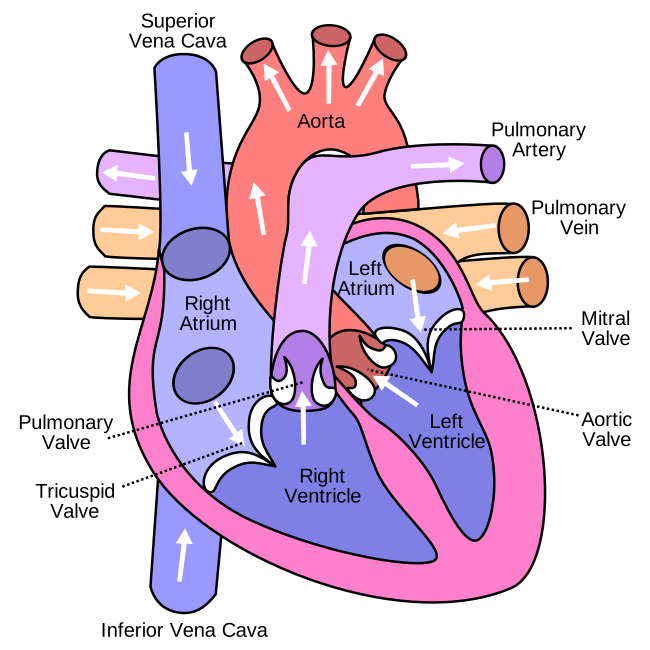
This diagram of the aorta indicates the superior and inferior vena cava, pulmonary artery, pulmonary vein, mitral valve, aortic valve, left and right ventricle, left and right atria, tricuspid valve, and pulmonary valve.

Diagram of Human Heart: This diagram of the human heart shows all the major vessels, and arrows indicate the direction of flow through the heart.

The aorta is divided into three parts: the ascending aorta, where the aorta initially leaves the heart and points superiorly toward the head; the arch of the aorta where the aorta changes direction; and the descending aorta where the aorta points inferiorly toward the feet.

This diagram indicates the left and right common carotid arteries, the right and left subclavian arteries, the brachiocephalic artery, the aortic arch, the ascending aorta, descending aorta, and left and right coronary arteries.

Ascending Aorta: The aorta has three parts: the ascending, the arch and the descending.

The ascending aorta has two small branches, the left and right coronary arteries. These arteries provide blood to the heart muscle, and their blockage is the cause myocardial infarctions or heart attacks.

The arch of the aorta has three branches: the brachiocephalic artery, which itself divides into right common carotid artery and the right subclavian artery, the left common carotid artery, and the left subclavian artery. These arteries provide blood to both arms and the head.

The descending aorta is the largest artery in the body; it runs from the heart down the length of the chest and abdomen. It is divided into two portions, the thoracic and abdominal, in correspondence with the two great cavities of the trunk in which it sits. Within the abdomen, the descending aorta branches into the two common iliac arteries that provide blood to the pelvis and, eventually, the legs.

Ascending Aorta

The ascending aorta is the first portion of the aorta; it includes the aortic sinuses, the bulb of the aorta, and the sinotubular junction.

Key Points

The ascending aorta passes diagonally upward, forward, and to the right, in the direction of the heart ‘s axis.

The aortic sinuses end at the sinotubular junction, the point in the ascending aorta where the aorta becomes a tubular structure.

The ascending aorta has two branching vessels, the left and right coronary arteries, which supply blood to the heart muscle.

Key Terms

  • aortic sinuses: An aortic sinus is one of the anatomic dilations of the ascending aorta, which occurs just above the aortic valve.
  • sinotubular junction: The sinotubular junction is the point in the ascending aorta where the aortic sinuses end and the aorta becomes a tubular structure.
  • bulb of the aorta: At the union of the ascending aorta with the aortic arch, the caliber of the vessel increases with a bulging of its right wall. This dilation is termed the bulb of the aorta, and on transverse section presents a somewhat oval figure.

The ascending aorta is a portion of the aorta beginning at the upper part of the base of the left ventricle, on a level with the lower border of the third costal cartilage behind the left half of the sternum; it passes diagonally upward, forward, and to the right, in the direction of the heart’s axis, as high as the upper border of the second right costal cartilage. Its total length is about five centimeters.

This diagram of the aorta indicates the right and left common carotid arteries, right and left subclavian arteries, brachiocephalic artery, aortic arch, ascending and descending aorta, and right and left coronary arteries.

Ascending Aorta: The aorta has three parts: the ascending, the arch and the descending.

The aortic root is the portion of the ascending aorta beginning at the aortic annulus, the fibrous attachment between the heart and the aorta, and extending to the sinotubular junction. Just above the aortic valve are three small dilations called the aortic sinuses. The two anterior sinuses give rise to the coronary arteries, while the third posterior sinus does not usually give rise to any vessels and so is known as the non-coronary sinus.

The sinotubular junction is the point in the ascending aorta where the aortic sinuses end and the aorta becomes a tubular structure.

At the junction of the ascending aorta with the aortic arch, the caliber of the vessel increases with a bulging of its right wall. This dilatation is termed the “bulb of the aorta.” The ascending aorta is contained within the pericardium. It is enclosed in a tube of the serous pericardium, which also encloses the pulmonary artery.

The ascending aorta is covered at its beginning by the trunk of the pulmonary artery and, higher up, is separated from the sternum by the pericardium, the right pleura, the anterior margin of the right lung, some loose areolar tissue, and the remains of the thymus. Posteriorly, it rests upon the left atrium and right pulmonary artery.

Arch of the Aorta

The arch of the aorta follows the ascending aorta and begins at the level of the second sternocostal articulation of the right side.

Key Points

Three vessels come out of the aortic arch: the brachiocephalic artery, the left common carotid artery, and the left subclavian artery.

These vessels supply blood to the head, neck, thorax and upper limbs.

In some individuals, the left common carotid artery and left subclavian artery may arise from the brachiocephalic artery rather than the aortic arch.

Key Terms

  • arch of the aorta: Also called the transverse aortic arch, is continuous with the upper border of the ascending aorta and begins at the level of the upper border of the second sternocostal articulation of the right side.
This diagram of the aortic arch includes the right and left common carotid arteries, right and left subclavian arteries, brachiocephalic artery, ascending and descending aorta, and right and left coronary arteries.

Aortic arch: This diagram shows the arch of the aorta and its branches.

The arch of the aorta, or the transverse aortic arch, is continuous with the upper border of the ascending aorta and begins at the level of the upper border of the second sternocostal articulation of the right side. The arch of the aorta runs at first upward, backward, and to the left in front of the trachea; it is then directed backward on the left side of the trachea and finally passes downward on the left side of the body of the fourth thoracic vertebra. At the lower border, this vertebra becomes continuous with the descending aorta.

Three vessels come out of the aortic arch: the brachiocephalic artery, the left common carotid artery, and the left subclavian artery. These vessels supply blood to the head, neck, thorax and upper limbs. In approximately 20% of individuals, the left common carotid artery arises from the brachiocephalic artery rather than the aortic arch, and in approximately 7% of individuals the left subclavian artery also arises here.

Thoracic Aorta

The thoracic aorta is the section of the aorta that travels through the thoracic cavity to carry blood to the head, neck, thorax and arms.

Key Points

The thoracic aorta is contained in the posterior mediastinal cavity, begins at the 4th thoracic vertebra where it is continuous with the aortic arch, and ends in front of the lower border of the twelfth thoracic vertebra.

Branches from the thoracic aorta include the bronchial arteries, the mediastinal arteries, the esophageal arteries, the pericardial arteries, and the superior phrenic artery.

The thoracic aorta and the esophagus run parallel for most of its length, with the esophagus lying on the right side of the aorta. At the lower part of the thorax, the esophagus is placed in front of the aorta, situated on its left side close to the diaphragm.

Key Terms

  • mediastinal cavity: The central compartment of the thoracic cavity. It contains the heart, the great vessels of the heart, the esophagus, the trachea, the phrenic nerve, the cardiac nerve, the thoracic duct, the thymus, and the lymph nodes of the central chest.
  • Thoracic Aorta: Contained in the posterior mediastinal cavity, it begins at the lower border of the fourth thoracic vertebra where it is continuous with the aortic arch, and ends in front of the lower border of the twelfth thoracic vertebra, at the aortic hiatus in the diaphragm where it becomes the abdominal aorta.
This diagram of the thoracic aorta indicates the highest intercostal artery and vein, ascending aorta, pericardium, left cupola, esophagus, and diaphragm.

Thoracic aorta: The aorta, highlighted in red, includes the thoracic aorta, the section of the aorta which runs from the lower border of the fourth thoracic vertebra to the diaphragm.

The thoracic aorta forms part of the descending aorta and is continuous with the aortic arch at its origin before becoming the abdominal aorta. Contained within the posterior mediastinal cavity, it begins at the lower border of the fourth thoracic vertebra where it is continuous with the aortic arch, and ends in front of the lower border of the twelfth thoracic vertebra at the aortic hiatus in the diaphragm. At its commencement, the thoracic aorta is situated on the left of the vertebral column; it approaches the median line as it descends, and at its termination lies directly in front of the column.

The thoracic aorta’s relation, from above downward, is as follows: anteriorly with the root of the left lung, the pericardium, the esophagus and the diaphragm; posteriorly with the vertebral column; on the right side with the hemiazygos veins and thoracic duct; and on the left side with the left pleura and lung. The esophagus lies on the right side of the aorta for most of its length, but at the lower part of the thorax is placed in front of the aorta and close to the diaphragm, situated on its left side.

As it descends in the thorax, the aorta gives off several paired branches. In descending order these are the bronchial arteries, the mediastinal arteries, the esophageal arteries, the pericardial arteries, and the superior phrenic artery. The posterior intercostal arteries are branches that originate throughout the length of the posterior aspect of the thoracic aorta.

Abdominal Aorta

The abdominal aorta is the largest artery in the abdominal cavity and supplies blood to most of the abdominal organs.

Key Points

The abdominal aorta lies slightly to the left of the midline of the body.

The abdominal aorta has a venous counterpart called the inferior vena cava that travels parallel to it on its right side.

The abdominal aorta branches into many arteries that supply blood to the abdominal organs.

Key Terms

  • abdominal aorta: The largest artery in the abdominal cavity. As part of the aorta, it is a direct continuation of the descending aorta (of the thorax).
  • omentum: Either of two folds of the peritoneum that support the viscera.
  • inferior vena cava: The large vein which returns blood from the lower extremities and the pelvic and abdominal organs to the right atrium of the heart.
image

Abdominal Aorta: The aorta, highlighted in red, includes the abdominal aorta which begins at the diaphragm and ends as it branches into the common iliac arteries.

The abdominal aorta is the largest artery in the abdominal cavity. As part of the descending aorta, it is a direct continuation of the thoracic aorta.

It begins at the level of the diaphragm, crossing it via the aortic hiatus. This hole in the diaphragm that allows the passage of the great vessels at the vertebral level of T12. The abdominal aorta travels down the posterior wall of the abdomen, anterior to the vertebral column, following the curvature of the lumbar vertebrae. The abdominal aorta runs parallel to the inferior vena cava, located just to the right of the abdominal aorta.

The abdominal aorta lies slightly to the left of the midline of the body. It is covered anteriorly by the lesser omentum and stomach. Posteriorly, it is separated from the lumbar vertebrae by the anterior longitudinal ligament and left lumbar veins.

The abdominal aorta supplies blood to much of the abdominal cavity through numerous branches that become smaller in diameter as it descends. Terminally it branches into the paired common iliac arteries, which supply the pelvis and lower limbs.

Arteries of the Pelvis and Lower Limbs

The abdominal aorta divides into the major arteries of the leg: the femoral, popliteal, tibial, dorsal foot, plantar, and fibular arteries.

Key Points

The pelvic cavity is supplied by the paired internal iliac arteries.

The internal iliac artery divides into posterior and anterior trunks which supply the reproductive and other organs of the pelvis with blood.

Key Terms

  • internal iliac arteries: Formed when the common iliac artery divides the internal iliac artery at the vertebral level L5 descends inferiorly into the lesser pelvis.
The division of the internal iliac artery into its posterior and anterior trunks.

Internal Iliac Artery: The division of the internal iliac artery into its posterior and anterior trunks.

The pelvic cavity is largely supplied by the paired internal iliac arteries, formed when the common iliac artery divides the internal iliac artery at the vertebral level L5 descends inferiorly into the lesser pelvis. The external iliac artery passes into the thigh, becoming the femoral artery.

At the most superior border of the greater sciatic foramen, the large opening to the rear of the pelvis, the internal iliac artery divides into anterior and posterior trunks.

The anterior trunk gives rise to numerous arteries that supply the organs of the pelvis and the gluteal and adductor muscles of the leg. Key branches include the obturator artery, the inferior vesical artery in men and the equivalent vaginal artery in females, and the rectal and gluteal arteries.

The posterior trunk gives rise to arteries that supply the posterior pelvic wall and the gluteal region, including the iliolumbar artery that supplies the psoas major muscle, the lateral sacral arteries, and the superior gluteal artery.

Principal Veins

Veins are blood vessels that carry blood towards the heart, have thin, inelastic walls, and contain numerous valves.

Key Points

Veins, blood vessels that return blood to the heart, are different in structure and function from the arteries, which carry blood to the circulation.

Most veins carry deoxygenated blood from the tissues back to the heart. The exceptions are the pulmonary and umbilical veins, both of which carry oxygenated blood to the heart, but the umbilical vein deteriorates shortly after birth.

The venae cavae are two large veins that drain into the right atrium of the heart, returning the majority of blood from the systemic circulation.

Key Terms

  • vein: A blood vessel that transports blood from the capillaries back to the heart.

In the circulatory system, veins are blood vessels that carry blood towards the heart. Veins have thin, inelastic walls, and contain numerous valves in order to prevent the backflow of blood. Most veins carry deoxygenated blood from the tissues back to the heart with the exceptions of the pulmonary and umbilical veins, both of which carry oxygenated blood to the heart.

This diagram of the principal veins indicates the sigmoid signus, interior and exterior jugular veins, inferior thyroid vein, pulmonary arteries, heart, inferior vena cava, hepatic veins, renal veins, abdominal vena cava, testicularis vein, common iliac vein, perforating branches, external and internal iliac vein, external pudendal vein, deep femoral vein, great saphenous vein, femoral vein, accessory saphenous veins, superior genicular veins, popliteal vein, inferior genicular veins, small saphenous veins, anterior and posterior tibial veins, deep plantar veins, dorsal venous arch, dorsal digital vein, palmar digital veins, superficial palmar arch, deep palmar arch, ulnar vein, median antebranchial vein, cephalic vein, thoracoepigastric vein, median cubital vein, basilic vein, intercostal vein, brachial veins, axillary vein, internal thoracic vein, and subclavian vein.

Principle Veins: This diagram shows the principal veins of the human body and their locations.

Veins can be broadly classified based on their depth within the body. Superficial veins are located close to the surface of the body and have no corresponding arteries, such as the great saphenous vein which runs the length of the leg. The deep veins lie deeper in the body and often run adjacent to corresponding arteries, such as the femoral vein which sits adjacent to the femoral artery in the thigh. Deep veins are often of larger caliber than superficial veins and carry the majority of the blood within the circulatory system. Communicating veins, or perforator veins if they pass through a large muscle mass, directly connect superficial and direct veins. The above veins form part of the systemic circulatory system. The pulmonary veins and venules that run from the lungs to the heart form part of the pulmonary circulatory system and are distinct from other veins in that they carry oxygenated blood.

Venae Cavae

The venae cavae are the veins with the largest diameter. Both enter the right atrium of the heart with the superior vena cava carrying blood from the arms, head, and thoracic cavity and the inferior vena cava carrying blood from the legs and abdomen. The inferior vena cava runs parallel to the abdominal aorta.

The superior vena cava is formed from the brachiocephalic veins which are in turn formed from the subclavian and internal jugular veins that serve the arm and head respectively. The inferior vena cava is formed from the common iliac veins that serve the legs and abdomen. The renal and hepatic veins from the kidneys and liver respectively also feed into the inferior vena cava.

Other Important Veins

Other important venous systems include the cardiac veins, which return blood from the heart tissue back to the general circulation. The cardiac veins merge into the coronary sinus, which empties directly into the right atrium.

The pulmonary veins are large blood vessels which receive oxygenated blood from the lungs and return it to the left atrium of the heart. There are four pulmonary veins, two from each lung, each of which forms from three to four bronchial veins. In approximately 25% of individuals, the left pulmonary veins may merge into a single vein; the same effect on the right side is only seen in approximately 3% of individuals.

The hepatic portal vein carries blood from the gastrointestinal tract to the liver. The portal vein is often described as a false vein because it conducts blood between capillary networks rather than between a capillary network and the heart. It functions to supply the liver with blood and required metabolites, but also ensures that ingested substances are first processed in the liver before reaching the wider systemic circulation.

Veins of the Head and Neck

In the head and neck, blood circulates from the upper systemic loop, which originates at the aortic arch.

Key Points

The dural sinuses within the dura mater surrounding the brain receive blood from the brain. From these sinuses, blood eventually enters the internal jugular vein.

The head and neck are emptied of blood by the internal and external jugular veins.

Key Terms

  • jugular vein: Any of several veins on each side of the neck that drain the brain, face and neck of deoxygenated blood.

Two main jugular veins are responsible for the venous draining of the head and neck.

image

Veins of the Head and Neck: The veins of head and neck are labeled in blue, with an arrow pointing to the auricular vein.

The superficial external jugular vein is formed from the retromandibular vein and the posterior auricular vein at a point adjacent to the mandible. The external jugular vein passes down the neck and underneath the clavicle before draining into the subclavian vein.

The deep-lying internal jugular vein receives blood from the dural venous sinuses in the brain as well as the cerebral and cerebellar veins. Dural sinuses are composed of dural mater lined with endothelium, making them distinct from arteries, veins, and capillaries. The dural sinuses receive blood from the veins that drain the brain and skull.

Formed at the base of the brain from the inferior petrosal sinus and the sigmoid sinus, the internal jugular vein runs down the side of the neck adjacent to the internal carotid artery. As well as removing blood from the brain, the anterior retromandibular, facial, and lingual veins also drain into the internal jugular. Upon exiting the neck, the internal jugular vein merges with the subclavian vein to form the brachiocephalic vein.

Additional veins such as the occipital, deep cervical, and thyroid veins drain directly into the brachiocephalic vein.

Veins of the Upper Limbs

The veins of the upper extremity are divided into superficial and deep veins, indicating their relative depths from the skin.

Key Points

The brachial, radial, and ulnar veins are the major deep veins that drain blood from the arm.

The major superficial veins of the arm include the cephalic and basilic veins, as well as the median cubital vein which joins the two at the elbow.

At the shoulder, the brachial and basilic veins merge to form the axillary vein, to which the cephaliac vein merges to form the subclavian vein.

Key Terms

  • brachial vein: Runs from the elbow to the shoulder parallel to the brachial artery.
  • cephalic vein: Arises from the dorsal venous network of the hand and passes the elbow anteriorly, continuing up the upper arm to the shoulder.
  • median cubital vein: The vein that links the basilic and cephalic veins.
  • basilic vein: Located medially to the cephalic vein, following a similar path.
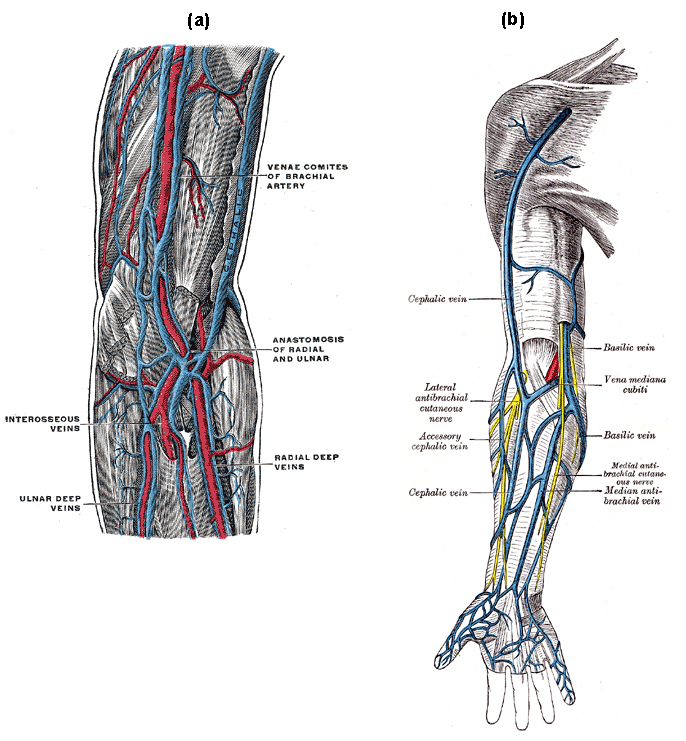
Diagram A of the deep veins of the upper extremity indicates the venae comites of brachial artery, anastamosis of radius and ulna, radial deep veins, ulnar deep veins, and interosseous veins. Diagram B of the superficial veins of the upper arm indicates the cephalic vein, basilic vein, vena mediana cubiti, medial antebrachial cutaneous nerve, medial antebrachial vein, accessory cephalic vein, and lateral antebrachial cutaneous nerve. 

(a) Deep veins of the upper extremity (b) Superficial veins of the upper extremity: The veins of the upper extremity are divided into two sets, superficial and deep. The deep veins are shown in blue. The superficial veins of the upper extremity are shown in blue.

Veins of the arm are either deep or superficial and are responsible for draining the hand and arm.

The major deep veins of the arm are the radial and ulnar veins, which run along the length of their respective bones and merge at the elbow to form the paired brachial vein. The brachial vein runs from the elbow up to the shoulder parallel to the brachial artery.

The major superficial veins of the upper limb are the cephalic, median cubital and basilic veins. The cephalic vein arises from the dorsal venous network of the hand and passes the elbow anteriorly, continuing up the upper arm to the shoulder. The basilic vein follows a similar path but is located medially to the cephalic vein. At the elbow, the basilic and cephalic veins are linked by the median cubital vein, from which blood is often drawn.

At the shoulder, the basilic vein passes deep into the arm and merges with the brachial veins to form the axillary vein, to which the cephaliac vein merges, forming the subclavian vein.

Veins of the Thorax

The veins of the thorax drain deoxygenated blood from the thorax region for return to the heart

Key Points

Major veins of the thorax include the superior and inferior vena cava.

The superior vena cava is formed by the left and right brachiocephalic veins,  which receive blood from the upper limbs, head and neck.

The inferior vena cava returns blood from the abdomen and lower limbs. The hepatic veins of the liver and renal veins of the kidney drain directly into the inferior vena cava.

Key Terms

  • supreme intercostal vein: A paired vein that drains the first intercostal space on its corresponding side.
  • internal thoracic vein: Drains the chest wall and breasts.
  • inferior vena cava: Returns blood from the abdomen and lower limbs to the right atrium of the heart.
  • superior vena cava: Formed from the left and right brachiocephalic veins, this vein returns deoxygenated blood from the upper half of the body and carries blood from the upper limbs, head, and neck via the thyroid and jugular veins.
This diagram of the thoracic veins indicates the anterior jugular, external jugular, superior thyroid, middle thyroid, internal mammary, azygos vein, inferior phrenic, suprarenal, left and right kidneys. 

Veins of the Thorax: The veins of the thorax are shown in blue.

Two venae cavae return deoxygenated blood from the systemic circulation to the right atrium of the heart.

The superior vena cava, formed from the left and right brachiocephalic veins, returns deoxygenated blood from the upper half of the body and carries blood from the upper limbs, head, and neck via the thyroid and jugular veins. It is joined just before entering the heart by the azygos vein, which runs up the right side of the thoracic vertebral column and transports blood from the external thoracic cavity.

The internal thoracic vein is a vessel that drains the chest wall and breasts. Bilaterally, it arises from the superior epigastric vein, accompanies the internal thoracic artery along its course, and terminates in the brachiocephalic vein.

The supreme intercostal vein is a paired vein that drains the first intercostal space on its corresponding side. It usually drains into the brachiocephalic vein.

The inferior vena cava returns blood from the abdomen and lower limbs to the right atrium of the heart. The renal veins from the kidney and hepatic veins of the liver drain directly into the inferior vena cava. Additionally, the superior and inferior phrenic veins drain the diaphragm and usually open into the internal mammary vein and inferior vena cava, respectively.

Veins of the Abdomen and Pelvis

The major veins of the abdomen and pelvis return deoxygenated blood from the abdomen and pelvis to the heart.

Key Points

The external iliac vein, the upward continuation of the femoral vein, passes upward along the pelvis and ends to form the common iliac vein.

The tributaries that feed into the external iliac vein include the inferior epigastric, deep iliac circumflex, and pubic veins.

The inferior epigastric vein refers to the vein that drains into the external iliac vein and arises from the superior epigastric vein.

Key Terms

  • External iliac vein: Large veins that connect the femoral veins to the common iliac veins
  • Common iliac vein: Formed by the external iliac veins and internal iliac veins.

A number of veins remove deoxygenated blood from the abdomen and pelvis. The external iliac vein, the upward continuation of the femoral vein, passes upward along the pelvis and ends to form the common iliac vein.The tributaries of the external iliac vein are the inferior epigastric, deep iliac circumflex, and pubic veins.

The internal iliac vein begins near the upper part of the greater sciatic foramen, the large opening at the rear of the pelvis, passes upward behind and slightly medial to the internal iliac artery and, at the brim of the pelvis, joins with the external iliac vein to form the common iliac vein.

image

Veins of the abdomen and lower limbs: The veins of the abdomen and lower limb include the inferior vena cava, the common iliac veins, the external iliac veins, and their tributaries.

The left and right common iliac veins come together in the abdomen at the level of the fifth lumbar vertebra, forming the abdominal vena cava. They drain blood from the pelvis and lower limbs.

The superior epigastric vein refers to a blood vessel that carries deoxygenated blood and drains into the internal thoracic vein. It anastomoses with the inferior epigastric vein at the level of the umbilicus and drains the anterior part of the abdominal wall and some of the diaphragm.

The inferior epigastric vein refers to the vein that drains into the external iliac vein and arises from the superior epigastric vein.

The deep circumflex iliac vein is formed by the union of the venae comitantes of the deep iliac circumflex artery and joins the external iliac vein about 2 cm above the inguinal ligament.

Veins of the Lower Limbs

The deep veins of the lower extremity have valves for unidirectional flow and accompany the arteries and their branches.

Key Points

The tibial veins unite to form the popliteal vein.

The femoral vein is the ascending part of the popliteal vein.

The femoral vein accompanies the femoral artery into the thigh. It is later joined by the great saphenous vein forming the external iliac vein.

Key Terms

  • popliteal vein: Derived from the merging of the tibial veins it forms the femoral vein mid-thigh.
  • great saphenous ve: A long vein that runs the length of the leg before joining the femoral vein to form the external iliac vein.
  • Femoral Vein: A blood vessel that accompanies the femoral artery in the thigh. It merges with the great saphenous vein to form the external iliac vein.
  • Tibial Vein: Blood vessel of the calves which return blood from the foot, ankle, and calf and merges into the popliteal vein behind the knee.

The deep veins of the leg accompany the arteries and their branches and possess numerous valves that aid in unidirectional blood flow. The musculature of the leg is key in generating pressure in the veins to prevent pooling.

The posterior and anterior tibial veins return blood from the calf, ankle, and foot and merge into the popliteal vein behind the knee. The popliteal vein then carries blood from the knee joint up through the thigh. Mid-thigh, it becomes the femoral vein, which is closely associated with the femoral artery. The femoral vein merges with the great saphenous vein in the groin to form the external iliac vein.


(a) Veins of the lower extremities and (b) Veins of the lower extremities: The great saphenous vein and its tributaries, shown in blue, drain blood from the lower limbs. The popliteal vein, shown here in blue, extends from the hip to the knee and helps drain blood from the lower extremities.

Running the full length of the leg, making it the longest vein in the body, the great saphenous vein is a superficial vein that returns blood from the foot and superficial muscles of the leg before merging with the femoral vein to form the external iliac vein.

References

ByRx Harun

Circulatory Routes – Anatomy, Types, Functions

Circulatory Routes /The circulatory system includes the lymphatic system, which circulates lymph. The passage of lymph takes much longer than that of blood. Blood is a fluid consisting of plasma, red blood cells, white blood cells, and platelets that is circulated by the heart through the vertebrate vascular system, carrying oxygen and nutrients to and waste materials away from all body tissues. Lymph is essentially recycled excess blood plasma after it has been filtered from the interstitial fluid (between cells) and returned to the lymphatic system. The cardiovascular (from Latin words meaning “heart” and “vessel”) system comprises the blood, heart, and blood vessels.[rx] The lymph, lymph nodes, and lymph vessels form the lymphatic system, which returns filtered blood plasma from the interstitial fluid (between cells) as lymph.

What are Circulatory Pathways/Circulatory Routes?

Every other cell, tissue, and organ in the body is impacted to a great extent by the circulatory system of the body. This system is the most complex system, with the three main components of blood, blood vessels, and heart. The blood travels through the entire body through the arteries and veins. This is how circulation occurs in the body.

The pattern through which circulation happens is called the Circulatory pathway.  This pathway can be classified into two types – The open system of circulation and the closed system of circulation.

The open system of circulation is clearly visible in the two phyla Arthropoda and Mollusca. Here the blood that is pumped by the heart goes through large vessels into the open body cavities. But, when you see two other prominent phyla, Phylum Annelida and Phylum Chordata, you can see that there is a closed circulatory system. Blood is always circulated through closed blood vessels here. This closed pathway is said to be more advantageous, as the blood flow can be regulated with precision.

The Aorta and Its Branches for Circulatory Routes

The aorta is the largest artery in the body and is divided into 3 parts: the ascending aorta, arch of the aorta, and descending aorta.

Key Points

The blood is pumped from the left ventricle into the aorta and from there branches to all parts of the body.

The aorta is divided into three parts: the ascending aorta (where the aorta initially leaves the heart and points toward the head), the arch of the aorta (where the aorta changes direction), and the descending aorta (where the aorta points toward the feet).

The ascending aorta has two small branches, the left and right coronary arteries, that provide blood to the heart muscle.

The arch of the aorta has three branches: the brachiocephalic artery (which divides into right common carotid artery and the right subclavian artery), the left common carotid artery, and the left subclavian artery. These arteries provide blood to both arms and the head.

Within the abdomen, the descending aorta branches into the two common iliac arteries; these provide blood to the pelvis and, eventually, the legs.

Key Terms

  • descending aorta: The region of the aorta that passes inferiorly towards the feet.
  • ascending aorta: The region of the aorta directly attached to the heart that passes superiorly towards the head.
  • arch of the aorta: The region of the aorta that changes direction between the ascending and descending aorta.

The aorta is the largest artery in the systemic circulatory system. Blood is pumped from the left ventricle into the aorta and from there branches to all parts of the body. The aorta is an elastic artery, meaning it is able to distend. When the left ventricle contracts to force blood into the aorta, the aorta expands. This stretching generates the potential energy that helps maintain blood pressure during diastole, since during this time the aorta contracts passively.

This diagram of the aorta indicates the superior and inferior vena cava, pulmonary artery, pulmonary vein, mitral valve, aortic valve, left and right ventricle, left and right atria, tricuspid valve, and pulmonary valve.

Diagram of Human Heart: This diagram of the human heart shows all the major vessels, and arrows indicate the direction of flow through the heart.

The aorta is divided into three parts: the ascending aorta, where the aorta initially leaves the heart and points superiorly toward the head; the arch of the aorta where the aorta changes direction; and the descending aorta where the aorta points inferiorly toward the feet.

This diagram indicates the left and right common carotid arteries, the right and left subclavian arteries, the brachiocephalic artery, the aortic arch, the ascending aorta, descending aorta, and left and right coronary arteries.

Ascending Aorta: The aorta has three parts: the ascending, the arch and the descending.

The ascending aorta has two small branches, the left and right coronary arteries. These arteries provide blood to the heart muscle, and their blockage is the cause myocardial infarctions or heart attacks.

The arch of the aorta has three branches: the brachiocephalic artery, which itself divides into right common carotid artery and the right subclavian artery, the left common carotid artery, and the left subclavian artery. These arteries provide blood to both arms and the head.

The descending aorta is the largest artery in the body; it runs from the heart down the length of the chest and abdomen. It is divided into two portions, the thoracic and abdominal, in correspondence with the two great cavities of the trunk in which it sits. Within the abdomen, the descending aorta branches into the two common iliac arteries that provide blood to the pelvis and, eventually, the legs.

Ascending Aorta

The ascending aorta is the first portion of the aorta; it includes the aortic sinuses, the bulb of the aorta, and the sinotubular junction.

Key Points

The ascending aorta passes diagonally upward, forward, and to the right, in the direction of the heart ‘s axis.

The aortic sinuses end at the sinotubular junction, the point in the ascending aorta where the aorta becomes a tubular structure.

The ascending aorta has two branching vessels, the left and right coronary arteries, which supply blood to the heart muscle.

Key Terms

  • aortic sinuses: An aortic sinus is one of the anatomic dilations of the ascending aorta, which occurs just above the aortic valve.
  • sinotubular junction: The sinotubular junction is the point in the ascending aorta where the aortic sinuses end and the aorta becomes a tubular structure.
  • bulb of the aorta: At the union of the ascending aorta with the aortic arch, the caliber of the vessel increases with a bulging of its right wall. This dilation is termed the bulb of the aorta, and on transverse section presents a somewhat oval figure.

The ascending aorta is a portion of the aorta beginning at the upper part of the base of the left ventricle, on a level with the lower border of the third costal cartilage behind the left half of the sternum; it passes diagonally upward, forward, and to the right, in the direction of the heart’s axis, as high as the upper border of the second right costal cartilage. Its total length is about five centimeters.

This diagram of the aorta indicates the right and left common carotid arteries, right and left subclavian arteries, brachiocephalic artery, aortic arch, ascending and descending aorta, and right and left coronary arteries.

Ascending Aorta: The aorta has three parts: the ascending, the arch and the descending.

The aortic root is the portion of the ascending aorta beginning at the aortic annulus, the fibrous attachment between the heart and the aorta, and extending to the sinotubular junction. Just above the aortic valve are three small dilations called the aortic sinuses. The two anterior sinuses give rise to the coronary arteries, while the third posterior sinus does not usually give rise to any vessels and so is known as the non-coronary sinus.

The sinotubular junction is the point in the ascending aorta where the aortic sinuses end and the aorta becomes a tubular structure.

At the junction of the ascending aorta with the aortic arch, the caliber of the vessel increases with a bulging of its right wall. This dilatation is termed the “bulb of the aorta.” The ascending aorta is contained within the pericardium. It is enclosed in a tube of the serous pericardium, which also encloses the pulmonary artery.

The ascending aorta is covered at its beginning by the trunk of the pulmonary artery and, higher up, is separated from the sternum by the pericardium, the right pleura, the anterior margin of the right lung, some loose areolar tissue, and the remains of the thymus. Posteriorly, it rests upon the left atrium and right pulmonary artery.

Arch of the Aorta

The arch of the aorta follows the ascending aorta and begins at the level of the second sternocostal articulation of the right side.

Key Points

Three vessels come out of the aortic arch: the brachiocephalic artery, the left common carotid artery, and the left subclavian artery.

These vessels supply blood to the head, neck, thorax and upper limbs.

In some individuals, the left common carotid artery and left subclavian artery may arise from the brachiocephalic artery rather than the aortic arch.

Key Terms

  • arch of the aorta: Also called the transverse aortic arch, is continuous with the upper border of the ascending aorta and begins at the level of the upper border of the second sternocostal articulation of the right side.
This diagram of the aortic arch includes the right and left common carotid arteries, right and left subclavian arteries, brachiocephalic artery, ascending and descending aorta, and right and left coronary arteries.

Aortic arch: This diagram shows the arch of the aorta and its branches.

The arch of the aorta, or the transverse aortic arch, is continuous with the upper border of the ascending aorta and begins at the level of the upper border of the second sternocostal articulation of the right side. The arch of the aorta runs at first upward, backward, and to the left in front of the trachea; it is then directed backward on the left side of the trachea and finally passes downward on the left side of the body of the fourth thoracic vertebra. At the lower border, this vertebra becomes continuous with the descending aorta.

Three vessels come out of the aortic arch: the brachiocephalic artery, the left common carotid artery, and the left subclavian artery. These vessels supply blood to the head, neck, thorax and upper limbs. In approximately 20% of individuals, the left common carotid artery arises from the brachiocephalic artery rather than the aortic arch, and in approximately 7% of individuals the left subclavian artery also arises here.

Thoracic Aorta

The thoracic aorta is the section of the aorta that travels through the thoracic cavity to carry blood to the head, neck, thorax and arms.

Key Points

The thoracic aorta is contained in the posterior mediastinal cavity, begins at the 4th thoracic vertebra where it is continuous with the aortic arch, and ends in front of the lower border of the twelfth thoracic vertebra.

Branches from the thoracic aorta include the bronchial arteries, the mediastinal arteries, the esophageal arteries, the pericardial arteries, and the superior phrenic artery.

The thoracic aorta and the esophagus run parallel for most of its length, with the esophagus lying on the right side of the aorta. At the lower part of the thorax, the esophagus is placed in front of the aorta, situated on its left side close to the diaphragm.

Key Terms

  • mediastinal cavity: The central compartment of the thoracic cavity. It contains the heart, the great vessels of the heart, the esophagus, the trachea, the phrenic nerve, the cardiac nerve, the thoracic duct, the thymus, and the lymph nodes of the central chest.
  • Thoracic Aorta: Contained in the posterior mediastinal cavity, it begins at the lower border of the fourth thoracic vertebra where it is continuous with the aortic arch, and ends in front of the lower border of the twelfth thoracic vertebra, at the aortic hiatus in the diaphragm where it becomes the abdominal aorta.
This diagram of the thoracic aorta indicates the highest intercostal artery and vein, ascending aorta, pericardium, left cupola, esophagus, and diaphragm.

Thoracic aorta: The aorta, highlighted in red, includes the thoracic aorta, the section of the aorta which runs from the lower border of the fourth thoracic vertebra to the diaphragm.

The thoracic aorta forms part of the descending aorta and is continuous with the aortic arch at its origin before becoming the abdominal aorta. Contained within the posterior mediastinal cavity, it begins at the lower border of the fourth thoracic vertebra where it is continuous with the aortic arch, and ends in front of the lower border of the twelfth thoracic vertebra at the aortic hiatus in the diaphragm. At its commencement, the thoracic aorta is situated on the left of the vertebral column; it approaches the median line as it descends, and at its termination lies directly in front of the column.

The thoracic aorta’s relation, from above downward, is as follows: anteriorly with the root of the left lung, the pericardium, the esophagus and the diaphragm; posteriorly with the vertebral column; on the right side with the hemiazygos veins and thoracic duct; and on the left side with the left pleura and lung. The esophagus lies on the right side of the aorta for most of its length, but at the lower part of the thorax is placed in front of the aorta and close to the diaphragm, situated on its left side.

As it descends in the thorax, the aorta gives off several paired branches. In descending order these are the bronchial arteries, the mediastinal arteries, the esophageal arteries, the pericardial arteries, and the superior phrenic artery. The posterior intercostal arteries are branches that originate throughout the length of the posterior aspect of the thoracic aorta.

Abdominal Aorta

The abdominal aorta is the largest artery in the abdominal cavity and supplies blood to most of the abdominal organs.

Key Points

The abdominal aorta lies slightly to the left of the midline of the body.

The abdominal aorta has a venous counterpart called the inferior vena cava that travels parallel to it on its right side.

The abdominal aorta branches into many arteries that supply blood to the abdominal organs.

Key Terms

  • abdominal aorta: The largest artery in the abdominal cavity. As part of the aorta, it is a direct continuation of the descending aorta (of the thorax).
  • omentum: Either of two folds of the peritoneum that support the viscera.
  • inferior vena cava: The large vein which returns blood from the lower extremities and the pelvic and abdominal organs to the right atrium of the heart.
image

Abdominal Aorta: The aorta, highlighted in red, includes the abdominal aorta which begins at the diaphragm and ends as it branches into the common iliac arteries.

The abdominal aorta is the largest artery in the abdominal cavity. As part of the descending aorta, it is a direct continuation of the thoracic aorta.

It begins at the level of the diaphragm, crossing it via the aortic hiatus. This hole in the diaphragm that allows the passage of the great vessels at the vertebral level of T12. The abdominal aorta travels down the posterior wall of the abdomen, anterior to the vertebral column, following the curvature of the lumbar vertebrae. The abdominal aorta runs parallel to the inferior vena cava, located just to the right of the abdominal aorta.

The abdominal aorta lies slightly to the left of the midline of the body. It is covered anteriorly by the lesser omentum and stomach. Posteriorly, it is separated from the lumbar vertebrae by the anterior longitudinal ligament and left lumbar veins.

The abdominal aorta supplies blood to much of the abdominal cavity through numerous branches that become smaller in diameter as it descends. Terminally it branches into the paired common iliac arteries, which supply the pelvis and lower limbs.

Arteries of the Pelvis and Lower Limbs

The abdominal aorta divides into the major arteries of the leg: the femoral, popliteal, tibial, dorsal foot, plantar, and fibular arteries.

Key Points

The pelvic cavity is supplied by the paired internal iliac arteries.

The internal iliac artery divides into posterior and anterior trunks which supply the reproductive and other organs of the pelvis with blood.

Key Terms

  • internal iliac arteries: Formed when the common iliac artery divides the internal iliac artery at the vertebral level L5 descends inferiorly into the lesser pelvis.
The division of the internal iliac artery into its posterior and anterior trunks.

Internal Iliac Artery: The division of the internal iliac artery into its posterior and anterior trunks.

The pelvic cavity is largely supplied by the paired internal iliac arteries, formed when the common iliac artery divides the internal iliac artery at the vertebral level L5 descends inferiorly into the lesser pelvis. The external iliac artery passes into the thigh, becoming the femoral artery.

At the most superior border of the greater sciatic foramen, the large opening to the rear of the pelvis, the internal iliac artery divides into anterior and posterior trunks.

The anterior trunk gives rise to numerous arteries that supply the organs of the pelvis and the gluteal and adductor muscles of the leg. Key branches include the obturator artery, the inferior vesical artery in men and the equivalent vaginal artery in females, and the rectal and gluteal arteries.

The posterior trunk gives rise to arteries that supply the posterior pelvic wall and the gluteal region, including the iliolumbar artery that supplies the psoas major muscle, the lateral sacral arteries, and the superior gluteal artery.

Principal Veins

Veins are blood vessels that carry blood towards the heart, have thin, inelastic walls, and contain numerous valves.

Key Points

Veins, blood vessels that return blood to the heart, are different in structure and function from the arteries, which carry blood to the circulation.

Most veins carry deoxygenated blood from the tissues back to the heart. The exceptions are the pulmonary and umbilical veins, both of which carry oxygenated blood to the heart, but the umbilical vein deteriorates shortly after birth.

The venae cavae are two large veins that drain into the right atrium of the heart, returning the majority of blood from the systemic circulation.

Key Terms

  • vein: A blood vessel that transports blood from the capillaries back to the heart.

In the circulatory system, veins are blood vessels that carry blood towards the heart. Veins have thin, inelastic walls, and contain numerous valves in order to prevent the backflow of blood. Most veins carry deoxygenated blood from the tissues back to the heart with the exceptions of the pulmonary and umbilical veins, both of which carry oxygenated blood to the heart.

This diagram of the principal veins indicates the sigmoid signus, interior and exterior jugular veins, inferior thyroid vein, pulmonary arteries, heart, inferior vena cava, hepatic veins, renal veins, abdominal vena cava, testicularis vein, common iliac vein, perforating branches, external and internal iliac vein, external pudendal vein, deep femoral vein, great saphenous vein, femoral vein, accessory saphenous veins, superior genicular veins, popliteal vein, inferior genicular veins, small saphenous veins, anterior and posterior tibial veins, deep plantar veins, dorsal venous arch, dorsal digital vein, palmar digital veins, superficial palmar arch, deep palmar arch, ulnar vein, median antebranchial vein, cephalic vein, thoracoepigastric vein, median cubital vein, basilic vein, intercostal vein, brachial veins, axillary vein, internal thoracic vein, and subclavian vein.

Principle Veins: This diagram shows the principal veins of the human body and their locations.

Veins can be broadly classified based on their depth within the body. Superficial veins are located close to the surface of the body and have no corresponding arteries, such as the great saphenous vein which runs the length of the leg. The deep veins lie deeper in the body and often run adjacent to corresponding arteries, such as the femoral vein which sits adjacent to the femoral artery in the thigh. Deep veins are often of larger caliber than superficial veins and carry the majority of the blood within the circulatory system. Communicating veins, or perforator veins if they pass through a large muscle mass, directly connect superficial and direct veins. The above veins form part of the systemic circulatory system. The pulmonary veins and venules that run from the lungs to the heart form part of the pulmonary circulatory system and are distinct from other veins in that they carry oxygenated blood.

Venae Cavae

The venae cavae are the veins with the largest diameter. Both enter the right atrium of the heart with the superior vena cava carrying blood from the arms, head, and thoracic cavity and the inferior vena cava carrying blood from the legs and abdomen. The inferior vena cava runs parallel to the abdominal aorta.

The superior vena cava is formed from the brachiocephalic veins which are in turn formed from the subclavian and internal jugular veins that serve the arm and head respectively. The inferior vena cava is formed from the common iliac veins that serve the legs and abdomen. The renal and hepatic veins from the kidneys and liver respectively also feed into the inferior vena cava.

Other Important Veins

Other important venous systems include the cardiac veins, which return blood from the heart tissue back to the general circulation. The cardiac veins merge into the coronary sinus, which empties directly into the right atrium.

The pulmonary veins are large blood vessels which receive oxygenated blood from the lungs and return it to the left atrium of the heart. There are four pulmonary veins, two from each lung, each of which forms from three to four bronchial veins. In approximately 25% of individuals, the left pulmonary veins may merge into a single vein; the same effect on the right side is only seen in approximately 3% of individuals.

The hepatic portal vein carries blood from the gastrointestinal tract to the liver. The portal vein is often described as a false vein because it conducts blood between capillary networks rather than between a capillary network and the heart. It functions to supply the liver with blood and required metabolites, but also ensures that ingested substances are first processed in the liver before reaching the wider systemic circulation.

Veins of the Head and Neck

In the head and neck, blood circulates from the upper systemic loop, which originates at the aortic arch.

Key Points

The dural sinuses within the dura mater surrounding the brain receive blood from the brain. From these sinuses, blood eventually enters the internal jugular vein.

The head and neck are emptied of blood by the internal and external jugular veins.

Key Terms

  • jugular vein: Any of several veins on each side of the neck that drain the brain, face and neck of deoxygenated blood.

Two main jugular veins are responsible for the venous draining of the head and neck.

image

Veins of the Head and Neck: The veins of head and neck are labeled in blue, with an arrow pointing to the auricular vein.

The superficial external jugular vein is formed from the retromandibular vein and the posterior auricular vein at a point adjacent to the mandible. The external jugular vein passes down the neck and underneath the clavicle before draining into the subclavian vein.

The deep-lying internal jugular vein receives blood from the dural venous sinuses in the brain as well as the cerebral and cerebellar veins. Dural sinuses are composed of dural mater lined with endothelium, making them distinct from arteries, veins, and capillaries. The dural sinuses receive blood from the veins that drain the brain and skull.

Formed at the base of the brain from the inferior petrosal sinus and the sigmoid sinus, the internal jugular vein runs down the side of the neck adjacent to the internal carotid artery. As well as removing blood from the brain, the anterior retromandibular, facial, and lingual veins also drain into the internal jugular. Upon exiting the neck, the internal jugular vein merges with the subclavian vein to form the brachiocephalic vein.

Additional veins such as the occipital, deep cervical, and thyroid veins drain directly into the brachiocephalic vein.

Veins of the Upper Limbs

The veins of the upper extremity are divided into superficial and deep veins, indicating their relative depths from the skin.

Key Points

The brachial, radial, and ulnar veins are the major deep veins that drain blood from the arm.

The major superficial veins of the arm include the cephalic and basilic veins, as well as the median cubital vein which joins the two at the elbow.

At the shoulder, the brachial and basilic veins merge to form the axillary vein, to which the cephaliac vein merges to form the subclavian vein.

Key Terms

  • brachial vein: Runs from the elbow to the shoulder parallel to the brachial artery.
  • cephalic vein: Arises from the dorsal venous network of the hand and passes the elbow anteriorly, continuing up the upper arm to the shoulder.
  • median cubital vein: The vein that links the basilic and cephalic veins.
  • basilic vein: Located medially to the cephalic vein, following a similar path.
Diagram A of the deep veins of the upper extremity indicates the venae comites of brachial artery, anastamosis of radius and ulna, radial deep veins, ulnar deep veins, and interosseous veins. Diagram B of the superficial veins of the upper arm indicates the cephalic vein, basilic vein, vena mediana cubiti, medial antebrachial cutaneous nerve, medial antebrachial vein, accessory cephalic vein, and lateral antebrachial cutaneous nerve. 

(a) Deep veins of the upper extremity (b) Superficial veins of the upper extremity: The veins of the upper extremity are divided into two sets, superficial and deep. The deep veins are shown in blue. The superficial veins of the upper extremity are shown in blue.

Veins of the arm are either deep or superficial and are responsible for draining the hand and arm.

The major deep veins of the arm are the radial and ulnar veins, which run along the length of their respective bones and merge at the elbow to form the paired brachial vein. The brachial vein runs from the elbow up to the shoulder parallel to the brachial artery.

The major superficial veins of the upper limb are the cephalic, median cubital and basilic veins. The cephalic vein arises from the dorsal venous network of the hand and passes the elbow anteriorly, continuing up the upper arm to the shoulder. The basilic vein follows a similar path but is located medially to the cephalic vein. At the elbow, the basilic and cephalic veins are linked by the median cubital vein, from which blood is often drawn.

At the shoulder, the basilic vein passes deep into the arm and merges with the brachial veins to form the axillary vein, to which the cephaliac vein merges, forming the subclavian vein.

Veins of the Thorax

The veins of the thorax drain deoxygenated blood from the thorax region for return to the heart

Key Points

Major veins of the thorax include the superior and inferior vena cava.

The superior vena cava is formed by the left and right brachiocephalic veins,  which receive blood from the upper limbs, head and neck.

The inferior vena cava returns blood from the abdomen and lower limbs. The hepatic veins of the liver and renal veins of the kidney drain directly into the inferior vena cava.

Key Terms

  • supreme intercostal vein: A paired vein that drains the first intercostal space on its corresponding side.
  • internal thoracic vein: Drains the chest wall and breasts.
  • inferior vena cava: Returns blood from the abdomen and lower limbs to the right atrium of the heart.
  • superior vena cava: Formed from the left and right brachiocephalic veins, this vein returns deoxygenated blood from the upper half of the body and carries blood from the upper limbs, head, and neck via the thyroid and jugular veins.
This diagram of the thoracic veins indicates the anterior jugular, external jugular, superior thyroid, middle thyroid, internal mammary, azygos vein, inferior phrenic, suprarenal, left and right kidneys. 

Veins of the Thorax: The veins of the thorax are shown in blue.

Two venae cavae return deoxygenated blood from the systemic circulation to the right atrium of the heart.

The superior vena cava, formed from the left and right brachiocephalic veins, returns deoxygenated blood from the upper half of the body and carries blood from the upper limbs, head, and neck via the thyroid and jugular veins. It is joined just before entering the heart by the azygos vein, which runs up the right side of the thoracic vertebral column and transports blood from the external thoracic cavity.

The internal thoracic vein is a vessel that drains the chest wall and breasts. Bilaterally, it arises from the superior epigastric vein, accompanies the internal thoracic artery along its course, and terminates in the brachiocephalic vein.

The supreme intercostal vein is a paired vein that drains the first intercostal space on its corresponding side. It usually drains into the brachiocephalic vein.

The inferior vena cava returns blood from the abdomen and lower limbs to the right atrium of the heart. The renal veins from the kidney and hepatic veins of the liver drain directly into the inferior vena cava. Additionally, the superior and inferior phrenic veins drain the diaphragm and usually open into the internal mammary vein and inferior vena cava, respectively.

Veins of the Abdomen and Pelvis

The major veins of the abdomen and pelvis return deoxygenated blood from the abdomen and pelvis to the heart.

Key Points

The external iliac vein, the upward continuation of the femoral vein, passes upward along the pelvis and ends to form the common iliac vein.

The tributaries that feed into the external iliac vein include the inferior epigastric, deep iliac circumflex, and pubic veins.

The inferior epigastric vein refers to the vein that drains into the external iliac vein and arises from the superior epigastric vein.

Key Terms

  • External iliac vein: Large veins that connect the femoral veins to the common iliac veins
  • Common iliac vein: Formed by the external iliac veins and internal iliac veins.

A number of veins remove deoxygenated blood from the abdomen and pelvis. The external iliac vein, the upward continuation of the femoral vein, passes upward along the pelvis and ends to form the common iliac vein.The tributaries of the external iliac vein are the inferior epigastric, deep iliac circumflex, and pubic veins.

The internal iliac vein begins near the upper part of the greater sciatic foramen, the large opening at the rear of the pelvis, passes upward behind and slightly medial to the internal iliac artery and, at the brim of the pelvis, joins with the external iliac vein to form the common iliac vein.

image

Veins of the abdomen and lower limbs: The veins of the abdomen and lower limb include the inferior vena cava, the common iliac veins, the external iliac veins, and their tributaries.

The left and right common iliac veins come together in the abdomen at the level of the fifth lumbar vertebra, forming the abdominal vena cava. They drain blood from the pelvis and lower limbs.

The superior epigastric vein refers to a blood vessel that carries deoxygenated blood and drains into the internal thoracic vein. It anastomoses with the inferior epigastric vein at the level of the umbilicus and drains the anterior part of the abdominal wall and some of the diaphragm.

The inferior epigastric vein refers to the vein that drains into the external iliac vein and arises from the superior epigastric vein.

The deep circumflex iliac vein is formed by the union of the venae comitantes of the deep iliac circumflex artery and joins the external iliac vein about 2 cm above the inguinal ligament.

Veins of the Lower Limbs

The deep veins of the lower extremity have valves for unidirectional flow and accompany the arteries and their branches.

Key Points

The tibial veins unite to form the popliteal vein.

The femoral vein is the ascending part of the popliteal vein.

The femoral vein accompanies the femoral artery into the thigh. It is later joined by the great saphenous vein forming the external iliac vein.

Key Terms

  • popliteal vein: Derived from the merging of the tibial veins it forms the femoral vein mid-thigh.
  • great saphenous ve: A long vein that runs the length of the leg before joining the femoral vein to form the external iliac vein.
  • Femoral Vein: A blood vessel that accompanies the femoral artery in the thigh. It merges with the great saphenous vein to form the external iliac vein.
  • Tibial Vein: Blood vessel of the calves which return blood from the foot, ankle, and calf and merges into the popliteal vein behind the knee.

The deep veins of the leg accompany the arteries and their branches and possess numerous valves that aid in unidirectional blood flow. The musculature of the leg is key in generating pressure in the veins to prevent pooling.

The posterior and anterior tibial veins return blood from the calf, ankle, and foot and merge into the popliteal vein behind the knee. The popliteal vein then carries blood from the knee joint up through the thigh. Mid-thigh, it becomes the femoral vein, which is closely associated with the femoral artery. The femoral vein merges with the great saphenous vein in the groin to form the external iliac vein.


(a) Veins of the lower extremities and (b) Veins of the lower extremities: The great saphenous vein and its tributaries, shown in blue, drain blood from the lower limbs. The popliteal vein, shown here in blue, extends from the hip to the knee and helps drain blood from the lower extremities.

Running the full length of the leg, making it the longest vein in the body, the great saphenous vein is a superficial vein that returns blood from the foot and superficial muscles of the leg before merging with the femoral vein to form the external iliac vein.

References

ByRx Harun

Circulatory Shock – Anatomy, Types, Mechanism, Functions

Circulatory shock is characterized by the inability of multiorgan blood flow and oxygen delivery to meet metabolic demands. Cardiogenic shock is a type of circulatory shock resulting from severe impairment of ventricular pump function rather than from abnormalities of the vascular system or blood volume.

Shock is the state of insufficient blood flow to the tissues of the body as a result of problems with the circulatory system.[rx][rx] Initial symptoms of shock may include weakness, fast heart rate, fast breathing, sweating, anxiety, and increased thirst.[rx] This may be followed by confusion, unconsciousness, or cardiac arrest, as complications worsen.[rx]

Shock is divided into four main types based on the underlying cause: low volume, cardiogenic, obstructive, and distributive shock.[rx] Low volume shock, also known as hypovolemic shock, may be from bleeding, diarrhea, or vomiting.[rx] Cardiogenic shock may be due to a heart attack or cardiac contusion.[rx] Obstructive shock may be due to cardiac tamponade or tension pneumothorax.[rx] Distributive shock may be due to sepsis, anaphylaxis, injury to the upper spinal cord, or certain overdoses.[rx][rx]

Pathophysiological Mechanisms

Shock results from four potential, and not necessarily exclusive, pathophysiological mechanisms[rx] hypovolemia (from internal or external fluid loss), cardiogenic factors (e.g., acute myocardial infarction, end-stage cardiomyopathy, advanced valvular heart disease, myocarditis, or cardiac arrhythmias), obstruction (e.g., pulmonary embolism, cardiac tamponade, or tension pneumothorax), or distributive factors (e.g., severe sepsis or anaphylaxis from the release of inflammatory mediators) and the interactive graphic, available at NEJM.org). The first three mechanisms are characterized by low cardiac output and, hence, inadequate oxygen transport. In distributive shock, the main deficit lies in the periphery, with decreased systemic vascular resistance and altered oxygen extraction. Typically, in such cases, cardiac output is high, although it may be low as a result of associated myocardial depression. Patients with acute circulatory failure often have a combination of these mechanisms. For example, a patient with distributive shock from severe pancreatitis, anaphylaxis, or sepsis may also have hypovolemia and cardiogenic shock from myocardial depression.

Types of Shock

Circulatory shock is a life-threatening medical condition that occurs due to inadequate substrate for aerobic cellular respiration.

Key Points

Circulatory shock, commonly known simply as a shock, is a life-threatening medical condition that occurs due to the provision of inadequate substrates for cellular respiration. Typical symptoms of shock include elevated but weak heart rate, low blood pressure, and poor organ function, typically observed as low urine output, confusion, or loss of consciousness.

There are four subtypes of shock with different underlying causes and symptoms: hypovolemic, cardiogenic, obstructive, and distributive.

Distributive shock can be further divided into septic, anaphylaxis, and neurogenic shock.

Key Terms

  • shock: A medical condition that occurs due to an inadequate supply of substrates required for aerobic respiration by the bodies tissues.

Circulatory shock, commonly known simply as shock, is a life-threatening medical condition that occurs due to inadequate substrates for aerobic cellular respiration. In the early stages, this is generally caused by an inadequate tissue level of oxygen. The typical signs of shock are low blood pressure, a rapid heartbeat, and signs of poor end-organ perfusion or decompensation (such as low urine output, confusion, or loss of consciousness). In some people with circulatory shock, blood pressure remains stable.

This schematic of the manifestation of shock includes vasoconstriction, failure of precapillary sphincters, peripheral pooling of blood, inadequate perfusion, cell hypoxia, energy deficit, lactic acid accumulation and fall of pH, anaerobic metabolism, metabolic acidosis, cell membrane dysfunction and failure of sodium pump, intracellular lysosomes release digestive enzymes, efflux of potassium, influx of sodium and water, toxic substances enter circulation, capillary endothelium damage, destruction, dysfunction, and cel death.

Shock: The scheme depicts the cell metabolic response as a result of inadequate blood delivery during circulatory shock.

The presentation of shock is variable with some people having only minimal symptoms such as confusion and weakness. While the general signs for all types of shock are low blood pressure, decreased urine output, and confusion, these may not always be present. Specific subtypes of shock may have additional symptoms.

Hypovolemic Shock

Hypovolemic shock, the most common type, is caused by insufficient circulating volume, typically from hemorrhage although severe vomiting and diarrhea are also potential causes.

Hypovolemic shock is graded on a four-point scale depending on the severity of symptoms and level of blood loss. Typical symptoms include a rapid, weak pulse due to decreased blood flow combined with tachycardia, cool, clammy skin, and rapid and shallow breathing.

Cardiogenic Shock

Cardiogenic shock is caused by a failure of the heart to pump correctly, either due to damage to the heart muscle through myocardial infarction or through cardiac valve problems, congestive heart failure, or dysrhythmia.

Obstructive Shock

Obstructive shock is caused by an obstruction of blood flow outside of the heart. This typically occurs due to a reduction in venous return, but may also be caused by blockage of the aorta.

Distributive Shock

Distributive shock is caused by an abnormal distribution of blood to tissues and organs and includes septic, anaphylactic, and neurogenic causes.

Septic

Septic shock is the most common cause of distributive shock and is caused by an overwhelming systemic infection that cannot be cleared by the immune system, resulting in vasodilation and hypotension.

Anaphylactic

Anaphylactic shock is caused by a severe reaction to an allergen, leading to the release of histamine that causes widespread vasodilation and hypotension.

Neurogenic

Neurogenic shock arises due to damage to the central nervous system, which impairs cardiac function by reducing heart rate and loosening the blood vessel tone, resulting in severe hypotension.

or

1. Distributive Shock

Characterized by peripheral vasodilatation.

Types of distributive shock include:

Septic Shock

Sepsis is defined as life-threatening organ dysfunction resulting from dysregulated host response to infection. Septic shock is a subset of sepsis with severe circulatory, cellular, and metabolic abnormalities resulting in tissue hypoperfusion manifested as hypotension which requires vasopressor therapy and elevated lactate levels (more than 2 mmol/L)

The most common pathogens associated with sepsis and septic shock in the United States are gram-positive bacteria, including streptococcal pneumonia and Enterococcus.

Systemic Inflammatory Response Syndrome

Systemic inflammatory response syndrome (SIRS) is a clinical syndrome of the vigorous inflammatory response caused by either infectious or noninfectious causes. Infectious causes include pathogens such as gram-positive (most common) and gram-negative bacteria, fungi, viral infections (e.g., respiratory viruses), parasitic (e.g., malaria), rickettsial infections. Noninfectious causes of SIRS include but are not limited to pancreatitis, burns, fat embolism, air embolism, and amniotic fluid embolism

Anaphylactic Shock

Anaphylactic shock is a clinical syndrome of severe hypersensitivity reaction mediated by immunoglobulin E (Ig-E), resulting in cardiovascular collapse and respiratory distress due to bronchospasm. The immediate hypersensitivity reactions can occur within seconds to minutes after the presentation of the inciting antigen. Common allergens include drugs (e.g., antibiotics, NSAIDs), food, insect stings, and latex.

Neurogenic Shock

Neurogenic shock can occur in the setting of trauma to the spinal cord or the brain. The underlying mechanism is the disruption of the autonomic pathway resulting in decreased vascular resistance and changes in vagal tone.

Endocrine Shock

Due to underlying endocrine etiologies such as adrenal failure (Addisonian crisis) and myxedema.

2. Hypovolemic Shock

Hypovolemic shock is characterized by decreased intravascular volume and increased systemic venous assistance (compensatory the mechanism to maintain perfusion in the early stages of shock). In the later stages of shock due to progressive volume depletion, cardiac output also decreases and manifest as hypotension. Hypovolemic shock divides into two broad subtypes: hemorrhagic and non-hemorrhagic.

Common causes of hemorrhagic hypovolemic shock include

  • Gastrointestinal bleed (both upper and lower gastrointestinal bleed (e.g., variceal bleed, portal hypertensive gastropathy bleed, peptic ulcer, diverticulosis) trauma
  • Vascular etiologies (e.g., aortoenteric fistula, ruptured abdominal aortic aneurysm, tumor eroding into a major blood vessel)
  • Spontaneous bleeding in the setting of anticoagulant use (in the setting of supratherapeutic INR from drug interactions)

Common causes of non-hemorrhagic hypovolemic shock include:

  • GI losses – the setting of vomiting, diarrhea, NG suction, or drains.
  • Renal losses – medication-induced diuresis, endocrine disorders such as hypoaldosteronism.
  • Skin losses/insensible losses – burns, Stevens-Johnson syndrome, Toxic epidermal necrolysis, heatstroke, pyrexia.
  • Third-space loss – in the setting of pancreatitis, cirrhosis, intestinal obstruction, trauma.

3. Cardiogenic Shock

Due to intracardiac causes leading to decreased cardiac output and systemic hypoperfusion. Different subtypes of etiologies contributing to cardiogenic shock include:

  • Cardiomyopathies – include acute myocardial infarction affecting more than 40% of the left ventricle, acute myocardial infarction in the setting of multi-vessel coronary artery disease, right ventricular myocardial infarction, fulminant dilated cardiomyopathy, cardiac arrest (due to myocardial stunning), myocarditis.
  • Arrhythmias – both tachy- and bradyarrhythmias
  • Mechanical – severe aortic insufficiency, severe mitral insufficiency, rupture of papillary muscles, or chordae tendinae trauma rupture of ventricular free wall aneurysm.

4. Obstructive Shock

Mostly due to extracardiac causes leading to a decrease in the left ventricular cardiac output

  • Pulmonary vascular – due to impaired blood flow from the right heart to the left heart. Examples include hemodynamically significant pulmonary embolism, severe pulmonary hypertension.
  • Mechanical – impaired filling of right heart or due to decreased venous return to the right heart due to extrinsic compression. Examples include tension pneumothorax, pericardial tamponade, restrictive cardiomyopathy, constrictive pericarditis.

Homeostatic Responses to Shock

An organism responds with numerous reactions during each of the four stages of shock in an attempt to maintain cellular homeostasis.

Key Points

There are four stages of shock. As it is a complex and continuous condition, there is no sudden transition from one stage to the next.
The initial stage of shock is characterized by hypoxia and anaerobic cell respiration leading to lactic acidosis.

The compensatory stage is characterized by the employment of neural, hormonal, and biochemical mechanisms in the body’s attempt to reverse the condition.

The progressive stage is the point at which the compensatory mechanisms will begin to fail. If the crisis is not treated successfully, vital organs might be compromised.

The refractory stage is when vital organs have failed and the shock can no longer be reversed leading to imminent death.

Key Terms

  • hypoperfusion: Decreased perfusion of blood through an organ.
  • hypoxia: A condition in which tissues (especially the blood) are deprived of an adequate supply of oxygen; anoxia.

Circulatory shock, commonly known simply as shock, is a life-threatening medical condition that occurs due to inadequate substrate for aerobic cellular respiration. In the early stages this is generally an inadequate level of oxygen in the tissues.

This diagram of the process of shock indicates inadequate perfusion, cell hypoxia, energy deficit, lactic acid accumulation and fall in pH, anaerobic metabolism, metabolic acidosis, vasoconstriction, failure of precapillary sphincters, peripheral pooling of blood, cell membrane dysfunction and failure of sodium pump, intracellular lysosomes release digestive enzymes, efflux of potassium, influx of sodium and water, toxic substances enter circulation, capillary endothelium damaged, destruction, dysfunction, and cell death.

Shock: The scheme depicts the cell metabolic response as a result of inadequate blood delivery during circulatory shock.

There are four stages of shock. As it is a complex and continuous condition there is no sudden transition from one stage to the next.

Initial Stage

During the initial stage, the state of hypoperfusion causes hypoxia. Due to the lack of oxygen, the cells perform anaerobic respiration. Since oxygen is not abundant, the Kreb’s cycle is slowed, resulting in lactic acidosis (the accumulation of lactate).

Compensatory Stage

The compensatory stage is characterized by the employment of neural, hormonal, and biochemical mechanisms in the body’s attempt to reverse the lactic acidosis. The increase in acidity will initiate the Cushing reflex, generating the classic symptoms of shock. The individual will begin to hyperventilate to rid the body of carbon dioxide to raise the blood pH (lower the acidity). As a result, the baroreceptors in the arteries detect the hypotension and initiate the release of epinephrine and norepinephrine to increase heart rate and blood pressure.

Progressive Stage

Should the cause of the crisis not be successfully treated, the shock will proceed to the progressive stage, in which the compensatory mechanisms begin to fail. As anaerobic metabolism continues, increasing the body’s metabolic acidosis, the arteriolar smooth muscle and precapillary sphincters relax. Blood remains in the capillaries, leading to leakage of fluid and protein into the surrounding tissues. As fluid is lost, blood concentration and viscosity increase, causing blockage of the microcirculation. The prolonged vasoconstriction will also cause the vital organs to be compromised due to reduced perfusion. If the bowel becomes sufficiently ischemic, bacteria may enter the blood stream, resulting in the additional complication of endotoxic shock.

Refractory Stage

At the refractory stage, the vital organs have failed and shock can no longer be reversed. Brain damage and cell death are occurring, and death is imminent. Shock is irreversible at this point since a large amount of cellular ATP has been degraded into adenosine in the absence of oxygen as an electron receptor in the mitochondrial matrix. Adenosine easily perfuses out of cellular membranes into extracellular fluid, furthering capillary vasodilation, and then is transformed into uric acid. Because cells can only produce adenosine at a rate of about 2% of the cell’s total need per hour, even restoring oxygen is futile at this point because there is no adenosine to phosphorylate into ATP.

Signs and Symptoms of Shock

The clinical manifestation of shock varies depending on the type of shock and the individual, but there are some general symptoms.

Key Points

The general signs for all types of shock are low blood pressure, decreased urine output, and confusion. However, these may not always be present.

Hypovolemic shock is characterized by loss of effective circulating blood volume, which leads to rapid pulse, cool skin, shallow breathing, hypothermia, thirst, and cold mottled skin.

Cardiogenic shock is characterized by distended jugular veins, weak or absent pulse, and arrhythmia.

Distributive shock includes septic shock, characterized by fever or anaphylaxis, and neurogenic shock, characterized by a reduced heart rate and vasodilation of superficial vessels warming the skin.

The presentation of shock varies. Some people presenting only minimal symptoms, such as confusion and weakness. Typical symptoms of shock include elevated but weak heart rate, low blood pressure, and poor organ function, typically observed as low urine output, confusion or loss of consciousness.

While a fast heart rate is common, those on beta blockers and those who are athletic may have a normal or slow heart rate. This also occurs in 30% of cases of shock caused by abdominal bleeding. Specific subtypes of shock may have additional symptoms.

Hypovolemic shock results from the direct loss of effective circulating blood volume. This leads to a rapid, weak pulse due to decreased blood flow combined with tachycardia, stimulation of vasoconstriction, and cool, clammy skin. It also presents with acidosis as well as rapid, shallow breathing due to sympathetic nervous system stimulation. Hypothermia due to decreased perfusion and evaporation of sweat, and thirst and dry mouth due to fluid depletion, may also be present.

image

Anaphalactic Hives: Hives and flushing on the back of a person with anaphylaxis.

The symptoms of cardiogenic shock are similar to those of hypovolemic shock. Additional symptoms may include arrhythmia of the heart beat and visibly distended jugular veins.

Distributive shock includes septic, anaphylactic, and neurogenic causes. With septic shock, fever may occur and the skin may be warm and sweaty. With anaphylaxis, hives may present on the skin, and there may localized edema, especially around the face, and weak and rapid pulse. Breathlessness and cough due to narrowed airways and swelling of the throat may also occur. The symptoms of neurogenic shock are distinct from those of classical shock, as the heart rate slows and and superficial vessels vasodilate and warm the skin. These symptoms are caused by neural damage and resultant loss of muscle control.

First Aid

Take the following steps if you think a person is in shock:

  • Call 911 or the local emergency number for immediate medical help.
  • Check the person’s airway, breathing, and circulation. If necessary, begin rescue breathing and CPR.
  • Even if the person is able to breathe on their own, continue to check rate of breathing at least every 5 minutes until help arrives.
  • If the person is conscious and DOES NOT have an injury to the head, leg, neck, or spine, place the person in the shock position. Lay the person on the back and elevate the legs about 12 inches (30 centimeters). DO NOT elevate the head. If raising the legs will cause pain or potential harm, leave the person lying flat.
  • Give appropriate first aid for any wounds, injuries, or illnesses.
  • Keep the person warm and comfortable. Loosen tight clothing.

IF THE PERSON VOMITS OR DROOLS

  • Turn the head to one side to prevent choking. Do this as long as you do not suspect an injury to the spine.
  • If a spinal injury is suspected, “log roll” the person instead. To do this, keep the person’s head, neck, and back in line, and roll the body and head as a unit.

DO NOT

In case of shock:

  • DO NOT give the person anything by mouth, including anything to eat or drink.
  • DO NOT move the person with a known or suspected spinal injury.
  • DO NOT wait for milder shock symptoms to worsen before calling for emergency medical help.

References

ByRx Harun

Capillary Exchange – Anatomy, Structure, Types, Functions

Capillary exchange refers to the exchange of material from the blood into the tissues in the capillary. … Hydrostatic pressure is a force generated by the pressure of the fluid on the capillary walls either by the blood plasma or interstitial fluid.

Capillary exchange includes all exchanges that happen at the microcirculatory or capillary level. When capillaries penetrate the tissues, they branch or arborize out to maximize the surface area for the exchange of material that includes gases, nutrients, ions, and waste products. This also minimizes the distance between the capillaries and interstitial regions where such exchanges will occur. Altogether, capillaries contain about 7% of the blood in the body, and they are continuously exchanging material between the interstitial fluid.

Substances are exchanged between capillaries and interstitial fluid via three mechanisms:

  • Diffusion
  • Bulk flow
  • Transcytosis or vesicular transport

The only things excluded from passing through the capillary wall are plasma proteins and whole cells. Other properties that regulate capillary exchange include:

  • Close proximity of a capillary to an interstitial fluid region, which decreases the capillary diffusion rate distance.
  • A large surface area due to capillary branching within the tissue maximizes the surface area available for capillary exchange.
  • The blood flow in the capillaries, however, is relatively slow.

Diffusion

Diffusion is the primary mechanism by which small molecules flow across capillaries and into the interstitial fluid, and vice versa, from the interstitial fluid into the capillaries. In such cases. molecules diffuse across their natural gradient in that they will move from high concentrated areas to low concentrated ones. For instance, glucose, amino acids, and oxygen are in high concentrations, or partial pressure in the case of oxygen, within the capillaries compared to the interstitial fluid. Thus, they will diffuse across the capillaries and into the interstitial fluid.

In contrast, carbon dioxide and other waste products have greater partial pressure or concentration in the interstitial tissue than the capillaries. Thus, these enter the capillaries by diffusion. Properties of the capillaries that regulate what may diffuse across the capillary wall include:

  • Permeability of endothelial cells that line the capillary walls that can be continuous, discontinuous, or fenestrated, see below for more details.
  • The starling equation details the contributions of hydrostatic and osmotic pressures, as further discussed below.

Bulk Flow

Bulk flow is used for the exchange of small lipid-insoluble substances. This exchange is regulated by the architecture of the capillaries with continuous capillaries that have a tight structure reducing bulk flow. Fenestrated capillaries have a perforated structure and increase bulk flow relative to continuous capillaries. Discontinuous capillaries have large intercellular gaps, and thus, allow for the greatest amount of bulk flow.

Pressure gradients determine the exchange of materials. Filtration is where substances are transferred from the capillary to the interstitial space, which is induced by blood hydrostatic pressure (BHP) and interstitial fluid osmotic pressure (IFOP). In contrast, the movement of substances from interstitial tissue to the blood in the capillaries is via a process called reabsorption. This type of movement occurs due to blood colloid osmotic pressure (BCOP) and interstitial fluid hydrostatic pressure (IFHP). Net filtration pressure (NFP) determines whether a substance is filtered or reabsorbed. The formula for NFP is:

NFP = (BHP- IFHP) + (IFOP – BCOP)

Collectively, these pressures are known as Starling forces. If NFP is a positive integer, then filtration of that substance will occur, whereas a negative integer will result in reabsorption.

Transcytosis

Transcytosis, or vesicular transport, is when substances in the blood move across the endothelial cell lining, but exit these cells via exocytosis. This involves the transport of such stances via vesicles that move across the plasma membrane of the endothelial cells and then into the interstitial tissue. This type of capillary exchange is used for lipid-insoluble molecules, such as insulin. Once in the interstitial tissue, vesicles can combine with other vesicles resulting in mixed contents draining into the interstitial region.

Gas Exchange

A vital example of gas exchange occurs between the terminal portions of the lungs and pulmonary capillaries. Therefore, pulmonary capillaries possess characteristics that allow for rapid and efficient diffusion. The capillaries optimize the diffusion rate by receiving a constant blood supply. They also have an average membrane thickness of only 0.6 micrometers and form a network of capillaries over the alveoli. Furthermore, the alveoli themselves have an extremely large surface area of seventy square meters to further increase the surface area available for diffusion.

However, common diseases can interfere with this optimization. A useful way of thinking about these diseases is to frame them with respect to the variables of Fick’s law. For example, some pulmonary diseases cause fibrosis or edema. This increases the diffusion distance that the molecule has to travel, thus decreasing the diffusion rate. Other diseases, such as emphysema, result in damage to the walls of the alveoli causing them to rupture. This consequently forms one larger air space and decreases the surface area available for gas exchange.

Finally, if the lungs are unable to ventilate correctly, such as in restrictive lung diseases, a shallower concentration gradient is established, and the diffusion rate is impaired.

Capillary Dynamics

Hydrostatic and osmotic pressure are opposing factors that drive capillary dynamics.

Key Points

Capillary exchange refers to the exchange of material from the blood into the tissues in the capillary.

There are three mechanisms that facilitate capillary exchange: diffusion, transcytosis, and bulk flow.

Capillary dynamics are controlled by the four Starling forces.

The oncotic pressure is a form of osmotic pressure exerted by proteins either in the blood plasma or interstitial fluid.

Hydrostatic pressure is a force generated by the pressure of the fluid on the capillary walls either by the blood plasma or interstitial fluid.

The net filtration pressure is the balance of the four Starling forces and determines the net flow of fluid across the capillary membrane.

Key Terms

  • proteinuria: Excessive protein in the urine, a condition which can alter the net filtration pressure altering flow of fluid across the capillary wall.
  • hydrostatic pressure: A pressure generated by fluid on the walls of the capillary, usually forcing water out of the circulatory system.
  • net filtration pressure: The balance of the four Starling forces that determines the net flow of fluid across the capillary membrane.
  • oncotic pressure: A form of osmotic pressure exerted by proteins in a fluid that usually tends to pull water into the circulatory system.

Capillary exchange refers to the exchange of material between the blood and tissues in the capillaries. There are three mechanisms that facilitate capillary exchange: diffusion, transcytosis, and bulk flow.

Capillary Exchange Mechanisms

Diffusion, the most widely-used mechanism, allows the flow of small molecules across capillaries such as glucose and oxygen from the blood into the tissues and carbon dioxide from the tissue into the blood. The process depends on the difference of gradients between the interstitium and blood, with molecules moving to low-concentrated spaces from high-concentrated ones.

Transcytosis is the mechanism whereby large, lipid-insoluble substances cross the capillary membranes. The substance to be transported is endocytosed by the endothelial cell into a lipid vesicle which moves through the cell and is then exocytosed to the other side.

Bulk flow is used by small, lipid-insoluble solutes in water to cross the capillary wall. The movement of materials across the wall is dependent on pressure and is bi-directional depending on the net filtration pressure derived from the four Starling forces that modulate capillary dynamics.

Capillary Dynamics

The four Starling forces modulate capillary dynamics.

  • Oncotic or colloid osmotic pressure is a form of osmotic pressure exerted by proteins in the blood plasma or interstitial fluid.
  • Hydrostatic pressure is the force generated by the pressure of fluid within or outside of the capillary on the capillary wall.

The net filtration pressure derived from the sum of the four forces described above determines the fluid flow into or out of the capillary. Movement from the bloodstream into the interstitium is favored by blood hydrostatic pressure and interstitial fluid oncotic pressure. Alternatively, movement from the interstitium into the bloodstream is favored by blood oncotic pressure and interstitial fluid hydrostatic pressure.

This diagram of capillary microcirculation indicates the blood flow, capillary, venous end, osmotic pressure, hydrostatic pressure, and interstitial fluid.

Capillary Dynamics: Oncotic pressure exerted by proteins in blood plasma tends to pull water into the circulatory system.

Due to the pressure of the blood in the capillaries, blood hydrostatic pressure is greater than interstitial fluid hydrostatic pressure, promoting a net flow of fluid from the blood vessels into the interstitium. However, because large plasma proteins, especially albumin, cannot easily cross through the capillary walls, their effect on the osmotic pressure of the capillary interiors will to some extent balance the tendency for fluid to leak from the capillaries.In conditions where plasma proteins are reduced (e.g. from being lost in the urine or from malnutrition), or blood pressure is significantly increased, a change in net filtration pressure and an increase in fluid movement across the capillary result in excess fluid build-up in the tissues (edema).

Transcytosis

Transcytosis is a process by which molecules are transported into the capillaries.

Key Points

Transcytosis is the process by which various macromolecules are transported across the endothelium of the capillaries.

Due to this function, transcytosis can be a convenient mechanism for pathogens to invade a tissue.

transcytosis: The process whereby macromolecules are transported across the interior of a cell via vesicles.

Transcytosis, or vesicle transport, is one of three mechanisms that facilitate capillary exchange, along with diffusion and bulk flow.

Substances are transported through the endothelial cells themselves within vesicles. This mechanism is mainly used by large molecules, typically lipid-insoluble preventing the use of other transport mechanisms. The substance to be transported is endocytosed by the endothelial cell into a lipid vesicle which moves through the cell and is then exocytosed to the other side. Vesicles are capable of merging, allowing for their contents to mix, and can be transported directly to specific organs or tissues.

Pathology

Due to the function of transcytosis, it can be a convenient mechanism by which pathogens can invade a tissue. Transcytosis has been shown to be critical to the entry of Cronobacter sakazakii across the intestinal epithelium and the blood-brain barrier.

Listeria monocytogenes has been shown to enter the intestinal lumen via transcytosis across goblet cells. Shiga toxin secreted by entero-hemorrhagic E. coli has been shown to be transcytosed into the intestinal lumen. These examples illustrate that transcytosis is vital to the process of pathogenesis for a variety of infectious agents.

Transcytosis in Pharmaceuticals

Pharmaceutical companies are currently exploring the use of transcytosis as a mechanism for transporting therapeutic drugs across the human blood-brain barrier. Exploiting the body’s own transport mechanism can help to overcome the high selectivity of this barrier, which blocks the uptake of most therapeutic antibodies into the brain and central nervous system.

Bulk Flow: Filtration and Reabsorption

Capillary fluid movement occurs as a result of diffusion (colloid osmotic pressure), transcytosis, and filtration.

Key Points

Bulk flow is a process used by small lipid-insoluble proteins to cross the capillary wall.

Capillary structure plays a large role in the rate of bulk flow, with continuous capillaries limiting flow and discontinuous capillaries facilitating the greatest amount of flow.

When moving from the blood to the interstitium, bulk flow is termed filtration.

When moving from the interstitium to the blood, bulk flow is termed re-absorption.

The kidney is a major site of bulk flow where waste products are filtered from the blood.

Key Terms

  • filtration: In bulk flow, this refers to the movement of proteins or other large molecules from the blood into the interstitium.
  • reabsorption: In bulk flow, this refers to the movement of proteins or other large molecules from the interstitium into the blood.

Bulk flow is one of three mechanisms that facilitate capillary exchange, along with diffusion and transcytosis.

Bulk Flow Process

Bulk flow is used by small, lipid-insoluble solutes in water to cross the the capillary wall and is dependent on the physical characteristics of the capillary. Continuous capillaries have a tight structure reducing bulk flow. Fenestrated capillaries permit a larger amount of flow and discontinuous capillaries allow the largest amount of flow.

The movement of materials across the capillary wall is dependent on pressure and is bidirectional depending on the net filtration pressure derived from the four Starling forces.

When moving from the bloodstream into the interstitium, bulk flow is termed filtration, which is favored by blood hydrostatic pressure and interstitial fluid oncotic pressure. When moving from the interstitium into the bloodstream, the process is termed reabsorption and is favored by blood oncotic pressure and interstitial fluid hydrostatic pressure.

Modern evidence shows that in most cases, venular blood pressure exceeds the opposing pressure, thus maintaining a positive outward force. This indicates that capillaries are normally in a state of filtration along their entire length.

The Kidneys and Bulk Flow

The kidney is a major site for bulk flow transport. Blood that enters the kidneys is filtered by nephrons, the functional unit of the kidney. Each nephron begins in a renal corpuscle composed of a glomerulus containing numerous capillaries enclosed in a Bowman’s capsule. Proteins and other large molecules are filtered out of the oxygenated blood in the glomerulus and pass into Bowman’s capsule and the tubular fluid contained within. Blood continues to flow around the nephron until it reaches another capillary-rich region the peritubular capillaries, where the previously filtered molecules are reabsorbed from the tubule of the nephron.

Tubular reabsorption is the process by which solutes and water are removed from the tubular fluid and transported into the blood. Reabsorption is a two-step process beginning with the active or passive extraction of substances from the tubule fluid into the renal interstitium, and then the transport of these substances from the interstitium into the bloodstream

This diagram of the urinary excretion process indicates afferent and efferent arterioles, glomerular capillaries, Bowman's capsule, renal veins, and peritubular capillaries.

Tubular Secretion: Diagram showing the basic physiologic mechanisms of the kidney and the three steps involved in urine formation.

or

The primary purpose of the cardiovascular system is to circulate gases, nutrients, wastes, and other substances to and from the cells of the body. Small molecules, such as gases, lipids, and lipid-soluble molecules, can diffuse directly through the membranes of the endothelial cells of the capillary wall. Glucose, amino acids, and ions—including sodium, potassium, calcium, and chloride—use transporters to move through specific channels in the membrane by facilitated diffusion. Glucose, ions, and larger molecules may also leave the blood through intercellular clefts. Larger molecules can pass through the pores of fenestrated capillaries, and even large plasma proteins can pass through the great gaps in the sinusoids. Some large proteins in blood plasma can move into and out of the endothelial cells packaged within vesicles by endocytosis and exocytosis. Water moves by osmosis.

Hydrostatic Pressure

The primary force driving fluid transport between the capillaries and tissues is hydrostatic pressure, which can be defined as the pressure of any fluid enclosed in a space. Blood hydrostatic pressure is the force exerted by the blood confined within blood vessels or heart chambers. Even more specifically, the pressure exerted by blood against the wall of a capillary is called capillary hydrostatic pressure (CHP), and is the same as capillary blood pressure. CHP is the force that drives fluid out of capillaries and into the tissues.

As fluid exits a capillary and moves into tissues, the hydrostatic pressure in the interstitial fluid correspondingly rises. This opposing hydrostatic pressure is called the interstitial fluid hydrostatic pressure (IFHP). Generally, the CHP originating from the arterial pathways is considerably higher than the IFHP, because lymphatic vessels are continually absorbing excess fluid from the tissues. Thus, fluid generally moves out of the capillary and into the interstitial fluid. This process is called filtration.

Osmotic Pressure

The net pressure that drives reabsorption—the movement of fluid from the interstitial fluid back into the capillaries—is called osmotic pressure (sometimes referred to as oncotic pressure). Whereas hydrostatic pressure forces fluid out of the capillary, osmotic pressure draws fluid back in. Osmotic pressure is determined by osmotic concentration gradients, that is, the difference in the solute-to-water concentrations in the blood and tissue fluid. A region higher in solute concentration (and lower in water concentration) draws water across a semipermeable membrane from a region higher in water concentration (and lower in solute concentration).

As we discuss osmotic pressure in blood and tissue fluid, it is important to recognize that the formed elements of blood do not contribute to osmotic concentration gradients. Rather, it is the plasma proteins that play the key role. Solutes also move across the capillary wall according to their concentration gradient, but overall, the concentrations should be similar and not have a significant impact on osmosis. Because of their large size and chemical structure, plasma proteins are not truly solutes, that is, they do not dissolve but are dispersed or suspended in their fluid medium, forming a colloid rather than a solution.

The pressure created by the concentration of colloidal proteins in the blood is called the blood colloidal osmotic pressure (BCOP). Its effect on capillary exchange accounts for the reabsorption of water. The plasma proteins suspended in the blood cannot move across the semipermeable capillary cell membrane, and so they remain in the plasma. As a result, blood has a higher colloidal concentration and lower water concentration than tissue fluid. It, therefore, attracts water. We can also say that the BCOP is higher than the interstitial fluid colloidal osmotic pressure (IFCOP), which is always very low because interstitial fluid contains few proteins. Thus, water is drawn from the tissue fluid back into the capillary, carrying dissolved molecules with it. This difference in colloidal osmotic pressure accounts for reabsorption.

Interaction of Hydrostatic and Osmotic Pressures

The normal unit used to express pressures within the cardiovascular system is millimeters of mercury (mm Hg). When blood leaving an arteriole first enters a capillary bed, the CHP is quite high—about 35 mm Hg. Gradually, this initial CHP declines as the blood moves through the capillary so that by the time the blood has reached the venous end, the CHP has dropped to approximately 18 mm Hg. In comparison, the plasma proteins remain suspended in the blood, so the BCOP remains fairly constant at about 25 mm Hg throughout the length of the capillary and considerably below the osmotic pressure in the interstitial fluid.

The net filtration pressure (NFP) represents the interaction of the hydrostatic and osmotic pressures, driving fluid out of the capillary. It is equal to the difference between the CHP and the BCOP. Since filtration is, by definition, the movement of fluid out of the capillary, when reabsorption is occurring, the NFP is a negative number.

NFP changes at different points in a capillary bed. Close to the arterial end of the capillary, it is approximately 10 mm Hg, because the CHP of 35 mm Hg minus the BCOP of 25 mm Hg equals 10 mm Hg. Recall that the hydrostatic and osmotic pressures of the interstitial fluid are essentially negligible. Thus, the NFP of 10 mm Hg drives a net movement of fluid out of the capillary at the arterial end. At approximately the middle of the capillary, the CHP is about the same as the BCOP of 25 mm Hg, so the NFP drops to zero. At this point, there is no net change of volume: Fluid moves out of the capillary at the same rate as it moves into the capillary. Near the venous end of the capillary, the CHP has dwindled to about 18 mm Hg due to loss of fluid. Because the BCOP remains steady at 25 mm Hg, water is drawn into the capillary, that is, reabsorption occurs. Another way of expressing this is to say that at the venous end of the capillary, there is an NFP of −7 mm Hg.

This diagram shows the process of fluid exchange in a capillary from the arterial end to the venous end. 

Figure 1. Net filtration occurs near the arterial end of the capillary since capillary hydrostatic pressure (CHP) is greater than blood colloidal osmotic pressure (BCOP). There is no net movement of fluid near the midpoint since CHP = BCOP. Net reabsorption occurs near the venous end since BCOP is greater than CHP.

The Role of Lymphatic Capillaries

Since overall CHP is higher than BCOP, it is inevitable that more net fluid will exit the capillary through filtration at the arterial end than enters through reabsorption at the venous end. Considering all capillaries over the course of a day, this can be quite a substantial amount of fluid: Approximately 24 liters per day are filtered, whereas 20.4 liters are reabsorbed. This excess fluid is picked up by capillaries of the lymphatic system. These extremely thin-walled vessels have copious numbers of valves that ensure unidirectional flow through ever-larger lymphatic vessels that eventually drain into the subclavian veins in the neck. An important function of the lymphatic system is to return the fluid (lymph) to the blood. Lymph may be thought of as recycled blood plasma. (Seek additional content for more detail on the lymphatic system.)

Glossary

blood colloidal osmotic pressure (BCOP): pressure exerted by colloids suspended in blood within a vessel; a primary determinant is the presence of plasma proteins

blood hydrostatic pressure: force blood exerts against the walls of a blood vessel or heart chamber

capillary hydrostatic pressure (CHP): force blood exerts against a capillary

filtration: in the cardiovascular system, the movement of material from a capillary into the interstitial fluid, moving from an area of higher pressure to lower pressure

interstitial fluid colloidal osmotic pressure (IFCOP): pressure exerted by the colloids within the interstitial fluid

interstitial fluid hydrostatic pressure (IFHP): force exerted by the fluid in the tissue spaces

net filtration pressure (NFP): force driving fluid out of the capillary and into the tissue spaces; equal to the difference of the capillary hydrostatic pressure and the blood colloidal osmotic pressure

reabsorption: in the cardiovascular system, the movement of material from the interstitial fluid into the capillaries

Lifestyle

  • Quit smoking. Your doctor can recommend programs and products to help.
  • Follow a healthy diet. Eat a variety of fruits, vegetables, and whole grains, plus lean meat, poultry, fish, and low-fat/fat-free milk. Your diet should be low in fat, cholesterol, sodium, and sugar.
  • Watch your weight. A daily record of your weight can help you be aware of rapid weight gain, which may be a sign that your pulmonary hypertension is worsening.
  • Stay active. Incorporate physical activity such as walking into your lifestyle. Discuss the level of activity with your doctor. Avoid straining or lifting heavyweights. Rest when you need to.
  • Avoid sitting in a hot tub or sauna, or taking long baths, which will lower your blood pressure.
  • Be cautious about air travel or high-altitude locales. You may need to travel with extra oxygen.
  • Get support for the anxiety and stress of living with pulmonary hypertension. Talk with your healthcare team, or ask for a referral to a counselor. A support group for people living with pulmonary hypertension can be invaluable in learning how to cope with the illness.

References

ByRx Harun

Systemic Blood Pressure – Anatomy, Types, Functions

Systemic blood pressure refers to the pressure exerted on blood vessels in the systemic circulation and is often measured using arterial pressure, or pressure exerted upon arteries during heart contractions

systemic arterial pressure, refers to the pressure measured within large arteries in the systemic circulation. This number splits into systolic blood pressure and diastolic blood pressure. Blood pressure is traditionally measured using auscultation with a mercury-tube sphygmomanometer. It is measured in millimeters of mercury and expressed in terms of the systolic pressure over diastolic pressure. Systolic pressure refers to the maximum pressure within the large arteries when the heart muscle contracts to propel blood through the body. Diastolic pressure describes the lowest pressure within the large arteries during heart muscle relaxation between beating.

Introduction to Blood Pressure

Blood pressure is a vital sign reflecting the pressure exerted on blood vessels when blood is forced out of the heart during contraction.

Key Points

Diastole is the relaxation of the chambers of the heart and systole is the contraction of the heart chambers.

Blood pressure is composed of systolic and diastolic blood pressure, which correspond to the pressure following a contraction of the heart and pressure during a relaxation for the heart, respectively. Normal blood pressure should be around 120/80, with the systolic number on top.

Mean blood pressure decreases as the circulating blood moves away from the heart through arteries, capillaries, and veins due to viscous loss of energy. Mean blood pressure drops during circulation, although most of this decrease occurs along the small arteries and arterioles.

Key Terms

  • blood pressure: The pressure exerted by the blood against the walls of the arteries and veins; it varies during the heartbeat cycle and according to a person’s age, health, and physical condition.
  • systolic pressure: The peak arterial pressure during heart contraction.
  • diastolic pressure: The minimum arterial pressure between contractions, when the heart expands and refills.

Blood pressure is the pressure that blood exerts on the wall of the blood vessels. This pressure originates in the contraction of the heart, which forces blood out of the heart and into the blood vessels.

Two mechanisms take place in the heart: diastole and systole. Diastole is the relaxation of the chambers of the heart and systole is the contraction of the heart chambers. Systolic pressure is thus the pressure that your heart emits when blood is forced out of the heart and diastolic pressure is the pressure exerted when the heart is relaxed. This is the main mechanism by which blood pressure operates.

Blood pressure is one of the principal vital signs. During each heartbeat, blood pressure varies between a maximum (systolic) and a minimum (diastolic) pressure. Normal blood pressure should be around 120/80, with the systolic pressure expressed first.

image 

Measurement of vital signs using a sphygmomanometer: Blood pressure and pulse, or the vital signs, are measured as indicators of several aspects of cardiovascular health.

Differences in mean blood pressure are responsible for blood flow from one location to another in circulation. The rate of mean blood flow depends on the resistance to flow presented by the blood vessels. Mean blood pressure decreases as circulating blood moves away from the heart through arteries, capillaries, and veins due to viscous loss of energy. Mean blood pressure decreases during circulation, although most of this decrease occurs along the small arteries and arterioles. Gravity affects blood pressure via hydrostatic forces (for example, during standing) Valves in veins, breathing, and pumping from contraction of skeletal muscles also influence venous blood pressure.

Arterial Blood Pressure

The measurement of blood pressure without further specification usually refers to systemic arterial pressure measured at the upper arm.

Key Points

Systemic blood pressure refers to the pressure exerted on blood vessels in the systemic circulation and is often measured using arterial pressure, or pressure exerted upon arteries during heart contractions.

Blood pressure (BP), sometimes referred to as arterial blood pressure, is the pressure exerted by circulating blood upon the walls of blood vessels and is one of the principal vital signs.

All levels of arterial pressure put mechanical stress on the arterial walls. Higher pressures increase heart workload and progression of unhealthy tissue growth ( atheroma ) that develops within the walls of arteries.

Key Terms

  • atheroma: An abnormal fatty deposit that develops within the walls of arteries.
  • arterial blood pressure: The pressure of the blood within an arterial vessel, typically the brachial artery in the upper arm. Calculated over a cardiac cycle and determined by the cardiac output (CO), systemic vascular resistance (SVR), and central venous pressure (CVP). It can be approximately determined from measurements of the systolic pressure and the diastolic pressure while there is a normal resting heart rate.
  • systemic circulation: The part of blood circulation that carries oxygenated blood away from the heart to the body, and returns deoxygenated blood back to the heart.

The measurement of blood pressure without further specification usually refers to the systemic arterial pressure, defined as the pressure exerted by circulating blood upon the walls of blood vessels. Pressure is typically measured with a blood pressure cuff ( sphygmomanometer ) wrapped around a person’s upper arm, which measures the pressure in the brachial artery. A person’s blood pressure is usually expressed in terms of the systolic pressure over diastolic pressure and is measured in millimeters of mercury (mmHg), for example, 140/90.

Blood pressure in the arteries is much higher than in the veins, in part due to receiving blood from the heart after contraction, but also due to their contractile capacity. The tunica media of arteries is thickened compared to veins, with smoother muscle fibers and elastic tissue. Together, these generate of elastic recoil and blood vessel contraction, allowing for the maintenance of higher pressure.

image 

Typical Tools of Auscultatory Measurement: Shown here are a stethoscope and a sphygmomanometer, used for ascultatory measurement.

Blood Pressure and Cardiovascular Disease

While average values for arterial pressure could be computed for any given population, there is extensive variation from person to person and even from minute to minute for an individual. Additionally, the average arterial pressure of a given population has only a questionable correlation with its general health. However, in a study of 100 human subjects with no known history of hypertension, the average blood pressure of 112/64 mmHg, currently classified as a desirable or “normal” value. Normal values fluctuate through the 24-hour cycle, with the highest readings in the afternoons and lowest readings at night

image 

Changes in Arterial Pressure: Arterial pressures changes across the cardiac cycle.

The risk of cardiovascular disease increases progressively above 115/75 mmHg. In the past, hypertension was only diagnosed if secondary signs of high arterial pressure were present along with a prolonged high systolic pressure reading over several visits. Hypotension is typically diagnosed only if noticeable symptoms are present. Clinical trials demonstrate that people who maintain arterial pressures at the low end of these ranges have much better long-term cardiovascular health. The principal medical debate concerns the aggressiveness and relative value of methods used to lower pressures into this range for those with high blood pressure. Elevations more commonly seen in older people, though often considered normal, are associated with increased morbidity and mortality.

Arterial Hypertension

Arterial hypertension can be an indicator of other problems and may have long-term adverse effects. Sometimes it can be an acute problem, such as a hypertensive emergency. All levels of arterial pressure put mechanical stress on the arterial walls. Higher pressures increase heart workload and progression of unhealthy tissue growth (atheroma) that develops within the walls of arteries. The higher the pressure, the more stress that is present, the more the atheroma tends to progress, and the more heart muscle may thicken, enlarge, and weaken over time.

Persistent hypertension is one of the risk factors for strokes, heart attacks, heart failure, and arterial aneurysms, and is the leading cause of chronic renal failure. Even moderate elevation of arterial pressure leads to shortened life expectancy. At mean arterial pressures 50% or more above average, a person can expect to live no more than a few years unless appropriately treated.

In the past, most attention was paid to diastolic pressure, but now we know that both high systolic pressure and high pulse pressure (the numerical difference between systolic and diastolic pressures) are also risk factors for disease. In some cases, a decrease in excessive diastolic pressure can actually increase risk, probably due to the increased difference between systolic and diastolic pressures. If systolic blood pressure is elevated (>140) with a normal diastolic blood pressure (<90), it is called “isolated systolic hypertension” and may present a health concern.

Venous Blood Pressure

Venous pressure is the vascular pressure in a vein or the atria of the heart and is much lower than arterial pressure.

Key Points

Venous pressure values are commonly 5 mmHg in the right atrium and 8 mmHg in the left atrium.

Several measurements of venous blood pressure exist in various locations within the heart, including central venous pressure, jugular venous pressure, and portal venous pressure.

The portal venous pressure is the blood pressure in the portal vein and is normally 5–10 mm Hg.

Variants of venous pressure include central venous pressure, which is a good approximation of right atrial pressure, which can then be used to calculate right ventricular end-diastolic volume.

Neurogenic and hypovolemic shock can cause fainting. When the smooth muscles surrounding the veins become slack, the veins fill with the majority of the blood in the body, keeping blood away from the brain and causing unconsciousness.

Key Terms

  • central venous pressure: The pressure of blood in the thoracic vena cava, near the right atrium of the heart, reflecting the amount of blood returning to the heart and the ability of the heart to pump the blood into the arterial system.
  • jugular venous pressure: The indirectly observed pressure over the venous system via visualization of the internal jugular vein.
  • venous system: The portion of the circulatory system composed of veins, which carry blood towards the heart.

Blood pressure generally refers to the arterial pressure in the systemic circulation. However, measurement of pressures in the human venous system and the pulmonary vessels play an important role in intensive care medicine and are physiologically important in ensuring the proper return of blood to the heart, maintaining flow in the closed circulatory system.

This diagram of the venous system indicates the sigmoid sinus, internal and external jugular vein, inferior thyroid vein, pulmonary arteries, heart, inferior vena cava, hepatic veins, renal veins, abdominal vena cava, testicularis vein, common iliac vein, perforating branches, external and internal iliac vein, external pudendal vein, deep femoral vein, great saphenous vein, femoral vein, accessory saphenous vein, superior genicular vein, popliteal vein, inferior genicular vein, small saphenous vein, anterior and posterior tibial veins, deep plantar veins, dorsal venous arch, dorsal digital vein, palmar digital veins, superficial palmar arch, deep palmar arch, inferior epigastric vein, median antebranchial vein, ulnar vein, cephalic vein, thoracoepigastric vein, median cubital vein, basilic vein, intercostal veins, brachial veins, cephalic vein, axillary vein, internal thoracic vein, and subclavial vein. 

The Human Venous System: Veins (from the Latin vena) are blood vessels that carry blood towards the heart. Veins differ from arteries in structure and function; arteries are more muscular than veins, while veins are often closer to the skin and contain valves to help keep blood flowing toward the heart.

Systemic Venous Pressure

Venous pressure is the vascular pressure in a vein or the atria of the heart. It is much lower than arterial pressure, with common values of 5 mmHg in the right atrium and 8 mmHg in the left atrium. Variants of venous pressure include:

  • Central venous pressure, a good approximation of right atrial pressure, which is a major determinant of right ventricular end-diastolic volume.
  • Jugular venous pressure (JVP), the indirectly observed pressure over the venous system. It can be useful in differentiating different forms of heart and lung disease.
  • Portal venous pressure or the blood pressure in the portal vein. It is normally 5–10 mmHg.

Vein Structure and Function

In general, veins function to return deoxygenated blood to the heart and are essentially tubes that collapse when their lumens are not filled with blood. Compared with arteries, the tunica media of veins, which contains smooth muscle or elastic fibers allowing for contraction, is much thinner, resulting in a compromised ability to deliver pressure. The actions of the skeletal-muscle pump and the thoracic pump of breathing during respiration aid in the generation of venous pressure and the return of blood to the heart.

The pressure within the circulatory circuit as a whole is mean arterial pressure (MAP). This value is a function of the cardiac output (total blood pumped) and total peripheral resistance (TPR). TPR is primarily a function of the resistance of the systemic circulation. The resistance to flow generated by veins, due to their minimal ability to contract and reduce their diameter, means that regulation of blood pressure by veins is minimal in contrast to that of muscular vessels, primarily arterioles. The latter can actively contract, reduce the diameter, and increase resistance and pressure. In addition, veins can easily distend or stretch. A vein’s ability to increase in diameter in response to a given blood volume also contributes to the very low pressures within this segment of the circulatory system.

Pooling and Fainting

Standing or sitting for a prolonged period of time can cause low venous return in the absence of the muscle pump, resulting in venous pooling (vascular) and shock. Fainting can occur, but usually, baroreceptors within the aortic sinuses initiate a baroreflex, triggering angiotensin II and norepinephrine release and consequent vasoconstriction and heart rate increases to augment blood flow return.

Neurogenic and hypovolemic shock can also cause fainting. The smooth muscles surrounding the veins become slack and the veins fill with the majority of the blood in the body, keeping blood away from the brain and causing unconsciousness. Jet pilots wear pressurized suits to help maintain their venous return and blood pressure since high-speed maneuvers increase venous pooling in the legs. Pressure suits specifically squeeze the lower extremities, increasing venous return to the heart. This ensures that end-diastolic volumes are maintained and that the brain will receive adequate blood, preventing loss of consciousness.

Lifestyle

  • Quit smoking. Your doctor can recommend programs and products to help.
  • Follow a healthy diet. Eat a variety of fruits, vegetables, and whole grains, plus lean meat, poultry, fish, and low-fat/fat-free milk. Your diet should be low in fat, cholesterol, sodium, and sugar.
  • Watch your weight. A daily record of your weight can help you be aware of rapid weight gain, which may be a sign that your pulmonary hypertension is worsening.
  • Stay active. Incorporate physical activity such as walking into your lifestyle. Discuss the level of activity with your doctor. Avoid straining or lifting heavyweights. Rest when you need to.
  • Avoid sitting in a hot tub or sauna, or taking long baths, which will lower your blood pressure.
  • Be cautious about air travel or high-altitude locales. You may need to travel with extra oxygen.
  • Get support for the anxiety and stress of living with pulmonary hypertension. Talk with your healthcare team, or ask for a referral to a counselor. A support group for people living with pulmonary hypertension can be invaluable in learning how to cope with the illness.

References

ByRx Harun

Mean Arterial Pressure – What About You Need To Know

Mean arterial pressure (MAP) is the average arterial pressure throughout one cardiac cycle, systole, and diastole. MAP is influenced by cardiac output and systemic vascular resistance, each of which is influenced by several variables. These will be discussed further under the Mechanism heading of this article.

Cardiac output is calculated as the product of heart rate and stroke volume. The determination of stroke volume is by ventricular inotropy and preload. Preload is affected by blood volume and the compliance of veins. Increasing the blood volume increases the preload, increasing the stroke volume and therefore increasing cardiac output. Afterload also affects the stroke volume in that an increase in afterload will decrease stroke volume. Heart rate is affected by the chronotropic, homotopy, and lusitropy of the myocardium.

Systemic vascular resistance is determined primarily by the radius of the blood vessels. Decreasing the radius of the vessels increases vascular resistance. Increasing the radius of the vessels would have the opposite effect. Blood viscosity can also affect systemic vascular resistance. An increase in hematocrit will increase blood viscosity and increase systemic vascular resistance. Viscosity, however, is considered only to play a minor role in systemic vascular resistance.

A common method used to estimate the MAP is the following formula:

  • MAP = DP + 1/3(SP – DP) or MAP = DP + 1/3(PP)

Where DP is the diastolic blood pressure, SP is the systolic blood pressure, and PP is the pulse pressure. This method is often more conducive to measuring MAP in most clinical settings as it offers a quick means of calculation if the blood pressure is known.

Cellular

MAP regulation is on the cellular level through a complex interplay between the cardiovascular, renal, and autonomic nervous systems. The relationships of these involved systems to one another will be discussed in more detail under the Mechanism heading of this article.

Organ Systems Involved

The cardiovascular system determines the MAP through cardiac output and systemic vascular resistance. Cardiac output is regulated on the level of intravascular volume, preload, afterload, myocardial contractility, heart rate, and conduction velocity. Systemic vascular resistance regulation is via vasoconstriction and dilation.

The renal system affects MAP via the renin-angiotensin-aldosterone system; this is a cascade that ends in the release of aldosterone, which increases sodium reabsorption in the distal convoluted tubules of the kidneys and ultimately increases plasma volume.

The autonomic nervous system plays a role in regulating MAP via baroreceptors located in the carotid sinus and aortic arch. The autonomic nervous system can affect both cardiac output and systemic vascular resistance to maintain MAP in the ideal range.

The functions of the above organ systems in regulating MAP are discussed further under the Mechanism heading of this article.

Function

MAP functions to perfuse blood to all the tissues of the body to keep them functional. Mechanisms are in place to ensure that the MAP remains at least 60 mmHg so that blood can effectively reach all tissues.

Mechanism

Alterations in systemic vascular resistance and cardiac output are responsible for changes in MAP.

The most influential variable in determining systemic vascular resistance is the radius of the blood vessels themselves. The radius of these vessels is influenced both by local mediators and the autonomic nervous system. Endothelial cells lining the blood vessels produce and respond to vasoactive substances to either dilate or constrict the vessels depending on the body’s needs.

When MAP is elevated, shearing forces on the vessel walls induce nitric oxide synthesis (NO) in endothelial cells. NO diffuses into vascular smooth muscle cells where it activates guanylyl cyclase and results in the dephosphorylation of GTP to cGMP. The cGMP acts as a second messenger within the cell, ultimately leading to smooth muscle relaxation and dilation of the vessel. Other vasodilating compounds produced locally are bradykinin and the various prostaglandins, which act through similar mechanisms to result in the relaxation of vascular smooth muscle.

Endothelin is a local vasoactive compound that has the opposite effects as NO on vascular smooth muscle. A reduced MAP triggers the production of endothelin within the endothelial cells. Endothelin then diffuses into the vascular smooth muscle cells to bind the ET-1 receptor, a Gq-coupled receptor, resulting in the formation of IP3 and calcium release from the sarcoplasmic reticulum, which leads to smooth muscle contraction and constriction of the vessel.

The autonomic nervous system also plays a vital role in regulating MAP via the baroreceptor reflex. The arterial baroreceptors found in the carotid sinus and aortic arch act through a negative feedback system to maintain the MAP in the ideal range. Baroreceptors communicate with the nucleus tractus solitarius in the medulla of the brainstem via the glossopharyngeal nerve (cranial nerve IX) in the carotid sinus and the vagus nerve (cranial nerve X) in the aortic arch. The nucleus tractus solitarius determines the sympathetic or parasympathetic tone to either raise or lower MAP according to the body’s needs.

When MAP is elevated, increasing baroreceptor stimulation, the nucleus tractus solitarius decreases sympathetic output and increases parasympathetic output. The increase in parasympathetic tone will decrease myocardial chronotropy and homotopy, with less pronounced effects on inotropy and lusitropy, via the effect of acetylcholine on M2 muscarinic receptors in the myocardium. M2 receptors are Gi-coupled, inhibiting adenylate cyclase and causing a decrease in cAMP levels within the cell. The result is a decrease in cardiac output and a subsequent decrease in MAP.

Conversely, when the MAP decreases, baroreceptor firing decreases and the nucleus tractus solitarius acts to reduce parasympathetic tone and increase sympathetic tone. The increase in sympathetic tone will increase myocardial chronotropy, dromotropy, inotropy, and lusitropy via the effect of epinephrine and norepinephrine on beta1 adrenergic receptors in the myocardium. Beta1 receptors are Gs-coupled, activating adenylate cyclase and causing an increase in cAMP levels within the cell. In addition to this, epinephrine and norepinephrine act on vascular smooth muscle cells via alpha1 adrenergic receptors to induce vasoconstriction of both arteries and veins. Alpha1 receptors are Gq-coupled and act via the same mechanism as the ET-1 receptor mentioned above. The combination of these events increases both cardiac output and systemic vascular resistance, effectively increasing MAP.

Increased sympathetic tone also occurs during exercise, severe hemorrhage, and in times of psychological stress.

The renal system helps to maintain MAP primarily through the regulation of plasma volume, which directly affects the cardiac output. A drop in renal perfusion triggers the release of renin, launching the renin-angiotensin-aldosterone cascade. Aldosterone acts on the distal convoluted renal tubules to increase sodium reabsorption and therefore increase water reuptake and plasma volume. Angiotensin II acts on the vasculature via the AT1 receptor to induce smooth muscle contraction, resulting in vasoconstriction. The AT1 receptor is Gq-coupled and works via the same mechanism as the ET-1 and alpha1 receptors mentioned above. Together these changes will increase both cardiac output and systemic vascular resistance to increase MAP.

References

ByRx Harun

Control of Blood Pressure – Anatomy, Types, Functions

Control of Blood pressure is a cardinal vital sign that guides both acute and long-term clinical decision-making. Given its importance in directing care, it is essential to measure blood pressure accurately and consistently.

In general, two values are recorded during the measurement of blood pressure. The first, systolic pressure, represents the peak arterial pressure during systole. The second, diastolic pressure, represents the minimum arterial pressure during diastole. A third value, mean arterial pressure, can be calculated from the systolic and diastolic pressures.

The overall blood pressure as measured in the brachial artery is maintained by the cardiac output and the total peripheral resistance (TPR) to flow. The mean arterial pressure (MAP) is calculated by the formula:

where DBP and SBP are diastolic and systolic blood pressure, respectively. Mean arterial pressure is a useful concept because it can be used to calculate overall blood flow, and thus delivery of nutrients to the various organs. It is a good indicator of perfusion pressure (ΔP).

Blood flow is defined by Poiseuille’s law

Image ch16e2.jpg

where Q is the blood flow, ΔP is the pressure gradient, r is the radius of the vessel, N is the blood viscosity, and L is the length of the vessel. This formula is commonly restated in a more clinically useful expression:

Image ch16e3.jpg

Here CO is the cardiac output in liters/minute and is the clinical equivalent of blood flow (Q). MAP (in mm Hg) is used to approximate the pressure gradient (ΔP). TPR is the resistance to flow in dynes · sec · cm−5 and clinically represents 8 NLr4 The conversion factor 80 appears in the formula simply to allow the use of more conventional units.

Example 1: BP of 120/80 and normal cardiac output of 5 L/min:

Image ch16e4.jpg

In this example, the TPR demonstrated can be used as a standard in evaluating pathologic conditions.

Example 2: Normal cardiac output of 5.0 L/min and BP of 170/110:

Image ch16e5.jpg

In this example of a typical hypertensive, the cardiac output is normal and the elevated blood pressure is thought to occur as a direct result of increased TPR. The TPR is maintained by resistance vessels, small precapillary muscular arterioles that regulate the rate of diastolic runoff in the arterial tree. These resistance vessels regulate blood flow by changes in vascular tone that adjust the radius (r) of the vessel. Since radius appears in the formula to the fourth power (i.e., TPR = 8NLr4), small adjustments cause significant changes in TPR.

Example 3: BP of 80/60, TPR of 600:

Image ch16e6.jpg

This example is representative of septic shock. Lax vasomotor tone causes a low TPR, and blood pressure can be maintained only by a substantial rise in cardiac output.

Cardiac output is calculated by multiplying heart rate by stroke volume. In intrinsic cardiac disease, the stroke volume may be decreased, but the cardiac output can be maintained by a compensatory rise in heart rate. For a given TPR, the blood pressure is maintained unless there is relative bradycardia or a further fall in stroke volume.

During systole, the volume of blood ejected from the left ventricle must enter the aorta and major arterial branches. The distensibility of the arteries compensates for this volume and stores energy in order to perfuse the capillary beds during diastole. If, for example, the aorta is stiff from atherosclerotic disease, the left ventricle generates a higher pressure to eject a given quantity of blood, and so the systolic pressure is higher.

With each heartbeat, there are minor adjustments in these factors that are all intricately controlled to provide perfusion of the organs. Baroreceptors in the aorta and carotid body are stretched by the blood pressure and send feedback information to autonomic nervous system centers in the brainstem. Autonomic outflow then controls heart rate, vascular tone, and contractile state of the myocardium to adjust blood pressure accordingly.

Pulse pressure

Pulse pressure is the difference between systolic and diastolic blood pressures.

  • Pulse Pressure = Systolic Blood Pressure – Diastolic Blood Pressure

The systolic blood pressure is defined as the maximum pressure experienced in the aorta when the heart contracts and ejects blood into the aorta from the left ventricle (approximately 120 mmHg). The diastolic blood pressure is the minimum pressure experienced in the aorta when the heart is relaxing before ejecting blood into the aorta from the left ventricle (approximately 80 mmHg). Normal pulse pressure is, therefore, approximately 40 mmHg.

A change in pulse pressure (delta Pp) is proportional to volume change (delta-V) but inversely proportional to arterial compliance (C):

  • Delta Pp =  Delta V/C

Because the change in volume is due to the stroke volume of blood ejected from the left ventricle (SV), we can approximate pulse pressure as:

  • Pp = SV/C

A normal young adult at rest has a stroke volume of approximately 80 mL. Arterial compliance is approximately 2 mL/mm Hg, which confirms that normal pulse pressure is approximately 40 mm Hg.

Arterial compliance is equal to the change in volume (Delta V) over a given change in pressure (Delta P):

  • C = Delta V/Delta P

Because the aorta is the most compliant portion of the human arterial system, the pulse pressure is the lowest. Compliance progressively decreases until it reaches a minimum in the femoral and saphenous arteries, and then it begins to increase again. This concept requires an understanding of the effect of pressure wave reflection on the amplification of aortic pressure and thus pulse pressure. The phenomenon mainly occurs in the lower body, especially the lower extremities where pressure waves reflect back due to vessel branching, and the vessels are less compliant (stiffer) When a reflected wave is in phase with a forward wave, it generates a wave with higher amplitude. An analogy here is waves bouncing off a seawall and interacting with an incoming wave. If they are in phase, the wave height is greater.

Definitions of hypertension based on the 2013 ESH/ESC guidelines

Category Subtype Systolic BP (mmHg) Diastolic BP (mmHg)
Office BP NA ≥ 140 ≥ 90
Ambulatory BP Daytime (awake) ≥ 135 ≥ 85
Nighttime (asleep) ≥ 120 ≥ 70
24hr ≥ 130 ≥ 80
Home BP NA ≥ 135 ≥ 85

For the diagnosis of hypertension, systolic BP, diastolic BP or both have to exceed the reported values. NA, not applicable. Modified from Ref.

Blood pressure targets recommended by various guidelines

Guideline Population Goal BP (mmHg)
2010 Chinese Guidelines Adults < 65 years < 140/90
Adults 65 years and older <150/90 (<140/90 if tolerated)
Adults with diabetes, CHD, or renal disease <130/80
2013 ESH/ESC Nonfrail adults < 80 years < 140/90
Adults > 80 years < 150/90
Adults with diabetes < 140/85
Adults with CKD without proteinuria < 140/90
Adults with CKD with overt proteinuria < 130/90
Adults with CHD < 140/90
2013 ASH/ISH Adults 55–80 years < 140/90
Young adults < 130/80
Elderly > 80 years < 150/90
2014 Hypertension guideline

(formerly known as JNC 8)

Adults < 60 years < 140/90
Adults ≥ 60 years < 150/90
Adults with diabetes < 140/90
Adults with CKD < 140/90
2014 South African Guidelines Most adults < 140/90
Adults > 80 years SBP 140–150
2014 Japanese Guidelines Most adults < 140/90
Late phase elderly patients <150/90 (<140/90 if tolerated)
Adults with diabetes or CKD < 130/80
Adults with CHD or CVD < 140/90
CHEP 2016 Adults < 80 years < 140/90
Adults ≥ 80 years < 150
High-risk adults ≥ 50 years ≤ 120*
2016 Australian guidelines Adults at high CV risk without diabetes mellitus, including CKD patients and those >75 years < 120
Adults with diabetes in whom prevention of stroke is priority < 120
ADA Adults with diabetes < 140/90
Adults with diabetes and high risk for CVD < 130/80
2017 ACC/AHA/AAPA/ABC/ACPM/

AGS/APhA/ASH/ASPC/NMA/PCNA

Adults with known CVD or 10-year ASCVD event risk ≥ 10% < 130/80
Adults without additional markers of increased CVD risk < 130/80
Older adults ≥ 65 years of age,
noninstitutionalized, ambulatory
< 130/80
Older adults ≥ 65 years of age, with comorbidities and limited life expectancy Individualized goal based on clinical judgment and patient preference

Role of the Cardiovascular Center

The cardiovascular system plays a role in body maintenance by transporting hormones and nutrients and removing waste products.

KEY TAKEAWAYS

Key Points

  • The cardiovascular center is a part of the human brain found in the medulla oblongata, responsible for the regulation of cardiac output.
  • Numerous receptors in the circulatory system can detect changes in pH or stretch and signal these changes to the cardiovascular center.
  • The cardiovascular center can alter heart rate and stroke volume to increase blood pressure and flow.

Key Terms

  • cardiovascular center: A region of the brain responsible for nervous control of the cardiac output.

The cardiovascular center forms part of the autonomic nervous system and is responsible for the regulation of cardiac output. Located in the medulla oblongata, the cardiovascular center contains three distinct components: the cardio accelerator center, the cardioinhibitory center, and the vasomotor center.

The cardio accelerator center stimulates cardiac function by regulating heart rate and stroke volume via sympathetic stimulation from the cardiac accelerator nerve. The cardioinhibitory center slows cardiac function by decreasing heart rate and stroke volume via parasympathetic stimulation from the vagus nerve. The vasomotor center controls vessel tone or contraction of the smooth muscle in the tunica media. Changes in diameter affect peripheral resistance, pressure, and flow, which in turn affect cardiac output. The majority of these neurons act via the release of the neurotransmitter norepinephrine from sympathetic neurons. Although each center functions independently, they are not anatomically distinct.

The cardiovascular center can respond to numerous stimuli. Hormones such as epinephrine and norepinephrine or changes in pH such as acidification due to carbon dioxide accumulation in tissue during exercise are detected by chemoreceptors. Baroreceptors that detect stretch can also signal to the cardiovascular center to alter heart rate.

image

Human circulatory system: The cardiovascular system is composed largely of the circulatory system, or the system of blood vessels that distributes oxygen from the lungs throughout the body.

Short-Term Neural Control

Neural regulation of blood pressure is achieved through the role of cardiovascular centers and baroreceptor stimulation.

KEY TAKEAWAYS

Key Points

  • The cardio accelerator center, the cardioinhibitory center, and the vasomotor center form the cardiovascular center, a cluster of neurons that function independently to regulate blood pressure and flow.
  • The release of the neurotransmitter norepinephrine from sympathetic neurons directs the majority of neurons associated with the cardiovascular center.
  • Baroreceptors respond to the degree of stretch caused by the presence of blood; this stimulates impulses to be sent to the cardiovascular center to regulate blood pressure to achieve homeostasis when needed.

Key Terms

  • autonomic nervous system: The part of the nervous system that regulates the involuntary activity of the heart, intestines, and glands. These activities include digestion, respiration, perspiration, metabolism, and blood pressure modulation.
  • norepinephrine: A catecholamine with multiple roles including as a hormone and neurotransmitter. Areas of the body that produce or are affected by this substance are described as noradrenergic.
  • sympathetic: Of or related to the part of the autonomic nervous system that under stress raises blood pressure and heart rate, constricts blood vessels and dilates the pupils.
  • baroreceptor: A nerve ending that is sensitive to changes in blood pressure.
  • parasympathetic: Of or relating to the part of the autonomic nervous system that inhibits or opposes the effects of the sympathetic nervous system.

The autonomic nervous system plays a critical role in the regulation of vascular homeostasis. The primary regulatory sites include the cardiovascular centers in the brain that control both cardiac and vascular functions.

Neurological regulation of blood pressure and flow depends on the cardiovascular centers located in the medulla oblongata. This cluster of neurons responds to changes in blood pressure as well as blood concentrations of oxygen, carbon dioxide, and other factors such as pH.

Baroreceptor Function

Baroreceptors are specialized stretch receptors located within thin areas of blood vessels and heart chambers that respond to the degree of stretch caused by the presence of blood. They send impulses to the cardiovascular center to regulate blood pressure. Vascular baroreceptors are found primarily in sinuses (small cavities) within the aorta and carotid arteries. The aortic sinuses are found in the walls of the ascending aorta just superior to the aortic valve, whereas the carotid sinuses are located in the base of the internal carotid arteries. There are also low-pressure baroreceptors located in the walls of the venae cavae and right atrium.

When blood pressure increases, the baroreceptors are stretched more tightly and initiate action potentials at a higher rate. At lower blood pressures, the degree of stretch is lower and the rate of firing is slower. When the cardiovascular center in the medulla oblongata receives this input, it triggers a reflex that maintains homeostasis.

image

Baroreceptor Reflexes: Increased blood pressure results in increased rates of baroreceptor firing, whereas decreased blood pressure results in slower rates of fire, both initiating the homeostatic mechanism to restore blood pressure.

Baroreceptor Reflexes

When blood pressure rises too high, baroreceptors fire at a higher rate and trigger parasympathetic stimulation of the heart. As a result, cardiac output falls. Sympathetic stimulation of the peripheral arterioles will also decrease, resulting in vasodilation. Combined, these activities cause blood pressure to fall.

When blood pressure drops too low, the rate of baroreceptor firing decreases. This triggers an increase in sympathetic stimulation of the heart, causing the cardiac output to increase. It also triggers sympathetic stimulation of the peripheral vessels, resulting in vasoconstriction. Combined, these activities cause blood pressure to rise.

The baroreceptors in the venae cavae and right atrium monitor blood pressure as the blood returns to the heart from the systemic circulation. Normally, blood flow into the aorta is the same as blood flow back into the right atrium. If blood is returning to the right atrium more rapidly than it is being ejected from the left ventricle, the atrial receptors will stimulate the cardiovascular centers to increase sympathetic firing and cardiac output until homeostasis is achieved. The opposite is also true. This mechanism is referred to as the atrial reflex.

Other neural mechanisms can also have a significant impact on cardiovascular function. These include the limbic system, which links physiological responses to psychological stimuli, chemoreceptor reflexes, generalized sympathetic stimulation, and parasympathetic stimulation.

Short-Term Chemical Control

Blood pressure is controlled chemically through dilation or constriction of the blood vessels by vasodilators and vasoconstrictors.

KEY TAKEAWAYS

Key Points

  • Constriction or dilation of blood vessels alters resistance, increasing or decreasing blood pressure respectively.
  • Generalized vasoconstriction usually results in an increase in systemic blood pressure, but it may also occur in specific tissues, causing a localized reduction in blood flow.
  • Vasoconstriction results from increased concentration of calcium (Ca2+) ions within the vascular smooth muscle.
  • When blood vessels dilate, the flow of blood is increased due to a decrease in vascular resistance. Therefore, dilation of arterial blood vessels (mainly the arterioles ) causes a decrease in blood pressure.
  • Localized tissues increase blood flow in multiple ways, including releasing vasodilators, primarily adenosine, into the local interstitial fluid, which diffuses to capillary beds provoking local vasodilation.

Key Terms

  • vasodilation: The dilation (widening) of a blood vessel.
  • vasoconstriction: The constriction (narrowing) of a blood vessel.

Many physical factors influence arterial pressure. Each may in turn be influenced by physiological factors such as diet, exercise, disease, drugs or alcohol, stress, and obesity. In practice, each individual’s autonomic nervous system responds to and regulates all of these interacting factors so that the actual arterial pressure response varies widely because of both split-second and slow-moving responses of the nervous system and end organs. These responses are very effective in changing the variables and resulting blood pressure from moment to moment.

Chemical Vasoconstriction

Vasoconstriction is the narrowing of blood vessels resulting from the contraction of the muscular wall of the vessels, particularly the large arteries and small arterioles. Generalized vasoconstriction usually results in an increase in systemic blood pressure, but may also occur in specific tissues, causing a localized reduction in blood flow.

The mechanism that leads to vasoconstriction results from the increased concentration of calcium (Ca2+ ions) and phosphorylated myosin within vascular smooth muscle cells. When stimulated, a signal transduction cascade leads to increased intracellular calcium from the sarcoplasmic reticulum through IP3 mediated calcium release, as well as enhanced calcium entry across the sarcolemma through calcium channels.

The rise in intracellular calcium interacts with calmodulin, which in turn activates myosin light chain kinase. This enzyme is responsible for phosphorylating the light chain of myosin to stimulate cross-bridge cycling. Once elevated, the intracellular calcium concentration is returned to its basal level through a variety of protein pumps and calcium exchanges located on the plasma membrane and sarcoplasmic reticulum. This reduction in calcium removes the stimulus necessary for contraction allowing for a return to baseline.

Endogenous vasoconstrictors include ATP, epinephrine, and angiotensin II.

image

Vasoconstriction: Vasoconstriction of a microvessel by pericytes and endothelial cells that encircle an erythrocyte (E).

Chemical Vasodilation

Vasodilation is the widening of blood vessels resulting from the relaxation of smooth muscle cells within the vessel walls, particularly in the large veins, large arteries, and smaller arterioles. Generalized vasodilation usually results in a decrease in systemic blood pressure, but may also occur in specific tissues causing a localized increase in blood flow.

The primary function of vasodilation is to increase blood flow in the body to tissues that need it most. This is often in response to a localized need for oxygen but can occur when the tissue in question is not receiving enough glucose, lipids, or other nutrients. Localized tissues increase blood flow by several methods, including the release of vasodilators, primarily adenosine, into the local interstitial fluid, which diffuses to capillary beds provoking local vasodilation. Some physiologists have suggested the lack of oxygen itself causes capillary beds to vasodilate by the smooth muscle hypoxia of the vessels in the region.

As with vasoconstriction, vasodilation is modulated by calcium ion concentration and myosin phosphorylation within vascular smooth muscle cells. Dephosphorylation by myosin light-chain phosphatase and induction of calcium symporters and antiporters that pump calcium ions out of the intracellular compartment both contribute to smooth muscle cell relaxation and therefore vasodilation. This is accomplished through the reuptake of ions into the sarcoplasmic reticulum via exchangers and expulsion across the plasma membrane. Endogenous vasodilators include arginine and lactic acid.

Long-Term Renal Regulation

Consistent and long-term control of blood pressure is determined by the renin-angiotensin system.

KEY TAKEAWAYS

Key Points

  • When blood volume is low, renin, excreted by the kidneys, stimulates the production of angiotensin I, which is converted into angiotensin II. This substance has many effects, including the increase in blood pressure due to its vasoconstrictive properties.
  • The cells that excrete renin are called juxtaglomerular cells. When blood volume is low, juxtaglomerular cells in the kidneys secrete renin directly into circulation. Plasma renin then carries out the conversion of angiotensinogen released by the liver to angiotensin I.
  • Aldosterone secretion from the adrenal cortex is induced by angiotensin II and causes the tubules of the kidneys to increase the reabsorption of sodium and water into the blood, thereby increasing blood volume and blood pressure.

Key Terms

  • juxtaglomerular cells: The juxtaglomerular cells (JG cells, or granular cells) are cells in the kidney that synthesize, store, and secrete the enzyme renin.
  • aldosterone: A mineralocorticoid hormone secreted by the adrenal cortex that regulates the balance of sodium and potassium in the body.
  • adrenal cortex: The outer portion of the adrenal glands that produce hormones essential to homeostasis.

Along with vessel morphology, blood viscosity is one of the key factors influencing resistance and hence blood pressure. A key modulator of blood viscosity is the renin-angiotensin system (RAS) or the renin-angiotensin-aldosterone system (RAAS), a hormone system that regulates blood pressure and water balance.

When blood volume is low, juxtaglomerular cells in the kidneys secrete renin directly into circulation. Plasma renin then carries out the conversion of angiotensinogen released by the liver to angiotensin I. Angiotensin I is subsequently converted to angiotensin II by the enzyme angiotensin-converting enzyme found in the lungs. Angiotensin II is a potent vasoactive peptide that causes blood vessels to constrict, resulting in increased blood pressure. Angiotensin II also stimulates the secretion of the hormone aldosterone from the adrenal cortex.

Aldosterone causes the tubules of the kidneys to increase the reabsorption of sodium and water into the blood. This increases the volume of fluid in the body, which also increases blood pressure. If the renin-angiotensin-aldosterone system is too active, blood pressure will be too high. Many drugs interrupt different steps in this system to lower blood pressure. These drugs are one of the main ways to control high blood pressure (hypertension), heart failure, kidney failure, and the harmful effects of diabetes.

It is believed that angiotensin I may have some minor activity, but angiotensin II is the major bioactive product. Angiotensin II has a variety of effects on the body: throughout the body, it is a potent vasoconstrictor of arterioles.

image

The renin-angiotensin pathway: The figures outline the origination of the renin-angiotensin pathway molecules, as well as effects on target organs and systems.

Checking Circulation

Checking circulation involves the measurement of blood pressure and pulse through a variety of invasive and noninvasive methods.

KEY TAKEAWAYS

Key Points

  • Pulse rate is most commonly measured manually at the wrist by a trained medical professional.
  • Arterial catheters and pulse oximetry allow for more accurate and long-term measurement of pulse rate.
  • Heart rate can be measured directly by listening to the heart through the chest.
  • Electrocardiography, which detects the electrical pattern of the heart muscle through the skin, can be used for more accurate or long-term measurements.
  • Arterial pressure is most commonly measured via a sphygmomanometer.
  • Blood pressure values are generally reported in millimeters of mercury (mmHg), though aneroid and electronic devices do not use mercury.
  • The auscultatory method for determining blood pressure uses a stethoscope and a sphygmomanometer.

Key Terms

  • electrocardiography: A measure of the electrical output of the heart detected through the skin.
  • sphygmomanometer: A device used to measure blood pressure.

Circulatory health can be measured in a variety of ways as follows.

Pulse

While a simple pulse rate measurement can be achieved by anyone, trained medical staff are capable of much more accurate measurements. The radial pulse is commonly measured using three fingers: the finger closest to the heart is used to occlude the pulse pressure, the middle finger is used to get a crude estimate of blood pressure, and the finger most distal to the heart is used to nullify the effect of the ulnar pulse as the two arteries are connected via the palmar arches.

Where more accurate or long-term measurements are required, pulse rate, pulse deficits, and much more physiologic data are readily visualized by the use of one or more arterial catheters connected to a transducer and oscilloscope. This invasive technique has been commonly used in intensive care since the 1970s. The rate of the pulse is observed and measured by tactile or visual means on the outside of an artery and recorded as beats per minute (BPM). The pulse may be further indirectly observed under light absorbencies of varying wavelengths with assigned and inexpensively reproduced mathematical ratios. Applied capture of variances of the light signal from the blood component hemoglobin under oxygenated vs. deoxygenated conditions allows the technology of pulse oximetry.

Heart Rate

ECG graph of a normal heartbeat indicating QRS complex, PR segment, ST segment, PR interval, and QT interval.

ECG Graph: ECG graph of a normal heartbeat.

Heart rate can be measured by listening to the heart directly through the chest, traditionally using a stethoscope. For more accurate or long-term measurements, electrocardiography may be used.

During each heartbeat, a healthy heart has an orderly progression of depolarization that starts with pacemaker cells in the sinoatrial (SA) node, spreads out through the atrium, passes through the atrioventricular node down into the bundle of His and into the Purkinje fibers, and down and to the left throughout the ventricles. This organized pattern of depolarization can be detected through electrodes placed on the skin and recorded as the commonly seen ECG tracing. ECG provides a very accurate means to measure heart rate, rhythm, and other factors such as chamber sizing, as well as identifying possible regions of damage.

Blood Pressure

Arterial pressure is most commonly measured via a sphygmomanometer, which historically used the height of a column of mercury to reflect the circulating pressure. Blood pressure values are generally reported in millimeters of mercury (mmHg), though aneroid and electronic devices do not use mercury. For each heartbeat, blood pressure varies between systolic and diastolic pressures. Systolic pressure is peak pressure in the arteries, which occurs near the end of the cardiac cycle when the ventricles are contracting. Diastolic pressure is minimum pressure in the arteries, which occurs near the beginning of the cardiac cycle when the ventricles are filled with blood. An example of normal measured values for a resting, healthy adult human is 120 mmHg systolic and 80 mmHg diastolic.

Hypertension refers to abnormally high arterial pressure, as opposed to hypotension, when it is abnormally low. Along with body temperature, respiratory rate, and pulse rate, blood pressure is one of the four main vital signs routinely monitored by medical professionals and healthcare providers.

Measuring pressure invasively by penetrating the arterial wall to take the measurement is much less common and usually restricted to a hospital setting. The noninvasive auscultatory and oscillometric measurements are simpler and faster than invasive measurements, require less expertise, have virtually no complications, are less unpleasant and painful for the patient. However, noninvasive methods may yield somewhat lower accuracy and small systematic differences in numerical results. Noninvasive measurement methods are more commonly used for routine examinations and monitoring.

The Auscultatory Method

image

Typical Tools of Auscultatory Measurement: Shown here are a stethoscope and a sphygmomanometer, which are used for ascultatory measurement.

The auscultatory method uses a stethoscope and a sphygmomanometer. This comprises an inflatable cuff placed around the upper arm at roughly the same vertical height as the heart, attached to a mercury or aneroid manometer. The mercury manometer, considered the gold standard, measures the height of a column of mercury, giving an absolute result without need for calibration.

A cuff of appropriate size is fitted smoothly and snugly, then inflated manually by repeatedly squeezing a rubber bulb until the artery is completely occluded. Listening with the stethoscope to the brachial artery at the elbow, the examiner slowly releases the pressure in the cuff. When blood just starts to flow in the artery, the turbulent flow creates a “whooshing” or pounding (first Korotkoff sound). The pressure at which this sound is first heard is the systolic blood pressure. The cuff pressure is further released until no sound can be heard (fifth Korotkoff sound), at the diastolic arterial pressure. The auscultatory method is the predominant method of clinical measurement.

Pulse

Pulse is a measurement of heart rate by touching and counting beats at several body locations, typically at the wrist radial artery.

KEY TAKEAWAYS

Key Points

  • Physiologically, pulse is the expansion of the artery due to pressure from the heartbeat, and thus is most closely correlated to systolic blood pressure.
  • Sometimes the pulse cannot be taken at the wrist and may therefore be taken at the neck against the carotid artery (carotid pulse) or behind the knee ( popliteal artery ).
  • The heart rate may be greater or less than the pulse rate depending upon physiologic demand. In this case, the heart rate is determined by auscultation or audible sounds at the heart apex, not the pulse.
  • Pulse rate is recorded as beats per minute (bpm) and varies with age. A newborn or infant can have a heart rate of approximately 130-150 bpm, while an adult pulse rate is between 50 and 80 bpm.

Key Terms

  • popliteal artery: The popliteal artery is defined as the extension of the superficial femoral artery after passing through the adductor canal and adductor hiatus above the knee.
  • radial artery: The main artery that enters the wrist on the side of the thumb, it is the most common location for measuring pulse rate.
  • heart rate: The number of heartbeats per unit of time, usually expressed as beats per minute.
  • pulse rate: The physical expansion of an artery per unit of time, usually expressed as beats per minute.
  • carotid artery: Either of a pair of arteries on each side of the neck that branch from the aorta and supply blood to the head.

The pulse is the physical expansion of an artery generated by the increase in pressure associated with systole of the heart. Pulse is often used as an equivalent of heart rate due to the relative ease of measurement; heart rate can be measured by listening to the heart directly through the chest, traditionally using a stethoscope.

image

Measurement of the pulse: Measurement of the pulse can occur at several locations, including the radial artery shown here.

Pulse rate or velocity is usually measured either at the wrist from the radial artery and is recorded as beats per minute (bpm). Other common measurement locations include the carotid artery in the neck and popliteal artery behind the knee

Pulse varies with age; a newborn or infant can have a heart rate of about 130-150 bpm. A toddler’s heart will beat about 100-120 times per minute, an older child’s heartbeat is around 60-100 bpm, adolescents around 80-100 bpm, and a healthy adults pulse rate is anywhere between 50 and 80 bpm.

The heart rate may be greater or less than the pulse rate depending upon physiologic demand. In this case, the heart rate is determined by auscultation or audible sounds at the heart apex, not the pulse. The pulse deficit (difference between heartbeats and pulsations at the periphery) is determined by simultaneous palpation at the radial artery and auscultation at the heart apex.

Measurement Techniques

While a simple measurement of pulse rate is achievable by anyone, trained medical staff are capable of much more accurate measurements. Radial pulse is commonly measured using three fingers: the finger closest to the heart used to occlude the pulse pressure, the middle finger used get a crude estimate of blood pressure, and the finger most distal to the heart used to nullify the effect of the ulnar pulse as the two arteries are connected via the palmar arches.

Where more accurate or long-term measurements are required, pulse rate, pulse deficits, and more physiologic data are readily visualized by the use of one or more arterial catheters connected to a transducer and oscilloscope. This invasive technique has been commonly used in intensive care since the 1970’s. The rate of the pulse is observed and measured by tactile or visual means on the outside of an artery and is recorded as beats per minute. The pulse may be further indirectly observed under light absorbencies of varying wavelengths with assigned and inexpensively reproduced mathematical ratios. Applied capture of variances of light signal from the blood component hemoglobin under oxygenated vs. deoxygenated conditions allows the technology of pulse oximetry.

Measuring Blood Pressure

Measurement of blood pressure includes systolic pressure during cardiac contraction and diastolic pressure during cardiac relaxation.

KEY TAKEAWAYS

Key Points

  • The difference between systolic and diastolic pressure is referred to as the pulse pressure. That difference can indicate hypertension or hypotension with a deviation from the norm.
  • The measurement of these pressures is now usually done with an aneroid or electronic sphygmomanometer. The classic measurement device is a mercury sphygmomanometer, using a column of mercury measured in millimeters.
  • Blood pressures are also taken at other portions of the extremities. These pressures are called segmental blood pressures and are used to evaluate blockage or arterial occlusion in a limb.

Key Terms

  • pulse pressure: Blood pressure when feeling the pulse, measured by millimeters of mercury (mmHg).
  • diastolic blood pressure: The lowest pressure within the bloodstream, occurring between heartbeats because of a diastole.
  • systolic blood pressure: The highest pressure within the bloodstream, occurring during each heartbeat because of the systole.

Blood pressure is the pressure blood exerts on the arterial walls. It is recorded as two readings: the systolic blood pressure (the top number) occurs during cardiac contraction, and the diastolic blood pressure or resting pressure (the bottom number), occurs between heartbeats when the heart is not actively contracting.

image

A sphygmomanometer: A blood pressure cuff and associated monitor used for determining systolic and diastolic pressures within an artery.

Normal blood pressure is about 120 mmHg systolic over 80 mmHg diastolic. Usually, the blood pressure is read from the left arm, although blood pressures are also taken at other locations along the extremities. These pressures, called segmental blood pressures, are used to evaluate blockage or arterial occlusion in a limb (for example, the ankle-brachial pressure index). The difference between systolic and diastolic pressure is called pulse pressure.

The measurement of these pressures is usually performed with an aneroid or electronic sphygmomanometer. The classic measurement device is a mercury sphygmomanometer, using a column of mercury measured off in millimeters. In the United States and the UK, the common form is millimeters of mercury (mm Hg), while elsewhere SI units of pressure are used. There is no natural or normal value for blood pressure, but rather a range of values that are associated with increased risks for disease and health:

  • Hypotension: under 90 mmHg systolic and under 60 mmHg diastolic.
  • Normal: 90–119 mmHg systolic and 60–79 mmHg diastolic.
  • Prehypertensive: 120–139 mmHg systolic and 80–89 mmHg diastolic.
  • Hypertensive: 140 mmHg and above systolic and 90 mmHg and above diastolic.

The guidelines for acceptable readings also take into account other cofactors for disease, such as pre-existing health factors. Therefore, hypertension is indicated when the systolic number is persistently over 140–160 mmHg. Low blood pressure, or hypotension, is indicated when the systolic number is persistently below 90 mmHg.

Extremes in Blood Pressure

Chronically elevated blood pressure is called hypertension, while chronically low blood pressure is called hypotension.

KEY TAKEAWAYS

Key Points

  • Hypertension, the unhealthy elevation of blood pressure, is a major risk factor for stroke, myocardial infarction ( heart attacks), heart failure, aneurysms of the arteries, and peripheral arterial disease and a cause of chronic kidney disease.
  • Hypertension is classified as either primary or secondary hypertension. The majority of cases are primary hypertension, high blood pressure with no identified cause. The remaining 5–10% of cases (secondary hypertension) are caused by other conditions that affect the organs or endocrine system.
  • Dietary and lifestyle changes can improve blood pressure control and decrease the risk of associated health complications, although drug treatment is often necessary in people for whom lifestyle changes prove ineffective or insufficient.
  • Hypotension is an abnormally low blood pressure and often indicative of a short-term condition that is not necessarily linked to disease, but rather an altered physiological state.
  • For some people who exercise and are in top physical condition, low blood pressure is a sign of good health and fitness.
  • For many people, low blood pressure can cause dizziness and fainting or indicate serious heart, endocrine, or neurological disorders.

Key Terms

  • hypertension: High blood pressure, clinically diagnosed when above 140/90 mmHg.
  • hypotension: Low blood pressure, clinically diagnosed when below 100/60 mmHg.

In healthy adults, physiological blood pressure should fall between the range of 100-140 mmHg systolic and 60-90 mmHg diastolic. Blood pressures above this are classed as hypertension and those below are hypotension, both considered medical conditions.

Hypertension

Hypertension or high blood pressure, sometimes called arterial hypertension, is a chronic medical condition in which the blood pressure in the arteries is elevated above 140/90 mmHg.

image

Arterial Blood Pressure over the Cardiac Cycle: Graph showing changes in blood pressure during a single contraction-relaxation cycle of the heart.

Hypertension is classified as either primary (essential) hypertension or secondary hypertension; about 90–95% of cases are categorized as “primary hypertension” which means high blood pressure with no obvious underlying medical cause. The remaining 5–10% of cases (secondary hypertension) are caused by other conditions that affect the kidneys, arteries, heart, or endocrine system.

Hypertension is a major risk factor for stroke, myocardial infarction (heart attacks), heart failure, aneurysms of the arteries (e.g. aortic aneurysm), peripheral arterial disease and a cause of chronic kidney disease. Even moderate elevation of arterial blood pressure is associated with a shortened life expectancy. Dietary and lifestyle changes can improve blood pressure control and decrease the risk of associated health complications, although drug treatment is often necessary in people for whom lifestyle changes prove ineffective or insufficient.

Hypotension

Hypotension is a medical condition in which the blood pressure in the arteries is reduced below 100/60 mmHg. Hypotension is best understood as a physiological state rather than a disease and is often associated with shock, though not necessarily indicative of it. However, blood pressure is considered too low only if noticeable symptoms are present.

For some people who exercise and are in top physical condition, hypotension is a sign of good health and fitness. For many people, low blood pressure can cause dizziness and fainting or indicate serious heart, endocrine, or neurological disorders. Severely low blood pressure can deprive the brain and other vital organs of oxygen and nutrients, leading to a life-threatening condition called shock.

Lifestyle Modification

Lifestyle modification is a very important aspect of the treatment of diabetes and hypertension. It is generally agreed that lifestyle modification has a modest antihypertensive effect resulting in an effective blood pressure reduction of 5-10 mmHg. Changes to lifestyle which appear to have health benefits include:

  • Reducing salt intake to less than 1.5 g/day
  • Increasing consumption of fruits and vegetables (8-10 servings per day)
  • Increasing consumption of low-fat dairy products (2-3 servings per day)
  • Increasing activity levels/ engaging in regular aerobic physical activity (e.g. brisk walking 30 min/day)
  • Losing excess weight
  • Avoiding excessive alcohol consumption (less than 2 drinks (30 ml ethanol)/day for men and less than 1 drink/day for women)
  • Lifestyle modification may be used as a sole treatment modality in patients with blood pressure <140/80, but ideally should be combined with pharmacotherapy in patients with systolic blood pressure (SBP) ≥ 140 and or diastolic blood pressure (DBP) ≥ 80

References

ByRx Harun

Blood Flow Mechanisms – Anatomy, Types, Structure, Function

Blood Flow Mechanisms through the body delivers oxygen, nutrients, hormones, cells, products of defense mechanisms for wound healing, and platelets. The heart pumps these products to the organs, while the vessels transport them to and from the organs. Arteries perfuse the organs and veins drain the organs of waste products. The lymphatic system helps in draining excess tissue fluid to the bloodstream. Two circulatory loops are most important to survival: pulmonary circulation and systemic circulation. The pulmonary circulation pumps blood from the right ventricle to the pulmonary artery. Blood exchanges carbon dioxide for oxygen while passing through the lung and the newly oxygenated blood drains into the left atrium from the pulmonary veins. The other circulatory loop is the systemic circulation, which pumps blood from the left ventricle to the aorta to the rest of the body. It transports nutrients to the intestines and hormones to the endocrine glands. Waste excretion then occurs via the kidneys, intestines, lungs, and skin. Blood returns to the right atrium from the superior and inferior vena cava.

Blood flow ensures the transportation of nutrients, hormones, metabolic waste products, O2, and CO2 throughout the body to maintain cell-level metabolism, the regulation of the pH, osmotic pressure, and temperature of the whole body, and the protection from microbial and mechanical harm.[rx]

Introduction to Blood Flow, Pressure, Mechanisms

Blood flow

Diagram of the circulatory system

The heart is the driver of the circulatory system, pumping blood through rhythmic contraction and relaxation. The rate of blood flow out of the heart (often expressed in L/min) is known as cardiac output (CO).

Blood is pumped out of the heart first enters the aorta, the largest artery of the body. It then proceeds to divide into smaller and smaller arteries, then into arterioles, and eventually capillaries, where oxygen transfer occurs. The capillaries connect to venules, and the blood then travels back through the network of veins to the right heart. The micro-circulation — the arterioles, capillaries, and venules —constitutes most of the area of the vascular system and is the site of the transfer of O2, glucose, and enzyme substrates into the cells. The venous system returns the deoxygenated blood to the right heart where it is pumped into the lungs to become oxygenated and CO2 and other gaseous wastes exchanged and expelled during breathing. Blood then returns to the left side of the heart where it begins the process again.

In a normal circulatory system, the volume of blood returning to the heart each minute is approximately equal to the volume that is pumped out each minute (the cardiac output).[rx] Because of this, the velocity of blood flow across each level of the circulatory system is primarily determined by the total cross-sectional area of that level. This is mathematically expressed by the following equation:

v = Q/A

where

  • v = velocity (cm/s)
  • Q = blood flow (ml/s)
  • A = cross-sectional area (cm2)

Anatomical features

The circulatory system of species subjected to orthostatic blood pressure (such as arboreal snakes) has evolved with physiological and morphological features to overcome circulatory disturbance. For instance, in arboreal snakes, the heart is closer to the head, in comparison with aquatic snakes. This facilitates blood perfusion to the brain.[rx][rx]

Turbulence

Blood flow is also affected by the smoothness of the vessels, resulting in either turbulent (chaotic) or laminar (smooth) flow. Smoothness is reduced by the buildup of fatty deposits on the arterial walls.

The Reynolds number (denoted NR or Re) is a relationship that helps determine the behavior of a fluid in a tube, in this case, blood in the vessel.

The equation for this dimensionless relationship is written as:[rx]

{\displaystyle NR={\frac {\rho vL}{\mu }}}

  • ρ: density of the blood
  • v: mean velocity of the blood
  • L: the characteristic dimension of the vessel, in this case, diameter
  • μ: viscosity of blood

The Reynolds number is directly proportional to the velocity and diameter of the tube. Note that NR is directly proportional to the mean velocity as well as the diameter. A Reynolds number of less than 2300 is laminar fluid flow, which is characterized by constant flow motion, whereas a value of over 4000, is represented as turbulent flow.[11] Due to its smaller radius and lowest velocity compared to other vessels, the Reynolds number at the capillaries is very low, resulting in laminar instead of turbulent flow.[rx]

Velocity

Often expressed in cm/s. This value is inversely related to the total cross-sectional area of the blood vessel and also differs per cross-section, because in normal conditions the blood flow has laminar characteristics. For this reason, the blood flow velocity is the fastest in the middle of the vessel and slowest at the vessel wall. In most cases, the mean velocity is used.[rx] There are many ways to measure blood flow velocities, like video capillary micro scoping with frame-to-frame analysis, or laser Doppler anemometry.[rx] Blood velocities in arteries are higher during systole than during diastole. One parameter to quantify this difference is the pulsatility index (PI), which is equal to the difference between the peak systolic velocity and the minimum diastolic velocity divided by the mean velocity during the cardiac cycle. This value decreases with distance from the heart.[rx]

{\displaystyle PI={\frac {v_{systole}-v_{diastole}}{v_{mean}}}}
Relation between blood flow velocity and total cross-section area in human
Type of blood vessels Total cross-section area Blood velocity in cm/s
Aorta 3–5 cm2 40 cm/s
Capillaries 4500–6000 cm2 0.03 cm/s[rx]
Vena cavae inferior and superior 14 cm2 15 cm/s

The circulatory system is the continuous system of tubes that pumps blood to tissues and organs throughout the body.

Key Points

The pulmonary circulatory system circulates deoxygenated blood from the heart to the lungs via the pulmonary artery and returns it to the heart via the pulmonary vein.

The systemic circulatory system circulates oxygenated blood from the heart around the body into the tissues before it is returned to the heart.

The arteries divide into thin vessels called arterioles, which in turn divide into smaller capillaries that form a network between the cells of the body. The capillaries then join up again to make veins that return the blood to the heart.

The flow of blood along arteries, arterioles and capillaries is not constant but can be controlled depending upon the body’s requirements.

Vascular resistance generated by the blood vessels must be overcome by blood pressure generated in the heart to allow blood to flow through the circulatory system.

Key Terms

  • vasodilation: The opening of a blood vessel.
  • flow: The movement of blood around the body, closely controlled by alterations in resistance and pressure.
  • vasoconstriction: The closing or tightening of a blood vessel.
  • resistance: The resistance which must be overcome by pressure to maintain blood flow throughout the body.
  • pressure: The force which overcomes resistance to maintain blood flow throughout the body.

The circulatory system is the continuous system of tubes through which the blood is pumped around the body. It supplies the tissues with their nutritional requirements and removes waste products. The pulmonary circulatory system circulates deoxygenated blood from the heart to the lungs via the pulmonary artery and returns it to the heart via the pulmonary vein. The systemic circulatory system circulates oxygenated blood from the heart around the body into the tissues before returning deoxygenated blood to the heart.

image

Pulmonary circulation: Pulmonary circulation is the half of the cardiovascular system that carries oxygen-depleted blood away from the heart to the lungs and returns oxygenated blood back to the heart.

Resistance, Pressure, and Flow

Three key factors influence blood circulation.

Resistance

Resistance to flow must be overcome to push blood through the circulatory system. If resistance increases, either pressure must increase to maintain flow, or flow rate must reduce to maintain pressure. Numerous factors can alter resistance, but the three most important are vessel length, vessel radius, and blood viscosity. With increasing length, increasing viscosity, and decreasing radius, resistance is increased. The arterioles and capillary networks are the main regions of the circulatory system that generate resistance, due to the small caliber of their lumen. Arterioles in particular are able to rapidly alter resistance by altering their radius through vasodilation or vasoconstriction.

The resistance offered by peripheral circulation is known as systemic vascular resistance (SVR), while the resistance offered by the vasculature of the lungs is known as pulmonary vascular resistance (PVR).

Blood Pressure

Blood pressure is the pressure that blood exerts on the wall of the blood vessels. The pressure originates in the contraction of the heart, which forces blood out of the heart and into the blood vessels. If the flow is impaired through increased resistance then blood pressure must increase, so blood pressure is often used as a test for circulatory health. Blood pressure can be modulated through altering cardiac activity, vasoconstriction, or vasodilation.

Blood Flow

Flow is the movement of the blood around the circulatory system. A relatively constant flow is required by the body’s tissues, so pressure and resistance are altered to maintain this consistency. A too-high flow can damage blood vessels and tissue, while flow that’s too low means tissues served by the blood vessel may not receive sufficient oxygen to function.

Distribution of Blood Flow

Humans have a closed cardiovascular system, meaning that blood never leaves the network of arteries, veins, and capillaries.

Key Points

In humans, blood is pumped from the strong left ventricle of the heart through arteries to peripheral tissues and returns to the right atrium of the heart through veins.

After blood returns to the right atrium, it enters the right ventricle and is pumped through the pulmonary artery to the lungs, then returns to the left atrium through the pulmonary veins. Blood then enters the left ventricle to be circulated through the systemic circulation again.

The closing of blood vessels is termed vasoconstriction. Vasoconstriction occurs through contraction of the muscular walls of vessels and results in increased blood pressure.

Vasoconstriction is important for minimizing acute blood loss in the event of hemorrhage as well as retaining body heat and regulating mean arterial pressure.

Dilation, or opening of blood vessels, is termed vasodilation. Vasodilation occurs through relaxation of smooth muscle cells within vessel walls.

Vasodilation increases blood flow by reducing vascular resistance. Therefore, dilation of arterial blood vessels (mainly arterioles ) causes a decrease in blood pressure.

Key Terms

  • vasoconstriction: The constriction of the blood vessels.
  • vascular resistance: The resistance to flow that must be overcome to push blood through the circulatory system. The resistance offered by the peripheral circulation is known as systemic vascular resistance (SVR), while the resistance offered by the vasculature of the lungs is known as pulmonary vascular resistance (PVR).
  • vasodilation: The dilation of the blood vessels.
  • mean arterial pressure: The average arterial pressure during a single cardiac cycle.

Humans have a closed cardiovascular system, meaning that the blood never leaves the network of arteries, veins, and capillaries. Blood is circulated through blood vessels by the pumping action of the heart, pumped from the left ventricle through arteries to peripheral tissues and returning to the right atrium through veins. It then enters the right ventricle and is pumped through the pulmonary artery to the lungs and returns to the left atrium through the pulmonary veins. Blood then enters the left ventricle to be circulated again.

This diagram of the pulmonary circuit indicates the right and left pulmonary arteries, right and left pulmonary veins, left and right atria, left and right ventricles, and heart muscle.

Pulmonary circuit: Diagram of pulmonary circulation. Oxygen-rich blood is shown in red; oxygen-depleted blood in blue.

The distribution of blood can be modulated by many factors, including increasing or decreasing heart rate and dilation or constriction of blood vessels.

Vasoconstriction

image

Blood distribution: Oxygenated arterial blood (red) and deoxygenated venous blood (blue) are distributed around the body.

Vasoconstriction is the narrowing of the blood vessels resulting from the contraction of the muscular wall of the vessels, particularly the large arteries and small arterioles. The process is the opposite of vasodilation, the widening of blood vessels. The process is particularly important in staunching hemorrhage and acute blood loss. When blood vessels constrict, the flow of blood is restricted or decreased, thus retaining body heat or increasing vascular resistance. This makes the skin turn paler because less blood reaches the surface, reducing the radiation of heat.

On a larger level, vasoconstriction is one mechanism by which the body regulates and maintains mean arterial pressure. Substances causing vasoconstriction are called vasoconstrictors or vasopressors. Generalized vasoconstriction usually results in an increase in systemic blood pressure, but it may also occur in specific tissues, causing a localized reduction in blood flow. The extent of vasoconstriction may be slight or severe depending on the substance or circumstance.

Vasodilation

Vasodilation refers to the widening of blood vessels resulting from the relaxation of smooth muscle cells within the vessel walls, particularly in the large veins, large arteries, and smaller arterioles. The process is essentially the opposite of vasoconstriction. When blood vessels dilate, the flow of blood is increased due to a decrease in vascular resistance. Therefore, dilation of arterial blood vessels (mainly the arterioles) causes a decrease in blood pressure. The response may be intrinsic (due to local processes in the surrounding tissue) or extrinsic (due to hormones or the nervous system). Additionally, the response may be localized to a specific organ (depending on the metabolic needs of a particular tissue, as during strenuous exercise), or it may be systemic (seen throughout the entire systemic circulation). Substances that cause vasodilation are termed vasodilators.

Blood Supply and Lymphatics Hemodynamics

Blood flow can either be laminar or turbulent. Laminar flow is linear flow, mainly found in the middle of the vessel. Turbulent flow is any disruption in the laminar flow. Reynold’s number predicts the chances of flow being turbulent. The higher the number, the increased likelihood of being turbulent and vice versa. Reynold’s number is proportional to density, velocity, and diameter and inversely proportional to viscosity. For example, high blood pressure causes increased velocity, which increases Reynold’s Number and increases the chances of turbulent flow. Anemia indicates low blood viscosity, which will also increase Reynold’s Number. Therefore, turbulence (which is identifiable on the physical exam via auscultation) could represent an underlying pathology. Shear forces can be a consequence of turbulent flow because velocity on the wall should be near zero. Disruption at the wall can damage the vessels and lead to atherosclerosis, thrombosis, and emboli.

Many organs, such as the heart, brain, and kidney, rely on autoregulatory mechanisms, or local control of blood flow, that affect perfusion. Other organs rely mostly on sympathetic stimulation or extrinsic control of blood flow. The coronary arteries are locally regulated by hypoxia and adenosine, which vasodilates the vessels to maintain oxygenation to the heart. When the heart increases in contractility, the oxygen demand of the coronary arteries increases. Therefore, vasodilation occurs to increase blood flow and oxygen to the arteries. The afferent arteries in the kidney are the main pressure-induced auto-regulators of renal blood flow and glomerular filtration rate via stretch and tubuloglomerular feedback. Carbon dioxide is the main autoregulator in the brain that stimulates cerebral vasodilation to maintain blood flow during ischemia. Astrocytes also play an important role in cerebral blood flow by mediating functional hyperemia, which states that blood flow is dependent on the amount of metabolic activity. Astrocytes release vasoactive substances depending on the oxygen state of the brain. For example, during normoxic conditions, astrocytes mediate vasodilation, and during hyperoxic states, they mediate vasoconstriction. These findings have shown that astrocyte disruption causes a lack of efficient cerebral blood flow in conditions such as Alzheimer’s disease and diabetic retinopathy. Autonomic receptors regulate blood flow to skeletal muscles at rest and metabolites during exercise. Lactate, potassium, and adenosine vasodilate the vessels during exercise. This vasodilation during exercise is essential for the proper delivery of oxygen skeletal muscle and the removal of waste products and heat. The skin has the highest amount of sympathetic innervation, mainly for temperature regulation. Vasoconstriction to maintain core body temperature during cold climates and vasodilation to dissipate the heat in hot climates.

Nerves

Baroreceptors located on the carotid sinus respond to the decreased pressure (low blood pressure), which signals to activate the sympathetic nerves and vasoconstrictors arteries and veins. The chemoreceptors in the carotid and aortic bodies are sensitive to oxygen pressures and respond with vasoconstriction if the partial pressure of oxygen is too low. Vasopressin or anti-diuretic hormone (ADH) is a vasoconstrictor released from the posterior pituitary in response to low blood volume. In contrast, atrial natriuretic peptide (ANP) is a vasodilator released from the atrium in response to fluid overload in the heart.

References

ByRx Harun

Blood Flow System – Anatomy, Types, Structure, Function

Blood Flow System through the body delivers oxygen, nutrients, hormones, cells, products of defense mechanisms for wound healing, and platelets. The heart pumps these products to the organs, while the vessels transport them to and from the organs. Arteries perfuse the organs and veins drain the organs of waste products. The lymphatic system helps in draining excess tissue fluid to the bloodstream. Two circulatory loops are most important to survival: pulmonary circulation and systemic circulation. The pulmonary circulation pumps blood from the right ventricle to the pulmonary artery. Blood exchanges carbon dioxide for oxygen while passing through the lung and the newly oxygenated blood drains into the left atrium from the pulmonary veins. The other circulatory loop is the systemic circulation, which pumps blood from the left ventricle to the aorta to the rest of the body. It transports nutrients to the intestines and hormones to the endocrine glands. Waste excretion then occurs via the kidneys, intestines, lungs, and skin. Blood returns to the right atrium from the superior and inferior vena cava.

Blood flow ensures the transportation of nutrients, hormones, metabolic waste products, O2, and CO2 throughout the body to maintain cell-level metabolism, the regulation of the pH, osmotic pressure, and temperature of the whole body, and the protection from microbial and mechanical harm.[rx]

Introduction to Blood Flow, Pressure, and Resistance

Blood flow

Diagram of the circulatory system

The heart is the driver of the circulatory system, pumping blood through rhythmic contraction and relaxation. The rate of blood flow out of the heart (often expressed in L/min) is known as cardiac output (CO).

Blood being pumped out of the heart first enters the aorta, the largest artery of the body. It then proceeds to divide into smaller and smaller arteries, then into arterioles, and eventually capillaries, where oxygen transfer occurs. The capillaries connect to venules, and the blood then travels back through the network of veins to the right heart. The micro-circulation — the arterioles, capillaries, and venules —constitutes most of the area of the vascular system and is the site of the transfer of O2, glucose, and enzyme substrates into the cells. The venous system returns the deoxygenated blood to the right heart where it is pumped into the lungs to become oxygenated and CO2 and other gaseous wastes exchanged and expelled during breathing. Blood then returns to the left side of the heart where it begins the process again.

In a normal circulatory system, the volume of blood returning to the heart each minute is approximately equal to the volume that is pumped out each minute (the cardiac output).[rx] Because of this, the velocity of blood flow across each level of the circulatory system is primarily determined by the total cross-sectional area of that level. This is mathematically expressed by the following equation:

v = Q/A

where

  • v = velocity (cm/s)
  • Q = blood flow (ml/s)
  • A = cross-sectional area (cm2)

Anatomical features

The circulatory system of species subjected to orthostatic blood pressure (such as arboreal snakes) has evolved with physiological and morphological features to overcome circulatory disturbance. For instance, in arboreal snakes, the heart is closer to the head, in comparison with aquatic snakes. This facilitates blood perfusion to the brain.[rx][rx]

Turbulence

Blood flow is also affected by the smoothness of the vessels, resulting in either turbulent (chaotic) or laminar (smooth) flow. Smoothness is reduced by the buildup of fatty deposits on the arterial walls.

The Reynolds number (denoted NR or Re) is a relationship that helps determine the behavior of a fluid in a tube, in this case, blood in the vessel.

The equation for this dimensionless relationship is written as:[rx]

{\displaystyle NR={\frac {\rho vL}{\mu }}}

  • ρ: density of the blood
  • v: mean velocity of the blood
  • L: the characteristic dimension of the vessel, in this case, diameter
  • μ: viscosity of blood

The Reynolds number is directly proportional to the velocity and diameter of the tube. Note that NR is directly proportional to the mean velocity as well as the diameter. A Reynolds number of less than 2300 is laminar fluid flow, which is characterized by constant flow motion, whereas a value of over 4000, is represented as turbulent flow.[11] Due to its smaller radius and lowest velocity compared to other vessels, the Reynolds number at the capillaries is very low, resulting in laminar instead of turbulent flow.[rx]

Velocity

Often expressed in cm/s. This value is inversely related to the total cross-sectional area of the blood vessel and also differs per cross-section, because in normal conditions the blood flow has laminar characteristics. For this reason, the blood flow velocity is the fastest in the middle of the vessel and slowest at the vessel wall. In most cases, the mean velocity is used.[rx] There are many ways to measure blood flow velocities, like video capillary micro scoping with frame-to-frame analysis, or laser Doppler anemometry.[rx] Blood velocities in arteries are higher during systole than during diastole. One parameter to quantify this difference is the pulsatility index (PI), which is equal to the difference between the peak systolic velocity and the minimum diastolic velocity divided by the mean velocity during the cardiac cycle. This value decreases with distance from the heart.[rx]

{\displaystyle PI={\frac {v_{systole}-v_{diastole}}{v_{mean}}}}
Relation between blood flow velocity and total cross-section area in human
Type of blood vessels Total cross-section area Blood velocity in cm/s
Aorta 3–5 cm2 40 cm/s
Capillaries 4500–6000 cm2 0.03 cm/s[rx]
Vena cavae inferior and superior 14 cm2 15 cm/s

The circulatory system is the continuous system of tubes that pumps blood to tissues and organs throughout the body.

Key Points

The pulmonary circulatory system circulates deoxygenated blood from the heart to the lungs via the pulmonary artery and returns it to the heart via the pulmonary vein.

The systemic circulatory system circulates oxygenated blood from the heart around the body into the tissues before it is returned to the heart.

The arteries divide into thin vessels called arterioles, which in turn divide into smaller capillaries that form a network between the cells of the body. The capillaries then join up again to make veins that return the blood to the heart.

The flow of blood along arteries, arterioles and capillaries is not constant but can be controlled depending upon the body’s requirements.

Vascular resistance generated by the blood vessels must be overcome by blood pressure generated in the heart to allow blood to flow through the circulatory system.

Key Terms

  • vasodilation: The opening of a blood vessel.
  • flow: The movement of blood around the body, closely controlled by alterations in resistance and pressure.
  • vasoconstriction: The closing or tightening of a blood vessel.
  • resistance: The resistance which must be overcome by pressure to maintain blood flow throughout the body.
  • pressure: The force which overcomes resistance to maintain blood flow throughout the body.

The circulatory system is the continuous system of tubes through which the blood is pumped around the body. It supplies the tissues with their nutritional requirements and removes waste products. The pulmonary circulatory system circulates deoxygenated blood from the heart to the lungs via the pulmonary artery and returns it to the heart via the pulmonary vein. The systemic circulatory system circulates oxygenated blood from the heart around the body into the tissues before returning deoxygenated blood to the heart.

image

Pulmonary circulation: Pulmonary circulation is the half of the cardiovascular system that carries oxygen-depleted blood away from the heart to the lungs and returns oxygenated blood back to the heart.

Resistance, Pressure and Flow

Three key factors influence blood circulation.

Resistance

Resistance to flow must be overcome to push blood through the circulatory system. If resistance increases, either pressure must increase to maintain flow, or flow rate must reduce to maintain pressure. Numerous factors can alter resistance, but the three most important are vessel length, vessel radius, and blood viscosity. With increasing length, increasing viscosity, and decreasing radius, resistance is increased. The arterioles and capillary networks are the main regions of the circulatory system that generate resistance, due to the small caliber of their lumen. Arterioles in particular are able to rapidly alter resistance by altering their radius through vasodilation or vasoconstriction.

The resistance offered by peripheral circulation is known as systemic vascular resistance (SVR), while the resistance offered by the vasculature of the lungs is known as pulmonary vascular resistance (PVR).

Blood Pressure

Blood pressure is the pressure that blood exerts on the wall of the blood vessels. The pressure originates in the contraction of the heart, which forces blood out of the heart and into the blood vessels. If the flow is impaired through increased resistance then blood pressure must increase, so blood pressure is often used as a test for circulatory health. Blood pressure can be modulated through altering cardiac activity, vasoconstriction, or vasodilation.

Blood Flow

Flow is the movement of the blood around the circulatory system. A relatively constant flow is required by the body’s tissues, so pressure and resistance are altered to maintain this consistency. A too-high flow can damage blood vessels and tissue, while flow that’s too low means tissues served by the blood vessel may not receive sufficient oxygen to function.

Distribution of Blood Flow

Humans have a closed cardiovascular system, meaning that blood never leaves the network of arteries, veins, and capillaries.

Key Points

In humans, blood is pumped from the strong left ventricle of the heart through arteries to peripheral tissues and returns to the right atrium of the heart through veins.

After blood returns to the right atrium, it enters the right ventricle and is pumped through the pulmonary artery to the lungs, then returns to the left atrium through the pulmonary veins. Blood then enters the left ventricle to be circulated through the systemic circulation again.

The closing of blood vessels is termed vasoconstriction. Vasoconstriction occurs through contraction of the muscular walls of vessels and results in increased blood pressure.

Vasoconstriction is important for minimizing acute blood loss in the event of hemorrhage as well as retaining body heat and regulating mean arterial pressure.

Dilation, or opening of blood vessels, is termed vasodilation. Vasodilation occurs through relaxation of smooth muscle cells within vessel walls.

Vasodilation increases blood flow by reducing vascular resistance. Therefore, dilation of arterial blood vessels (mainly arterioles ) causes a decrease in blood pressure.

Key Terms

  • vasoconstriction: The constriction of the blood vessels.
  • vascular resistance: The resistance to flow that must be overcome to push blood through the circulatory system. The resistance offered by the peripheral circulation is known as systemic vascular resistance (SVR), while the resistance offered by the vasculature of the lungs is known as pulmonary vascular resistance (PVR).
  • vasodilation: The dilation of the blood vessels.
  • mean arterial pressure: The average arterial pressure during a single cardiac cycle.

Humans have a closed cardiovascular system, meaning that the blood never leaves the network of arteries, veins, and capillaries. Blood is circulated through blood vessels by the pumping action of the heart, pumped from the left ventricle through arteries to peripheral tissues and returning to the right atrium through veins. It then enters the right ventricle and is pumped through the pulmonary artery to the lungs and returns to the left atrium through the pulmonary veins. Blood then enters the left ventricle to be circulated again.

This diagram of the pulmonary circuit indicates the right and left pulmonary arteries, right and left pulmonary veins, left and right atria, left and right ventricles, and heart muscle.

Pulmonary circuit: Diagram of pulmonary circulation. Oxygen-rich blood is shown in red; oxygen-depleted blood in blue.

The distribution of blood can be modulated by many factors, including increasing or decreasing heart rate and dilation or constriction of blood vessels.

Vasoconstriction

image

Blood distribution: Oxygenated arterial blood (red) and deoxygenated venous blood (blue) are distributed around the body.

Vasoconstriction is the narrowing of the blood vessels resulting from the contraction of the muscular wall of the vessels, particularly the large arteries and small arterioles. The process is the opposite of vasodilation, the widening of blood vessels. The process is particularly important in staunching hemorrhage and acute blood loss. When blood vessels constrict, the flow of blood is restricted or decreased, thus retaining body heat or increasing vascular resistance. This makes the skin turn paler because less blood reaches the surface, reducing the radiation of heat.

On a larger level, vasoconstriction is one mechanism by which the body regulates and maintains mean arterial pressure. Substances causing vasoconstriction are called vasoconstrictors or vasopressors. Generalized vasoconstriction usually results in an increase in systemic blood pressure, but it may also occur in specific tissues, causing a localized reduction in blood flow. The extent of vasoconstriction may be slight or severe depending on the substance or circumstance.

Vasodilation

Vasodilation refers to the widening of blood vessels resulting from the relaxation of smooth muscle cells within the vessel walls, particularly in the large veins, large arteries, and smaller arterioles. The process is essentially the opposite of vasoconstriction. When blood vessels dilate, the flow of blood is increased due to a decrease in vascular resistance. Therefore, dilation of arterial blood vessels (mainly the arterioles) causes a decrease in blood pressure. The response may be intrinsic (due to local processes in the surrounding tissue) or extrinsic (due to hormones or the nervous system). Additionally, the response may be localized to a specific organ (depending on the metabolic needs of a particular tissue, as during strenuous exercise), or it may be systemic (seen throughout the entire systemic circulation). Substances that cause vasodilation are termed vasodilators.

Blood Supply and Lymphatics Hemodynamics

Blood flow can either be laminar or turbulent. Laminar flow is linear flow, mainly found in the middle of the vessel. Turbulent flow is any disruption in the laminar flow. Reynold’s number predicts the chances of flow being turbulent. The higher the number, the increased likelihood of being turbulent and vice versa. Reynold’s number is proportional to density, velocity, and diameter and inversely proportional to viscosity. For example, high blood pressure causes increased velocity, which increases Reynold’s Number and increases the chances of turbulent flow. Anemia indicates low blood viscosity, which will also increase Reynold’s Number. Therefore, turbulence (which is identifiable on the physical exam via auscultation) could represent an underlying pathology. Shear forces can be a consequence of turbulent flow because velocity on the wall should be near zero. Disruption at the wall can damage the vessels and lead to atherosclerosis, thrombosis, and emboli.

Many organs, such as the heart, brain, and kidney, rely on autoregulatory mechanisms, or local control of blood flow, that affect perfusion. Other organs rely mostly on sympathetic stimulation or extrinsic control of blood flow. The coronary arteries are locally regulated by hypoxia and adenosine, which vasodilates the vessels to maintain oxygenation to the heart. When the heart increases in contractility, the oxygen demand of the coronary arteries increases. Therefore, vasodilation occurs to increase blood flow and oxygen to the arteries. The afferent arteries in the kidney are the main pressure-induced auto-regulators of renal blood flow and glomerular filtration rate via stretch and tubuloglomerular feedback. Carbon dioxide is the main autoregulator in the brain that stimulates cerebral vasodilation to maintain blood flow during ischemia. Astrocytes also play an important role in cerebral blood flow by mediating functional hyperemia, which states that blood flow is dependent on the amount of metabolic activity. Astrocytes release vasoactive substances depending on the oxygen state of the brain. For example, during normoxic conditions, astrocytes mediate vasodilation, and during hyperoxic states, they mediate vasoconstriction. These findings have shown that astrocyte disruption causes a lack of efficient cerebral blood flow in conditions such as Alzheimer’s disease and diabetic retinopathy. Autonomic receptors regulate blood flow to skeletal muscles at rest and metabolites during exercise. Lactate, potassium, and adenosine vasodilate the vessels during exercise. This vasodilation during exercise is essential for the proper delivery of oxygen skeletal muscle and the removal of waste products and heat. The skin has the highest amount of sympathetic innervation, mainly for temperature regulation. Vasoconstriction to maintain core body temperature during cold climates and vasodilation to dissipate the heat in hot climates.

Nerves

Baroreceptors located on the carotid sinus respond to the decreased pressure (low blood pressure), which signals to activate the sympathetic nerves and vasoconstrictors arteries and veins. The chemoreceptors in the carotid and aortic bodies are sensitive to oxygen pressures and respond with vasoconstriction if the partial pressure of oxygen is too low. Vasopressin or anti-diuretic hormone (ADH) is a vasoconstrictor released from the posterior pituitary in response to low blood volume. In contrast, atrial natriuretic peptide (ANP) is a vasodilator released from the atrium in response to fluid overload in the heart.

References

ByRx Harun

Hemodynamics – Anatomy, Types, Structure, Function

Hemodynamics is the dynamics of blood flow. The circulatory system is controlled by homeostatic mechanisms of autoregulation, just as hydraulic circuits are controlled by control systems. The hemodynamic response continuously monitors and adjusts to conditions in the body and its environment. Thus, hemodynamics explains the physical laws that govern the flow of blood in the blood vessels.

Blood flow through the body delivers oxygen, nutrients, hormones, cells, products of defense mechanisms for wound healing, and platelets. The heart pumps these products to the organs, while the vessels transport them to and from the organs. Arteries perfuse the organs and veins drain the organs of waste products. The lymphatic system helps in draining excess tissue fluid to the bloodstream. Two circulatory loops are most important to survival: pulmonary circulation and systemic circulation. The pulmonary circulation pumps blood from the right ventricle to the pulmonary artery. Blood exchanges carbon dioxide for oxygen while passing through the lung and the newly oxygenated blood drains into the left atrium from the pulmonary veins. The other circulatory loop is the systemic circulation, which pumps blood from the left ventricle to the aorta to the rest of the body. It transports nutrients to the intestines and hormones to the endocrine glands. Waste excretion then occurs via the kidneys, intestines, lungs, and skin. Blood returns to the right atrium from the superior and inferior vena cava.

Blood flow ensures the transportation of nutrients, hormones, metabolic waste products, O2, and CO2 throughout the body to maintain cell-level metabolism, the regulation of the pH, osmotic pressure, and temperature of the whole body, and the protection from microbial and mechanical harm.[rx]

Introduction to Blood Flow, Pressure, and Resistance

Blood flow

Diagram of the circulatory system

The heart is the driver of the circulatory system, pumping blood through rhythmic contraction and relaxation. The rate of blood flow out of the heart (often expressed in L/min) is known as cardiac output (CO).

Blood being pumped out of the heart first enters the aorta, the largest artery of the body. It then proceeds to divide into smaller and smaller arteries, then into arterioles, and eventually capillaries, where oxygen transfer occurs. The capillaries connect to venules, and the blood then travels back through the network of veins to the right heart. The micro-circulation — the arterioles, capillaries, and venules —constitutes most of the area of the vascular system and is the site of the transfer of O2, glucose, and enzyme substrates into the cells. The venous system returns the deoxygenated blood to the right heart where it is pumped into the lungs to become oxygenated and CO2 and other gaseous wastes exchanged and expelled during breathing. Blood then returns to the left side of the heart where it begins the process again.

In a normal circulatory system, the volume of blood returning to the heart each minute is approximately equal to the volume that is pumped out each minute (the cardiac output).[rx] Because of this, the velocity of blood flow across each level of the circulatory system is primarily determined by the total cross-sectional area of that level. This is mathematically expressed by the following equation:

v = Q/A

where

  • v = velocity (cm/s)
  • Q = blood flow (ml/s)
  • A = cross-sectional area (cm2)

Anatomical features

The circulatory system of species subjected to orthostatic blood pressure (such as arboreal snakes) has evolved with physiological and morphological features to overcome circulatory disturbance. For instance, in arboreal snakes, the heart is closer to the head, in comparison with aquatic snakes. This facilitates blood perfusion to the brain.[rx][rx]

Turbulence

Blood flow is also affected by the smoothness of the vessels, resulting in either turbulent (chaotic) or laminar (smooth) flow. Smoothness is reduced by the buildup of fatty deposits on the arterial walls.

The Reynolds number (denoted NR or Re) is a relationship that helps determine the behavior of a fluid in a tube, in this case, blood in the vessel.

The equation for this dimensionless relationship is written as:[rx]

{\displaystyle NR={\frac {\rho vL}{\mu }}}

  • ρ: density of the blood
  • v: mean velocity of the blood
  • L: the characteristic dimension of the vessel, in this case, diameter
  • μ: viscosity of blood

The Reynolds number is directly proportional to the velocity and diameter of the tube. Note that NR is directly proportional to the mean velocity as well as the diameter. A Reynolds number of less than 2300 is laminar fluid flow, which is characterized by constant flow motion, whereas a value of over 4000, is represented as turbulent flow.[11] Due to its smaller radius and lowest velocity compared to other vessels, the Reynolds number at the capillaries is very low, resulting in laminar instead of turbulent flow.[rx]

Velocity

Often expressed in cm/s. This value is inversely related to the total cross-sectional area of the blood vessel and also differs per cross-section, because in normal conditions the blood flow has laminar characteristics. For this reason, the blood flow velocity is the fastest in the middle of the vessel and slowest at the vessel wall. In most cases, the mean velocity is used.[rx] There are many ways to measure blood flow velocities, like video capillary micro scoping with frame-to-frame analysis, or laser Doppler anemometry.[rx] Blood velocities in arteries are higher during systole than during diastole. One parameter to quantify this difference is the pulsatility index (PI), which is equal to the difference between the peak systolic velocity and the minimum diastolic velocity divided by the mean velocity during the cardiac cycle. This value decreases with distance from the heart.[rx]

{\displaystyle PI={\frac {v_{systole}-v_{diastole}}{v_{mean}}}}
Relation between blood flow velocity and total cross-section area in human
Type of blood vessels Total cross-section area Blood velocity in cm/s
Aorta 3–5 cm2 40 cm/s
Capillaries 4500–6000 cm2 0.03 cm/s[rx]
Vena cavae inferior and superior 14 cm2 15 cm/s

The circulatory system is the continuous system of tubes that pumps blood to tissues and organs throughout the body.

Key Points

The pulmonary circulatory system circulates deoxygenated blood from the heart to the lungs via the pulmonary artery and returns it to the heart via the pulmonary vein.

The systemic circulatory system circulates oxygenated blood from the heart around the body into the tissues before it is returned to the heart.

The arteries divide into thin vessels called arterioles, which in turn divide into smaller capillaries that form a network between the cells of the body. The capillaries then join up again to make veins that return the blood to the heart.

The flow of blood along arteries, arterioles and capillaries is not constant but can be controlled depending upon the body’s requirements.

Vascular resistance generated by the blood vessels must be overcome by blood pressure generated in the heart to allow blood to flow through the circulatory system.

Key Terms

  • vasodilation: The opening of a blood vessel.
  • flow: The movement of blood around the body, closely controlled by alterations in resistance and pressure.
  • vasoconstriction: The closing or tightening of a blood vessel.
  • resistance: The resistance which must be overcome by pressure to maintain blood flow throughout the body.
  • pressure: The force which overcomes resistance to maintain blood flow throughout the body.

The circulatory system is the continuous system of tubes through which the blood is pumped around the body. It supplies the tissues with their nutritional requirements and removes waste products. The pulmonary circulatory system circulates deoxygenated blood from the heart to the lungs via the pulmonary artery and returns it to the heart via the pulmonary vein. The systemic circulatory system circulates oxygenated blood from the heart around the body into the tissues before returning deoxygenated blood to the heart.

image

Pulmonary circulation: Pulmonary circulation is the half of the cardiovascular system that carries oxygen-depleted blood away from the heart to the lungs and returns oxygenated blood back to the heart.

Resistance, Pressure and Flow

Three key factors influence blood circulation.

Resistance

Resistance to flow must be overcome to push blood through the circulatory system. If resistance increases, either pressure must increase to maintain flow, or flow rate must reduce to maintain pressure. Numerous factors can alter resistance, but the three most important are vessel length, vessel radius, and blood viscosity. With increasing length, increasing viscosity, and decreasing radius, resistance is increased. The arterioles and capillary networks are the main regions of the circulatory system that generate resistance, due to the small caliber of their lumen. Arterioles in particular are able to rapidly alter resistance by altering their radius through vasodilation or vasoconstriction.

The resistance offered by peripheral circulation is known as systemic vascular resistance (SVR), while the resistance offered by the vasculature of the lungs is known as pulmonary vascular resistance (PVR).

Blood Pressure

Blood pressure is the pressure that blood exerts on the wall of the blood vessels. The pressure originates in the contraction of the heart, which forces blood out of the heart and into the blood vessels. If the flow is impaired through increased resistance then blood pressure must increase, so blood pressure is often used as a test for circulatory health. Blood pressure can be modulated through altering cardiac activity, vasoconstriction, or vasodilation.

Blood Flow

Flow is the movement of the blood around the circulatory system. A relatively constant flow is required by the body’s tissues, so pressure and resistance are altered to maintain this consistency. A too-high flow can damage blood vessels and tissue, while flow that’s too low means tissues served by the blood vessel may not receive sufficient oxygen to function.

Distribution of Blood Flow

Humans have a closed cardiovascular system, meaning that blood never leaves the network of arteries, veins, and capillaries.

Key Points

In humans, blood is pumped from the strong left ventricle of the heart through arteries to peripheral tissues and returns to the right atrium of the heart through veins.

After blood returns to the right atrium, it enters the right ventricle and is pumped through the pulmonary artery to the lungs, then returns to the left atrium through the pulmonary veins. Blood then enters the left ventricle to be circulated through the systemic circulation again.

The closing of blood vessels is termed vasoconstriction. Vasoconstriction occurs through contraction of the muscular walls of vessels and results in increased blood pressure.

Vasoconstriction is important for minimizing acute blood loss in the event of hemorrhage as well as retaining body heat and regulating mean arterial pressure.

Dilation, or opening of blood vessels, is termed vasodilation. Vasodilation occurs through relaxation of smooth muscle cells within vessel walls.

Vasodilation increases blood flow by reducing vascular resistance. Therefore, dilation of arterial blood vessels (mainly arterioles ) causes a decrease in blood pressure.

Key Terms

  • vasoconstriction: The constriction of the blood vessels.
  • vascular resistance: The resistance to flow that must be overcome to push blood through the circulatory system. The resistance offered by the peripheral circulation is known as systemic vascular resistance (SVR), while the resistance offered by the vasculature of the lungs is known as pulmonary vascular resistance (PVR).
  • vasodilation: The dilation of the blood vessels.
  • mean arterial pressure: The average arterial pressure during a single cardiac cycle.

Humans have a closed cardiovascular system, meaning that the blood never leaves the network of arteries, veins, and capillaries. Blood is circulated through blood vessels by the pumping action of the heart, pumped from the left ventricle through arteries to peripheral tissues and returning to the right atrium through veins. It then enters the right ventricle and is pumped through the pulmonary artery to the lungs and returns to the left atrium through the pulmonary veins. Blood then enters the left ventricle to be circulated again.

This diagram of the pulmonary circuit indicates the right and left pulmonary arteries, right and left pulmonary veins, left and right atria, left and right ventricles, and heart muscle.

Pulmonary circuit: Diagram of pulmonary circulation. Oxygen-rich blood is shown in red; oxygen-depleted blood in blue.

The distribution of blood can be modulated by many factors, including increasing or decreasing heart rate and dilation or constriction of blood vessels.

Vasoconstriction

image

Blood distribution: Oxygenated arterial blood (red) and deoxygenated venous blood (blue) are distributed around the body.

Vasoconstriction is the narrowing of the blood vessels resulting from the contraction of the muscular wall of the vessels, particularly the large arteries and small arterioles. The process is the opposite of vasodilation, the widening of blood vessels. The process is particularly important in staunching hemorrhage and acute blood loss. When blood vessels constrict, the flow of blood is restricted or decreased, thus retaining body heat or increasing vascular resistance. This makes the skin turn paler because less blood reaches the surface, reducing the radiation of heat.

On a larger level, vasoconstriction is one mechanism by which the body regulates and maintains mean arterial pressure. Substances causing vasoconstriction are called vasoconstrictors or vasopressors. Generalized vasoconstriction usually results in an increase in systemic blood pressure, but it may also occur in specific tissues, causing a localized reduction in blood flow. The extent of vasoconstriction may be slight or severe depending on the substance or circumstance.

Vasodilation

Vasodilation refers to the widening of blood vessels resulting from the relaxation of smooth muscle cells within the vessel walls, particularly in the large veins, large arteries, and smaller arterioles. The process is essentially the opposite of vasoconstriction. When blood vessels dilate, the flow of blood is increased due to a decrease in vascular resistance. Therefore, dilation of arterial blood vessels (mainly the arterioles) causes a decrease in blood pressure. The response may be intrinsic (due to local processes in the surrounding tissue) or extrinsic (due to hormones or the nervous system). Additionally, the response may be localized to a specific organ (depending on the metabolic needs of a particular tissue, as during strenuous exercise), or it may be systemic (seen throughout the entire systemic circulation). Substances that cause vasodilation are termed vasodilators.

Blood Supply and Lymphatics Hemodynamics

Blood flow can either be laminar or turbulent. Laminar flow is linear flow, mainly found in the middle of the vessel. Turbulent flow is any disruption in the laminar flow. Reynold’s number predicts the chances of flow being turbulent. The higher the number, the increased likelihood of being turbulent and vice versa. Reynold’s number is proportional to density, velocity, and diameter and inversely proportional to viscosity. For example, high blood pressure causes increased velocity, which increases Reynold’s Number and increases the chances of turbulent flow. Anemia indicates low blood viscosity, which will also increase Reynold’s Number. Therefore, turbulence (which is identifiable on the physical exam via auscultation) could represent an underlying pathology. Shear forces can be a consequence of turbulent flow because velocity on the wall should be near zero. Disruption at the wall can damage the vessels and lead to atherosclerosis, thrombosis, and emboli.

Many organs, such as the heart, brain, and kidney, rely on autoregulatory mechanisms, or local control of blood flow, that affect perfusion. Other organs rely mostly on sympathetic stimulation or extrinsic control of blood flow. The coronary arteries are locally regulated by hypoxia and adenosine, which vasodilates the vessels to maintain oxygenation to the heart. When the heart increases in contractility, the oxygen demand of the coronary arteries increases. Therefore, vasodilation occurs to increase blood flow and oxygen to the arteries. The afferent arteries in the kidney are the main pressure-induced auto-regulators of renal blood flow and glomerular filtration rate via stretch and tubuloglomerular feedback. Carbon dioxide is the main autoregulator in the brain that stimulates cerebral vasodilation to maintain blood flow during ischemia. Astrocytes also play an important role in cerebral blood flow by mediating functional hyperemia, which states that blood flow is dependent on the amount of metabolic activity. Astrocytes release vasoactive substances depending on the oxygen state of the brain. For example, during normoxic conditions, astrocytes mediate vasodilation, and during hyperoxic states, they mediate vasoconstriction. These findings have shown that astrocyte disruption causes a lack of efficient cerebral blood flow in conditions such as Alzheimer’s disease and diabetic retinopathy. Autonomic receptors regulate blood flow to skeletal muscles at rest and metabolites during exercise. Lactate, potassium, and adenosine vasodilate the vessels during exercise. This vasodilation during exercise is essential for the proper delivery of oxygen skeletal muscle and the removal of waste products and heat. The skin has the highest amount of sympathetic innervation, mainly for temperature regulation. Vasoconstriction to maintain core body temperature during cold climates and vasodilation to dissipate the heat in hot climates.

Nerves

Baroreceptors located on the carotid sinus respond to the decreased pressure (low blood pressure), which signals to activate the sympathetic nerves and vasoconstrictors arteries and veins. The chemoreceptors in the carotid and aortic bodies are sensitive to oxygen pressures and respond with vasoconstriction if the partial pressure of oxygen is too low. Vasopressin or anti-diuretic hormone (ADH) is a vasoconstrictor released from the posterior pituitary in response to low blood volume. In contrast, atrial natriuretic peptide (ANP) is a vasodilator released from the atrium in response to fluid overload in the heart.

References

ByRx Harun

Blood Flow – Anatomy, Structure, Functions

Blood flow through the body delivers oxygen, nutrients, hormones, cells, products of defense mechanisms for wound healing, and platelets. The heart pumps these products to the organs, while the vessels transport them to and from the organs. Arteries perfuse the organs and veins drain the organs of waste products. The lymphatic system helps in draining excess tissue fluid to the bloodstream. Two circulatory loops are most important to survival: pulmonary circulation and systemic circulation. The pulmonary circulation pumps blood from the right ventricle to the pulmonary artery. Blood exchanges carbon dioxide for oxygen while passing through the lung and the newly oxygenated blood drains into the left atrium from the pulmonary veins. The other circulatory loop is the systemic circulation, which pumps blood from the left ventricle to the aorta to the rest of the body. It transports nutrients to the intestines and hormones to the endocrine glands. Waste excretion then occurs via the kidneys, intestines, lungs, and skin. Blood returns to the right atrium from the superior and inferior vena cava.

Blood flow ensures the transportation of nutrients, hormones, metabolic waste products, O2, and CO2 throughout the body to maintain cell-level metabolism, the regulation of the pH, osmotic pressure, and temperature of the whole body, and the protection from microbial and mechanical harm.[rx]

Hemodynamics or hemodynamics are the dynamics of blood flow. The circulatory system is controlled by homeostatic mechanisms of autoregulation, just as hydraulic circuits are controlled by control systems. The hemodynamic response continuously monitors and adjusts to conditions in the body and its environment. Thus, hemodynamics explains the physical laws that govern the flow of blood in the blood vessels.

Introduction to Blood Flow, Pressure, and Resistance

Blood flow

Diagram of the circulatory system

The heart is the driver of the circulatory system, pumping blood through rhythmic contraction and relaxation. The rate of blood flow out of the heart (often expressed in L/min) is known as cardiac output (CO).

Blood being pumped out of the heart first enters the aorta, the largest artery of the body. It then proceeds to divide into smaller and smaller arteries, then into arterioles, and eventually capillaries, where oxygen transfer occurs. The capillaries connect to venules, and the blood then travels back through the network of veins to the right heart. The micro-circulation — the arterioles, capillaries, and venules —constitutes most of the area of the vascular system and is the site of the transfer of O2, glucose, and enzyme substrates into the cells. The venous system returns the deoxygenated blood to the right heart where it is pumped into the lungs to become oxygenated and CO2 and other gaseous wastes exchanged and expelled during breathing. Blood then returns to the left side of the heart where it begins the process again.

In a normal circulatory system, the volume of blood returning to the heart each minute is approximately equal to the volume that is pumped out each minute (the cardiac output).[rx] Because of this, the velocity of blood flow across each level of the circulatory system is primarily determined by the total cross-sectional area of that level. This is mathematically expressed by the following equation:

v = Q/A

where

  • v = velocity (cm/s)
  • Q = blood flow (ml/s)
  • A = cross-sectional area (cm2)

Anatomical features

The circulatory system of species subjected to orthostatic blood pressure (such as arboreal snakes) has evolved with physiological and morphological features to overcome circulatory disturbance. For instance, in arboreal snakes, the heart is closer to the head, in comparison with aquatic snakes. This facilitates blood perfusion to the brain.[rx][rx]

Turbulence

Blood flow is also affected by the smoothness of the vessels, resulting in either turbulent (chaotic) or laminar (smooth) flow. Smoothness is reduced by the buildup of fatty deposits on the arterial walls.

The Reynolds number (denoted NR or Re) is a relationship that helps determine the behavior of a fluid in a tube, in this case, blood in the vessel.

The equation for this dimensionless relationship is written as:[rx]

{\displaystyle NR={\frac {\rho vL}{\mu }}}

  • ρ: density of the blood
  • v: mean velocity of the blood
  • L: the characteristic dimension of the vessel, in this case, diameter
  • μ: viscosity of blood

The Reynolds number is directly proportional to the velocity and diameter of the tube. Note that NR is directly proportional to the mean velocity as well as the diameter. A Reynolds number of less than 2300 is laminar fluid flow, which is characterized by constant flow motion, whereas a value of over 4000, is represented as turbulent flow.[11] Due to its smaller radius and lowest velocity compared to other vessels, the Reynolds number at the capillaries is very low, resulting in laminar instead of turbulent flow.[rx]

Velocity

Often expressed in cm/s. This value is inversely related to the total cross-sectional area of the blood vessel and also differs per cross-section, because in normal conditions the blood flow has laminar characteristics. For this reason, the blood flow velocity is the fastest in the middle of the vessel and slowest at the vessel wall. In most cases, the mean velocity is used.[rx] There are many ways to measure blood flow velocities, like video capillary micro scoping with frame-to-frame analysis, or laser Doppler anemometry.[rx] Blood velocities in arteries are higher during systole than during diastole. One parameter to quantify this difference is the pulsatility index (PI), which is equal to the difference between the peak systolic velocity and the minimum diastolic velocity divided by the mean velocity during the cardiac cycle. This value decreases with distance from the heart.[rx]

{\displaystyle PI={\frac {v_{systole}-v_{diastole}}{v_{mean}}}}
Relation between blood flow velocity and total cross-section area in human
Type of blood vessels Total cross-section area Blood velocity in cm/s
Aorta 3–5 cm2 40 cm/s
Capillaries 4500–6000 cm2 0.03 cm/s[rx]
Vena cavae inferior and superior 14 cm2 15 cm/s

The circulatory system is the continuous system of tubes that pumps blood to tissues and organs throughout the body.

Key Points

The pulmonary circulatory system circulates deoxygenated blood from the heart to the lungs via the pulmonary artery and returns it to the heart via the pulmonary vein.

The systemic circulatory system circulates oxygenated blood from the heart around the body into the tissues before it is returned to the heart.

The arteries divide into thin vessels called arterioles, which in turn divide into smaller capillaries that form a network between the cells of the body. The capillaries then join up again to make veins that return the blood to the heart.

The flow of blood along arteries, arterioles and capillaries is not constant but can be controlled depending upon the body’s requirements.

Vascular resistance generated by the blood vessels must be overcome by blood pressure generated in the heart to allow blood to flow through the circulatory system.

Key Terms

  • vasodilation: The opening of a blood vessel.
  • flow: The movement of blood around the body, closely controlled by alterations in resistance and pressure.
  • vasoconstriction: The closing or tightening of a blood vessel.
  • resistance: The resistance which must be overcome by pressure to maintain blood flow throughout the body.
  • pressure: The force which overcomes resistance to maintain blood flow throughout the body.

The circulatory system is the continuous system of tubes through which the blood is pumped around the body. It supplies the tissues with their nutritional requirements and removes waste products. The pulmonary circulatory system circulates deoxygenated blood from the heart to the lungs via the pulmonary artery and returns it to the heart via the pulmonary vein. The systemic circulatory system circulates oxygenated blood from the heart around the body into the tissues before returning deoxygenated blood to the heart.

image

Pulmonary circulation: Pulmonary circulation is the half of the cardiovascular system that carries oxygen-depleted blood away from the heart to the lungs and returns oxygenated blood back to the heart.

Resistance, Pressure and Flow

Three key factors influence blood circulation.

Resistance

Resistance to flow must be overcome to push blood through the circulatory system. If resistance increases, either pressure must increase to maintain flow, or flow rate must reduce to maintain pressure. Numerous factors can alter resistance, but the three most important are vessel length, vessel radius, and blood viscosity. With increasing length, increasing viscosity, and decreasing radius, resistance is increased. The arterioles and capillary networks are the main regions of the circulatory system that generate resistance, due to the small caliber of their lumen. Arterioles in particular are able to rapidly alter resistance by altering their radius through vasodilation or vasoconstriction.

The resistance offered by peripheral circulation is known as systemic vascular resistance (SVR), while the resistance offered by the vasculature of the lungs is known as pulmonary vascular resistance (PVR).

Blood Pressure

Blood pressure is the pressure that blood exerts on the wall of the blood vessels. The pressure originates in the contraction of the heart, which forces blood out of the heart and into the blood vessels. If the flow is impaired through increased resistance then blood pressure must increase, so blood pressure is often used as a test for circulatory health. Blood pressure can be modulated through altering cardiac activity, vasoconstriction, or vasodilation.

Blood Flow

Flow is the movement of the blood around the circulatory system. A relatively constant flow is required by the body’s tissues, so pressure and resistance are altered to maintain this consistency. A too-high flow can damage blood vessels and tissue, while flow that’s too low means tissues served by the blood vessel may not receive sufficient oxygen to function.

Distribution of Blood Flow

Humans have a closed cardiovascular system, meaning that blood never leaves the network of arteries, veins, and capillaries.

Key Points

In humans, blood is pumped from the strong left ventricle of the heart through arteries to peripheral tissues and returns to the right atrium of the heart through veins.

After blood returns to the right atrium, it enters the right ventricle and is pumped through the pulmonary artery to the lungs, then returns to the left atrium through the pulmonary veins. Blood then enters the left ventricle to be circulated through the systemic circulation again.

The closing of blood vessels is termed vasoconstriction. Vasoconstriction occurs through contraction of the muscular walls of vessels and results in increased blood pressure.

Vasoconstriction is important for minimizing acute blood loss in the event of hemorrhage as well as retaining body heat and regulating mean arterial pressure.

Dilation, or opening of blood vessels, is termed vasodilation. Vasodilation occurs through relaxation of smooth muscle cells within vessel walls.

Vasodilation increases blood flow by reducing vascular resistance. Therefore, dilation of arterial blood vessels (mainly arterioles ) causes a decrease in blood pressure.

Key Terms

  • vasoconstriction: The constriction of the blood vessels.
  • vascular resistance: The resistance to flow that must be overcome to push blood through the circulatory system. The resistance offered by the peripheral circulation is known as systemic vascular resistance (SVR), while the resistance offered by the vasculature of the lungs is known as pulmonary vascular resistance (PVR).
  • vasodilation: The dilation of the blood vessels.
  • mean arterial pressure: The average arterial pressure during a single cardiac cycle.

Humans have a closed cardiovascular system, meaning that the blood never leaves the network of arteries, veins, and capillaries. Blood is circulated through blood vessels by the pumping action of the heart, pumped from the left ventricle through arteries to peripheral tissues and returning to the right atrium through veins. It then enters the right ventricle and is pumped through the pulmonary artery to the lungs and returns to the left atrium through the pulmonary veins. Blood then enters the left ventricle to be circulated again.

This diagram of the pulmonary circuit indicates the right and left pulmonary arteries, right and left pulmonary veins, left and right atria, left and right ventricles, and heart muscle.

Pulmonary circuit: Diagram of pulmonary circulation. Oxygen-rich blood is shown in red; oxygen-depleted blood in blue.

The distribution of blood can be modulated by many factors, including increasing or decreasing heart rate and dilation or constriction of blood vessels.

Vasoconstriction

image

Blood distribution: Oxygenated arterial blood (red) and deoxygenated venous blood (blue) are distributed around the body.

Vasoconstriction is the narrowing of the blood vessels resulting from the contraction of the muscular wall of the vessels, particularly the large arteries and small arterioles. The process is the opposite of vasodilation, the widening of blood vessels. The process is particularly important in staunching hemorrhage and acute blood loss. When blood vessels constrict, the flow of blood is restricted or decreased, thus retaining body heat or increasing vascular resistance. This makes the skin turn paler because less blood reaches the surface, reducing the radiation of heat.

On a larger level, vasoconstriction is one mechanism by which the body regulates and maintains mean arterial pressure. Substances causing vasoconstriction are called vasoconstrictors or vasopressors. Generalized vasoconstriction usually results in an increase in systemic blood pressure, but it may also occur in specific tissues, causing a localized reduction in blood flow. The extent of vasoconstriction may be slight or severe depending on the substance or circumstance.

Vasodilation

Vasodilation refers to the widening of blood vessels resulting from the relaxation of smooth muscle cells within the vessel walls, particularly in the large veins, large arteries, and smaller arterioles. The process is essentially the opposite of vasoconstriction. When blood vessels dilate, the flow of blood is increased due to a decrease in vascular resistance. Therefore, dilation of arterial blood vessels (mainly the arterioles) causes a decrease in blood pressure. The response may be intrinsic (due to local processes in the surrounding tissue) or extrinsic (due to hormones or the nervous system). Additionally, the response may be localized to a specific organ (depending on the metabolic needs of a particular tissue, as during strenuous exercise), or it may be systemic (seen throughout the entire systemic circulation). Substances that cause vasodilation are termed vasodilators.

Blood Supply and Lymphatics for Blood Flow

Blood flow can either be laminar or turbulent. Laminar flow is linear flow, mainly found in the middle of the vessel. Turbulent flow is any disruption in the laminar flow. Reynold’s number predicts the chances of flow being turbulent. The higher the number, the increased likelihood of being turbulent and vice versa. Reynold’s number is proportional to density, velocity, and diameter and inversely proportional to viscosity. For example, high blood pressure causes increased velocity, which increases Reynold’s Number and increases the chances of turbulent flow. Anemia indicates low blood viscosity, which will also increase Reynold’s Number. Therefore, turbulence (which is identifiable on the physical exam via auscultation) could represent an underlying pathology. Shear forces can be a consequence of turbulent flow because velocity on the wall should be near zero. Disruption at the wall can damage the vessels and lead to atherosclerosis, thrombosis, and emboli.

Many organs, such as the heart, brain, and kidney, rely on autoregulatory mechanisms, or local control of blood flow, that affect perfusion. Other organs rely mostly on sympathetic stimulation or extrinsic control of blood flow. The coronary arteries are locally regulated by hypoxia and adenosine, which vasodilates the vessels to maintain oxygenation to the heart. When the heart increases in contractility, the oxygen demand of the coronary arteries increases. Therefore, vasodilation occurs to increase blood flow and oxygen to the arteries. The afferent arteries in the kidney are the main pressure-induced auto-regulators of renal blood flow and glomerular filtration rate via stretch and tubuloglomerular feedback. Carbon dioxide is the main autoregulator in the brain that stimulates cerebral vasodilation to maintain blood flow during ischemia. Astrocytes also play an important role in cerebral blood flow by mediating functional hyperemia, which states that blood flow is dependent on the amount of metabolic activity. Astrocytes release vasoactive substances depending on the oxygen state of the brain. For example, during normoxic conditions, astrocytes mediate vasodilation, and during hyperoxic states, they mediate vasoconstriction. These findings have shown that astrocyte disruption causes a lack of efficient cerebral blood flow in conditions such as Alzheimer’s disease and diabetic retinopathy. Autonomic receptors regulate blood flow to skeletal muscles at rest and metabolites during exercise. Lactate, potassium, and adenosine vasodilate the vessels during exercise. This vasodilation during exercise is essential for the proper delivery of oxygen skeletal muscle and the removal of waste products and heat. The skin has the highest amount of sympathetic innervation, mainly for temperature regulation. Vasoconstriction to maintain core body temperature during cold climates and vasodilation to dissipate the heat in hot climates.

Nerves

Baroreceptors located on the carotid sinus respond to the decreased pressure (low blood pressure), which signals to activate the sympathetic nerves and vasoconstrictors arteries and veins. The chemoreceptors in the carotid and aortic bodies are sensitive to oxygen pressures and respond with vasoconstriction if the partial pressure of oxygen is too low. Vasopressin or anti-diuretic hormone (ADH) is a vasoconstrictor released from the posterior pituitary in response to low blood volume. In contrast, atrial natriuretic peptide (ANP) is a vasodilator released from the atrium in response to fluid overload in the heart.

References

ByRx Harun

Venule – Anatomy, Types, Structure, Function

venule is a small blood vessel in the microcirculation that allows deoxygenated blood to return from capillary beds to larger blood vessels called veins. Venules range from 8 to 100μm in diameter and are formed when capillaries come together. Many venules unite to form a vein.

venule is a very small blood vessel in the microcirculation that allows blood to return from the capillary beds to drain into the larger blood vessels, the veins. Venules range from 7μm to 1mm in diameter. Veins contain approximately 70% of total blood volume, 25% of which is contained in the venules.[rx] Many venules unite to form a vein.

Venules in the upper and mid dermis usually run in a horizontal orientation. The diameter of the postcapillary venule ranges from 12 to 35 nm. Collecting venules range from 40 to 60 nm in the upper and mid dermis and enlarge to 100 to 400 nm in diameter in the deeper tissues.126 One-way valves are found at the subcutis (dermis)–adipose junction on the venous side of the circulation.25 Valves are found usually in the area of anastomosis of small to large venules and also within larger venules unassociated with branching points. The free edges of the valves are always directed away from the smaller vessel and toward the larger, and serve to direct blood flow toward the deeper venous system.

Microscopic Anatomy

Venules

  • The transition from capillaries somewhat arbitrary, based on size
  • Pericytes still present
  • More subendothelial connective tissue than capillaries
  • At most, a single smooth muscle medial layer (often absent)
  • High endothelial venules: Specialized venular segment within lymph nodes; site of leukocyte migration

Veins

  • Intima – Endothelium and connective tissue; absent internal elastic lamina
  • Media – Variable thickness; greatest in lower extremities, mesentery, uterus, umbilicus, and nearly absent in CNS, retina, medullary bone, penis
  • Adventitia – Most prominent layer; predominantly longitudinally oriented bundles of dense collagen &/or smooth muscle with coarse elastic fibers
  • Valves are present in most veins, composed of paired infoldings from the intimal layer

Venules Structure

Venule walls have three layers: An inner endothelium composed of squamous endothelial cells that act as a membrane, a middle layer of muscle and elastic tissue, and an outer layer of fibrous connective tissue. The middle layer is poorly developed so that venules have thinner walls than arterioles. They are porous so that fluid and blood cells can move easily from the bloodstream through their walls.

Short portal venules between the neural and anterior pituitary lobes provide an avenue for rapid hormonal exchange via the blood.[rx] Specifically within and between the pituitary lobes is anatomical evidence for confluent interlope venules providing blood from the anterior to the neural lobe that would facilitate moment-to-moment sharing of information between lobes of the pituitary gland.[rx]

In contrast to regular venules, high endothelial venules are a special type of venue where the endothelium is made up of simple cuboidal cells. Lymphocytes exit the bloodstream and enter the lymph nodes via these specialized venules when an infection is detected. Compared with arterioles, the venules are larger with a much weaker muscular coat. They are the smallest united common branch in the human body. Venules are small blood vessels in the microcirculation that connect capillary beds to veins.

Vein Classification

Veins are classified in a number of ways, including superficial vs. deep, pulmonary vs. systemic, and large vs. small:

  • Superficial veins: Superficial veins are close to the surface of the body and have no corresponding arteries.
  • Deep veins: Deep veins are deeper in the body and have corresponding arteries.
  • Communicating veins: Communicating veins (or perforator veins) directly connect superficial veins to deep veins.
  • Pulmonary veins: The pulmonary veins deliver oxygenated blood from the lungs to the heart.
  • Systemic veins: Systemic veins drain the tissues of the body and deliver deoxygenated blood to the heart.

Key Points

Many venules unite to form a vein.

Venule walls have three layers: an inner endothelium composed of squamous endothelial cells that act as a membrane, a middle layer of muscle and elastic tissue, and an outer layer of fibrous connective tissue.

High-endothelial venules are specialized post-capillary venous swellings characterized by plump endothelial cells, in contrast with the thinner endothelial cells found in regular venules.

Key Terms

  • high endothelial venule: A specialized post-capillary venous swelling of the lymphatic system that allows lymphocytes (white blood cells) to easily exit the circulatory system.
  • venule: A small blood vessel in the microcirculation that allows deoxygenated blood to return from capillary beds to veins.

A venule is a small blood vessel in the microcirculation that allows deoxygenated blood to return from capillary beds to larger blood vessels called veins. Venules range from 8 to 100μm in diameter and are formed when capillaries come together. Many venules unite to form a vein.

This diagram indicates capillaries, arteries, arterioles, venules, tissue cells, and veins.

Venule: Venules form when capillaries come together and converging venules form a vein.

Venule walls have three layers: an inner endothelium composed of squamous endothelial cells that act as a membrane, a middle layer of muscle and elastic tissue, and an outer layer of fibrous connective tissue. The middle layer is poorly developed so that venules have thinner walls than arterioles. Venules are extremely porous so that fluid and blood cells can move easily from the bloodstream through their walls.

In contrast to regular venules, high-endothelial venules (HEV) are specialized post-capillary venous swellings. They are characterized by plump endothelial cells as opposed to the usual thinner endothelial cells found in regular venules. HEVs enable lymphocytes (white blood cells) circulating in the blood to directly enter a lymph node by crossing through the HEV.

Veins

Veins are blood vessels that carry blood from tissues and organs back to the heart; they have thin walls and one-way valves.

Key Points

The difference between veins and arteries is the direction of blood flow (out of the heart through arteries, returning to the heart through veins).

Veins differ from arteries in structure and function. For example, arteries are more muscular than veins, veins are often closer to the skin, and veins contain valves to help keep blood flowing toward the heart, while arteries do not have valves and carry blood away from the heart.

Veins are also called capacitance vessels because they contain 60% of the body’s blood volume.

The return of blood to the heart is assisted by the action of the skeletal- muscle pump. As muscles move, they squeeze the veins running through them. Veins contain a series of one-way valves, and they are squeezed, blood is pushed through the valves, which then close to prevent backflow.

Key Terms

  • venous pooling: When blood accumulates in the lower extremities, resulting in low venous return to the heart which can result in fainting.
  • skeletal-muscle pump: Rhythmic contraction of limb muscles that occurs during normal locomotory activity (walking, running, swimming), which promotes venous return by the pumping action on veins within muscles.
  • portal vein: A short, wide vein that carries blood to the liver from the organs of the digestive system.

Veins are blood vessels that carry blood towards the heart. Most carry deoxygenated blood from the tissues back to the heart, but the pulmonary and umbilical veins both carry oxygenated blood to the heart. The difference between veins and arteries is the direction of blood flow (out of the heart through arteries, back to the heart through veins), not their oxygen content. Veins differ from arteries in structure and function. For example, arteries are more muscular than veins, veins are often closer to the skin, and veins contain valves to help keep blood flowing toward the heart, while arteries do not have valves and carry blood away from the heart. The precise location of veins is much more variable than that of arteries, since veins often display anatomical variation from person to person.

Veins are also called capacitance vessels because they contain 60% of the body’s blood volume. In systemic circulation, oxygenated blood is pumped by the left ventricle through the arteries to the muscles and organs of the body, where its nutrients and gases are exchanged at capillaries. The blood then enters venules, then veins filled with cellular waste and carbon dioxide. The deoxygenated blood is taken by veins to the right atrium of the heart, which transfers the blood to the right ventricle, where it is then pumped through the pulmonary arteries to the lungs. In pulmonary circulation the veins return oxygenated blood from the lungs to the left atrium, which empties into the left ventricle, completing the cycle of blood circulation.

Mechanisms to Return Blood

The return of blood to the heart is assisted by the action of the skeletal-muscle pump and by the thoracic pump action of breathing during respiration. As muscles move, they squeeze the veins that run through them. Veins contain a series of one-way valves. As the vein is squeezed, it pushes blood through the valves, which then close to prevent backflow. Standing or sitting for prolonged periods can cause low venous return from venous pooling. In venous pooling, the smooth muscles surrounding the veins become slack and the veins fill with the majority of the blood in the body, keeping blood away from the brain, which can cause unconsciousness.

image

Venous valve: Venous valves prevent backflow and ensure that blood flows in one direction.

Although most veins take the blood back to the heart, portal veins carry blood between capillary beds. For example, the hepatic portal vein takes blood from the capillary beds in the digestive tract and transports it to the capillary beds in the liver. The blood is then drained in the gastrointestinal tract and spleen, where it is taken up by the hepatic veins and blood is taken back into the heart. Since this is an important function in mammals, damage to the hepatic portal vein can be dangerous. Blood clotting in the hepatic portal vein can cause portal hypertension, which results in a decrease of blood fluid to the liver.

Blood Supply and Lymphatics

The walls of large blood vessels, like the aorta and the vena cava, are supplied with blood by vasa vasorum. This term translates to mean “vessel of a vessel.”

Three types of vasa vasorum exist (1) vasa vasorum internae, (2) vasa vasorum externae, and (3) venous vasa vasorae. Vasa vasorum internal originates from the lumen of a vessel and penetrates the vessel wall to supply oxygen and nutrients. Vasa vasorum external originates from a nearby branching vessel and feedback into the larger vessel wall. Some infections, such as late-stage manifestations of tertiary syphilis may lead to endarteritis of the vasa vasorum of the ascending aorta. Venous vasa vasorae originate within the vessel wall and drain into a nearby vein to provide venous drainage for vessel walls.

Nerves

The sympathetic nervous system primarily innervates blood vessels. The smooth muscles of vasculature contain alpha-1, alpha-2, and beta-2 receptors. A delicate balance between the influence of the sympathetic and parasympathetic nervous systems is responsible for the underlying physiological vascular tone. Specialized receptors located in the aortic arch and the carotid arteries acquire information regarding blood pressure (baroreceptors) and oxygen content (chemoreceptors) from passing blood. This information is then relayed to the nucleus of the solitary tract via the vagus nerve. Blood vessel constriction or relaxation then ensues accordingly, determined by the body’s sympathetic response.

Muscles

Blood vessels contain only smooth muscle cells. These muscle cells reside within the tunica media along with elastic fibers and connective tissue. Although vessels only contain smooth muscles, the contraction of skeletal muscle plays an important role in the movement of blood from the periphery towards the heart in the venous system.

References

Translate »