Category Archive Anatomy A – Z

ByRx Harun

Back Muscles; Types, Classification, Functions

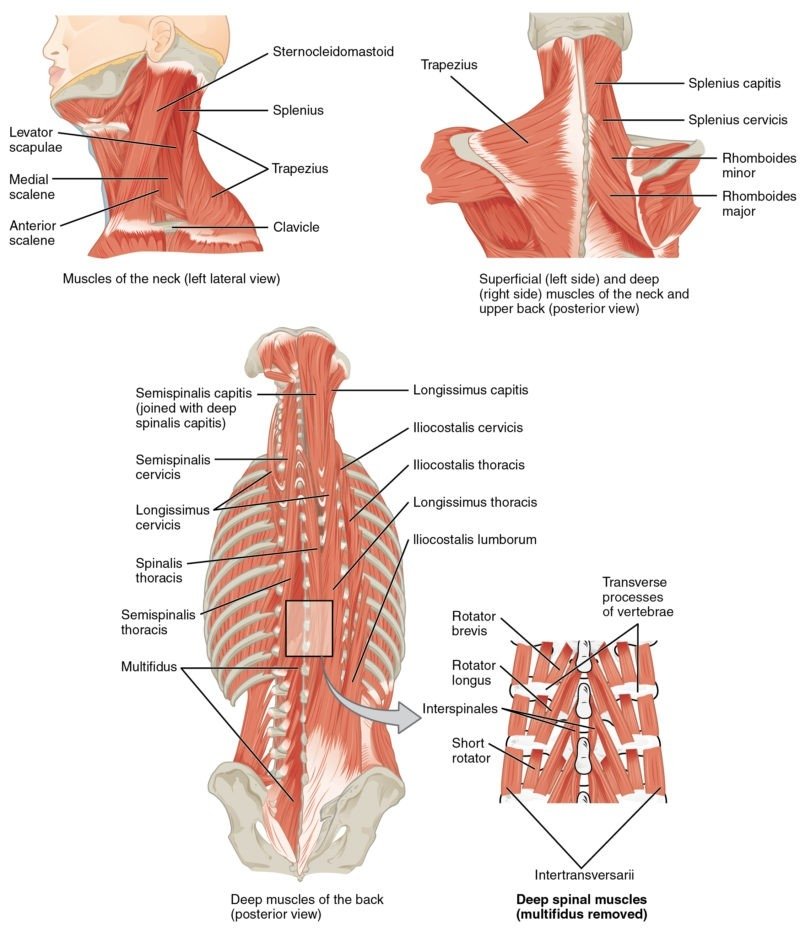
Back Muscles are separated into extrinsic and intrinsic components, which are based on their function in movement and embryological origin. The extrinsic muscles include the trapezius, latissimus dorsi, rhomboid major and minor, levator scapulae and the serratus posterior superior and inferior muscles. The principal function of the extrinsic muscles of the back is to move the upper extremity by controlling the movement of the scapula and humerus.

Types of Back Muscles

There are seven extrinsic muscles of the back –  the trapezius, the latissimus dorsi, the levator scapulae, the rhomboids (major and minor) and the serratus posterior (superior and inferior)

The trapezius

  • It is the most superficial muscle of the back is made up of two triangles that together make the shape of a trapezoid, thus its name.
  • This muscle originates from the center of the spinal column and skull; the fibers connect to the middle portion of the superior nuchal line, the external occipital protuberance, the ligament nuchae, and the apices of the spinous processes of C7-T12.
  • The fibers run laterally toward the shoulder where they attach. The superior fibers descend to connect to the posterior border of the distal 1/3 of the clavicle; the middle fibers run horizontally to connect to the superior portion of the scapular spine; the inferior fibers ascend toward the apex of the scapula.

Latissimus dorsi

  • It is the largest extrinsic back muscle, spanning across the entire lateral side of the back. It originates from the lateral sides of the spinous processes of T7 – T12, the thoracodorsal fascia, which connects to the spinous processes of the lumbar and sacral vertebrae, the posterior portion of the iliac crest, and proximal 1/3 of ribs 9 – 12.
  • The fibers ascend in a superolateral fashion towards its insertion point, the floor of the bicipital groove of the humerus.

 Levator scapulae

  • It is a thin muscle that descends from the neck to the scapula. It originates from the transverse processes of C1 (atlas), C2 (axis), C3, and C4.
  • The fibers run diagonally from these points to the medial scapular border just above where the spine of the scapula connects. Origination points of this muscle can vary in the neck and posterior skull.

The rhomboids

  • It has minor and major, these two muscles originate from the spines and supraspinous ligaments of the cervical and thoracic vertebrae.
  • Rhomboideus minor is the smaller of the two muscles and located superiorly. It originates from the seventh cervical vertebrae and first thoracic vertebrae and attaches to the medial border of the scapula at the point where the spine connects.
  • Rhomboid major takes its origin from the second to the fifth thoracic vertebrae and attaches just below the rhomboid minor on the medial border of the scapula.

The serratus posterior muscles

  • Separated into superior and inferior are attached to the spinous processes of the vertebrae and the ribs.
  • The superior muscle originates from the spinous processes of C7-T3 and attaches to ribs two through five.
  • The inferior muscle originates from T11-L1 and attaches to ribs 9-12.

Splenius capitis

  • Origin: Spinous processes of C7 vertebrae and T1-T3 (or T4) vertebrae and supraspinous ligaments
  • Insertion: Mastoid process and lateral third of the superior nuchal line
  • Relationships: Deep to the trapezius and superficial to semispinalis capitis and longissimus capitis
  • Forms a portion of the floor of the posterior triangle of the neck.
Action
  • Unilateral: rotation of the head to the ipsilateral side.
  • Bilateral: extension of the head.

Splenius cervicis

  • Origin: T3-T6 spinous processes
  • Insertion: transverse processes of atlas and axis, posterior tubercle of the C3 vertebra
  • Action:

    • Unilateral: rotation of the upper cervical vertebra
    • Bilateral: extension of the upper cervical spine
  • Relationships:

    • Deep to serratus posterior superior, rhomboids and trapezius
    • Superficial to parts of erector spinae and semispinalis muscles

Erector spinae

  • Three muscles that span the entire back comprise the erector spinae.  It divides into three regional groups, named for the region they span.
  • Action – It controls the forward flexion of the thorax which can occur secondary to gravity.  The actions of the cervical and capital groups are unknown.  These muscles are small when compared to the larger cervical muscle groups and have little force capacity
  • Relationships – Covered by thoracolumbar fascia, serratus posterior inferior, rhomboids, and splenii muscle groups

Spinalis /Spinalis thoracis

  • Most medial of erector spine in the thoracic region
  • Origin – Spinous processes of T11-L2
  • Insertion – Spinous processes of the upper thoracic vertebra
  • Blends with longissimus thoracis laterally

Spinalis services and capital are not well defined and are poorly developed. These fibers may be absent in some people.

  • Spinalis cervicis

    • Origin: ligamentum nuchae and C7 spinous process
    • Insertion: spinous processes of the axis and C3-C4
  • Spinalis capitis

    • Usually a few fibers of semispinalis capitis that inserts on the spinous processes of C7 and T1 (rather than the usual insertions on the thoracic transverse processes)

Longissimus

  • Longissimus capitis
    • Origin: C4-T4 transverse processes
    • Insertion: Posterior edge of the mastoid process
  • Longissimus cervicis
    • Origin: T1-T4 transverse processes
    • Insertion: Posterior tubercle of C2-C6 transverse processes
  • Longissimus thoracis
  • Contains lumbar and thoracic sections
  • Largest of erector spinae group
  • Origin: Transverse process at inferior vertebral levels
  • Insertion: Transverse process at superior vertebral levels and mastoid process

Iliocostalis

  • Most lateral of erector spinae
  • Attaches to ribs
  • Iliocostalis cervicis

    • Origin: Angle of ribs 3-6
    • Insertion: posterior tubercle of the transverse process of C4-C6
  • Iliocostalis thoracic
    • narrow, fusiform shape.
    • Origin: Angle of lower six ribs
    • Insertion: Transverse process of C7 and angles of upper six ribs
  • Iliocostalis lumborum

    • Contains lumbar and thoracic sections
    • Origin: Medial end and dorsal segment of the iliac crest
    • Insertion: L1-L4 lumbar transverse processes, the angle of ribs 4-12 and thoracolumbar fascia

 Transversospinalis Group

  • This group consists of muscles between a spinous process and the transverse process of a vertebra below
  • Grouped by length and region covered
  • Rotatores are deepest and shortest
    • Span 1-2 segments
    • Eleven pairs between T1-T12
    • Rotator brevis connects the transverse process of the lower vertebra to the lateral lamina of the upper vertebra immediately above.
    • Rotator longus connects the transverse process of the lower vertebra to the base of the spinous process of upper vertebra two levels above.
  • Multifidus can span 2-4 segments.

    • Covers lamina of vertebra
    • Origin: Sacrum & ilium, transverse processes of T1-L5 and articular processes of C4-C7
    • Insertion: Spinous processes 2-4 segments above origin
  • Semispinalis can span 4-6 segments.

    • Origin: Thoracic & cervical transverse processes
    • Insertion: Occipital bone and spinous processes in thoracic and cervical regions 4-6 segments above origin
  • The splenius cervicis and splenius capitis – may be absent or vary in the vertebral attachment.
  • Rotatores thoracic – may have one or more pairs absent at the upper or lower end of the thoracic vertebrae.

Nerves

The posterior, or dorsal, primary rami of the spinal nerves innervates only the intrinsic, or true, back muscles.

  • Splenius capitis – The lateral branches of the C2-C3 dorsal rami
  • Splenius cervicis – lateral branches of lower cervical dorsal rami
  • Erector spinae – At the lumbar level, the lateral branches of dorsal rami of the corresponding vertebrae level innervate the iliocostalis muscle.  The intermediate branches of the dorsal rami innervate the longissimus muscle.
  • Transversospinalis group: dorsal primary rami of C1-L5

Ventral rami of the spinal nerves innervate the extrinsic muscles (trapezius, latissimus dorsi, levator scapulae, and rhomboid muscles).

Blood Supply and Lymphatics

The deep cervical, posterior intercostal, subcostal or lumbar arteries provide the blood supply for all the muscle groups of the back.  Arterial supply will vary person-to-person.

References


Back Muscles

ByRx Harun

Which Muscle Are Called The Trunk Muscles

Which Muscle Are Called The Trunk Muscles/Trunk Muscles mean muscles of the trunk include those that move the vertebral column, the muscles that form the thoracic and abdominal walls, and those that cover the pelvic outlet. The erector spinae group of muscles on each side of the vertebral column is a large muscle mass that extends from the sacrum to the skull. These muscles are primarily responsible for extending the vertebral column to maintain an erect posture. The deep back muscles occupy the space between the spinous and transverse processes of adjacent vertebrae.

The muscles of the thoracic wall are involved primarily in the process of breathing. The intercostal muscles are located in spaces between the ribs. They contract during forced expiration. External intercostal muscles contract to elevate the ribs during the inspiration phase of breathing. The diaphragm is a dome-shaped muscle that forms a partition between the thorax and the abdomen. It has three openings in it for structures that have to pass from the thorax to the abdomen.

Which Muscle Are Called The Trunk Muscles

Trunk Muscles

Anterior Muscles

The anterior muscles of the torso (trunk) are those on the front of the body, including the muscles of the chest, abdomen, and pelvis.

Muscles of the Chest

Pectoral Muscles

  • Pectoral muscles lie in the chest and exert force through the shoulder to move the upper arm.

Pectoralis Major – The pectoralis major is a fan-shaped muscle covering the chest and comprised of clavicular and sternocostal regions.

  • Attachments: The clavicular region originates from the clavicle and the sternocostal region originates from the sternum and the fascia of the oblique muscles of the abdomen. Both attach to the humerus.
  • Actions: Adducts and rotates the upper arm.

Pectoralis Minor  The smaller pectoralis minor muscle lies beneath the pectoralis major.

  • Attachments: The pectoralis minor originates from the third to fifth ribs and attaches to the scapula.
  • Actions: Supports and depresses the scapula.

Serratus Anterior The serratus anterior is located in the lateral wall of the chest.

  • Attachments: The muscle is formed of several strips originating from the second to eighth ribs, each of which attaches to the scapula.
  • Actions: Supports the scapula, allowing for elevation of the upper arm.

Intercostal Muscles

Intercostal muscles of the anterior trunk – Deep muscles of the chest and front of the arm, with the boundaries of the axilla. The intercostals are muscles between the ribs that form the chest cavity wall. Lying below the pectoral muscles, the intercostal muscles from the chest wall and play a key role in respiration. All intercostal muscles originate on the lower border of a rib and attach to the upper border of the rib below.

External Intercostals  The external intercostals are the most superficial of the intercostal muscles. They are continuous with the external oblique muscle of the abdomen.

  • Actions: Elevate the ribs.

Internal Intercostals – Lying below the external intercostals, the internal intercostals are continuous with the internal oblique muscle of the abdomen.

  • Actions: Elevate or depress the ribs.

Innermost Intercostals The deepest lying of the intercostals, these muscles are similar in structure to the internal intercostals.

  • Actions: Elevate or depress the ribs.

Other Muscles

Diaphragm  The diaphragm is a large, flat, sheet-like muscle that extends horizontally underneath the rib cage.

Functionally, the diaphragm separates the thoracic cavity, containing the lungs and heart and enclosed by the rib cage from the abdominal cavity, which contains the digestive organs. The diaphragm’s position allows it to aid in respiration. When it contracts, it physically moves the lungs and deforms the volume of the thoracic cavity.

  • Attachments: The diaphragm has several points of origin along the sternum, the lower ribs, and the lower vertebrae. The muscle fibers combine into a central tendon, which ascends and attaches to the surface of the pericardium.
  • Actions: Contracts, flattening and increasing the volume of the thoracic cavity. Relaxes and returns to the original shape, reducing the volume of the thoracic cavity.

Muscles of the Abdomen

The skeletal muscles of the abdomen form part of the abdominal wall, which holds and protects the gastrointestinal system. Five muscles form the abdominal wall, divided into vertical and flat groups. The flat muscles act to flex, laterally flex, and rotate the trunk. The fibers run in different directions and cross each other, strengthening the abdominal wall. The vertical muscles aid in compressing the abdominal cavity, stabilizing the pelvis, and depressing the ribs when a person is walking. Toward the midline, the muscles form aponeuroses, which merge into the linea alba.

Location of the external obliques: Highlighted in orange, the external obliques lie inferior to the pectoral muscles

External Oblique – The external oblique is the largest and most superficial of the flat muscles.

  • Attachments: Originates from the lower ribs and attaches to the pelvis, forming an aponeurosis toward the midline and linea alba.

Internal Oblique – Lying deep to the external oblique, the internal oblique is smaller and thinner. Its fibers run perpendicular to the external oblique, improving the strength of the abdominal wall.

  • Attachments: Originates from the pelvis and thoracolumbar fascia, running through the back. Attaches to the lower ribs and forms an aponeurosis toward the midline and linea alba.

Transversus Abdominis The deepest of the flat muscles, the transversus abdominis consists of transversely-running fibers.

  • Attachments: Originates from the lower ribs, thoracolumbar fascia, and pelvis, forming an aponeurosis toward the midline and linea alba.

Rectus Abdominis A long vertical muscle that covers the abdomen, lying below the flat muscles. It is split through the midline by the linea alba formed from the aponeuroses of the abdominal muscles and separated by horizontal tendinous intersections which give rise to the six-pack.

  • Attachments: Originates from the pubis and attaches to the lower edge of the rib cage and sternum.

Pyramidalis  Lying superficial to the rectus abdominal,s the pyramidalis is a small, triangular vertical muscle.

  • Attachments: Originates from the pubis and attaches to the linea alba.


Posterior Muscles

Muscles of the posterior portion of the trunk include muscles of the back, suboccipital region, and perineum region.

Superficial Posterior Muscles

Location of the latissimus dorsi muscle – Highlighted in orange, the latissimus dorsi is a muscle of the posterior torso. The superficial posterior muscles are associated with the movement of the shoulder. As the name suggests, they are the most superficially located of the muscles covering the intermediate and intrinsic layers.

Trapezius – The trapezius is the most superficial muscle of the back and forms a broad flat triangle.

  • Attachments: The trapezius originates from the skull and spine of the upper back and neck. It attaches to the clavicle and scapula.
  • Actions: The superior region supports the arm and elevates and rotates the scapula, the intermediate region retracts the scapula, and the inferior region rotates and depresses the scapula.

Latissimus Dorsi  The latissimus dorsi originates from the lower back and covers a wide area.

  • Attachments: The latissimus dorsi originates from the lower spine and ribs and the upper pelvis and fascia of the deep trunk muscles. The muscle converges into a tendon attaching to the humerus.
  • Actions: Extends, adducts, and medially rotates the upper arm.

Levator Scapulae A small, strap-like muscle that joins the neck to the scapula.

  • Attachments: Originates from the side of the spine in the neck and attaches to the scapula.
  • Actions: Elevates the scapula.

Rhomboid Major  Sits inferiorly to the levator scapulae.

  • Attachments: Originates from the spine in the upper back and attaches to the scapula inferior to the levator scapulae attachment.
  • Actions: Retracts and rotates the scapula.

Rhomboid Minor  Sits between the levator scapulae and rhomboid major, with which it is paired in action and function, this retracts and rotates the scapula.

Intermediate Posterior Muscles

The intermediate muscles of the posterior contribute to the movements of the ribcage during respiration.

Serratus Posterior Superior – The serratus posterior superior is a thin, rectangular-shaped muscle lying below the rhomboid muscles.

  • Attachments: Originates from the lower spine and attaches to ribs 2 through 5.
  • Actions: Elevates ribs 2 through 5.

Serratus Posterior Inferior  The serratus posterior inferior is a broad muscle lying beneath the latissimus dorsi.

  • Attachments: Originates from the spine and attaches to ribs 9 through 12.
  • Actions: Depresses ribs 9 through 12.

Intrinsic Posterior Muscles

Which Muscle Are Called The Trunk Muscles

The intrinsic muscles of the posterior are responsible for maintaining posture and facilitating the movement of the head and neck. They are divided into three layers.

Superficial Layer

Location of the splenius muscle – The splenius capitis is highlighted in orange, with the splenius cervicis directly below. Two muscles in the superficial layer are responsible for the rotation of the head.

Splenius CapitisThis thick rectangular muscle is the most superior of the next muscles.

  • Attachments: Originates from the upper spine and attaches to the skull.
  • Actions: Rotates and extends the head and neck.

Splenius cervicis A small triangular-shaped muscle located immediately below the splenius capitis.

  • Attachments: Originates from the spine and attaches several vertebrae higher.
  • Actions: Rotates and extends the head and neck.

Intermediate Layer

Three columnar muscles in the intermediate layer are responsible for flexing and extending the neck as well as maintaining posture. All three originate from a common tendon associated with the pelvis.

Iliocostalis  The most laterally located of the three intermediate muscles.

  • Attachments: Originates from the common tendon and attaches to the ribs and lower neck.
  • Actions: Extends and controls abduction and adduction of the spine and neck.

Longissimus Located between the iliocostalis and spinal muscles, it is the largest of the intermediate layer muscles.

  • Attachments: Originates from the common tendon and attaches to the lower ribs, spine, and skull.
  • Actions: Extends and controls abduction and adduction of the spine and neck.

Spinalis  The most medially-located and smallest of the three intermediate layer muscles.

  • Attachments: Originates from the common tendon and attaches to the upper spine and skull.
  • Actions: Extends, flexes, and controls abduction and adduction of the spine and neck.

Deep Layer

Two muscles in the deep layer are responsible for the maintenance of posture and rotation of the neck.

Semispinalis  The semispinalis is the most superficial of the deep muscles.

  • Attachments: A broad origin on the upper regions of the spine, with each origin attaching several vertebrae higher or to the skull.
  • Actions: Extends and rotates the head and maintains posture.

Multifidus – The multifidus is located underneath the semispinalis muscle, and is key in maintaining posture.

  • Attachments: A broad origin up the length of the spine, with each origin attaching several vertebrae higher.
  • Actions: Maintains posture through the spine.

Location of the multifidus muscle – Highlighted in orange, the multifidus muscle is a muscle of the posterior trunk and lies interior to a majority of muscles.

Key Terms

  • Diaphragm – The key muscle in the control of respiration.
  • Abdominal wall – A layer of muscle and fascia that protects and encloses the abdominal cavity, allowing for its compression as well as torso movement.
  • Linea alba – A tough, fibrous line running down the midline of the abdomen, formed from the aponeuroses of the abdominal muscles.
  • Intercostal – Muscles forming the chest wall, which aids in respiration.
  • The back is characterized by numerous muscle groups which allow movement of the shoulder, head, and neck, as well as aid in respiration and maintain posture and balance.
  • The superficial muscles of the back are responsible for the movement of the shoulder.
  • The intermediate muscles of the back assist in the movement of the rib cage during respiration.
  • The intrinsic back muscles facilitate the movement of the head and neck and are fundamental in maintaining posture and balance.
  • The posterior or back muscles perform a wide range of functions, including the movement of the shoulder, head, and neck and assisting in respiration, posture, and balance. Posterior muscles are split into three groups depending on their physiological location.
  • The anterior muscles of the trunk (torso) are associated with the front of the body, include chest and abdominal muscles. Chest muscles function in respiration while abdominal muscles function in torso movement and in the maintenance of balance and posture.
  • The intercostal muscles from the chest wall and function in respiration.
  • The diaphragm is a sheet-like muscle that extends underneath the rib cage and aids in respiration by physically moving the lungs.
  • The obliques are abdominal muscles that assist during bending and twisting of the torso.
  • The rectus abdominis is the muscles often referred to as the “six-pack abs” and is involved in numerous aspects of trunk stabilization and bending.

Frequently Asking  Muscle of Face and Neck

  • Anterior scalene – a muscle anterior to the middle scalene
  • Appendicular – of the arms and legs axial of the trunk and head
  • Buccinator – the muscle that compresses the cheek
  • Corrugator supercilii – prime mover of the eyebrows
  • Deglutition – swallowing
  • Digastric – a muscle that has anterior and posterior bellies and elevates the hyoid bone and larynx when one swallows; it also depresses the mandible
  • Epicranial aponeurosis – (also, galea aponeurosis) flat broad tendon that connects the frontalis and occipitalis
  • Erector spinae group – large muscle mass of the back; primary extensor of the vertebral column
  • Extrinsic eye muscles – originate outside the eye and insert into the outer surface of the white of the eye, and create eyeball movement
  • Frontalis – the front part of the occipitofrontalis muscle
  • Genioglossus – the muscle that originates on the mandible and allows the tongue to move downward and forward
  • Geniohyoid – the muscle that depresses the mandible, and raises and pulls the hyoid bone anteriorly
  • Hyoglossus – a muscle that originates on the hyoid bone to move the tongue downward and flatten it
  • Iliocostalis cervicis – the muscle of the iliocostalis group associated with the cervical region
  • Iliocostalis group – laterally placed muscles of the erector spinae
  • Iliocostalis lumborum – the muscle of the iliocostalis group associated with the lumbar region
  • Iliocostalis thoracic – the muscle of the iliocostalis group associated with the thoracic region
  • Infrahyoid muscles – anterior neck muscles that are attached to, and inferior to the hyoid bone
  • Lateral pterygoid – the muscle that moves the mandible from side to side
  • Longissimus capitis – the muscle of the longissimus group associated with the head region
  • Longissimus cervicis – the muscle of the longissimus group associated with the cervical region
  • Longissimus group – intermediately placed muscles of the erector spinae
  • Longissimus thoracis – the muscle of the longissimus group associated with the thoracic region
  • Masseter – main muscle for chewing that elevates the mandible to close the mouth
  • Mastication – chewing
  • Medial pterygoid – the muscle that moves the mandible from side to side
  • Middle scalene – longest scalene muscle, located between the anterior and posterior scalenes
  • Multifidus – the muscle of the lumbar region that helps extend and laterally flex the vertebral column
  • Mylohyoid – the muscle that lifts the hyoid bone and helps press the tongue to the top of the mouth
  • Occipitalis – posterior part of the occipitofrontalis muscle
  • Occipitofrontalis – the muscle that makes up the scalp with a frontal belly and an occipital belly
  • Omohyoid – a muscle that has superior and inferior bellies and depresses the hyoid bone
  • Orbicularis oculi – a circular muscle that closes the eye
  • Orbicularis oris – a circular muscle that moves the lips
  • Palatoglossus – the muscle that originates on the soft palate to elevate the back of the tongue
  • Posterior scalene – smallest scalene muscle, located posterior to the middle scalene
  • Scalene muscles – flex, laterally flex, and rotate the head; contribute to deep inhalation
  • Segmental muscle group – interspinal and intertransversarii muscles that bring together the spinous and transverse processes of each consecutive vertebra
  • Semispinalis capitis – transversospinales muscle associated with the head region
  • Semispinalis services – transversospinales muscle associated with the cervical region
  • Semispinalis thoracic – transversospinales muscle associated with the thoracic region
  • Spinalis capitis – the muscle of the spinal group associated with the head region
  • Spinalis cervicis – the muscle of the spinal group associated with the cervical region
  • Spinalis group – medially placed muscles of the erector spinae
  • Spinalis thoracis – the muscle of the spinal group associated with the thoracic region
  • Splenius – posterior neck muscles; includes the splenius capitis and splenius cervicis
  • Splenius capitis – neck muscle that inserts into the head region
  • Splenius cervicis – neck muscle that inserts into the cervical region
  • Sternocleidomastoid – the major muscle that laterally flexes and rotates the head
  • Sternohyoid – a muscle that depresses the hyoid bone
  • Sternothyroid – a muscle that depresses the larynx’s thyroid cartilage
  • Styloglossus – a muscle that originates on the styloid bone, and allows upward and backward motion of the tongue
  • Stylohyoid – a muscle that elevates the hyoid bone posteriorly
  • Suprahyoid muscles – neck muscles that are superior to the hyoid bone
  • Temporalis – a muscle that retracts the mandible
  • Thyrohyoid – a muscle that depresses the hyoid bone and elevates the larynx’s thyroid cartilage
  • Transversospinales – muscles that originate at the transverse processes and insert at the spinous processes of the vertebrae.


References


ByRx Harun

What are the muscles on the side of your torso?

What are the muscles on the side of your torso?/Trunk Muscles mean muscles of the trunk include those that move the vertebral column, the muscles that form the thoracic and abdominal walls, and those that cover the pelvic outlet. The erector spinae group of muscles on each side of the vertebral column is a large muscle mass that extends from the sacrum to the skull. These muscles are primarily responsible for extending the vertebral column to maintain an erect posture. The deep back muscles occupy the space between the spinous and transverse processes of adjacent vertebrae.

The muscles of the thoracic wall are involved primarily in the process of breathing. The intercostal muscles are located in spaces between the ribs. They contract during forced expiration. External intercostal muscles contract to elevate the ribs during the inspiration phase of breathing. The diaphragm is a dome-shaped muscle that forms a partition between the thorax and the abdomen. It has three openings in it for structures that have to pass from the thorax to the abdomen.

What are the muscles on the side of your torso?/Trunk Muscles

Trunk Muscles

Anterior Muscles

The anterior muscles of the torso (trunk) are those on the front of the body, including the muscles of the chest, abdomen, and pelvis.

Muscles of the Chest

Pectoral Muscles

  • Pectoral muscles lie in the chest and exert force through the shoulder to move the upper arm.

Pectoralis Major – The pectoralis major is a fan-shaped muscle covering the chest and comprised of clavicular and sternocostal regions.

  • Attachments: The clavicular region originates from the clavicle and the sternocostal region originates from the sternum and the fascia of the oblique muscles of the abdomen. Both attach to the humerus.
  • Actions: Adducts and rotates the upper arm.

Pectoralis Minor  The smaller pectoralis minor muscle lies beneath the pectoralis major.

  • Attachments: The pectoralis minor originates from the third to fifth ribs and attaches to the scapula.
  • Actions: Supports and depresses the scapula.

Serratus Anterior The serratus anterior is located in the lateral wall of the chest.

  • Attachments: The muscle is formed of several strips originating from the second to eighth ribs, each of which attaches to the scapula.
  • Actions: Supports the scapula, allowing for elevation of the upper arm.

Intercostal Muscles

Intercostal muscles of the anterior trunk – Deep muscles of the chest and front of the arm, with the boundaries of the axilla. The intercostals are muscles between the ribs that form the chest cavity wall. Lying below the pectoral muscles, the intercostal muscles from the chest wall and play a key role in respiration. All intercostal muscles originate on the lower border of a rib and attach to the upper border of the rib below.

External Intercostals  The external intercostals are the most superficial of the intercostal muscles. They are continuous with the external oblique muscle of the abdomen.

  • Actions: Elevate the ribs.

Internal Intercostals – Lying below the external intercostals, the internal intercostals are continuous with the internal oblique muscle of the abdomen.

  • Actions: Elevate or depress the ribs.

Innermost Intercostals The deepest lying of the intercostals, these muscles are similar in structure to the internal intercostals.

  • Actions: Elevate or depress the ribs.

Other Muscles

Diaphragm  The diaphragm is a large, flat, sheet-like muscle that extends horizontally underneath the rib cage.

Functionally, the diaphragm separates the thoracic cavity, containing the lungs and heart and enclosed by the rib cage from the abdominal cavity, which contains the digestive organs. The diaphragm’s position allows it to aid in respiration. When it contracts, it physically moves the lungs and deforms the volume of the thoracic cavity.

  • Attachments: The diaphragm has several points of origin along the sternum, the lower ribs, and the lower vertebrae. The muscle fibers combine into a central tendon, which ascends and attaches to the surface of the pericardium.
  • Actions: Contracts, flattening and increasing the volume of the thoracic cavity. Relaxes and returns to the original shape, reducing the volume of the thoracic cavity.

Muscles of the Abdomen

The skeletal muscles of the abdomen form part of the abdominal wall, which holds and protects the gastrointestinal system. Five muscles form the abdominal wall, divided into vertical and flat groups. The flat muscles act to flex, laterally flex, and rotate the trunk. The fibers run in different directions and cross each other, strengthening the abdominal wall. The vertical muscles aid in compressing the abdominal cavity, stabilizing the pelvis, and depressing the ribs when a person is walking. Toward the midline, the muscles form aponeuroses, which merge into the linea alba.

Location of the external obliques: Highlighted in orange, the external obliques lie inferior to the pectoral muscles

External Oblique – The external oblique is the largest and most superficial of the flat muscles.

  • Attachments: Originates from the lower ribs and attaches to the pelvis, forming an aponeurosis toward the midline and linea alba.

Internal Oblique – Lying deep to the external oblique, the internal oblique is smaller and thinner. Its fibers run perpendicular to the external oblique, improving the strength of the abdominal wall.

  • Attachments: Originates from the pelvis and thoracolumbar fascia, running through the back. Attaches to the lower ribs and forms an aponeurosis toward the midline and linea alba.

Transversus Abdominis The deepest of the flat muscles, the transversus abdominis consists of transversely-running fibers.

  • Attachments: Originates from the lower ribs, thoracolumbar fascia, and pelvis, forming an aponeurosis toward the midline and linea alba.

Rectus Abdominis A long vertical muscle that covers the abdomen, lying below the flat muscles. It is split through the midline by the linea alba formed from the aponeuroses of the abdominal muscles and separated by horizontal tendinous intersections which give rise to the six-pack.

  • Attachments: Originates from the pubis and attaches to the lower edge of the rib cage and sternum.

Pyramidalis  Lying superficial to the rectus abdominal,s the pyramidalis is a small, triangular vertical muscle.

  • Attachments: Originates from the pubis and attaches to the linea alba.


Posterior Muscles

Muscles of the posterior portion of the trunk include muscles of the back, suboccipital region, and perineum region.

Superficial Posterior Muscles

Location of the latissimus dorsi muscle – Highlighted in orange, the latissimus dorsi is a muscle of the posterior torso. The superficial posterior muscles are associated with the movement of the shoulder. As the name suggests, they are the most superficially located of the muscles covering the intermediate and intrinsic layers.

Trapezius – The trapezius is the most superficial muscle of the back and forms a broad flat triangle.

  • Attachments: The trapezius originates from the skull and spine of the upper back and neck. It attaches to the clavicle and scapula.
  • Actions: The superior region supports the arm and elevates and rotates the scapula, the intermediate region retracts the scapula, and the inferior region rotates and depresses the scapula.

Latissimus Dorsi  The latissimus dorsi originates from the lower back and covers a wide area.

  • Attachments: The latissimus dorsi originates from the lower spine and ribs and the upper pelvis and fascia of the deep trunk muscles. The muscle converges into a tendon attaching to the humerus.
  • Actions: Extends, adducts, and medially rotates the upper arm.

Levator Scapulae A small, strap-like muscle that joins the neck to the scapula.

  • Attachments: Originates from the side of the spine in the neck and attaches to the scapula.
  • Actions: Elevates the scapula.

Rhomboid Major  Sits inferiorly to the levator scapulae.

  • Attachments: Originates from the spine in the upper back and attaches to the scapula inferior to the levator scapulae attachment.
  • Actions: Retracts and rotates the scapula.

Rhomboid Minor  Sits between the levator scapulae and rhomboid major, with which it is paired in action and function, this retracts and rotates the scapula.

Intermediate Posterior Muscles

The intermediate muscles of the posterior contribute to the movements of the ribcage during respiration.

Serratus Posterior Superior – The serratus posterior superior is a thin, rectangular-shaped muscle lying below the rhomboid muscles.

  • Attachments: Originates from the lower spine and attaches to ribs 2 through 5.
  • Actions: Elevates ribs 2 through 5.

Serratus Posterior Inferior  The serratus posterior inferior is a broad muscle lying beneath the latissimus dorsi.

  • Attachments: Originates from the spine and attaches to ribs 9 through 12.
  • Actions: Depresses ribs 9 through 12.

Intrinsic Posterior Muscles

What are the muscles on the side of your torso?/Trunk Muscles

The intrinsic muscles of the posterior are responsible for maintaining posture and facilitating the movement of the head and neck. They are divided into three layers.

Superficial Layer

Location of the splenius muscle – The splenius capitis is highlighted in orange, with the splenius cervicis directly below. Two muscles in the superficial layer are responsible for the rotation of the head.

Splenius CapitisThis thick rectangular muscle is the most superior of the next muscles.

  • Attachments: Originates from the upper spine and attaches to the skull.
  • Actions: Rotates and extends the head and neck.

Splenius cervicis A small triangular-shaped muscle located immediately below the splenius capitis.

  • Attachments: Originates from the spine and attaches several vertebrae higher.
  • Actions: Rotates and extends the head and neck.

Intermediate Layer

Three columnar muscles in the intermediate layer are responsible for flexing and extending the neck as well as maintaining posture. All three originate from a common tendon associated with the pelvis.

Iliocostalis  The most laterally located of the three intermediate muscles.

  • Attachments: Originates from the common tendon and attaches to the ribs and lower neck.
  • Actions: Extends and controls abduction and adduction of the spine and neck.

Longissimus Located between the iliocostalis and spinal muscles, it is the largest of the intermediate layer muscles.

  • Attachments: Originates from the common tendon and attaches to the lower ribs, spine, and skull.
  • Actions: Extends and controls abduction and adduction of the spine and neck.

Spinalis  The most medially-located and smallest of the three intermediate layer muscles.

  • Attachments: Originates from the common tendon and attaches to the upper spine and skull.
  • Actions: Extends, flexes, and controls abduction and adduction of the spine and neck.

Deep Layer

Two muscles in the deep layer are responsible for the maintenance of posture and rotation of the neck.

Semispinalis  The semispinalis is the most superficial of the deep muscles.

  • Attachments: A broad origin on the upper regions of the spine, with each origin attaching several vertebrae higher or to the skull.
  • Actions: Extends and rotates the head and maintains posture.

Multifidus – The multifidus is located underneath the semispinalis muscle, and is key in maintaining posture.

  • Attachments: A broad origin up the length of the spine, with each origin attaching several vertebrae higher.
  • Actions: Maintains posture through the spine.

Location of the multifidus muscle – Highlighted in orange, the multifidus muscle is a muscle of the posterior trunk and lies interior to a majority of muscles.

Key Terms

  • Diaphragm – The key muscle in the control of respiration.
  • Abdominal wall – A layer of muscle and fascia that protects and encloses the abdominal cavity, allowing for its compression as well as torso movement.
  • Linea alba – A tough, fibrous line running down the midline of the abdomen, formed from the aponeuroses of the abdominal muscles.
  • Intercostal – Muscles forming the chest wall, which aids in respiration.
  • The back is characterized by numerous muscle groups which allow movement of the shoulder, head, and neck, as well as aid in respiration and maintain posture and balance.
  • The superficial muscles of the back are responsible for the movement of the shoulder.
  • The intermediate muscles of the back assist in the movement of the rib cage during respiration.
  • The intrinsic back muscles facilitate the movement of the head and neck and are fundamental in maintaining posture and balance.
  • The posterior or back muscles perform a wide range of functions, including the movement of the shoulder, head, and neck and assisting in respiration, posture, and balance. Posterior muscles are split into three groups depending on their physiological location.
  • The anterior muscles of the trunk (torso) are associated with the front of the body, include chest and abdominal muscles. Chest muscles function in respiration while abdominal muscles function in torso movement and in the maintenance of balance and posture.
  • The intercostal muscles from the chest wall and function in respiration.
  • The diaphragm is a sheet-like muscle that extends underneath the rib cage and aids in respiration by physically moving the lungs.
  • The obliques are abdominal muscles that assist during bending and twisting of the torso.
  • The rectus abdominis is the muscles often referred to as the “six-pack abs” and is involved in numerous aspects of trunk stabilization and bending.

Frequently Asking  Muscle of Face and Neck

  • Anterior scalene – a muscle anterior to the middle scalene
  • Appendicular – of the arms and legs axial of the trunk and head
  • Buccinator – the muscle that compresses the cheek
  • Corrugator supercilii – prime mover of the eyebrows
  • Deglutition – swallowing
  • Digastric – a muscle that has anterior and posterior bellies and elevates the hyoid bone and larynx when one swallows; it also depresses the mandible
  • Epicranial aponeurosis – (also, galea aponeurosis) flat broad tendon that connects the frontalis and occipitalis
  • Erector spinae group – large muscle mass of the back; primary extensor of the vertebral column
  • Extrinsic eye muscles – originate outside the eye and insert into the outer surface of the white of the eye, and create eyeball movement
  • Frontalis – the front part of the occipitofrontalis muscle
  • Genioglossus – the muscle that originates on the mandible and allows the tongue to move downward and forward
  • Geniohyoid – the muscle that depresses the mandible, and raises and pulls the hyoid bone anteriorly
  • Hyoglossus – a muscle that originates on the hyoid bone to move the tongue downward and flatten it
  • Iliocostalis cervicis – the muscle of the iliocostalis group associated with the cervical region
  • Iliocostalis group – laterally placed muscles of the erector spinae
  • Iliocostalis lumborum – the muscle of the iliocostalis group associated with the lumbar region
  • Iliocostalis thoracic – the muscle of the iliocostalis group associated with the thoracic region
  • Infrahyoid muscles – anterior neck muscles that are attached to, and inferior to the hyoid bone
  • Lateral pterygoid – the muscle that moves the mandible from side to side
  • Longissimus capitis – the muscle of the longissimus group associated with the head region
  • Longissimus cervicis – the muscle of the longissimus group associated with the cervical region
  • Longissimus group – intermediately placed muscles of the erector spinae
  • Longissimus thoracis – the muscle of the longissimus group associated with the thoracic region
  • Masseter – main muscle for chewing that elevates the mandible to close the mouth
  • Mastication – chewing
  • Medial pterygoid – the muscle that moves the mandible from side to side
  • Middle scalene – longest scalene muscle, located between the anterior and posterior scalenes
  • Multifidus – the muscle of the lumbar region that helps extend and laterally flex the vertebral column
  • Mylohyoid – the muscle that lifts the hyoid bone and helps press the tongue to the top of the mouth
  • Occipitalis – posterior part of the occipitofrontalis muscle
  • Occipitofrontalis – the muscle that makes up the scalp with a frontal belly and an occipital belly
  • Omohyoid – a muscle that has superior and inferior bellies and depresses the hyoid bone
  • Orbicularis oculi – a circular muscle that closes the eye
  • Orbicularis oris – a circular muscle that moves the lips
  • Palatoglossus – the muscle that originates on the soft palate to elevate the back of the tongue
  • Posterior scalene – smallest scalene muscle, located posterior to the middle scalene
  • Scalene muscles – flex, laterally flex, and rotate the head; contribute to deep inhalation
  • Segmental muscle group – interspinal and intertransversarii muscles that bring together the spinous and transverse processes of each consecutive vertebra
  • Semispinalis capitis – transversospinales muscle associated with the head region
  • Semispinalis services – transversospinales muscle associated with the cervical region
  • Semispinalis thoracic – transversospinales muscle associated with the thoracic region
  • Spinalis capitis – the muscle of the spinal group associated with the head region
  • Spinalis cervicis – the muscle of the spinal group associated with the cervical region
  • Spinalis group – medially placed muscles of the erector spinae
  • Spinalis thoracis – the muscle of the spinal group associated with the thoracic region
  • Splenius – posterior neck muscles; includes the splenius capitis and splenius cervicis
  • Splenius capitis – neck muscle that inserts into the head region
  • Splenius cervicis – neck muscle that inserts into the cervical region
  • Sternocleidomastoid – the major muscle that laterally flexes and rotates the head
  • Sternohyoid – a muscle that depresses the hyoid bone
  • Sternothyroid – a muscle that depresses the larynx’s thyroid cartilage
  • Styloglossus – a muscle that originates on the styloid bone, and allows upward and backward motion of the tongue
  • Stylohyoid – a muscle that elevates the hyoid bone posteriorly
  • Suprahyoid muscles – neck muscles that are superior to the hyoid bone
  • Temporalis – a muscle that retracts the mandible
  • Thyrohyoid – a muscle that depresses the hyoid bone and elevates the larynx’s thyroid cartilage
  • Transversospinales – muscles that originate at the transverse processes and insert at the spinous processes of the vertebrae.


References


ByRx Harun

What muscle flexes the trunk? Functions, Origin

What muscle flexes the trunk?/Trunk Muscles mean muscles of the trunk include those that move the vertebral column, the muscles that form the thoracic and abdominal walls, and those that cover the pelvic outlet. The erector spinae group of muscles on each side of the vertebral column is a large muscle mass that extends from the sacrum to the skull. These muscles are primarily responsible for extending the vertebral column to maintain an erect posture. The deep back muscles occupy the space between the spinous and transverse processes of adjacent vertebrae.

The muscles of the thoracic wall are involved primarily in the process of breathing. The intercostal muscles are located in spaces between the ribs. They contract during forced expiration. External intercostal muscles contract to elevate the ribs during the inspiration phase of breathing. The diaphragm is a dome-shaped muscle that forms a partition between the thorax and the abdomen. It has three openings in it for structures that have to pass from the thorax to the abdomen.

What muscle flexes the trunk?

Trunk Muscles

Anterior Muscles

The anterior muscles of the torso (trunk) are those on the front of the body, including the muscles of the chest, abdomen, and pelvis.

Muscles of the Chest

Pectoral Muscles

  • Pectoral muscles lie in the chest and exert force through the shoulder to move the upper arm.

Pectoralis Major – The pectoralis major is a fan-shaped muscle covering the chest and comprised of clavicular and sternocostal regions.

  • Attachments: The clavicular region originates from the clavicle and the sternocostal region originates from the sternum and the fascia of the oblique muscles of the abdomen. Both attach to the humerus.
  • Actions: Adducts and rotates the upper arm.

Pectoralis Minor  The smaller pectoralis minor muscle lies beneath the pectoralis major.

  • Attachments: The pectoralis minor originates from the third to fifth ribs and attaches to the scapula.
  • Actions: Supports and depresses the scapula.

Serratus Anterior The serratus anterior is located in the lateral wall of the chest.

  • Attachments: The muscle is formed of several strips originating from the second to eighth ribs, each of which attaches to the scapula.
  • Actions: Supports the scapula, allowing for elevation of the upper arm.

Intercostal Muscles

Intercostal muscles of the anterior trunk – Deep muscles of the chest and front of the arm, with the boundaries of the axilla. The intercostals are muscles between the ribs that form the chest cavity wall. Lying below the pectoral muscles, the intercostal muscles from the chest wall and play a key role in respiration. All intercostal muscles originate on the lower border of a rib and attach to the upper border of the rib below.

External Intercostals  The external intercostals are the most superficial of the intercostal muscles. They are continuous with the external oblique muscle of the abdomen.

  • Actions: Elevate the ribs.

Internal Intercostals – Lying below the external intercostals, the internal intercostals are continuous with the internal oblique muscle of the abdomen.

  • Actions: Elevate or depress the ribs.

Innermost Intercostals The deepest lying of the intercostals, these muscles are similar in structure to the internal intercostals.

  • Actions: Elevate or depress the ribs.

Other Muscles

Diaphragm  The diaphragm is a large, flat, sheet-like muscle that extends horizontally underneath the rib cage.

Functionally, the diaphragm separates the thoracic cavity, containing the lungs and heart and enclosed by the rib cage from the abdominal cavity, which contains the digestive organs. The diaphragm’s position allows it to aid in respiration. When it contracts, it physically moves the lungs and deforms the volume of the thoracic cavity.

  • Attachments: The diaphragm has several points of origin along the sternum, the lower ribs, and the lower vertebrae. The muscle fibers combine into a central tendon, which ascends and attaches to the surface of the pericardium.
  • Actions: Contracts, flattening and increasing the volume of the thoracic cavity. Relaxes and returns to the original shape, reducing the volume of the thoracic cavity.

Muscles of the Abdomen

The skeletal muscles of the abdomen form part of the abdominal wall, which holds and protects the gastrointestinal system. Five muscles form the abdominal wall, divided into vertical and flat groups. The flat muscles act to flex, laterally flex, and rotate the trunk. The fibers run in different directions and cross each other, strengthening the abdominal wall. The vertical muscles aid in compressing the abdominal cavity, stabilizing the pelvis, and depressing the ribs when a person is walking. Toward the midline, the muscles form aponeuroses, which merge into the linea alba.

Location of the external obliques: Highlighted in orange, the external obliques lie inferior to the pectoral muscles

External Oblique – The external oblique is the largest and most superficial of the flat muscles.

  • Attachments: Originates from the lower ribs and attaches to the pelvis, forming an aponeurosis toward the midline and linea alba.

Internal Oblique – Lying deep to the external oblique, the internal oblique is smaller and thinner. Its fibers run perpendicular to the external oblique, improving the strength of the abdominal wall.

  • Attachments: Originates from the pelvis and thoracolumbar fascia, running through the back. Attaches to the lower ribs and forms an aponeurosis toward the midline and linea alba.

Transversus Abdominis The deepest of the flat muscles, the transversus abdominis consists of transversely-running fibers.

  • Attachments: Originates from the lower ribs, thoracolumbar fascia, and pelvis, forming an aponeurosis toward the midline and linea alba.

Rectus Abdominis A long vertical muscle that covers the abdomen, lying below the flat muscles. It is split through the midline by the linea alba formed from the aponeuroses of the abdominal muscles and separated by horizontal tendinous intersections which give rise to the six-pack.

  • Attachments: Originates from the pubis and attaches to the lower edge of the rib cage and sternum.

Pyramidalis  Lying superficial to the rectus abdominal,s the pyramidalis is a small, triangular vertical muscle.

  • Attachments: Originates from the pubis and attaches to the linea alba.


Posterior Muscles

Muscles of the posterior portion of the trunk include muscles of the back, suboccipital region, and perineum region.

Superficial Posterior Muscles

Location of the latissimus dorsi muscle – Highlighted in orange, the latissimus dorsi is a muscle of the posterior torso. The superficial posterior muscles are associated with the movement of the shoulder. As the name suggests, they are the most superficially located of the muscles covering the intermediate and intrinsic layers.

Trapezius – The trapezius is the most superficial muscle of the back and forms a broad flat triangle.

  • Attachments: The trapezius originates from the skull and spine of the upper back and neck. It attaches to the clavicle and scapula.
  • Actions: The superior region supports the arm and elevates and rotates the scapula, the intermediate region retracts the scapula, and the inferior region rotates and depresses the scapula.

Latissimus Dorsi  The latissimus dorsi originates from the lower back and covers a wide area.

  • Attachments: The latissimus dorsi originates from the lower spine and ribs and the upper pelvis and fascia of the deep trunk muscles. The muscle converges into a tendon attaching to the humerus.
  • Actions: Extends, adducts, and medially rotates the upper arm.

Levator Scapulae A small, strap-like muscle that joins the neck to the scapula.

  • Attachments: Originates from the side of the spine in the neck and attaches to the scapula.
  • Actions: Elevates the scapula.

Rhomboid Major  Sits inferiorly to the levator scapulae.

  • Attachments: Originates from the spine in the upper back and attaches to the scapula inferior to the levator scapulae attachment.
  • Actions: Retracts and rotates the scapula.

Rhomboid Minor  Sits between the levator scapulae and rhomboid major, with which it is paired in action and function, this retracts and rotates the scapula.

Intermediate Posterior Muscles

The intermediate muscles of the posterior contribute to the movements of the ribcage during respiration.

Serratus Posterior Superior – The serratus posterior superior is a thin, rectangular-shaped muscle lying below the rhomboid muscles.

  • Attachments: Originates from the lower spine and attaches to ribs 2 through 5.
  • Actions: Elevates ribs 2 through 5.

Serratus Posterior Inferior  The serratus posterior inferior is a broad muscle lying beneath the latissimus dorsi.

  • Attachments: Originates from the spine and attaches to ribs 9 through 12.
  • Actions: Depresses ribs 9 through 12.

Intrinsic Posterior Muscles

What muscle flexes the trunk?

The intrinsic muscles of the posterior are responsible for maintaining posture and facilitating the movement of the head and neck. They are divided into three layers.

Superficial Layer

Location of the splenius muscle – The splenius capitis is highlighted in orange, with the splenius cervicis directly below. Two muscles in the superficial layer are responsible for the rotation of the head.

Splenius CapitisThis thick rectangular muscle is the most superior of the next muscles.

  • Attachments: Originates from the upper spine and attaches to the skull.
  • Actions: Rotates and extends the head and neck.

Splenius cervicis A small triangular-shaped muscle located immediately below the splenius capitis.

  • Attachments: Originates from the spine and attaches several vertebrae higher.
  • Actions: Rotates and extends the head and neck.

Intermediate Layer

Three columnar muscles in the intermediate layer are responsible for flexing and extending the neck as well as maintaining posture. All three originate from a common tendon associated with the pelvis.

Iliocostalis  The most laterally located of the three intermediate muscles.

  • Attachments: Originates from the common tendon and attaches to the ribs and lower neck.
  • Actions: Extends and controls abduction and adduction of the spine and neck.

Longissimus Located between the iliocostalis and spinal muscles, it is the largest of the intermediate layer muscles.

  • Attachments: Originates from the common tendon and attaches to the lower ribs, spine, and skull.
  • Actions: Extends and controls abduction and adduction of the spine and neck.

Spinalis  The most medially-located and smallest of the three intermediate layer muscles.

  • Attachments: Originates from the common tendon and attaches to the upper spine and skull.
  • Actions: Extends, flexes, and controls abduction and adduction of the spine and neck.

Deep Layer

Two muscles in the deep layer are responsible for the maintenance of posture and rotation of the neck.

Semispinalis  The semispinalis is the most superficial of the deep muscles.

  • Attachments: A broad origin on the upper regions of the spine, with each origin attaching several vertebrae higher or to the skull.
  • Actions: Extends and rotates the head and maintains posture.

Multifidus – The multifidus is located underneath the semispinalis muscle, and is key in maintaining posture.

  • Attachments: A broad origin up the length of the spine, with each origin attaching several vertebrae higher.
  • Actions: Maintains posture through the spine.

Location of the multifidus muscle – Highlighted in orange, the multifidus muscle is a muscle of the posterior trunk and lies interior to a majority of muscles.

Key Terms

  • Diaphragm – The key muscle in the control of respiration.
  • Abdominal wall – A layer of muscle and fascia that protects and encloses the abdominal cavity, allowing for its compression as well as torso movement.
  • Linea alba – A tough, fibrous line running down the midline of the abdomen, formed from the aponeuroses of the abdominal muscles.
  • Intercostal – Muscles forming the chest wall, which aids in respiration.
  • The back is characterized by numerous muscle groups which allow movement of the shoulder, head, and neck, as well as aid in respiration and maintain posture and balance.
  • The superficial muscles of the back are responsible for the movement of the shoulder.
  • The intermediate muscles of the back assist in the movement of the rib cage during respiration.
  • The intrinsic back muscles facilitate the movement of the head and neck and are fundamental in maintaining posture and balance.
  • The posterior or back muscles perform a wide range of functions, including the movement of the shoulder, head, and neck and assisting in respiration, posture, and balance. Posterior muscles are split into three groups depending on their physiological location.
  • The anterior muscles of the trunk (torso) are associated with the front of the body, include chest and abdominal muscles. Chest muscles function in respiration while abdominal muscles function in torso movement and in the maintenance of balance and posture.
  • The intercostal muscles from the chest wall and function in respiration.
  • The diaphragm is a sheet-like muscle that extends underneath the rib cage and aids in respiration by physically moving the lungs.
  • The obliques are abdominal muscles that assist during bending and twisting of the torso.
  • The rectus abdominis is the muscles often referred to as the “six-pack abs” and is involved in numerous aspects of trunk stabilization and bending.

Frequently Asking  Muscle of Face and Neck

  • Anterior scalene – a muscle anterior to the middle scalene
  • Appendicular – of the arms and legs axial of the trunk and head
  • Buccinator – the muscle that compresses the cheek
  • Corrugator supercilii – prime mover of the eyebrows
  • Deglutition – swallowing
  • Digastric – a muscle that has anterior and posterior bellies and elevates the hyoid bone and larynx when one swallows; it also depresses the mandible
  • Epicranial aponeurosis – (also, galea aponeurosis) flat broad tendon that connects the frontalis and occipitalis
  • Erector spinae group – large muscle mass of the back; primary extensor of the vertebral column
  • Extrinsic eye muscles – originate outside the eye and insert into the outer surface of the white of the eye, and create eyeball movement
  • Frontalis – the front part of the occipitofrontalis muscle
  • Genioglossus – the muscle that originates on the mandible and allows the tongue to move downward and forward
  • Geniohyoid – the muscle that depresses the mandible, and raises and pulls the hyoid bone anteriorly
  • Hyoglossus – a muscle that originates on the hyoid bone to move the tongue downward and flatten it
  • Iliocostalis cervicis – the muscle of the iliocostalis group associated with the cervical region
  • Iliocostalis group – laterally placed muscles of the erector spinae
  • Iliocostalis lumborum – the muscle of the iliocostalis group associated with the lumbar region
  • Iliocostalis thoracic – the muscle of the iliocostalis group associated with the thoracic region
  • Infrahyoid muscles – anterior neck muscles that are attached to, and inferior to the hyoid bone
  • Lateral pterygoid – the muscle that moves the mandible from side to side
  • Longissimus capitis – the muscle of the longissimus group associated with the head region
  • Longissimus cervicis – the muscle of the longissimus group associated with the cervical region
  • Longissimus group – intermediately placed muscles of the erector spinae
  • Longissimus thoracis – the muscle of the longissimus group associated with the thoracic region
  • Masseter – main muscle for chewing that elevates the mandible to close the mouth
  • Mastication – chewing
  • Medial pterygoid – the muscle that moves the mandible from side to side
  • Middle scalene – longest scalene muscle, located between the anterior and posterior scalenes
  • Multifidus – the muscle of the lumbar region that helps extend and laterally flex the vertebral column
  • Mylohyoid – the muscle that lifts the hyoid bone and helps press the tongue to the top of the mouth
  • Occipitalis – posterior part of the occipitofrontalis muscle
  • Occipitofrontalis – the muscle that makes up the scalp with a frontal belly and an occipital belly
  • Omohyoid – a muscle that has superior and inferior bellies and depresses the hyoid bone
  • Orbicularis oculi – a circular muscle that closes the eye
  • Orbicularis oris – a circular muscle that moves the lips
  • Palatoglossus – the muscle that originates on the soft palate to elevate the back of the tongue
  • Posterior scalene – smallest scalene muscle, located posterior to the middle scalene
  • Scalene muscles – flex, laterally flex, and rotate the head; contribute to deep inhalation
  • Segmental muscle group – interspinal and intertransversarii muscles that bring together the spinous and transverse processes of each consecutive vertebra
  • Semispinalis capitis – transversospinales muscle associated with the head region
  • Semispinalis services – transversospinales muscle associated with the cervical region
  • Semispinalis thoracic – transversospinales muscle associated with the thoracic region
  • Spinalis capitis – the muscle of the spinal group associated with the head region
  • Spinalis cervicis – the muscle of the spinal group associated with the cervical region
  • Spinalis group – medially placed muscles of the erector spinae
  • Spinalis thoracis – the muscle of the spinal group associated with the thoracic region
  • Splenius – posterior neck muscles; includes the splenius capitis and splenius cervicis
  • Splenius capitis – neck muscle that inserts into the head region
  • Splenius cervicis – neck muscle that inserts into the cervical region
  • Sternocleidomastoid – the major muscle that laterally flexes and rotates the head
  • Sternohyoid – a muscle that depresses the hyoid bone
  • Sternothyroid – a muscle that depresses the larynx’s thyroid cartilage
  • Styloglossus – a muscle that originates on the styloid bone, and allows upward and backward motion of the tongue
  • Stylohyoid – a muscle that elevates the hyoid bone posteriorly
  • Suprahyoid muscles – neck muscles that are superior to the hyoid bone
  • Temporalis – a muscle that retracts the mandible
  • Thyrohyoid – a muscle that depresses the hyoid bone and elevates the larynx’s thyroid cartilage
  • Transversospinales – muscles that originate at the transverse processes and insert at the spinous processes of the vertebrae.


References
 

ByRx Harun

What Is Trunk Muscles? Functions, Anatomy

What Is Trunk Muscles?/Trunk Muscles mean muscles of the trunk include those that move the vertebral column, the muscles that form the thoracic and abdominal walls, and those that cover the pelvic outlet. The erector spinae group of muscles on each side of the vertebral column is a large muscle mass that extends from the sacrum to the skull. These muscles are primarily responsible for extending the vertebral column to maintain an erect posture. The deep back muscles occupy the space between the spinous and transverse processes of adjacent vertebrae.

The muscles of the thoracic wall are involved primarily in the process of breathing. The intercostal muscles are located in spaces between the ribs. They contract during forced expiration. External intercostal muscles contract to elevate the ribs during the inspiration phase of breathing. The diaphragm is a dome-shaped muscle that forms a partition between the thorax and the abdomen. It has three openings in it for structures that have to pass from the thorax to the abdomen.

What Is Trunk Muscles?

Trunk Muscles

Anterior Muscles

The anterior muscles of the torso (trunk) are those on the front of the body, including the muscles of the chest, abdomen, and pelvis.

Muscles of the Chest

Pectoral Muscles

  • Pectoral muscles lie in the chest and exert force through the shoulder to move the upper arm.

Pectoralis Major – The pectoralis major is a fan-shaped muscle covering the chest and comprised of clavicular and sternocostal regions.

  • Attachments: The clavicular region originates from the clavicle and the sternocostal region originates from the sternum and the fascia of the oblique muscles of the abdomen. Both attach to the humerus.
  • Actions: Adducts and rotates the upper arm.

Pectoralis Minor  The smaller pectoralis minor muscle lies beneath the pectoralis major.

  • Attachments: The pectoralis minor originates from the third to fifth ribs and attaches to the scapula.
  • Actions: Supports and depresses the scapula.

Serratus Anterior The serratus anterior is located in the lateral wall of the chest.

  • Attachments: The muscle is formed of several strips originating from the second to eighth ribs, each of which attaches to the scapula.
  • Actions: Supports the scapula, allowing for elevation of the upper arm.

Intercostal Muscles

Intercostal muscles of the anterior trunk – Deep muscles of the chest and front of the arm, with the boundaries of the axilla. The intercostals are muscles between the ribs that form the chest cavity wall. Lying below the pectoral muscles, the intercostal muscles from the chest wall and play a key role in respiration. All intercostal muscles originate on the lower border of a rib and attach to the upper border of the rib below.

External Intercostals  The external intercostals are the most superficial of the intercostal muscles. They are continuous with the external oblique muscle of the abdomen.

  • Actions: Elevate the ribs.

Internal Intercostals – Lying below the external intercostals, the internal intercostals are continuous with the internal oblique muscle of the abdomen.

  • Actions: Elevate or depress the ribs.

Innermost Intercostals The deepest lying of the intercostals, these muscles are similar in structure to the internal intercostals.

  • Actions: Elevate or depress the ribs.

Other Muscles

Diaphragm  The diaphragm is a large, flat, sheet-like muscle that extends horizontally underneath the rib cage.

Functionally, the diaphragm separates the thoracic cavity, containing the lungs and heart and enclosed by the rib cage from the abdominal cavity, which contains the digestive organs. The diaphragm’s position allows it to aid in respiration. When it contracts, it physically moves the lungs and deforms the volume of the thoracic cavity.

  • Attachments: The diaphragm has several points of origin along the sternum, the lower ribs, and the lower vertebrae. The muscle fibers combine into a central tendon, which ascends and attaches to the surface of the pericardium.
  • Actions: Contracts, flattening and increasing the volume of the thoracic cavity. Relaxes and returns to the original shape, reducing the volume of the thoracic cavity.

Muscles of the Abdomen

The skeletal muscles of the abdomen form part of the abdominal wall, which holds and protects the gastrointestinal system. Five muscles form the abdominal wall, divided into vertical and flat groups. The flat muscles act to flex, laterally flex, and rotate the trunk. The fibers run in different directions and cross each other, strengthening the abdominal wall. The vertical muscles aid in compressing the abdominal cavity, stabilizing the pelvis, and depressing the ribs when a person is walking. Toward the midline, the muscles form aponeuroses, which merge into the linea alba.

Location of the external obliques: Highlighted in orange, the external obliques lie inferior to the pectoral muscles

External Oblique – The external oblique is the largest and most superficial of the flat muscles.

  • Attachments: Originates from the lower ribs and attaches to the pelvis, forming an aponeurosis toward the midline and linea alba.

Internal Oblique – Lying deep to the external oblique, the internal oblique is smaller and thinner. Its fibers run perpendicular to the external oblique, improving the strength of the abdominal wall.

  • Attachments: Originates from the pelvis and thoracolumbar fascia, running through the back. Attaches to the lower ribs and forms an aponeurosis toward the midline and linea alba.

Transversus Abdominis The deepest of the flat muscles, the transversus abdominis consists of transversely-running fibers.

  • Attachments: Originates from the lower ribs, thoracolumbar fascia, and pelvis, forming an aponeurosis toward the midline and linea alba.

Rectus Abdominis A long vertical muscle that covers the abdomen, lying below the flat muscles. It is split through the midline by the linea alba formed from the aponeuroses of the abdominal muscles and separated by horizontal tendinous intersections which give rise to the six-pack.

  • Attachments: Originates from the pubis and attaches to the lower edge of the rib cage and sternum.

Pyramidalis  Lying superficial to the rectus abdominal,s the pyramidalis is a small, triangular vertical muscle.

  • Attachments: Originates from the pubis and attaches to the linea alba.


Posterior Muscles

Muscles of the posterior portion of the trunk include muscles of the back, suboccipital region, and perineum region.

Superficial Posterior Muscles

Location of the latissimus dorsi muscle – Highlighted in orange, the latissimus dorsi is a muscle of the posterior torso. The superficial posterior muscles are associated with the movement of the shoulder. As the name suggests, they are the most superficially located of the muscles covering the intermediate and intrinsic layers.

Trapezius – The trapezius is the most superficial muscle of the back and forms a broad flat triangle.

  • Attachments: The trapezius originates from the skull and spine of the upper back and neck. It attaches to the clavicle and scapula.
  • Actions: The superior region supports the arm and elevates and rotates the scapula, the intermediate region retracts the scapula, and the inferior region rotates and depresses the scapula.

Latissimus Dorsi  The latissimus dorsi originates from the lower back and covers a wide area.

  • Attachments: The latissimus dorsi originates from the lower spine and ribs and the upper pelvis and fascia of the deep trunk muscles. The muscle converges into a tendon attaching to the humerus.
  • Actions: Extends, adducts, and medially rotates the upper arm.

Levator Scapulae A small, strap-like muscle that joins the neck to the scapula.

  • Attachments: Originates from the side of the spine in the neck and attaches to the scapula.
  • Actions: Elevates the scapula.

Rhomboid Major  Sits inferiorly to the levator scapulae.

  • Attachments: Originates from the spine in the upper back and attaches to the scapula inferior to the levator scapulae attachment.
  • Actions: Retracts and rotates the scapula.

Rhomboid Minor  Sits between the levator scapulae and rhomboid major, with which it is paired in action and function, this retracts and rotates the scapula.

Intermediate Posterior Muscles

The intermediate muscles of the posterior contribute to the movements of the ribcage during respiration.

Serratus Posterior Superior – The serratus posterior superior is a thin, rectangular-shaped muscle lying below the rhomboid muscles.

  • Attachments: Originates from the lower spine and attaches to ribs 2 through 5.
  • Actions: Elevates ribs 2 through 5.

Serratus Posterior Inferior  The serratus posterior inferior is a broad muscle lying beneath the latissimus dorsi.

  • Attachments: Originates from the spine and attaches to ribs 9 through 12.
  • Actions: Depresses ribs 9 through 12.

Intrinsic Posterior Muscles

What Is Trunk Muscles?

The intrinsic muscles of the posterior are responsible for maintaining posture and facilitating the movement of the head and neck. They are divided into three layers.

Superficial Layer

Location of the splenius muscle – The splenius capitis is highlighted in orange, with the splenius cervicis directly below. Two muscles in the superficial layer are responsible for the rotation of the head.

Splenius CapitisThis thick rectangular muscle is the most superior of the next muscles.

  • Attachments: Originates from the upper spine and attaches to the skull.
  • Actions: Rotates and extends the head and neck.

Splenius cervicis A small triangular-shaped muscle located immediately below the splenius capitis.

  • Attachments: Originates from the spine and attaches several vertebrae higher.
  • Actions: Rotates and extends the head and neck.

Intermediate Layer

Three columnar muscles in the intermediate layer are responsible for flexing and extending the neck as well as maintaining posture. All three originate from a common tendon associated with the pelvis.

Iliocostalis  The most laterally located of the three intermediate muscles.

  • Attachments: Originates from the common tendon and attaches to the ribs and lower neck.
  • Actions: Extends and controls abduction and adduction of the spine and neck.

Longissimus Located between the iliocostalis and spinal muscles, it is the largest of the intermediate layer muscles.

  • Attachments: Originates from the common tendon and attaches to the lower ribs, spine, and skull.
  • Actions: Extends and controls abduction and adduction of the spine and neck.

Spinalis  The most medially-located and smallest of the three intermediate layer muscles.

  • Attachments: Originates from the common tendon and attaches to the upper spine and skull.
  • Actions: Extends, flexes, and controls abduction and adduction of the spine and neck.

Deep Layer

Two muscles in the deep layer are responsible for the maintenance of posture and rotation of the neck.

Semispinalis  The semispinalis is the most superficial of the deep muscles.

  • Attachments: A broad origin on the upper regions of the spine, with each origin attaching several vertebrae higher or to the skull.
  • Actions: Extends and rotates the head and maintains posture.

Multifidus – The multifidus is located underneath the semispinalis muscle, and is key in maintaining posture.

  • Attachments: A broad origin up the length of the spine, with each origin attaching several vertebrae higher.
  • Actions: Maintains posture through the spine.

Location of the multifidus muscle – Highlighted in orange, the multifidus muscle is a muscle of the posterior trunk and lies interior to a majority of muscles.

Key Terms

  • Diaphragm – The key muscle in the control of respiration.
  • Abdominal wall – A layer of muscle and fascia that protects and encloses the abdominal cavity, allowing for its compression as well as torso movement.
  • Linea alba – A tough, fibrous line running down the midline of the abdomen, formed from the aponeuroses of the abdominal muscles.
  • Intercostal – Muscles forming the chest wall, which aids in respiration.
  • The back is characterized by numerous muscle groups which allow movement of the shoulder, head, and neck, as well as aid in respiration and maintain posture and balance.
  • The superficial muscles of the back are responsible for the movement of the shoulder.
  • The intermediate muscles of the back assist in the movement of the rib cage during respiration.
  • The intrinsic back muscles facilitate the movement of the head and neck and are fundamental in maintaining posture and balance.
  • The posterior or back muscles perform a wide range of functions, including the movement of the shoulder, head, and neck and assisting in respiration, posture, and balance. Posterior muscles are split into three groups depending on their physiological location.
  • The anterior muscles of the trunk (torso) are associated with the front of the body, include chest and abdominal muscles. Chest muscles function in respiration while abdominal muscles function in torso movement and in the maintenance of balance and posture.
  • The intercostal muscles from the chest wall and function in respiration.
  • The diaphragm is a sheet-like muscle that extends underneath the rib cage and aids in respiration by physically moving the lungs.
  • The obliques are abdominal muscles that assist during bending and twisting of the torso.
  • The rectus abdominis is the muscles often referred to as the “six-pack abs” and is involved in numerous aspects of trunk stabilization and bending.

Frequently Asking  Muscle of Face and Neck

  • Anterior scalene – a muscle anterior to the middle scalene
  • Appendicular – of the arms and legs axial of the trunk and head
  • Buccinator – the muscle that compresses the cheek
  • Corrugator supercilii – prime mover of the eyebrows
  • Deglutition – swallowing
  • Digastric – a muscle that has anterior and posterior bellies and elevates the hyoid bone and larynx when one swallows; it also depresses the mandible
  • Epicranial aponeurosis – (also, galea aponeurosis) flat broad tendon that connects the frontalis and occipitalis
  • Erector spinae group – large muscle mass of the back; primary extensor of the vertebral column
  • Extrinsic eye muscles – originate outside the eye and insert into the outer surface of the white of the eye, and create eyeball movement
  • Frontalis – the front part of the occipitofrontalis muscle
  • Genioglossus – the muscle that originates on the mandible and allows the tongue to move downward and forward
  • Geniohyoid – the muscle that depresses the mandible, and raises and pulls the hyoid bone anteriorly
  • Hyoglossus – a muscle that originates on the hyoid bone to move the tongue downward and flatten it
  • Iliocostalis cervicis – the muscle of the iliocostalis group associated with the cervical region
  • Iliocostalis group – laterally placed muscles of the erector spinae
  • Iliocostalis lumborum – the muscle of the iliocostalis group associated with the lumbar region
  • Iliocostalis thoracic – the muscle of the iliocostalis group associated with the thoracic region
  • Infrahyoid muscles – anterior neck muscles that are attached to, and inferior to the hyoid bone
  • Lateral pterygoid – the muscle that moves the mandible from side to side
  • Longissimus capitis – the muscle of the longissimus group associated with the head region
  • Longissimus cervicis – the muscle of the longissimus group associated with the cervical region
  • Longissimus group – intermediately placed muscles of the erector spinae
  • Longissimus thoracis – the muscle of the longissimus group associated with the thoracic region
  • Masseter – main muscle for chewing that elevates the mandible to close the mouth
  • Mastication – chewing
  • Medial pterygoid – the muscle that moves the mandible from side to side
  • Middle scalene – longest scalene muscle, located between the anterior and posterior scalenes
  • Multifidus – the muscle of the lumbar region that helps extend and laterally flex the vertebral column
  • Mylohyoid – the muscle that lifts the hyoid bone and helps press the tongue to the top of the mouth
  • Occipitalis – posterior part of the occipitofrontalis muscle
  • Occipitofrontalis – the muscle that makes up the scalp with a frontal belly and an occipital belly
  • Omohyoid – a muscle that has superior and inferior bellies and depresses the hyoid bone
  • Orbicularis oculi – a circular muscle that closes the eye
  • Orbicularis oris – a circular muscle that moves the lips
  • Palatoglossus – the muscle that originates on the soft palate to elevate the back of the tongue
  • Posterior scalene – smallest scalene muscle, located posterior to the middle scalene
  • Scalene muscles – flex, laterally flex, and rotate the head; contribute to deep inhalation
  • Segmental muscle group – interspinal and intertransversarii muscles that bring together the spinous and transverse processes of each consecutive vertebra
  • Semispinalis capitis – transversospinales muscle associated with the head region
  • Semispinalis services – transversospinales muscle associated with the cervical region
  • Semispinalis thoracic – transversospinales muscle associated with the thoracic region
  • Spinalis capitis – the muscle of the spinal group associated with the head region
  • Spinalis cervicis – the muscle of the spinal group associated with the cervical region
  • Spinalis group – medially placed muscles of the erector spinae
  • Spinalis thoracis – the muscle of the spinal group associated with the thoracic region
  • Splenius – posterior neck muscles; includes the splenius capitis and splenius cervicis
  • Splenius capitis – neck muscle that inserts into the head region
  • Splenius cervicis – neck muscle that inserts into the cervical region
  • Sternocleidomastoid – the major muscle that laterally flexes and rotates the head
  • Sternohyoid – a muscle that depresses the hyoid bone
  • Sternothyroid – a muscle that depresses the larynx’s thyroid cartilage
  • Styloglossus – a muscle that originates on the styloid bone, and allows upward and backward motion of the tongue
  • Stylohyoid – a muscle that elevates the hyoid bone posteriorly
  • Suprahyoid muscles – neck muscles that are superior to the hyoid bone
  • Temporalis – a muscle that retracts the mandible
  • Thyrohyoid – a muscle that depresses the hyoid bone and elevates the larynx’s thyroid cartilage
  • Transversospinales – muscles that originate at the transverse processes and insert at the spinous processes of the vertebrae.


References


ByRx Harun

What are the muscles of the trunk?

What are the muscles of the trunk?/Trunk Muscles mean muscles of the trunk include those that move the vertebral column, the muscles that form the thoracic and abdominal walls, and those that cover the pelvic outlet. The erector spinae group of muscles on each side of the vertebral column is a large muscle mass that extends from the sacrum to the skull. These muscles are primarily responsible for extending the vertebral column to maintain an erect posture. The deep back muscles occupy the space between the spinous and transverse processes of adjacent vertebrae.

The muscles of the thoracic wall are involved primarily in the process of breathing. The intercostal muscles are located in spaces between the ribs. They contract during forced expiration. External intercostal muscles contract to elevate the ribs during the inspiration phase of breathing. The diaphragm is a dome-shaped muscle that forms a partition between the thorax and the abdomen. It has three openings in it for structures that have to pass from the thorax to the abdomen.

What muscles are involved in trunk flexion?

Trunk Muscles

Anterior Muscles

The anterior muscles of the torso (trunk) are those on the front of the body, including the muscles of the chest, abdomen, and pelvis.

Muscles of the Chest

Pectoral Muscles

  • Pectoral muscles lie in the chest and exert force through the shoulder to move the upper arm.

Pectoralis Major – The pectoralis major is a fan-shaped muscle covering the chest and comprised of clavicular and sternocostal regions.

  • Attachments: The clavicular region originates from the clavicle and the sternocostal region originates from the sternum and the fascia of the oblique muscles of the abdomen. Both attach to the humerus.
  • Actions: Adducts and rotates the upper arm.

Pectoralis Minor  The smaller pectoralis minor muscle lies beneath the pectoralis major.

  • Attachments: The pectoralis minor originates from the third to fifth ribs and attaches to the scapula.
  • Actions: Supports and depresses the scapula.

Serratus Anterior The serratus anterior is located in the lateral wall of the chest.

  • Attachments: The muscle is formed of several strips originating from the second to eighth ribs, each of which attaches to the scapula.
  • Actions: Supports the scapula, allowing for elevation of the upper arm.

Intercostal Muscles

Intercostal muscles of the anterior trunk – Deep muscles of the chest and front of the arm, with the boundaries of the axilla. The intercostals are muscles between the ribs that form the chest cavity wall. Lying below the pectoral muscles, the intercostal muscles from the chest wall and play a key role in respiration. All intercostal muscles originate on the lower border of a rib and attach to the upper border of the rib below.

External Intercostals  The external intercostals are the most superficial of the intercostal muscles. They are continuous with the external oblique muscle of the abdomen.

  • Actions: Elevate the ribs.

Internal Intercostals – Lying below the external intercostals, the internal intercostals are continuous with the internal oblique muscle of the abdomen.

  • Actions: Elevate or depress the ribs.

Innermost Intercostals The deepest lying of the intercostals, these muscles are similar in structure to the internal intercostals.

  • Actions: Elevate or depress the ribs.

Other Muscles

Diaphragm  The diaphragm is a large, flat, sheet-like muscle that extends horizontally underneath the rib cage.

Functionally, the diaphragm separates the thoracic cavity, containing the lungs and heart and enclosed by the rib cage from the abdominal cavity, which contains the digestive organs. The diaphragm’s position allows it to aid in respiration. When it contracts, it physically moves the lungs and deforms the volume of the thoracic cavity.

  • Attachments: The diaphragm has several points of origin along the sternum, the lower ribs, and the lower vertebrae. The muscle fibers combine into a central tendon, which ascends and attaches to the surface of the pericardium.
  • Actions: Contracts, flattening and increasing the volume of the thoracic cavity. Relaxes and returns to the original shape, reducing the volume of the thoracic cavity.

Muscles of the Abdomen

The skeletal muscles of the abdomen form part of the abdominal wall, which holds and protects the gastrointestinal system. Five muscles form the abdominal wall, divided into vertical and flat groups. The flat muscles act to flex, laterally flex, and rotate the trunk. The fibers run in different directions and cross each other, strengthening the abdominal wall. The vertical muscles aid in compressing the abdominal cavity, stabilizing the pelvis, and depressing the ribs when a person is walking. Toward the midline, the muscles form aponeuroses, which merge into the linea alba.

Location of the external obliques: Highlighted in orange, the external obliques lie inferior to the pectoral muscles

External Oblique – The external oblique is the largest and most superficial of the flat muscles.

  • Attachments: Originates from the lower ribs and attaches to the pelvis, forming an aponeurosis toward the midline and linea alba.

Internal Oblique – Lying deep to the external oblique, the internal oblique is smaller and thinner. Its fibers run perpendicular to the external oblique, improving the strength of the abdominal wall.

  • Attachments: Originates from the pelvis and thoracolumbar fascia, running through the back. Attaches to the lower ribs and forms an aponeurosis toward the midline and linea alba.

Transversus Abdominis The deepest of the flat muscles, the transversus abdominis consists of transversely-running fibers.

  • Attachments: Originates from the lower ribs, thoracolumbar fascia, and pelvis, forming an aponeurosis toward the midline and linea alba.

Rectus Abdominis A long vertical muscle that covers the abdomen, lying below the flat muscles. It is split through the midline by the linea alba formed from the aponeuroses of the abdominal muscles and separated by horizontal tendinous intersections which give rise to the six-pack.

  • Attachments: Originates from the pubis and attaches to the lower edge of the rib cage and sternum.

Pyramidalis  Lying superficial to the rectus abdominal,s the pyramidalis is a small, triangular vertical muscle.

  • Attachments: Originates from the pubis and attaches to the linea alba.


Posterior Muscles

Muscles of the posterior portion of the trunk include muscles of the back, suboccipital region, and perineum region.

Superficial Posterior Muscles

Location of the latissimus dorsi muscle – Highlighted in orange, the latissimus dorsi is a muscle of the posterior torso. The superficial posterior muscles are associated with the movement of the shoulder. As the name suggests, they are the most superficially located of the muscles covering the intermediate and intrinsic layers.

Trapezius – The trapezius is the most superficial muscle of the back and forms a broad flat triangle.

  • Attachments: The trapezius originates from the skull and spine of the upper back and neck. It attaches to the clavicle and scapula.
  • Actions: The superior region supports the arm and elevates and rotates the scapula, the intermediate region retracts the scapula, and the inferior region rotates and depresses the scapula.

Latissimus Dorsi  The latissimus dorsi originates from the lower back and covers a wide area.

  • Attachments: The latissimus dorsi originates from the lower spine and ribs and the upper pelvis and fascia of the deep trunk muscles. The muscle converges into a tendon attaching to the humerus.
  • Actions: Extends, adducts, and medially rotates the upper arm.

Levator Scapulae A small, strap-like muscle that joins the neck to the scapula.

  • Attachments: Originates from the side of the spine in the neck and attaches to the scapula.
  • Actions: Elevates the scapula.

Rhomboid Major  Sits inferiorly to the levator scapulae.

  • Attachments: Originates from the spine in the upper back and attaches to the scapula inferior to the levator scapulae attachment.
  • Actions: Retracts and rotates the scapula.

Rhomboid Minor  Sits between the levator scapulae and rhomboid major, with which it is paired in action and function, this retracts and rotates the scapula.

Intermediate Posterior Muscles

The intermediate muscles of the posterior contribute to the movements of the ribcage during respiration.

Serratus Posterior Superior – The serratus posterior superior is a thin, rectangular-shaped muscle lying below the rhomboid muscles.

  • Attachments: Originates from the lower spine and attaches to ribs 2 through 5.
  • Actions: Elevates ribs 2 through 5.

Serratus Posterior Inferior  The serratus posterior inferior is a broad muscle lying beneath the latissimus dorsi.

  • Attachments: Originates from the spine and attaches to ribs 9 through 12.
  • Actions: Depresses ribs 9 through 12.

Intrinsic Posterior Muscles

What muscles are involved in trunk flexion?

The intrinsic muscles of the posterior are responsible for maintaining posture and facilitating the movement of the head and neck. They are divided into three layers.

Superficial Layer

Location of the splenius muscle – The splenius capitis is highlighted in orange, with the splenius cervicis directly below. Two muscles in the superficial layer are responsible for the rotation of the head.

Splenius CapitisThis thick rectangular muscle is the most superior of the next muscles.

  • Attachments: Originates from the upper spine and attaches to the skull.
  • Actions: Rotates and extends the head and neck.

Splenius cervicis A small triangular-shaped muscle located immediately below the splenius capitis.

  • Attachments: Originates from the spine and attaches several vertebrae higher.
  • Actions: Rotates and extends the head and neck.

Intermediate Layer

Three columnar muscles in the intermediate layer are responsible for flexing and extending the neck as well as maintaining posture. All three originate from a common tendon associated with the pelvis.

Iliocostalis  The most laterally located of the three intermediate muscles.

  • Attachments: Originates from the common tendon and attaches to the ribs and lower neck.
  • Actions: Extends and controls abduction and adduction of the spine and neck.

Longissimus Located between the iliocostalis and spinal muscles, it is the largest of the intermediate layer muscles.

  • Attachments: Originates from the common tendon and attaches to the lower ribs, spine, and skull.
  • Actions: Extends and controls abduction and adduction of the spine and neck.

Spinalis  The most medially-located and smallest of the three intermediate layer muscles.

  • Attachments: Originates from the common tendon and attaches to the upper spine and skull.
  • Actions: Extends, flexes, and controls abduction and adduction of the spine and neck.

Deep Layer

Two muscles in the deep layer are responsible for the maintenance of posture and rotation of the neck.

Semispinalis  The semispinalis is the most superficial of the deep muscles.

  • Attachments: A broad origin on the upper regions of the spine, with each origin attaching several vertebrae higher or to the skull.
  • Actions: Extends and rotates the head and maintains posture.

Multifidus – The multifidus is located underneath the semispinalis muscle, and is key in maintaining posture.

  • Attachments: A broad origin up the length of the spine, with each origin attaching several vertebrae higher.
  • Actions: Maintains posture through the spine.

Location of the multifidus muscle – Highlighted in orange, the multifidus muscle is a muscle of the posterior trunk and lies interior to a majority of muscles.

Key Terms

  • Diaphragm – The key muscle in the control of respiration.
  • Abdominal wall – A layer of muscle and fascia that protects and encloses the abdominal cavity, allowing for its compression as well as torso movement.
  • Linea alba – A tough, fibrous line running down the midline of the abdomen, formed from the aponeuroses of the abdominal muscles.
  • Intercostal – Muscles forming the chest wall, which aids in respiration.
  • The back is characterized by numerous muscle groups which allow movement of the shoulder, head, and neck, as well as aid in respiration and maintain posture and balance.
  • The superficial muscles of the back are responsible for the movement of the shoulder.
  • The intermediate muscles of the back assist in the movement of the rib cage during respiration.
  • The intrinsic back muscles facilitate the movement of the head and neck and are fundamental in maintaining posture and balance.
  • The posterior or back muscles perform a wide range of functions, including the movement of the shoulder, head, and neck and assisting in respiration, posture, and balance. Posterior muscles are split into three groups depending on their physiological location.
  • The anterior muscles of the trunk (torso) are associated with the front of the body, include chest and abdominal muscles. Chest muscles function in respiration while abdominal muscles function in torso movement and in the maintenance of balance and posture.
  • The intercostal muscles from the chest wall and function in respiration.
  • The diaphragm is a sheet-like muscle that extends underneath the rib cage and aids in respiration by physically moving the lungs.
  • The obliques are abdominal muscles that assist during bending and twisting of the torso.
  • The rectus abdominis is the muscles often referred to as the “six-pack abs” and is involved in numerous aspects of trunk stabilization and bending.

Frequently Asking  Muscle of Face and Neck

  • Anterior scalene – a muscle anterior to the middle scalene
  • Appendicular – of the arms and legs axial of the trunk and head
  • Buccinator – the muscle that compresses the cheek
  • Corrugator supercilii – prime mover of the eyebrows
  • Deglutition – swallowing
  • Digastric – a muscle that has anterior and posterior bellies and elevates the hyoid bone and larynx when one swallows; it also depresses the mandible
  • Epicranial aponeurosis – (also, galea aponeurosis) flat broad tendon that connects the frontalis and occipitalis
  • Erector spinae group – large muscle mass of the back; primary extensor of the vertebral column
  • Extrinsic eye muscles – originate outside the eye and insert into the outer surface of the white of the eye, and create eyeball movement
  • Frontalis – the front part of the occipitofrontalis muscle
  • Genioglossus – the muscle that originates on the mandible and allows the tongue to move downward and forward
  • Geniohyoid – the muscle that depresses the mandible, and raises and pulls the hyoid bone anteriorly
  • Hyoglossus – a muscle that originates on the hyoid bone to move the tongue downward and flatten it
  • Iliocostalis cervicis – the muscle of the iliocostalis group associated with the cervical region
  • Iliocostalis group – laterally placed muscles of the erector spinae
  • Iliocostalis lumborum – the muscle of the iliocostalis group associated with the lumbar region
  • Iliocostalis thoracic – the muscle of the iliocostalis group associated with the thoracic region
  • Infrahyoid muscles – anterior neck muscles that are attached to, and inferior to the hyoid bone
  • Lateral pterygoid – the muscle that moves the mandible from side to side
  • Longissimus capitis – the muscle of the longissimus group associated with the head region
  • Longissimus cervicis – the muscle of the longissimus group associated with the cervical region
  • Longissimus group – intermediately placed muscles of the erector spinae
  • Longissimus thoracis – the muscle of the longissimus group associated with the thoracic region
  • Masseter – main muscle for chewing that elevates the mandible to close the mouth
  • Mastication – chewing
  • Medial pterygoid – the muscle that moves the mandible from side to side
  • Middle scalene – longest scalene muscle, located between the anterior and posterior scalenes
  • Multifidus – the muscle of the lumbar region that helps extend and laterally flex the vertebral column
  • Mylohyoid – the muscle that lifts the hyoid bone and helps press the tongue to the top of the mouth
  • Occipitalis – posterior part of the occipitofrontalis muscle
  • Occipitofrontalis – the muscle that makes up the scalp with a frontal belly and an occipital belly
  • Omohyoid – a muscle that has superior and inferior bellies and depresses the hyoid bone
  • Orbicularis oculi – a circular muscle that closes the eye
  • Orbicularis oris – a circular muscle that moves the lips
  • Palatoglossus – the muscle that originates on the soft palate to elevate the back of the tongue
  • Posterior scalene – smallest scalene muscle, located posterior to the middle scalene
  • Scalene muscles – flex, laterally flex, and rotate the head; contribute to deep inhalation
  • Segmental muscle group – interspinal and intertransversarii muscles that bring together the spinous and transverse processes of each consecutive vertebra
  • Semispinalis capitis – transversospinales muscle associated with the head region
  • Semispinalis services – transversospinales muscle associated with the cervical region
  • Semispinalis thoracic – transversospinales muscle associated with the thoracic region
  • Spinalis capitis – the muscle of the spinal group associated with the head region
  • Spinalis cervicis – the muscle of the spinal group associated with the cervical region
  • Spinalis group – medially placed muscles of the erector spinae
  • Spinalis thoracis – the muscle of the spinal group associated with the thoracic region
  • Splenius – posterior neck muscles; includes the splenius capitis and splenius cervicis
  • Splenius capitis – neck muscle that inserts into the head region
  • Splenius cervicis – neck muscle that inserts into the cervical region
  • Sternocleidomastoid – the major muscle that laterally flexes and rotates the head
  • Sternohyoid – a muscle that depresses the hyoid bone
  • Sternothyroid – a muscle that depresses the larynx’s thyroid cartilage
  • Styloglossus – a muscle that originates on the styloid bone, and allows upward and backward motion of the tongue
  • Stylohyoid – a muscle that elevates the hyoid bone posteriorly
  • Suprahyoid muscles – neck muscles that are superior to the hyoid bone
  • Temporalis – a muscle that retracts the mandible
  • Thyrohyoid – a muscle that depresses the hyoid bone and elevates the larynx’s thyroid cartilage
  • Transversospinales – muscles that originate at the transverse processes and insert at the spinous processes of the vertebrae.


References


ByRx Harun

What muscles are involved in trunk flexion?

What muscles are involved in trunk flexion?/Trunk Muscles mean muscles of the trunk include those that move the vertebral column, the muscles that form the thoracic and abdominal walls, and those that cover the pelvic outlet. The erector spinae group of muscles on each side of the vertebral column is a large muscle mass that extends from the sacrum to the skull. These muscles are primarily responsible for extending the vertebral column to maintain an erect posture. The deep back muscles occupy the space between the spinous and transverse processes of adjacent vertebrae.

The muscles of the thoracic wall are involved primarily in the process of breathing. The intercostal muscles are located in spaces between the ribs. They contract during forced expiration. External intercostal muscles contract to elevate the ribs during the inspiration phase of breathing. The diaphragm is a dome-shaped muscle that forms a partition between the thorax and the abdomen. It has three openings in it for structures that have to pass from the thorax to the abdomen.

What muscles are involved in trunk flexion?

Trunk Muscles

Anterior Muscles

The anterior muscles of the torso (trunk) are those on the front of the body, including the muscles of the chest, abdomen, and pelvis.

Muscles of the Chest

Pectoral Muscles

  • Pectoral muscles lie in the chest and exert force through the shoulder to move the upper arm.

Pectoralis Major – The pectoralis major is a fan-shaped muscle covering the chest and comprised of clavicular and sternocostal regions.

  • Attachments: The clavicular region originates from the clavicle and the sternocostal region originates from the sternum and the fascia of the oblique muscles of the abdomen. Both attach to the humerus.
  • Actions: Adducts and rotates the upper arm.

Pectoralis Minor  The smaller pectoralis minor muscle lies beneath the pectoralis major.

  • Attachments: The pectoralis minor originates from the third to fifth ribs and attaches to the scapula.
  • Actions: Supports and depresses the scapula.

Serratus Anterior The serratus anterior is located in the lateral wall of the chest.

  • Attachments: The muscle is formed of several strips originating from the second to eighth ribs, each of which attaches to the scapula.
  • Actions: Supports the scapula, allowing for elevation of the upper arm.

Intercostal Muscles

Intercostal muscles of the anterior trunk – Deep muscles of the chest and front of the arm, with the boundaries of the axilla. The intercostals are muscles between the ribs that form the chest cavity wall. Lying below the pectoral muscles, the intercostal muscles from the chest wall and play a key role in respiration. All intercostal muscles originate on the lower border of a rib and attach to the upper border of the rib below.

External Intercostals  The external intercostals are the most superficial of the intercostal muscles. They are continuous with the external oblique muscle of the abdomen.

  • Actions: Elevate the ribs.

Internal Intercostals – Lying below the external intercostals, the internal intercostals are continuous with the internal oblique muscle of the abdomen.

  • Actions: Elevate or depress the ribs.

Innermost Intercostals The deepest lying of the intercostals, these muscles are similar in structure to the internal intercostals.

  • Actions: Elevate or depress the ribs.

Other Muscles

Diaphragm  The diaphragm is a large, flat, sheet-like muscle that extends horizontally underneath the rib cage.

Functionally, the diaphragm separates the thoracic cavity, containing the lungs and heart and enclosed by the rib cage from the abdominal cavity, which contains the digestive organs. The diaphragm’s position allows it to aid in respiration. When it contracts, it physically moves the lungs and deforms the volume of the thoracic cavity.

  • Attachments: The diaphragm has several points of origin along the sternum, the lower ribs, and the lower vertebrae. The muscle fibers combine into a central tendon, which ascends and attaches to the surface of the pericardium.
  • Actions: Contracts, flattening and increasing the volume of the thoracic cavity. Relaxes and returns to the original shape, reducing the volume of the thoracic cavity.

Muscles of the Abdomen

The skeletal muscles of the abdomen form part of the abdominal wall, which holds and protects the gastrointestinal system. Five muscles form the abdominal wall, divided into vertical and flat groups. The flat muscles act to flex, laterally flex, and rotate the trunk. The fibers run in different directions and cross each other, strengthening the abdominal wall. The vertical muscles aid in compressing the abdominal cavity, stabilizing the pelvis, and depressing the ribs when a person is walking. Toward the midline, the muscles form aponeuroses, which merge into the linea alba.

Location of the external obliques: Highlighted in orange, the external obliques lie inferior to the pectoral muscles

External Oblique – The external oblique is the largest and most superficial of the flat muscles.

  • Attachments: Originates from the lower ribs and attaches to the pelvis, forming an aponeurosis toward the midline and linea alba.

Internal Oblique – Lying deep to the external oblique, the internal oblique is smaller and thinner. Its fibers run perpendicular to the external oblique, improving the strength of the abdominal wall.

  • Attachments: Originates from the pelvis and thoracolumbar fascia, running through the back. Attaches to the lower ribs and forms an aponeurosis toward the midline and linea alba.

Transversus Abdominis The deepest of the flat muscles, the transversus abdominis consists of transversely-running fibers.

  • Attachments: Originates from the lower ribs, thoracolumbar fascia, and pelvis, forming an aponeurosis toward the midline and linea alba.

Rectus Abdominis A long vertical muscle that covers the abdomen, lying below the flat muscles. It is split through the midline by the linea alba formed from the aponeuroses of the abdominal muscles and separated by horizontal tendinous intersections which give rise to the six-pack.

  • Attachments: Originates from the pubis and attaches to the lower edge of the rib cage and sternum.

Pyramidalis  Lying superficial to the rectus abdominal,s the pyramidalis is a small, triangular vertical muscle.

  • Attachments: Originates from the pubis and attaches to the linea alba.


Posterior Muscles

Muscles of the posterior portion of the trunk include muscles of the back, suboccipital region, and perineum region.

Superficial Posterior Muscles

Location of the latissimus dorsi muscle – Highlighted in orange, the latissimus dorsi is a muscle of the posterior torso. The superficial posterior muscles are associated with the movement of the shoulder. As the name suggests, they are the most superficially located of the muscles covering the intermediate and intrinsic layers.

Trapezius – The trapezius is the most superficial muscle of the back and forms a broad flat triangle.

  • Attachments: The trapezius originates from the skull and spine of the upper back and neck. It attaches to the clavicle and scapula.
  • Actions: The superior region supports the arm and elevates and rotates the scapula, the intermediate region retracts the scapula, and the inferior region rotates and depresses the scapula.

Latissimus Dorsi  The latissimus dorsi originates from the lower back and covers a wide area.

  • Attachments: The latissimus dorsi originates from the lower spine and ribs and the upper pelvis and fascia of the deep trunk muscles. The muscle converges into a tendon attaching to the humerus.
  • Actions: Extends, adducts, and medially rotates the upper arm.

Levator Scapulae A small, strap-like muscle that joins the neck to the scapula.

  • Attachments: Originates from the side of the spine in the neck and attaches to the scapula.
  • Actions: Elevates the scapula.

Rhomboid Major  Sits inferiorly to the levator scapulae.

  • Attachments: Originates from the spine in the upper back and attaches to the scapula inferior to the levator scapulae attachment.
  • Actions: Retracts and rotates the scapula.

Rhomboid Minor  Sits between the levator scapulae and rhomboid major, with which it is paired in action and function, this retracts and rotates the scapula.

Intermediate Posterior Muscles

The intermediate muscles of the posterior contribute to the movements of the ribcage during respiration.

Serratus Posterior Superior – The serratus posterior superior is a thin, rectangular-shaped muscle lying below the rhomboid muscles.

  • Attachments: Originates from the lower spine and attaches to ribs 2 through 5.
  • Actions: Elevates ribs 2 through 5.

Serratus Posterior Inferior  The serratus posterior inferior is a broad muscle lying beneath the latissimus dorsi.

  • Attachments: Originates from the spine and attaches to ribs 9 through 12.
  • Actions: Depresses ribs 9 through 12.

Intrinsic Posterior Muscles

What muscles are involved in trunk flexion?

The intrinsic muscles of the posterior are responsible for maintaining posture and facilitating the movement of the head and neck. They are divided into three layers.

Superficial Layer

Location of the splenius muscle – The splenius capitis is highlighted in orange, with the splenius cervicis directly below. Two muscles in the superficial layer are responsible for the rotation of the head.

Splenius CapitisThis thick rectangular muscle is the most superior of the next muscles.

  • Attachments: Originates from the upper spine and attaches to the skull.
  • Actions: Rotates and extends the head and neck.

Splenius cervicis A small triangular-shaped muscle located immediately below the splenius capitis.

  • Attachments: Originates from the spine and attaches several vertebrae higher.
  • Actions: Rotates and extends the head and neck.

Intermediate Layer

Three columnar muscles in the intermediate layer are responsible for flexing and extending the neck as well as maintaining posture. All three originate from a common tendon associated with the pelvis.

Iliocostalis  The most laterally located of the three intermediate muscles.

  • Attachments: Originates from the common tendon and attaches to the ribs and lower neck.
  • Actions: Extends and controls abduction and adduction of the spine and neck.

Longissimus Located between the iliocostalis and spinal muscles, it is the largest of the intermediate layer muscles.

  • Attachments: Originates from the common tendon and attaches to the lower ribs, spine, and skull.
  • Actions: Extends and controls abduction and adduction of the spine and neck.

Spinalis  The most medially-located and smallest of the three intermediate layer muscles.

  • Attachments: Originates from the common tendon and attaches to the upper spine and skull.
  • Actions: Extends, flexes, and controls abduction and adduction of the spine and neck.

Deep Layer

Two muscles in the deep layer are responsible for the maintenance of posture and rotation of the neck.

Semispinalis  The semispinalis is the most superficial of the deep muscles.

  • Attachments: A broad origin on the upper regions of the spine, with each origin attaching several vertebrae higher or to the skull.
  • Actions: Extends and rotates the head and maintains posture.

Multifidus – The multifidus is located underneath the semispinalis muscle, and is key in maintaining posture.

  • Attachments: A broad origin up the length of the spine, with each origin attaching several vertebrae higher.
  • Actions: Maintains posture through the spine.

Location of the multifidus muscle – Highlighted in orange, the multifidus muscle is a muscle of the posterior trunk and lies interior to a majority of muscles.

Key Terms

  • Diaphragm – The key muscle in the control of respiration.
  • Abdominal wall – A layer of muscle and fascia that protects and encloses the abdominal cavity, allowing for its compression as well as torso movement.
  • Linea alba – A tough, fibrous line running down the midline of the abdomen, formed from the aponeuroses of the abdominal muscles.
  • Intercostal – Muscles forming the chest wall, which aids in respiration.
  • The back is characterized by numerous muscle groups which allow movement of the shoulder, head, and neck, as well as aid in respiration and maintain posture and balance.
  • The superficial muscles of the back are responsible for the movement of the shoulder.
  • The intermediate muscles of the back assist in the movement of the rib cage during respiration.
  • The intrinsic back muscles facilitate the movement of the head and neck and are fundamental in maintaining posture and balance.
  • The posterior or back muscles perform a wide range of functions, including the movement of the shoulder, head, and neck and assisting in respiration, posture, and balance. Posterior muscles are split into three groups depending on their physiological location.
  • The anterior muscles of the trunk (torso) are associated with the front of the body, include chest and abdominal muscles. Chest muscles function in respiration while abdominal muscles function in torso movement and in the maintenance of balance and posture.
  • The intercostal muscles from the chest wall and function in respiration.
  • The diaphragm is a sheet-like muscle that extends underneath the rib cage and aids in respiration by physically moving the lungs.
  • The obliques are abdominal muscles that assist during bending and twisting of the torso.
  • The rectus abdominis is the muscles often referred to as the “six-pack abs” and is involved in numerous aspects of trunk stabilization and bending.

Frequently Asking  Muscle of Face and Neck

  • Anterior scalene – a muscle anterior to the middle scalene
  • Appendicular – of the arms and legs axial of the trunk and head
  • Buccinator – the muscle that compresses the cheek
  • Corrugator supercilii – prime mover of the eyebrows
  • Deglutition – swallowing
  • Digastric – a muscle that has anterior and posterior bellies and elevates the hyoid bone and larynx when one swallows; it also depresses the mandible
  • Epicranial aponeurosis – (also, galea aponeurosis) flat broad tendon that connects the frontalis and occipitalis
  • Erector spinae group – large muscle mass of the back; primary extensor of the vertebral column
  • Extrinsic eye muscles – originate outside the eye and insert into the outer surface of the white of the eye, and create eyeball movement
  • Frontalis – the front part of the occipitofrontalis muscle
  • Genioglossus – the muscle that originates on the mandible and allows the tongue to move downward and forward
  • Geniohyoid – the muscle that depresses the mandible, and raises and pulls the hyoid bone anteriorly
  • Hyoglossus – a muscle that originates on the hyoid bone to move the tongue downward and flatten it
  • Iliocostalis cervicis – the muscle of the iliocostalis group associated with the cervical region
  • Iliocostalis group – laterally placed muscles of the erector spinae
  • Iliocostalis lumborum – the muscle of the iliocostalis group associated with the lumbar region
  • Iliocostalis thoracic – the muscle of the iliocostalis group associated with the thoracic region
  • Infrahyoid muscles – anterior neck muscles that are attached to, and inferior to the hyoid bone
  • Lateral pterygoid – the muscle that moves the mandible from side to side
  • Longissimus capitis – the muscle of the longissimus group associated with the head region
  • Longissimus cervicis – the muscle of the longissimus group associated with the cervical region
  • Longissimus group – intermediately placed muscles of the erector spinae
  • Longissimus thoracis – the muscle of the longissimus group associated with the thoracic region
  • Masseter – main muscle for chewing that elevates the mandible to close the mouth
  • Mastication – chewing
  • Medial pterygoid – the muscle that moves the mandible from side to side
  • Middle scalene – longest scalene muscle, located between the anterior and posterior scalenes
  • Multifidus – the muscle of the lumbar region that helps extend and laterally flex the vertebral column
  • Mylohyoid – the muscle that lifts the hyoid bone and helps press the tongue to the top of the mouth
  • Occipitalis – posterior part of the occipitofrontalis muscle
  • Occipitofrontalis – the muscle that makes up the scalp with a frontal belly and an occipital belly
  • Omohyoid – a muscle that has superior and inferior bellies and depresses the hyoid bone
  • Orbicularis oculi – a circular muscle that closes the eye
  • Orbicularis oris – a circular muscle that moves the lips
  • Palatoglossus – the muscle that originates on the soft palate to elevate the back of the tongue
  • Posterior scalene – smallest scalene muscle, located posterior to the middle scalene
  • Scalene muscles – flex, laterally flex, and rotate the head; contribute to deep inhalation
  • Segmental muscle group – interspinal and intertransversarii muscles that bring together the spinous and transverse processes of each consecutive vertebra
  • Semispinalis capitis – transversospinales muscle associated with the head region
  • Semispinalis services – transversospinales muscle associated with the cervical region
  • Semispinalis thoracic – transversospinales muscle associated with the thoracic region
  • Spinalis capitis – the muscle of the spinal group associated with the head region
  • Spinalis cervicis – the muscle of the spinal group associated with the cervical region
  • Spinalis group – medially placed muscles of the erector spinae
  • Spinalis thoracis – the muscle of the spinal group associated with the thoracic region
  • Splenius – posterior neck muscles; includes the splenius capitis and splenius cervicis
  • Splenius capitis – neck muscle that inserts into the head region
  • Splenius cervicis – neck muscle that inserts into the cervical region
  • Sternocleidomastoid – the major muscle that laterally flexes and rotates the head
  • Sternohyoid – a muscle that depresses the hyoid bone
  • Sternothyroid – a muscle that depresses the larynx’s thyroid cartilage
  • Styloglossus – a muscle that originates on the styloid bone, and allows upward and backward motion of the tongue
  • Stylohyoid – a muscle that elevates the hyoid bone posteriorly
  • Suprahyoid muscles – neck muscles that are superior to the hyoid bone
  • Temporalis – a muscle that retracts the mandible
  • Thyrohyoid – a muscle that depresses the hyoid bone and elevates the larynx’s thyroid cartilage
  • Transversospinales – muscles that originate at the transverse processes and insert at the spinous processes of the vertebrae.


References


ByRx Harun

Which muscle is located at the front of the trunk?

Which muscle is located at the front of the trunk?/Trunk Muscles mean muscles of the trunk include those that move the vertebral column, the muscles that form the thoracic and abdominal walls, and those that cover the pelvic outlet. The erector spinae group of muscles on each side of the vertebral column is a large muscle mass that extends from the sacrum to the skull. These muscles are primarily responsible for extending the vertebral column to maintain an erect posture. The deep back muscles occupy the space between the spinous and transverse processes of adjacent vertebrae.

The muscles of the thoracic wall are involved primarily in the process of breathing. The intercostal muscles are located in spaces between the ribs. They contract during forced expiration. External intercostal muscles contract to elevate the ribs during the inspiration phase of breathing. The diaphragm is a dome-shaped muscle that forms a partition between the thorax and the abdomen. It has three openings in it for structures that have to pass from the thorax to the abdomen.

Which muscle is located at the front of the trunk?

Trunk Muscles

Anterior Muscles

The anterior muscles of the torso (trunk) are those on the front of the body, including the muscles of the chest, abdomen, and pelvis.

Muscles of the Chest

Pectoral Muscles

  • Pectoral muscles lie in the chest and exert force through the shoulder to move the upper arm.

Pectoralis Major – The pectoralis major is a fan-shaped muscle covering the chest and comprised of clavicular and sternocostal regions.

  • Attachments: The clavicular region originates from the clavicle and the sternocostal region originates from the sternum and the fascia of the oblique muscles of the abdomen. Both attach to the humerus.
  • Actions: Adducts and rotates the upper arm.

Pectoralis Minor  The smaller pectoralis minor muscle lies beneath the pectoralis major.

  • Attachments: The pectoralis minor originates from the third to fifth ribs and attaches to the scapula.
  • Actions: Supports and depresses the scapula.

Serratus Anterior The serratus anterior is located in the lateral wall of the chest.

  • Attachments: The muscle is formed of several strips originating from the second to eighth ribs, each of which attaches to the scapula.
  • Actions: Supports the scapula, allowing for elevation of the upper arm.

Intercostal Muscles

Intercostal muscles of the anterior trunk – Deep muscles of the chest and front of the arm, with the boundaries of the axilla. The intercostals are muscles between the ribs that form the chest cavity wall. Lying below the pectoral muscles, the intercostal muscles from the chest wall and play a key role in respiration. All intercostal muscles originate on the lower border of a rib and attach to the upper border of the rib below.

External Intercostals  The external intercostals are the most superficial of the intercostal muscles. They are continuous with the external oblique muscle of the abdomen.

  • Actions: Elevate the ribs.

Internal Intercostals – Lying below the external intercostals, the internal intercostals are continuous with the internal oblique muscle of the abdomen.

  • Actions: Elevate or depress the ribs.

Innermost Intercostals The deepest lying of the intercostals, these muscles are similar in structure to the internal intercostals.

  • Actions: Elevate or depress the ribs.

Other Muscles

Diaphragm  The diaphragm is a large, flat, sheet-like muscle that extends horizontally underneath the rib cage.

Functionally, the diaphragm separates the thoracic cavity, containing the lungs and heart and enclosed by the rib cage from the abdominal cavity, which contains the digestive organs. The diaphragm’s position allows it to aid in respiration. When it contracts, it physically moves the lungs and deforms the volume of the thoracic cavity.

  • Attachments: The diaphragm has several points of origin along the sternum, the lower ribs, and the lower vertebrae. The muscle fibers combine into a central tendon, which ascends and attaches to the surface of the pericardium.
  • Actions: Contracts, flattening and increasing the volume of the thoracic cavity. Relaxes and returns to the original shape, reducing the volume of the thoracic cavity.

Muscles of the Abdomen

The skeletal muscles of the abdomen form part of the abdominal wall, which holds and protects the gastrointestinal system. Five muscles form the abdominal wall, divided into vertical and flat groups. The flat muscles act to flex, laterally flex, and rotate the trunk. The fibers run in different directions and cross each other, strengthening the abdominal wall. The vertical muscles aid in compressing the abdominal cavity, stabilizing the pelvis, and depressing the ribs when a person is walking. Toward the midline, the muscles form aponeuroses, which merge into the linea alba.

Location of the external obliques: Highlighted in orange, the external obliques lie inferior to the pectoral muscles

External Oblique – The external oblique is the largest and most superficial of the flat muscles.

  • Attachments: Originates from the lower ribs and attaches to the pelvis, forming an aponeurosis toward the midline and linea alba.

Internal Oblique – Lying deep to the external oblique, the internal oblique is smaller and thinner. Its fibers run perpendicular to the external oblique, improving the strength of the abdominal wall.

  • Attachments: Originates from the pelvis and thoracolumbar fascia, running through the back. Attaches to the lower ribs and forms an aponeurosis toward the midline and linea alba.

Transversus Abdominis The deepest of the flat muscles, the transversus abdominis consists of transversely-running fibers.

  • Attachments: Originates from the lower ribs, thoracolumbar fascia, and pelvis, forming an aponeurosis toward the midline and linea alba.

Rectus Abdominis A long vertical muscle that covers the abdomen, lying below the flat muscles. It is split through the midline by the linea alba formed from the aponeuroses of the abdominal muscles and separated by horizontal tendinous intersections which give rise to the six-pack.

  • Attachments: Originates from the pubis and attaches to the lower edge of the rib cage and sternum.

Pyramidalis  Lying superficial to the rectus abdominal,s the pyramidalis is a small, triangular vertical muscle.

  • Attachments: Originates from the pubis and attaches to the linea alba.


Posterior Muscles

Muscles of the posterior portion of the trunk include muscles of the back, suboccipital region, and perineum region.

Superficial Posterior Muscles

Location of the latissimus dorsi muscle – Highlighted in orange, the latissimus dorsi is a muscle of the posterior torso. The superficial posterior muscles are associated with the movement of the shoulder. As the name suggests, they are the most superficially located of the muscles covering the intermediate and intrinsic layers.

Trapezius – The trapezius is the most superficial muscle of the back and forms a broad flat triangle.

  • Attachments: The trapezius originates from the skull and spine of the upper back and neck. It attaches to the clavicle and scapula.
  • Actions: The superior region supports the arm and elevates and rotates the scapula, the intermediate region retracts the scapula, and the inferior region rotates and depresses the scapula.

Latissimus Dorsi  The latissimus dorsi originates from the lower back and covers a wide area.

  • Attachments: The latissimus dorsi originates from the lower spine and ribs and the upper pelvis and fascia of the deep trunk muscles. The muscle converges into a tendon attaching to the humerus.
  • Actions: Extends, adducts, and medially rotates the upper arm.

Levator Scapulae A small, strap-like muscle that joins the neck to the scapula.

  • Attachments: Originates from the side of the spine in the neck and attaches to the scapula.
  • Actions: Elevates the scapula.

Rhomboid Major  Sits inferiorly to the levator scapulae.

  • Attachments: Originates from the spine in the upper back and attaches to the scapula inferior to the levator scapulae attachment.
  • Actions: Retracts and rotates the scapula.

Rhomboid Minor  Sits between the levator scapulae and rhomboid major, with which it is paired in action and function, this retracts and rotates the scapula.

Intermediate Posterior Muscles

The intermediate muscles of the posterior contribute to the movements of the ribcage during respiration.

Serratus Posterior Superior – The serratus posterior superior is a thin, rectangular-shaped muscle lying below the rhomboid muscles.

  • Attachments: Originates from the lower spine and attaches to ribs 2 through 5.
  • Actions: Elevates ribs 2 through 5.

Serratus Posterior Inferior  The serratus posterior inferior is a broad muscle lying beneath the latissimus dorsi.

  • Attachments: Originates from the spine and attaches to ribs 9 through 12.
  • Actions: Depresses ribs 9 through 12.

Intrinsic Posterior Muscles

Which muscle is located at the front of the trunk?

The intrinsic muscles of the posterior are responsible for maintaining posture and facilitating the movement of the head and neck. They are divided into three layers.

Superficial Layer

Location of the splenius muscle – The splenius capitis is highlighted in orange, with the splenius cervicis directly below. Two muscles in the superficial layer are responsible for the rotation of the head.

Splenius CapitisThis thick rectangular muscle is the most superior of the next muscles.

  • Attachments: Originates from the upper spine and attaches to the skull.
  • Actions: Rotates and extends the head and neck.

Splenius cervicis A small triangular-shaped muscle located immediately below the splenius capitis.

  • Attachments: Originates from the spine and attaches several vertebrae higher.
  • Actions: Rotates and extends the head and neck.

Intermediate Layer

Three columnar muscles in the intermediate layer are responsible for flexing and extending the neck as well as maintaining posture. All three originate from a common tendon associated with the pelvis.

Iliocostalis  The most laterally located of the three intermediate muscles.

  • Attachments: Originates from the common tendon and attaches to the ribs and lower neck.
  • Actions: Extends and controls abduction and adduction of the spine and neck.

Longissimus Located between the iliocostalis and spinal muscles, it is the largest of the intermediate layer muscles.

  • Attachments: Originates from the common tendon and attaches to the lower ribs, spine, and skull.
  • Actions: Extends and controls abduction and adduction of the spine and neck.

Spinalis  The most medially-located and smallest of the three intermediate layer muscles.

  • Attachments: Originates from the common tendon and attaches to the upper spine and skull.
  • Actions: Extends, flexes, and controls abduction and adduction of the spine and neck.

Deep Layer

Two muscles in the deep layer are responsible for the maintenance of posture and rotation of the neck.

Semispinalis  The semispinalis is the most superficial of the deep muscles.

  • Attachments: A broad origin on the upper regions of the spine, with each origin attaching several vertebrae higher or to the skull.
  • Actions: Extends and rotates the head and maintains posture.

Multifidus – The multifidus is located underneath the semispinalis muscle, and is key in maintaining posture.

  • Attachments: A broad origin up the length of the spine, with each origin attaching several vertebrae higher.
  • Actions: Maintains posture through the spine.

Location of the multifidus muscle – Highlighted in orange, the multifidus muscle is a muscle of the posterior trunk and lies interior to a majority of muscles.

Key Terms

  • Diaphragm – The key muscle in the control of respiration.
  • Abdominal wall – A layer of muscle and fascia that protects and encloses the abdominal cavity, allowing for its compression as well as torso movement.
  • Linea alba – A tough, fibrous line running down the midline of the abdomen, formed from the aponeuroses of the abdominal muscles.
  • Intercostal – Muscles forming the chest wall, which aids in respiration.
  • The back is characterized by numerous muscle groups which allow movement of the shoulder, head, and neck, as well as aid in respiration and maintain posture and balance.
  • The superficial muscles of the back are responsible for the movement of the shoulder.
  • The intermediate muscles of the back assist in the movement of the rib cage during respiration.
  • The intrinsic back muscles facilitate the movement of the head and neck and are fundamental in maintaining posture and balance.
  • The posterior or back muscles perform a wide range of functions, including the movement of the shoulder, head, and neck and assisting in respiration, posture, and balance. Posterior muscles are split into three groups depending on their physiological location.
  • The anterior muscles of the trunk (torso) are associated with the front of the body, include chest and abdominal muscles. Chest muscles function in respiration while abdominal muscles function in torso movement and in the maintenance of balance and posture.
  • The intercostal muscles from the chest wall and function in respiration.
  • The diaphragm is a sheet-like muscle that extends underneath the rib cage and aids in respiration by physically moving the lungs.
  • The obliques are abdominal muscles that assist during bending and twisting of the torso.
  • The rectus abdominis is the muscles often referred to as the “six-pack abs” and is involved in numerous aspects of trunk stabilization and bending.

Frequently Asking  Muscle of Face and Neck

  • Anterior scalene – a muscle anterior to the middle scalene
  • Appendicular – of the arms and legs axial of the trunk and head
  • Buccinator – the muscle that compresses the cheek
  • Corrugator supercilii – prime mover of the eyebrows
  • Deglutition – swallowing
  • Digastric – a muscle that has anterior and posterior bellies and elevates the hyoid bone and larynx when one swallows; it also depresses the mandible
  • Epicranial aponeurosis – (also, galea aponeurosis) flat broad tendon that connects the frontalis and occipitalis
  • Erector spinae group – large muscle mass of the back; primary extensor of the vertebral column
  • Extrinsic eye muscles – originate outside the eye and insert into the outer surface of the white of the eye, and create eyeball movement
  • Frontalis – the front part of the occipitofrontalis muscle
  • Genioglossus – the muscle that originates on the mandible and allows the tongue to move downward and forward
  • Geniohyoid – the muscle that depresses the mandible, and raises and pulls the hyoid bone anteriorly
  • Hyoglossus – a muscle that originates on the hyoid bone to move the tongue downward and flatten it
  • Iliocostalis cervicis – the muscle of the iliocostalis group associated with the cervical region
  • Iliocostalis group – laterally placed muscles of the erector spinae
  • Iliocostalis lumborum – the muscle of the iliocostalis group associated with the lumbar region
  • Iliocostalis thoracic – the muscle of the iliocostalis group associated with the thoracic region
  • Infrahyoid muscles – anterior neck muscles that are attached to, and inferior to the hyoid bone
  • Lateral pterygoid – the muscle that moves the mandible from side to side
  • Longissimus capitis – the muscle of the longissimus group associated with the head region
  • Longissimus cervicis – the muscle of the longissimus group associated with the cervical region
  • Longissimus group – intermediately placed muscles of the erector spinae
  • Longissimus thoracis – the muscle of the longissimus group associated with the thoracic region
  • Masseter – main muscle for chewing that elevates the mandible to close the mouth
  • Mastication – chewing
  • Medial pterygoid – the muscle that moves the mandible from side to side
  • Middle scalene – longest scalene muscle, located between the anterior and posterior scalenes
  • Multifidus – the muscle of the lumbar region that helps extend and laterally flex the vertebral column
  • Mylohyoid – the muscle that lifts the hyoid bone and helps press the tongue to the top of the mouth
  • Occipitalis – posterior part of the occipitofrontalis muscle
  • Occipitofrontalis – the muscle that makes up the scalp with a frontal belly and an occipital belly
  • Omohyoid – a muscle that has superior and inferior bellies and depresses the hyoid bone
  • Orbicularis oculi – a circular muscle that closes the eye
  • Orbicularis oris – a circular muscle that moves the lips
  • Palatoglossus – the muscle that originates on the soft palate to elevate the back of the tongue
  • Posterior scalene – smallest scalene muscle, located posterior to the middle scalene
  • Scalene muscles – flex, laterally flex, and rotate the head; contribute to deep inhalation
  • Segmental muscle group – interspinal and intertransversarii muscles that bring together the spinous and transverse processes of each consecutive vertebra
  • Semispinalis capitis – transversospinales muscle associated with the head region
  • Semispinalis services – transversospinales muscle associated with the cervical region
  • Semispinalis thoracic – transversospinales muscle associated with the thoracic region
  • Spinalis capitis – the muscle of the spinal group associated with the head region
  • Spinalis cervicis – the muscle of the spinal group associated with the cervical region
  • Spinalis group – medially placed muscles of the erector spinae
  • Spinalis thoracis – the muscle of the spinal group associated with the thoracic region
  • Splenius – posterior neck muscles; includes the splenius capitis and splenius cervicis
  • Splenius capitis – neck muscle that inserts into the head region
  • Splenius cervicis – neck muscle that inserts into the cervical region
  • Sternocleidomastoid – the major muscle that laterally flexes and rotates the head
  • Sternohyoid – a muscle that depresses the hyoid bone
  • Sternothyroid – a muscle that depresses the larynx’s thyroid cartilage
  • Styloglossus – a muscle that originates on the styloid bone, and allows upward and backward motion of the tongue
  • Stylohyoid – a muscle that elevates the hyoid bone posteriorly
  • Suprahyoid muscles – neck muscles that are superior to the hyoid bone
  • Temporalis – a muscle that retracts the mandible
  • Thyrohyoid – a muscle that depresses the hyoid bone and elevates the larynx’s thyroid cartilage
  • Transversospinales – muscles that originate at the transverse processes and insert at the spinous processes of the vertebrae.


References


ByRx Harun

Which part of the body is the trunk?

Which part of the body is the trunk?/Trunk Muscles mean muscles of the trunk include those that move the vertebral column, the muscles that form the thoracic and abdominal walls, and those that cover the pelvic outlet. The erector spinae group of muscles on each side of the vertebral column is a large muscle mass that extends from the sacrum to the skull. These muscles are primarily responsible for extending the vertebral column to maintain an erect posture. The deep back muscles occupy the space between the spinous and transverse processes of adjacent vertebrae.

The muscles of the thoracic wall are involved primarily in the process of breathing. The intercostal muscles are located in spaces between the ribs. They contract during forced expiration. External intercostal muscles contract to elevate the ribs during the inspiration phase of breathing. The diaphragm is a dome-shaped muscle that forms a partition between the thorax and the abdomen. It has three openings in it for structures that have to pass from the thorax to the abdomen.

Which part of the body is the trunk?

Trunk Muscles

Anterior Muscles

The anterior muscles of the torso (trunk) are those on the front of the body, including the muscles of the chest, abdomen, and pelvis.

Muscles of the Chest

Pectoral Muscles

  • Pectoral muscles lie in the chest and exert force through the shoulder to move the upper arm.

Pectoralis Major – The pectoralis major is a fan-shaped muscle covering the chest and comprised of clavicular and sternocostal regions.

  • Attachments: The clavicular region originates from the clavicle and the sternocostal region originates from the sternum and the fascia of the oblique muscles of the abdomen. Both attach to the humerus.
  • Actions: Adducts and rotates the upper arm.

Pectoralis Minor  The smaller pectoralis minor muscle lies beneath the pectoralis major.

  • Attachments: The pectoralis minor originates from the third to fifth ribs and attaches to the scapula.
  • Actions: Supports and depresses the scapula.

Serratus Anterior The serratus anterior is located in the lateral wall of the chest.

  • Attachments: The muscle is formed of several strips originating from the second to eighth ribs, each of which attaches to the scapula.
  • Actions: Supports the scapula, allowing for elevation of the upper arm.

Intercostal Muscles

Intercostal muscles of the anterior trunk – Deep muscles of the chest and front of the arm, with the boundaries of the axilla. The intercostals are muscles between the ribs that form the chest cavity wall. Lying below the pectoral muscles, the intercostal muscles from the chest wall and play a key role in respiration. All intercostal muscles originate on the lower border of a rib and attach to the upper border of the rib below.

External Intercostals  The external intercostals are the most superficial of the intercostal muscles. They are continuous with the external oblique muscle of the abdomen.

  • Actions: Elevate the ribs.

Internal Intercostals – Lying below the external intercostals, the internal intercostals are continuous with the internal oblique muscle of the abdomen.

  • Actions: Elevate or depress the ribs.

Innermost Intercostals The deepest lying of the intercostals, these muscles are similar in structure to the internal intercostals.

  • Actions: Elevate or depress the ribs.

Other Muscles

Diaphragm  The diaphragm is a large, flat, sheet-like muscle that extends horizontally underneath the rib cage.

Functionally, the diaphragm separates the thoracic cavity, containing the lungs and heart and enclosed by the rib cage from the abdominal cavity, which contains the digestive organs. The diaphragm’s position allows it to aid in respiration. When it contracts, it physically moves the lungs and deforms the volume of the thoracic cavity.

  • Attachments: The diaphragm has several points of origin along the sternum, the lower ribs, and the lower vertebrae. The muscle fibers combine into a central tendon, which ascends and attaches to the surface of the pericardium.
  • Actions: Contracts, flattening and increasing the volume of the thoracic cavity. Relaxes and returns to the original shape, reducing the volume of the thoracic cavity.

Muscles of the Abdomen

The skeletal muscles of the abdomen form part of the abdominal wall, which holds and protects the gastrointestinal system. Five muscles form the abdominal wall, divided into vertical and flat groups. The flat muscles act to flex, laterally flex, and rotate the trunk. The fibers run in different directions and cross each other, strengthening the abdominal wall. The vertical muscles aid in compressing the abdominal cavity, stabilizing the pelvis, and depressing the ribs when a person is walking. Toward the midline, the muscles form aponeuroses, which merge into the linea alba.

Location of the external obliques: Highlighted in orange, the external obliques lie inferior to the pectoral muscles

External Oblique – The external oblique is the largest and most superficial of the flat muscles.

  • Attachments: Originates from the lower ribs and attaches to the pelvis, forming an aponeurosis toward the midline and linea alba.

Internal Oblique – Lying deep to the external oblique, the internal oblique is smaller and thinner. Its fibers run perpendicular to the external oblique, improving the strength of the abdominal wall.

  • Attachments: Originates from the pelvis and thoracolumbar fascia, running through the back. Attaches to the lower ribs and forms an aponeurosis toward the midline and linea alba.

Transversus Abdominis The deepest of the flat muscles, the transversus abdominis consists of transversely-running fibers.

  • Attachments: Originates from the lower ribs, thoracolumbar fascia, and pelvis, forming an aponeurosis toward the midline and linea alba.

Rectus Abdominis A long vertical muscle that covers the abdomen, lying below the flat muscles. It is split through the midline by the linea alba formed from the aponeuroses of the abdominal muscles and separated by horizontal tendinous intersections which give rise to the six-pack.

  • Attachments: Originates from the pubis and attaches to the lower edge of the rib cage and sternum.

Pyramidalis  Lying superficial to the rectus abdominal,s the pyramidalis is a small, triangular vertical muscle.

  • Attachments: Originates from the pubis and attaches to the linea alba.


Posterior Muscles

Muscles of the posterior portion of the trunk include muscles of the back, suboccipital region, and perineum region.

Superficial Posterior Muscles

Location of the latissimus dorsi muscle – Highlighted in orange, the latissimus dorsi is a muscle of the posterior torso. The superficial posterior muscles are associated with the movement of the shoulder. As the name suggests, they are the most superficially located of the muscles covering the intermediate and intrinsic layers.

Trapezius – The trapezius is the most superficial muscle of the back and forms a broad flat triangle.

  • Attachments: The trapezius originates from the skull and spine of the upper back and neck. It attaches to the clavicle and scapula.
  • Actions: The superior region supports the arm and elevates and rotates the scapula, the intermediate region retracts the scapula, and the inferior region rotates and depresses the scapula.

Latissimus Dorsi  The latissimus dorsi originates from the lower back and covers a wide area.

  • Attachments: The latissimus dorsi originates from the lower spine and ribs and the upper pelvis and fascia of the deep trunk muscles. The muscle converges into a tendon attaching to the humerus.
  • Actions: Extends, adducts, and medially rotates the upper arm.

Levator Scapulae A small, strap-like muscle that joins the neck to the scapula.

  • Attachments: Originates from the side of the spine in the neck and attaches to the scapula.
  • Actions: Elevates the scapula.

Rhomboid Major  Sits inferiorly to the levator scapulae.

  • Attachments: Originates from the spine in the upper back and attaches to the scapula inferior to the levator scapulae attachment.
  • Actions: Retracts and rotates the scapula.

Rhomboid Minor  Sits between the levator scapulae and rhomboid major, with which it is paired in action and function, this retracts and rotates the scapula.

Intermediate Posterior Muscles

The intermediate muscles of the posterior contribute to the movements of the ribcage during respiration.

Serratus Posterior Superior – The serratus posterior superior is a thin, rectangular-shaped muscle lying below the rhomboid muscles.

  • Attachments: Originates from the lower spine and attaches to ribs 2 through 5.
  • Actions: Elevates ribs 2 through 5.

Serratus Posterior Inferior  The serratus posterior inferior is a broad muscle lying beneath the latissimus dorsi.

  • Attachments: Originates from the spine and attaches to ribs 9 through 12.
  • Actions: Depresses ribs 9 through 12.

Intrinsic Posterior Muscles

Which part of the body is the trunk?

The intrinsic muscles of the posterior are responsible for maintaining posture and facilitating the movement of the head and neck. They are divided into three layers.

Superficial Layer

Location of the splenius muscle – The splenius capitis is highlighted in orange, with the splenius cervicis directly below. Two muscles in the superficial layer are responsible for the rotation of the head.

Splenius CapitisThis thick rectangular muscle is the most superior of the next muscles.

  • Attachments: Originates from the upper spine and attaches to the skull.
  • Actions: Rotates and extends the head and neck.

Splenius cervicis A small triangular-shaped muscle located immediately below the splenius capitis.

  • Attachments: Originates from the spine and attaches several vertebrae higher.
  • Actions: Rotates and extends the head and neck.

Intermediate Layer

Three columnar muscles in the intermediate layer are responsible for flexing and extending the neck as well as maintaining posture. All three originate from a common tendon associated with the pelvis.

Iliocostalis  The most laterally located of the three intermediate muscles.

  • Attachments: Originates from the common tendon and attaches to the ribs and lower neck.
  • Actions: Extends and controls abduction and adduction of the spine and neck.

Longissimus Located between the iliocostalis and spinal muscles, it is the largest of the intermediate layer muscles.

  • Attachments: Originates from the common tendon and attaches to the lower ribs, spine, and skull.
  • Actions: Extends and controls abduction and adduction of the spine and neck.

Spinalis  The most medially-located and smallest of the three intermediate layer muscles.

  • Attachments: Originates from the common tendon and attaches to the upper spine and skull.
  • Actions: Extends, flexes, and controls abduction and adduction of the spine and neck.

Deep Layer

Two muscles in the deep layer are responsible for the maintenance of posture and rotation of the neck.

Semispinalis  The semispinalis is the most superficial of the deep muscles.

  • Attachments: A broad origin on the upper regions of the spine, with each origin attaching several vertebrae higher or to the skull.
  • Actions: Extends and rotates the head and maintains posture.

Multifidus – The multifidus is located underneath the semispinalis muscle, and is key in maintaining posture.

  • Attachments: A broad origin up the length of the spine, with each origin attaching several vertebrae higher.
  • Actions: Maintains posture through the spine.

Location of the multifidus muscle – Highlighted in orange, the multifidus muscle is a muscle of the posterior trunk and lies interior to a majority of muscles.

Key Terms

  • Diaphragm – The key muscle in the control of respiration.
  • Abdominal wall – A layer of muscle and fascia that protects and encloses the abdominal cavity, allowing for its compression as well as torso movement.
  • Linea alba – A tough, fibrous line running down the midline of the abdomen, formed from the aponeuroses of the abdominal muscles.
  • Intercostal – Muscles forming the chest wall, which aids in respiration.
  • The back is characterized by numerous muscle groups which allow movement of the shoulder, head, and neck, as well as aid in respiration and maintain posture and balance.
  • The superficial muscles of the back are responsible for the movement of the shoulder.
  • The intermediate muscles of the back assist in the movement of the rib cage during respiration.
  • The intrinsic back muscles facilitate the movement of the head and neck and are fundamental in maintaining posture and balance.
  • The posterior or back muscles perform a wide range of functions, including the movement of the shoulder, head, and neck and assisting in respiration, posture, and balance. Posterior muscles are split into three groups depending on their physiological location.
  • The anterior muscles of the trunk (torso) are associated with the front of the body, include chest and abdominal muscles. Chest muscles function in respiration while abdominal muscles function in torso movement and in the maintenance of balance and posture.
  • The intercostal muscles from the chest wall and function in respiration.
  • The diaphragm is a sheet-like muscle that extends underneath the rib cage and aids in respiration by physically moving the lungs.
  • The obliques are abdominal muscles that assist during bending and twisting of the torso.
  • The rectus abdominis is the muscles often referred to as the “six-pack abs” and is involved in numerous aspects of trunk stabilization and bending.

Frequently Asking  Muscle of Face and Neck

  • Anterior scalene – a muscle anterior to the middle scalene
  • Appendicular – of the arms and legs axial of the trunk and head
  • Buccinator – the muscle that compresses the cheek
  • Corrugator supercilii – prime mover of the eyebrows
  • Deglutition – swallowing
  • Digastric – a muscle that has anterior and posterior bellies and elevates the hyoid bone and larynx when one swallows; it also depresses the mandible
  • Epicranial aponeurosis – (also, galea aponeurosis) flat broad tendon that connects the frontalis and occipitalis
  • Erector spinae group – large muscle mass of the back; primary extensor of the vertebral column
  • Extrinsic eye muscles – originate outside the eye and insert into the outer surface of the white of the eye, and create eyeball movement
  • Frontalis – the front part of the occipitofrontalis muscle
  • Genioglossus – the muscle that originates on the mandible and allows the tongue to move downward and forward
  • Geniohyoid – the muscle that depresses the mandible, and raises and pulls the hyoid bone anteriorly
  • Hyoglossus – a muscle that originates on the hyoid bone to move the tongue downward and flatten it
  • Iliocostalis cervicis – the muscle of the iliocostalis group associated with the cervical region
  • Iliocostalis group – laterally placed muscles of the erector spinae
  • Iliocostalis lumborum – the muscle of the iliocostalis group associated with the lumbar region
  • Iliocostalis thoracic – the muscle of the iliocostalis group associated with the thoracic region
  • Infrahyoid muscles – anterior neck muscles that are attached to, and inferior to the hyoid bone
  • Lateral pterygoid – the muscle that moves the mandible from side to side
  • Longissimus capitis – the muscle of the longissimus group associated with the head region
  • Longissimus cervicis – the muscle of the longissimus group associated with the cervical region
  • Longissimus group – intermediately placed muscles of the erector spinae
  • Longissimus thoracis – the muscle of the longissimus group associated with the thoracic region
  • Masseter – main muscle for chewing that elevates the mandible to close the mouth
  • Mastication – chewing
  • Medial pterygoid – the muscle that moves the mandible from side to side
  • Middle scalene – longest scalene muscle, located between the anterior and posterior scalenes
  • Multifidus – the muscle of the lumbar region that helps extend and laterally flex the vertebral column
  • Mylohyoid – the muscle that lifts the hyoid bone and helps press the tongue to the top of the mouth
  • Occipitalis – posterior part of the occipitofrontalis muscle
  • Occipitofrontalis – the muscle that makes up the scalp with a frontal belly and an occipital belly
  • Omohyoid – a muscle that has superior and inferior bellies and depresses the hyoid bone
  • Orbicularis oculi – a circular muscle that closes the eye
  • Orbicularis oris – a circular muscle that moves the lips
  • Palatoglossus – the muscle that originates on the soft palate to elevate the back of the tongue
  • Posterior scalene – smallest scalene muscle, located posterior to the middle scalene
  • Scalene muscles – flex, laterally flex, and rotate the head; contribute to deep inhalation
  • Segmental muscle group – interspinal and intertransversarii muscles that bring together the spinous and transverse processes of each consecutive vertebra
  • Semispinalis capitis – transversospinales muscle associated with the head region
  • Semispinalis services – transversospinales muscle associated with the cervical region
  • Semispinalis thoracic – transversospinales muscle associated with the thoracic region
  • Spinalis capitis – the muscle of the spinal group associated with the head region
  • Spinalis cervicis – the muscle of the spinal group associated with the cervical region
  • Spinalis group – medially placed muscles of the erector spinae
  • Spinalis thoracis – the muscle of the spinal group associated with the thoracic region
  • Splenius – posterior neck muscles; includes the splenius capitis and splenius cervicis
  • Splenius capitis – neck muscle that inserts into the head region
  • Splenius cervicis – neck muscle that inserts into the cervical region
  • Sternocleidomastoid – the major muscle that laterally flexes and rotates the head
  • Sternohyoid – a muscle that depresses the hyoid bone
  • Sternothyroid – a muscle that depresses the larynx’s thyroid cartilage
  • Styloglossus – a muscle that originates on the styloid bone, and allows upward and backward motion of the tongue
  • Stylohyoid – a muscle that elevates the hyoid bone posteriorly
  • Suprahyoid muscles – neck muscles that are superior to the hyoid bone
  • Temporalis – a muscle that retracts the mandible
  • Thyrohyoid – a muscle that depresses the hyoid bone and elevates the larynx’s thyroid cartilage
  • Transversospinales – muscles that originate at the transverse processes and insert at the spinous processes of the vertebrae.


References


ByRx Harun

Neck Muscles; Types, Classification, Function

Neck Muscles mean the muscle of the cervical spine and contribute to movements of the head, neck, upper back, and shoulders. The neck is the region between the head and the rest of the body, which is built of different tissue and organs, including many skeletal muscles. The main functions of the neck muscles are to permit movements of the neck or head and to provide structural support of the head. The muscles of the neck can be divided into groups according to their location.

The muscles that comprise the boundary of the posterior neck triangle in the sternocleidomastoid and trapezius muscles. The platysma muscle is found overlying the triangle superficially. Muscles coursing within the boundaries of the posterior neck triangle include the anterior, middle, and posterior scalene muscles as well as the omohyoid muscle. Superiorly, the semispinalis capitis and splenius capitis muscles insert near the apex of the junction of the sternocleidomastoid and trapezius muscles at the superior nuchal line of the occiput.
Neck Muscles

Muscles Back

Neck Muscles

The muscles of the back subdivide into three categories.The first category is the superficial, or extrinsic, back muscles. These muscles are located posteriorly on the back, but they assist in movement of the limbs. The superficial muscles include

  • Trapezius
  • Latissimus dorsi
  • Levator scapulae
  • Rhomboids
  • Serratus posterior inferior
  • Serratus posterior superior
  • Iliocostalis
  • Longissimus
  • Spinalis
  • Semispinalis
  • Multifidus
  • Rotatores
Like the erector spinae group, the transversospinalis group is located bilaterally on the vertebral column between the transverse processes and the spinous processes. These muscles assist in bending the back posteriorly when contracted bilaterally. When unilateral contraction occurs, they are responsible for assisting with lateral bending and rotation.The muscles of the thorax discussed in this article include the following

Thoracic Wall

  • Intercostal muscles

    • External intercostal muscle
    • Internal intercostal muscle
    • Innermost intercostal muscle
  • Subcostalis
  • Transversus thoracis
  • Posterior Thorax
    • Lavatories costarum
    • Serratus posterior superior and inferior muscles
  • Anterior/Superficial Thorax
    • Pectoralis major and minor muscles
    • Subclavius
    • Serratus anterior
  • Floor
    • Diaphragm

Several muscles should be considered when discussing neck and thyroid surgical anatomy-

  • Platysma – The first muscle encountered during neck dissection, it is enveloped by the superficial cervical fascia. It sits in the anterior neck and extends from the superficial fascia of the deltoid, over the clavicle, reaching the mandible and superficial fascia of the face superiorly.
  • Sternocleidomastoid – This muscle forms the anterior portion of the posterior triangle of the neck. The muscle runs obliquely from the mastoid to the clavicle and sternum. The sternocleidomastoid is found anterolaterally relative to the thyroid gland.
  • Digastric muscle – This muscle extends from the mandibular tubercle, passes deep and inferior to the hyoid, and loops back up to attach to the mastoid tip.
  • Infrahyoid muscles – These are also referred to as “strap muscles.” They include four paired muscles found on the anterolateral surface of the thyroid gland. The strap muscles result in gross movement of the larynx during swallowing and also adjust the positioning of the larynx during vocalization.
  • Omohyoid muscle – The omohyoid muscle is found deep in the sternocleidomastoid. It extends from the hyoid bone to the lateral aspect of the clavicle.
  • Sternohyoid muscle – This muscle sits anterior the remaining strap muscles and the thyroid gland. The sternohyoid muscle extends from its superior attachment at the hyoid bone inferiorly to the sternum.
  • Sternothyroid muscle – This muscle extends from the oblique line of the thyroid cartilage to the sternum. This muscle contacts the anterior surface of the thyroid gland.
  • Thyrohyoid muscle – The thyrohyoid muscle extends from the oblique line of the thyroid cartilage to the hyoid bone superiorly.
  •  Inferior pharyngeal constrictor – This muscle extends from its anterior attachment at the oblique line of the thyroid cartilage and lateral aspect of the cricoid cartilage to the pharyngeal raphe. This muscle contacts the superior pole of the lateral lobe of the thyroid gland medially.


Frequently Asking  Muscle of Face and Neck

  • Anterior scalene – a muscle anterior to the middle scalene
  • Appendicular – of the arms and legs axial of the trunk and head
  • Buccinator – the muscle that compresses the cheek
  • Corrugator supercilii – prime mover of the eyebrows
  • Deglutition – swallowing
  • Digastric – a muscle that has anterior and posterior bellies and elevates the hyoid bone and larynx when one swallows; it also depresses the mandible
  • Epicranial aponeurosis – (also, galea aponeurosis) flat broad tendon that connects the frontalis and occipitalis
  • Erector spinae group – large muscle mass of the back; primary extensor of the vertebral column
  • Extrinsic eye muscles – originate outside the eye and insert into the outer surface of the white of the eye, and create eyeball movement
  • Frontalis – the front part of the occipitofrontalis muscle
  • Genioglossus – the muscle that originates on the mandible and allows the tongue to move downward and forward
  • Geniohyoid – the muscle that depresses the mandible, and raises and pulls the hyoid bone anteriorly
  • Hyoglossus – a muscle that originates on the hyoid bone to move the tongue downward and flatten it
  • Iliocostalis cervicis – the muscle of the iliocostalis group associated with the cervical region
  • Iliocostalis group – laterally placed muscles of the erector spinae
  • Iliocostalis lumborum – the muscle of the iliocostalis group associated with the lumbar region
  • Iliocostalis thoracic – the muscle of the iliocostalis group associated with the thoracic region
  • Infrahyoid muscles – anterior neck muscles that are attached to, and inferior to the hyoid bone
  • Lateral pterygoid – the muscle that moves the mandible from side to side
  • Longissimus capitis – the muscle of the longissimus group associated with the head region
  • Longissimus cervicis – the muscle of the longissimus group associated with the cervical region
  • Longissimus group – intermediately placed muscles of the erector spinae
  • Longissimus thoracis – the muscle of the longissimus group associated with the thoracic region
  • Masseter – main muscle for chewing that elevates the mandible to close the mouth
  • Mastication – chewing
  • Medial pterygoid – the muscle that moves the mandible from side to side
  • Middle scalene – longest scalene muscle, located between the anterior and posterior scalenes
  • Multifidus – the muscle of the lumbar region that helps extend and laterally flex the vertebral column
  • Mylohyoid – the muscle that lifts the hyoid bone and helps press the tongue to the top of the mouth
  • Occipitalis – posterior part of the occipitofrontalis muscle
  • Occipitofrontalis – the muscle that makes up the scalp with a frontal belly and an occipital belly
  • Omohyoid – a muscle that has superior and inferior bellies and depresses the hyoid bone
  • Orbicularis oculi – a circular muscle that closes the eye
  • Orbicularis oris – a circular muscle that moves the lips
  • Palatoglossus – the muscle that originates on the soft palate to elevate the back of the tongue
  • Posterior scalene – smallest scalene muscle, located posterior to the middle scalene
  • Scalene muscles – flex, laterally flex, and rotate the head; contribute to deep inhalation
  • Segmental muscle group – interspinal and intertransversarii muscles that bring together the spinous and transverse processes of each consecutive vertebra
  • Semispinalis capitis – transversospinales muscle associated with the head region
  • Semispinalis services – transversospinales muscle associated with the cervical region
  • Semispinalis thoracic – transversospinales muscle associated with the thoracic region
  • Spinalis capitis – the muscle of the spinal group associated with the head region
  • Spinalis cervicis – the muscle of the spinal group associated with the cervical region
  • Spinalis group – medially placed muscles of the erector spinae
  • Spinalis thoracis – the muscle of the spinal group associated with the thoracic region
  • Splenius – posterior neck muscles; includes the splenius capitis and splenius cervicis
  • Splenius capitis – neck muscle that inserts into the head region
  • Splenius cervicis – neck muscle that inserts into the cervical region
  • Sternocleidomastoid – the major muscle that laterally flexes and rotates the head
  • Sternohyoid – a muscle that depresses the hyoid bone
  • Sternothyroid – a muscle that depresses the larynx’s thyroid cartilage
  • Styloglossus – a muscle that originates on the styloid bone, and allows upward and backward motion of the tongue
  • Stylohyoid – a muscle that elevates the hyoid bone posteriorly
  • Suprahyoid muscles – neck muscles that are superior to the hyoid bone
  • Temporalis – a muscle that retracts the mandible
  • Thyrohyoid – a muscle that depresses the hyoid bone and elevates the larynx’s thyroid cartilage
  • Transversospinales – muscles that originate at the transverse processes and insert at the spinous processes of the vertebrae.


References


ByRx Harun

Extensors Muscles of Arm; Types, Anatomy, Functions

Extensors Muscles of Arm/Upper Limb Muscle comprises many muscles that are organized into anatomical compartments. These muscles act on the various joints of the hand, arm, and shoulder, maintaining tone, providing stability and allowing precise fluid movement.

Axioappendicular groups of muscles arise from the axial skeleton to act upon the pectoral girdle. Scapulohumeral muscles originate from the scapula and insert into the proximal humerus. Included in this category are the rotator cuff muscles which provide stability to the glenohumeral joint. In the arm, the muscles of the anterior compartment are involved in flexion of the forearm, and the posterior comprises of the forearm extensors. Similarly, the anterior compartment of the forearm contains the flexors of the hand and the posterior has extensors. The hand is divided into the thenar, the hypothenar, the adductor compartment, as well as the short muscles of the hand.

The upper extremity (UE) is comprised of its associated muscles, nerves, and vessels, organized into anatomical compartments. The muscles cross joints to provide tone, maintain dynamic joint stability, and perform dynamic functions of the entire extremity.  In addition, the arteries and veins provide nourishment and remove waste, and the nerves provide the motor and sensory innervations.

Extensors Muscles of Arm

Types of Muscle of Upper Limb Muscle

Pectoral Anterior Axioappendicular Muscles (Thoracoappendicular Muscles)

Pectoral muscles lie in the chest and exert force through the shoulder to move the upper arm. Three pectoral muscles interact with the shoulder.

Pectoralis major

The pectoralis major is a large, fan-shaped muscle covering the chest. It is comprised of clavicular and sternocostal regions.

  • Function – flexion, adduction, medial rotation of the humerus.
  • Origin – clavicular head: medial clavicle anteriorly, sternocostal head: anterior sternum and costal cartilages of ribs 1 to 6 as well as an external oblique aponeurosis
  • Insertion: the lateral edge of the intertrabecular groove of the humerus
  • Innervation: medial pectoral nerve (C8, T1) lateral pectoral nerve (C5, C6, C7) of brachial plexus
  • Attachments: The clavicular region originates from the clavicle and the sternocostal region originates from the sternum and the fascia of the oblique muscles of the abdomen. Both attach to the humerus.
  • Actions: Adducts and rotates the upper arm.

Pectoralis minor

The pectoralis minor muscle is smaller and lies beneath the pectoralis major.

  • Function: Depression of the shoulder, protraction of the scapula
  • Origin: Third, fourth, fifth ribs close to their respective costal cartilages
  • Insertion: Coracoid process
  • Innervation: Medial pectoral nerve (C8, T1)
  • Attachments: The pectoralis minor originates from the third to fifth ribs and attaches to the scapula.
  • Actions: Supports and depresses the scapula.

Subclavius

  • Function: Depression and stabilization of the clavicle
  • Origin: First rib medially
  • Insertion: Middle of the clavicle, inferiorly
  • Innervation: Nerve to subclavius (C5, C6)

Serratus anterior 

The serratus anterior is located in the lateral wall of the chest.

  • Function: Protraction of scapula, rotation of the scapula
  • Origin: Lateral first to the eighth rib
  • Insertion: anterior scapula, medially
  • Innervation: long thoracic nerve (C5, C6, C7)
  • Attachments: The muscle is formed of several strips originating from the second to eight ribs, each of which attaches to the scapula.
  • Actions: Supports the scapula allowing for elevation of the upper arm.

Posterior Axioappendicular Muscles

Extensors Muscles of Arm

Superficial layer 

Latissimus dorsi 

The latissimus dorsi originates from the lower back and covers a wide area.

  • Function: Adduction, medial rotation, an extension of humerus
  • Origin: Spinous processes of seventh to 12th thoracic vertebrae, iliac crest, thoracolumbar fascia, and inferior third and fourth rib
  • Insertion: Intertubercular groove of humerus
  • Innervation: Thoracodorsal nerve (C5,C6,C7)
  • Attachments: The latissimus dorsi originates from the lower spine and ribs and the upper pelvis and fascia of the deep trunk muscles. The muscle converges into a tendon attaching to the humerus.
  • Actions: Extends, adducts, and medially rotates the upper arm.

Trapezius 

The trapezius is the most superficial muscle of the back and forms a broad flat triangle.

  • Function: Elevation, depression, and retraction of the scapula, rotation of glenoid cavity
  • Origin: Superior nuchal line, nuchal ligament, occipital protuberance, spinous processes of C7- T12
  • Insertion: Spine of scapula, acromion, and lateral clavicle
  • Innervation: CN XI
  • Actions: The superior region supports the arm and elevates and rotates the scapula, the intermediate region retracts the scapula, and the inferior region rotates and depresses the scapula.
  • Attachments: The trapezius originates from the skull and spine of the upper back and neck. It attaches to the clavicle and scapula.

Deep Layer

Levator scapulae

  • Function: Adduction, medial rotation, an extension of humerus
  • Origin: Transverse processes of C1 through C4 vertebrae
  • Insertion: Scapula at its medial border
  • Innervation: Thoracodorsal nerve (C5, C6, C7)

Rhomboid major

  • Function: Retraction of scapula and depression of glenoid cavity
  • Origin: Spinous processes of T2 through T5 vertebrae
  • Insertion: Inferior aspect of medial scapula
  • Innervation: Dorsal scapular nerve (C4, C5)

Rhomboid minor

  • Function: Retraction of scapula and depression of glenoid cavity
  • Origin: Nuchal ligament as well as spines of C7 and T1 vertebrae
  • Insertion: Superior aspect of medial scapula
  • Innervation: Dorsal scapular nerve (C4, C5)

Three deep muscles lie below the superficial muscles of the shoulder

Levator Scapulae  A small, strap-like muscle that joins the neck to the scapula.

  • Attachments: Originates from the side of the spine in the neck and attaches to the scapula.
  • Actions: Elevates the scapula.

Rhomboid Major  Sits inferiorly to the levator scapulae.

  • Attachments: Originates from the spine in the upper back and attaches to the scapula in an inferior position to the levator scapulae attachment.
  • Actions: Retracts and rotates the scapula.

Rhomboid Minor  Sits between the levator scapulae and rhomboid major, with which it is paired in action and function. It retracts and rotates the scapula.

Scapulohumeral (Intrinsic Shoulder Muscles)

Location of the deltoid muscles

  • Highlighted in orange, the deltoids cover the rounding of the shoulder joint. Intrinsic muscles originate from the scapula or clavicle and attach to the humerus. There are six intrinsic muscles, four of which form the rotator cuff.

Deltoid Muscle 

The deltoid muscle is a triangular muscle that covers the shoulder. The action of the muscle is complex, with the components acting in opposing and separate ways during the course of a contraction.

  • Attachments: The deltoid muscle originates from the scapula and clavicle and attaches to the lateral surface of the humerus.
  • Actions: The anterior region assists the pectoralis major during transverse flexion of the shoulder and acts weakly in strict transverse flexion. The lateral region assists in shoulder flexion when the shoulder is rotating, although it also assists the transverse abduction of the shoulder. The posterior region is the hyperextension of the shoulder, contributing to the transverse extension.
  • Function: Anterior part: flexion and medial rotation of the arm, middle part: the abduction of arm, posterior part: extension and lateral rotation of the arm
  • Origin: Lateral clavicle, acromion and scapular spine
  • Insertion: Deltoid tuberosity
  • Innervation: Axillary nerve (C5, C6)

Teres major

The teres major is a thick flattened muscle connecting the lower scapula with the humerus.

  • Function: Adduction and medial rotation of the arm
  • Origin: Posterior surface of  scapula at its inferior angle
  • Insertion: Intertubercular groove on its medial aspect
  • Innervation: Lower scapular nerve (C5, C6)
  • Attachments: Originates from the posterior of the scapula and attaches to the humerus.
  • Actions: Adducts the shoulder and assists in rotation of the arm.

Supraspinatus 

  • Function: Initiation of arm abduction
  • Origin: Posterior scapula, superior to the scapular spine
  • Insertion: Superior aspect of the greater tubercle
  • Innervation: Suprascapular nerve (C5, C6)
  • Part of rotator cuff muscles

Infraspinatus

  • Function: Lateral rotation of arm
  • Origin: Posterior scapula, inferior  to the scapular spine
  • Insertion: Greater tubercle of the humerus, between the supraspinatus and teres minor insertion
  • Innervation: Suprascapular nerve (C5, C6)
  • Part of rotator cuff muscles

Teres minor 

  • Function: Lateral rotation of arm
  • Origin: Posterior surface of scapula at its inferior angle
  • Insertion: Inferior aspect of the greater tubercle
  • Innervation: Axillary nerve (C5, C6)
  • Part of rotator cuff muscles

Subscapularis

  • Function: Adduction and medial rotation of the arm
  • Origin: Anterior aspect of the scapula
  • Insertion: Lesser tubercle of the humerus
  • Innervation: Subscapular nerves (C5, C6, C7)
  • Part of rotator cuff muscles

Rotator cuff muscles: supraspinatus, infraspinatus, teres minor, subscapularis

Muscles of Anterior Compartment of Arm (Flexors of Arm)

Biceps brachii The biceps brachii is a two-headed muscle. Although the majority of the muscle mass is located anteriorly to the humerus, it has no attachment to the bone itself.

  • Function: Major flexion of forearm, supination of forearm, resists dislocation of shoulder
  • Origin: Short head originates from the coracoid process. The long head is from the supraglenoid tubercle of scapula
  • Insertion: Radial tuberosity and forearm fascia (as bicipital aponeurosis)
  • Innervation: Musculocutaneous nerve (C5, C6)
  • Attachments: Both heads originate from the scapula and attach via the bicipital aponeurosis to the fascia of the forearm.
  • Action: Supination of the forearm. It also flexes the arm at the elbow and at the shoulder.

Brachialis  The brachialis muscle lies within the distal region of the biceps brachii.

  • Attachments: Originates from the humerus and attaches to the ulna.
  • Action: Flexing of the arm at the elbow.
  • Function: Flexion of forearm
  • Origin: Distal anterior humerus
  • Insertion: Coronoid process and ulnar tuberosity
  • Innervation:  musculocutaneous nerve (C5, C6, C7 small contribution)

Coracobrachialis – The coracobrachialis lies within the two heads of the biceps brachii.

  • Attachments: Originates from the scapula and attaches to the humerus.
  • Action: Flexing of the arm at the shoulder, and weak adduction
  • Function: Flexion and adduction of arm
  • Origin: Coracoid process
  • Insertion: Middle of the humerus, on its medial aspect
  • Innervation: Musculocutaneous nerve (C5, C6, C7)

Muscles of Posterior Compartment of Arm (Extensors of Arm)

Triceps brachii

  • Function: Major extensor of the forearm, resists dislocation of the shoulder
  • Origin: Lateral head: above the radial groove, medial head: below the radial groove, long head: infraglenoid tubercle of the scapula
  • Insertion: Olecranon process of ulna and  forearm fascia
  • Innervation: Radial nerve (C6,C7,C8)

Anconeus- The anconeus is located in the superficial region of the forearm posterior compartment and is blended with the triceps brachii.

  • Function: Extension of the forearm, stabilization of elbow joint
  • Origin: Lateral epicondyle of humerus
  • Insertion: Olecranon process and posterior ulna
  • Innervation: Radial nerve (C7, C8, T1)
  • Attachments: Originates from the humerus and attaches to the ulna.
  • Actions: Moves the ulna during pronation and extends the forearm at the elbow.

Muscles of Anterior Compartment of Forearm (Flexors of Forearm)

Superficial layer

Pronator Teres – A rectangular muscle located in the superficial region of the anterior compartment.

  • Attachments: The pronator teres has two origins, one on the proximal end of the humerus and one of the distal end of the ulna. It attaches to the mid-region of the radius.
  • Function: Pronation of radio-ulnar joint and Pronates the forearm.
  • Origin: Coronoid process and medial epicondyle of humerus
  • Insertion: Lateral surface of the radius
  • Innervation: Median nerve (C6, C7)

Pronator Quadratus A square-shaped muscle located adjacent to the wrist in the deep region of the anterior compartment.

  • Attachments: Originates from the ulna and attaches to the radius.
  • Action: Pronates the forearm.

Posterior

Superficial Layer

The superficial layer of the posterior forearm contains seven muscles. The posterior compartment of the forearm is split into superficial and deep regions.

Anconeus The anconeus is located in the superficial region of the forearm posterior compartment and is blended with the triceps brachii.

  • Attachments: Originates from the humerus and attaches to the ulna.
  • Action: Moves the ulna during pronation and extends the forearm at the elbow.

Brachioradialis  The brachioradialis is located in the superficial region of the forearm posterior compartment,The brachioradialis is located in the superficial region of the forearm posterior compartment

  • Attachments: Originates from the humerus and attaches to the distal end of the radius.
  • Action: Flexes the forearm at the elbow.
  • Attachments: Originates from the humerus and attaches to the distal end of the radius.
  • Actions: Flexes the forearm at the elbow.

Supinator – The supinator is located in the deep region of the forearm posterior compartment.

  • Attachments: The supinator has two heads: one originating from the humerus, the other from the ulna. Together they attach to the radius.
  • Action: Supinates the forearm.

Flexor carpi radialis

  • Function: Flexion and adduction at the wrist
  • Origin: Medial epicondyle of humerus
  • Insertion: Base of the second metacarpal
  • Innervation: Median nerve (C6, C7)

Palmaris longus

  • Function: Flexion at the wrist, tensing of the palmar aponeurosis
  • Origin: Medial epicondyle of humerus
  • Insertion: Flexor retinaculum
  • Innervation: Median nerve (C7, C8)

Flexor carpi ulnaris

  • Function: Flexion and adduction at the wrist
  • Origin: Medial epicondyle of humerus and olecranon
  • Insertion: Pisiform, hook of hamate and fifth metacarpal
  • Innervation: Median nerve (C7, C8)

Extensor Carpi Radialis Longus and Brevis A pair of muscles located on the side of the forearm, allowing them to control the extension and abduction of the wrist.

  • Attachments: Both originate from the humerus and attach to the base of the hand.
  • Actions: Extend and abduct the wrist.

Extensor Digitorum  The extensor digitorum is the main extensor of the fingers.

  • Attachments: Originates from the humerus, splitting into four tendons at the wrist which travel through the carpal tunnel and attach to the digits.
  • Actions: Extends fingers.

Extensor Digiti Minimi  Originates from the extensor digitorum. In some people, these muscles cannot be individually defined.

  • Attachments: Originates from the humerus and attaches to the little finger.
  • Actions: Extends the little finger, and contributes to extension at the wrist.

Extensor Carpi Ulnaris  Located on the other side of the forearm to the extensor carpi radialis longus and brevis, it performs a similar role.

  • Attachments: Originates from the humerus and attaches to the base of the hand.
  • Actions: Extension and adduction of the wrist.

Intermediate Layer

Flexor digitorum superficialis 

  • Function: Flexion of the proximal interphalangeal joint of the second, third, fourth, and fifth finger. Also has a weaker flexion action on the metacarpophalangeal joints of the same fingers
  • Origin: Medial epicondyle, coronoid process, and anterior radius
  • Insertion: Second, third, fourth, and fifth middle phalanges
  • Innervation: Median nerve (C7, C8, T1)

Deep Layer

Flexor digitorum profundus

  • Function: Flexion of the distal interphalangeal joint of the second, third, fourth, and fifth finger
  • Origin: Medial and the anterior surface of the proximal ulna and interosseous membrane
  • Insertion: Second, third, fourth, and fifth distal phalanges
  • Innervation: Ulnar nerve (C8, T1) for the medial part, anterior interosseous nerve (C8,T1) for the lateral

Flexor pollicis longus

  • Function: Flexion of the interphalangeal joint of the thumb
  • Origin: Anterior aspect of radius as well as interosseous membrane
  • Insertion: Base of distal phalanx of thumb
  • Innervation: Anterior interosseous nerve (C7, C8)

Pronator quadratus

  • Function: Pronator of the forearm
  • Origin: Anterior aspect of the distal ulna
  • Insertion: Anterior aspect of the distal radius
  • Innervation: Anterior interosseous nerve (C7, C8)

Brachioradialis

  • Function: Weak flexor of the forearm
  • Origin: Proximal supracondylar ridge on the humerus
  • Insertion: Lateral surface of distal end of radius
  • Innervation: Radial nerve (C5, C6, C7)

Muscles of Posterior Compartment of Forearm

Superficial

Extensor carpi radialis longus

  • Function: Extension and abduction of the wrist
  • Origin: Proximal supracondylar ridge on humerus
  • Insertion: Dorsal base of second metacarpal
  • Innervation: Radial nerve (C6, C7)

Extensor carpi radialis brevis 

  • Function: Extension and abduction of the wrist
  • Origin: Lateral epicondyle of humerus
  • Insertion: Dorsal base of the third metacarpal
  • Innervation: Deep branch of the radial nerve (C7, C8)

Extensor digitorum

  • Function: Extension of the proximal interphalangeal joint of the second, third, fourth, and fifth finger. Also has a weaker extension action on the metacarpophalangeal joints of the same fingers
  • Origin: Lateral epicondyle of humerus
  • Insertion: Extensor expansions on the dorsal aspect of second, third, fourth, and fifth middle and distal phalanges
  • Innervation: Posterior interosseous nerve (C7, C8)

Extensor digit minimi

  • Function: Extension of the little finger at the metacarpophalangeal joint and interphalangeal joint
  • Origin: Lateral epicondyle of humerus
  • Insertion: Extensor expansion on the dorsal aspect of the fifth phalanx
  • Innervation: Posterior interosseous nerve (C7, C8)

Extensor carpi ulnaris

  • Function: Extension and adduction of the wrist
  • Origin: Lateral epicondyle of the humerus and posterior ulna
  • Insertion: Fifth metacarpal base
  • Innervation: Posterior interosseous nerve (C7, C8)

Muscles of the Forearm

As with the upper arm, the forearm is split into the anterior and posterior compartment. Each contains many more muscles than described below due to the requirement for more complex movements in the wrist and hand.

Superficial Layer

Three muscles are located in the superficial layer of the anterior compartment of the forearm.

Flexor Carpi Ulnaris  A long muscle originating near the elbow and passing through into the wrist.

  • Attachments: Originates from the humerus and ulna and attaches to one of the carpal bones in the wrist.
  • Actions: Flexion and adduction at the wrist.

Palmaris Longus  – A long muscle originating near the elbow and passing through into the wrist.

  • Attachments: Originates from the humerus and attaches to the base of the hand.
  • Actions: Flexion at the wrist.

Flexor Carpi Radialis  A long muscle originating near the elbow and passing through into the wrist.

  • Attachments: Originates from the humerus and attaches to the base of the digits.
  • Actions: Flexion and abduction at the wrist.

Pronator Teres  A rectangular muscle.

  • Attachments: The pronator teres has two origins, one on the proximal end of the humerus and one of the distal end of the ulna. It attaches to the mid region of the radius.
  • Actions: Pronates the forearm.

Deep Layer

There are four muscles in the deep layer of the posterior compartment of the forearm.

Supinator  The supinator is located in the deep region of the forearm posterior compartment.

  • Attachments: The supinator has two heads: one originates from the humerus, the other from the ulna. Together they attach to the radius.
  • Actions: Supinates the forearm.

Abductor Pollicis Longus  The abductor pollicis longus is situated immediately distal to the supinator muscle.

  • Attachments: Originates from the radius and ulna attaching to the base of the thumb.
  • Actions: Abducts the thumb.

Extensor Pollicis Brevis The extensor pollicis Brevis is located below the abductor pollicis longus.

  • Attachments: Originates from radius and attaches to the base of the thumb.
  • Actions: Extends the thumb.

Extensor Indices Proprius – This muscle allows the index finger to be independent of the other fingers during extension.

  • Attachments: Originates from the ulna and attaches to the index finger.
  • Actions: Extends the index finger.

Intermediate Layer

There is just one muscle in the intermediate layer of the anterior compartment of the forearm.

Flexor Digitorum Superficialis – Lying below the superficial region, the flexor digitorum superficialis is a key muscle controlling wrist and finger flex.

  • Attachments: Originates from the humerus and the radius, splitting into four tendons at the wrist which travel through the carpal tunnel and attach to the fingers.
  • Actions: Flexes fingers and wrist.

Deep Layer

There are three muscles in the deep layer of the anterior compartment of the forearm.

Flexor Digitorum Profundus  A long muscle originating near the elbow and passing through into the wrist, lying adjacent to the flexor pollicis longus.

  • Attachments: Originates from the ulna, splitting into four tendons at the wrist which travel through the carpal tunnel and attach distally to the fingers.
  • Actions: Flexes the wrist and the most distal regions of the fingers.

Flexor Pollicis Longus  A long muscle originating near the elbow and passing through into the wrist, lying adjacent to the flexor digitorum profundus.

  • Attachments: Originates from the radius and attaches to the base of the thumb.
  • Actions: Flexes the thumb.

Pronator quadratus  A square-shaped muscle located adjacent to the wrist.

  • Attachments: Originates from the ulna and attaches to the radius.
  • Actions: Pronates the forearm.

Deep Layer

Extensor indices

  • Function: Extension of the index finger
  • Origin: Dorsal surface of the distal ulna and interosseous membrane
  • Insertion: Extensor expansion of the second finger
  • Innervation: Posterior interosseous nerve (C7, C8)

Supinator 

  • Function: Supination of the forearm
  • Origin: Lateral epicondyle and supinator crest of the ulna
  • Insertion: Lateral surface of radius
  • Innervation: Deep branch of the radial nerve (C7, C8)

Abductor policies longus 

  • Function: Abduction of the thumb by acting on the carpometacarpal joint and the metacarpophalangeal joint
  • Origin: Dorsal aspects of the proximal radius, ulna, and interosseous membrane
  • Insertion: Base of the first metacarpal
  • Innervation: Posterior interosseous nerve (C7, C8)

Extensor policies longus 

  • Function: Extension of the thumb by acting on the carpometacarpal joint, the metacarpophalangeal joint, and the interphalangeal joint.
  • Origin: Dorsal aspects of the middle ulna and interosseous membrane
  • Insertion: Distal phalanx of 1st finger
  • Innervation: Posterior interosseous nerve (C7, C8)

Extensor policies Brevis

  • Function: Extension of the thumb by acting on the carpometacarpal joint and the metacarpophalangeal joint
  • Origin: Dorsal aspects of middle radius and interosseous membrane
  • Insertion: Distal phalanx of 1st finger
  • innervation: Posterior interosseous nerve (C7, C8)

Intrinsic Muscles of Hand

Thenar muscles

  • The thenar muscles are three short muscles located at the base of the thumb and responsible for its fine movement.

Opponents policies 

The opponent’s pollicis is the largest and deepest-lying of the thenar muscles.

  • Function: Opposition of the thumb
  • Origin: Flexor retinaculum  and tubercle of trapezium
  • Insertion: Lateral aspect of the first metacarpal
  • Innervation: Recurrent branch of the median nerve (C8, T1)
  • Attachments: Originates from the wrist and attaches to the thumb.
  • Actions: Rotates the thumb towards the palm, producing opposition and improving grip.

Abductor policies Brevis

Located anteriorly to the opponens pollicis and proximal to the flexor pollicis brevis.

  • Function: Abduction of the thumb at the metacarpophalangeal joint, Abducts the thumb.
  • Origin: Flexor retinaculum  and tubercle of the scaphoid
  • Insertion: Lateral aspect of proximal phalanx of the first finger
  • Innervation: Recurrent branch of the median nerve (C8, T1)
  • Attachments: Originates from the wrist and attaches to the thumb.

Flexor policies Brevis 

The smallest and most distal of the thenar muscles.

  • Function: Flexion of the thumb at the metacarpophalangeal joint
  • Origin: Flexor retinaculum  and tubercle of trapezium
  • Insertion: Lateral aspect of proximal phalanx of the first finger
  • Actions: Flexes the thumb.Innervation: Recurrent branch of the median nerve (C8, T1)
  • Attachments: Originates from the wrist and attaches to the thumb

Adductor Compartment

Adductor policies

  • Function: Adduction of the thumb
  • Origin: Second, third metacarpal, and capitate
  • Insertion: Proximal phalanx and extensor expansion of 1st finger
  • Innervation: Deep branch of ulnar nerve (C8, T1)

Hypothenar Muscles

Hypothenar Muscles

  • The hypothenar muscles are located at the base of the little finger. Their naming, function, and organization are similar to those of the thenar muscles.

Abductor digiti minimi

The most superficial of the hypothenar muscles.

  • Function: Abduction of the little finger at the metacarpophalangeal joint
  • Origin: Pisiform
  • Insertion: Medial aspect of proximal phalanx of the fifth finger
  • Innervation: Deep branch of the ulnar nerve (C8, T1)
  • Attachments: Originates from the wrist and attaches to the little finger.
  • Actions: Abducts the little finger.

Flexor digiti Minimi Brevis

Located laterally to the digiti minimi.

  • Function: Flexion of the little finger at the metacarpophalangeal joint
  • Origin: Flexor retinaculum and hook of hamate
  • Insertion: Medial aspect of proximal phalanx of the fifth finger
  • Innervation: Deep branch of the ulnar nerve (C8, T1)
  • Attachments: Originates from the wrist and attaches to the little finger.
  • Actions: Flexes little finger.

Opponents digit minimi

The opponent’s digit minimi is the deepest-lying of the hypothenar muscles.

  • Function: Opposition of the little finger
  • Origin: Flexor retinaculum and hook of hamate
  • Insertion: Medial aspect of the fifth metacarpal
  • Innervation: Deep branch of the ulnar nerve (C8, T1)
  • Attachments: Originates from the wrist and attaches to the little finger.
  • Actions: Rotates little finger towards the palm, producing opposition and improving grip.


Short Muscles

Lubricants 

These are four lumbricals in the hand, each associated with an individual finger.

  • Attachments: Originates from a tendon of attached to the flexor digitorum profundus of the forearm, each attaching to an individual finger
  • Actions: Flexes and extends the fingers.
  • Function: Flexion of the metacarpophalangeal joints with the extension of the interphalangeal joints
  • Origin: Arise from tendons of flexor digitorum profundus. First 2 are unipennate, and the third and fourth are bipennate
  • Insertion: Extensor expansions of the second, third, fourth, and fifth finger
  • Innervation: Median nerve (C8, T1) for the lateral 2 lumbricals, deep branch of the ulnar nerve (C8, T1) for the medial 2 lumbricals

Interossei

The interossei muscles are located between the fingers; they can be split into two groups.

Dorsal interossei 

Located superficially on the dorsal side of the hand, there are four dorsal interossei muscles.

  • Function: Abduction of the second, third, and fourth finger away from the axial line
  • Origin: Adjacent metacarpals
  • Insertion: Extensor expansions and proximal phalanges of the second, third, and fourth fingers
  • Innervation: Deep branch of the ulnar nerve (C8, T1)
  • Attachments: Originates from the base of the finger, each attaching after the first finger joint.
  • Actions: Abducts the fingers.

Palmar interossei

Located on the anterior side of the hand, there are three palmar interossei, with the index finger controlled by the extensor indices properties.

  • Function: Adduction of the second, third, and fourth finger towards the axial line
  • Origin: Palmar surfaces of second, fourth, and fifth metacarpals
  • Insertion: Extensor expansions and proximal phalanges of the second, fourth, and fifth fingers
  • Innervation: Deep branch of the ulnar nerve (C8, T1)
  • Attachments: Originates from the base of the finger, each attaching after the first finger joint.
  • Actions: Adducts the fingers.

Palmaris Brevis  The palmaris brevis is a small superficial muscle found in the palm.

  • Attachments: Originates from the fascia of the palm and attaches to the dermis.
  • Actions: Wrinkles the skin and deepens the curvature of the palm improving grip.

Key Terms and Overview Upper Limb Muscle

  • Pronator Teres – A muscle of the anterior compartment of the forearm that controls pronation.
  • Supinator – A muscle of the posterior compartment of the forearm that controls supination.
  • Pronator Quadraturs – A muscle of the anterior compartment of the forearm that controls pronation.
  • Brachioradialis – A muscle of the posterior compartment of the forearm that flexes the forearm.
  • Biceps Brachii – A muscle of the anterior compartment of the upper arm that flexes the forearm.
  • Triceps Brachii – A muscle of the posterior compartment of the upper arm that extends the forearm.
  • The extension (forearm away from the upper arm) – Produced by the triceps brachii and anconeus of the forearm.
  • Flexion (forearm towards the upper arm) – Produced by the brachialis, biceps brachii, and brachioradialis of the forearm.
  • Pronation (rotation of the forearm so the palm faces downwards) – Produced by the pronator quadratus and pronator teres of the forearm.
  • Supination(rotation of the forearm so the palm faces upwards) – Produced by the supinator of the forearm and biceps brachii.
  • Palmaris Longus – A long muscle originating near the elbow and passing through into the wrist, attaching to the base of the hand.
  • Flexor Digitorum Superficialis – A key muscle controlling wrist and finger flex.
  • Flexor Carpi Ulnaris – A long muscle originating near the elbow and passing through into the wrist, attaching to one of the carpal bones in the wrist.
  • Flexor Carpi Radialis – A long muscle originating near the elbow and passing through into the wrist, attaching to the base of the digits (fingers).
  • Flexor Digitorum Profundus – A long muscle originating near the elbow and passing through into the wrist, flexing the wrist and the most distant regions of the fingers.
  • Pronator Teres – A rectangular muscle that pronates the forearm.
  • Flexor Pollicis Longus – A long, deep muscle responsible for flexing the thumb.
  • Pronator quadratus – A square-shaped muscle located adjacent to the wrists

Key Terms

  • Pectoralis major – A large, fan-shaped muscle of the chest.
  • Rotator cuff – A set of four smaller muscles in the shoulder responsible for rotating the humerus (upper arm bone).
  • Trapezius A large vertebrate skeletal muscle divided into an ascending, descending, and transverse portion, attaching the neck and central spine to the outer extremity of the scapula. It functions in scapular elevation, adduction, and depression.
  • Deltoid – The deltoid muscle, a triangular muscle on the human shoulder.
  • The extension (upper limb backward behind back) – Produced by the posterior deltoid, latissimus dorsi, and teres major.
  • Flexion (upper limb forwards past chest – Produced by the biceps brachii (both heads), pectoralis major, anterior deltoid, and coracobrachialis.
  • Abduction (upper limb away from the trunk, spreading arms wide) – Produced by the supraspinatus and deltoid. Past 90 degrees, the scapula needs to be rotated by the trapezius and serratus anterior to achieve abduction.
  • Adduction (upper limb towards the trunk, bringing arms down to side) – Produced by contraction of the pectoralis major, latissimus dorsi, and teres major.
  • Medial Rotation (rotation of arm inwards to cover abdomen) – Produced by contraction of the subscapularis, pectoralis major, latissimus dorsi, teres major, and anterior deltoid.
  • Lateral Rotation (rotation of arm outwards away from the abdomen) – Produced by contraction of the infraspinatus and teres minor.
  • The shoulder exhibits a wide range of movement, which makes it susceptible to dislocation and injury.
  • The trapezius muscles rotate the scapulae upward.
  • The rhomboid major and the rhomboid minor press the scapula against the thoracic wall, retracting the scapula towards the spine.
  • The deltoid is a complex muscle that forms the rounded edge of the shoulder and participates in many articulations of the shoulder joint.
  • The rotator cuff are the muscles that stabilize the movement of the shoulder.
  • The pectoralis minor and pectoralis major are large muscles of the chest that participate in many movements, including flexion of the humerus.

Blood Supply of Upper Limb Muscle

Blood supply of the supraspinatus

  • The suprascapular artery delivers blood to the supraspinatus muscle.

Blood supply of the deltoid

  • The posterior circumflex humeral artery and the deltoid branch of the thoracoacromial artery are the vascular sources for the deltoid.

Blood supply of the trapezius

  • The transverse cervical artery provides vascular supply to the trapezius.

Blood supply of the serratus anterior

  • The circumflex scapular artery is the blood supply to the serratus anterior.

Nerves of Upper Limb Muscle

The collateral nerves of the brachial plexus are listed as follows:

  • The dorsal scapular nerve.
  • The long thoracic nerve.
  • The suprascapular nerve.
  • The lateral pectoral nerve.
  • The medial pectoral nerve.
  • The upper subscapular nerve.
  • The lower subscapular nerve.
  • The thoracodorsal nerve.
  • The medial brachial cutaneous nerve.
  • The medial antebrachial cutaneous nerve.

Innervation of the supraspinatus

  • The neural supply of the supraspinatus is by the suprascapular nerve (C5, C6) from the upper trunk of the brachial plexus.

Innervation of the deltoid

  • The neural supply of the deltoid is via the axillary nerve (C5, C6) from the posterior cord of the brachial plexus.

Innervation of the trapezius

  • The neural supply of the trapezius is the spinal accessory nerve (C1-C5). C3 and C4 are responsible for the proprioception of the trapezius.

Innervation of the serratus anterior

  • The neural supply of the serratus anterior is the long thoracic nerve (C5-C7) which originates from the roots of the brachial plexus.


ByRx Harun

Arm Muscles; Types, Anatomy, Functions

Arm Muscles/Upper Limb Muscle comprises many muscles that are organized into anatomical compartments. These muscles act on the various joints of the hand, arm, and shoulder, maintaining tone, providing stability and allowing precise fluid movement.

Axioappendicular groups of muscles arise from the axial skeleton to act upon the pectoral girdle. Scapulohumeral muscles originate from the scapula and insert into the proximal humerus. Included in this category are the rotator cuff muscles which provide stability to the glenohumeral joint. In the arm, the muscles of the anterior compartment are involved in flexion of the forearm, and the posterior comprises of the forearm extensors. Similarly, the anterior compartment of the forearm contains the flexors of the hand and the posterior has extensors. The hand is divided into the thenar, the hypothenar, the adductor compartment, as well as the short muscles of the hand.

The upper extremity (UE) is comprised of its associated muscles, nerves, and vessels, organized into anatomical compartments. The muscles cross joints to provide tone, maintain dynamic joint stability, and perform dynamic functions of the entire extremity.  In addition, the arteries and veins provide nourishment and remove waste, and the nerves provide the motor and sensory innervations.

Muscles of Anterior Compartment of Forearm

Types of Muscle of Upper Limb Muscle

Pectoral Anterior Axioappendicular Muscles (Thoracoappendicular Muscles)

Pectoral muscles lie in the chest and exert force through the shoulder to move the upper arm. Three pectoral muscles interact with the shoulder.

Pectoralis major

The pectoralis major is a large, fan-shaped muscle covering the chest. It is comprised of clavicular and sternocostal regions.

  • Function – flexion, adduction, medial rotation of the humerus.
  • Origin – clavicular head: medial clavicle anteriorly, sternocostal head: anterior sternum and costal cartilages of ribs 1 to 6 as well as an external oblique aponeurosis
  • Insertion: the lateral edge of the intertrabecular groove of the humerus
  • Innervation: medial pectoral nerve (C8, T1) lateral pectoral nerve (C5, C6, C7) of brachial plexus
  • Attachments: The clavicular region originates from the clavicle and the sternocostal region originates from the sternum and the fascia of the oblique muscles of the abdomen. Both attach to the humerus.
  • Actions: Adducts and rotates the upper arm.

Pectoralis minor

The pectoralis minor muscle is smaller and lies beneath the pectoralis major.

  • Function: Depression of the shoulder, protraction of the scapula
  • Origin: Third, fourth, fifth ribs close to their respective costal cartilages
  • Insertion: Coracoid process
  • Innervation: Medial pectoral nerve (C8, T1)
  • Attachments: The pectoralis minor originates from the third to fifth ribs and attaches to the scapula.
  • Actions: Supports and depresses the scapula.

Subclavius

  • Function: Depression and stabilization of the clavicle
  • Origin: First rib medially
  • Insertion: Middle of the clavicle, inferiorly
  • Innervation: Nerve to subclavius (C5, C6)

Serratus anterior 

The serratus anterior is located in the lateral wall of the chest.

  • Function: Protraction of scapula, rotation of the scapula
  • Origin: Lateral first to the eighth rib
  • Insertion: anterior scapula, medially
  • Innervation: long thoracic nerve (C5, C6, C7)
  • Attachments: The muscle is formed of several strips originating from the second to eight ribs, each of which attaches to the scapula.
  • Actions: Supports the scapula allowing for elevation of the upper arm.

Posterior Axioappendicular Muscles

Scapulohumeral (Intrinsic Shoulder Muscles)

Superficial layer 

Latissimus dorsi 

The latissimus dorsi originates from the lower back and covers a wide area.

  • Function: Adduction, medial rotation, an extension of humerus
  • Origin: Spinous processes of seventh to 12th thoracic vertebrae, iliac crest, thoracolumbar fascia, and inferior third and fourth rib
  • Insertion: Intertubercular groove of humerus
  • Innervation: Thoracodorsal nerve (C5,C6,C7)
  • Attachments: The latissimus dorsi originates from the lower spine and ribs and the upper pelvis and fascia of the deep trunk muscles. The muscle converges into a tendon attaching to the humerus.
  • Actions: Extends, adducts, and medially rotates the upper arm.

Trapezius 

The trapezius is the most superficial muscle of the back and forms a broad flat triangle.

  • Function: Elevation, depression, and retraction of the scapula, rotation of glenoid cavity
  • Origin: Superior nuchal line, nuchal ligament, occipital protuberance, spinous processes of C7- T12
  • Insertion: Spine of scapula, acromion, and lateral clavicle
  • Innervation: CN XI
  • Actions: The superior region supports the arm and elevates and rotates the scapula, the intermediate region retracts the scapula, and the inferior region rotates and depresses the scapula.
  • Attachments: The trapezius originates from the skull and spine of the upper back and neck. It attaches to the clavicle and scapula.

Deep Layer

Levator scapulae

  • Function: Adduction, medial rotation, an extension of humerus
  • Origin: Transverse processes of C1 through C4 vertebrae
  • Insertion: Scapula at its medial border
  • Innervation: Thoracodorsal nerve (C5, C6, C7)

Rhomboid major

  • Function: Retraction of scapula and depression of glenoid cavity
  • Origin: Spinous processes of T2 through T5 vertebrae
  • Insertion: Inferior aspect of medial scapula
  • Innervation: Dorsal scapular nerve (C4, C5)

Rhomboid minor

  • Function: Retraction of scapula and depression of glenoid cavity
  • Origin: Nuchal ligament as well as spines of C7 and T1 vertebrae
  • Insertion: Superior aspect of medial scapula
  • Innervation: Dorsal scapular nerve (C4, C5)

Three deep muscles lie below the superficial muscles of the shoulder

Levator Scapulae  A small, strap-like muscle that joins the neck to the scapula.

  • Attachments: Originates from the side of the spine in the neck and attaches to the scapula.
  • Actions: Elevates the scapula.

Rhomboid Major  Sits inferiorly to the levator scapulae.

  • Attachments: Originates from the spine in the upper back and attaches to the scapula in an inferior position to the levator scapulae attachment.
  • Actions: Retracts and rotates the scapula.

Rhomboid Minor  Sits between the levator scapulae and rhomboid major, with which it is paired in action and function. It retracts and rotates the scapula.

Scapulohumeral (Intrinsic Shoulder Muscles)

Location of the deltoid muscles

  • Highlighted in orange, the deltoids cover the rounding of the shoulder joint. Intrinsic muscles originate from the scapula or clavicle and attach to the humerus. There are six intrinsic muscles, four of which form the rotator cuff.

Deltoid Muscle 

The deltoid muscle is a triangular muscle that covers the shoulder. The action of the muscle is complex, with the components acting in opposing and separate ways during the course of a contraction.

  • Attachments: The deltoid muscle originates from the scapula and clavicle and attaches to the lateral surface of the humerus.
  • Actions: The anterior region assists the pectoralis major during transverse flexion of the shoulder and acts weakly in strict transverse flexion. The lateral region assists in shoulder flexion when the shoulder is rotating, although it also assists the transverse abduction of the shoulder. The posterior region is the hyperextension of the shoulder, contributing to the transverse extension.
  • Function: Anterior part: flexion and medial rotation of the arm, middle part: the abduction of arm, posterior part: extension and lateral rotation of the arm
  • Origin: Lateral clavicle, acromion and scapular spine
  • Insertion: Deltoid tuberosity
  • Innervation: Axillary nerve (C5, C6)

Teres major

The teres major is a thick flattened muscle connecting the lower scapula with the humerus.

  • Function: Adduction and medial rotation of the arm
  • Origin: Posterior surface of  scapula at its inferior angle
  • Insertion: Intertubercular groove on its medial aspect
  • Innervation: Lower scapular nerve (C5, C6)
  • Attachments: Originates from the posterior of the scapula and attaches to the humerus.
  • Actions: Adducts the shoulder and assists in rotation of the arm.

Supraspinatus 

  • Function: Initiation of arm abduction
  • Origin: Posterior scapula, superior to the scapular spine
  • Insertion: Superior aspect of the greater tubercle
  • Innervation: Suprascapular nerve (C5, C6)
  • Part of rotator cuff muscles

Infraspinatus

  • Function: Lateral rotation of arm
  • Origin: Posterior scapula, inferior  to the scapular spine
  • Insertion: Greater tubercle of the humerus, between the supraspinatus and teres minor insertion
  • Innervation: Suprascapular nerve (C5, C6)
  • Part of rotator cuff muscles

Teres minor 

  • Function: Lateral rotation of arm
  • Origin: Posterior surface of scapula at its inferior angle
  • Insertion: Inferior aspect of the greater tubercle
  • Innervation: Axillary nerve (C5, C6)
  • Part of rotator cuff muscles

Subscapularis

  • Function: Adduction and medial rotation of the arm
  • Origin: Anterior aspect of the scapula
  • Insertion: Lesser tubercle of the humerus
  • Innervation: Subscapular nerves (C5, C6, C7)
  • Part of rotator cuff muscles

Rotator cuff muscles: supraspinatus, infraspinatus, teres minor, subscapularis

Muscles of Anterior Compartment of Arm (Flexors of Arm)

Biceps brachii The biceps brachii is a two-headed muscle. Although the majority of the muscle mass is located anteriorly to the humerus, it has no attachment to the bone itself.

  • Function: Major flexion of forearm, supination of forearm, resists dislocation of shoulder
  • Origin: Short head originates from the coracoid process. The long head is from the supraglenoid tubercle of scapula
  • Insertion: Radial tuberosity and forearm fascia (as bicipital aponeurosis)
  • Innervation: Musculocutaneous nerve (C5, C6)
  • Attachments: Both heads originate from the scapula and attach via the bicipital aponeurosis to the fascia of the forearm.
  • Action: Supination of the forearm. It also flexes the arm at the elbow and at the shoulder.

Brachialis  The brachialis muscle lies within the distal region of the biceps brachii.

  • Attachments: Originates from the humerus and attaches to the ulna.
  • Action: Flexing of the arm at the elbow.
  • Function: Flexion of forearm
  • Origin: Distal anterior humerus
  • Insertion: Coronoid process and ulnar tuberosity
  • Innervation:  musculocutaneous nerve (C5, C6, C7 small contribution)

Coracobrachialis – The coracobrachialis lies within the two heads of the biceps brachii.

  • Attachments: Originates from the scapula and attaches to the humerus.
  • Action: Flexing of the arm at the shoulder, and weak adduction
  • Function: Flexion and adduction of arm
  • Origin: Coracoid process
  • Insertion: Middle of the humerus, on its medial aspect
  • Innervation: Musculocutaneous nerve (C5, C6, C7)

Muscles of Posterior Compartment of Arm (Extensors of Arm)

Triceps brachii

  • Function: Major extensor of the forearm, resists dislocation of the shoulder
  • Origin: Lateral head: above the radial groove, medial head: below the radial groove, long head: infraglenoid tubercle of the scapula
  • Insertion: Olecranon process of ulna and  forearm fascia
  • Innervation: Radial nerve (C6,C7,C8)

Anconeus- The anconeus is located in the superficial region of the forearm posterior compartment and is blended with the triceps brachii.

  • Function: Extension of the forearm, stabilization of elbow joint
  • Origin: Lateral epicondyle of humerus
  • Insertion: Olecranon process and posterior ulna
  • Innervation: Radial nerve (C7, C8, T1)
  • Attachments: Originates from the humerus and attaches to the ulna.
  • Actions: Moves the ulna during pronation and extends the forearm at the elbow.

Muscles of Anterior Compartment of Forearm (Flexors of Forearm)

Superficial layer

Pronator Teres – A rectangular muscle located in the superficial region of the anterior compartment.

  • Attachments: The pronator teres has two origins, one on the proximal end of the humerus and one of the distal end of the ulna. It attaches to the mid-region of the radius.
  • Function: Pronation of radio-ulnar joint and Pronates the forearm.
  • Origin: Coronoid process and medial epicondyle of humerus
  • Insertion: Lateral surface of the radius
  • Innervation: Median nerve (C6, C7)

Pronator Quadratus A square-shaped muscle located adjacent to the wrist in the deep region of the anterior compartment.

  • Attachments: Originates from the ulna and attaches to the radius.
  • Action: Pronates the forearm.

Posterior

Superficial Layer

The superficial layer of the posterior forearm contains seven muscles. The posterior compartment of the forearm is split into superficial and deep regions.

Anconeus The anconeus is located in the superficial region of the forearm posterior compartment and is blended with the triceps brachii.

  • Attachments: Originates from the humerus and attaches to the ulna.
  • Action: Moves the ulna during pronation and extends the forearm at the elbow.

Brachioradialis  The brachioradialis is located in the superficial region of the forearm posterior compartment,The brachioradialis is located in the superficial region of the forearm posterior compartment

  • Attachments: Originates from the humerus and attaches to the distal end of the radius.
  • Action: Flexes the forearm at the elbow.
  • Attachments: Originates from the humerus and attaches to the distal end of the radius.
  • Actions: Flexes the forearm at the elbow.

Supinator – The supinator is located in the deep region of the forearm posterior compartment.

  • Attachments: The supinator has two heads: one originating from the humerus, the other from the ulna. Together they attach to the radius.
  • Action: Supinates the forearm.

Flexor carpi radialis

  • Function: Flexion and adduction at the wrist
  • Origin: Medial epicondyle of humerus
  • Insertion: Base of the second metacarpal
  • Innervation: Median nerve (C6, C7)

Palmaris longus

  • Function: Flexion at the wrist, tensing of the palmar aponeurosis
  • Origin: Medial epicondyle of humerus
  • Insertion: Flexor retinaculum
  • Innervation: Median nerve (C7, C8)

Flexor carpi ulnaris

  • Function: Flexion and adduction at the wrist
  • Origin: Medial epicondyle of humerus and olecranon
  • Insertion: Pisiform, hook of hamate and fifth metacarpal
  • Innervation: Median nerve (C7, C8)

Extensor Carpi Radialis Longus and Brevis A pair of muscles located on the side of the forearm, allowing them to control the extension and abduction of the wrist.

  • Attachments: Both originate from the humerus and attach to the base of the hand.
  • Actions: Extend and abduct the wrist.

Extensor Digitorum  The extensor digitorum is the main extensor of the fingers.

  • Attachments: Originates from the humerus, splitting into four tendons at the wrist which travel through the carpal tunnel and attach to the digits.
  • Actions: Extends fingers.

Extensor Digiti Minimi  Originates from the extensor digitorum. In some people, these muscles cannot be individually defined.

  • Attachments: Originates from the humerus and attaches to the little finger.
  • Actions: Extends the little finger, and contributes to extension at the wrist.

Extensor Carpi Ulnaris  Located on the other side of the forearm to the extensor carpi radialis longus and brevis, it performs a similar role.

  • Attachments: Originates from the humerus and attaches to the base of the hand.
  • Actions: Extension and adduction of the wrist.

Intermediate Layer

Flexor digitorum superficialis 

  • Function: Flexion of the proximal interphalangeal joint of the second, third, fourth, and fifth finger. Also has a weaker flexion action on the metacarpophalangeal joints of the same fingers
  • Origin: Medial epicondyle, coronoid process, and anterior radius
  • Insertion: Second, third, fourth, and fifth middle phalanges
  • Innervation: Median nerve (C7, C8, T1)

Deep Layer

Flexor digitorum profundus

  • Function: Flexion of the distal interphalangeal joint of the second, third, fourth, and fifth finger
  • Origin: Medial and the anterior surface of the proximal ulna and interosseous membrane
  • Insertion: Second, third, fourth, and fifth distal phalanges
  • Innervation: Ulnar nerve (C8, T1) for the medial part, anterior interosseous nerve (C8,T1) for the lateral

Flexor pollicis longus

  • Function: Flexion of the interphalangeal joint of the thumb
  • Origin: Anterior aspect of radius as well as interosseous membrane
  • Insertion: Base of distal phalanx of thumb
  • Innervation: Anterior interosseous nerve (C7, C8)

Pronator quadratus

  • Function: Pronator of the forearm
  • Origin: Anterior aspect of the distal ulna
  • Insertion: Anterior aspect of the distal radius
  • Innervation: Anterior interosseous nerve (C7, C8)

Brachioradialis

  • Function: Weak flexor of the forearm
  • Origin: Proximal supracondylar ridge on the humerus
  • Insertion: Lateral surface of distal end of radius
  • Innervation: Radial nerve (C5, C6, C7)

Muscles of Posterior Compartment of Forearm

Superficial

Extensor carpi radialis longus

  • Function: Extension and abduction of the wrist
  • Origin: Proximal supracondylar ridge on humerus
  • Insertion: Dorsal base of second metacarpal
  • Innervation: Radial nerve (C6, C7)

Extensor carpi radialis brevis 

  • Function: Extension and abduction of the wrist
  • Origin: Lateral epicondyle of humerus
  • Insertion: Dorsal base of the third metacarpal
  • Innervation: Deep branch of the radial nerve (C7, C8)

Extensor digitorum

  • Function: Extension of the proximal interphalangeal joint of the second, third, fourth, and fifth finger. Also has a weaker extension action on the metacarpophalangeal joints of the same fingers
  • Origin: Lateral epicondyle of humerus
  • Insertion: Extensor expansions on the dorsal aspect of second, third, fourth, and fifth middle and distal phalanges
  • Innervation: Posterior interosseous nerve (C7, C8)

Extensor digit minimi

  • Function: Extension of the little finger at the metacarpophalangeal joint and interphalangeal joint
  • Origin: Lateral epicondyle of humerus
  • Insertion: Extensor expansion on the dorsal aspect of the fifth phalanx
  • Innervation: Posterior interosseous nerve (C7, C8)

Extensor carpi ulnaris

  • Function: Extension and adduction of the wrist
  • Origin: Lateral epicondyle of the humerus and posterior ulna
  • Insertion: Fifth metacarpal base
  • Innervation: Posterior interosseous nerve (C7, C8)

Muscles of the Forearm

As with the upper arm, the forearm is split into the anterior and posterior compartment. Each contains many more muscles than described below due to the requirement for more complex movements in the wrist and hand.

Superficial Layer

Three muscles are located in the superficial layer of the anterior compartment of the forearm.

Flexor Carpi Ulnaris  A long muscle originating near the elbow and passing through into the wrist.

  • Attachments: Originates from the humerus and ulna and attaches to one of the carpal bones in the wrist.
  • Actions: Flexion and adduction at the wrist.

Palmaris Longus  – A long muscle originating near the elbow and passing through into the wrist.

  • Attachments: Originates from the humerus and attaches to the base of the hand.
  • Actions: Flexion at the wrist.

Flexor Carpi Radialis  A long muscle originating near the elbow and passing through into the wrist.

  • Attachments: Originates from the humerus and attaches to the base of the digits.
  • Actions: Flexion and abduction at the wrist.

Pronator Teres  A rectangular muscle.

  • Attachments: The pronator teres has two origins, one on the proximal end of the humerus and one of the distal end of the ulna. It attaches to the mid region of the radius.
  • Actions: Pronates the forearm.

Deep Layer

There are four muscles in the deep layer of the posterior compartment of the forearm.

Supinator  The supinator is located in the deep region of the forearm posterior compartment.

  • Attachments: The supinator has two heads: one originates from the humerus, the other from the ulna. Together they attach to the radius.
  • Actions: Supinates the forearm.

Abductor Pollicis Longus  The abductor pollicis longus is situated immediately distal to the supinator muscle.

  • Attachments: Originates from the radius and ulna attaching to the base of the thumb.
  • Actions: Abducts the thumb.

Extensor Pollicis Brevis The extensor pollicis Brevis is located below the abductor pollicis longus.

  • Attachments: Originates from radius and attaches to the base of the thumb.
  • Actions: Extends the thumb.

Extensor Indices Proprius – This muscle allows the index finger to be independent of the other fingers during extension.

  • Attachments: Originates from the ulna and attaches to the index finger.
  • Actions: Extends the index finger.

Intermediate Layer

There is just one muscle in the intermediate layer of the anterior compartment of the forearm.

Flexor Digitorum Superficialis – Lying below the superficial region, the flexor digitorum superficialis is a key muscle controlling wrist and finger flex.

  • Attachments: Originates from the humerus and the radius, splitting into four tendons at the wrist which travel through the carpal tunnel and attach to the fingers.
  • Actions: Flexes fingers and wrist.

Deep Layer

There are three muscles in the deep layer of the anterior compartment of the forearm.

Flexor Digitorum Profundus  A long muscle originating near the elbow and passing through into the wrist, lying adjacent to the flexor pollicis longus.

  • Attachments: Originates from the ulna, splitting into four tendons at the wrist which travel through the carpal tunnel and attach distally to the fingers.
  • Actions: Flexes the wrist and the most distal regions of the fingers.

Flexor Pollicis Longus  A long muscle originating near the elbow and passing through into the wrist, lying adjacent to the flexor digitorum profundus.

  • Attachments: Originates from the radius and attaches to the base of the thumb.
  • Actions: Flexes the thumb.

Pronator quadratus  A square-shaped muscle located adjacent to the wrist.

  • Attachments: Originates from the ulna and attaches to the radius.
  • Actions: Pronates the forearm.

Deep Layer

Extensor indices

  • Function: Extension of the index finger
  • Origin: Dorsal surface of the distal ulna and interosseous membrane
  • Insertion: Extensor expansion of the second finger
  • Innervation: Posterior interosseous nerve (C7, C8)

Supinator 

  • Function: Supination of the forearm
  • Origin: Lateral epicondyle and supinator crest of the ulna
  • Insertion: Lateral surface of radius
  • Innervation: Deep branch of the radial nerve (C7, C8)

Abductor policies longus 

  • Function: Abduction of the thumb by acting on the carpometacarpal joint and the metacarpophalangeal joint
  • Origin: Dorsal aspects of the proximal radius, ulna, and interosseous membrane
  • Insertion: Base of the first metacarpal
  • Innervation: Posterior interosseous nerve (C7, C8)

Extensor policies longus 

  • Function: Extension of the thumb by acting on the carpometacarpal joint, the metacarpophalangeal joint, and the interphalangeal joint.
  • Origin: Dorsal aspects of the middle ulna and interosseous membrane
  • Insertion: Distal phalanx of 1st finger
  • Innervation: Posterior interosseous nerve (C7, C8)

Extensor policies Brevis

  • Function: Extension of the thumb by acting on the carpometacarpal joint and the metacarpophalangeal joint
  • Origin: Dorsal aspects of middle radius and interosseous membrane
  • Insertion: Distal phalanx of 1st finger
  • innervation: Posterior interosseous nerve (C7, C8)

Intrinsic Muscles of Hand

Thenar muscles

  • The thenar muscles are three short muscles located at the base of the thumb and responsible for its fine movement.

Opponents policies 

The opponent’s pollicis is the largest and deepest-lying of the thenar muscles.

  • Function: Opposition of the thumb
  • Origin: Flexor retinaculum  and tubercle of trapezium
  • Insertion: Lateral aspect of the first metacarpal
  • Innervation: Recurrent branch of the median nerve (C8, T1)
  • Attachments: Originates from the wrist and attaches to the thumb.
  • Actions: Rotates the thumb towards the palm, producing opposition and improving grip.

Abductor policies Brevis

Located anteriorly to the opponens pollicis and proximal to the flexor pollicis brevis.

  • Function: Abduction of the thumb at the metacarpophalangeal joint, Abducts the thumb.
  • Origin: Flexor retinaculum  and tubercle of the scaphoid
  • Insertion: Lateral aspect of proximal phalanx of the first finger
  • Innervation: Recurrent branch of the median nerve (C8, T1)
  • Attachments: Originates from the wrist and attaches to the thumb.

Flexor policies Brevis 

The smallest and most distal of the thenar muscles.

  • Function: Flexion of the thumb at the metacarpophalangeal joint
  • Origin: Flexor retinaculum  and tubercle of trapezium
  • Insertion: Lateral aspect of proximal phalanx of the first finger
  • Actions: Flexes the thumb.Innervation: Recurrent branch of the median nerve (C8, T1)
  • Attachments: Originates from the wrist and attaches to the thumb

Adductor Compartment

Adductor policies

  • Function: Adduction of the thumb
  • Origin: Second, third metacarpal, and capitate
  • Insertion: Proximal phalanx and extensor expansion of 1st finger
  • Innervation: Deep branch of ulnar nerve (C8, T1)

Hypothenar Muscles

Hypothenar Muscles

  • The hypothenar muscles are located at the base of the little finger. Their naming, function, and organization are similar to those of the thenar muscles.

Abductor digiti minimi

The most superficial of the hypothenar muscles.

  • Function: Abduction of the little finger at the metacarpophalangeal joint
  • Origin: Pisiform
  • Insertion: Medial aspect of proximal phalanx of the fifth finger
  • Innervation: Deep branch of the ulnar nerve (C8, T1)
  • Attachments: Originates from the wrist and attaches to the little finger.
  • Actions: Abducts the little finger.

Flexor digiti Minimi Brevis

Located laterally to the digiti minimi.

  • Function: Flexion of the little finger at the metacarpophalangeal joint
  • Origin: Flexor retinaculum and hook of hamate
  • Insertion: Medial aspect of proximal phalanx of the fifth finger
  • Innervation: Deep branch of the ulnar nerve (C8, T1)
  • Attachments: Originates from the wrist and attaches to the little finger.
  • Actions: Flexes little finger.

Opponents digit minimi

The opponent’s digit minimi is the deepest-lying of the hypothenar muscles.

  • Function: Opposition of the little finger
  • Origin: Flexor retinaculum and hook of hamate
  • Insertion: Medial aspect of the fifth metacarpal
  • Innervation: Deep branch of the ulnar nerve (C8, T1)
  • Attachments: Originates from the wrist and attaches to the little finger.
  • Actions: Rotates little finger towards the palm, producing opposition and improving grip.


Short Muscles

Lubricants 

These are four lumbricals in the hand, each associated with an individual finger.

  • Attachments: Originates from a tendon of attached to the flexor digitorum profundus of the forearm, each attaching to an individual finger
  • Actions: Flexes and extends the fingers.
  • Function: Flexion of the metacarpophalangeal joints with the extension of the interphalangeal joints
  • Origin: Arise from tendons of flexor digitorum profundus. First 2 are unipennate, and the third and fourth are bipennate
  • Insertion: Extensor expansions of the second, third, fourth, and fifth finger
  • Innervation: Median nerve (C8, T1) for the lateral 2 lumbricals, deep branch of the ulnar nerve (C8, T1) for the medial 2 lumbricals

Interossei

The interossei muscles are located between the fingers; they can be split into two groups.

Dorsal interossei 

Located superficially on the dorsal side of the hand, there are four dorsal interossei muscles.

  • Function: Abduction of the second, third, and fourth finger away from the axial line
  • Origin: Adjacent metacarpals
  • Insertion: Extensor expansions and proximal phalanges of the second, third, and fourth fingers
  • Innervation: Deep branch of the ulnar nerve (C8, T1)
  • Attachments: Originates from the base of the finger, each attaching after the first finger joint.
  • Actions: Abducts the fingers.

Palmar interossei

Located on the anterior side of the hand, there are three palmar interossei, with the index finger controlled by the extensor indices properties.

  • Function: Adduction of the second, third, and fourth finger towards the axial line
  • Origin: Palmar surfaces of second, fourth, and fifth metacarpals
  • Insertion: Extensor expansions and proximal phalanges of the second, fourth, and fifth fingers
  • Innervation: Deep branch of the ulnar nerve (C8, T1)
  • Attachments: Originates from the base of the finger, each attaching after the first finger joint.
  • Actions: Adducts the fingers.

Palmaris Brevis  The palmaris brevis is a small superficial muscle found in the palm.

  • Attachments: Originates from the fascia of the palm and attaches to the dermis.
  • Actions: Wrinkles the skin and deepens the curvature of the palm improving grip.

Key Terms and Overview Upper Limb Muscle

  • Pronator Teres – A muscle of the anterior compartment of the forearm that controls pronation.
  • Supinator – A muscle of the posterior compartment of the forearm that controls supination.
  • Pronator Quadraturs – A muscle of the anterior compartment of the forearm that controls pronation.
  • Brachioradialis – A muscle of the posterior compartment of the forearm that flexes the forearm.
  • Biceps Brachii – A muscle of the anterior compartment of the upper arm that flexes the forearm.
  • Triceps Brachii – A muscle of the posterior compartment of the upper arm that extends the forearm.
  • The extension (forearm away from the upper arm) – Produced by the triceps brachii and anconeus of the forearm.
  • Flexion (forearm towards the upper arm) – Produced by the brachialis, biceps brachii, and brachioradialis of the forearm.
  • Pronation (rotation of the forearm so the palm faces downwards) – Produced by the pronator quadratus and pronator teres of the forearm.
  • Supination(rotation of the forearm so the palm faces upwards) – Produced by the supinator of the forearm and biceps brachii.
  • Palmaris Longus – A long muscle originating near the elbow and passing through into the wrist, attaching to the base of the hand.
  • Flexor Digitorum Superficialis – A key muscle controlling wrist and finger flex.
  • Flexor Carpi Ulnaris – A long muscle originating near the elbow and passing through into the wrist, attaching to one of the carpal bones in the wrist.
  • Flexor Carpi Radialis – A long muscle originating near the elbow and passing through into the wrist, attaching to the base of the digits (fingers).
  • Flexor Digitorum Profundus – A long muscle originating near the elbow and passing through into the wrist, flexing the wrist and the most distant regions of the fingers.
  • Pronator Teres – A rectangular muscle that pronates the forearm.
  • Flexor Pollicis Longus – A long, deep muscle responsible for flexing the thumb.
  • Pronator quadratus – A square-shaped muscle located adjacent to the wrists

Key Terms

  • Pectoralis major – A large, fan-shaped muscle of the chest.
  • Rotator cuff – A set of four smaller muscles in the shoulder responsible for rotating the humerus (upper arm bone).
  • Trapezius A large vertebrate skeletal muscle divided into an ascending, descending, and transverse portion, attaching the neck and central spine to the outer extremity of the scapula. It functions in scapular elevation, adduction, and depression.
  • Deltoid – The deltoid muscle, a triangular muscle on the human shoulder.
  • The extension (upper limb backward behind back) – Produced by the posterior deltoid, latissimus dorsi, and teres major.
  • Flexion (upper limb forwards past chest – Produced by the biceps brachii (both heads), pectoralis major, anterior deltoid, and coracobrachialis.
  • Abduction (upper limb away from the trunk, spreading arms wide) – Produced by the supraspinatus and deltoid. Past 90 degrees, the scapula needs to be rotated by the trapezius and serratus anterior to achieve abduction.
  • Adduction (upper limb towards the trunk, bringing arms down to side) – Produced by contraction of the pectoralis major, latissimus dorsi, and teres major.
  • Medial Rotation (rotation of arm inwards to cover abdomen) – Produced by contraction of the subscapularis, pectoralis major, latissimus dorsi, teres major, and anterior deltoid.
  • Lateral Rotation (rotation of arm outwards away from the abdomen) – Produced by contraction of the infraspinatus and teres minor.
  • The shoulder exhibits a wide range of movement, which makes it susceptible to dislocation and injury.
  • The trapezius muscles rotate the scapulae upward.
  • The rhomboid major and the rhomboid minor press the scapula against the thoracic wall, retracting the scapula towards the spine.
  • The deltoid is a complex muscle that forms the rounded edge of the shoulder and participates in many articulations of the shoulder joint.
  • The rotator cuff are the muscles that stabilize the movement of the shoulder.
  • The pectoralis minor and pectoralis major are large muscles of the chest that participate in many movements, including flexion of the humerus.

Blood Supply of Upper Limb Muscle

Blood supply of the supraspinatus

  • The suprascapular artery delivers blood to the supraspinatus muscle.

Blood supply of the deltoid

  • The posterior circumflex humeral artery and the deltoid branch of the thoracoacromial artery are the vascular sources for the deltoid.

Blood supply of the trapezius

  • The transverse cervical artery provides vascular supply to the trapezius.

Blood supply of the serratus anterior

  • The circumflex scapular artery is the blood supply to the serratus anterior.

Nerves of Upper Limb Muscle

The collateral nerves of the brachial plexus are listed as follows:

  • The dorsal scapular nerve.
  • The long thoracic nerve.
  • The suprascapular nerve.
  • The lateral pectoral nerve.
  • The medial pectoral nerve.
  • The upper subscapular nerve.
  • The lower subscapular nerve.
  • The thoracodorsal nerve.
  • The medial brachial cutaneous nerve.
  • The medial antebrachial cutaneous nerve.

Innervation of the supraspinatus

  • The neural supply of the supraspinatus is by the suprascapular nerve (C5, C6) from the upper trunk of the brachial plexus.

Innervation of the deltoid

  • The neural supply of the deltoid is via the axillary nerve (C5, C6) from the posterior cord of the brachial plexus.

Innervation of the trapezius

  • The neural supply of the trapezius is the spinal accessory nerve (C1-C5). C3 and C4 are responsible for the proprioception of the trapezius.

Innervation of the serratus anterior

  • The neural supply of the serratus anterior is the long thoracic nerve (C5-C7) which originates from the roots of the brachial plexus.


Translate »