Category Archive Anatomy A – Z

ByRx Harun

Urine Elimination – Anatomy, Mechanism, Functions

Urine Elimination/Urine transport means the transport of water, ions, and secreted molecules that leave the collecting duct of the many nephrons of the kidney and flow into the ureters. The ureters are two tubes that drain urine from the kidneys to the bladder. Each ureter is a muscular tube that drains into the bladder.

Composition of Urine

The two kidneys filter your entire blood volume many times each day to remove wastes as urine. Characteristics of urine can be variable depending on water intake and losses, nutrient intake, and other factors described in this chapter, though cells, proteins, and blood are not normally found in the urine. Some of the characteristics such as color and odor are rough descriptors of your state of hydration. For example, if you exercise or work outside, and sweat a great deal, your urine will turn darker and produce a slight odor. Alternatively, a well-hydrated person will have light or clear colored urine with little odor.

Normal Urine Characteristics (Table 25.1)
Characteristic Normal values
Color Pale yellow to deep amber
Odor Odorless
Volume 750–2000 mL/24 hour
pH 4.5–8.0
Specific gravity 1.003–1.032
Osmolarity 40–1350 mOsmol/kg
Urobilinogen 0.2–1.0 mg/100 mL
White blood cells 0–2 HPF (per high-power field of microscope)
Leukocyte esterase None
Protein None or trace
Bilirubin <0.3 mg/100 mL
Ketones None
Nitrites None
Blood None
Glucose None

Overview of Urine Transport, Storage, and Elimination

The urinary organs include the kidneys, ureters, bladder, and urethra.

Key Points

Urine collects from the nephrons and flows into the ureters.

The ureters use smooth muscle contractions to facilitate the flow of urine.

The urinary bladder is a hollow, muscular, and elastic organ that stores urine.

Urine exits the bladder and the body through the urethra.

The kidneys, ureters, bladder, and urethra make up the urinary tract, the pathway through which urine flows and is eliminated from the body.

Key Terms

  • ureter: These are two long, narrow ducts that carry urine from the kidneys to the urinary bladder.
  • urinary bladder: An elastic, muscular sac situated in the pelvic cavity, into which urine from the kidneys is stored prior to disposal by urination. Urine enters the bladder via the ureters and exits via the urethra.

The Urinary System

A schematic depiction of the urinary tract. The transport and removal of urine from the body follows the urinary tract—from a kidney, to a ureter, to the bladder, to the urethra.

Urinary tract: The transport and removal of urine from the body follows the urinary tract.

The organs, tubes, muscles, and nerves that work together to create, store, and carry urine are referred to as the urinary system, which is another name for the renal system. The renal system filters the plasma of blood and regulates blood volume by excreting excess water in the form of urine. Urine transport follows a path through the kidneys, ureters, bladder, and urethra, which are collectively known as the urinary tract.

Urine Transport

Urine is essentially water, ions, and secreted molecules that leave the collecting duct of the many nephrons of the kidney and flow into the ureters. The ureters are two tubes that drain urine from the kidneys to the bladder.

Each ureter is a muscular tube that drains into the bladder. Smooth muscle contractions in the walls of the ureters, over time, send the urine in small spurts into the bladder, the organ where urine is stored before it can be eliminated.

Urine Storage

The bladder is a hollow muscular organ shaped like a balloon. It sits in the pelvis and is held in place by ligaments attached to other organs and the pelvic bones. The bladder stores urine until enough of it accumulates for removal from the body. It swells into a round shape when it is full and gets smaller when empty.

If the urinary system is healthy, the bladder can hold up to 16 ounces (2 cups) of urine comfortably for 2 to 5 hours. Circular muscles called sphincters help keep urine from leaking. The sphincter muscles close tightly, like a rubber band, around the opening of the bladder into the urethra, the tube that allows urine to pass outside the body.

Urine Elimination

Nerves in the bladder are stimulated as the bladder fills with urine and becomes larger, which in turn stimulates the need to urinate. When you urinate, the brain signals the bladder muscles to tighten, squeezing urine out of the bladder.

At the same time, the brain signals the sphincter muscles to relax. As these muscles relax, urine exits the bladder through the urethra, and leaves the body through an opening in the genital region that contains the urethra. When all the signals occur in the correct order, normal urination occurs, removing urine from the body.

Ureters

The ureters are two tubes that drain urine from each of the kidneys into the bladder.

Key Points

The ureter contains transitional epithelium and an additional smooth muscle layer in the more distal one-third to assist with peristalsis.

The ureters are usually 25–30 cm (10–12 in) long and 3–4 mm in diameter.

Muscles in the walls of the ureters send the urine in small spurts into the bladder.

Kidney stones are a common disease of the ureter, in which a stone made of minerals obstructs the ureter.

The ureter has a few points of constriction where kidney stones are more commonly found.

Key Terms

  • transitional epithelial tissues: Epithelial tissues that can change between columnar and squamous forms that are found in the ureters and the cervix.
  • peristalsis: The rhythmic, wave-like contraction of smooth muscle tissue that can propel substances through the many muscular tubes of the body.

The ureters are tubes made of smooth muscle fibers that propel urine from the kidneys to the urinary bladder. In the adult, the ureters are usually 25–30 cm (10–12 in) long and 3–4 mm in diameter. The ureter is one of the essential organs of urinary tract that controls urine transport.

Ureter Structure and Function

The ureters are two tubes that are made out of smooth muscle and transitional epithelial tissues, which are a type of epithelial tissue that may either be columnar or squamous. Each kidney has its own ureter through which urine drains into.

This is a schematic diagram of the human urinary system, identified as number 1 in the illustration. The other labels are: 2) Kidney. 3) Renal pelvis. 4) Ureter. 5) Urinary bladder. 6) Urethra (left side with frontal section). 7) Adrenal gland vessels. 8) Renal artery and vein. 9) Inferior vena cava. 10) Abdominal aorta. 11) Common iliac artery and vein with transparency. 12) Liver. 13) Large intestine. 14) Pelvis.

Human urinary system: 1) Human urinary system. 2) Kidney. 3) Renal pelvis. 4) Ureter. 5) Urinary bladder. 6) Urethra (left side with frontal section). 7) Adrenal gland vessels. 8) Renal artery and vein. 9) Inferior vena cava. 10) Abdominal aorta. 11) Common iliac artery and vein with transparency. 12) Liver. 13) Large intestine. 14) Pelvis.

The ureters are long tubes that have a few points of constriction, where obstructions are more common. The ureters receive a blood supply from a few different major arteries including the renal and iliac artery derivatives and have a relatively dense nerve supply as well.

Muscles in the walls of the ureters send the urine in small spurts into the bladder, in a process called peristalsis. After the urine enters the bladder from the ureters, small folds in the bladder mucosa act like valves to prevent the backward flow of the urine; these are called the ureteral valves. The ureteral valves function similarly to the semilunar valves in the veins of the body, but are structurally different, consisting of transverse mucosal epithelial folds.

Ureter Pathology

Kidney stones and cancer are common diseases of the ureter. A kidney stone can move from the kidney and become lodged inside the ureter, which can block the flow of urine, as well as cause a sharp cramp in the back, side, or lower abdomen. The affected kidney could then develop hydronephrosis, should a part of the kidney become swollen due to the blocked flow of urine.

Kidney stones are very common and are usually clumps of aggregated minerals that are most often found at the constriction points in the ureter. Ureter cancer is often due to a malignant transformation of the transitional epithelial tissue, which is more vulnerable to developing cancer cells compared to other tissues.

Urinary Bladder

The urinary bladder is a hollow, muscular, and distensible or elastic organ that sits on the pelvic floor.

Key Points

The bladder is made of transitional epithelium and has a trigone.

A normal bladder empties completely upon a complete discharge, otherwise, it is a sign that its elasticity is compromised.

When the bladder becomes half full, stretch receptors send nerve impulses to the spinal cord, which then sends a reflex nerve impulse back to the sphincter (a muscular valve) at the neck of the bladder, causing it to relax and allow the flow of urine into the urethra.

The internal urethral sphincter is involuntary and the external sphincter is voluntary.

The bladder plays a minor role in temperature regulation.

The bladder has both mechanical and sensory innervation through the sympathetic and parasympathetic nervous systems.

Key Terms

  • trigone: A triangle-shaped part of an organ, such as the bottom of the bladder.
  • urine: A liquid excrement consisting of water, salts, and urea that is made in the kidneys then released through the urethra.
  • reflex: An automatic response to a simple stimulus that does not require mental processing.

The Urinary Bladder

The urinary bladder is a urine storage organ that is a part of the urinary tract. The bladder is a hollow, muscular, and elastic organ that sits on the pelvic floor. The bladder expands and fills with urine before it is discharged into the urethra during urination.

Bladder Anatomy

The bladder is a hollow, sac-like organ made of transitional epithelium, similar to the ureter that feeds into it. The ureters enter the bladder diagonally from its dorsolateral floor in
an area called the trigone, which is a triangle-shaped anatomical region. The urethra exits at the
lowest point of the triangle of the trigone.

There are two sphincters or muscular valves, that separates the bladder from the urethra. The sphincters must open before the urine can flow into the urethra. The internal sphincter is under involuntary control and the external sphincter is under voluntary control.

Bladder Physiology

This is an illustration of the urinary bladder. It shows how the urinary bladder is composed of several layers of tissue that facilitate urine storage and expulsion. The associated structures of the urinary and male reproductive tract are labelled. These are the ureter, peritoneum, detrusor muscle, submucosa, mucosa, fibrous connective tissue, internal urethral orifice, external urethral orifice, rugae, ureteral opening, trigone, and the prostate gland.

The urinary bladder: The urinary bladder is composed of several layers of tissue that facilitate urine storage and expulsion. The associated structures of the urinary and male reproductive tract are labeled.

When the bladder fills with urine stretch receptors send nerve impulses to the spinal cord, which then sends a reflex nerve impulse back to the internal sphincter valve at the neck of the bladder that causes it to relax and allow the flow of urine into the urethra. The internal urethral sphincter is involuntary and controlled by the autonomic nerves.

The bladder has a minor temperature regulation function since some heat may leave the body in the form of urine. A normal bladder empties completely upon a complete discharge, otherwise, it is a sign that its elasticity is compromised; when it becomes completely void of fluid, it may cause a chilling sensation due to the rapid change of body temperature.

The urinary bladder usually holds 300–350 ml of urine. As urine accumulates, the walls of the bladder thin as it stretches, allowing the bladder to store larger amounts of urine without a significant rise in the internal pressure of the bladder.

The bladder receives motor innervation from both sympathetic fibers, most of which arise from the hypogastric plexuses and nerves, and parasympathetic fibers, which come from the pelvic splanchnic nerves and the inferior hypogastric plexus. Sensation from the bladder is transmitted to the central nervous system (CNS) via general visceral afferent fibers.

Urethra

The urethra is a muscular tube that connects the bladder with the outside of the body and removes urine from the body.

Key Points

The external urethral sphincter is a striated muscle that allows voluntary control over urination.

Since the urethra is much shorter in females, they are much more susceptible to bacterial infections or urinary tract infections.

The urethra has smooth muscle tissue, erectile tissue, and mucous membrane tissue. In males, the urethra travels through the penis and carries semen as well as urine.

Semen is carried into the urethra through the vas deferens.

Key Terms

  • vagina: A fibromuscular tubular tract that is the female sex organ and has two main functions: sexual intercourse and childbirth.
  • penis: The male sexual organ for copulation and urination; also the tubular portion of the male genitalia (excluding the scrotum).

The Urethra

The urethra is a tube that connects the urinary bladder to the genitals for the removal of fluids from the body. The external urethral sphincter is a striated muscle that allows voluntary control over urination by controlling the flow of urine from the bladder into the urethra.

The Female Urethra

This is an anatomical drawing of a female urethra.

Female urethra: A depiction of a female urethra.

In females, the urethra is shorter relative to males and emerges above the vaginal opening. Its lining is composed primarily of non-keratinized stratified squamous epithelium that becomes transitional near the bladder. The urethra consists of three layers of tissues:

  • The muscular layer is a continuation of the smooth muscle of the bladder.
  • The erectile urethral tissue is a specialized tissue that may become engorged with blood during sexual arousal.
  • The mucous urethral tissue is mucous membranes that line the interior of the urethra. The mucous membranes are especially important for protecting the urethral tissues from the corrosive effects of urine.

The urethral sphincter separates the bladder from the urethra. Somatic (conscious) innervation of the external urethral sphincter is supplied by the pudendal nerve, which allows the sphincter to open and close. As the urethra is shorter in females relative to males, they are more vulnerable to bacterial urinary tract infections.

The Male Urethra

In males, the urethra travels through the penis and carries semen as well as urine. Semen does not flow through the bladder or the rest of the urinary tract, instead, it is a fluid made of sperm cells and other fluids that passes through a few different glands from the testes to the urethra through the vas deferens. Aside from semen, and the male urethra’s greater length, it is structurally similar to the female urethra.

This is a detailed view of the male urethra. Starting from the bladder, we see labeled the prostate, urethral crest, the openings of the prostatic utricle and ejaculatory ducts, the prostatic part of the urethra, the membranous part of the urethra, the small lacuna, the lacuna magna, and the exterior urethral orifice at the tip of the penis.

Male urethra: A detailed view of the male urethra.

Micturition and the Micturition Reflex

Micturition is the ejection of urine from the urinary bladder through the urethra to the outside of the body.

Key Points

  • In infants, elderly individuals, and those with neurological injury, urination may occur as an involuntary reflex.
  • Physiologically, micturition involves coordination among the central, autonomic, and somatic nervous systems that stem from different centers of the brain.
  • The brain centers that regulate urination include the pontine micturition center, periaqueductal gray, and the cerebral cortex.
  • Micturition consists of a storage phase and an avoiding phase. Stretch receptors in the bladder increase their firing rate as the bladder becomes more full. This causes the micturition reflex, and increases urinary urge, and can even cause involuntary urination.

Key Terms

  • micturition: Also known as urination, this is the ejection of urine from the urinary bladder through the urethra to the outside of the body.
  • urine: A liquid excrement consisting of water, salts, and urea that is made in the kidneys then released through the urethra.

Micturition, also known as urination, is the ejection of urine from the urinary bladder through the urethra to the outside of the body. In healthy humans, the process of urination is under voluntary control. In infants, elderly individuals, and those with neurological injury, urination may occur as an involuntary reflex.

Physiology of Micturition

Physiologically, micturition involves the coordination of the central, autonomic, and somatic nervous systems. The brain centers that regulate urination include the pontine micturition center, the periaqueductal gray, and the cerebral cortex, which cause both involuntary and voluntary control over micturition.

In males, urine is ejected through the penis, and in females through the urethral opening. Due to sexual dimorphism, and the positions where the urethra ends, males and females often use different techniques for urination. Micturition consists of two phases:

  • The storage phase: A relaxed bladder in which urine slowly fills the bladder.
  • The voiding phase: A contracted bladder that forces the external sphincter open and discharges urine through the urethra.

This anatomical drawing shows the location of the external urethral orifice in adult females. It is located between the vestibule and the vaginal orifice.

Location of urethral orifice in females: Location of the external urethral orifice in adult females. between the vestibule and the vaginal orifice.

The muscles controlling micturition are controlled by the autonomic and somatic nervous systems, which open the two sphincters during the voiding phase of micturition. During the storage phase, the internal urethral sphincter is tense and the detrusor muscle is relaxed by sympathetic stimulation. During the voiding phase of micturition, parasympathetic stimulation causes the internal urethral sphincter to relax. The external urethral sphincter (sphincter urethrae) is under somatic control and is consciously relaxed (and thus opened) during micturition.

Many males prefer to urinate standing. In females, the urethra opens straight into the vulva. Because of this, the urine often does not exist at a distance from the body and is therefore seen as harder to control.

The Micturition Reflex

The state of the micturition reflex system is dependent on both a conscious signal from the brain and the firing rate of sensory stretch fibers from the bladder and urethra. At low bladder volumes, the afferent firing of the stretch receptors is low and results in relaxation of the bladder. At high bladder volumes, the afferent firing of the stretch receptors increases and causes a conscious sensation of urinary urge. This urge becomes stronger as the bladder becomes more full.

The micturition reflex causes bladder contraction during voiding, through a neural pathway. This reflex may lead to involuntary micturition in individuals that may not be able to feel the sensation of urinary urge, due to the firing of the stretch receptors themselves.

Waste Management in Other Body Systems

In addition to the kidneys, the liver, skin, and lungs also have important roles in the excretion of waste from the body.

Key Points

The lungs, liver, and skin are the main non- renal system organs involved in waste excretion.

The liver is a vital organ with a wide range of functions, including detoxification, protein synthesis, and the production of the biochemicals necessary for digestion.

The liver converts waste into other substances but does not remove it from the body directly.

The skin has sweat glands that secrete a fluid waste called perspiration, or sweat, which is a pathway for water and ion removal from the body, among other things.

The lungs diffuse gaseous wastes, such as carbon dioxide, from the bloodstream as a normal part of respiration.

Key Terms

  • bilirubin: A bile pigment that is a product of the breakdown of the heme portion of hemoglobin, that is processed into bile by the liver.
  • urea: A water-soluble organic compound, CO(NH2)2, formed by the metabolism of proteins and excreted in the urine. The liver converts ammonia to urea.

Besides the renal system, many other organs and body systems are directly involved in the excretion of waste products. These other systems are responsible for the elimination of the waste products of the metabolism, as well as other liquid and gaseous wastes, but also provide other critical functions.

This is a color illustration of the lungs, with nothing identified on it. The lungs are responsible for the removal of gaseous waste from the body.

The lungs: The lungs are responsible for the removal of gaseous waste from the body.

Similar to renal clearance, these other organs have a clearance rate of their own, and also form a part of total body clearance. The skin, lungs, and liver are the main waste removal organs outside of the non-renal system; however, their ability to remove wastes is generally less than that of the renal system.

Liver Waste Removal

The liver has many vital functions, including a role in digestion, protein synthesis, and nutrient and vitamin storage. The liver also plays an important function in the management of body waste. It acts as a detoxification system for the body, processing and neutralizing drugs and toxins.

The liver is involved in the breakdown and recycling of red blood cells, including the removal of bilirubin from the body by secreting it into the bile, which then functions as a fat emulsifier in the digestive system.

Additionally, the liver is involved in the removal of toxic ammonia from the body by converting it to non-toxic urea, which is then excreted by the kidneys and put into the urine during tubular secretion. While the liver may break down or neutralize waste in a different and safer form for the body, it doesn’t directly remove the waste from the body.

Skin Waste Removal

The skin has sweat glands that secrete a fluid waste called perspiration. Perspiration, or sweat, is a fluid consisting primarily of water, as well as various dissolved solid wastes, that are excreted by the sweat glands. The sweat glands remove a bit of excess water and salts, and also serve the function of cooling the body during thermoregulation.

Respiratory Waste Removal

The lungs are responsible for the removal of gaseous waste from the body. Carbon dioxide is a toxic byproduct of cellular respiration. The lungs remove carbon dioxide from the bloodstream during ventilation, exchanging it for oxygen. This function is essentially important for regulating blood pH since blood acidity is directly related to the concentration of carbon dioxide dissolved in carbonic acid in the bloodstream. Excreting more carbon dioxide waste will reduce the acidity of the blood.

References

ByRx Harun

Urine Storage – Anatomy, Mechanism, Functions

Urine Storage /Urine transport means the transport of water, ions, and secreted molecules that leave the collecting duct of the many nephrons of the kidney and flow into the ureters. The ureters are two tubes that drain urine from the kidneys to the bladder. Each ureter is a muscular tube that drains into the bladder.

Composition of Urine

The two kidneys filter your entire blood volume many times each day to remove wastes as urine. Characteristics of urine can be variable depending on water intake and losses, nutrient intake, and other factors described in this chapter, though cells, proteins, and blood are not normally found in the urine. Some of the characteristics such as color and odor are rough descriptors of your state of hydration. For example, if you exercise or work outside, and sweat a great deal, your urine will turn darker and produce a slight odor. Alternatively, a well-hydrated person will have light or clear colored urine with little odor.

Normal Urine Characteristics (Table 25.1)
Characteristic Normal values
Color Pale yellow to deep amber
Odor Odorless
Volume 750–2000 mL/24 hour
pH 4.5–8.0
Specific gravity 1.003–1.032
Osmolarity 40–1350 mOsmol/kg
Urobilinogen 0.2–1.0 mg/100 mL
White blood cells 0–2 HPF (per high-power field of microscope)
Leukocyte esterase None
Protein None or trace
Bilirubin <0.3 mg/100 mL
Ketones None
Nitrites None
Blood None
Glucose None

Overview of Urine Transport, Storage, and Elimination

The urinary organs include the kidneys, ureters, bladder, and urethra.

Key Points

Urine collects from the nephrons and flows into the ureters.

The ureters use smooth muscle contractions to facilitate the flow of urine.

The urinary bladder is a hollow, muscular, and elastic organ that stores urine.

Urine exits the bladder and the body through the urethra.

The kidneys, ureters, bladder, and urethra make up the urinary tract, the pathway through which urine flows and is eliminated from the body.

Key Terms

  • ureter: These are two long, narrow ducts that carry urine from the kidneys to the urinary bladder.
  • urinary bladder: An elastic, muscular sac situated in the pelvic cavity, into which urine from the kidneys is stored prior to disposal by urination. Urine enters the bladder via the ureters and exits via the urethra.

The Urinary System

A schematic depiction of the urinary tract. The transport and removal of urine from the body follows the urinary tract—from a kidney, to a ureter, to the bladder, to the urethra.

Urinary tract: The transport and removal of urine from the body follows the urinary tract.

The organs, tubes, muscles, and nerves that work together to create, store, and carry urine are referred to as the urinary system, which is another name for the renal system. The renal system filters the plasma of blood and regulates blood volume by excreting excess water in the form of urine. Urine transport follows a path through the kidneys, ureters, bladder, and urethra, which are collectively known as the urinary tract.

Urine Transport

Urine is essentially water, ions, and secreted molecules that leave the collecting duct of the many nephrons of the kidney and flow into the ureters. The ureters are two tubes that drain urine from the kidneys to the bladder.

Each ureter is a muscular tube that drains into the bladder. Smooth muscle contractions in the walls of the ureters, over time, send the urine in small spurts into the bladder, the organ where urine is stored before it can be eliminated.

Urine Storage

The bladder is a hollow muscular organ shaped like a balloon. It sits in the pelvis and is held in place by ligaments attached to other organs and the pelvic bones. The bladder stores urine until enough of it accumulates for removal from the body. It swells into a round shape when it is full and gets smaller when empty.

If the urinary system is healthy, the bladder can hold up to 16 ounces (2 cups) of urine comfortably for 2 to 5 hours. Circular muscles called sphincters help keep urine from leaking. The sphincter muscles close tightly, like a rubber band, around the opening of the bladder into the urethra, the tube that allows urine to pass outside the body.

Urine Elimination

Nerves in the bladder are stimulated as the bladder fills with urine and becomes larger, which in turn stimulates the need to urinate. When you urinate, the brain signals the bladder muscles to tighten, squeezing urine out of the bladder.

At the same time, the brain signals the sphincter muscles to relax. As these muscles relax, urine exits the bladder through the urethra, and leaves the body through an opening in the genital region that contains the urethra. When all the signals occur in the correct order, normal urination occurs, removing urine from the body.

Ureters

The ureters are two tubes that drain urine from each of the kidneys into the bladder.

Key Points

The ureter contains transitional epithelium and an additional smooth muscle layer in the more distal one-third to assist with peristalsis.

The ureters are usually 25–30 cm (10–12 in) long and 3–4 mm in diameter.

Muscles in the walls of the ureters send the urine in small spurts into the bladder.

Kidney stones are a common disease of the ureter, in which a stone made of minerals obstructs the ureter.

The ureter has a few points of constriction where kidney stones are more commonly found.

Key Terms

  • transitional epithelial tissues: Epithelial tissues that can change between columnar and squamous forms that are found in the ureters and the cervix.
  • peristalsis: The rhythmic, wave-like contraction of smooth muscle tissue that can propel substances through the many muscular tubes of the body.

The ureters are tubes made of smooth muscle fibers that propel urine from the kidneys to the urinary bladder. In the adult, the ureters are usually 25–30 cm (10–12 in) long and 3–4 mm in diameter. The ureter is one of the essential organs of urinary tract that controls urine transport.

Ureter Structure and Function

The ureters are two tubes that are made out of smooth muscle and transitional epithelial tissues, which are a type of epithelial tissue that may either be columnar or squamous. Each kidney has its own ureter through which urine drains into.

This is a schematic diagram of the human urinary system, identified as number 1 in the illustration. The other labels are: 2) Kidney. 3) Renal pelvis. 4) Ureter. 5) Urinary bladder. 6) Urethra (left side with frontal section). 7) Adrenal gland vessels. 8) Renal artery and vein. 9) Inferior vena cava. 10) Abdominal aorta. 11) Common iliac artery and vein with transparency. 12) Liver. 13) Large intestine. 14) Pelvis.

Human urinary system: 1) Human urinary system. 2) Kidney. 3) Renal pelvis. 4) Ureter. 5) Urinary bladder. 6) Urethra (left side with frontal section). 7) Adrenal gland vessels. 8) Renal artery and vein. 9) Inferior vena cava. 10) Abdominal aorta. 11) Common iliac artery and vein with transparency. 12) Liver. 13) Large intestine. 14) Pelvis.

The ureters are long tubes that have a few points of constriction, where obstructions are more common. The ureters receive a blood supply from a few different major arteries including the renal and iliac artery derivatives and have a relatively dense nerve supply as well.

Muscles in the walls of the ureters send the urine in small spurts into the bladder, in a process called peristalsis. After the urine enters the bladder from the ureters, small folds in the bladder mucosa act like valves to prevent the backward flow of the urine; these are called the ureteral valves. The ureteral valves function similarly to the semilunar valves in the veins of the body, but are structurally different, consisting of transverse mucosal epithelial folds.

Ureter Pathology

Kidney stones and cancer are common diseases of the ureter. A kidney stone can move from the kidney and become lodged inside the ureter, which can block the flow of urine, as well as cause a sharp cramp in the back, side, or lower abdomen. The affected kidney could then develop hydronephrosis, should a part of the kidney become swollen due to the blocked flow of urine.

Kidney stones are very common and are usually clumps of aggregated minerals that are most often found at the constriction points in the ureter. Ureter cancer is often due to a malignant transformation of the transitional epithelial tissue, which is more vulnerable to developing cancer cells compared to other tissues.

Urinary Bladder

The urinary bladder is a hollow, muscular, and distensible or elastic organ that sits on the pelvic floor.

Key Points

The bladder is made of transitional epithelium and has a trigone.

A normal bladder empties completely upon a complete discharge, otherwise, it is a sign that its elasticity is compromised.

When the bladder becomes half full, stretch receptors send nerve impulses to the spinal cord, which then sends a reflex nerve impulse back to the sphincter (a muscular valve) at the neck of the bladder, causing it to relax and allow the flow of urine into the urethra.

The internal urethral sphincter is involuntary and the external sphincter is voluntary.

The bladder plays a minor role in temperature regulation.

The bladder has both mechanical and sensory innervation through the sympathetic and parasympathetic nervous systems.

Key Terms

  • trigone: A triangle-shaped part of an organ, such as the bottom of the bladder.
  • urine: A liquid excrement consisting of water, salts, and urea that is made in the kidneys then released through the urethra.
  • reflex: An automatic response to a simple stimulus that does not require mental processing.

The Urinary Bladder

The urinary bladder is a urine storage organ that is a part of the urinary tract. The bladder is a hollow, muscular, and elastic organ that sits on the pelvic floor. The bladder expands and fills with urine before it is discharged into the urethra during urination.

Bladder Anatomy

The bladder is a hollow, sac-like organ made of transitional epithelium, similar to the ureter that feeds into it. The ureters enter the bladder diagonally from its dorsolateral floor in
an area called the trigone, which is a triangle-shaped anatomical region. The urethra exits at the
lowest point of the triangle of the trigone.

There are two sphincters or muscular valves, that separates the bladder from the urethra. The sphincters must open before the urine can flow into the urethra. The internal sphincter is under involuntary control and the external sphincter is under voluntary control.

Bladder Physiology

This is an illustration of the urinary bladder. It shows how the urinary bladder is composed of several layers of tissue that facilitate urine storage and expulsion. The associated structures of the urinary and male reproductive tract are labelled. These are the ureter, peritoneum, detrusor muscle, submucosa, mucosa, fibrous connective tissue, internal urethral orifice, external urethral orifice, rugae, ureteral opening, trigone, and the prostate gland.

The urinary bladder: The urinary bladder is composed of several layers of tissue that facilitate urine storage and expulsion. The associated structures of the urinary and male reproductive tract are labeled.

When the bladder fills with urine stretch receptors send nerve impulses to the spinal cord, which then sends a reflex nerve impulse back to the internal sphincter valve at the neck of the bladder that causes it to relax and allow the flow of urine into the urethra. The internal urethral sphincter is involuntary and controlled by the autonomic nerves.

The bladder has a minor temperature regulation function since some heat may leave the body in the form of urine. A normal bladder empties completely upon a complete discharge, otherwise, it is a sign that its elasticity is compromised; when it becomes completely void of fluid, it may cause a chilling sensation due to the rapid change of body temperature.

The urinary bladder usually holds 300–350 ml of urine. As urine accumulates, the walls of the bladder thin as it stretches, allowing the bladder to store larger amounts of urine without a significant rise in the internal pressure of the bladder.

The bladder receives motor innervation from both sympathetic fibers, most of which arise from the hypogastric plexuses and nerves, and parasympathetic fibers, which come from the pelvic splanchnic nerves and the inferior hypogastric plexus. Sensation from the bladder is transmitted to the central nervous system (CNS) via general visceral afferent fibers.

Urethra

The urethra is a muscular tube that connects the bladder with the outside of the body and removes urine from the body.

Key Points

The external urethral sphincter is a striated muscle that allows voluntary control over urination.

Since the urethra is much shorter in females, they are much more susceptible to bacterial infections or urinary tract infections.

The urethra has smooth muscle tissue, erectile tissue, and mucous membrane tissue. In males, the urethra travels through the penis and carries semen as well as urine.

Semen is carried into the urethra through the vas deferens.

Key Terms

  • vagina: A fibromuscular tubular tract that is the female sex organ and has two main functions: sexual intercourse and childbirth.
  • penis: The male sexual organ for copulation and urination; also the tubular portion of the male genitalia (excluding the scrotum).

The Urethra

The urethra is a tube that connects the urinary bladder to the genitals for the removal of fluids from the body. The external urethral sphincter is a striated muscle that allows voluntary control over urination by controlling the flow of urine from the bladder into the urethra.

The Female Urethra

This is an anatomical drawing of a female urethra.

Female urethra: A depiction of a female urethra.

In females, the urethra is shorter relative to males and emerges above the vaginal opening. Its lining is composed primarily of non-keratinized stratified squamous epithelium that becomes transitional near the bladder. The urethra consists of three layers of tissues:

  • The muscular layer is a continuation of the smooth muscle of the bladder.
  • The erectile urethral tissue is a specialized tissue that may become engorged with blood during sexual arousal.
  • The mucous urethral tissue is mucous membranes that line the interior of the urethra. The mucous membranes are especially important for protecting the urethral tissues from the corrosive effects of urine.

The urethral sphincter separates the bladder from the urethra. Somatic (conscious) innervation of the external urethral sphincter is supplied by the pudendal nerve, which allows the sphincter to open and close. As the urethra is shorter in females relative to males, they are more vulnerable to bacterial urinary tract infections.

The Male Urethra

In males, the urethra travels through the penis and carries semen as well as urine. Semen does not flow through the bladder or the rest of the urinary tract, instead, it is a fluid made of sperm cells and other fluids that passes through a few different glands from the testes to the urethra through the vas deferens. Aside from semen, and the male urethra’s greater length, it is structurally similar to the female urethra.

This is a detailed view of the male urethra. Starting from the bladder, we see labeled the prostate, urethral crest, the openings of the prostatic utricle and ejaculatory ducts, the prostatic part of the urethra, the membranous part of the urethra, the small lacuna, the lacuna magna, and the exterior urethral orifice at the tip of the penis.

Male urethra: A detailed view of the male urethra.

Micturition and the Micturition Reflex

Micturition is the ejection of urine from the urinary bladder through the urethra to the outside of the body.

Key Points

  • In infants, elderly individuals, and those with neurological injury, urination may occur as an involuntary reflex.
  • Physiologically, micturition involves coordination among the central, autonomic, and somatic nervous systems that stem from different centers of the brain.
  • The brain centers that regulate urination include the pontine micturition center, periaqueductal gray, and the cerebral cortex.
  • Micturition consists of a storage phase and an avoiding phase. Stretch receptors in the bladder increase their firing rate as the bladder becomes more full. This causes the micturition reflex, and increases urinary urge, and can even cause involuntary urination.

Key Terms

  • micturition: Also known as urination, this is the ejection of urine from the urinary bladder through the urethra to the outside of the body.
  • urine: A liquid excrement consisting of water, salts, and urea that is made in the kidneys then released through the urethra.

Micturition, also known as urination, is the ejection of urine from the urinary bladder through the urethra to the outside of the body. In healthy humans, the process of urination is under voluntary control. In infants, elderly individuals, and those with neurological injury, urination may occur as an involuntary reflex.

Physiology of Micturition

Physiologically, micturition involves the coordination of the central, autonomic, and somatic nervous systems. The brain centers that regulate urination include the pontine micturition center, the periaqueductal gray, and the cerebral cortex, which cause both involuntary and voluntary control over micturition.

In males, urine is ejected through the penis, and in females through the urethral opening. Due to sexual dimorphism, and the positions where the urethra ends, males and females often use different techniques for urination. Micturition consists of two phases:

  • The storage phase: A relaxed bladder in which urine slowly fills the bladder.
  • The voiding phase: A contracted bladder that forces the external sphincter open and discharges urine through the urethra.

This anatomical drawing shows the location of the external urethral orifice in adult females. It is located between the vestibule and the vaginal orifice.

Location of urethral orifice in females: Location of the external urethral orifice in adult females. between the vestibule and the vaginal orifice.

The muscles controlling micturition are controlled by the autonomic and somatic nervous systems, which open the two sphincters during the voiding phase of micturition. During the storage phase, the internal urethral sphincter is tense and the detrusor muscle is relaxed by sympathetic stimulation. During the voiding phase of micturition, parasympathetic stimulation causes the internal urethral sphincter to relax. The external urethral sphincter (sphincter urethrae) is under somatic control and is consciously relaxed (and thus opened) during micturition.

Many males prefer to urinate standing. In females, the urethra opens straight into the vulva. Because of this, the urine often does not exist at a distance from the body and is therefore seen as harder to control.

The Micturition Reflex

The state of the micturition reflex system is dependent on both a conscious signal from the brain and the firing rate of sensory stretch fibers from the bladder and urethra. At low bladder volumes, the afferent firing of the stretch receptors is low and results in relaxation of the bladder. At high bladder volumes, the afferent firing of the stretch receptors increases and causes a conscious sensation of urinary urge. This urge becomes stronger as the bladder becomes more full.

The micturition reflex causes bladder contraction during voiding, through a neural pathway. This reflex may lead to involuntary micturition in individuals that may not be able to feel the sensation of urinary urge, due to the firing of the stretch receptors themselves.

Waste Management in Other Body Systems

In addition to the kidneys, the liver, skin, and lungs also have important roles in the excretion of waste from the body.

Key Points

The lungs, liver, and skin are the main non- renal system organs involved in waste excretion.

The liver is a vital organ with a wide range of functions, including detoxification, protein synthesis, and the production of the biochemicals necessary for digestion.

The liver converts waste into other substances but does not remove it from the body directly.

The skin has sweat glands that secrete a fluid waste called perspiration, or sweat, which is a pathway for water and ion removal from the body, among other things.

The lungs diffuse gaseous wastes, such as carbon dioxide, from the bloodstream as a normal part of respiration.

Key Terms

  • bilirubin: A bile pigment that is a product of the breakdown of the heme portion of hemoglobin, that is processed into bile by the liver.
  • urea: A water-soluble organic compound, CO(NH2)2, formed by the metabolism of proteins and excreted in the urine. The liver converts ammonia to urea.

Besides the renal system, many other organs and body systems are directly involved in the excretion of waste products. These other systems are responsible for the elimination of the waste products of the metabolism, as well as other liquid and gaseous wastes, but also provide other critical functions.

This is a color illustration of the lungs, with nothing identified on it. The lungs are responsible for the removal of gaseous waste from the body.

The lungs: The lungs are responsible for the removal of gaseous waste from the body.

Similar to renal clearance, these other organs have a clearance rate of their own, and also form a part of total body clearance. The skin, lungs, and liver are the main waste removal organs outside of the non-renal system; however, their ability to remove wastes is generally less than that of the renal system.

Liver Waste Removal

The liver has many vital functions, including a role in digestion, protein synthesis, and nutrient and vitamin storage. The liver also plays an important function in the management of body waste. It acts as a detoxification system for the body, processing and neutralizing drugs and toxins.

The liver is involved in the breakdown and recycling of red blood cells, including the removal of bilirubin from the body by secreting it into the bile, which then functions as a fat emulsifier in the digestive system.

Additionally, the liver is involved in the removal of toxic ammonia from the body by converting it to non-toxic urea, which is then excreted by the kidneys and put into the urine during tubular secretion. While the liver may break down or neutralize waste in a different and safer form for the body, it doesn’t directly remove the waste from the body.

Skin Waste Removal

The skin has sweat glands that secrete a fluid waste called perspiration. Perspiration, or sweat, is a fluid consisting primarily of water, as well as various dissolved solid wastes, that are excreted by the sweat glands. The sweat glands remove a bit of excess water and salts, and also serve the function of cooling the body during thermoregulation.

Respiratory Waste Removal

The lungs are responsible for the removal of gaseous waste from the body. Carbon dioxide is a toxic byproduct of cellular respiration. The lungs remove carbon dioxide from the bloodstream during ventilation, exchanging it for oxygen. This function is essentially important for regulating blood pH since blood acidity is directly related to the concentration of carbon dioxide dissolved in carbonic acid in the bloodstream. Excreting more carbon dioxide waste will reduce the acidity of the blood.

References

ByRx Harun

Composition of Urine – Anatomy, Mechanism, Functions

Composition of Urine/Urine transport means the transport of water, ions, and secreted molecules that leave the collecting duct of the many nephrons of the kidney and flow into the ureters. The ureters are two tubes that drain urine from the kidneys to the bladder. Each ureter is a muscular tube that drains into the bladder.

Composition of Urine

The two kidneys filter your entire blood volume many times each day to remove wastes as urine. Characteristics of urine can be variable depending on water intake and losses, nutrient intake, and other factors described in this chapter, though cells, proteins, and blood are not normally found in the urine. Some of the characteristics such as color and odor are rough descriptors of your state of hydration. For example, if you exercise or work outside, and sweat a great deal, your urine will turn darker and produce a slight odor. Alternatively, a well-hydrated person will have light or clear colored urine with little odor.

Normal Urine Characteristics (Table 25.1)
Characteristic Normal values
Color Pale yellow to deep amber
Odor Odorless
Volume 750–2000 mL/24 hour
pH 4.5–8.0
Specific gravity 1.003–1.032
Osmolarity 40–1350 mOsmol/kg
Urobilinogen 0.2–1.0 mg/100 mL
White blood cells 0–2 HPF (per high-power field of microscope)
Leukocyte esterase None
Protein None or trace
Bilirubin <0.3 mg/100 mL
Ketones None
Nitrites None
Blood None
Glucose None

Overview of Urine Transport, Storage, and Elimination

The urinary organs include the kidneys, ureters, bladder, and urethra.

Key Points

Urine collects from the nephrons and flows into the ureters.

The ureters use smooth muscle contractions to facilitate the flow of urine.

The urinary bladder is a hollow, muscular, and elastic organ that stores urine.

Urine exits the bladder and the body through the urethra.

The kidneys, ureters, bladder, and urethra make up the urinary tract, the pathway through which urine flows and is eliminated from the body.

Key Terms

  • ureter: These are two long, narrow ducts that carry urine from the kidneys to the urinary bladder.
  • urinary bladder: An elastic, muscular sac situated in the pelvic cavity, into which urine from the kidneys is stored prior to disposal by urination. Urine enters the bladder via the ureters and exits via the urethra.

The Urinary System

A schematic depiction of the urinary tract. The transport and removal of urine from the body follows the urinary tract—from a kidney, to a ureter, to the bladder, to the urethra.

Urinary tract: The transport and removal of urine from the body follows the urinary tract.

The organs, tubes, muscles, and nerves that work together to create, store, and carry urine are referred to as the urinary system, which is another name for the renal system. The renal system filters the plasma of blood and regulates blood volume by excreting excess water in the form of urine. Urine transport follows a path through the kidneys, ureters, bladder, and urethra, which are collectively known as the urinary tract.

Urine Transport

Urine is essentially water, ions, and secreted molecules that leave the collecting duct of the many nephrons of the kidney and flow into the ureters. The ureters are two tubes that drain urine from the kidneys to the bladder.

Each ureter is a muscular tube that drains into the bladder. Smooth muscle contractions in the walls of the ureters, over time, send the urine in small spurts into the bladder, the organ where urine is stored before it can be eliminated.

Urine Storage

The bladder is a hollow muscular organ shaped like a balloon. It sits in the pelvis and is held in place by ligaments attached to other organs and the pelvic bones. The bladder stores urine until enough of it accumulates for removal from the body. It swells into a round shape when it is full and gets smaller when empty.

If the urinary system is healthy, the bladder can hold up to 16 ounces (2 cups) of urine comfortably for 2 to 5 hours. Circular muscles called sphincters help keep urine from leaking. The sphincter muscles close tightly, like a rubber band, around the opening of the bladder into the urethra, the tube that allows urine to pass outside the body.

Urine Elimination

Nerves in the bladder are stimulated as the bladder fills with urine and becomes larger, which in turn stimulates the need to urinate. When you urinate, the brain signals the bladder muscles to tighten, squeezing urine out of the bladder.

At the same time, the brain signals the sphincter muscles to relax. As these muscles relax, urine exits the bladder through the urethra, and leaves the body through an opening in the genital region that contains the urethra. When all the signals occur in the correct order, normal urination occurs, removing urine from the body.

Ureters

The ureters are two tubes that drain urine from each of the kidneys into the bladder.

Key Points

The ureter contains transitional epithelium and an additional smooth muscle layer in the more distal one-third to assist with peristalsis.

The ureters are usually 25–30 cm (10–12 in) long and 3–4 mm in diameter.

Muscles in the walls of the ureters send the urine in small spurts into the bladder.

Kidney stones are a common disease of the ureter, in which a stone made of minerals obstructs the ureter.

The ureter has a few points of constriction where kidney stones are more commonly found.

Key Terms

  • transitional epithelial tissues: Epithelial tissues that can change between columnar and squamous forms that are found in the ureters and the cervix.
  • peristalsis: The rhythmic, wave-like contraction of smooth muscle tissue that can propel substances through the many muscular tubes of the body.

The ureters are tubes made of smooth muscle fibers that propel urine from the kidneys to the urinary bladder. In the adult, the ureters are usually 25–30 cm (10–12 in) long and 3–4 mm in diameter. The ureter is one of the essential organs of urinary tract that controls urine transport.

Ureter Structure and Function

The ureters are two tubes that are made out of smooth muscle and transitional epithelial tissues, which are a type of epithelial tissue that may either be columnar or squamous. Each kidney has its own ureter through which urine drains into.

This is a schematic diagram of the human urinary system, identified as number 1 in the illustration. The other labels are: 2) Kidney. 3) Renal pelvis. 4) Ureter. 5) Urinary bladder. 6) Urethra (left side with frontal section). 7) Adrenal gland vessels. 8) Renal artery and vein. 9) Inferior vena cava. 10) Abdominal aorta. 11) Common iliac artery and vein with transparency. 12) Liver. 13) Large intestine. 14) Pelvis.

Human urinary system: 1) Human urinary system. 2) Kidney. 3) Renal pelvis. 4) Ureter. 5) Urinary bladder. 6) Urethra (left side with frontal section). 7) Adrenal gland vessels. 8) Renal artery and vein. 9) Inferior vena cava. 10) Abdominal aorta. 11) Common iliac artery and vein with transparency. 12) Liver. 13) Large intestine. 14) Pelvis.

The ureters are long tubes that have a few points of constriction, where obstructions are more common. The ureters receive a blood supply from a few different major arteries including the renal and iliac artery derivatives and have a relatively dense nerve supply as well.

Muscles in the walls of the ureters send the urine in small spurts into the bladder, in a process called peristalsis. After the urine enters the bladder from the ureters, small folds in the bladder mucosa act like valves to prevent the backward flow of the urine; these are called the ureteral valves. The ureteral valves function similarly to the semilunar valves in the veins of the body, but are structurally different, consisting of transverse mucosal epithelial folds.

Ureter Pathology

Kidney stones and cancer are common diseases of the ureter. A kidney stone can move from the kidney and become lodged inside the ureter, which can block the flow of urine, as well as cause a sharp cramp in the back, side, or lower abdomen. The affected kidney could then develop hydronephrosis, should a part of the kidney become swollen due to the blocked flow of urine.

Kidney stones are very common and are usually clumps of aggregated minerals that are most often found at the constriction points in the ureter. Ureter cancer is often due to a malignant transformation of the transitional epithelial tissue, which is more vulnerable to developing cancer cells compared to other tissues.

Urinary Bladder

The urinary bladder is a hollow, muscular, and distensible or elastic organ that sits on the pelvic floor.

Key Points

The bladder is made of transitional epithelium and has a trigone.

A normal bladder empties completely upon a complete discharge, otherwise, it is a sign that its elasticity is compromised.

When the bladder becomes half full, stretch receptors send nerve impulses to the spinal cord, which then sends a reflex nerve impulse back to the sphincter (a muscular valve) at the neck of the bladder, causing it to relax and allow the flow of urine into the urethra.

The internal urethral sphincter is involuntary and the external sphincter is voluntary.

The bladder plays a minor role in temperature regulation.

The bladder has both mechanical and sensory innervation through the sympathetic and parasympathetic nervous systems.

Key Terms

  • trigone: A triangle-shaped part of an organ, such as the bottom of the bladder.
  • urine: A liquid excrement consisting of water, salts, and urea that is made in the kidneys then released through the urethra.
  • reflex: An automatic response to a simple stimulus that does not require mental processing.

The Urinary Bladder

The urinary bladder is a urine storage organ that is a part of the urinary tract. The bladder is a hollow, muscular, and elastic organ that sits on the pelvic floor. The bladder expands and fills with urine before it is discharged into the urethra during urination.

Bladder Anatomy

The bladder is a hollow, sac-like organ made of transitional epithelium, similar to the ureter that feeds into it. The ureters enter the bladder diagonally from its dorsolateral floor in
an area called the trigone, which is a triangle-shaped anatomical region. The urethra exits at the
lowest point of the triangle of the trigone.

There are two sphincters or muscular valves, that separates the bladder from the urethra. The sphincters must open before the urine can flow into the urethra. The internal sphincter is under involuntary control and the external sphincter is under voluntary control.

Bladder Physiology

This is an illustration of the urinary bladder. It shows how the urinary bladder is composed of several layers of tissue that facilitate urine storage and expulsion. The associated structures of the urinary and male reproductive tract are labelled. These are the ureter, peritoneum, detrusor muscle, submucosa, mucosa, fibrous connective tissue, internal urethral orifice, external urethral orifice, rugae, ureteral opening, trigone, and the prostate gland.

The urinary bladder: The urinary bladder is composed of several layers of tissue that facilitate urine storage and expulsion. The associated structures of the urinary and male reproductive tract are labeled.

When the bladder fills with urine stretch receptors send nerve impulses to the spinal cord, which then sends a reflex nerve impulse back to the internal sphincter valve at the neck of the bladder that causes it to relax and allow the flow of urine into the urethra. The internal urethral sphincter is involuntary and controlled by the autonomic nerves.

The bladder has a minor temperature regulation function since some heat may leave the body in the form of urine. A normal bladder empties completely upon a complete discharge, otherwise, it is a sign that its elasticity is compromised; when it becomes completely void of fluid, it may cause a chilling sensation due to the rapid change of body temperature.

The urinary bladder usually holds 300–350 ml of urine. As urine accumulates, the walls of the bladder thin as it stretches, allowing the bladder to store larger amounts of urine without a significant rise in the internal pressure of the bladder.

The bladder receives motor innervation from both sympathetic fibers, most of which arise from the hypogastric plexuses and nerves, and parasympathetic fibers, which come from the pelvic splanchnic nerves and the inferior hypogastric plexus. Sensation from the bladder is transmitted to the central nervous system (CNS) via general visceral afferent fibers.

Urethra

The urethra is a muscular tube that connects the bladder with the outside of the body and removes urine from the body.

Key Points

The external urethral sphincter is a striated muscle that allows voluntary control over urination.

Since the urethra is much shorter in females, they are much more susceptible to bacterial infections or urinary tract infections.

The urethra has smooth muscle tissue, erectile tissue, and mucous membrane tissue. In males, the urethra travels through the penis and carries semen as well as urine.

Semen is carried into the urethra through the vas deferens.

Key Terms

  • vagina: A fibromuscular tubular tract that is the female sex organ and has two main functions: sexual intercourse and childbirth.
  • penis: The male sexual organ for copulation and urination; also the tubular portion of the male genitalia (excluding the scrotum).

The Urethra

The urethra is a tube that connects the urinary bladder to the genitals for the removal of fluids from the body. The external urethral sphincter is a striated muscle that allows voluntary control over urination by controlling the flow of urine from the bladder into the urethra.

The Female Urethra

This is an anatomical drawing of a female urethra.

Female urethra: A depiction of a female urethra.

In females, the urethra is shorter relative to males and emerges above the vaginal opening. Its lining is composed primarily of non-keratinized stratified squamous epithelium that becomes transitional near the bladder. The urethra consists of three layers of tissues:

  • The muscular layer is a continuation of the smooth muscle of the bladder.
  • The erectile urethral tissue is a specialized tissue that may become engorged with blood during sexual arousal.
  • The mucous urethral tissue is mucous membranes that line the interior of the urethra. The mucous membranes are especially important for protecting the urethral tissues from the corrosive effects of urine.

The urethral sphincter separates the bladder from the urethra. Somatic (conscious) innervation of the external urethral sphincter is supplied by the pudendal nerve, which allows the sphincter to open and close. As the urethra is shorter in females relative to males, they are more vulnerable to bacterial urinary tract infections.

The Male Urethra

In males, the urethra travels through the penis and carries semen as well as urine. Semen does not flow through the bladder or the rest of the urinary tract, instead, it is a fluid made of sperm cells and other fluids that passes through a few different glands from the testes to the urethra through the vas deferens. Aside from semen, and the male urethra’s greater length, it is structurally similar to the female urethra.

This is a detailed view of the male urethra. Starting from the bladder, we see labeled the prostate, urethral crest, the openings of the prostatic utricle and ejaculatory ducts, the prostatic part of the urethra, the membranous part of the urethra, the small lacuna, the lacuna magna, and the exterior urethral orifice at the tip of the penis.

Male urethra: A detailed view of the male urethra.

Micturition and the Micturition Reflex

Micturition is the ejection of urine from the urinary bladder through the urethra to the outside of the body.

Key Points

  • In infants, elderly individuals, and those with neurological injury, urination may occur as an involuntary reflex.
  • Physiologically, micturition involves coordination among the central, autonomic, and somatic nervous systems that stem from different centers of the brain.
  • The brain centers that regulate urination include the pontine micturition center, periaqueductal gray, and the cerebral cortex.
  • Micturition consists of a storage phase and an avoiding phase. Stretch receptors in the bladder increase their firing rate as the bladder becomes more full. This causes the micturition reflex, and increases urinary urge, and can even cause involuntary urination.

Key Terms

  • micturition: Also known as urination, this is the ejection of urine from the urinary bladder through the urethra to the outside of the body.
  • urine: A liquid excrement consisting of water, salts, and urea that is made in the kidneys then released through the urethra.

Micturition, also known as urination, is the ejection of urine from the urinary bladder through the urethra to the outside of the body. In healthy humans, the process of urination is under voluntary control. In infants, elderly individuals, and those with neurological injury, urination may occur as an involuntary reflex.

Physiology of Micturition

Physiologically, micturition involves the coordination of the central, autonomic, and somatic nervous systems. The brain centers that regulate urination include the pontine micturition center, the periaqueductal gray, and the cerebral cortex, which cause both involuntary and voluntary control over micturition.

In males, urine is ejected through the penis, and in females through the urethral opening. Due to sexual dimorphism, and the positions where the urethra ends, males and females often use different techniques for urination. Micturition consists of two phases:

  • The storage phase: A relaxed bladder in which urine slowly fills the bladder.
  • The voiding phase: A contracted bladder that forces the external sphincter open and discharges urine through the urethra.

This anatomical drawing shows the location of the external urethral orifice in adult females. It is located between the vestibule and the vaginal orifice.

Location of urethral orifice in females: Location of the external urethral orifice in adult females. between the vestibule and the vaginal orifice.

The muscles controlling micturition are controlled by the autonomic and somatic nervous systems, which open the two sphincters during the voiding phase of micturition. During the storage phase, the internal urethral sphincter is tense and the detrusor muscle is relaxed by sympathetic stimulation. During the voiding phase of micturition, parasympathetic stimulation causes the internal urethral sphincter to relax. The external urethral sphincter (sphincter urethrae) is under somatic control and is consciously relaxed (and thus opened) during micturition.

Many males prefer to urinate standing. In females, the urethra opens straight into the vulva. Because of this, the urine often does not exist at a distance from the body and is therefore seen as harder to control.

The Micturition Reflex

The state of the micturition reflex system is dependent on both a conscious signal from the brain and the firing rate of sensory stretch fibers from the bladder and urethra. At low bladder volumes, the afferent firing of the stretch receptors is low and results in relaxation of the bladder. At high bladder volumes, the afferent firing of the stretch receptors increases and causes a conscious sensation of urinary urge. This urge becomes stronger as the bladder becomes more full.

The micturition reflex causes bladder contraction during voiding, through a neural pathway. This reflex may lead to involuntary micturition in individuals that may not be able to feel the sensation of urinary urge, due to the firing of the stretch receptors themselves.

Waste Management in Other Body Systems

In addition to the kidneys, the liver, skin, and lungs also have important roles in the excretion of waste from the body.

Key Points

The lungs, liver, and skin are the main non- renal system organs involved in waste excretion.

The liver is a vital organ with a wide range of functions, including detoxification, protein synthesis, and the production of the biochemicals necessary for digestion.

The liver converts waste into other substances but does not remove it from the body directly.

The skin has sweat glands that secrete a fluid waste called perspiration, or sweat, which is a pathway for water and ion removal from the body, among other things.

The lungs diffuse gaseous wastes, such as carbon dioxide, from the bloodstream as a normal part of respiration.

Key Terms

  • bilirubin: A bile pigment that is a product of the breakdown of the heme portion of hemoglobin, that is processed into bile by the liver.
  • urea: A water-soluble organic compound, CO(NH2)2, formed by the metabolism of proteins and excreted in the urine. The liver converts ammonia to urea.

Besides the renal system, many other organs and body systems are directly involved in the excretion of waste products. These other systems are responsible for the elimination of the waste products of the metabolism, as well as other liquid and gaseous wastes, but also provide other critical functions.

This is a color illustration of the lungs, with nothing identified on it. The lungs are responsible for the removal of gaseous waste from the body.

The lungs: The lungs are responsible for the removal of gaseous waste from the body.

Similar to renal clearance, these other organs have a clearance rate of their own, and also form a part of total body clearance. The skin, lungs, and liver are the main waste removal organs outside of the non-renal system; however, their ability to remove wastes is generally less than that of the renal system.

Liver Waste Removal

The liver has many vital functions, including a role in digestion, protein synthesis, and nutrient and vitamin storage. The liver also plays an important function in the management of body waste. It acts as a detoxification system for the body, processing and neutralizing drugs and toxins.

The liver is involved in the breakdown and recycling of red blood cells, including the removal of bilirubin from the body by secreting it into the bile, which then functions as a fat emulsifier in the digestive system.

Additionally, the liver is involved in the removal of toxic ammonia from the body by converting it to non-toxic urea, which is then excreted by the kidneys and put into the urine during tubular secretion. While the liver may break down or neutralize waste in a different and safer form for the body, it doesn’t directly remove the waste from the body.

Skin Waste Removal

The skin has sweat glands that secrete a fluid waste called perspiration. Perspiration, or sweat, is a fluid consisting primarily of water, as well as various dissolved solid wastes, that are excreted by the sweat glands. The sweat glands remove a bit of excess water and salts, and also serve the function of cooling the body during thermoregulation.

Respiratory Waste Removal

The lungs are responsible for the removal of gaseous waste from the body. Carbon dioxide is a toxic byproduct of cellular respiration. The lungs remove carbon dioxide from the bloodstream during ventilation, exchanging it for oxygen. This function is essentially important for regulating blood pH since blood acidity is directly related to the concentration of carbon dioxide dissolved in carbonic acid in the bloodstream. Excreting more carbon dioxide waste will reduce the acidity of the blood.

References

ByRx Harun

Urine Transport – Anatomy, Types, Mechanism, Functions

Urine transport means the transport of water, ions, and secreted molecules that leave the collecting duct of the many nephrons of the kidney and flow into the ureters. The ureters are two tubes that drain urine from the kidneys to the bladder. Each ureter is a muscular tube that drains into the bladder.

Composition of Urine

The two kidneys filter your entire blood volume many times each day to remove wastes as urine. Characteristics of urine can be variable depending on water intake and losses, nutrient intake, and other factors described in this chapter, though cells, proteins, and blood are not normally found in the urine. Some of the characteristics such as color and odor are rough descriptors of your state of hydration. For example, if you exercise or work outside, and sweat a great deal, your urine will turn darker and produce a slight odor. Alternatively, a well-hydrated person will have light or clear colored urine with little odor.

Normal Urine Characteristics (Table 25.1)
Characteristic Normal values
Color Pale yellow to deep amber
Odor Odorless
Volume 750–2000 mL/24 hour
pH 4.5–8.0
Specific gravity 1.003–1.032
Osmolarity 40–1350 mOsmol/kg
Urobilinogen 0.2–1.0 mg/100 mL
White blood cells 0–2 HPF (per high-power field of microscope)
Leukocyte esterase None
Protein None or trace
Bilirubin <0.3 mg/100 mL
Ketones None
Nitrites None
Blood None
Glucose None

Overview of Urine Transport, Storage, and Elimination

The urinary organs include the kidneys, ureters, bladder, and urethra.

Key Points

Urine collects from the nephrons and flows into the ureters.

The ureters use smooth muscle contractions to facilitate the flow of urine.

The urinary bladder is a hollow, muscular, and elastic organ that stores urine.

Urine exits the bladder and the body through the urethra.

The kidneys, ureters, bladder, and urethra make up the urinary tract, the pathway through which urine flows and is eliminated from the body.

Key Terms

  • ureter: These are two long, narrow ducts that carry urine from the kidneys to the urinary bladder.
  • urinary bladder: An elastic, muscular sac situated in the pelvic cavity, into which urine from the kidneys is stored prior to disposal by urination. Urine enters the bladder via the ureters and exits via the urethra.

The Urinary System

A schematic depiction of the urinary tract. The transport and removal of urine from the body follows the urinary tract—from a kidney, to a ureter, to the bladder, to the urethra.

Urinary tract: The transport and removal of urine from the body follows the urinary tract.

The organs, tubes, muscles, and nerves that work together to create, store, and carry urine are referred to as the urinary system, which is another name for the renal system. The renal system filters the plasma of blood and regulates blood volume by excreting excess water in the form of urine. Urine transport follows a path through the kidneys, ureters, bladder, and urethra, which are collectively known as the urinary tract.

Urine Transport

Urine is essentially water, ions, and secreted molecules that leave the collecting duct of the many nephrons of the kidney and flow into the ureters. The ureters are two tubes that drain urine from the kidneys to the bladder.

Each ureter is a muscular tube that drains into the bladder. Smooth muscle contractions in the walls of the ureters, over time, send the urine in small spurts into the bladder, the organ where urine is stored before it can be eliminated.

Urine Storage

The bladder is a hollow muscular organ shaped like a balloon. It sits in the pelvis and is held in place by ligaments attached to other organs and the pelvic bones. The bladder stores urine until enough of it accumulates for removal from the body. It swells into a round shape when it is full and gets smaller when empty.

If the urinary system is healthy, the bladder can hold up to 16 ounces (2 cups) of urine comfortably for 2 to 5 hours. Circular muscles called sphincters help keep urine from leaking. The sphincter muscles close tightly, like a rubber band, around the opening of the bladder into the urethra, the tube that allows urine to pass outside the body.

Urine Elimination

Nerves in the bladder are stimulated as the bladder fills with urine and becomes larger, which in turn stimulates the need to urinate. When you urinate, the brain signals the bladder muscles to tighten, squeezing urine out of the bladder.

At the same time, the brain signals the sphincter muscles to relax. As these muscles relax, urine exits the bladder through the urethra, and leaves the body through an opening in the genital region that contains the urethra. When all the signals occur in the correct order, normal urination occurs, removing urine from the body.

Ureters

The ureters are two tubes that drain urine from each of the kidneys into the bladder.

Key Points

The ureter contains transitional epithelium and an additional smooth muscle layer in the more distal one-third to assist with peristalsis.

The ureters are usually 25–30 cm (10–12 in) long and 3–4 mm in diameter.

Muscles in the walls of the ureters send the urine in small spurts into the bladder.

Kidney stones are a common disease of the ureter, in which a stone made of minerals obstructs the ureter.

The ureter has a few points of constriction where kidney stones are more commonly found.

Key Terms

  • transitional epithelial tissues: Epithelial tissues that can change between columnar and squamous forms that are found in the ureters and the cervix.
  • peristalsis: The rhythmic, wave-like contraction of smooth muscle tissue that can propel substances through the many muscular tubes of the body.

The ureters are tubes made of smooth muscle fibers that propel urine from the kidneys to the urinary bladder. In the adult, the ureters are usually 25–30 cm (10–12 in) long and 3–4 mm in diameter. The ureter is one of the essential organs of urinary tract that controls urine transport.

Ureter Structure and Function

The ureters are two tubes that are made out of smooth muscle and transitional epithelial tissues, which are a type of epithelial tissue that may either be columnar or squamous. Each kidney has its own ureter through which urine drains into.

This is a schematic diagram of the human urinary system, identified as number 1 in the illustration. The other labels are: 2) Kidney. 3) Renal pelvis. 4) Ureter. 5) Urinary bladder. 6) Urethra (left side with frontal section). 7) Adrenal gland vessels. 8) Renal artery and vein. 9) Inferior vena cava. 10) Abdominal aorta. 11) Common iliac artery and vein with transparency. 12) Liver. 13) Large intestine. 14) Pelvis.

Human urinary system: 1) Human urinary system. 2) Kidney. 3) Renal pelvis. 4) Ureter. 5) Urinary bladder. 6) Urethra (left side with frontal section). 7) Adrenal gland vessels. 8) Renal artery and vein. 9) Inferior vena cava. 10) Abdominal aorta. 11) Common iliac artery and vein with transparency. 12) Liver. 13) Large intestine. 14) Pelvis.

The ureters are long tubes that have a few points of constriction, where obstructions are more common. The ureters receive a blood supply from a few different major arteries including the renal and iliac artery derivatives and have a relatively dense nerve supply as well.

Muscles in the walls of the ureters send the urine in small spurts into the bladder, in a process called peristalsis. After the urine enters the bladder from the ureters, small folds in the bladder mucosa act like valves to prevent the backward flow of the urine; these are called the ureteral valves. The ureteral valves function similarly to the semilunar valves in the veins of the body, but are structurally different, consisting of transverse mucosal epithelial folds.

Ureter Pathology

Kidney stones and cancer are common diseases of the ureter. A kidney stone can move from the kidney and become lodged inside the ureter, which can block the flow of urine, as well as cause a sharp cramp in the back, side, or lower abdomen. The affected kidney could then develop hydronephrosis, should a part of the kidney become swollen due to the blocked flow of urine.

Kidney stones are very common and are usually clumps of aggregated minerals that are most often found at the constriction points in the ureter. Ureter cancer is often due to a malignant transformation of the transitional epithelial tissue, which is more vulnerable to developing cancer cells compared to other tissues.

Urinary Bladder

The urinary bladder is a hollow, muscular, and distensible or elastic organ that sits on the pelvic floor.

Key Points

The bladder is made of transitional epithelium and has a trigone.

A normal bladder empties completely upon a complete discharge, otherwise, it is a sign that its elasticity is compromised.

When the bladder becomes half full, stretch receptors send nerve impulses to the spinal cord, which then sends a reflex nerve impulse back to the sphincter (a muscular valve) at the neck of the bladder, causing it to relax and allow the flow of urine into the urethra.

The internal urethral sphincter is involuntary and the external sphincter is voluntary.

The bladder plays a minor role in temperature regulation.

The bladder has both mechanical and sensory innervation through the sympathetic and parasympathetic nervous systems.

Key Terms

  • trigone: A triangle-shaped part of an organ, such as the bottom of the bladder.
  • urine: A liquid excrement consisting of water, salts, and urea that is made in the kidneys then released through the urethra.
  • reflex: An automatic response to a simple stimulus that does not require mental processing.

The Urinary Bladder

The urinary bladder is a urine storage organ that is a part of the urinary tract. The bladder is a hollow, muscular, and elastic organ that sits on the pelvic floor. The bladder expands and fills with urine before it is discharged into the urethra during urination.

Bladder Anatomy

The bladder is a hollow, sac-like organ made of transitional epithelium, similar to the ureter that feeds into it. The ureters enter the bladder diagonally from its dorsolateral floor in
an area called the trigone, which is a triangle-shaped anatomical region. The urethra exits at the
lowest point of the triangle of the trigone.

There are two sphincters or muscular valves, that separates the bladder from the urethra. The sphincters must open before the urine can flow into the urethra. The internal sphincter is under involuntary control and the external sphincter is under voluntary control.

Bladder Physiology

This is an illustration of the urinary bladder. It shows how the urinary bladder is composed of several layers of tissue that facilitate urine storage and expulsion. The associated structures of the urinary and male reproductive tract are labelled. These are the ureter, peritoneum, detrusor muscle, submucosa, mucosa, fibrous connective tissue, internal urethral orifice, external urethral orifice, rugae, ureteral opening, trigone, and the prostate gland.

The urinary bladder: The urinary bladder is composed of several layers of tissue that facilitate urine storage and expulsion. The associated structures of the urinary and male reproductive tract are labeled.

When the bladder fills with urine stretch receptors send nerve impulses to the spinal cord, which then sends a reflex nerve impulse back to the internal sphincter valve at the neck of the bladder that causes it to relax and allow the flow of urine into the urethra. The internal urethral sphincter is involuntary and controlled by the autonomic nerves.

The bladder has a minor temperature regulation function since some heat may leave the body in the form of urine. A normal bladder empties completely upon a complete discharge, otherwise, it is a sign that its elasticity is compromised; when it becomes completely void of fluid, it may cause a chilling sensation due to the rapid change of body temperature.

The urinary bladder usually holds 300–350 ml of urine. As urine accumulates, the walls of the bladder thin as it stretches, allowing the bladder to store larger amounts of urine without a significant rise in the internal pressure of the bladder.

The bladder receives motor innervation from both sympathetic fibers, most of which arise from the hypogastric plexuses and nerves, and parasympathetic fibers, which come from the pelvic splanchnic nerves and the inferior hypogastric plexus. Sensation from the bladder is transmitted to the central nervous system (CNS) via general visceral afferent fibers.

Urethra

The urethra is a muscular tube that connects the bladder with the outside of the body and removes urine from the body.

Key Points

The external urethral sphincter is a striated muscle that allows voluntary control over urination.

Since the urethra is much shorter in females, they are much more susceptible to bacterial infections or urinary tract infections.

The urethra has smooth muscle tissue, erectile tissue, and mucous membrane tissue. In males, the urethra travels through the penis and carries semen as well as urine.

Semen is carried into the urethra through the vas deferens.

Key Terms

  • vagina: A fibromuscular tubular tract that is the female sex organ and has two main functions: sexual intercourse and childbirth.
  • penis: The male sexual organ for copulation and urination; also the tubular portion of the male genitalia (excluding the scrotum).

The Urethra

The urethra is a tube that connects the urinary bladder to the genitals for the removal of fluids from the body. The external urethral sphincter is a striated muscle that allows voluntary control over urination by controlling the flow of urine from the bladder into the urethra.

The Female Urethra

This is an anatomical drawing of a female urethra.

Female urethra: A depiction of a female urethra.

In females, the urethra is shorter relative to males and emerges above the vaginal opening. Its lining is composed primarily of non-keratinized stratified squamous epithelium that becomes transitional near the bladder. The urethra consists of three layers of tissues:

  • The muscular layer is a continuation of the smooth muscle of the bladder.
  • The erectile urethral tissue is a specialized tissue that may become engorged with blood during sexual arousal.
  • The mucous urethral tissue is mucous membranes that line the interior of the urethra. The mucous membranes are especially important for protecting the urethral tissues from the corrosive effects of urine.

The urethral sphincter separates the bladder from the urethra. Somatic (conscious) innervation of the external urethral sphincter is supplied by the pudendal nerve, which allows the sphincter to open and close. As the urethra is shorter in females relative to males, they are more vulnerable to bacterial urinary tract infections.

The Male Urethra

In males, the urethra travels through the penis and carries semen as well as urine. Semen does not flow through the bladder or the rest of the urinary tract, instead, it is a fluid made of sperm cells and other fluids that passes through a few different glands from the testes to the urethra through the vas deferens. Aside from semen, and the male urethra’s greater length, it is structurally similar to the female urethra.

This is a detailed view of the male urethra. Starting from the bladder, we see labeled the prostate, urethral crest, the openings of the prostatic utricle and ejaculatory ducts, the prostatic part of the urethra, the membranous part of the urethra, the small lacuna, the lacuna magna, and the exterior urethral orifice at the tip of the penis.

Male urethra: A detailed view of the male urethra.

Micturition and the Micturition Reflex

Micturition is the ejection of urine from the urinary bladder through the urethra to the outside of the body.

Key Points

  • In infants, elderly individuals, and those with neurological injury, urination may occur as an involuntary reflex.
  • Physiologically, micturition involves coordination among the central, autonomic, and somatic nervous systems that stem from different centers of the brain.
  • The brain centers that regulate urination include the pontine micturition center, periaqueductal gray, and the cerebral cortex.
  • Micturition consists of a storage phase and an avoiding phase. Stretch receptors in the bladder increase their firing rate as the bladder becomes more full. This causes the micturition reflex, and increases urinary urge, and can even cause involuntary urination.

Key Terms

  • micturition: Also known as urination, this is the ejection of urine from the urinary bladder through the urethra to the outside of the body.
  • urine: A liquid excrement consisting of water, salts, and urea that is made in the kidneys then released through the urethra.

Micturition, also known as urination, is the ejection of urine from the urinary bladder through the urethra to the outside of the body. In healthy humans, the process of urination is under voluntary control. In infants, elderly individuals, and those with neurological injury, urination may occur as an involuntary reflex.

Physiology of Micturition

Physiologically, micturition involves the coordination of the central, autonomic, and somatic nervous systems. The brain centers that regulate urination include the pontine micturition center, the periaqueductal gray, and the cerebral cortex, which cause both involuntary and voluntary control over micturition.

In males, urine is ejected through the penis, and in females through the urethral opening. Due to sexual dimorphism, and the positions where the urethra ends, males and females often use different techniques for urination. Micturition consists of two phases:

  • The storage phase: A relaxed bladder in which urine slowly fills the bladder.
  • The voiding phase: A contracted bladder that forces the external sphincter open and discharges urine through the urethra.

This anatomical drawing shows the location of the external urethral orifice in adult females. It is located between the vestibule and the vaginal orifice.

Location of urethral orifice in females: Location of the external urethral orifice in adult females. between the vestibule and the vaginal orifice.

The muscles controlling micturition are controlled by the autonomic and somatic nervous systems, which open the two sphincters during the voiding phase of micturition. During the storage phase, the internal urethral sphincter is tense and the detrusor muscle is relaxed by sympathetic stimulation. During the voiding phase of micturition, parasympathetic stimulation causes the internal urethral sphincter to relax. The external urethral sphincter (sphincter urethrae) is under somatic control and is consciously relaxed (and thus opened) during micturition.

Many males prefer to urinate standing. In females, the urethra opens straight into the vulva. Because of this, the urine often does not exist at a distance from the body and is therefore seen as harder to control.

The Micturition Reflex

The state of the micturition reflex system is dependent on both a conscious signal from the brain and the firing rate of sensory stretch fibers from the bladder and urethra. At low bladder volumes, the afferent firing of the stretch receptors is low and results in relaxation of the bladder. At high bladder volumes, the afferent firing of the stretch receptors increases and causes a conscious sensation of urinary urge. This urge becomes stronger as the bladder becomes more full.

The micturition reflex causes bladder contraction during voiding, through a neural pathway. This reflex may lead to involuntary micturition in individuals that may not be able to feel the sensation of urinary urge, due to the firing of the stretch receptors themselves.

Waste Management in Other Body Systems

In addition to the kidneys, the liver, skin, and lungs also have important roles in the excretion of waste from the body.

Key Points

The lungs, liver, and skin are the main non- renal system organs involved in waste excretion.

The liver is a vital organ with a wide range of functions, including detoxification, protein synthesis, and the production of the biochemicals necessary for digestion.

The liver converts waste into other substances but does not remove it from the body directly.

The skin has sweat glands that secrete a fluid waste called perspiration, or sweat, which is a pathway for water and ion removal from the body, among other things.

The lungs diffuse gaseous wastes, such as carbon dioxide, from the bloodstream as a normal part of respiration.

Key Terms

  • bilirubin: A bile pigment that is a product of the breakdown of the heme portion of hemoglobin, that is processed into bile by the liver.
  • urea: A water-soluble organic compound, CO(NH2)2, formed by the metabolism of proteins and excreted in the urine. The liver converts ammonia to urea.

Besides the renal system, many other organs and body systems are directly involved in the excretion of waste products. These other systems are responsible for the elimination of the waste products of the metabolism, as well as other liquid and gaseous wastes, but also provide other critical functions.

This is a color illustration of the lungs, with nothing identified on it. The lungs are responsible for the removal of gaseous waste from the body.

The lungs: The lungs are responsible for the removal of gaseous waste from the body.

Similar to renal clearance, these other organs have a clearance rate of their own, and also form a part of total body clearance. The skin, lungs, and liver are the main waste removal organs outside of the non-renal system; however, their ability to remove wastes is generally less than that of the renal system.

Liver Waste Removal

The liver has many vital functions, including a role in digestion, protein synthesis, and nutrient and vitamin storage. The liver also plays an important function in the management of body waste. It acts as a detoxification system for the body, processing and neutralizing drugs and toxins.

The liver is involved in the breakdown and recycling of red blood cells, including the removal of bilirubin from the body by secreting it into the bile, which then functions as a fat emulsifier in the digestive system.

Additionally, the liver is involved in the removal of toxic ammonia from the body by converting it to non-toxic urea, which is then excreted by the kidneys and put into the urine during tubular secretion. While the liver may break down or neutralize waste in a different and safer form for the body, it doesn’t directly remove the waste from the body.

Skin Waste Removal

The skin has sweat glands that secrete a fluid waste called perspiration. Perspiration, or sweat, is a fluid consisting primarily of water, as well as various dissolved solid wastes, that are excreted by the sweat glands. The sweat glands remove a bit of excess water and salts, and also serve the function of cooling the body during thermoregulation.

Respiratory Waste Removal

The lungs are responsible for the removal of gaseous waste from the body. Carbon dioxide is a toxic byproduct of cellular respiration. The lungs remove carbon dioxide from the bloodstream during ventilation, exchanging it for oxygen. This function is essentially important for regulating blood pH since blood acidity is directly related to the concentration of carbon dioxide dissolved in carbonic acid in the bloodstream. Excreting more carbon dioxide waste will reduce the acidity of the blood.

References

ByRx Harun

Physiology of the Kidneys – Anatomy. Mechanism, Functions

Physiology of the Kidneys is the study of the physiology of the kidney. This encompasses all functions of the kidney, including maintenance of acid-base balance; regulation of fluid balance; regulation of sodium, potassium, and other electrolytes; clearance of toxins; absorption of glucose, amino acids, and other small molecules; regulation of blood pressure; production of various hormones, such as erythropoietin; and activation of vitamin D.

Urine Formation is the liquid waste product of the human body. It contains urea, uric acid, salts, water and other waste products that are the result of various metabolic processes occurring in the body. It is formed in the primary excretory organs– the kidneys. The structural and functional unit of the kidneys is called the nephrons. Millions of nephrons are involved in the process of urine formation.

The kidneys function in a wide variety of ways necessary for health. They excrete metabolic waste, regulate fluid and electrolyte balance, promote bone integrity, and more. These two bean-shaped organs interact with the cardiovascular system to maintain hemodynamic stability. Renal blood flow (RBF) and glomerular filtration are important aspects of sustaining proper organ functions. A delicate balance exists between renal blood flow and the glomerular filtration rate as changes in one may affect the other.

Anatomy of the Nephron

(Source: sites.google.com)

The anatomy of the nephron is important to understand the urine formation process. Each nephron is made up of two parts:

  • Renal Corpuscle
  • Renal Tubule

The renal corpuscle is divided into the glomerular capillaries or glomerulus and the Bowman’s capsule. It is in the renal corpuscle that the blood is filtered at high pressure. The arteriole that brings blood into the glomerulus is called the afferent arteriole whereas the artery that takes blood away from the glomerulus is known as the efferent arteriole.

Between these arterioles forms, a network of capillaries called the glomerular capillaries of the glomerulus. The Bowman’s capsule is a cup-shaped structure in which this glomerulus is located. The glomerulus along with the Bowman’s capsule achieve the filtration of blood to form urine. The renal tubule consists of :

  • The proximal convoluted Tubule(PCT)
  • The U-shaped Loop Of Henle
  • The Distal Convoluted Tubule(DCT)

Once the blood is filtered in the renal corpuscle, the resultant fluid is called the glomerular filtrate. This glomerular filtrate now passes into the PCT. In the PCT, substances like NaCl, K+, water, glucose, and bicarbonate are reabsorbed into the filtrate whereas urea, creatinine, uric acid are added to the filtrate.

From the PCT, the filtrate enters the U-shaped Loop of Henle where reabsorption and secretion of water and various metabolites occurs. The filtrate then passes into the DCT. From the DCT, the filtrate passes into the collecting tubules, into the renal pelvis, and the ureters as urine to be stored int the urinary bladder.

Process of Urine Formation

Urine Formation

Glomerular Filtration

This process occurs in the glomerular capillaries. The process of filtration leads to the formation of an ultrafiltrate. The blood gushes into these capillaries with high pressure and gets filtered across the thin capillary walls. Everything except the blood cells and proteins are pushed into the capsular space of the Bowman’s capsule to form the ultrafiltrate. The glomerular filtration rate (GFR) is 125ml/min or 180 Litres/day.

Tubular Reabsorption

During glomerular filtration, all substances except blood cells and proteins are pushed through the capillaries at high pressure. At the level of the Proximal Convoluted Tubule(PCT), some of the substances from the filtrate are reabsorbed. These include sodium chloride, potassium, glucose, amino acids, bicarbonate, and 75% of water.

Absorption of some substances is passive, some substances are actively transported while others are co-transported. The absorption depends upon the permeability of different parts of the nephron. The distal convoluted tubule shows selective absorption. The substances and water which is reabsorbed are taken up by the peritubular capillaries to be returned to the blood.

Tubular Secretion

The peritubular capillaries that help in transporting the reabsorbed substances into the bloodstream, also help in actively secreting substances like H+ ions, K+ ions. Whenever excess K+ is secreted into the filtrate, Na+ ions are actively reabsorbed to maintain the Na-K balance. Some drugs are not filtered in the glomerulus and so are actively secreted into the filtrate during the tubular secretion phase.

Composition of Urine

Physical characteristics: Urine is the waste product that is eliminated by the kidneys. Urine contains waste products like urea, salts, excess ions, water, and metabolized products of drugs.

Urine is often light or pale yellow in color and fresh urine has a slight ammoniacal smell. It is often clear in turbidity with a pH of around 4-8. These characteristics vary depending upon the nature of the disease in the body. Often a urine sample analysis helps to detect diseases like diabetes, kidney failures, etc.

Chemical composition: Chemically, urine is composed mainly of urea, sodium chloride, potassium ions, creatinine, ammonia products, and some amount of protein, and other metabolites. Certain abnormalities in the urine composition occur in the following:

  • Hematuria- When blood is found in the urine, the condition is called hematuria. This indicates some pathology either injury or infection-related.
  • Pyuria- This condition is characterized by the presence of pus cells in the urine. This indicates the presence of infection somewhere in the body.
  • Glycosuria- This is a condition characterized by the presence of glucose in the urine. This is indicative of diabetes that is most likely uncontrolled.
  • Proteinuria- This is a condition where protein molecules are found in the urine. This indicates some defect in the kidney’s filtration process.

Overview of Urine Formation

Urine is formed in three steps: filtration, reabsorption, and secretion.

Key Points

Filtration involves the transfer of soluble components, such as water and waste, from the blood into the glomerulus.

Reabsorption involves the absorption of molecules, ions, and water that are necessary for the body to maintain homeostasis from the glomerular filtrate back into the blood.

Secretion involves the transfer of hydrogen ions, creatinine, drugs, and urea from the blood into the collecting duct, and is primarily made of water.

Blood and glucose are not normally found in urine.

Key Terms

  • urine: A liquid excrement consisting of water, salts, and urea, which is made in the kidneys then released through the urethra.
  • glomerulus: A small, intertwined group of capillaries within nephrons of the kidney that filter the blood to make urine.

Urine is a waste byproduct formed from excess water and metabolic waste molecules during the process of renal system filtration. The primary function of the renal system is to regulate blood volume and plasma osmolarity, and waste removal via urine is essentially a convenient way that the body performs many functions using one process.
Urine formation occurs during three processes:

  1. Filtration
  2. Reabsorption
  3. Secretion

Filtration

During filtration, blood enters the afferent arteriole and flows into the glomerulus where filterable blood components, such as water and nitrogenous waste, will move towards the inside of the glomerulus, and nonfilterable components, such as cells and serum albumins, will exit via the efferent arteriole. These filterable components accumulate in the glomerulus to form the glomerular filtrate.

Normally, about 20% of the total blood pumped by the heart each minute will enter the kidneys to undergo filtration; this is called the filtration fraction. The remaining 80% of the blood flows through the rest of the body to facilitate tissue perfusion and gas exchange.

Reabsorption

The next step is reabsorptionduring which molecules and ions will be reabsorbed into the circulatory system. The fluid passes through the components of the nephron (the proximal/distal convoluted tubules, loop of Henle, the collecting duct) as water and ions are removed as the fluid osmolarity (ion concentration) changes. In the collecting duct, secretion will occur before the fluid leaves the ureter in the form of urine.

Secretion

During secretion some substances±such as hydrogen ions, creatinine, and drugs—will be removed from the blood through the peritubular capillary network into the collecting duct. The end product of all these processes is urine, which is essentially a collection of substances that has not been reabsorbed during glomerular filtration or tubular reabsorbtion.

Urine is mainly composed of water that has not been reabsorbed, which is the way in which the body lowers blood volume, by increasing the amount of water that becomes urine instead of becoming reabsorbed. The other main component of urine is urea, a highly soluble molecule composed of ammonia and carbon dioxide, and provides a way for nitrogen (found in ammonia) to be removed from the body. Urine also contains many salts and other waste components. Red blood cells and sugar are not normally found in urine but may indicate glomerulus injury and diabetes mellitus respectively.

This illustration demonstrates the physiology of a normal kidney, showing where some types of diuretics act, and what they do. For instance, loop diuretics work in the loop of Henle and osmotic diuretics work in the collecting duct and tubule.

Normal kidney physiology: This illustration demonstrates normal kidney physiology, showing where some types of diuretics act, and what they do.

Glomerular Filtration

Glomerular filtration is the renal process whereby fluid in the blood is filtered across the capillaries of the glomerulus.

Key Points

The formation of urine begins with the process of filtration. Fluid and small solutes are forced under pressure to flow from the glomerulus into the capsular space of the glomerular capsule.

The Bowman’s capsule is the filtration unit of the glomerulus and has tiny slits in which filtrate may pass through into the nephron. Blood entering the glomerulus has filterable and non-filterable components.

Filterable blood components include water, nitrogenous waste, and nutrients that will be transferred into the glomerulus to form the glomerular filtrate.

Non-filterable blood components include blood cells, albumins, and platelets, that will leave the glomerulus through the efferent arteriole.

Glomerular filtration is caused by the force of the difference between hydrostatic and osmotic pressure (though the glomerular filtration rate includes other variables as well).

Key Terms

  • glomerulus: A small, intertwined group of capillaries within nephrons of the kidney that filter the blood to make urine.
  • hydrostatic pressure: The pushing force exerted by the pressure in a blood vessel. It is the primary force that drives glomerular filtration.

Glomerular filtration is the first step in urine formation and constitutes the basic physiologic function of the kidneys. It describes the process of blood filtration in the kidney, in which fluid, ions, glucose, and waste products are removed from the glomerular capillaries.

Many of these materials are reabsorbed by the body as the fluid travels through the various parts of the nephron, but those that are not reabsorbed leave the body in the form of urine.

Glomerulus Structure

This is a diagram that shows the afferent and efferent arterioles bringing blood in and out of the Bowman's capsule, a cup-like sac at the beginning of the tubular component of a nephron.

Glomerulus structure: A diagram showing the afferent and efferent arterioles bringing blood in and out of the Bowman’s capsule, a cup-like sac at the beginning of the tubular component of a nephron.

Blood plasma enters the afferent arteriole and flows into the glomerulus, a cluster of intertwined capillaries. The Bowman’s capsule (also called the glomerular capsule) surrounds the glomerulus and is composed of visceral (simple squamous epithelial cells—inner) and parietal (simple squamous epithelial cells—outer) layers.

The visceral layer lies just beneath the thickened glomerular basement membrane and is made of podocytes that form small slits in which the fluid passes through into the nephron. The size of the filtration slits restricts the passage of large molecules (such as albumin) and cells (such as red blood cells and platelets) that are the non-filterable components of blood.

These then leave the glomerulus through the efferent arteriole, which becomes capillaries meant for kidney–oxygen exchange and reabsorption before becoming venous circulation. The positively charged podocytes will impede the filtration of negatively charged particles as well (such as albumins).

The Mechanisms of Filtration

The process by which glomerular filtration occurs is called renal ultrafiltration. The force of hydrostatic pressure in the glomerulus (the force of pressure exerted from the pressure of the blood vessel itself) is the driving force that pushes filtrate out of the capillaries and into the slits in the nephron.

Osmotic pressure (the pulling force exerted by the albumins) works against the greater force of hydrostatic pressure, and the difference between the two determines the effective pressure of the glomerulus that determines the force by which molecules are filtered. These factors will influence the glomeruluar filtration rate, along with a few other factors.

Regulation of Glomerular Filtration Rate

Regulation of GFR requires both a mechanism of detecting an inappropriate GFR as well as an effector mechanism that corrects it.

Key Points

Glomerular filtration is occurred due to the pressure gradient in the glomerulus.

Increased blood volume and increased blood pressure will increase GFR.

Constriction in the afferent arterioles going into the glomerulus and dilation of the efferent arterioles coming out of the glomerulus will decrease GFR.

Hydrostatic pressure in the Bowman’s capsule will work to decrease GFR.

Normally, the osmotic pressure in the Bowman’s space is zero, but it will become present and decrease GFR if the glomerulus becomes leaky.

Low GFR will activate the renin-angiotensin feedback system that will address the low GFR by increasing blood volume.

Key Terms

  • Bowman’s capsule: A cup-like sac at the beginning of the tubular component of a nephron in the mammalian kidney.
  • osmotic pressure: The pressure exerted by proteins that attracts water. Water tends to follow proteins based on an osmotic pressure gradient.

Glomerular Filtration Rate

Glomerular filtration rate (GFR) is the measure that describes the total amount of filtrate formed by all the renal corpuscles in both kidneys per minute. The glomerular filtration rate is directly proportional to the pressure gradient in the glomerulus, so changes in pressure will change GFR.

GFR is also an indicator of urine production, increased GFR will increase urine production, and vice versa.

The Starling equation for GFR is:

GFR=Filtration Constant × (Hydrostatic Glomerulus Pressure–Hydrostatic Bowman’s Capsule Pressure)–(Osmotic Glomerulus Pressure+Osmotic Bowman’s Capsule Pressure)

The filtration constant is based on the surface area of the glomerular capillaries, and the hydrostatic pressure is a pushing force exerted from the flow of a fluid itself; osmotic pressure is the pulling force exerted by proteins. Changes in either the hydrostatic or osmotic pressure in the glomerulus or Bowman’s capsule will change GFR.

Hydrostatic Pressure Changes

Many factors can change GFR through changes in hydrostatic pressure, in terms of the flow of blood to the glomerulus. GFR is most sensitive to hydrostatic pressure changes within the glomerulus. A notable body-wide example is blood volume.

Due to Starling’s law of the heart, increased blood volume will increase blood pressure throughout the body. The increased blood volume with its higher blood pressure will go into the afferent arteriole and into the glomerulus, resulting in increased GFR. Conversely, those with low blood volume due to dehydration will have a decreased GFR.

Pressure changes within the afferent and efferent arterioles that go into and out of the glomerulus itself will also impact GFR. Vasodilation in the afferent arteriole and vasoconstriction in the efferent arteriole will increase blood flow (and hydrostatic pressure) in the glomerulus and will increase GFR. Conversely, vasoconstriction in the afferent arteriole and vasodilation in the efferent arteriole will decrease GFR.

The Bowman’s capsule space exerts hydrostatic pressure of its own that pushes against the glomerulus. Increased Bowman’s capsule hydrostatic pressure will decrease GFR, while decreased Bowman’s capsule hydrostatic pressure will increase GFR.

An example of this is a ureter obstruction to the flow of urine that gradually causes a fluid buildup within the nephrons. An obstruction will increase the Bowman’s capsule hydrostatic pressure and will consequently decrease GFR.

Osmotic Pressure Changes

Osmotic pressure is the force exerted by proteins and works against filtration because the proteins draw water in. Increased osmotic pressure in the glomerulus is due to increased serum albumin in the bloodstream and decreases GFR, and vice versa.

Under normal conditions, albumins cannot be filtered into the Bowman’s capsule, so the osmotic pressure in the Bowman’s space is generally not present, and is removed from the GFR equation. In certain kidney diseases, the basement membrane may be damaged (becoming leaky to proteins), which results in decreased GFR due to the increased Bowman’s capsule osmotic pressure.

This is a diagram of glomeruluar filtration. The glomerulus is seen filtering fluid into the Bowman's capsule that sends fluid through the nephron. GFR is the rate at which is this filtration occurs.

Glomeruluar filtration: The glomerulus (red) filters fluid into the Bowman’s capsule (blue) that sends fluid through the nephron (yellow). GFR is the rate at which is this filtration occurs.

GFR Feedback

GFR is one of the many ways in which homeostasis of blood volume and blood pressure may occur. In particular, low GFR is one of the variables that will activate the renin–angiotensin feedback system, a complex process that will increase blood volume, blood pressure, and GFR. This system is also activated by low blood pressure itself, and sympathetic nervous stimulation, in addition to low GFR.

Tubular Reabsorption

Tubular reabsorption is the process by which solutes and water are removed from the tubular fluid and transported into the blood.

Key Points

Proper function of the kidney requires that it receives and adequately filters blood.

Reabsorption includes passive diffusion, active transport, and cotransport.

Water is mostly reabsorbed by the cotransport of glucose and sodium.

Filtrate osmolarity changes drastically throughout the nephron as varying amounts of the components of filtrate are reabsorbed in the different parts of the nephron.

The normal osmolarity of plasma is 300 mOsm/L, which is the same osmolarity within the proximal convoluted tubule.

Key Terms

  • NA+/K+ ATPase: An ATPase pump that consumes ATP to facilitate the active transport of ions infiltrate of the nephron.
  • peri-tubular capillaries: The capillaries through which components of filtrate are reabsorbed from the lumen of the nephron.

Filtrate

The fluid filtered from the blood, called filtrate, passes through the nephron, much of the filtrate and its contents are reabsorbed into the body. Reabsorption is a finely tuned process that is altered to maintain homeostasis of blood volume, blood pressure, plasma osmolarity, and blood pH. Reabsorbed fluids, ions, and molecules are returned to the bloodstream through the peritubular capillaries and are not excreted as urine.

Mechanisms of Reabsorption

This is a diagram that shows the basic physiologic mechanisms of the kidney and the three steps involved in urine formation, namely filtration, reabsorption, secretion, and excretion.

Tubular secretion: Diagram showing the basic physiologic mechanisms of the kidney and the three steps involved in urine formation. Namely filtration, reabsorption, secretion, and excretion.

Reabsorption in the nephron may be either a passive or active process, and the specific permeability of each part of the nephron varies considerably in terms of the amount and type of substance reabsorbed. The mechanisms of reabsorption into the peritubular capillaries include:

  • Passive diffusion—passing through plasma membranes of the kidney epithelial cells by concentration gradients.
  • Active transport—membrane-bound ATPase pumps (such as NA+/K+ ATPase pumps) with carrier proteins that carry substances across the plasma membranes of the kidney epithelial cells by consuming ATP.
  • Cotransport—this process is particularly important for the reabsorption of water. Water can follow other molecules that are actively transported, particularly glucose and sodium ions in the nephron.

These processes involve the substance passing through the luminal barrier and the basolateral membrane, two plasma membranes of the kidney epithelial cells, and into the peritubular capillaries on the other side. Some substances can also pass through tiny spaces in between the renal epithelial cells, called tight junctions.

Osmolarity Changes

As filtrate passes through the nephron, its osmolarity (ion concentration) changes as ions and water are reabsorbed. The filtrate entering the proximal convoluted tubule is 300 mOsm/L, which is the same osmolarity as normal plasma osmolarity.

In the proximal convoluted tubules, all the glucose in the filtrate is reabsorbed, along with an equal concentration of ions and water (through cotransport), so that the filtrate is still 300 mOsm/L as it leaves the tubule. The filtrate osmolarity drops to 1200 mOsm/L as water leaves through the descending loop of Henle, which is impermeable to ions. In the ascending loop of Henle, which is permeable to ions but not water, osmolarity falls to 100–200 mOsm/L.

Finally, in the distal convoluted tubule and collecting duct, a variable amount of ions and water are reabsorbed depending on hormonal stimulus. The final osmolarity of urine is therefore dependent on whether or not the final collecting tubules and ducts are permeable to water or not, which is regulated by homeostasis.

A diagram of the nephron that shows, from left to right: filtration in the renal corpuscle, vital reabsorption and secretion in the proximal convoluted tubule, solution concentration in the loop of Henle, and optional reabsorption and secretion in the distal convoluted tubule and the collecting duct.

Reabsorption throughout the nephron: A diagram of the nephron that shows the mechanisms of reabsorption.

Tubular Secretion

Hydrogen, creatinine, and drugs are removed from the blood and into the collecting duct through the peritubular capillary network.

Key Points

The substance that remains in the collecting duct of the kidneys following reabsorption is better known as urine.

Secreted substances largely include hydrogen, creatinine, ions, and other types of waste products, such as drugs. Tubular secretion is the transfer of materials from peritubular capillaries to the renal tubular lumen and occurs mainly by active transport and passive diffusion.

It is the tubular secretion of H+ and NH4+ from the blood into the tubular fluid that helps to keep blood pH at its normal level—this is also a respiratory process.

Urine leaves the kidney through the ureter following secretion.

Key Terms

  • collecting duct: A system of the kidneys that consists of a series of tubules and ducts that connect the nephrons to the ureter.
  • peritubular capillaries: Tiny blood vessels that travel alongside nephrons, allowing reabsorption and secretion between blood and the inner lumen of the nephron.
  • lumen: The inside space of a tubular structure, such as an artery or intestine.

Tubular secretion is the transfer of materials from peritubular capillaries to the renal tubular lumen; it is the opposite process of reabsorption. This secretion is caused mainly by active transport and passive diffusion.

Usually, only a few substances are secreted and are typically waste products. Urine is the substance leftover in the collecting duct following reabsorption and secretion.

Mechanisms of Secretion

The mechanisms by which secretion occurs are similar to those of reabsorption, however, these processes occur in the opposite direction.

  • Passive diffusion—the movement of molecules from the peritubular capillaries to the interstitial fluid within the nephron.
  • Active transport—the movement of molecules via ATPase pumps that transport the substance through the renal epithelial cell into the lumen of the nephron.

Renal secretion is different from reabsorption because it deals with filtering and cleaning substances from the blood, rather than retaining them. The substances that are secreted into the tubular fluid for removal from the body include:

  • Potassium ions (K+)
  • Hydrogen ions (H+)
  • Ammonium ions (NH4+)
  • Creatinine
  • Urea
  • Some hormones
  • Some drugs (e.g., penicillin)
This is a diagram that shows the basic physiologic mechanisms of the kidney and the three steps involved in urine formation, namely filtration, reabsorption, secretion, and excretion.

Tubular secretion: Diagram showing the basic physiologic mechanisms of the kidney and the three steps involved in urine formation.

Many pharmaceutical drugs are protein-bound molecules that diagram showing the basic physiologic mechanisms of the kidney and the three steps involved in urine formation. namely filtration, reabsorption, secretion, and excretion. are easily secreted, which is why urine testing can detect exposure to many types of drugs. Tubular secretion occurs throughout the different parts of the nephron, from the proximal convoluted tubule to the collecting duct at the end of the nephron.

Hydrogen Ion Secretion

The tubular secretion of H+ and NH4+ from the blood into the tubular fluid is involved in blood pH regulation. The movement of these ions also helps to conserve sodium bicarbonate (NaHCO3). The typical pH of urine is about 6.0, while it is ideally 7.35 to 7.45 for blood.

pH regulation is primarily a respiratory system process, due to the exchange of carbon dioxide (a component of carbonic acid in the blood), however tubular secretion assists in pH homeostasis as well.

Following Secretion

Urine that is formed via the three processes of filtration, reabsorption, and secretion leaves the kidney through the ureter and is stored in the bladder before being removed through the urethra. At this final stage, it is only approximately one percent of the originally filtered volume, consisting mostly of water with highly diluted amounts of urea, creatinine, and variable concentrations of ions.

References

ByRx Harun

Renal Physiology – Anatomy, Structure, Functions

Renal physiology is the study of the physiology of the kidney. This encompasses all functions of the kidney, including maintenance of acid-base balance; regulation of fluid balance; regulation of sodium, potassium, and other electrolytes; clearance of toxins; absorption of glucose, amino acids, and other small molecules; regulation of blood pressure; production of various hormones, such as erythropoietin; and activation of vitamin D.

Urine Formation is the liquid waste product of the human body. It contains urea, uric acid, salts, water and other waste products that are the result of various metabolic processes occurring in the body. It is formed in the primary excretory organs– the kidneys. The structural and functional unit of the kidneys is called the nephrons. Millions of nephrons are involved in the process of urine formation.

The kidneys function in a wide variety of ways necessary for health. They excrete metabolic waste, regulate fluid and electrolyte balance, promote bone integrity, and more. These two bean-shaped organs interact with the cardiovascular system to maintain hemodynamic stability. Renal blood flow (RBF) and glomerular filtration are important aspects of sustaining proper organ functions. A delicate balance exists between renal blood flow and the glomerular filtration rate as changes in one may affect the other.

Anatomy of the Nephron

(Source: sites.google.com)

The anatomy of the nephron is important to understand the urine formation process. Each nephron is made up of two parts:

  • Renal Corpuscle
  • Renal Tubule

The renal corpuscle is divided into the glomerular capillaries or glomerulus and the Bowman’s capsule. It is in the renal corpuscle that the blood is filtered at high pressure. The arteriole that brings blood into the glomerulus is called the afferent arteriole whereas the artery that takes blood away from the glomerulus is known as the efferent arteriole.

Between these arterioles forms, a network of capillaries called the glomerular capillaries of the glomerulus. The Bowman’s capsule is a cup-shaped structure in which this glomerulus is located. The glomerulus along with the Bowman’s capsule achieve the filtration of blood to form urine. The renal tubule consists of :

  • The proximal convoluted Tubule(PCT)
  • The U-shaped Loop Of Henle
  • The Distal Convoluted Tubule(DCT)

Once the blood is filtered in the renal corpuscle, the resultant fluid is called the glomerular filtrate. This glomerular filtrate now passes into the PCT. In the PCT, substances like NaCl, K+, water, glucose, and bicarbonate are reabsorbed into the filtrate whereas urea, creatinine, uric acid are added to the filtrate.

From the PCT, the filtrate enters the U-shaped Loop of Henle where reabsorption and secretion of water and various metabolites occurs. The filtrate then passes into the DCT. From the DCT, the filtrate passes into the collecting tubules, into the renal pelvis, and the ureters as urine to be stored int the urinary bladder.

Process of Urine Formation

Urine Formation

Glomerular Filtration

This process occurs in the glomerular capillaries. The process of filtration leads to the formation of an ultrafiltrate. The blood gushes into these capillaries with high pressure and gets filtered across the thin capillary walls. Everything except the blood cells and proteins are pushed into the capsular space of the Bowman’s capsule to form the ultrafiltrate. The glomerular filtration rate (GFR) is 125ml/min or 180 Litres/day.

Tubular Reabsorption

During glomerular filtration, all substances except blood cells and proteins are pushed through the capillaries at high pressure. At the level of the Proximal Convoluted Tubule(PCT), some of the substances from the filtrate are reabsorbed. These include sodium chloride, potassium, glucose, amino acids, bicarbonate, and 75% of water.

Absorption of some substances is passive, some substances are actively transported while others are co-transported. The absorption depends upon the permeability of different parts of the nephron. The distal convoluted tubule shows selective absorption. The substances and water which is reabsorbed are taken up by the peritubular capillaries to be returned to the blood.

Tubular Secretion

The peritubular capillaries that help in transporting the reabsorbed substances into the bloodstream, also help in actively secreting substances like H+ ions, K+ ions. Whenever excess K+ is secreted into the filtrate, Na+ ions are actively reabsorbed to maintain the Na-K balance. Some drugs are not filtered in the glomerulus and so are actively secreted into the filtrate during the tubular secretion phase.

Composition of Urine

Physical characteristics: Urine is the waste product that is eliminated by the kidneys. Urine contains waste products like urea, salts, excess ions, water, and metabolized products of drugs.

Urine is often light or pale yellow in color and fresh urine has a slight ammoniacal smell. It is often clear in turbidity with a pH of around 4-8. These characteristics vary depending upon the nature of the disease in the body. Often a urine sample analysis helps to detect diseases like diabetes, kidney failures, etc.

Chemical composition: Chemically, urine is composed mainly of urea, sodium chloride, potassium ions, creatinine, ammonia products, and some amount of protein, and other metabolites. Certain abnormalities in the urine composition occur in the following:

  • Hematuria- When blood is found in the urine, the condition is called hematuria. This indicates some pathology either injury or infection-related.
  • Pyuria- This condition is characterized by the presence of pus cells in the urine. This indicates the presence of infection somewhere in the body.
  • Glycosuria- This is a condition characterized by the presence of glucose in the urine. This is indicative of diabetes that is most likely uncontrolled.
  • Proteinuria- This is a condition where protein molecules are found in the urine. This indicates some defect in the kidney’s filtration process.

Overview of Urine Formation

Urine is formed in three steps: filtration, reabsorption, and secretion.

Key Points

Filtration involves the transfer of soluble components, such as water and waste, from the blood into the glomerulus.

Reabsorption involves the absorption of molecules, ions, and water that are necessary for the body to maintain homeostasis from the glomerular filtrate back into the blood.

Secretion involves the transfer of hydrogen ions, creatinine, drugs, and urea from the blood into the collecting duct, and is primarily made of water.

Blood and glucose are not normally found in urine.

Key Terms

  • urine: A liquid excrement consisting of water, salts, and urea, which is made in the kidneys then released through the urethra.
  • glomerulus: A small, intertwined group of capillaries within nephrons of the kidney that filter the blood to make urine.

Urine is a waste byproduct formed from excess water and metabolic waste molecules during the process of renal system filtration. The primary function of the renal system is to regulate blood volume and plasma osmolarity, and waste removal via urine is essentially a convenient way that the body performs many functions using one process.
Urine formation occurs during three processes:

  1. Filtration
  2. Reabsorption
  3. Secretion

Filtration

During filtration, blood enters the afferent arteriole and flows into the glomerulus where filterable blood components, such as water and nitrogenous waste, will move towards the inside of the glomerulus, and nonfilterable components, such as cells and serum albumins, will exit via the efferent arteriole. These filterable components accumulate in the glomerulus to form the glomerular filtrate.

Normally, about 20% of the total blood pumped by the heart each minute will enter the kidneys to undergo filtration; this is called the filtration fraction. The remaining 80% of the blood flows through the rest of the body to facilitate tissue perfusion and gas exchange.

Reabsorption

The next step is reabsorptionduring which molecules and ions will be reabsorbed into the circulatory system. The fluid passes through the components of the nephron (the proximal/distal convoluted tubules, loop of Henle, the collecting duct) as water and ions are removed as the fluid osmolarity (ion concentration) changes. In the collecting duct, secretion will occur before the fluid leaves the ureter in the form of urine.

Secretion

During secretion some substances±such as hydrogen ions, creatinine, and drugs—will be removed from the blood through the peritubular capillary network into the collecting duct. The end product of all these processes is urine, which is essentially a collection of substances that has not been reabsorbed during glomerular filtration or tubular reabsorbtion.

Urine is mainly composed of water that has not been reabsorbed, which is the way in which the body lowers blood volume, by increasing the amount of water that becomes urine instead of becoming reabsorbed. The other main component of urine is urea, a highly soluble molecule composed of ammonia and carbon dioxide, and provides a way for nitrogen (found in ammonia) to be removed from the body. Urine also contains many salts and other waste components. Red blood cells and sugar are not normally found in urine but may indicate glomerulus injury and diabetes mellitus respectively.

This illustration demonstrates the physiology of a normal kidney, showing where some types of diuretics act, and what they do. For instance, loop diuretics work in the loop of Henle and osmotic diuretics work in the collecting duct and tubule.

Normal kidney physiology: This illustration demonstrates normal kidney physiology, showing where some types of diuretics act, and what they do.

Glomerular Filtration

Glomerular filtration is the renal process whereby fluid in the blood is filtered across the capillaries of the glomerulus.

Key Points

The formation of urine begins with the process of filtration. Fluid and small solutes are forced under pressure to flow from the glomerulus into the capsular space of the glomerular capsule.

The Bowman’s capsule is the filtration unit of the glomerulus and has tiny slits in which filtrate may pass through into the nephron. Blood entering the glomerulus has filterable and non-filterable components.

Filterable blood components include water, nitrogenous waste, and nutrients that will be transferred into the glomerulus to form the glomerular filtrate.

Non-filterable blood components include blood cells, albumins, and platelets, that will leave the glomerulus through the efferent arteriole.

Glomerular filtration is caused by the force of the difference between hydrostatic and osmotic pressure (though the glomerular filtration rate includes other variables as well).

Key Terms

  • glomerulus: A small, intertwined group of capillaries within nephrons of the kidney that filter the blood to make urine.
  • hydrostatic pressure: The pushing force exerted by the pressure in a blood vessel. It is the primary force that drives glomerular filtration.

Glomerular filtration is the first step in urine formation and constitutes the basic physiologic function of the kidneys. It describes the process of blood filtration in the kidney, in which fluid, ions, glucose, and waste products are removed from the glomerular capillaries.

Many of these materials are reabsorbed by the body as the fluid travels through the various parts of the nephron, but those that are not reabsorbed leave the body in the form of urine.

Glomerulus Structure

This is a diagram that shows the afferent and efferent arterioles bringing blood in and out of the Bowman's capsule, a cup-like sac at the beginning of the tubular component of a nephron.

Glomerulus structure: A diagram showing the afferent and efferent arterioles bringing blood in and out of the Bowman’s capsule, a cup-like sac at the beginning of the tubular component of a nephron.

Blood plasma enters the afferent arteriole and flows into the glomerulus, a cluster of intertwined capillaries. The Bowman’s capsule (also called the glomerular capsule) surrounds the glomerulus and is composed of visceral (simple squamous epithelial cells—inner) and parietal (simple squamous epithelial cells—outer) layers.

The visceral layer lies just beneath the thickened glomerular basement membrane and is made of podocytes that form small slits in which the fluid passes through into the nephron. The size of the filtration slits restricts the passage of large molecules (such as albumin) and cells (such as red blood cells and platelets) that are the non-filterable components of blood.

These then leave the glomerulus through the efferent arteriole, which becomes capillaries meant for kidney–oxygen exchange and reabsorption before becoming venous circulation. The positively charged podocytes will impede the filtration of negatively charged particles as well (such as albumins).

The Mechanisms of Filtration

The process by which glomerular filtration occurs is called renal ultrafiltration. The force of hydrostatic pressure in the glomerulus (the force of pressure exerted from the pressure of the blood vessel itself) is the driving force that pushes filtrate out of the capillaries and into the slits in the nephron.

Osmotic pressure (the pulling force exerted by the albumins) works against the greater force of hydrostatic pressure, and the difference between the two determines the effective pressure of the glomerulus that determines the force by which molecules are filtered. These factors will influence the glomeruluar filtration rate, along with a few other factors.

Regulation of Glomerular Filtration Rate

Regulation of GFR requires both a mechanism of detecting an inappropriate GFR as well as an effector mechanism that corrects it.

Key Points

Glomerular filtration is occurred due to the pressure gradient in the glomerulus.

Increased blood volume and increased blood pressure will increase GFR.

Constriction in the afferent arterioles going into the glomerulus and dilation of the efferent arterioles coming out of the glomerulus will decrease GFR.

Hydrostatic pressure in the Bowman’s capsule will work to decrease GFR.

Normally, the osmotic pressure in the Bowman’s space is zero, but it will become present and decrease GFR if the glomerulus becomes leaky.

Low GFR will activate the renin-angiotensin feedback system that will address the low GFR by increasing blood volume.

Key Terms

  • Bowman’s capsule: A cup-like sac at the beginning of the tubular component of a nephron in the mammalian kidney.
  • osmotic pressure: The pressure exerted by proteins that attracts water. Water tends to follow proteins based on an osmotic pressure gradient.

Glomerular Filtration Rate

Glomerular filtration rate (GFR) is the measure that describes the total amount of filtrate formed by all the renal corpuscles in both kidneys per minute. The glomerular filtration rate is directly proportional to the pressure gradient in the glomerulus, so changes in pressure will change GFR.

GFR is also an indicator of urine production, increased GFR will increase urine production, and vice versa.

The Starling equation for GFR is:

GFR=Filtration Constant × (Hydrostatic Glomerulus Pressure–Hydrostatic Bowman’s Capsule Pressure)–(Osmotic Glomerulus Pressure+Osmotic Bowman’s Capsule Pressure)

The filtration constant is based on the surface area of the glomerular capillaries, and the hydrostatic pressure is a pushing force exerted from the flow of a fluid itself; osmotic pressure is the pulling force exerted by proteins. Changes in either the hydrostatic or osmotic pressure in the glomerulus or Bowman’s capsule will change GFR.

Hydrostatic Pressure Changes

Many factors can change GFR through changes in hydrostatic pressure, in terms of the flow of blood to the glomerulus. GFR is most sensitive to hydrostatic pressure changes within the glomerulus. A notable body-wide example is blood volume.

Due to Starling’s law of the heart, increased blood volume will increase blood pressure throughout the body. The increased blood volume with its higher blood pressure will go into the afferent arteriole and into the glomerulus, resulting in increased GFR. Conversely, those with low blood volume due to dehydration will have a decreased GFR.

Pressure changes within the afferent and efferent arterioles that go into and out of the glomerulus itself will also impact GFR. Vasodilation in the afferent arteriole and vasoconstriction in the efferent arteriole will increase blood flow (and hydrostatic pressure) in the glomerulus and will increase GFR. Conversely, vasoconstriction in the afferent arteriole and vasodilation in the efferent arteriole will decrease GFR.

The Bowman’s capsule space exerts hydrostatic pressure of its own that pushes against the glomerulus. Increased Bowman’s capsule hydrostatic pressure will decrease GFR, while decreased Bowman’s capsule hydrostatic pressure will increase GFR.

An example of this is a ureter obstruction to the flow of urine that gradually causes a fluid buildup within the nephrons. An obstruction will increase the Bowman’s capsule hydrostatic pressure and will consequently decrease GFR.

Osmotic Pressure Changes

Osmotic pressure is the force exerted by proteins and works against filtration because the proteins draw water in. Increased osmotic pressure in the glomerulus is due to increased serum albumin in the bloodstream and decreases GFR, and vice versa.

Under normal conditions, albumins cannot be filtered into the Bowman’s capsule, so the osmotic pressure in the Bowman’s space is generally not present, and is removed from the GFR equation. In certain kidney diseases, the basement membrane may be damaged (becoming leaky to proteins), which results in decreased GFR due to the increased Bowman’s capsule osmotic pressure.

This is a diagram of glomeruluar filtration. The glomerulus is seen filtering fluid into the Bowman's capsule that sends fluid through the nephron. GFR is the rate at which is this filtration occurs.

Glomeruluar filtration: The glomerulus (red) filters fluid into the Bowman’s capsule (blue) that sends fluid through the nephron (yellow). GFR is the rate at which is this filtration occurs.

GFR Feedback

GFR is one of the many ways in which homeostasis of blood volume and blood pressure may occur. In particular, low GFR is one of the variables that will activate the renin–angiotensin feedback system, a complex process that will increase blood volume, blood pressure, and GFR. This system is also activated by low blood pressure itself, and sympathetic nervous stimulation, in addition to low GFR.

Tubular Reabsorption

Tubular reabsorption is the process by which solutes and water are removed from the tubular fluid and transported into the blood.

Key Points

Proper function of the kidney requires that it receives and adequately filters blood.

Reabsorption includes passive diffusion, active transport, and cotransport.

Water is mostly reabsorbed by the cotransport of glucose and sodium.

Filtrate osmolarity changes drastically throughout the nephron as varying amounts of the components of filtrate are reabsorbed in the different parts of the nephron.

The normal osmolarity of plasma is 300 mOsm/L, which is the same osmolarity within the proximal convoluted tubule.

Key Terms

  • NA+/K+ ATPase: An ATPase pump that consumes ATP to facilitate the active transport of ions infiltrate of the nephron.
  • peri-tubular capillaries: The capillaries through which components of filtrate are reabsorbed from the lumen of the nephron.

Filtrate

The fluid filtered from the blood, called filtrate, passes through the nephron, much of the filtrate and its contents are reabsorbed into the body. Reabsorption is a finely tuned process that is altered to maintain homeostasis of blood volume, blood pressure, plasma osmolarity, and blood pH. Reabsorbed fluids, ions, and molecules are returned to the bloodstream through the peritubular capillaries and are not excreted as urine.

Mechanisms of Reabsorption

This is a diagram that shows the basic physiologic mechanisms of the kidney and the three steps involved in urine formation, namely filtration, reabsorption, secretion, and excretion.

Tubular secretion: Diagram showing the basic physiologic mechanisms of the kidney and the three steps involved in urine formation. Namely filtration, reabsorption, secretion, and excretion.

Reabsorption in the nephron may be either a passive or active process, and the specific permeability of each part of the nephron varies considerably in terms of the amount and type of substance reabsorbed. The mechanisms of reabsorption into the peritubular capillaries include:

  • Passive diffusion—passing through plasma membranes of the kidney epithelial cells by concentration gradients.
  • Active transport—membrane-bound ATPase pumps (such as NA+/K+ ATPase pumps) with carrier proteins that carry substances across the plasma membranes of the kidney epithelial cells by consuming ATP.
  • Cotransport—this process is particularly important for the reabsorption of water. Water can follow other molecules that are actively transported, particularly glucose and sodium ions in the nephron.

These processes involve the substance passing through the luminal barrier and the basolateral membrane, two plasma membranes of the kidney epithelial cells, and into the peritubular capillaries on the other side. Some substances can also pass through tiny spaces in between the renal epithelial cells, called tight junctions.

Osmolarity Changes

As filtrate passes through the nephron, its osmolarity (ion concentration) changes as ions and water are reabsorbed. The filtrate entering the proximal convoluted tubule is 300 mOsm/L, which is the same osmolarity as normal plasma osmolarity.

In the proximal convoluted tubules, all the glucose in the filtrate is reabsorbed, along with an equal concentration of ions and water (through cotransport), so that the filtrate is still 300 mOsm/L as it leaves the tubule. The filtrate osmolarity drops to 1200 mOsm/L as water leaves through the descending loop of Henle, which is impermeable to ions. In the ascending loop of Henle, which is permeable to ions but not water, osmolarity falls to 100–200 mOsm/L.

Finally, in the distal convoluted tubule and collecting duct, a variable amount of ions and water are reabsorbed depending on hormonal stimulus. The final osmolarity of urine is therefore dependent on whether or not the final collecting tubules and ducts are permeable to water or not, which is regulated by homeostasis.

A diagram of the nephron that shows, from left to right: filtration in the renal corpuscle, vital reabsorption and secretion in the proximal convoluted tubule, solution concentration in the loop of Henle, and optional reabsorption and secretion in the distal convoluted tubule and the collecting duct.

Reabsorption throughout the nephron: A diagram of the nephron that shows the mechanisms of reabsorption.

Tubular Secretion

Hydrogen, creatinine, and drugs are removed from the blood and into the collecting duct through the peritubular capillary network.

Key Points

The substance that remains in the collecting duct of the kidneys following reabsorption is better known as urine.

Secreted substances largely include hydrogen, creatinine, ions, and other types of waste products, such as drugs. Tubular secretion is the transfer of materials from peritubular capillaries to the renal tubular lumen and occurs mainly by active transport and passive diffusion.

It is the tubular secretion of H+ and NH4+ from the blood into the tubular fluid that helps to keep blood pH at its normal level—this is also a respiratory process.

Urine leaves the kidney through the ureter following secretion.

Key Terms

  • collecting duct: A system of the kidneys that consists of a series of tubules and ducts that connect the nephrons to the ureter.
  • peritubular capillaries: Tiny blood vessels that travel alongside nephrons, allowing reabsorption and secretion between blood and the inner lumen of the nephron.
  • lumen: The inside space of a tubular structure, such as an artery or intestine.

Tubular secretion is the transfer of materials from peritubular capillaries to the renal tubular lumen; it is the opposite process of reabsorption. This secretion is caused mainly by active transport and passive diffusion.

Usually, only a few substances are secreted and are typically waste products. Urine is the substance leftover in the collecting duct following reabsorption and secretion.

Mechanisms of Secretion

The mechanisms by which secretion occurs are similar to those of reabsorption, however, these processes occur in the opposite direction.

  • Passive diffusion—the movement of molecules from the peritubular capillaries to the interstitial fluid within the nephron.
  • Active transport—the movement of molecules via ATPase pumps that transport the substance through the renal epithelial cell into the lumen of the nephron.

Renal secretion is different from reabsorption because it deals with filtering and cleaning substances from the blood, rather than retaining them. The substances that are secreted into the tubular fluid for removal from the body include:

  • Potassium ions (K+)
  • Hydrogen ions (H+)
  • Ammonium ions (NH4+)
  • Creatinine
  • Urea
  • Some hormones
  • Some drugs (e.g., penicillin)
This is a diagram that shows the basic physiologic mechanisms of the kidney and the three steps involved in urine formation, namely filtration, reabsorption, secretion, and excretion.

Tubular secretion: Diagram showing the basic physiologic mechanisms of the kidney and the three steps involved in urine formation.

Many pharmaceutical drugs are protein-bound molecules that diagram showing the basic physiologic mechanisms of the kidney and the three steps involved in urine formation. namely filtration, reabsorption, secretion, and excretion. are easily secreted, which is why urine testing can detect exposure to many types of drugs. Tubular secretion occurs throughout the different parts of the nephron, from the proximal convoluted tubule to the collecting duct at the end of the nephron.

Hydrogen Ion Secretion

The tubular secretion of H+ and NH4+ from the blood into the tubular fluid is involved in blood pH regulation. The movement of these ions also helps to conserve sodium bicarbonate (NaHCO3). The typical pH of urine is about 6.0, while it is ideally 7.35 to 7.45 for blood.

pH regulation is primarily a respiratory system process, due to the exchange of carbon dioxide (a component of carbonic acid in the blood), however tubular secretion assists in pH homeostasis as well.

Following Secretion

Urine that is formed via the three processes of filtration, reabsorption, and secretion leaves the kidney through the ureter and is stored in the bladder before being removed through the urethra. At this final stage, it is only approximately one percent of the originally filtered volume, consisting mostly of water with highly diluted amounts of urea, creatinine, and variable concentrations of ions.

References

ByRx Harun

Urine Formation – Process, Mechanism, Functions

Urine Formation is the liquid waste product of the human body. It contains urea, uric acid, salts, water and other waste products that are the result of various metabolic processes occurring in the body. It is formed in the primary excretory organs– the kidneys. The structural and functional unit of the kidneys is called the nephrons. Millions of nephrons are involved in the process of urine formation.

The kidneys function in a wide variety of ways necessary for health. They excrete metabolic waste, regulate fluid and electrolyte balance, promote bone integrity, and more. These two bean-shaped organs interact with the cardiovascular system to maintain hemodynamic stability. Renal blood flow (RBF) and glomerular filtration are important aspects of sustaining proper organ functions. A delicate balance exists between renal blood flow and the glomerular filtration rate as changes in one may affect the other.

Anatomy of the Nephron

(Source: sites.google.com)

The anatomy of the nephron is important to understand the urine formation process. Each nephron is made up of two parts:

  • Renal Corpuscle
  • Renal Tubule

The renal corpuscle is divided into the glomerular capillaries or glomerulus and the Bowman’s capsule. It is in the renal corpuscle that the blood is filtered at high pressure. The arteriole that brings blood into the glomerulus is called the afferent arteriole whereas the artery that takes blood away from the glomerulus is known as the efferent arteriole.

Between these arterioles forms, a network of capillaries called the glomerular capillaries of the glomerulus. The Bowman’s capsule is a cup-shaped structure in which this glomerulus is located. The glomerulus along with the Bowman’s capsule achieve the filtration of blood to form urine. The renal tubule consists of :

  • The proximal convoluted Tubule(PCT)
  • The U-shaped Loop Of Henle
  • The Distal Convoluted Tubule(DCT)

Once the blood is filtered in the renal corpuscle, the resultant fluid is called the glomerular filtrate. This glomerular filtrate now passes into the PCT. In the PCT, substances like NaCl, K+, water, glucose, and bicarbonate are reabsorbed into the filtrate whereas urea, creatinine, uric acid are added to the filtrate.

From the PCT, the filtrate enters the U-shaped Loop of Henle where reabsorption and secretion of water and various metabolites occurs. The filtrate then passes into the DCT. From the DCT, the filtrate passes into the collecting tubules, into the renal pelvis, and the ureters as urine to be stored int the urinary bladder.

Process of Urine Formation

Urine Formation

Glomerular Filtration

This process occurs in the glomerular capillaries. The process of filtration leads to the formation of an ultrafiltrate. The blood gushes into these capillaries with high pressure and gets filtered across the thin capillary walls. Everything except the blood cells and proteins are pushed into the capsular space of the Bowman’s capsule to form the ultrafiltrate. The glomerular filtration rate (GFR) is 125ml/min or 180 Litres/day.

Tubular Reabsorption

During glomerular filtration, all substances except blood cells and proteins are pushed through the capillaries at high pressure. At the level of the Proximal Convoluted Tubule(PCT), some of the substances from the filtrate are reabsorbed. These include sodium chloride, potassium, glucose, amino acids, bicarbonate, and 75% of water.

Absorption of some substances is passive, some substances are actively transported while others are co-transported. The absorption depends upon the permeability of different parts of the nephron. The distal convoluted tubule shows selective absorption. The substances and water which is reabsorbed are taken up by the peritubular capillaries to be returned to the blood.

Tubular Secretion

The peritubular capillaries that help in transporting the reabsorbed substances into the bloodstream, also help in actively secreting substances like H+ ions, K+ ions. Whenever excess K+ is secreted into the filtrate, Na+ ions are actively reabsorbed to maintain the Na-K balance. Some drugs are not filtered in the glomerulus and so are actively secreted into the filtrate during the tubular secretion phase.

Composition of Urine

Physical characteristics: Urine is the waste product that is eliminated by the kidneys. Urine contains waste products like urea, salts, excess ions, water, and metabolized products of drugs.

Urine is often light or pale yellow in color and fresh urine has a slight ammoniacal smell. It is often clear in turbidity with a pH of around 4-8. These characteristics vary depending upon the nature of the disease in the body. Often a urine sample analysis helps to detect diseases like diabetes, kidney failures, etc.

Chemical composition: Chemically, urine is composed mainly of urea, sodium chloride, potassium ions, creatinine, ammonia products, and some amount of protein, and other metabolites. Certain abnormalities in the urine composition occur in the following:

  • Hematuria- When blood is found in the urine, the condition is called hematuria. This indicates some pathology either injury or infection-related.
  • Pyuria- This condition is characterized by the presence of pus cells in the urine. This indicates the presence of infection somewhere in the body.
  • Glycosuria- This is a condition characterized by the presence of glucose in the urine. This is indicative of diabetes that is most likely uncontrolled.
  • Proteinuria- This is a condition where protein molecules are found in the urine. This indicates some defect in the kidney’s filtration process.

Overview of Urine Formation

Urine is formed in three steps: filtration, reabsorption, and secretion.

Key Points

Filtration involves the transfer of soluble components, such as water and waste, from the blood into the glomerulus.

Reabsorption involves the absorption of molecules, ions, and water that are necessary for the body to maintain homeostasis from the glomerular filtrate back into the blood.

Secretion involves the transfer of hydrogen ions, creatinine, drugs, and urea from the blood into the collecting duct, and is primarily made of water.

Blood and glucose are not normally found in urine.

Key Terms

  • urine: A liquid excrement consisting of water, salts, and urea, which is made in the kidneys then released through the urethra.
  • glomerulus: A small, intertwined group of capillaries within nephrons of the kidney that filter the blood to make urine.

Urine is a waste byproduct formed from excess water and metabolic waste molecules during the process of renal system filtration. The primary function of the renal system is to regulate blood volume and plasma osmolarity, and waste removal via urine is essentially a convenient way that the body performs many functions using one process.
Urine formation occurs during three processes:

  1. Filtration
  2. Reabsorption
  3. Secretion

Filtration

During filtration, blood enters the afferent arteriole and flows into the glomerulus where filterable blood components, such as water and nitrogenous waste, will move towards the inside of the glomerulus, and nonfilterable components, such as cells and serum albumins, will exit via the efferent arteriole. These filterable components accumulate in the glomerulus to form the glomerular filtrate.

Normally, about 20% of the total blood pumped by the heart each minute will enter the kidneys to undergo filtration; this is called the filtration fraction. The remaining 80% of the blood flows through the rest of the body to facilitate tissue perfusion and gas exchange.

Reabsorption

The next step is reabsorptionduring which molecules and ions will be reabsorbed into the circulatory system. The fluid passes through the components of the nephron (the proximal/distal convoluted tubules, loop of Henle, the collecting duct) as water and ions are removed as the fluid osmolarity (ion concentration) changes. In the collecting duct, secretion will occur before the fluid leaves the ureter in the form of urine.

Secretion

During secretion some substances±such as hydrogen ions, creatinine, and drugs—will be removed from the blood through the peritubular capillary network into the collecting duct. The end product of all these processes is urine, which is essentially a collection of substances that has not been reabsorbed during glomerular filtration or tubular reabsorbtion.

Urine is mainly composed of water that has not been reabsorbed, which is the way in which the body lowers blood volume, by increasing the amount of water that becomes urine instead of becoming reabsorbed. The other main component of urine is urea, a highly soluble molecule composed of ammonia and carbon dioxide, and provides a way for nitrogen (found in ammonia) to be removed from the body. Urine also contains many salts and other waste components. Red blood cells and sugar are not normally found in urine but may indicate glomerulus injury and diabetes mellitus respectively.

This illustration demonstrates the physiology of a normal kidney, showing where some types of diuretics act, and what they do. For instance, loop diuretics work in the loop of Henle and osmotic diuretics work in the collecting duct and tubule.

Normal kidney physiology: This illustration demonstrates normal kidney physiology, showing where some types of diuretics act, and what they do.

Glomerular Filtration

Glomerular filtration is the renal process whereby fluid in the blood is filtered across the capillaries of the glomerulus.

Key Points

The formation of urine begins with the process of filtration. Fluid and small solutes are forced under pressure to flow from the glomerulus into the capsular space of the glomerular capsule.

The Bowman’s capsule is the filtration unit of the glomerulus and has tiny slits in which filtrate may pass through into the nephron. Blood entering the glomerulus has filterable and non-filterable components.

Filterable blood components include water, nitrogenous waste, and nutrients that will be transferred into the glomerulus to form the glomerular filtrate.

Non-filterable blood components include blood cells, albumins, and platelets, that will leave the glomerulus through the efferent arteriole.

Glomerular filtration is caused by the force of the difference between hydrostatic and osmotic pressure (though the glomerular filtration rate includes other variables as well).

Key Terms

  • glomerulus: A small, intertwined group of capillaries within nephrons of the kidney that filter the blood to make urine.
  • hydrostatic pressure: The pushing force exerted by the pressure in a blood vessel. It is the primary force that drives glomerular filtration.

Glomerular filtration is the first step in urine formation and constitutes the basic physiologic function of the kidneys. It describes the process of blood filtration in the kidney, in which fluid, ions, glucose, and waste products are removed from the glomerular capillaries.

Many of these materials are reabsorbed by the body as the fluid travels through the various parts of the nephron, but those that are not reabsorbed leave the body in the form of urine.

Glomerulus Structure

This is a diagram that shows the afferent and efferent arterioles bringing blood in and out of the Bowman's capsule, a cup-like sac at the beginning of the tubular component of a nephron.

Glomerulus structure: A diagram showing the afferent and efferent arterioles bringing blood in and out of the Bowman’s capsule, a cup-like sac at the beginning of the tubular component of a nephron.

Blood plasma enters the afferent arteriole and flows into the glomerulus, a cluster of intertwined capillaries. The Bowman’s capsule (also called the glomerular capsule) surrounds the glomerulus and is composed of visceral (simple squamous epithelial cells—inner) and parietal (simple squamous epithelial cells—outer) layers.

The visceral layer lies just beneath the thickened glomerular basement membrane and is made of podocytes that form small slits in which the fluid passes through into the nephron. The size of the filtration slits restricts the passage of large molecules (such as albumin) and cells (such as red blood cells and platelets) that are the non-filterable components of blood.

These then leave the glomerulus through the efferent arteriole, which becomes capillaries meant for kidney–oxygen exchange and reabsorption before becoming venous circulation. The positively charged podocytes will impede the filtration of negatively charged particles as well (such as albumins).

The Mechanisms of Filtration

The process by which glomerular filtration occurs is called renal ultrafiltration. The force of hydrostatic pressure in the glomerulus (the force of pressure exerted from the pressure of the blood vessel itself) is the driving force that pushes filtrate out of the capillaries and into the slits in the nephron.

Osmotic pressure (the pulling force exerted by the albumins) works against the greater force of hydrostatic pressure, and the difference between the two determines the effective pressure of the glomerulus that determines the force by which molecules are filtered. These factors will influence the glomeruluar filtration rate, along with a few other factors.

Regulation of Glomerular Filtration Rate

Regulation of GFR requires both a mechanism of detecting an inappropriate GFR as well as an effector mechanism that corrects it.

Key Points

Glomerular filtration is occurred due to the pressure gradient in the glomerulus.

Increased blood volume and increased blood pressure will increase GFR.

Constriction in the afferent arterioles going into the glomerulus and dilation of the efferent arterioles coming out of the glomerulus will decrease GFR.

Hydrostatic pressure in the Bowman’s capsule will work to decrease GFR.

Normally, the osmotic pressure in the Bowman’s space is zero, but it will become present and decrease GFR if the glomerulus becomes leaky.

Low GFR will activate the renin-angiotensin feedback system that will address the low GFR by increasing blood volume.

Key Terms

  • Bowman’s capsule: A cup-like sac at the beginning of the tubular component of a nephron in the mammalian kidney.
  • osmotic pressure: The pressure exerted by proteins that attracts water. Water tends to follow proteins based on an osmotic pressure gradient.

Glomerular Filtration Rate

Glomerular filtration rate (GFR) is the measure that describes the total amount of filtrate formed by all the renal corpuscles in both kidneys per minute. The glomerular filtration rate is directly proportional to the pressure gradient in the glomerulus, so changes in pressure will change GFR.

GFR is also an indicator of urine production, increased GFR will increase urine production, and vice versa.

The Starling equation for GFR is:

GFR=Filtration Constant × (Hydrostatic Glomerulus Pressure–Hydrostatic Bowman’s Capsule Pressure)–(Osmotic Glomerulus Pressure+Osmotic Bowman’s Capsule Pressure)

The filtration constant is based on the surface area of the glomerular capillaries, and the hydrostatic pressure is a pushing force exerted from the flow of a fluid itself; osmotic pressure is the pulling force exerted by proteins. Changes in either the hydrostatic or osmotic pressure in the glomerulus or Bowman’s capsule will change GFR.

Hydrostatic Pressure Changes

Many factors can change GFR through changes in hydrostatic pressure, in terms of the flow of blood to the glomerulus. GFR is most sensitive to hydrostatic pressure changes within the glomerulus. A notable body-wide example is blood volume.

Due to Starling’s law of the heart, increased blood volume will increase blood pressure throughout the body. The increased blood volume with its higher blood pressure will go into the afferent arteriole and into the glomerulus, resulting in increased GFR. Conversely, those with low blood volume due to dehydration will have a decreased GFR.

Pressure changes within the afferent and efferent arterioles that go into and out of the glomerulus itself will also impact GFR. Vasodilation in the afferent arteriole and vasoconstriction in the efferent arteriole will increase blood flow (and hydrostatic pressure) in the glomerulus and will increase GFR. Conversely, vasoconstriction in the afferent arteriole and vasodilation in the efferent arteriole will decrease GFR.

The Bowman’s capsule space exerts hydrostatic pressure of its own that pushes against the glomerulus. Increased Bowman’s capsule hydrostatic pressure will decrease GFR, while decreased Bowman’s capsule hydrostatic pressure will increase GFR.

An example of this is a ureter obstruction to the flow of urine that gradually causes a fluid buildup within the nephrons. An obstruction will increase the Bowman’s capsule hydrostatic pressure and will consequently decrease GFR.

Osmotic Pressure Changes

Osmotic pressure is the force exerted by proteins and works against filtration because the proteins draw water in. Increased osmotic pressure in the glomerulus is due to increased serum albumin in the bloodstream and decreases GFR, and vice versa.

Under normal conditions, albumins cannot be filtered into the Bowman’s capsule, so the osmotic pressure in the Bowman’s space is generally not present, and is removed from the GFR equation. In certain kidney diseases, the basement membrane may be damaged (becoming leaky to proteins), which results in decreased GFR due to the increased Bowman’s capsule osmotic pressure.

This is a diagram of glomeruluar filtration. The glomerulus is seen filtering fluid into the Bowman's capsule that sends fluid through the nephron. GFR is the rate at which is this filtration occurs.

Glomeruluar filtration: The glomerulus (red) filters fluid into the Bowman’s capsule (blue) that sends fluid through the nephron (yellow). GFR is the rate at which is this filtration occurs.

GFR Feedback

GFR is one of the many ways in which homeostasis of blood volume and blood pressure may occur. In particular, low GFR is one of the variables that will activate the renin–angiotensin feedback system, a complex process that will increase blood volume, blood pressure, and GFR. This system is also activated by low blood pressure itself, and sympathetic nervous stimulation, in addition to low GFR.

Tubular Reabsorption

Tubular reabsorption is the process by which solutes and water are removed from the tubular fluid and transported into the blood.

Key Points

Proper function of the kidney requires that it receives and adequately filters blood.

Reabsorption includes passive diffusion, active transport, and cotransport.

Water is mostly reabsorbed by the cotransport of glucose and sodium.

Filtrate osmolarity changes drastically throughout the nephron as varying amounts of the components of filtrate are reabsorbed in the different parts of the nephron.

The normal osmolarity of plasma is 300 mOsm/L, which is the same osmolarity within the proximal convoluted tubule.

Key Terms

  • NA+/K+ ATPase: An ATPase pump that consumes ATP to facilitate the active transport of ions infiltrate of the nephron.
  • peri-tubular capillaries: The capillaries through which components of filtrate are reabsorbed from the lumen of the nephron.

Filtrate

The fluid filtered from the blood, called filtrate, passes through the nephron, much of the filtrate and its contents are reabsorbed into the body. Reabsorption is a finely tuned process that is altered to maintain homeostasis of blood volume, blood pressure, plasma osmolarity, and blood pH. Reabsorbed fluids, ions, and molecules are returned to the bloodstream through the peritubular capillaries and are not excreted as urine.

Mechanisms of Reabsorption

This is a diagram that shows the basic physiologic mechanisms of the kidney and the three steps involved in urine formation, namely filtration, reabsorption, secretion, and excretion.

Tubular secretion: Diagram showing the basic physiologic mechanisms of the kidney and the three steps involved in urine formation. Namely filtration, reabsorption, secretion, and excretion.

Reabsorption in the nephron may be either a passive or active process, and the specific permeability of each part of the nephron varies considerably in terms of the amount and type of substance reabsorbed. The mechanisms of reabsorption into the peritubular capillaries include:

  • Passive diffusion—passing through plasma membranes of the kidney epithelial cells by concentration gradients.
  • Active transport—membrane-bound ATPase pumps (such as NA+/K+ ATPase pumps) with carrier proteins that carry substances across the plasma membranes of the kidney epithelial cells by consuming ATP.
  • Cotransport—this process is particularly important for the reabsorption of water. Water can follow other molecules that are actively transported, particularly glucose and sodium ions in the nephron.

These processes involve the substance passing through the luminal barrier and the basolateral membrane, two plasma membranes of the kidney epithelial cells, and into the peritubular capillaries on the other side. Some substances can also pass through tiny spaces in between the renal epithelial cells, called tight junctions.

Osmolarity Changes

As filtrate passes through the nephron, its osmolarity (ion concentration) changes as ions and water are reabsorbed. The filtrate entering the proximal convoluted tubule is 300 mOsm/L, which is the same osmolarity as normal plasma osmolarity.

In the proximal convoluted tubules, all the glucose in the filtrate is reabsorbed, along with an equal concentration of ions and water (through cotransport), so that the filtrate is still 300 mOsm/L as it leaves the tubule. The filtrate osmolarity drops to 1200 mOsm/L as water leaves through the descending loop of Henle, which is impermeable to ions. In the ascending loop of Henle, which is permeable to ions but not water, osmolarity falls to 100–200 mOsm/L.

Finally, in the distal convoluted tubule and collecting duct, a variable amount of ions and water are reabsorbed depending on hormonal stimulus. The final osmolarity of urine is therefore dependent on whether or not the final collecting tubules and ducts are permeable to water or not, which is regulated by homeostasis.

A diagram of the nephron that shows, from left to right: filtration in the renal corpuscle, vital reabsorption and secretion in the proximal convoluted tubule, solution concentration in the loop of Henle, and optional reabsorption and secretion in the distal convoluted tubule and the collecting duct.

Reabsorption throughout the nephron: A diagram of the nephron that shows the mechanisms of reabsorption.

Tubular Secretion

Hydrogen, creatinine, and drugs are removed from the blood and into the collecting duct through the peritubular capillary network.

Key Points

The substance that remains in the collecting duct of the kidneys following reabsorption is better known as urine.

Secreted substances largely include hydrogen, creatinine, ions, and other types of waste products, such as drugs. Tubular secretion is the transfer of materials from peritubular capillaries to the renal tubular lumen and occurs mainly by active transport and passive diffusion.

It is the tubular secretion of H+ and NH4+ from the blood into the tubular fluid that helps to keep blood pH at its normal level—this is also a respiratory process.

Urine leaves the kidney through the ureter following secretion.

Key Terms

  • collecting duct: A system of the kidneys that consists of a series of tubules and ducts that connect the nephrons to the ureter.
  • peritubular capillaries: Tiny blood vessels that travel alongside nephrons, allowing reabsorption and secretion between blood and the inner lumen of the nephron.
  • lumen: The inside space of a tubular structure, such as an artery or intestine.

Tubular secretion is the transfer of materials from peritubular capillaries to the renal tubular lumen; it is the opposite process of reabsorption. This secretion is caused mainly by active transport and passive diffusion.

Usually, only a few substances are secreted and are typically waste products. Urine is the substance leftover in the collecting duct following reabsorption and secretion.

Mechanisms of Secretion

The mechanisms by which secretion occurs are similar to those of reabsorption, however, these processes occur in the opposite direction.

  • Passive diffusion—the movement of molecules from the peritubular capillaries to the interstitial fluid within the nephron.
  • Active transport—the movement of molecules via ATPase pumps that transport the substance through the renal epithelial cell into the lumen of the nephron.

Renal secretion is different from reabsorption because it deals with filtering and cleaning substances from the blood, rather than retaining them. The substances that are secreted into the tubular fluid for removal from the body include:

  • Potassium ions (K+)
  • Hydrogen ions (H+)
  • Ammonium ions (NH4+)
  • Creatinine
  • Urea
  • Some hormones
  • Some drugs (e.g., penicillin)
This is a diagram that shows the basic physiologic mechanisms of the kidney and the three steps involved in urine formation, namely filtration, reabsorption, secretion, and excretion.

Tubular secretion: Diagram showing the basic physiologic mechanisms of the kidney and the three steps involved in urine formation.

Many pharmaceutical drugs are protein-bound molecules that diagram showing the basic physiologic mechanisms of the kidney and the three steps involved in urine formation. namely filtration, reabsorption, secretion, and excretion. are easily secreted, which is why urine testing can detect exposure to many types of drugs. Tubular secretion occurs throughout the different parts of the nephron, from the proximal convoluted tubule to the collecting duct at the end of the nephron.

Hydrogen Ion Secretion

The tubular secretion of H+ and NH4+ from the blood into the tubular fluid is involved in blood pH regulation. The movement of these ions also helps to conserve sodium bicarbonate (NaHCO3). The typical pH of urine is about 6.0, while it is ideally 7.35 to 7.45 for blood.

pH regulation is primarily a respiratory system process, due to the exchange of carbon dioxide (a component of carbonic acid in the blood), however tubular secretion assists in pH homeostasis as well.

Following Secretion

Urine that is formed via the three processes of filtration, reabsorption, and secretion leaves the kidney through the ureter and is stored in the bladder before being removed through the urethra. At this final stage, it is only approximately one percent of the originally filtered volume, consisting mostly of water with highly diluted amounts of urea, creatinine, and variable concentrations of ions.

References

ByRx Harun

 The Kidneys – Anatomy, Structure, Functions

The Kidneys are bean-shaped organs, with medial concavity and lateral convexity, weighing anywhere from 150 to 200 g in males and about 120 to 135 g in females. The dimensions are usually a length of 10 to 12 cm, a width of 5 to 7 cm, and a thickness of 3 to 5 cm. Each kidney is about the size of a closed fist. They are located retroperitoneally on the posterior abdominal wall and are found between the transverse processes of T12 and L3. Both of the upper poles are usually oriented slightly medially and posteriorly relative to the lower poles. If the upper renal poles are oriented laterally, this could suggest a horseshoe kidney or a superior pole renal mass.  Further, the right kidney is usually slightly more inferior in position than the left kidney, likely because of the liver.

The following are the kidneys relative to surrounding organs:

  • Superiorly, on top of each kidney and separated by renal fascia, are the suprarenal glands (adrenal glands), the right pyramidal suprarenal gland oriented apically on the right kidney, and the left crescentic suprarenal gland oriented more medially on the left kidney
  • The right kidney is posterior to the ascending colon, the second part of the duodenum medially, and the liver, separated by the hepatorenal recess
  • The left kidney is posterior to the descending colon, its renal hilum lateral to the tail of the pancreas, superomedial aspect adjacent to the greater curvature of the stomach, and left upper pole adjacent to the spleen and connected by splenorenal ligaments

Posteriorly, the diaphragm rests over the upper third of each kidney with the 12th rib passing posteriorly over the upper pole. The kidneys usually sit located over the medial aspect of the psoas muscle and the lateral aspect of the quadratus lumborum. The proximal ureters will typically pass over the psoas muscle on their way to the bony pelvis.

At the medial margin of each kidney lies the renal hilum, where the renal artery enters, and the renal pelvis and vein leave the renal sinus. The renal vein is found anterior to the renal artery, which is anterior to the renal pelvis. The renal pelvis is the flattened, superior end of the ureter. It receives 2 or 3 major calyces, each of which receives 2 or 3 minor calyces. The minor calyces are indented by the renal papillae, which are the apices of the renal pyramids. A pyramid and its cortical tissue comprise a lobe.

Each kidney is covered by a two-layered capsule and is surrounded by perinephric fat, Gerota’s fascia, Zuckerkandl fascia, and perinephric fat. The entire area immediately involving the kidneys is considered the retroperitoneum.

Location and External Anatomy of the Kidneys

The kidneys are located at the rear wall of the abdominal cavity and are protected by the ribcage.

Key Points

The kidneys lie in the lower abdominal cavity, on its rear wall.

Adhering to the surface of each kidney are two layers of fat to help cushion them.

The kidneys are located at the rear wall of the abdominal cavity just above the waistline and are protected by the ribcage. They are considered retroperitoneal, which means that they lie behind the peritoneum.

The renal artery connects the kidneys to the aorta, while the renal vein connects the kidneys to the inferior vena cava.

The adrenal glands lie superior to the kidneys.

Key Terms

  • adrenal gland: Two glands that are responsible for releasing hormones in response to stress, such as catecholamines, and that also produce aldosterone, a renal system hormone.

The Kidneys

The kidneys are the primary functional organ of the renal system. They are essential in homeostatic functions such as the regulation of electrolytes, maintenance of acid-base balance, and the regulation of blood pressure (by maintaining salt and water balance). They serve the body as a natural filter of the blood and remove wastes that are excreted through the urine.

They are also responsible for the reabsorption of water, glucose, and amino acids, and will maintain the balance of these molecules in the body. In addition, the kidneys produce hormones including calcitriol, erythropoietin, and the enzyme renin, which are involved in renal and hematological physiological processes.

Anatomical Location

The kidneys are a pair of bean-shaped, brown organs about the size of your fist. They are covered by the renal capsule, which is a tough capsule of fibrous connective tissue. Adhering to the surface of each kidney are two layers of fat to help cushion them.

The asymmetry within the abdominal cavity caused by the liver typically results in the right kidney being slightly lower than the left, and the left kidney is located slightly more medial than the right. The right kidney sits just below the diaphragm and posterior to the liver, the left below the diaphragm and posterior to the spleen.

This is a drawing of human kidneys, viewed from behind with the spine removed. The left kidney is slightly higher than the right one due to the asymmetry within the abdominal cavity caused by the liver. 

The kidneys: Human kidneys are viewed from behind with the spine removed.

Resting on top of each kidney is an adrenal gland (adrenal meaning on top of renal), which is involved in some renal system processes despite being a primary endocrine organ. The upper parts of the kidneys are partially protected by lower ribs, and each whole kidney and adrenal gland are surrounded by two layers of fat (the perirenal and pararenal fat) and the renal fascia.

The kidneys are located at the rear wall of the abdominal cavity just above the waistline and are protected by the ribcage. They are considered retroperitoneal, which means that they lie behind the peritoneum, the membrane lining of the abdominal cavity.

There are a number of important external structures connecting the kidneys to the rest of the body. The renal artery branches off from the lower part of the aorta and provides the blood supply to the kidneys. Renal veins take blood away from the kidneys into the inferior vena cava. The ureters are structures that come out of the kidneys, bringing urine down into the bladder.

Internal Anatomy of the Kidneys

The cortex and medulla makeup two of the internal layers of a kidney and are composed of individual filtering units known as nephrons.

Key Points

The renal cortex, renal medulla, and renal pelvis are the three main internal regions found in a kidney.

Nephrons, masses of tiny tubules, are largely located in the medulla and receive fluid from the blood vessels in the renal cortex.

The renal cortex produces erythropoietin.

The kidneys are made up of three external layers, which include the renal fascia (the outermost layer), the perirenal fat capsule, and lastly, the innermost layer, the renal capsule, which then surrounds the space of the renal cortex.

The Bowman’s or renal capsule, located at one end of each nephron in the cortex of the kidney, is the blood-filtering region of the nephron.

The renal pelvis contains helium —the concave site in which the renal artery and vein and nerves enter the kidney and the ureter leaves the kidney.

Key Terms

  • renal medulla: The inner-most region of the kidney, arranged into pyramid-like structures, that consist of the bulk of the nephron structure.
  • renal cortex: The outer region of the kidney, between the renal capsule and the renal medulla, that consists of a space that contains blood vessels that connect to the nephrons.
  • nephron: The basic structural and functional unit of the kidney that filters the blood in order to regulate chemical concentrations and produce urine.

There are three major regions of the kidney

  • Renal cortex
  • Renal medulla
  • Renal pelvis

The renal cortex is a space between the medulla and the outer capsule. The renal medulla contains the majority of the length of nephrons, the main functional component of the kidney that filters fluid from the blood. The renal pelvis connects the kidney with the circulatory and nervous systems from the rest of the body.

Renal Cortex

The kidneys are surrounded by a renal cortex, a layer of tissue that is also covered by renal fascia (connective tissue) and the renal capsule. The renal cortex is granular tissue due to the presence of nephrons—the functional unit of the kidney—that are located deeper within the kidney, within the renal pyramids of the medulla.

The cortex provides a space for arterioles and venules from the renal artery and vein, as well as the glomerular capillaries, to perfuse the nephrons of the kidney. Erythropoietin, a hormone necessary for the synthesis of new red blood cells, is also produced in the renal cortex.

This is a drawing of the kidney. It highlights the kidney's three main areas, which are the outer cortex, a medulla in the middle, and the renal pelvis. 

Kidney structure: The kidney is made up of three main areas: the outer cortex, a medulla in the middle, and the renal pelvis.

Renal Medulla

The medulla is the inner region of the parenchyma of the kidney.
The medulla consists of multiple pyramidal tissue masses, called the renal pyramids, which are triangle structures that contain a dense network of nephrons.

At one end of each nephron, in the cortex of the kidney, is a cup-shaped structure called the Bowman’s capsule. It surrounds a tuft of capillaries called the glomerulus that carries blood from the renal arteries into the nephron, where plasma is filtered through the capsule.

After entering the capsule, the filtered fluid flows along the proximal convoluted tubule to the loop of Henle and then to the distal convoluted tubule and the collecting ducts, which flow into the ureter. Each of the different components of the nephrons is selectively permeable to different molecules and enables the complex regulation of water and ion concentrations in the body.

Renal Pelvis

The renal pelvis contains helium. The hilum is the concave part of the bean shape where blood vessels and nerves enter and exit the kidney; it is also the point of exit for the ureters—the urine-bearing tubes that exit the kidney and empty into the urinary bladder. The renal pelvis connects the kidney to the rest of the body.

Supply of Blood and Nerves to the Kidneys

The renal veins drain the kidney and the renal arteries supply blood to the kidney.

Key Points

The renal arteries branch off of the abdominal aorta and supply the kidneys with blood. The arterial supply of the kidneys varies from person to person, and there may be one or more renal arteries to supply each kidney.

The renal veins are the veins that drain the kidneys and connect them to the inferior vena cava.

The kidney and the nervous system communicate via the renal plexus. The sympathetic nervous system will trigger vasoconstriction and reduce renal blood flow, while parasympathetic nervous stimulation will trigger vasodilation and increased blood flow.

Afferent arterioles branch into the glomerular capillaries, while efferent arterioles take blood away from the glomerular capillaries and into the interlobular capillaries that provide oxygen to the kidney.

Key Terms

  • renal artery: These arise off the side of the abdominal aorta, immediately below the superior mesenteric artery, and supply the kidneys with blood.
  • renal vein: The veins that drain the kidney and connect the kidney to the inferior vena cava.

Because the kidney filters blood, its network of blood vessels is an important component of its structure and function. The arteries, veins, and nerves that supply the kidney enter and exit at the renal hilum.

Renal Arteries

The renal arteries branch off of the abdominal aorta and supply the kidneys with blood. The arterial supply of the kidneys is variable from person to person, and there may be one or more renal arteries supplying each kidney.

Due to the position of the aorta, the inferior vena cava, and the kidneys in the body, the right renal artery is normally longer than the left renal artery. The renal arteries carry a large portion of the total blood flow to the kidneys—up to a third of the total cardiac output can pass through the renal arteries to be filtered by the kidneys.

Renal blood supply starts with the branching of the aorta into the renal arteries (which are each named based on the region of the kidney they pass through) and ends with the exiting of the renal veins to join the inferior vena cava. The renal arteries split into several segmental arteries upon entering the kidneys, which then split into several arterioles.

These afferent arterioles branch into the glomerular capillaries, which facilitate fluid transfer to the nephrons inside the Bowman’s capsule, while efferent arterioles take blood away from the glomerulus, and into the interlobular capillaries, which provide tissue oxygenation to the parenchyma of the kidney.

Renal Veins

The renal veins are the veins that drain the kidneys and connect them to the inferior vena cava. The renal vein drains blood from venules that arise from the interlobular capillaries inside the parenchyma of the kidney.

Renal Plexus

The renal plexus are the source of nervous tissue innervation within the kidney, which surrounds and primarily alters the size of the arterioles within the renal cortex. Input from the sympathetic nervous system triggers vasoconstriction of the arterioles in the kidney, thereby reducing renal blood flow into the glomerulus.

The kidney also receives input from the parasympathetic nervous system, by way of the renal branches of the vagus nerve (cranial nerve X), which causes vasodilation and increased blood flow of the afferent arterioles. Due to this mechanism, sympathetic nervous stimulation will decrease urine production, while parasympathetic nervous stimulation will increase urine production.

This is a photograph of the kidneys and their surroundings. The renal arteries are seen to branch off of the abdominal aorta and supply the kidneys with blood. 

Blood supply to the kidneys: The renal arteries branch off of the abdominal aorta and supply the kidneys with blood.

Nephron, Parts, and Histology

The nephron of the kidney is involved in the regulation of water and soluble substances in the blood.

Key Points

The glomerulus is the site in the nephron where fluid and solutes are filtered out of the blood to form a glomerular filtrate.

The proximal and distal tubules, the loop of Henle, and the collecting ducts are sites for the reabsorption of water and ions.

All of the glucose in the blood is reabsorbed by the proximal convoluted tubule through ion cotransport.

The loop of Henle (sometimes known as the nephron loop) is a U-shaped tube that consists of a descending limb and ascending limb, which differ in permeability.

The collecting duct and distal convoluted tubule are normally impermeable to water, but this is altered due to hormone stimulus during homeostasis.

Key Terms

  • Bowman’s capsule: A cup-like sac at the beginning of the tubular component of a nephron in the mammalian kidney.
  • proximal tubule: The first and primary sort of water and ion reabsorption in the kidney, where all glucose in the blood is reabsorbed.
  • glomerulus: A small, intertwined group of capillaries within the nephrons of the kidney that filter the blood to make urine.

A Nephron

A nephron is the basic structural and functional unit of the kidneys that regulates water and soluble substances in the blood by filtering the blood, reabsorbing what is needed, and excreting the rest as urine. Its function is vital for the homeostasis of blood volume, blood pressure, and plasma osmolarity. It is regulated by the neuroendocrine system by hormones such as antidiuretic hormone, aldosterone, and parathyroid hormone.

An illustration of the basic physiology of a nephron within a kidney The labels on the figure are: 1. Glomerulus, 2. Efferent arteriole, 3. Bowman's capsule, 4. Proximal tube, 5. Cortical collecting tube, 6. Distal tube, 7. Loop of Henle, 8. Collecting duct, 9. Peritubular capillaries, 10. Arcuate vein, 11. Arcuate artery, 12. Afferent arteriole, and 13. Juxtaglomerular apparatus. 

The basic physiology of a nephron within a kidney:

The labels are:

  • The glomerulus,
  • Efferent arteriole,
  • Bowman’s capsule,
  • Proximal tube,
  • Cortical collecting tube,
  • Distal tube,
  • Loop of Henle,
  • Collecting duct,
  • Peritubular capillaries,
  • Arcuate vein,
  • Arcuate artery,
  • Afferent arteriole, and
  • Juxtaglomerular apparatus.

The Glomerulus

The glomerulus is a capillary tuft that receives its blood supply from an afferent arteriole of the renal circulation. Here, fluid and solutes are filtered out of the blood and into the space made by Bowman’s capsule.

A group of specialized cells known as juxtaglomerular apparatus (JGA) is located around the afferent arteriole where it enters the renal corpuscle. The JGA secretes an enzyme called renin, due to a variety of stimuli, and it is involved in the process of blood volume homeostasis.

Bowman’s capsule (also called the glomerular capsule) surrounds the glomerulus. It is composed of visceral (simple squamous epithelial cells; inner) and parietal (simple squamous epithelial cells; outer) layers. The visceral layer lies just beneath the thickened glomerular basement membrane and only allows fluid and small molecules like glucose and ions like sodium to pass through into the nephron.

Red blood cells and large proteins, such as serum albumins, cannot pass through the glomerulus under normal circumstances. However, in some injuries, they may be able to pass through and can cause blood and protein content to enter the urine, which is a sign of problems in the kidney.

Proximal Convoluted Tubule

The proximal tubule is the first site of water reabsorption into the bloodstream and the site where the majority of water and salt reabsorption takes place. Water reabsorption in the proximal convoluted tubule occurs due to both passive diffusion across the basolateral membrane, and active transport from Na+/K+/ATPase pumps that actively transports sodium across the basolateral membrane.

Water and glucose follow sodium through the basolateral membrane via an osmotic gradient, in a process called co-transport. Approximately 2/3rds of water in the nephron and 100% of the glucose in the nephron are reabsorbed by cotransport in the proximal convoluted tubule.

Fluid leaving this tubule generally is unchanged due to the equivalent water and ion reabsorption, with an osmolarity (ion concentration) of 300 mOSm/L, which is the same osmolarity as normal plasma.

The Loop of Henle

The loop of Henle is a U-shaped tube that consists of a descending limb and ascending limb. It transfers fluid from the proximal to the distal tubule. The descending limb is highly permeable to water but completely impermeable to ions, causing a large amount of water to be reabsorbed, which increases fluid osmolarity to about 1200 mOSm/L. In contrast, the ascending limb of Henle’s loop is impermeable to water but highly permeable to ions, which causes a large drop in the osmolarity of fluid passing through the loop, from 1200 mOSM/L to 100 mOSm/L.

Distal Convoluted Tubule and Collecting Duct

The distal convoluted tubule and collecting duct is the final site of reabsorption in the nephron. Unlike the other components of the nephron, its permeability to water is variable depending on a hormone stimulus to enable the complex regulation of blood osmolarity, volume, pressure, and pH.

Normally, it is impermeable to water and permeable to ions, driving the osmolarity of fluid even lower. However, anti-diuretic hormone (secreted from the pituitary gland as a part of homeostasis) will act on the distal convoluted tubule to increase the permeability of the tubule to water to increase water reabsorption. This example results in increased blood volume and increased blood pressure. Many other hormones will induce other important changes in the distal convoluted tubule that fulfill the other homeostatic functions of the kidney.

The collecting duct is similar in function to the distal convoluted tubule and generally responds the same way to the same hormone stimuli. It is, however, different in terms of histology. The osmolarity of fluid through the distal tubule and collecting duct is highly variable depending on hormone stimulus. After passage through the collecting duct, the fluid is brought into the ureter, where it leaves the kidney as urine.

Mechanism

Glomerular Filtration

Glomerular filtration is the initial process in urine production. It is a passive process in which hydrostatic pressure pushes fluid and solute through a membrane with no energy requirement. The filtration membrane has three layers: fenestrated endothelium of the glomerular capillaries which allow blood components except the cells to pass through; basement membrane, which is a negatively charged physical barrier that prevents proteins from permeating; and foot processes of podocytes of the glomerular capsule that creates more selective filtration. The outward and inward force from the capillaries determines how much water and solutes cross the filtration membrane. Hydrostatic pressure from the glomerular capillaries is the major filtration force with a pressure of 55mmHg. The other potential filtration force is the capsular space colloid osmotic pressure, but it is zero because proteins are not usually present within the capsular space. Then the capsular space hydrostatic pressure and the colloid osmotic pressure in glomerular capillaries negate the filtration force from the hydrostatic pressure in the glomerular capillaries, creating a net filtration pressure which plays a big role in the glomerular filtration rate (GFR).

GFR is the volume of fluid filtered in a minute, and it depends on the net filtration pressure, the total available surface area for filtration, and filtration membrane permeability. The normal GFR is between 120 to 125ml/min. It is regulated intrinsically and extrinsically to maintain the GFR. The intrinsic control function by adjusting its own resistance to blood flow via a myogenic mechanism and a tubuloglomerular feedback mechanism. The myogenic mechanism maintains the GFR by constricting the afferent arteriole when the vascular smooth muscle stretches due to high blood pressure. It dilates the vascular smooth muscle when pressure is low within the afferent arteriole allowing more blood to flow through. Then the tubuloglomerular feedback mechanism function to maintain the GFR by sensing the amount of NaCl within the tubule. Macula densa cells sense NaCl around the ascending limb of the nephron loop. When blood pressure is high, the GFR will also be high; this decreases the time needed for sodium reabsorption, and therefore sodium concentration is high in the tubule. The macula densa cell senses it and releases the vasoconstrictor chemicals which constricts the afferent arteriole and reduces blood flow. Then when the pressure is low, Na gets reabsorbed more causing its concentration in the tubule to below, and macula densa do not release vasoconstricting molecules.

The extrinsic control maintains the GFR and also maintains the systemic blood pressure via the sympathetic nervous system and the renin-angiotensin-aldosterone mechanism. When the volume of fluid in the extracellular decreases excessively, norepinephrine and epinephrine get released and cause vasoconstriction leading to a decrease in blood flow to the kidney and the level of GFR. Also, the renin-angiotensin-aldosterone axis gets activated by three means when the blood pressure drops. The first is the activation of the beta-1 adrenergic receptor, which causes the release of renin from the granular cells of the kidney. The second mechanism is the macula densa cells which senses low NaCl concentration during decreased blood flow to the kidney and trigger the granular cells to release renin. The third mechanism is the stretch receptor around the granular cells senses decreased tension during decreased blood flow to the kidney and also triggers the release of renin, therefore, regulating the glomerular filtration.

Tubular Reabsorption

The four different tubular segments have unique absorptive properties. The first is the proximal convoluted tubule (PCT). The PCT cells have the most absorptive capability. In the normal circumstance, the PCT reabsorbs all the glucose and amino acids as well as 65% of Na and water. The PCT reabsorb sodium ions by primary active transport via a basolateral Na-K pump. It reabsorbs glucose, amino acids, and vitamins through secondary active transport with Na and an electrochemical gradient drives passive paracellular diffusion. The PCT reabsorbs water by osmosis that is driven by solute reabsorption. It also reabsorbs lipid-soluble solutes via passive diffusion driven by the concentration gradient created by the reabsorption of water. Reabsorption of urea occurs in the PCT as well by passive paracellular diffusion driven by a chemical gradient.

From the PCT, the non-reabsorbed filtrates move on to the nephron loop. The nephron loop functionally divides into a descending and an ascending limb. The descending limb functions to reabsorb water via osmosis. This process is possible due to the abundance of aquaporins. Solutes do not get reabsorbed in this region. However, in the ascending limb, Na moves passively down its concentration gradient in the thin segment of the ascending limb, and also sodium, potassium, and chlorides get reabsorbed together through a symporter in the thick segment of the ascending limb. The presence of Na-K ATPase in the basolateral membrane keeps this symporter functional by creating an ionic gradient. There is also the reabsorption of the calcium and magnesium ions in the ascending limb via passive paracellular diffusion driven by the electrochemical gradient. No water reabsorption in the ascending limb.

The next tubular segment for reabsorption in the distal convoluted tubule (DCT). There is a primary active sodium transport at the basolateral membrane and secondary active transport at the apical membrane through Na-Cl symporter and channels. This process is aldosterone regulated at the distal portion. There is also calcium reabsorption via passive uptake controlled by the parathyroid hormone. Aldosterone targets the cells of the distal portion of the DCT causing synthesis and retention of apical Na and K channel as well as the synthesis of Na-K ATPase.

Right after the DCT, there is a collecting tubule where the final stage of reabsorption occurs. The reabsorptions that occur here include primary active sodium transport at basolateral membrane; secondary active transport at apical membrane via Na-Cl symporter and channels with aldosterone regulation; passive calcium uptake via PTH-modulated channels in the apical membrane; and primary and secondary active transport in the basolateral membrane.

Tubular Secretion

Tubular secretion function is to dispose of substances such as drugs and metabolites that bind to plasma protein. Tubular secretion also functions to eliminate undesirable substances that were reabsorbed passively such as urea and uric acids. Elimination of excess potassium via aldosterone hormone regulation at collecting duct and distal DCT are part of tubular secretion function. There is an elimination of hydrogen ions when the blood pH drops below the normal range. Then when the blood pH increases above the normal range, reabsorption of chloride ions occurs as carbonic acid gets excreted. The secretion of creatinine, ammonia and many other organic acids and basics occur.

Storage of Urine

Once the production of urine is complete, it travels through a structure called the ureter for urine storage in the bladder. There are two ureters in a human body; one on each side; left and right. They are slender tubes with three-layered walls: the mucosa that contains a transitional epithelial tissue; muscular that is composed of the internal longitudinal layer and the external circular layer; and adventitia that is a fibrous connective tissue that covers the ureter’s external surface. As urine make its way to the ureters, the stretching of the ureter’s smooth muscle results in peristaltic contractile waves that help move the urine into the bladder. The oblique insertion of the ureter at the posterior bladder wall prevents backflow of urine. Once the urine is in the bladder, the bladder’s unique anatomy allows for efficient storage of urine.

The bladder is essentially a muscular sac with three layers. Its three layers are similar to the ureter except that the muscular layer has muscle fibers organized in inner and outer longitudinal layers and a middle circular layer. The muscular layer is also known as the detrusor muscle. The distensibility of the bladder allows it to hold a maximum capacity of up to 1000ml, though normal functional capacity is 300 to  400mL. The bladder has three openings at the smooth triangular region of the bladder; this is called the trigone. Two of the openings are where the distal portions of the ureters insert, and the other opening is the orifice for the urethra.

The urethra is a thin-walled muscular tube that functions to drain urine out of the bladder. Its mucosa lining consists of the mostly pseudostratified columnar epithelium through the proximal portion has transitional epithelial tissue. The thickening of the detrusor muscle at the bladder-urethra junction forms the internal urethral sphincter which has an autonomic nervous system control. The urethra has an additional function for males as it transports semen. In males, the urethra is approximately 22.3 cm long with three regions which include the prostatic urethra, membranous urethra, and the spongy urethra. Females, on the other hand, has a urethra that is approximately 3.8 to 5.1 cm long with an external urethral orifice that lies anterior to the vaginal opening and posterior to the clitoris.

Micturition Process

The micturition process entails contraction of the detrusor muscle and relaxation of the internal and external urethral sphincter. The process is slightly different based on age. Children younger than three years old have the micturition process coordinated by the spinal reflex. It starts with urine accumulation in the bladder that stretches the detrusor muscle causing activation of stretch receptors. The stretch sensation is carried by the visceral afferent to the sacral region of the spinal cord where it synapses with the interneuron that excites the parasympathetic neurons and inhibits the sympathetic neurons. The visceral afferent impulse concurrently decreases the firing of the somatic efferent that normally keeps the external urethral sphincter closed allowing reflexive urine output. However, after the age of 3, there is an override of reflexive urination where there is the conscious control of the external urethral sphincter. High bladder volume activates the pontine micturition center which activates the parasympathetic nervous system and inhibits the sympathetic nervous system as well as triggers awareness of a full bladder; consequently leading to relaxation of the internal sphincter and a choice to relax the external urethral sphincter once ready to void. Low bladder volume activates the pontine storage center which activates the sympathetic nervous system and inhibits the parasympathetic nervous system cumulatively allowing the accumulation of urine in the bladder.

References

ByRx Harun

Metabolic Reactions – Anatomy, Types, Structure, Functions

Metabolic reactions provide energy in multiple-step processes in which metabolites are oxidized. Biosynthetic reactions, which build the necessary compounds to maintain organisms, are often reduction reactions. Thus, organisms require both oxidizing and reducing agents.

Metabolism refers to the dynamic changes of the molecules within a cell, especially those small molecules used as sources of energy and as precursors for the synthesis of proteins, lipids, and nucleic acids. These reactions occur in the steady-state rather than all at once. Steady-state refers to dynamic equilibrium, or homeostasis, where the individual molecules change but the rate at which they are made equals the rate at which they are destroyed. Concentrations of individual molecules in metabolic reactions are therefore kept relatively constant, while any individual molecules are present only for a brief time. Metabolism, therefore, is said to be an open chemical system. Metabolic reactions can be catabolic (directed toward the breakdown of larger molecules to produce energy), or anabolic (directed toward the energy‐consuming synthesis of cellular components from smaller molecules).

Breakdown of Pyruvate For Metabolic Reactions

After glycolysis, pyruvate is converted into acetyl CoA in order to enter the citric acid cycle.

Key Points

In the conversion of pyruvate to acetyl CoA, each pyruvate molecule loses one carbon atom with the release of carbon dioxide.

During the breakdown of pyruvate, electrons are transferred to NAD+ to produce NADH, which will be used by the cell to produce ATP.

In the final step of the breakdown of pyruvate, an acetyl group is transferred to Coenzyme A to produce acetyl CoA.

Key Terms

  • acetyl CoA: a molecule that conveys the carbon atoms from glycolysis (pyruvate) to the citric acid cycle to be oxidized for energy production

Breakdown of Pyruvate

In order for pyruvate, the product of glycolysis, to enter the next pathway, it must undergo several changes to become acetyl Coenzyme A (acetyl CoA). Acetyl CoA is a molecule that is further converted to oxaloacetate, which enters the citric acid cycle (Krebs cycle). The conversion of pyruvate to acetyl CoA is a three-step process.

image

Breakdown of Pyruvate: Each pyruvate molecule loses a carboxylic group in the form of carbon dioxide. The remaining two carbons are then transferred to the enzyme CoA to produce Acetyl CoA.

  • Step 1. A carboxyl group is removed from pyruvate, releasing a molecule of carbon dioxide into the surrounding medium. (Note: carbon dioxide is one carbon attached to two oxygen atoms and is one of the major end products of cellular respiration. ) The result of this step is a two-carbon hydroxyethyl group bound to the enzyme pyruvate dehydrogenase; the lost carbon dioxide is the first of the six carbons from the original glucose molecule to be removed. This step proceeds twice for every molecule of glucose metabolized (remember: there are two pyruvate molecules produced at the end of glycolysis); thus, two of the six carbons will have been removed at the end of both of these steps.
  • Step 2. The hydroxyethyl group is oxidized to an acetyl group, and the electrons are picked up by NAD+, forming NADH (the reduced form of NAD+). The high-energy electrons from NADH will be used later by the cell to generate ATP for energy.
  • Step 3. The enzyme-bound acetyl group is transferred to CoA, producing a molecule of acetyl CoA. This molecule of acetyl CoA is then further converted to be used in the next pathway of metabolism, the citric acid cycle.

Citric Acid Cycle of Metabolic Reactions

The citric acid cycle is a series of reactions that produces two carbon dioxide molecules, one GTP/ATP, and reduced forms of NADH and FADH2.

Key Points

The four-carbon molecule, oxaloacetate, that began the cycle is regenerated after the eight steps of the citric acid cycle.

The eight steps of the citric acid cycle are a series of redox, dehydration, hydration, and decarboxylation reactions.

Each turn of the cycle forms one GTP or ATP as well as three NADH molecules and one FADH2 molecule, which will be used in further steps of cellular respiration to produce ATP for the cell.

Key Terms

  • citric acid cycle: a series of chemical reactions used by all aerobic organisms to generate energy through the oxidization of acetate derived from carbohydrates, fats, and proteins into carbon dioxide
  • Krebs cycle: a series of enzymatic reactions that occurs in all aerobic organisms; it involves the oxidative metabolism of acetyl units and serves as the main source of cellular energy
  • mitochondria: in cell biology, a mitochondrion (plural mitochondria) is a membrane-enclosed organelle, often described as “cellular power plants” because they generate most of the ATP

Citric Acid Cycle (Krebs Cycle)

Like the conversion of pyruvate to acetyl CoA, the citric acid cycle takes place in the matrix of the mitochondria. Almost all of the enzymes of the citric acid cycle are soluble, with the single exception of the enzyme succinate dehydrogenase, which is embedded in the inner membrane of the mitochondrion. Unlike glycolysis, the citric acid cycle is a closed loop: the last part of the pathway regenerates the compound used in the first step. The eight steps of the cycle are a series of redox, dehydration, hydration, and decarboxylation reactions that produce two carbon dioxide molecules, one GTP/ATP, and reduced forms of NADH and FADH2. This is considered an aerobic pathway because the NADH and FADH2 produced must transfer their electrons to the next pathway in the system, which will use oxygen. If this transfer does not occur, the oxidation steps of the citric acid cycle also do not occur. Note that the citric acid cycle produces very little ATP directly and does not directly consume oxygen.

image

The citric acid cycle: In the citric acid cycle, the acetyl group from acetyl CoA is attached to a four-carbon oxaloacetate molecule to form a six-carbon citrate molecule. Through a series of steps, citrate is oxidized, releasing two carbon dioxide molecules for each acetyl group fed into the cycle. In the process, three NAD+ molecules are reduced to NADH, one FAD molecule is reduced to FADH2, and one ATP or GTP (depending on the cell type) is produced (by substrate-level phosphorylation). Because the final product of the citric acid cycle is also the first reactant, the cycle runs continuously in the presence of sufficient reactants.

Steps in the Citric Acid Cycle

  • Step 1 – The first step is a condensation step, combining the two-carbon acetyl group (from acetyl CoA) with a four-carbon oxaloacetate molecule to form a six-carbon molecule of citrate. CoA is bound to a sulfhydryl group (-SH) and diffuses away to eventually combine with another acetyl group. This step is irreversible because it is highly exergonic. The rate of this reaction is controlled by negative feedback and the amount of ATP available. If ATP levels increase, the rate of this reaction decreases. If ATP is in short supply, the rate increases.
  • Step 2 – Citrate loses one water molecule and gains another as citrate is converted into its isomer, isocitrate.
  • Steps 3 and 4 – In step three, isocitrate is oxidized, producing a five-carbon molecule, α-ketoglutarate, together with a molecule of CO2 and two electrons, which reduce NAD+ to NADH. This step is also regulated by negative feedback from ATP and NADH and by a positive effect of ADP. Steps three and four are both oxidation and decarboxylation steps, which release electrons that reduce NADto NADH and release carboxyl groups that form CO2 molecules. α-Ketoglutarate is the product of step three, and a succinyl group is the product of step four. CoA binds the succinyl group to form succinyl CoA. The enzyme that catalyzes step four is regulated by feedback inhibition of ATP, succinyl CoA, and NADH.
  • Step 5 – A phosphate group is substituted for coenzyme A, and a high-energy bond is formed. This energy is used in substrate-level phosphorylation (during the conversion of the succinyl group to succinate) to form either guanine triphosphate (GTP) or ATP. There are two forms of the enzyme, called isoenzymes, for this step, depending upon the type of animal tissue in which they are found. One form is found in tissues that use large amounts of ATP, such as the heart and skeletal muscle. This form produces ATP. The second form of the enzyme is found in tissues that have a high number of anabolic pathways, such as the liver. This form produces GTP. GTP is energetically equivalent to ATP; however, its use is more restricted. In particular, protein synthesis primarily uses GTP.
  • Step 6 – Step six is a dehydration process that converts succinate into fumarate. Two hydrogen atoms are transferred to FAD, producing FADH2. The energy contained in the electrons of these atoms is insufficient to reduce NAD+ but adequate to reduce FAD. Unlike NADH, this carrier remains attached to the enzyme and transfers the electrons to the electron transport chain directly. This process is made possible by the localization of the enzyme catalyzing this step inside the inner membrane of the mitochondrion.
  • Step 7 – Water is added to fumarate during step seven, and malate is produced. The last step in the citric acid cycle regenerates oxaloacetate by oxidizing malate. Another molecule of NADH is produced.

Products of the Citric Acid Cycle

Two carbon atoms come into the citric acid cycle from each acetyl group, representing four out of the six carbons of one glucose molecule. Two carbon dioxide molecules are released at each turn of the cycle; however, these do not necessarily contain the most recently added carbon atoms. The two acetyl carbon atoms will eventually be released on later turns of the cycle; thus, all six carbon atoms from the original glucose molecule are eventually incorporated into carbon dioxide. Each turn of the cycle forms three NADH molecules and one FADH2 molecule. These carriers will connect with the last portion of aerobic respiration to produce ATP molecules. One GTP or ATP is also made in each cycle. Several of the intermediate compounds in the citric acid cycle can be used in synthesizing non-essential amino acids; therefore, the cycle is amphibolic (both catabolic and anabolic).

Importance of Glycolysis

Glycolysis is the first step in the breakdown of glucose to extract energy for cellular metabolism.

Key Points

Glycolysis is present in nearly all living organisms.

Glucose is the source of almost all energy used by cells.

Overall, glycolysis produces two pyruvate molecules, a net gain of two ATP molecules, and two NADH molecules.

Key Terms

  • glycolysis: the cellular metabolic pathway of the simple sugar glucose to yield pyruvic acid and ATP as an energy source
  • heterotroph: an organism that requires an external supply of energy in the form of food, as it cannot synthesize its own

Nearly all of the energy used by living cells comes to them from the energy in the bonds of the sugar glucose. Glucose enters heterotrophic cells in two ways. One method is through secondary active transport in which the transport takes place against the glucose concentration gradient. The other mechanism uses a group of integral proteins called GLUT proteins, also known as glucose transporter proteins. These transporters assist in the facilitated diffusion of glucose. Glycolysis is the first pathway used in the breakdown of glucose to extract energy. It takes place in the cytoplasm of both prokaryotic and eukaryotic cells. It was probably one of the earliest metabolic pathways to evolve since it is used by nearly all of the organisms on earth. The process does not use oxygen and is, therefore, anaerobic.

Glycolysis is the first of the main metabolic pathways of cellular respiration to produce energy in the form of ATP. Through two distinct phases, the six-carbon ring of glucose is cleaved into two three-carbon sugars of pyruvate through a series of enzymatic reactions. The first phase of glycolysis requires energy, while the second phase completes the conversion to pyruvate and produces ATP and NADH for the cell to use for energy. Overall, the process of glycolysis produces a net gain of two pyruvate molecules, two ATP molecules, and two NADH molecules for the cell to use for energy. Following the conversion of glucose to pyruvate, the glycolytic pathway is linked to the Krebs Cycle, where further ATP will be produced for the cell’s energy needs.

image

Cellular Respiration: Glycolysis is the first pathway of cellular respiration that oxidizes glucose molecules. It is followed by the Krebs cycle and oxidative phosphorylation to produce ATP.

Electron Transport Chain

The electron transport chain uses the electrons from electron carriers to create a chemical gradient that can be used to power oxidative phosphorylation.

Key Points

Oxidative phosphorylation is the metabolic pathway in which electrons are transferred from electron donors to electron acceptors in redox reactions; this series of reactions releases energy which is used to form ATP.

There are four protein complexes (labeled complex I-IV) in the electron transport chain, which are involved in moving electrons from NADH and FADH2 to molecular oxygen.

Complex I establishes the hydrogen ion gradient by pumping four hydrogen ions across the membrane from the matrix into the intermembrane space.

Complex II receives FADH2, which bypasses complex I, and delivers electrons directly to the electron transport chain.

Ubiquinone (Q) accepts the electrons from both complex I and complex II and delivers them to complex III.

Complex III pumps protons through the membrane and passes its electrons to cytochrome c for transport to the fourth complex of proteins and enzymes.

Complex IV reduces oxygen; the reduced oxygen then picks up two hydrogen ions from the surrounding medium to make water.

Key Terms

  • prosthetic group: The non-protein component of a conjugated protein.
  • complex: A structure consisting of a central atom, molecule, or protein weakly connected to surrounding atoms, molecules, or proteins.
  • ubiquinone: A lipid-soluble substance that is a component of the electron transport chain and accepts electrons from complexes I and II.

Oxidative phosphorylation is a highly efficient method of producing large amounts of ATP, the basic unit of energy for metabolic processes. During this process, electrons are exchanged between molecules, which creates a chemical gradient that allows for the production of ATP. The most vital part of this process is the electron transport chain, which produces more ATP than any other part of cellular respiration.

Electron Transport Chain

The electron transport chain is the final component of aerobic respiration and is the only part of glucose metabolism that uses atmospheric oxygen. Electron transport is a series of redox reactions that resemble a relay race. Electrons are passed rapidly from one component to the next to the endpoint of the chain, where the electrons reduce molecular oxygen, producing water. This requirement for oxygen in the final stages of the chain can be seen in the overall equation for cellular respiration, which requires both glucose and oxygen.

A complex is a structure consisting of a central atom, molecule, or protein weakly connected to surrounding atoms, molecules, or proteins. The electron transport chain is an aggregation of four of these complexes (labeled I through IV), together with associated mobile electron carriers. The electron transport chain is present in multiple copies in the inner mitochondrial membrane of eukaryotes and the plasma membrane of prokaryotes.

image

The electron transport chain: The electron transport chain is a series of electron transporters embedded in the inner mitochondrial membrane that shuttles electrons from NADH and FADH2 to molecular oxygen. In the process, protons are pumped from the mitochondrial matrix to the intermembrane space, and oxygen is reduced to form water.

Complex I

To start, two electrons are carried to the first complex aboard NADH. Complex I is composed of flavin mononucleotide (FMN) and an enzyme-containing iron-sulfur (Fe-S). FMN, which is derived from vitamin B2 (also called riboflavin), is one of several prosthetic groups or co-factors in the electron transport chain. A prosthetic group is a non-protein molecule required for the activity of a protein. Prosthetic groups can be organic or inorganic and are non-peptide molecules bound to a protein that facilitate its function.

Prosthetic groups include co-enzymes, which are the prosthetic groups of enzymes. The enzyme in complex I is NADH dehydrogenase, a very large protein containing 45 amino acid chains. Complex I can pump four hydrogen ions across the membrane from the matrix into the intermembrane space; it is in this way that the hydrogen ion gradient is established and maintained between the two compartments separated by the inner mitochondrial membrane.

Q and Complex II

Complex II directly receives FADH2, which does not pass through complex I. The compound connecting the first and second complexes to the third is ubiquinone (Q). The Q molecule is lipid soluble and freely moves through the hydrophobic core of the membrane. Once it is reduced to QH2, ubiquinone delivers its electrons to the next complex in the electron transport chain. Q receives the electrons derived from NADH from complex I and the electrons derived from FADH2 from complex II, including succinate dehydrogenase. This enzyme and FADH2 form a small complex that delivers electrons directly to the electron transport chain, bypassing the first complex. Since these electrons bypass, and thus do not energize, the proton pump in the first complex, fewer ATP molecules are made from the FADH2 electrons. The number of ATP molecules ultimately obtained is directly proportional to the number of protons pumped across the inner mitochondrial membrane.

Complex III

The third complex is composed of cytochrome b, another Fe-S protein, Rieske center (2Fe-2S center), and cytochrome c proteins; this complex is also called cytochrome oxidoreductase. Cytochrome proteins have a prosthetic heme group. The heme molecule is similar to the heme in hemoglobin, but it carries electrons, not oxygen. As a result, the iron ion at its core is reduced and oxidized as it passes the electrons, fluctuating between different oxidation states: Fe2+ (reduced) and Fe3+ (oxidized). The heme molecules in the cytochromes have slightly different characteristics due to the effects of the different proteins binding them, which makes each complex. Complex III pumps protons through the membrane and passes its electrons to cytochrome c for transport to the fourth complex of proteins and enzymes. Cytochrome c is the acceptor of electrons from Q; however, whereas Q carries pairs of electrons, cytochrome c can accept only one at a time.

Complex IV

The fourth complex is composed of cytochrome proteins c, a, and a3. This complex contains two heme groups (one in each of the cytochromes a and a3) and three copper ions (a pair of CuA and one CuB in cytochrome a3). The cytochromes hold an oxygen molecule very tightly between the iron and copper ions until the oxygen is completely reduced. The reduced oxygen then picks up two hydrogen ions from the surrounding medium to produce water (H2O). The removal of the hydrogen ions from the system also contributes to the ion gradient used in the process of chemiosmosis.

ATP Yield

The amount of energy (as ATP) gained from glucose catabolism varies across species and depends on other related cellular processes.

Key Points

While glucose catabolism always produces energy, the amount of energy (in terms of ATP equivalents) produced can vary, especially across different species.

The number of hydrogen ions the electron transport chain complexes can pump through the membrane varies between species.

NAD+ provides more ATP than FAD+ in the electron transport chain and can lead to variance in ATP production.

The use of intermediates from glucose catabolism in other biosynthetic pathways, such as amino acid synthesis, can lower the yield of ATP.

Key Terms

  • catabolism: Destructive metabolism, usually including the release of energy and breakdown of materials.

ATP Yield

In a eukaryotic cell, the process of cellular respiration can metabolize one molecule of glucose into 30 to 32 ATP. The process of glycolysis only produces two ATP, while all the rest are produced during the electron transport chain. Clearly, the electron transport chain is vastly more efficient, but it can only be carried out in the presence of oxygen.

image

Cellular respiration in a eukaryotic cell: Glycolysis on the left portion of this illustration can be seen to yield 2 ATP molecules, while the Electron Transport Chain portion at the upper right will yield the remaining 30-32 ATP molecules under the presence of oxygen.

The number of ATP molecules generated via the catabolism of glucose can vary substantially. For example, the number of hydrogen ions the electron transport chain complexes can pump through the membrane varies between species. Another source of variance occurs during the shuttle of electrons across the membranes of the mitochondria. The NADH generated from glycolysis cannot easily enter mitochondria. Thus, electrons are picked up on the inside of mitochondria by either NAD+ or FAD+. These FAD+ molecules can transport fewer ions; consequently, fewer ATP molecules are generated when FAD+ acts as a carrier. NAD+ is used as the electron transporter in the liver, and FAD+ acts in the brain.

image

Adenosine triphosphate: ATP is the main source of energy in many living organisms.

Another factor that affects the yield of ATP molecules generated from glucose is the fact that intermediate compounds in these pathways are used for other purposes. Glucose catabolism connects with the pathways that build or break down all other biochemical compounds in cells, but the result is not always ideal. For example, sugars other than glucose are fed into the glycolytic pathway for energy extraction. Moreover, the five-carbon sugars that form nucleic acids are made from intermediates in glycolysis. Certain nonessential amino acids can be made from intermediates of both glycolysis and the citric acid cycle. Lipids, such as cholesterol and triglycerides, are also made from intermediates in these pathways, and both amino acids and triglycerides are broken down for energy through these pathways. Overall, in living systems, these pathways of glucose catabolism extract about 34 percent of the energy contained in glucose.

Control of Catabolic Pathways

Catabolic pathways are controlled by enzymes, proteins, electron carriers, and pumps that ensure that the remaining reactions can proceed.

Key Points

Glycolysis, the citric acid cycle, and the electron transport chain are catabolic pathways that bring forth non-reversible reactions.

Glycolysis control begins with hexokinase, which catalyzes the phosphorylation of glucose; its product is glucose-6- phosphate, which accumulates when phosphofructokinase is inhibited.

The citric acid cycle is controlled through the enzymes that break down the reactions that make the first two molecules of NADH.

The rate of electron transport through the electron transport chain is affected by the levels of ADP and ATP, whereas specific enzymes of the electron transport chain are unaffected by feedback inhibition.

Key Terms

  • phosphofructokinase: any of a group of kinase enzymes that convert fructose phosphates to biphosphate
  • glycolysis: the cellular metabolic pathway of the simple sugar glucose to yield pyruvic acid and ATP as an energy source
  • kinase: any of a group of enzymes that transfers phosphate groups from high-energy donor molecules, such as ATP, to specific target molecules (substrates); the process is termed phosphorylation

Control of Catabolic Pathways

Enzymes, proteins, electron carriers, and pumps that play roles in glycolysis, the citric acid cycle, and the electron transport chain tend to catalyze non-reversible reactions. In other words, if the initial reaction takes place, the pathway is committed to proceeding with the remaining reactions. Whether a particular enzyme activity is released depends upon the energy needs of the cell (as reflected by the levels of ATP, ADP, and AMP).

Glycolysis

The control of glycolysis begins with the first enzyme in the pathway, hexokinase. This enzyme catalyzes the phosphorylation of glucose, which helps to prepare the compound for cleavage in a later step. The presence of the negatively-charged phosphate in the molecule also prevents the sugar from leaving the cell. When hexokinase is inhibited, glucose diffuses out of the cell and does not become a substrate for the respiration pathways in that tissue. The product of the hexokinase reaction is glucose-6-phosphate, which accumulates when a later enzyme, phosphofructokinase, is inhibited.

image

Glycolysis: The glycolysis pathway is primarily regulated at the three key enzymatic steps (1, 2, and 7) as indicated. Note that the first two steps that are regulated occur early in the pathway and involve hydrolysis of ATP.

Phosphofructokinase is the main enzyme controlled in glycolysis. High levels of ATP, citrate, or a lower, more acidic pH decrease the enzyme’s activity. An increase in citrate concentration can occur because of a blockage in the citric acid cycle. Fermentation, with its production of organic acids like lactic acid, frequently accounts for the increased acidity in a cell; however, the products of fermentation do not typically accumulate in cells.

The last step in glycolysis is catalyzed by pyruvate kinase. The pyruvate produced can proceed to be catabolized or converted into the amino acid alanine. If no more energy is needed and alanine is inadequate supply, the enzyme is inhibited. The enzyme’s activity is increased when fructose-1,6-bisphosphate levels increase. (Recall that fructose-1,6-bisphosphate is an intermediate in the first half of glycolysis. ) The regulation of pyruvate kinase involves phosphorylation, resulting in a less-active enzyme. Dephosphorylation by a phosphatase reactivates it. Pyruvate kinase is also regulated by ATP (a negative allosteric effect).

If more energy is needed, more pyruvate will be converted into acetyl CoA through the action of pyruvate dehydrogenase. If either acetyl groups or NADH accumulates, there is less need for the reaction, and the rate decreases. Pyruvate dehydrogenase is also regulated by phosphorylation: a kinase phosphorylates it to form an inactive enzyme, and a phosphatase reactivates it. The kinase and the phosphatase are also regulated.

Citric Acid Cycle

The citric acid cycle is controlled through the enzymes that catalyze the reactions that make the first two molecules of NADH. These enzymes are isocitrate dehydrogenase and α-ketoglutarate dehydrogenase. When adequate ATP and NADH levels are available, the rates of these reactions decrease. When more ATP is needed, as reflected in rising ADP levels, the rate increases. α-Ketoglutarate dehydrogenase will also be affected by the levels of succinyl CoA, a subsequent intermediate in the cycle, causing decrease inactivity. A decrease in the rate of operation of the pathway at this point is not necessarily negative as the increased levels of the α-ketoglutarate not used by the citric acid cycle can be used by the cell for amino acid (glutamate) synthesis.

image

Citric Acid Cycle: Enzymes, isocitrate dehydrogenase, and α-ketoglutarate dehydrogenase catalyze the reactions that make the first two molecules of NADH in the citric acid cycle. Rates of the reaction decrease when sufficient ATP and NADH levels are reached.

Electron Transport Chain

Specific enzymes of the electron transport chain are unaffected by feedback inhibition, but the rate of electron transport through the pathway is affected by the levels of ADP and ATP. Greater ATP consumption by a cell is indicated by a buildup of ADP. As ATP usage decreases, the concentration of ADP decreases: ATP begins to build up in the cell. This change in the relative concentration of ADP to ATP triggers the cell to slow down the electron transport chain.

image

Electron Chain Transport: Levels of ADP and ATP affect the rate of electron transport through this type of chain transport.

Transforming Chemical Energy

Cellular respiration is the process of transforming chemical energy into forms usable by the cell or organism.

Key Points

Organisms ingest organic molecules like carbohydrate glucose to obtain the energy needed for cellular functions.

The energy in glucose can be extracted in a series of chemical reactions known as cellular respiration.

Cellular respiration produces energy in the form of ATP, which is the universal energy currency for cells.

Key Terms

  • aerobic respiration: the process of converting the biochemical energy in nutrients to ATP in the presence of oxygen
  • adenosine triphosphate: a multifunctional nucleoside triphosphate used in cells as a coenzyme, often called the “molecular unit of energy currency” in intracellular energy transfer
  • cellular respiration: the set of the metabolic reactions and processes that take place in the cells of organisms to convert biochemical energy from nutrients into adenosine triphosphate (ATP)
  • catabolism: the breakdown of large molecules into smaller ones usually accompanied by the release of energy

Introduction: Cellular Respiration

An electrical energy plant converts energy from one form to another form that can be more easily used. For example, geothermal energy plants start with underground thermal energy (heat) and transform it into electrical energy that will be transported to homes and factories.

image

Energy Plant: This geothermal energy plant transforms thermal energy from deep in the ground into electrical energy, which can be easily used.

Like a generating plant, living organisms must take in energy from their environment and convert it into a form their cells can use. Organisms ingest large molecules, like carbohydrates, proteins, and fats, and convert them into smaller molecules like carbon dioxide and water. This process is called cellular respiration, a form of catabolism, and makes energy available for the cell to use. The energy released by cellular respiration is temporarily captured by the formation of adenosine triphosphate (ATP) within the cell. ATP is the principle form of stored energy used for cellular functions and is frequently referred to as the energy currency of the cell.

The nutrients broken down through cellular respiration lose electrons throughout the process and are said to be oxidized. When oxygen is used to help drive the oxidation of nutrients the process is called aerobic respiration. Aerobic respiration is common among the eukaryotes, including humans, and takes place mostly within the mitochondria. Respiration occurs within the cytoplasm of prokaryotes. Several prokaryotes and a few eukaryotes use an inorganic molecule other than oxygen to drive the oxidation of their nutrients in a process called anaerobic respiration. Electron acceptors for anaerobic respiration include nitrate, sulfate, carbon dioxide, and several metal ions.

The energy released during cellular respiration is then used in other biological processes. These processes build larger molecules that are essential to an organism’s survival, such as amino acids, DNA, and proteins. Because they synthesize new molecules, these processes are examples of anabolism.

Function

Role in Glucose Metabolism

The homeostasis of glucose metabolism is carried out by 2 signaling cascades: insulin-mediated glucose uptake (IMGU) and glucose-stimulated insulin secretion (GSIS). The IMGU cascade allows insulin to increase the uptake of glucose from skeletal muscle and adipose tissue and suppresses glucose generation by hepatic cells. Activation of the insulin cascade’s downstream signaling begins when insulin extracellularly interacts with the insulin receptor’s alpha subunit. This interaction leads to conformational changes in the insulin-receptor complex, eventually leading to tyrosine kinase phosphorylation of insulin receptor substrates and subsequent activation of phosphatidylinositol-3-kinase. These downstream events cause the desired translocation of the GLUT-4 transporter from intracellular to extracellular onto skeletal muscle cell’s plasma membrane. Intracellularly, GLUT4 is present within vesicles. The rate at which these GLUT4-vesicles are exocytosed increases due to insulin’s actions or exercise. Thus, by increasing GLUT-4’s presence on the plasma membrane, insulin allows for glucose entry into skeletal muscle cells for metabolism into glycogen.

Role in Glycogen Metabolism

In the liver, insulin affects glycogen metabolism by stimulation of glycogen synthesis. Protein phosphatase I (PPI) is the key molecule in the regulation of glycogen metabolism. Via dephosphorylation, PPI slows the rate of glycogenolysis by inactivating phosphorylase kinase and phosphorylase A. In contrast, PPI accelerates glycogenesis by activating glycogen synthase B.  Insulin serves to increase PPI substrate-specific activity on glycogen particles, in turn stimulating the synthesis of glycogen from glucose in the liver.

There are a variety of hepatic metabolic enzymes under the direct control of insulin through gene transcription. This affects gene expression in metabolic pathways. In gluconeogenesis, insulin inhibits gene expression of the rate-limiting step, phosphoenolpyruvate carboxylase, as well as fructose-1,6-bisphosphatase and glucose-6-phosphatase. In glycolysis, gene expression of glucokinase and pyruvate kinase increases. In lipogenesis, the expression is increased of fatty acid synthase, pyruvate dehydrogenase, and acetyl-CoA carboxylase.

Role in Lipid Metabolism

As previously mentioned, insulin increases the expression of some lipogenic enzymes. This is due to glucose stored as a lipid within adipocytes. Thus, an increase in a fatty acid generation will increase glucose uptake by the cells. Insulin further regulates this process by dephosphorylating and subsequently inhibiting hormone-sensitive lipase, leading to inhibition of lipolysis. Ultimately, insulin decreases serum free fatty acid levels.

Role in Protein Metabolism

Protein turnover rate is regulated in part by insulin. Protein synthesis is stimulated by insulin’s increase in intracellular uptake of alanine, arginine, and glutamine (short-chain amino acids) and gene expression of albumin and muscle myosin heavy chain alpha. Regulation of protein breakdown is affected by insulin’s downregulation of hepatic and muscle cell enzymes responsible for protein degradation. The impacted enzymes include ATP-ubiquitin-dependent proteases, and ATP-independent lysosomal proteases, and hydrolases.

Role in Inflammation and Vasodilation

Insulin’s actions within endothelial cells and macrophages have an anti-inflammatory effect on the body. Within endothelial cells, insulin stimulates the expression of endothelial nitric oxide synthase (eNOS).  eNOS functions to release nitric oxide (NO), which leads to vasodilation. Insulin suppresses nuclear factor-kappa-B (NF-kB) found intracellularly in endothelial cells. Endothelial NF-KB activates the expression of adhesion molecules, E-selectin, and ICAM-1, which release soluble cell adhesion molecules into the circulation. Studies have linked the presence of cell adhesion molecules on vascular endothelium to the development of atherosclerotic arterial plaques.

Insulin suppresses the generation of O2 radicals and reactive oxygen species (ROS). Within the macrophage, insulin inhibits NADPH oxidase expression by suppressing one of its key components, p47phox.  NADPH oxidase aids in generating oxygen radicals, which activate the inhibitor of NF-kB kinase beta (IKKB). IKKB phosphorylates IkB, leading to its degradation. This degradation releases NF-kB, allowing for its translocation in the macrophage’s nucleus. Once in the nucleus, NF-kB stimulates gene transcription of pro-inflammatory proteins that are released into the circulation, such as inducible nitric oxide synthase (iNOS), tumor necrosis factor-alpha (TNF-alpha), interleukin-6 (IL-6), interleukin-8 (IL-8), monocyte chemoattractant protein (MCP-1), and matrix metalloproteinase (MMP)

References

ByRx Harun

Proteins – Anatomy, Types, Structure, Functions

Proteins are the most versatile macromolecules in living systems and serve crucial functions in essentially all biological processes. They function as catalysts, transport and store other molecules such as oxygen, provide mechanical support and immune protection, generate movement, transmit nerve impulses, and control growth and differentiation. Indeed, much of this text will focus on understanding what proteins do and how they perform these functions.

Types and Functions of Proteins

Proteins perform many essential physiological functions, including catalyzing biochemical reactions.

Key Points

Proteins are essential for the main physiological processes of life and perform functions in every system of the human body.

A protein’s shape determines its function.

Proteins are composed of amino acid subunits that form polypeptide chains.

Enzymes catalyze biochemical reactions by speeding up chemical reactions and can either break down their substrate or build larger molecules from their substrate.

The shape of an enzyme’s active site matches the shape of the substrate.

Hormones are a type of protein used for cell signaling and communication.

Key Terms

  • amino acid: Any of 20 naturally occurring α-amino acids (having the amino, and carboxylic acid groups on the same carbon atom), and a variety of side chains, that combine, via peptide bonds, to form proteins.
  • polypeptide: Any polymer of (same or different) amino acids joined via peptide bonds.
  • catalyze: To accelerate a process.

EXAMPLES

Salivary amylase is an enzyme in the mouth that breaks down starch (a long carbohydrate chain) into amylose (a short chain of glucose molecules). The longer you chew a cracker, the sweeter the cracker will taste because your taste buds are receptive to the glucose molecules exposed by the amylase.

Proteins perform essential functions throughout the systems of the human body. These long chains of amino acids are critically important for:

  • catalyzing chemical reactions
  • synthesizing and repairing DNA
  • transporting materials across the cell
  • receiving and sending chemical signals
  • responding to stimuli
  • providing structural support
image

Human Hemoglobin: Structure of human hemoglobin. The proteins’ α and β subunits are in red and blue, and the iron-containing heme groups in green. From the protein database.

Proteins (a polymer) are macromolecules composed of amino acid subunits (the monomers ). These amino acids are covalently attached to one another to form long linear chains called polypeptides, which then fold into a specific three-dimensional shape. Sometimes these folded polypeptide chains are functional by themselves. Other times they combine with additional polypeptide chains to form the final protein structure. Sometimes non-polypeptide groups are also required in the final protein. For instance, the blood protein hemoglobin is made up of four polypeptide chains, each of which also contains a heme molecule, which is a ring structure with an iron atom in its center.

Proteins have different shapes and molecular weights, depending on the amino acid sequence. For example, hemoglobin is a globular protein, which means it folds into a compact globe-like structure, but collagen, found in our skin, is a fibrous protein, which means it folds into a long extended fiber-like chain. You probably look similar to your family members because you share similar proteins, but you look different from strangers because the proteins in your eyes, hair, and the rest of your body are different.

Because form determines function, any slight change to a protein’s shape may cause the protein to become dysfunctional. Small changes in the amino acid sequence of a protein can cause devastating genetic diseases such as Huntington’s disease or sickle cell anemia.

Enzymes

Enzymes are proteins that catalyze biochemical reactions, which otherwise would not take place. These enzymes are essential for chemical processes like digestion and cellular metabolism. Without enzymes, most physiological processes would proceed so slowly (or not at all) that life could not exist.

Because form determines function, each enzyme is specific to its substrates. The substrates are the reactants that undergo the chemical reaction catalyzed by the enzyme. The location where substrates bind to or interact with the enzyme is known as the active site because that is the site where the chemistry occurs. When the substrate binds to its active site at the enzyme, the enzyme may help in its breakdown, rearrangement, or synthesis. By placing the substrate into a specific shape and microenvironment in the active site, the enzyme encourages the chemical reaction to occur. There are two basic classes of enzymes:

image

Enzyme reaction: A catabolic enzyme reaction showing the substrate matching the exact shape of the active site.

  • Catabolic enzymes: enzymes that break down their substrate
  • Anabolic enzymes: enzymes that build more complex molecules from their substrates

Enzymes are essential for digestion: the process of breaking larger food molecules down into subunits small enough to diffuse through a cell membrane and to be used by the cell. These enzymes include amylase, which catalyzes the digestion of carbohydrates in the mouth and small intestine; pepsin, which catalyzes the digestion of proteins in the stomach; lipase, which catalyzes reactions need to emulsify fats in the small intestine; and trypsin, which catalyzes the further digestion of proteins in the small intestine.

Enzymes are also essential for biosynthesis: the process of making new, complex molecules from the smaller subunits that are provided to or generated by the cell. These biosynthetic enzymes include DNA Polymerase, which catalyzes the synthesis of new strands of the genetic material before cell division; fatty acid synthetase, which the synthesis of new fatty acids for fat or membrane lipid formation; and components of the ribosome, which catalyzes the formation of new polypeptides from amino acid monomers.

Hormones

Some proteins function as chemical-signaling molecules called hormones. These proteins are secreted by endocrine cells that act to control or regulate specific physiological processes, which include growth, development, metabolism, and reproduction. For example, insulin is a protein hormone that helps to regulate blood glucose levels. Other proteins act as receptors to detect the concentrations of chemicals and send signals to respond. Some types of hormones, such as estrogen and testosterone, are lipid steroids, not proteins.

Other Protein Functions

image

Tubulin: The structural protein tubulin stained red in mouse cells.

Proteins perform essential functions throughout the systems of the human body. In the respiratory system, hemoglobin (composed of four protein subunits) transports oxygen for use in cellular metabolism. Additional proteins in the blood plasma and lymph carry nutrients and metabolic waste products throughout the body. The proteins actin and tubulin form cellular structures, while keratin forms the structural support for the dead cells that become fingernails and hair. Antibodies also called immunoglobins, help recognize and destroy foreign pathogens in the immune system. Actin and myosin allow muscles to contract, while albumin nourishes the early development of an embryo or a seedling.

Amino Acids

An amino acid contains an amino group, a carboxyl group, and an R group, and it combines with other amino acids to form polypeptide chains.

Key Points

Each amino acid contains a central C atom, an amino group (NH2), a carboxyl group (COOH), and a specific R group.

The R group determines the characteristics (size, polarity, and pH) for each type of amino acid.

Peptide bonds form between the carboxyl group of one amino acid and the amino group of another through dehydration synthesis.

A chain of amino acids is a polypeptide.

Key Terms

  • amino acid: Any of 20 naturally occurring α-amino acids (having the amino, and carboxylic acid groups on the same carbon atom), and a variety of side chains, that combine, via peptide bonds, to form proteins.
  • R group: The R group is a side chain specific to each amino acid that confers particular chemical properties to that amino acid.
  • polypeptide: Any polymer of (same or different) amino acids joined via peptide bonds.

Structure of an Amino Acid

Amino acids are the monomers that makeup proteins. Each amino acid has the same fundamental structure, which consists of a central carbon atom, also known as the alpha (α) carbon, bonded to an amino group (NH2), a carboxyl group (COOH), and to a hydrogen atom. In the aqueous environment of the cell, both the amino group and the carboxyl group are ionized under physiological conditions, and so have the structures -NH3+ and -COO, respectively. Every amino acid also has another atom or group of atoms bonded to the central atom known as the R group. This R group, or side chain, gives each amino acid protein-specific characteristics, including size, polarity, and pH.

image

Amino acid structure: Amino acids have a central asymmetric carbon to which an amino group, a carboxyl group, a hydrogen atom, and a side chain (R group) are attached. This amino acid is unionized, but if it were placed in water at pH 7, its amino group would pick up another hydrogen and a positive charge, and the hydroxyl in its carboxyl group would lose and hydrogen and gain a negative charge.

Types of Amino Acids

The name “amino acid” is derived from the amino group and carboxyl-acid group in their basic structure. There are 21 amino acids present in proteins, each with a specific R group or side chain. Ten of these are considered essential amino acids in humans because the human body cannot produce them and they must be obtained from the diet. All organisms have different essential amino acids based on their physiology.

image

Types of amino acids: There are 21 common amino acids commonly found in proteins, each with a different R group (variant group) that determines its chemical nature. The 21st amino acid, not shown here, is selenocysteine, with an R group of -CH2-SeH.

Characteristics of Amino Acids

Which categories of amino acid would you expect to find on the surface of a soluble protein, and which would you expect to find in the interior? What distribution of amino acids would you expect to find in a protein embedded in a lipid bilayer?

The chemical composition of the side chain determines the characteristics of the amino acid. Amino acids such as valine, methionine, and alanine are nonpolar (hydrophobic), while amino acids such as serine, threonine, and cysteine are polar (hydrophilic). The side chains of lysine and arginine are positively charged so these amino acids are also known as basic (high pH) amino acids. Proline is an exception to the standard structure of an amino acid because its R group is linked to the amino group, forming a ring-like structure.

Amino acids are represented by a single upper case letter or a three-letter abbreviation. For example, valine is known by the letter V or the three-letter symbol val.

Peptide Bonds

image

Peptide bond formation: Peptide bond formation is a dehydration synthesis reaction. The carboxyl group of one amino acid is linked to the amino group of the incoming amino acid. In the process, a molecule of water is released.

The sequence and the number of amino acids ultimately determine the protein’s shape, size, and function. Each amino acid is attached to another amino acid by a covalent bond, known as a peptide bond. When two amino acids are covalently attached by a peptide bond, the carboxyl group of one amino acid and the amino group of the incoming amino acid combine and release a molecule of water. Any reaction that combines two monomers in a reaction that generates H2O as one of the products is known as a dehydration reaction, so peptide bond formation is an example of a dehydration reaction.

Polypeptide Chains

The resulting chain of amino acids is called a polypeptide chain. Each polypeptide has a free amino group at one end. This end is called the N terminal, or the amino-terminal, and the other end has a free carboxyl group, also known as the C or carboxyl-terminal. When reading or reporting the amino acid sequence of a protein or polypeptide, the convention is to use the N-to-C direction. That is, the first amino acid in the sequence is assumed to be one at the N terminal and the last amino acid is assumed to be the one at the C terminal.

Although the terms polypeptide and protein are sometimes used interchangeably, a polypeptide is technically any polymer of amino acids, whereas the term protein is used for a polypeptide or polypeptides that have folded properly, combined with any additional components needed for proper functioning, and is now functional.

Protein Structure

Each successive level of protein folding ultimately contributes to its shape and therefore its function.

Key Points

Protein structure depends on its amino acid sequence and local, low-energy chemical bonds between atoms in both the polypeptide backbone and in amino acid side chains.

Protein structure plays a key role in its function; if a protein loses its shape at any structural level, it may no longer be functional.

The primary structure is the amino acid sequence.

Secondary structure is local interactions between stretches of a polypeptide chain and includes α-helix and β-pleated sheet structures.

Tertiary structure is the overall three-dimension folding driven largely by interactions between R groups.

Quarternary structures are the orientation and arrangement of subunits in a multi-subunit protein.

Key Terms

  • antiparallel: The nature of the opposite orientations of the two strands of DNA or two beta-strands that comprise a protein’s secondary structure
  • disulfide bond: A bond, consisting of a covalent bond between two sulfur atoms, formed by the reaction of two thiol groups, especially between the thiol groups of two proteins
  • β-pleated sheet: secondary structure of proteins where N-H groups in the backbone of one fully-extended strand establish hydrogen bonds with C=O groups in the backbone of an adjacent fully extended strand
  • α-helix: secondary structure of proteins where every backbone N-H creates a hydrogen bond with the C=O group of the amino acid four residues earlier in the same helix.

The shape of a protein is critical to its function because it determines whether the protein can interact with other molecules. Protein structures are very complex, and researchers have only very recently been able to easily and quickly determine the structure of complete proteins down to the atomic level. (The techniques used date back to the 1950s, but until recently they were very slow and laborious to use, so complete protein structures were very slow to be solved.) Early structural biochemists conceptually divided protein structures into four “levels” to make it easier to get a handle on the complexity of the overall structures. To determine how the protein gets its final shape or conformation, we need to understand these four levels of protein structure: primary, secondary, tertiary, and quaternary.

Primary Structure

A protein’s primary structure is the unique sequence of amino acids in each polypeptide chain that makes up the protein. Really, this is just a list of which amino acids appear in which order in a polypeptide chain, not really a structure. But, because the final protein structure ultimately depends on this sequence, this was called the primary structure of the polypeptide chain. For example, the pancreatic hormone insulin has two polypeptide chains, A and B.

image

Primary structure: The A chain of insulin is 21 amino acids long and the B chain is 30 amino acids long, and each sequence is unique to the insulin protein.

The gene, or sequence of DNA, ultimately determines the unique sequence of amino acids in each peptide chain. A change in the nucleotide sequence of the gene’s coding region may lead to a different amino acid being added to the growing polypeptide chain, causing a change in protein structure and therefore function.

The oxygen-transport protein hemoglobin consists of four polypeptide chains, two identical α chains, and two identical β chains. In sickle cell anemia, a single amino substitution in the hemoglobin β chain causes a change in the structure of the entire protein. When the amino acid glutamic acid is replaced by valine in the β chain, the polypeptide folds into a slightly different shape that creates a dysfunctional hemoglobin protein. So, just one amino acid substitution can cause dramatic changes. These dysfunctional hemoglobin proteins, under low-oxygen conditions, start associating with one another, forming long fibers made from millions of aggregated hemoglobins that distort the red blood cells into crescent or “sickle” shapes, which clog arteries. People affected by the disease often experience breathlessness, dizziness, headaches, and abdominal pain.

Secondary Structure

A protein’s secondary structure is whatever regular structures arise from interactions between neighboring or nearby amino acids as the polypeptide starts to fold into its functional three-dimensional form. Secondary structures arise as H bonds form between local groups of amino acids in a region of the polypeptide chain. Rarely does a single secondary structure extend throughout the polypeptide chain? It is usually just in a section of the chain. The most common forms of secondary structure are the α-helix and β-pleated sheet structures and they play an important structural role in most globular and fibrous proteins.

image

Secondary structure: The α-helix and β-pleated sheet form because of hydrogen bonding between carbonyl and amino groups in the peptide backbone. Certain amino acids have a propensity to form an α-helix, while others have a propensity to form a β-pleated sheet.

In the α-helix chain, the hydrogen bond forms between the oxygen atom in the polypeptide backbone carbonyl group in one amino acid and the hydrogen atom in the polypeptide backbone amino group of another amino acid that is four amino acids farther along the chain. This holds the stretch of amino acids in a right-handed coil. Every helical turn in an alpha helix has 3.6 amino acid residues. The R groups (the side chains) of the polypeptide protrude out from the α-helix chain and are not involved in the H bonds that maintain the α-helix structure.

In β-pleated sheets, stretches of amino acids are held in an almost fully-extended confirmation that “pleats” or zig-zags due to the non-linear nature of single C-C and C-N covalent bonds. β-pleated sheets never occur alone. They have to hold in place by other β-pleated sheets. The stretches of amino acids in β-pleated sheets are held in their pleated sheet structure because hydrogen bonds form between the oxygen atom in a polypeptide backbone carbonyl group of one β-pleated sheet and the hydrogen atom in a polypeptide backbone amino group of another β-pleated sheet. The β-pleated sheets which hold each other together align parallel or antiparallel to each other. The R groups of the amino acids in a β-pleated sheet point out perpendicular to the hydrogen bonds holding the β-pleated sheets together and are not involved in maintaining the β-pleated sheet structure.

Tertiary Structure

The tertiary structure of a polypeptide chain is its overall three-dimensional shape, once all the secondary structure elements have folded together among each other. Interactions between polar, nonpolar, acidic, and basic R groups within the polypeptide chain create the complex three-dimensional tertiary structure of a protein. When protein folding takes place in the aqueous environment of the body, the hydrophobic R groups of nonpolar amino acids mostly lie in the interior of the protein, while the hydrophilic R groups lie mostly on the outside. Cysteine side chains form disulfide linkages in the presence of oxygen, the only covalent bond forming during protein folding. All of these interactions, weak and strong, determine the final three-dimensional shape of the protein. When a protein loses its three-dimensional shape, it will no longer be functional.

image

Tertiary structure: The tertiary structure of proteins is determined by hydrophobic interactions, ionic bonding, hydrogen bonding, and disulfide linkages.

Quaternary Structure

The quaternary structure of a protein is how its subunits are oriented and arranged with respect to one another. As a result, quaternary structure only applies to multi-subunit proteins; that is, proteins made from more than one polypeptide chain. Proteins made from a single polypeptide will not have a quaternary structure.

In proteins with more than one subunit, weak interactions between the subunits help to stabilize the overall structure. Enzymes often play key roles in bonding subunits to form the final, functioning protein.

For example, insulin is a ball-shaped, globular protein that contains both hydrogen bonds and disulfide bonds that hold its two polypeptide chains together. Silk is a fibrous protein that results from hydrogen bonding between different β-pleated chains.

image

Four levels of protein structure: The four levels of protein structure can be observed in these illustrations.

Functions of Proteins

Several key properties enable proteins to participate in such a wide range of functions.

  • Proteins are linear polymers built of monomer units called amino acids. The construction of a vast array of macromolecules from a limited number of monomer building blocks is a recurring theme in biochemistry. Does protein function depend on the linear sequence of amino acids? The function of a protein is directly dependent on its three-dimensional structure. Remarkably, proteins spontaneously fold up into three-dimensional structures that are determined by the sequence of amino acids in the protein polymer. Thus, proteins are the embodiment of the transition from the one-dimensional world of sequences to the three-dimensional world of molecules capable of diverse activities.
  • Proteins contain a wide range of functional groups. These functional groups include alcohols, thiols, thioethers, carboxylic acids, carboxamides, and a variety of basic groups. When combined in various sequences, this array of functional groups accounts for the broad spectrum of protein function. For instance, the chemical reactivity associated with these groups is essential to the function of enzymes, the proteins that catalyze specific chemical reactions in biological systems.
  •  Proteins can interact with one another and with other biological macromolecules to form complex assemblies. The proteins within these assemblies can act synergistically to generate capabilities not afforded by the individual component proteins. These assemblies include macro-molecular machines that carry out the accurate replication of , the transmission of signals within cells, and many other essential processes.
  • Some proteins are quite rigid, whereas others display limited flexibility. Rigid units can function as structural elements in the cytoskeleton (the internal scaffolding within cells) or in connective tissue. Parts of proteins with limited flexibility may act as hinges, springs, and levers that are crucial to protein function, to the assembly of proteins with one another and with other molecules into complex units, and to the transmission of information within and between cells

References
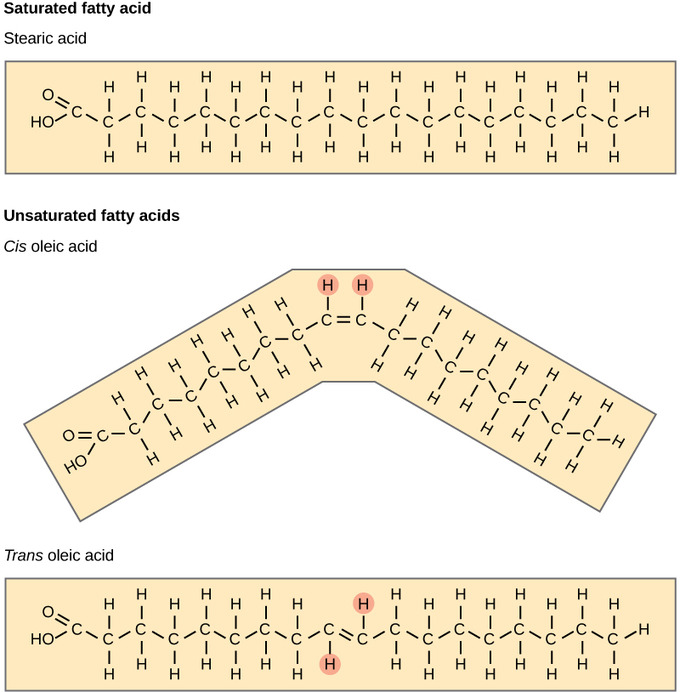
ByRx Harun

Lipids – Anatomy, Types, Structure, Functions

Lipids are compounds that are insoluble in water but are soluble in organic solvents such as ether and chloroform. Lipids that are important to our discussion include fats and oils (triglycerides or triacylglycerols), fatty acids, phospholipids, and cholesterol. Fats and oils are esters of glycerol and three fatty acids. They are important in the diet as energy sources and as sources of essential fatty acids and fat-soluble vitamins, which tend to associate with fats. They also contribute satiety, flavor, and palatability to the diet.

Lipid Molecules

Fats and oils, which may be saturated or unsaturated, can be unhealthy but also serve important functions for plants and animals.

Key Points

Fats provide energy, insulation, and storage of fatty acids for many organisms.

Fats may be saturated (having single bonds) or unsaturated (having double bonds).

Unsaturated fats may be cis (hydrogens in the same plane) or trans (hydrogens in two different planes).

Olive oil, a monounsaturated fat, has a single double bond whereas canola oil, a polyunsaturated fat, has more than one double bond.

Omega-3 fatty acids and omega-6 fatty acids are essential for human biological processes, but they must be ingested in the diet because they cannot be synthesized.

Key Terms

  • hydrogenation: The chemical reaction of hydrogen with another substance, especially with an unsaturated organic compound, and usually under the influence of temperature, pressure and catalysts.
  • ester: Compound most often formed by the condensation of an alcohol and an acid, by removing water. It contains the functional group carbon-oxygen double bond joined via carbon to another oxygen atom.
  • carboxyl: A univalent functional group consisting of a carbonyl and a hydroxyl functional group (-CO.OH); characteristic of carboxylic acids.

Fats have important functions, and many vitamins are fat-soluble. Fats serve as a long-term storage form of fatty acids and act as a source of energy. They also provide insulation for the body.

Glycerol and Fatty Acids

A fat molecule consists of two main components: glycerol and fatty acids. Glycerol is an alcohol with three carbons, five hydrogens, and three hydroxyls (OH) groups. Fatty acids have a long chain of hydrocarbons with a carboxyl group attached and may have 4-36 carbons; however, most of them have 12-18. In a fat molecule, the fatty acids are attached to each of the three carbons of the glycerol molecule with an ester bond through the oxygen atom. During the ester bond formation, three molecules are released. Since fats consist of three fatty acids and glycerol, they are also called triacylglycerols or triglycerides.

image 

Triacylglycerols: Triacylglycerol is formed by the joining of three fatty acids to a glycerol backbone in a dehydration reaction. Three molecules of water are released in the process.

Saturated vs. Unsaturated Fatty Acids

Fatty acids may be saturated or unsaturated. In a fatty acid chain, if there are only single bonds between neighboring carbons in the hydrocarbon chain, the fatty acid is said to be saturated. Saturated fatty acids are saturated with hydrogen since single bonds increase the number of hydrogens on each carbon. Stearic acid and palmitic acid, which are commonly found in meat, are examples of saturated fats.

When the hydrocarbon chain contains a double bond, the fatty acid is said to be unsaturated. Oleic acid is an example of an unsaturated fatty acid. Most unsaturated fats are liquid at room temperature and are called oils. If there is only one double bond in the molecule, then it is known as a monounsaturated fat; e.g. olive oil. If there is more than one double bond, then it is known as a polyunsaturated fat; e.g. canola oil. Unsaturated fats help to lower blood cholesterol levels whereas saturated fats contribute to plaque formation in the arteries.

Unsaturated fats or oils are usually of plant origin and contain cis unsaturated fatty acids. Cis and trans indicate the configuration of the molecule around the double bond. If hydrogens are present in the same plane, it is referred to as a cis fat; if the hydrogen atoms are on two different planes, it is referred to as a trans fat. The cis double bond causes a bend or a “kink” that prevents the fatty acids from packing tightly, keeping them liquid at room temperature.

image 

Fatty Acids: Saturated fatty acids have hydrocarbon chains connected by single bonds only. Unsaturated fatty acids have one or more double bonds. Each double bond may be in a cis or trans configuration. In the cis configuration, both hydrogens are on the same side of the hydrocarbon chain. In the trans configuration, the hydrogens are on opposite sides. A cis double bond causes a kink in the chain.

Trans Fats

In the food industry, oils are artificially hydrogenated to make them semi-solid and of a consistency desirable for many processed food products. During this hydrogenation process, gas is bubbled through oils to solidify them, and the double bonds of the cis-conformation in the hydrocarbon chain may be converted to double bonds in the trans-conformation.

Margarine, some types of peanut butter, and shortening are examples of artificially hydrogenated trans fats. Recent studies have shown that an increase in trans fats in the human diet may lead to an increase in levels of low-density lipoproteins (LDL), or “bad” cholesterol, which in turn may lead to plaque deposition in the arteries, resulting in heart disease. Many fast-food restaurants have recently banned the use of trans fats, and food labels are required to display the trans fat content.

Essential Fatty Acids

image 

Omega Fatty Acids: Alpha-linolenic acid is an example of an omega-3 fatty acid. It has three cis double bonds and, as a result, a curved shape. For clarity, the carbons are not shown. Each singly bonded carbon has two hydrogens associated with it, also not shown.

Essential fatty acids are fatty acids required for biological processes, but not synthesized by the human body. Consequently, they have to be supplemented through ingestion via the diet and are nutritionally very important. Omega-3 fatty acid, or alpha-linoleic acid (ALA), falls into this category and is one of only two fatty acids known to be essential for humans (the other being omega-6 fatty acid, or linoleic acid). These polyunsaturated fatty acids are called omega-3 because the third carbon from the end of the hydrocarbon chain is connected to its neighboring carbon by a double bond. Salmon, trout, and tuna are good sources of omega-3 fatty acids.

Research indicates that omega-3 fatty acids reduce the risk of sudden death from heart attacks, reduce triglycerides in the blood, lower blood pressure, and prevent thrombosis by inhibiting blood clotting. They also reduce inflammation and may help reduce the risk of some cancers in animals.

Phospholipids

Phospholipids are amphipathic molecules that make up the bilayer of the plasma membrane and keep the membrane fluid.

Key Points

Phospholipids consist of a glycerol molecule, two fatty acids, and a phosphate group that is modified by alcohol.

The phosphate group is the negatively charged polar head, which is hydrophilic.

The fatty acid chains are the uncharged, nonpolar tails, which are hydrophobic.

Since the tails are hydrophobic, they face the inside, away from the water, and meet in the inner region of the membrane.

Since the heads are hydrophilic, they face outward and are attracted to the intracellular and extracellular fluid.

If phospholipids are placed in water, they form into micelles, which are lipid molecules that arrange themselves in a spherical form in aqueous solutions.

Key Terms

  • micelle: Lipid molecules that arrange themselves in a spherical form in aqueous solutions.
  • amphipathic: Describing a molecule, such as a detergent, which has both hydrophobic and hydrophilic groups.

Defining Characteristics of Phospholipids

image 

Phospholipid Molecule: A phospholipid is a molecule with two fatty acids and a modified phosphate group attached to a glycerol backbone. The phosphate may be modified by the addition of charged or polar chemical groups. Two chemical groups that may modify the phosphate, choline, and serine, are shown here. Both choline and serine attach to the phosphate group at the position labeled R via the hydroxyl group indicated in green.

Phospholipids are major components of the plasma membrane, the outermost layer of animal cells. Like fats, they are composed of fatty acid chains attached to a glycerol backbone. Unlike triglycerides, which have three fatty acids, phospholipids have two fatty acids that help form a diacylglycerol. The third carbon of the glycerol backbone is also occupied by a modified phosphate group. However, just a phosphate group attached to a diacylglycerol does not qualify as a phospholipid. This would be considered a phosphatidate (diacylglycerol 3-phosphate), the precursor to phospholipids. To qualify as a phospholipid, the phosphate group should be modified by alcohol. Phosphatidylcholine and phosphatidylserine are examples of two important phospholipids that are found in plasma membranes.

Structure of a Phospholipid Molecule

A phospholipid is an amphipathic molecule which means it has both a hydrophobic and a hydrophilic component. A single phospholipid molecule has a phosphate group on one end, called the “head,” and two side-by-side chains of fatty acids that make up the lipid “tails.” The phosphate group is negatively charged, making the head polar and hydrophilic, or “water-loving.” The phosphate heads are thus attracted to the water molecules in their environment.

The lipid tails, on the other hand, are uncharged, nonpolar, and hydrophobic, or “water-fearing.” A hydrophobic molecule repels and is repelled by water. Some lipid tails consist of saturated fatty acids and some contain unsaturated fatty acids. This combination adds to the fluidity of the tails that are constantly in motion.

Phospholipids and Biological Membranes

image 

Phospholipid Bilayer: The phospholipid bilayer consists of two adjacent sheets of phospholipids, arranged tail to tail. The hydrophobic tails associate with one another, forming the interior of the membrane. The polar heads contact the fluid inside and outside of the cell.

The cell membrane consists of two adjacent layers of phospholipids, which form a bilayer. The fatty acid tails of phospholipids face inside, away from water, whereas the phosphate heads face the outward aqueous side. Since the heads face outward, one layer is exposed to the interior of the cell and one layer is exposed to the exterior. As the phosphate groups are polar and hydrophilic, they are attracted to water in the intracellular fluid.

Because of the phospholipids chemical and physical characteristics, the lipid bilayer acts as a semipermeable membrane; only lipophilic solutes can easily pass the phospholipid bilayer. As a result, there are two distinct aqueous compartments on each side of the membrane. This separation is essential for many biological functions, including cell communication and metabolism.

Membrane Fluidity

image 

Micelles: An example of micelles in water.

A cell’s plasma membrane contains proteins and other lipids (such as cholesterol) within the phospholipid bilayer. Biological membranes remain fluid because of the unsaturated hydrophobic tails, which prevent phospholipid molecules from packing together and forming a solid.

If a drop of phospholipids is placed in water, the phospholipids spontaneously form a structure known as a micelle, with their hydrophilic heads oriented toward the water. Micelles are lipid molecules that arrange themselves in a spherical form in an aqueous solution. The formation of a micelle is a response to the amphipathic nature of fatty acids, meaning that they contain both hydrophilic and hydrophobic regions.

Steroids

Steroids, like cholesterol, play roles in reproduction, absorption, metabolism regulation, and brain activity.

Key Points

Steroids are lipids because they are hydrophobic and insoluble in water, but they do not resemble lipids since they have a structure composed of four fused rings.

Cholesterol is the most common steroid and is the precursor to vitamin D, testosterone, estrogen, progesterone, aldosterone, cortisol, and bile salts.

Cholesterol is a component of the phospholipid bilayer and plays a role in the structure and function of membranes.

Steroids are found in the brain and alter electrical activity in the brain.

Because they can tone down receptors that communicate messages from neurotransmitters, steroids are often used in anesthetic medicines.

Key Terms

  • neurotransmitter: any substance, such as acetylcholine or dopamine, responsible for sending nerve signals across a synapse between two neurons
  • osmoregulation: the homeostatic regulation of osmotic pressure in the body in order to maintain a constant water content
  • hormone: any substance produced by one tissue and conveyed by the bloodstream to another to affect physiological activity

Structure of Steroid Molecules

Unlike phospholipids and fats, steroids have a fused ring structure. Although they do not resemble the other lipids, they are grouped with them because they are also hydrophobic and insoluble in water. All steroids have four linked carbon rings, and many of them, like cholesterol, have a short tail. Many steroids also have the –OH functional group, and these steroids are classified as alcohols called sterols.

image 

Steroid Structures: Steroids, such as cholesterol and cortisol, are composed of four fused hydrocarbon rings.

Cholesterol

Cholesterol is the most common steroid and is mainly synthesized in the liver; it is the precursor to vitamin D. Cholesterol is also a precursor to many important steroid hormones like estrogen, testosterone, and progesterone, which are secreted by the gonads and endocrine glands. Therefore, steroids play very important roles in the body’s reproductive system. Cholesterol also plays a role in synthesizing the steroid hormones aldosterone, which is used for osmoregulation, and cortisol, which plays a role in metabolism.

Cholesterol is also the precursor to bile salts, which help in the emulsification of fats and their absorption by cells. It is a component of the plasma membrane of animal cells and the phospholipid bilayer. Being the outermost structure in animal cells, the plasma membrane is responsible for the transport of materials and cellular recognition; and it is involved in cell-to-cell communication. Thus, steroids also play an important role in the structure and function of membranes.

It has also been discovered that steroids can be active in the brain where they affect the nervous system, These neurosteroids alter electrical activity in the brain. They can either activate or tone down receptors that communicate messages from neurotransmitters. Since these neurosteroids can tone down receptors and decrease brain activity, steroids are often used in anesthetic medicines.

References

ByRx Harun

Carbohydrates – Anatomy, Types, Structure, Functions

Carbohydrates are one of the three macronutrients in the human diet, along with protein and fat. These molecules contain carbon, hydrogen, and oxygen atoms. Carbohydrates play an important role in the human body. They act as an energy source, help control blood glucose and insulin metabolism, participate in cholesterol and triglyceride metabolism, and help with fermentation. The digestive tract begins to break down carbohydrates into glucose, which is used for energy, upon consumption. Any extra glucose in the bloodstream is stored in the liver and muscle tissue until further energy is needed. Carbohydrates is an umbrella term that encompasses sugar, fruits, vegetables, fibers, and legumes. While there are numerous divisions of carbohydrates, the human diet benefits mostly from a certain subset.

Structures

Monosaccharide: The most basic, fundamental unit of a carbohydrate. These are simple sugars with the general chemical structure of C6H12O6.

  • Examples: glucose, galactose, fructose

Disaccharide: Compound sugars containing two monosaccharides with the elimination of a water molecule with the general chemical structure C12H22O11

  • Examples: sucrose, lactose

Oligosaccharide: The polymer contains three to ten monosaccharides

  • Examples: maltodextrins, raffinose

Polysaccharides: Polymers containing long chains of monosaccharides connected through glycosidic bonds

  • Examples: amylose, cellulose

Types

Simple Carbohydrates: One or two sugars (monosaccharides or disaccharides) combined in a simple chemical structure. These easily are utilized for energy, causing a rapid rise in blood sugar and insulin secretion from the pancreas.

  • Examples: fructose, lactose, maltose, sucrose, glucose, galactose, ribose
  • Foods: candy, carbonated beverages, corn syrup, fruit juice, honey, table sugar

Complex Carbohydrates: Three or more sugars (oligosaccharides or polysaccharides) bonded together in a more complex chemical structure. These take longer to digest and therefore have a more gradual effect on the increase in blood sugar.

  • Examples: cellobiose, rutinulose, amylose, cellulose, dextrin
  • Foods: apples, broccoli, lentils, spinach, unrefined whole grains, brown rice

Starches: Complex carbohydrates contain a large number of glucose molecules. Plants produce these polysaccharides.

  • Examples include potatoes, chickpeas, pasta, and wheat.

Fiber: Non-digestible complex carbohydrates that encourage healthy bacterial growth in the colon and act as a bulking agent, easing defecation. The main components include cellulose, hemicellulose, and pectin.

  • Insoluble: Absorbs water in the intestines, thereby softening and bulking the stool. Benefits include regularity of bowel movements and a decreased risk of diverticulosis. Examples: brans, seeds, vegetables, brown rice, potato skins.
  • Soluble: Helps decrease blood cholesterol and LDL levels, reduces straining with defecation, and blunts postprandial blood glucose levels. Examples are fleshy fruit, oats, broccoli, and dried beans

There are three macronutrients—carbohydrates (4 kcal/gm), fat (9 kcal/gm), and protein (4 kcal/gm) found in food.  Therefore, studies have defined low carbohydrate as a percent of daily macronutrient intake or total daily carbohydrate load.  We will define it here as:

  • Very low-carbohydrate (< 10% carbohydrates) or 20-50 gm/day
  • Low-carbohydrate (<26% carbohydrates) or less than < 130 gm/day
  • Moderate-carbohydrate (26%-44%)
  • High-carbohydrate (45% or greater)

For reference, the Institute of Medicine proposes Americans obtain 45%-65% of calories from carbohydrates.  This article will review the evidence and effectiveness of low-carb approaches in clinical medicine.

Carbohydrate Molecules

Carbohydrates are essential macromolecules that are classified into three subtypes: monosaccharides, disaccharides, and polysaccharides.

KEY TAKEAWAYS

Key Points

Monosaccharides are simple sugars made up of three to seven carbons, and they can exist as a linear chain or as ring-shaped molecules.

Glucose, galactose, and fructose are monosaccharide isomers, which means they all have the same chemical formula but differ structurally and chemically.

Disaccharides form when two monosaccharides undergo a dehydration reaction (a condensation reaction); they are held together by a covalent bond.

Sucrose (table sugar) is the most common disaccharide, which is composed of the monomers glucose and fructose.

A polysaccharide is a long chain of monosaccharides linked by glycosidic bonds; the chain may be branched or unbranched and can contain many types of monosaccharides.

Key Terms

  • isomer: Any of two or more compounds with the same molecular formula but with different structure.
  • dehydration reaction: A chemical reaction in which two molecules are covalently linked in a reaction that generates H2O as a second product.
  • biopolymer: Any macromolecule of a living organism that is formed from the polymerization of smaller entities; a polymer that occurs in a living organism or results from life.

Carbohydrates can be represented by the stoichiometric formula (CH2O)n, where n is the number of carbons in the molecule. Therefore, the ratio of carbon to hydrogen to oxygen is 1:2:1 in carbohydrate molecules. The origin of the term “carbohydrate” is based on its components: carbon (“carbo”) and water (“hydrate”). Carbohydrates are classified into three subtypes: monosaccharides, disaccharides, and polysaccharides.

Monosaccharides

Monosaccharides (mono- = “one”; saccharine = “sweet”) are simple sugars. In monosaccharides, the number of carbons usually ranges from three to seven. If the sugar has an aldehyde group (the functional group with the structure R-CHO), it is known as an aldose, and if it has a ketone group (the functional group with the structure RC(=O)R’), it is known as a ketose. Depending on the number of carbons in the sugar, they also may be known as trioses (three carbons), pentoses (five carbons), and or hexoses (six carbons). Monosaccharides can exist as a linear chain or as ring-shaped molecules; in aqueous solutions they are usually found in ring forms.

image

Monosaccharides: Monosaccharides are classified based on the position of their carbonyl group and the number of carbons in the backbone. Aldoses have a carbonyl group (indicated in green) at the end of the carbon chain, and ketoses have a carbonyl group in the middle of the carbon chain. Trioses, pentoses, and hexoses have three, five, and six carbon backbones, respectively.

Common Monosaccharides

Glucose (C6H12O6) is a common monosaccharide and an important source of energy. During cellular respiration, energy is released from glucose and that energy is used to help make adenosine triphosphate (ATP). Plants synthesize glucose using carbon dioxide and water, and glucose, in turn, is used for energy requirements for the plant.

Galactose (a milk sugar) and fructose (found in fruit) are other common monosaccharides. Although glucose, galactose, and fructose all have the same chemical formula (C6H12O6), they differ structurally and stereochemically. This makes them different molecules despite sharing the same atoms in the same proportions, and they are all isomers of one another, or isomeric monosaccharides. Glucose and galactose are aldoses, and fructose is a ketose.

Disaccharides

Disaccharides (di- = “two”) form when two monosaccharides undergo a dehydration reaction (also known as a condensation reaction or dehydration synthesis). During this process, the hydroxyl group of one monosaccharide combines with the hydrogen of another monosaccharide, releasing a molecule of water and forming a covalent bond. A covalent bond formed between a carbohydrate molecule and another molecule (in this case, between two monosaccharides) is known as a glycosidic bond. Glycosidic bonds (also called glycosidic linkages) can be of the alpha or the beta type.

image

Disaccharides: Sucrose is formed when a monomer of glucose and a monomer of fructose are joined in a dehydration reaction to form a glycosidic bond. In the process, a water molecule is lost. By convention, the carbon atoms in a monosaccharide are numbered from the terminal carbon closest to the carbonyl group. In sucrose, a glycosidic linkage is formed between carbon 1 in glucose and carbon 2 in fructose.

Common Disaccharides

Common disaccharides include lactose, maltose, and sucrose. Lactose is a disaccharide consisting of the monomers glucose and galactose. It is found naturally in milk. Maltose, or malt sugar, is a disaccharide formed by a dehydration reaction between two glucose molecules. The most common disaccharide is sucrose, or table sugar, which is composed of the monomers glucose and fructose.

Polysaccharides

A long chain of monosaccharides linked by glycosidic bonds is known as a polysaccharide (poly- = “many”). The chain may be branched or unbranched, and it may contain different types of monosaccharides. Starch, glycogen, cellulose, and chitin are primary examples of polysaccharides.

Plants are able to synthesize glucose, and the excess glucose is stored as starch in different plant parts, including roots and seeds. Starch is the stored form of sugars in plants and is made up of glucose monomers that are joined by α1-4 or 1-6 glycosidic bonds. The starch in the seeds provides food for the embryo as it germinates while the starch that is consumed by humans is broken down by enzymes into smaller molecules, such as maltose and glucose. The cells can then absorb the glucose.

Common Polysaccharides

Glycogen is the storage form of glucose in humans and other vertebrates. It is made up of monomers of glucose. Glycogen is the animal equivalent of starch and is a highly branched molecule usually stored in liver and muscle cells. Whenever blood glucose levels decrease, glycogen is broken down to release glucose in a process known as glycogenolysis.

Cellulose is the most abundant natural biopolymer. The cell wall of plants is mostly made of cellulose and provides structural support to the cell. Cellulose is made up of glucose monomers that are linked by β 1-4 glycosidic bonds. Every other glucose monomer in cellulose is flipped over, and the monomers are packed tightly as extended long chains. This gives cellulose its rigidity and high tensile strength—which is so important to plant cells.

image

Polysaccharides: In cellulose, glucose monomers are linked in unbranched chains by β 1-4 glycosidic linkages. Because of the way the glucose subunits are joined, every glucose monomer is flipped relative to the next one resulting in a linear, fibrous structure.

Carbohydrate Function

Carbohydrates serve various functions in different animals. Arthropods have an outer skeleton, the exoskeleton, which protects their internal body parts. This exoskeleton is made of chitin, which is polysaccharide-containing nitrogen. It is made of repeating units of N-acetyl-β-d-glucosamine, a modified sugar. Chitin is also a major component of fungal cell walls.

Importance of Carbohydrates

Carbohydrates are a major class of biological macromolecules that are an essential part of our diet and provide energy to the body.

KEY TAKEAWAYS

Key Points

Carbohydrates provide energy to the body, particularly through glucose, a simple sugar that is found in many basic foods.

Carbohydrates contain soluble and insoluble elements; the insoluble part is known as fiber, which promotes regular bowel movement, regulates the rate of consumption of blood glucose, and also helps to remove excess cholesterol from the body.

As an immediate source of energy, glucose is broken down during the process of cellular respiration, which produces ATP, the energy currency of the cell.

Since carbohydrates are an important part of human nutrition, eliminating them from the diet is not the best way to lose weight.

Key Terms

  • carbohydrate: A sugar, starch, or cellulose that is a food source of energy for an animal or plant; a saccharide.
  • glucose: a simple monosaccharide (sugar) with a molecular formula of C6H12O6; it is a principal source of energy for cellular metabolism
  • ATP: A nucleotide that occurs in muscle tissue, and is used as a source of energy in cellular reactions, and in the synthesis of nucleic acids. ATP is the abbreviation for adenosine triphosphate.

Benefits of Carbohydrates

Biological macromolecules are large molecules that are necessary for life and are built from smaller organic molecules. One major class of biological macromolecules is carbohydrates, which are further divided into three subtypes: monosaccharides, disaccharides, and polysaccharides. Carbohydrates are, in fact, an essential part of our diet; grains, fruits, and vegetables are all-natural sources of carbohydrates. Importantly, carbohydrates provide energy to the body, particularly through glucose, a simple sugar that is a component of starch and an ingredient in many basic foods.

image

Carbohydrates: Carbohydrates are biological macromolecules that are further divided into three subtypes: monosaccharides, disaccharides, and polysaccharides. Like all macromolecules, carbohydrates are necessary for life and are built from smaller organic molecules.

Carbohydrates in Nutrition

Carbohydrates have been a controversial topic within the diet world. People trying to lose weight often avoid carbs, and some diets completely forbid carbohydrate consumption, claiming that a low-carb diet helps people to lose weight faster. However, carbohydrates have been an important part of the human diet for thousands of years; artifacts from ancient civilizations show the presence of wheat, rice, and corn in our ancestors’ storage areas.

Carbohydrates should be supplemented with proteins, vitamins, and fats to be part of a well-balanced diet. Calorie-wise, a gram of carbohydrate provides 4.3 Kcal. In comparison, fats provide 9 Kcal/g, a less desirable ratio. Carbohydrates contain soluble and insoluble elements; the insoluble part is known as fiber, which is mostly cellulose. Fiber has many uses; it promotes regular bowel movement by adding bulk, and it regulates the rate of consumption of blood glucose. Fiber also helps to remove excess cholesterol from the body. Fiber binds and attaches to the cholesterol in the small intestine and prevents the cholesterol particles from entering the bloodstream. Then cholesterol exits the body via the feces. Fiber-rich diets also have a protective role in reducing the occurrence of colon cancer. In addition, a meal containing whole grains and vegetables gives a feeling of fullness. As an immediate source of energy, glucose is broken down during the process of cellular respiration, which produces adenosine triphosphate (ATP), the energy currency of the cell. Without the consumption of carbohydrates, the availability of “instant energy” would be reduced. Eliminating carbohydrates from the diet is not the best way to lose weight. A low-calorie diet that is rich in whole grains, fruits, vegetables, and lean meat, together with plenty of exercises and plenty of water, is the more sensible way to lose weight.

Diet Recommendations

In its 2002 report (), the Institute of Medicine (IOM) established an RDA for carbohydrates of 130 g/d for adults and children aged ≥1 y. This value is based on the number of sugars and starches required to provide the brain with an adequate supply of glucose. The IOM set an acceptable macronutrient distribution range (AMDR) for carbohydrates of 45–65% of total calories. Thus, current dietary guidance recommends the consumption of carbohydrate-containing foods, including grains, vegetables, fruits, pulses, nuts, seeds, and milk products. Carbohydrate foods are an important source of fiber and other nutrients.

Sugars and starches provide glucose, the main energy source for the brain, central nervous system, and RBCs. Glucose also can be stored as glycogen (animal starch) in the liver and muscle or, like all excess calories in the body, converted to body fat. Dietary fibers are non-digestible forms of carbohydrates. Dietary fiber is intrinsic and intact in plants, helps provide satiety, and promotes healthy laxation. Diets high in fiber reduce the risk of coronary heart disease, diabetes, obesity, and other chronic diseases.

The energy value of digestible carbohydrates is generally accepted as 4 kcal/g for both sugars and starches. Fermentation of fiber in the gut will produce SCFAs that contribute calories, generally estimated to be ∼2 kcal/g. Few studies have linked carbohydrates to obesity. Indeed, observational data generally report that higher carbohydrate intake is linked to lower body weight.

In its 2002 report, the IOM set an Adequate Intake (AI) value for fiber of 14 g of fiber per 1000 kcal (). This value is derived from data on the relation of fiber consumption and coronary heart disease risk, although the IOM also considered the evidence for fiber decreasing the risk of chronic disease and other health-related conditions. Consequently, the IOM fiber recommendations are highest for populations who consume the most calories, namely young men. Fiber recommendations are lower for women and the elderly. The use of this method for determining recommended fiber intake for children is problematic (e.g., intake of 19 g of fiber is recommended for 2-y-old children, an implausible number). Past recommendations for children were based on the “age plus 5” rule (e.g., a child aged 2 y should consume 7 g of fiber/d) ().

Dietary fiber is listed on the Nutrition Facts panel, and 25 g of dietary fiber is the currently recommended amount in a 2000-kcal diet. Manufacturers are allowed to call a food a “good source of fiber” if it contains 10% of the recommended amount (2.5 g/serving) and an “excellent source of fiber” if the food contains 20% of the recommended amount (5 g/serving). Dietary fiber on food labels includes both dietary fiber and functional fiber.

Food Sources

Vegetables, fruits, whole grains, milk, and milk products are the major food sources of carbohydrates. Grains and certain vegetables including corn and potatoes are rich in starch, whereas sweet potatoes are mostly sucrose, not starch. Fruits and dark-green vegetables contain little or no starch but provide sugars and dietary fiber. Marriott et al. () examined the intake of added sugars and selected nutrients from 2003–2006 NHANES data. Thirteen percent of the population had an added-sugars intake of >25% of calories. Higher added-sugars intakes were associated with higher proportions of individuals with nutrient intakes below the Estimated Average Requirement (EAR), but the overall high-calorie content and low quality of the U.S. diet remained the predominant issue.

Dietary fiber intake was particularly low in their analysis. With the exception of older women (≥51 y), only 0–5% of individuals in all other life-stage groups had fiber intakes meeting or exceeding the AI (). Fiber intake is closely linked to calorie intake. Thus, recommendations to reduce calorie intake will make increasing fiber intake particularly challenging.

It is advisable to select foods high in dietary fiber, including whole-grain bread and cereals, legumes, vegetables, and fruits, whenever possible. Typically, vegetables and fruits are not the most concentrated fiber sources, but these are important foods to encourage because they contribute important micronutrients. Similarly, milk and milk products, which contain lactose, generally do not contain fiber but these, too, are important because they contribute calcium, vitamin D, and protein to the diet.

Function

Carbohydrates are an important part of a nutritional diet. The healthiest sources include complex carbohydrates because of their blunted effects on blood glucose. These options include unprocessed whole grains, vegetables, fruits, and legumes. While simple carbohydrates are acceptable in small amounts, white bread, sodas, pastries, and other highly processed foods are less nutritious and cause a sharp increase in blood glucose. Healthy adult diets should include 45% to 65% carbohydrates as part of the daily intake, equaling about 200 g to 300 g per day. Carbohydrates contain about 4 kcal/ gram (17 kJ/g). Fiber is an important carbohydrate as well. Healthy adults should consume about 30 g per day of fiber, as it is found to reduce the risk of coronary heart disease, strokes, and digestive issues.

A glycemic index is a tool used to track carbohydrates and their individual effects on blood sugar. This scale ranks carbohydrates from 0 to 100 based on how rapidly the rise in blood glucose occurs upon consumption. Low glycemic foods (55 or less) produce a gradual increase in blood sugar. These foods include steel-cut oatmeal, oat bran, muesli, sweet potatoes, peas, legumes, most fruits, non-starchy vegetables. Medium glycemic foods (56 to 69) include quick oats, brown rice, and whole-wheat bread. High glycemic foods (70 to 100) increase the risk of type 2 diabetes, heart disease, obesity, and ovulatory infertility. These foods include white bread, corn flakes, white potatoes, pretzels, rice cakes, and popcorn.

Initiation of a Low-Carb Lifestyle

After a shared decision-making process with the patient, there are numerous ways to start a patient on a low-carb diet. Low-carb nutrition may be advisable for those who desire healthy or athletic performance, weight loss, improvement of glycemic control for type 1 or 2 diabetes, or for a seizure disorder.

  • First, an understanding of what macronutrients are and their relation to food is a critical part of counseling.
  • Secondly, determine the patient’s desire for either small steps or a rapid induction phase through motivational interviewing and S.M.A.R.T goal setting.
  • Limitation of added sugar (sucrose) and refined carbohydrates is critical in the overall improvement of food quality and will generally reach a moderate carbohydrate (< 45% carbohydrates) level.
  • A way to initiate low-carb is through a rapid induction phase of 2 to 4 weeks, with 20 to 50 gms of carbohydrates to induce nutritional ketosis. Ad libitum vegetables that grow above the ground and are lower in carbohydrate content are encouraged. Additionally, carbs should be limited to those found in whole, unprocessed food.
  • Finally, after the induction phase, depending on goals, patients can remain in the keto phase or slowly add healthy carbohydrates from whole, unprocessed vegetables, and low-glycemic, high fiber fruit (i.e., berries).

Maintenance of a Low-Carb Lifestyle

If limited initially or during the induction phase, full-fat dairy, legumes, and whole grains can also be added during this maintenance phase as long as goals are maintained and tolerated without any hypersensitivity or an adverse response. The lifelong maintenance phase can then continue in accordance with patient preference. Periodic monitoring of cardiovascular risk markers and control of cardiometabolic disease should also be a priority. Those with type 2 diabetes require close monitoring for hypoglycemia, and reduction of insulin or hypoglycemic medications are prudent with rapid reductions in fasting glucose.

References

Translate »